HAMME, a town of Belgium, in the province of East Flanders and the arrondissement of Termonde or Dendermonde, is situated on the right bank of the Durme, near its junction with the Scheldt, and 18 miles E.N.E. of Ghent. It contains grain and oil-mills, has manufactures of lace, ribbons, linen, starch, ropes, and cordage, and carries on trade in flax. Population (1876), 10,778.
9th ed. Encyclopædia Britannica, vol. 11, p. 424 [67 words — estimated reading time: 1 minute]
An instrument for driving nails, beating metals, and the like. It consists of an iron head, fixed crosswise to a handle. Hammers are of various sizes; a large hammer used by smiths is called a sledge.
6. That part of a gunlock which strikes the percussion cap, or firing pin; the cock; formerly, however, a piece of steel covering the pan of a flintlockmusket and struck by the flint of the cock to ignite the priming.
7. Also, a person of thing that smites or shatters; as, St. Augustine was the hammer of heresies.
HAMMER. This well-known tool stands quite without rival for producing the numberless effects which are due to the remarkable force of “impact.” Of all the array of hand tools in use in the industrial arts it is undoubtedly the one that could least be dispensed with, and so it must have been from the very earliest days of handicraft. A hammer of some rude kind must have been as essential to the shaping of an arrow-head out of a flint, as is its modern representative to the forging of a bayonet out of a bar of steel.
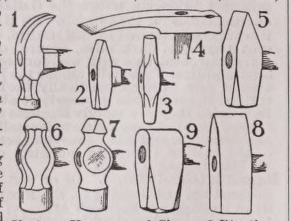
Hammer3 to be used by hand are made of an endless variety of shapes, and of weights varying from a small fraction of an ounce to 23 or 30 B⅛. Of the various types now in use the differences are mainly due to the special requirements of the particular trades for which they are intended, but partly also to individual fancy. A few examples are given in fig. 1— a being the ordinary carpenter’s hammer with a cross pane, δ a claw hammer, c an engineer’s, and d a shoemaker’s hammer, which last has apparently retained its form for many generations. The same may also be said of the two others in the woodcut, which are good examples of the roughness of the instruments with which results of almost incredible delicacy can be produced. Of these e is a favourite hammer used in the workshops of a London firm of goldbeaters, with which, together with others not less rude in appearance, gold is hammered out into leaves of such exceeding thinness that 250,000 are required to make up the thickness of an inch. Extraordinarily ill-shaped as ∕, the file-cutter’s hammer, looks, yet with this and a simple chisel the teeth of files are cut by hand with a precision with which no machinery has as yet been able to compete, at least in England....
Hanl-hammers and sledge-hammers being rigidly limited as to weight by the trifling power which one man—or at most two men—can bring to bear upon them, it long ago became obviously desirable to obtain the force of impact from some more powerful source than human muscles, so that the weight of hammer heads might be largely increased and their blows made proportionately more effective. The first step taken in this direction seems to have been the introduction of the “Hercules,” a ponderous mass of. iron attached to a vertical guide rod, which was lifted originally by a gang of men with ropes, but afterwards by steam power, and allowed to fall by its own weight. This was. a fairly efficient tool for forging large anchors and for similar purposes, the strength of the blow and the point at which it was delivered being easily regulated. But as the demand for wrought iron increased, the necessity for more rapid as well as more powerful hammers to aid in its manufacture increased also. The lift or helve hammer (fig. 2) and the tilt hammer (fig. 3) thus came into use, and under these forms hammers may be said to have ranked for the first time as true machine tools. Each of these consists of a heavy head attached to a beam mounted on gudgeons, which is lifted at regular intervals by suitable cams or pins carried by a revolving shaft driven by steam or other power, their chief points of difference being the relative position of the gudgeons and the portion of the beam at which the power is applied, as shown in the diagrams. Heavy blows are thus obtained with the one, and lighter but much more rapid blows with the other, both, however, invariable in their intensity, the lift being always to one fixed height.
In the steam hammer (fig. 4), which was first patented by Nasmyth in the year 1842, this objection is completely obviated. By the simple device of attaching the hammer head to the lower end of the rod of a piston working in an inverted steam cylinder, he produced a machine capable of being made to deliver its blows with a force to which no limit has yet been found, and yet so perfectly under control as to be able to crack a hazel nut without injuring the kernel. To the introduction of this invaluable tool is due more than to any other single cause the power which we now possess of producing the forgings in iron and steel which are demanded by the arts of modern times; and in one or other of its many forms it is now to be met with in every workshop in which heavy work is carried on. Many modifications of the Nasmyth steam hammer have been introduced. In one of these steam pressure has been applied above the piston to intensify the blow, it being only used in the original form for lifting the “tup” and piston and for regulating their descent. In another the piston and piston-rod have been attached to the framing, and the cylinder made movable, its weight being thu3 added to that of the hammer.
Duplex hammers differ materially from the ordinary steam hammer, inasmuch as no anvil is necessary,—two hammer heads of equal weight (and for some purposes they weigh only a few pounds, for others as much as 30 tons) being made to deliver horizontal blows of equal force simultaneously on opposite sides of the forging, which thus receive perfectly equal treatment. The importance of this may be gathered from the fact that every increase in the weight of the vertical steam hammer necessitates a very much larger increase in the weight and solidity of the anvil which is necessary to afford the requisite inertia for resisting the blow. For instance, the anvil of a 40-ton hammer now in use at WoolwichArsenal weighs upwards of 160 tons, and has nearly 500 tons of iron in its foundation, whereas the anvil of an 80-ton hammer of which a full-sized model was amongst the most striking objects at the Paris Exhibition of 1878, is of no less than 720 tons weight.
The recent growth of steam hammers to the enormous size just mentioned is due chiefly to the large dimensions, independently of the mere weight, of the forgings which have now to be made for heavy ordnance and for other purposes. As long as the thickness of a forging is moderate, the reaction of the anvil acting upon, its under side has an effect not greatly inferior to that of the hammer on the upper side. But with every increase in thickness some of this reaction is lost and the effect of the blow is more and more confined to the outer portions of the mass, which thus receive more than their share of treatment at the expense of the central portions. On this account the difficulty of obtaining thick forgings thoroughly sound throughout their substance is very great, and it seems as if we had now reached the limit beyond which the hammer cannot be advantageously applied for their production.. It has been found indeed in the case of large shafts that dispensing altogether with the central portion, thus making them tubular instead of solid, is accompanied by an increase in their strength, owing to the possibility of thus forging the metal uniformly throughout. But a much more widely applicable remedy, and one which will doubtless come into general use for heavy work, is the substitution of hydraulic or other pressure for the force of impact, a system which has lately been employed by Sir Joseph Whitworth with wonderfully good results. The reason of the superiority of its effect seems to be mainly this, that a certain amount of time is essential for completing the “flow” of the metal which it is the object of forging to induce. Under continuous pressure this flow can take place uniformly throughout the mass, whereas the instantaneous blow of the hammer, though it acts violently on the surface particles, and to a decreasing extent on the adjacent ones, is entirely expended before the action has had time to reach those at the centre, so that unequal density and consequent weakness is the result. For massive forgings therefore the old saying can be no longer accepted that “there is.no machine like a hammer.” (c. p. b. s.)
9th ed. Encyclopædia Britannica, vol. 11, p. 425 [1,407 words — estimated reading time: 9 minutes]
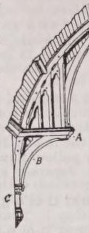
A member of one description of roof truss, called hammer-beam truss, which is so framed as not to have a tiebeam at the top of the wall. Each principal has two hammer-beams, which occupy the situation, and to some extent serve the purpose, of a tiebeam.
HAMMER-PURGSTALL, Joseph von (1774-1856), was born at Gratz in 1774, and after some training in the Oriental academy of Vienna entered the Austrian diplomatic service. He was the son of Joseph Johann von Hammer, and it was not till 1835, when he had inherited the estates of the countess of Purgstall (in Styria), that he received the title Baron von Hammer-Purgstall, by which he is generally known. His youth and early manhood were passed in the Levant, where he bent all his energies to the task of improving his acquaintance with Oriental literature, in which as early as 1796 he proved his interest by the translation of a Turkish poem. He did not again come forward as an author till 1804, when his Encyclopaedia of Oriental Learning appeared, a work whose ambitious character was so diffidently felt by its author that he feared to put his name to it. From that time there was little pause in his literary productiveness. For fifty years he wrote incessantly on the most diverse subjects, and his works were composed in most of the languages of Europe. He published numerous texts and translations of Arabic, Persian, and Turkish authors; compiled histories of Persian poetry, Turkish poetry, and Arabic literature; brought the poems of Hâfiz, Mutanebbi, Baki, and Ibn-el-Fâridh within the reach of European readers; published travels in Turkey and Austria; wrote the history of the Tatar races, the Krim Khans, the Golden Horde, the Russians, and the Ottoman Turks; formed a biographical gallery of Eastern celebrities; put forth theories about every possible subject in the wide range of Oriental learning, discussing the Arabian Hights, Arab music, Mahometan theology, Egyptian papyri, gnostic coffrets, Arabic grammar, Eastern antiquities, the sect of the Assassins, the sieges of ...Vienna, the Knights Templars, and Spenser’s sonnets, which he translated into German. Von Hammer did for Germany the same work that Sir William Jones did for England. He showed that Oriental subjects were not to be studied merely so far as they were connected with biblical theology, but were a worthy object of research for their own sake. For more than fifty years he persisted in introducing Eastern authors and Eastern topics to the general reader, and there was a time when no Orientalist was more widely known and admired. As Jules Mohl said—“C’était le doyen de la littérature orientale, le premier associé que la Société (Asiatique de Paris) ait tenu à l’honneur d’inscrire sur sa liste, et le plus zélé, le plus fertile, et le plus célèbre des hommes qui se sont voués, de nôtres temps, à la culture des lettres orientales.”
It was natural that a scholar who traversed so large a field and wrote so rapidly should lay himself open to the criticism of specialists, and no man was more severely handled by his critics than Von Hammer, to whom Diez, for example (in Unfug und Betrug, 1815), devotes nearly 600 pages of heavy abuse. Von Hammer was undoubtedly inaccurate and superficial at times; he attempted more than he could possibly achieve with thoroughness, and was in the habit of giving his own whimsical view of matters about which he knew next to nothing; and he used to offend his critics as much by his Oriental florid style and want of method as by the occasional inaccuracy of his facts and the inconsequence of his deductions. But in spite of his faults he did more for Oriental studies than most of his critics put together.
When he was seventy-six years of age he planned a second edition of his Encyclopaedia of Oriental Learning , and designed a “preliminary” series of twelve volumes which should clear the ground by expounding the history of Arabic literature, aud for the last seven years of his life he regularly put forth his annual volume. Jules Mohl, going to see him, found the old man hard at work, helped by no colleague, and disdaining the aid of an amanuensis. His early travels in the Levant, and then bisbusy life at Vienna, where he held the post of court-interpreter, saved him from the crushing influence of solitary study; and to the last he maintained his singular buoyancy of mind. “C’était un homme généreux, franc jusqu’à l’imprudence, hardi, bouillonnant d’esprit, aimable jusqu’à la coquetterie, doué d’une faculté de travail rare, ambitieux dans les grandes et les petites choses, et d’une vivacité inconcevable—vivacité qui fut la source de sa bonne et do sa mauvaise fortune.” So Mohl pictured him in his address to the Société Asiatique in 1857, when he recorded the death of Von Hammer on November 23, 1856, at the age of eighty-two, a hard worker to the last, like his younger but greater English contemporary Lane, with whom he came into collision in a friendly way on the subject of the origin of The Thousand and One Hights.
Von Hammer’s principal works are his Geschichte des osmanischen Reiches, 10 vols., 1827 (2d ed., 1834-6), translated into French (1835 and 1840); Geschichte der osmanischen Dichtkunst, 4 vols., 1836; Literatur-Geschichte der Araber (unfinished), 7 vols., 1850-6; Les Origines Russes, 1827; Geschichte der Goldenen Horde, 1840; Geschichte der Ilchane, 1842; Geschichte der Chane der Krim, 1856; Geschichte der Assassincn, 1818; Constantinopolis und der Bosporos, 1822; Enzyklopädische Uebersicht der Wissenschaften des Orients, 1804. Texts and translations of— Eth-ΤhaΛlabi, Arab, and Germ., 1829; Ibn Wahshiyah, History of the Mongols, Arab, and Engl., 1806; El-Wassâf, Pers, and Germ., 1856; Esch-Schebistani’s Rosenflor des Geheimnisses, Pers, and Germ., 1838; Ez-Zam-akhsheri, Goldene Halzbändcr, Arab, and Germ., 1835; El-GhazzΛli, Hujjet-el-Islàm, Arab, and Germ., 1838; El-Hamawi, Das arab. Hohe Lied der Liebe, Arab, and Germ., 1854. Translations of— El-Mutancbbi , s Poems; Er-Rcsmi's A ccount of his Em bassy, 1809; Contes inédits des 1001 Nuits, 1828. Besides these and smaller works, Von Hammer contributed numerous essays and criticisms to the Fundgrτιbcn des Orients, which he edited; to the Journal Asiatique; and to many other learned journals; above all to the Transactions of the Akademie der Wissenschaften of Vienna, of which he was mainly the founder; and he translated
Evliya Effendi’s Travels in Europe, for the English Oriental Translation Fund. For a fuller list of his works, which amount in all to nearly 100 volumes, see Comptes Rendus of the Acad, des Inscr. et des Belles Lettres, 1857.
9th ed. Encyclopædia Britannica, vol. 11, p. 426 — signed S. L. P. [1,098 words — estimated reading time: 7 minutes]
HAMMERFEST, the most northern town in Europe, is situated in the department of Hammerfest in the province of Finmark, on the western side of the island of Kvalö (‰e., “Whale Island”), which lies off the north-western coast of Norway. Its latitude is 70° 39' 15'', and the sun stays for two months above its horizon. Though a small place of about 2100 inhabitants, it is the seat of a considerable trade, in which not only Norwegian and Danish but English, German, and particularly Russian vessels are engaged. About thirty small ships are sent out from Hammerfest every spring to Spitzbergen to take part in the fisheries and walrus hunting. Train oil from the liver of the Scymnus microcephalus and cod-liver oil are manufactured in the town. The exports, among which salted fish occupies the principal place, amounted in 1876 to the value of 1,629,500 crowns (£90,528), and the imports, chiefly salt and coal, to 721,700 (£40,094). On the Fuglenaes or Birds’ Cape, which protects the harbour on the north, there stands a column with an inscription in Norse and Latin, stating that Hammerfest was one of the stations of the expedition for the measurement of the arc of the meridian. Nor is this its only association with science; for it was one of the spots chosen by Captain Sabine for his series of pendulum experiments. The ascent of the Tyven or Diebsberg in the neighbourhood is usually undertaken by travellers.
9th ed. Encyclopædia Britannica, vol. 11, p. 426 [247 words — estimated reading time: 2 minutes]
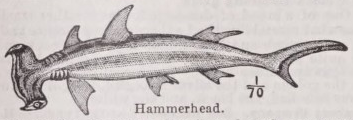
1. A shark of the genus Sphyrna or Zygaena, having the eyes set on projections from the sides of the head, which gives it a hammer shape. The Sphyrna zygaena is found in the North Atlantic. Called also hammer fish, and balance fish.
2. A fresh-water fish; the stone-roller.
3. An African fruit bat (Hypsignathus monstrosus); -- so called from its large bluntnozzle.
And thou shalt make a candlestick of pure gold: of beaten work shall the candlestick be made: his shaft, and his branches, his bowls, his knops, and his flowers, shall be of the same.
Then you are to make a lampstand of pure, hammered gold. It shall be made of one piece, including its base and shaft, its cups, and its buds and petals.
And he made the candlestick of pure gold: of beaten work made he the candlestick; his shaft, and his branch, his bowls, his knops, and his flowers, were of the same:
Then he made the lampstand out of pure hammered gold, all of one piece: its base and shaft, its cups, and its buds and petals.
And they did beat the gold into thin plates, and cut it into wires, to work it in the blue, and in the purple, and in the scarlet, and in the fine linen, with cunning work.
They hammered out thin sheets of gold and cut threads from them to interweave with the blue, purple, and scarlet yarn, and fine linen—the work of a skilled craftsman.
And this work of the candlestick was of beaten gold, unto the shaft thereof, unto the flowers thereof, was beaten work: according unto the pattern which the LORD had shewed Moses, so he made the candlestick.
This is how the lampstand was constructed: it was made of hammered gold from its base to its blossoms, fashioned according to the pattern the LORD had shown Moses.
Make thee two trumpets of silver; of a whole piece shalt thou make them: that thou mayest use them for the calling of the assembly, and for the journeying of the camps.
“Make two trumpets of hammered silver to be used for calling the congregation and for having the camps set out.
The censers of these sinners against their own souls, let them make them broad plates for a covering of the altar: for they offered them before the LORD, therefore they are hallowed: and they shall be a sign unto the children of Israel.
As for the censers of those who sinned at the cost of their own lives, hammer them into sheets to overlay the altar, for these were presented before the LORD, and so have become holy. They will serve as a sign to the Israelites.”
And Eleazar the priest took the brasen censers, wherewith they that were burnt had offered; and they were made broad plates for a covering of the altar:
So Eleazar the priest took the bronze censers brought by those who had been burned up, and he had them hammered out to overlay the altar,
Then Jael Heber’s wife took a nail of the tent, and took an hammer in her hand, and went softly unto him, and smote the nail into his temples, and fastened it into the ground: for he was fast asleep and weary. So he died.
But as he lay sleeping from exhaustion, Heber’s wife Jael took a tent peg, grabbed a hammer, and went silently to Sisera. She drove the peg through his temple and into the ground, and he died.
She put her hand to the nail, and her right hand to the workmen’s hammer; and with the hammer she smote Sisera, she smote off his head, when she had pierced and stricken through his temples.
She reached for the tent peg, her right hand for the workman’s hammer. She struck Sisera and crushed his skull; she shattered and pierced his temple.
And the house, when it was in building, was built of stone made ready before it was brought thither: so that there was neither hammer nor axe nor any tool of iron heard in the house, while it was in building.
The temple was constructed using finished stones cut at the quarry, so that no hammer or chisel or any other iron tool was heard in the temple while it was being built.
The two doors also were of olive tree; and he carved upon them carvings of cherubims and palm trees and open flowers, and overlaid them with gold, and spread gold upon the cherubims, and upon the palm trees.
The double doors were made of olive wood, and he carved into them cherubim, palm trees, and open flowers and overlaid the cherubim and palm trees with hammered gold.
And he made three hundred shields of beaten gold; three pound of gold went to one shield: and the king put them in the house of the forest of Lebanon.
He also made three hundred small shields of hammered gold; three minas of gold went into each shield. And the king put them in the House of the Forest of Lebanon.
And three hundred shields made he of beaten gold: three hundred shekels of gold went to one shield. And the king put them in the house of the forest of Lebanon.
He also made three hundred small shields of hammered gold; three hundred shekels of gold went into each shield. And the king put them in the House of the Forest of Lebanon.
This site uses cookies to remember your display preferences (search sources and editions, Bible version, auto-link, images, light/dark theme). No personal data whatsoever is collected. Privacy Policy