WHALE, a name applied rather loosely to various animals of the order Cetacea, the general characters and classification of which have been described in the article Mammalia (vol. xv. p. 391). All the members of the sub-order Mystacoceti, or Cetacea with whalebone, are called “whales.” But of the Odontoceti, or Cetacea with teeth, only certain of the larger ones are so termed, the smaller species being popularly spoken of as “bottlenoses,” “dolphins,” and “porpoises”; yet so indefinitely has the word been applied that a true dolphin {Delphinus tursw), not exceeding 8 feet in length, is described in some works as the “smaller bottlenosed whale.”...
Although by their mode of life so far removed from close observation that it is impossible to become as familiar with them in their natural condition as with many other animals, whales are in many respects the most interesting and wonderful of all creatures; and there is much in their structure and habits which is well worthy of study, much that is difficult to understand, and much that leads to great generalizations and throλvs light upon far-reaching philosophical speculations. One of the first lessons λvhich a study of these animals affords is that, in the endeavour to discover what a creature really is, from what others it is descended, and to what it is related, the general outward appearance affords little clue, and we must go deep below the surface to find out the essential characteristics of its nature. There was once, and may be still in many places, a common idea that a whale is a fish. To realize the fallacy of this notion we have only to consider what a fish really is, what under all the diversities of form, size, and colour known among fishes there is common to them all, and we see that in everything which characterizes a true fish and separates it from other classes, as reptiles, birds, and mammals, the whale resembles the last-named and differs from the fish. It is as essentially a mammal as a cow or a horse, and simply resembles a fish externally because it is adapted to inhabit the same element; but it is no more on that account a fish than is a bat, because adapted to pass a great part of its existence on the wing in the air, nearly related to a bird. The whole structure of a whale is a most instructive instance of a type of organization which is common to and characteristic of the class Mammalia, only specially modified or adapted to a peculiar mode of life. We see in every part the result of two great principles acting and reacting upon each other,—on the one hand, adherence to type, or rather to fundamental inherited structural conditions, and, on the other, adaptation to the peculiar circumstances under which it lives, and to which in all probability it has become gradually more and more fitted. The external fish-like form is perfectly suited for swimming through the water; the tail, however, is not placed vertically as in fishes, but horizontally, a position which accords better with the constant necessity for rising to the surface for the purpose of breathing. The hairy covering characteristic of all mammals, which if present might interfere with rapidity of movement through the water, is reduced to the merest rudiments,—a few short bristles about the chin or upper lip,—which are often only present in very young animals. The function of keeping the body warm is supplied by a thick layer of non-conducting material, the “blubber,” a peculiarly dense kind of fat placed immediately beneath the skin. The fore-limbs, though functionally reduced to mere paddles, with no power of motion except at the shoulder-joint, have beneath their smooth and continuous external covering all the bones, joints, and even most of the muscles, nerves, and arteries, of the human arm and hand; and rudiments even of hind legs are found buried deep in the interior of the animal, apparently subserving no useful purpose, but pointing an instructive lesson to those who are able to read it.
In what follows a more detailed account is given of the best known of those species of Cetacea to which the name “whale” is popularly applied, especially those frequenting British waters, than could be given under Mammalia.
I. Sub-order MYSTACOCETI or Whalebone Whales.
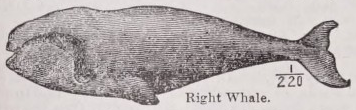
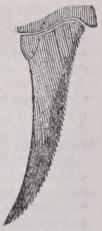
Genus Balaena.—The Greenland, or more properly Arctic, right whale {Balaena mysticetus) attains, when full-grown, a length of from 45 to 50 feet. Its external form is shown in fig. 1, from a careful drawing by Mr Robert Gray. In this species all the peculiarities which distinguish the head and mouth of the whales from those of other mammals have attained their greatest development. The head is of enormous size, exceeding one-third of the whole length of the creature. The cavity of the mouth is actually larger than that of the body, thorax, and abdomen together. The upper jaw is very narrow, but greatly arched from before backwards, to increase the height of the cavity and allow for the great length of the baleen or “whalebone” blades; the enormous rami of the mandible are widely separated posteriorly, and have a still further outward sweep before they meet at the symphysis in front, giving the floor of the mouth the shape of an immense spoon. The baleen blades attain the number of 380 or more on each side, and those in the middle of the series have a length of 10 or sometimes 12
feet. They are black in colour, fine and highly elastic in texture, and fray out at the inner edge and ends into long, delicate, soft, almost silky, but very tough, hairs. The remarkable development of the mouth and of the structures in connexion with it, which distinguishes the right whale among all its allies, is entirely in relation to the nature of its food. It is by this apparatus that it is enabled to avail itself of the minute but highly nutritious crustaceans and pteropods which swarm in immense shoals in the seas it frequents. The large mouth enables it to take in at one time a sufficient quantity of water filled with these small organisms, and the length and delicate structure of the baleen provide an efficient strainer or hair-sieve by which the water can be drained off. If the baleen were rigid, and only as long as is the aperture between the upper and lower jaws when the mouth is shut, a space would be left beneath it when the jaws were separated, through which the water and the minute particles of food would escape together. But instead of this the long, slender, brush-like, elastic ends of the whalebone blades fold back when the mouth is closed, the front ones passing below the hinder ones in a channel lying between the tongue and the lower jaw. When the mouth is opened, their elasticity causes them to straighten out like a bow unbent, so that at whatever distance the jaws are separated the strainer· remains in perfect action, filling the whole of the interval. The mechanical perfection of the arrangement is completed by the great development of the lower lip, which rises stiffly above the jaw-bone and prevents the long, slender, flexible ends of the baleen from being carried outwards by the rush of water from the mouth, when its cavity is being diminished by the closure of the jaws and raising of the tongue.
If, as appears highly probable, the ‘ ‘ bowhead” of the Okhotsk Sea and Behring Strait belongs to this species, its range is circumpolar. Though found in the seas on both sides of Greenland, and passing freely from one to the other, it is never seen so far south as Cape Farewell; but on the Labrador coast, where a cold stream sets down from the north, its range is somewhat farther. In the Behring Sea, according to Scammon, “it is seldom seen south of the fifty-fifth parallel, which is about the farthest southern extent of the winter ice, while in the Sea of Okhotsk its southern limit is about the latitude of 54°.” As has been abundantly shown by Eschricht and Reinhardt in the case of the Greenland seas, “everything tends to prove,” Scammon says, “that the Balaena mysticetus is truly an ‘ ice whale,’ for among the scattered floes, or about the borders of the ice-fields or barriers, is its home and feeding-ground. It is true that these animals are pursued in the open water during the summer months, but in no instance have we learned of their being captured south of where winter ice-fields are occasionally met with.” The occurrence of this species, therefore, on the British or any European coast is exceedingly unlikely, as when alive and in health the southern limit of its range in the North Sea has been ascertained to be from the east coast of Greenland at 64° N. lat. along the north of Iceland towards Spitzbergen, and a glance at a physical chart will show that there are no currents setting southwards which could bear a disabled animal or a floating carcase to British shores. To this a priori improbability may be added the fact that no authentic instance has been recorded of the capture or stranding of this species upon any European coast, for the cases of its having been reported as seen in British waters may be explained by the supposition of one of the other species of the genus being mistaken for it. Still, as two other Arctic cetaceans, the narwhal and the beluga, have in a few undoubted instances found their way to British shores, it would be rash absolutely to deny the possibility of the Greenland right whale doing the same. Further details of the migrations and habits of this species are given under “Whale Fisheries” (see ρ. 526 below).
The southern right whale (B. australis) resembles the last in the absence of dorsal fin and of longitudinal furrows in the skin of the throat and chest, but differs in that it possesses a smaller head in proportion to its body, shorter baleen, a different-shaped contour of the upper margin of the lower lip, and a greater number of vertebrae. The genus inhabits the temperate seas of both northern and southern hemispheres and is divided into several species according to their geographical distribution :— B. bisca r yensis of the North Atlantic, B. japoηica of the North Pacific, B. australis of the South Atlantic, and B. antipodarum and B. novae-zelandiae of the South Pacific. But the differential characters by which they have been separated, external as well as anatomical, are slight and subject to individual variation; and the number of specimens available for comparison in museums is not yet sufficient to afford the necessary data to determine whether these characters can be regarded as specific or not. The most interesting of these is the right whale, which was formerly abundant in the North Atlantic, but is now so scarce as to appear verging on extinction. This was the whale the pursuit of which gave occupation to a numerous population on the shores of the Basque provinces of France and Spain in the Middle Ages. From the 10th to the 16th centuries Bayonne, Biarritz, St Jean de Luz, and San Sebastian, as well as numerous other towns on the north coast of Spain, were the centres of an active whale “fishery,” which supplied Europe with oil and whalebone. In later times the whales were pursued as far as the coast of Newfoundland. They were, however, already getting scarce when the voyages undertaken towards the close of the 16th century for the discovery of the north-eastern route to China and the East Indies opened out the seas around Spitzbergen; then for the first time the existence of the Greenland whale became known, and henceforth the energies of the European whale-fishers became concentrated upon that animal. It is a singular fact that the existence of the Atlantic right whale was quite overlooked by naturalists till lately, all accounts referring to it being attributed to the Greenland whale, supposed once to have had a wider distribution than now, and to have been driven by the persecution of man to its present circumpolar haunts. To the two Danish cetologists Eschricht and Reinhardt is due the credit of having proved its existence as a distinct species, from a careful collation of numerous historical notices of its structure, distribution, and habits; and their restoration of the animal, founded upon these documents, has been abundantly confirmed. by the capture of various specimens in recent times, showing that it still lingers in some of the localities where it formerly was so abundant. The only known instances of its occurrence on the coasts of Europe in modern times are in the harbour of San Sebastian in January 1854, in the Gulf of Taranto, in the Mediterranean, in February 1877, and on the Spanish coast between Guetaria and Zarauz (Guipuzcoa) in February 1878. The skeletons of these three whales are preserved in the museums of Copenhagen, Naples, and San Sebastian respectively. On the coast of the United States several of these whales have been taken within the last few years. In the North Pacific a very similar if not identical species is regularly hunted by the Japanese, who tow the carcases ashore for the purposes of flensing and extracting the whalebone. In the tropica! seas, however, according to Captain Maury’s whale charts, right whales are never or rarely seen; but the southern temperate ocean, especially the neighbourhood of the Cape of Good Hope, Kerguelen’s Island, Australia, and New Zealand, is inhabited by “black whales,” once abundant, but now nearly exterminated through the wanton destruction of the females as they visit the bays and inlets round the coast, their constant habit in the breeding time. The range of these whales southward has not been accurately determined; but no species corresponding with the Arctic right whale has as yet been met with in the Antarctic icy seas.
Genus Megaptera.—The whale commonly called “humpback” (Megaptera boons) by whalers, perhaps on account of the low hump-like form of the dorsal fin, is very distinctly characterized from all others of the group, especially by the immense length of the pectoral fins or flippers, which are indented or scalloped along their margins, and are, except at their base, of a white colour, nearly all the rest of the body being black. It differs from the right whale and resembles the rorqual in having the skin of the throat and chest marked with deep longitudinal furrows. The baleen plates are short and broad and of a deep black colour.
Though common in the North Atlantic between Norway and Greenland, this whale does not frequently appear on the coasts of the British Isles. One came ashore at Newcastle in 1839; another, a young one, was taken in the estuary of the Dee in 1863 and its skeleton is preserved in the Liverpool museum; and a nearly full-grown animal was captured in the mouth of the Tay in the winter of 1883-84. The usual length of the adult ranges from 45 to 50 feet. Whales of the genus Megaptera are found in the South Atlantic and in both the North and the South Pacific. They resemble those of British seas so closely that it is doubtful whether the differences which have been observed, and upon which several species have been founded, may not have been individual peculiarities; but zoologists have not yet had the opportunity of examining and comparing such a series of specimens of different ages and sexes from different localities as would be necessary to determine these points satisfactorily.
Genus Balaenoptera.—The rorquals or fin whales have the plicated skin of the throat like that of Megaptera, the furrows being more numerous and close-set; but the pectoral fin is comparatively small and the dorsal fin distinct and falcate. The head is comparatively small and flat, and pointed in front, the baleen short and coarse, the body long and slender, and the tail very much compressed before it expands into the “flukes.” The rorquals are perhaps the most abundant and widely distributed of all the whales, being found in some of their modifications in all seas, except the extreme Arctic, and probably Antarctic, regions. Owing to the small quantity and inferior quality of their whalebone, the comparatively limited amount of blubber or subcutaneous fat, and their great activity and the difficulty of capturing them by the old methods, these whales were not until recently an object of pursuit by whale-fishers; but, since the introduction of steam-vessels, and especially of explosive harpoons fired from guns, in the place of those hurled by the human hand, a regular fishery has been established on the coast of Finmark (see p. 528 below). There are four distinct species of this genus in British seas. (1) Balaenoptera sibbaldii, the “blue whale," the largest of all known animals, attains a length of 80 or even sometimes 85 feet. Its colour is dark bluish grey, with small whitish spots on the breast; the baleen is black; the flippers are larger proportionally than in other rorquals, measuring one-seventh of the total length of the body; and the dorsal fin is small and placed very far back. This whale has usually 64 vertebrae, of which 16 bear ribs. Like the others of the genus, this species seems to pass the winter in the open seas, and approaches the coast of Norway at the end of April or beginning of May. At this time its sole food is a small crustacean {Euphausia inermis), which swarms in the fjords. Several specimens have been taken on the British coasts, two fine skeletons from the Firth of Forth being preserved in the Edinburgh museums. (2) Balaenoptera musculus, the common rorqual, has a length of 65 to 70 feet, is of a greyish slate colour above and white underneath, and the baleen is slate colour, variegated with yellow or brown.
It has usually 62 vertebrae, of which 15 bear ribs. This is the commonest of all the large whales on the British coasts; scarcely a winter passes without the body of one being somewhere washed ashore, usually after stormy weather, and more frequently on the south coast, as this species has a more southern range than the last, and frequently enters the Mediterranean. It feeds largely on fish, and is frequently seen feasting among shoals of herrings. (3) Balaenoptera borealis, often called Rudolphi’s whale from its first describer, is a smaller species, scarcely attaining a length of 50 feet. It is bluish black above, with oblong light-coloured spots, whilst the under parts are more or less white; the whole of the tail and both sides of the flippers are black; the baleen is black, and the bristly ends fine, curling, and white; the flippers are very small, measuring one-eleventh of the total length of the body. There are 56 vertebrae, with 14 pairs of ribs. This species, according to Collett, feeds chiefly on minute crustaceans, mainly Calanus finmar-chicus and Euρhausia inermis, and not on fish. Until lately it was considered the rarest of the whalés of European seas, and was only known to science from a few individuals stranded on the coasts of northern Europe at long intervals, the skeletons of which have been preserved in museums. The most southern point at which it has been met with hitherto is Biarritz in France. Since the establishment of the whaling station near the North Cape it has been shown to be a regular summer visitor, and in 1885 771 individuals were captured on the coast of Finmark. (4) Balaenoptera rostrata, the lesser fin whale or rorqual, is the smallest species found in the northern seas, rarely exceeding 30 feet in length. Its colour is greyish black above, whilst the under side is white, including the whole of the lower side of the tail; the inner side of the flippers is white; and there is a broad white band across the outer side, which is a very characteristic mark of the species; the baleen is yellowish white. The dorsal fin in this and the last species is comparatively high, and placed far forwards on the body. This whale has usually 48 vertebrae, of which 11 bear ribs. It is common in summer in the fjords of Norway, and is often seen around the British Isles. It has been taken, though rarely, in the Mediterranean, and it ranges as far north as Davis Strait. Rorquals are met with in almost all seas throughout the world, but further and more accurate observations are required before their specific characters and geographical distribution can be made out. Nearly all the individuals hitherto examined with any care, whether from the North Pacific, the Australian seas, or the Indian Ocean, come very near in structure to one or the other of the Atlantic forms described above, so much so that some zoologists have been induced to believe that there are...