
HELMERS, Jan Frederik (1767-1813), Dutch poet, was born at Amsterdam, March 7, 1767. His early poems Night (1788) and Socrates (1790) were tame and sentimental, but he woke up after 1805 to the melancholy condition of the Fatherland, and determined, in company with his friend Cornelis Loots, to rouse national feeling by a burst of patriotic poetry. His poems, published in 1809 and 1810, but especially hi3 great work The Dutch Nation (1812), created great enthusiasm and enjoyed immense success. Helmers died at Amsterdam, February 26, 1813. He was a fiery, somewhat turgid writer, by no means devoid of force, but owing his success mainly to the integrity of his patriotism and the opportune moment at which he sounded his counterblast to the French oppression. His posthumous poems were collected in 1815.
[133 words — estimated reading time: 1 minute]
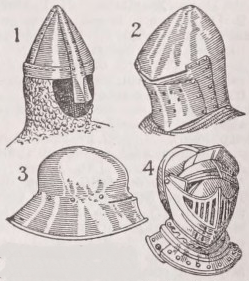
HELMET, or Helm (Anglo-Saxon, Helm ; Italian, Elme, Elmettο ; French, Heaume ; Icelandic, Hjalmr), is the term used in a general sense to include the various forms of head defences which were either made in solid metal or of metal plates. The form of helmet used among the Assyrians, as shown by the monumental sculptures, was a close-fitting skull-cap, round or conical, sometimes surmounted by a crest rising from the summit of the cone and curving forwards in a semicircular form. The Greek helmet was also in its simplest form a skull-cap, covering the head in front above the level of the eyes, but reaching down to the nape of the neck from ear to ear. Another form had this lower part prolonged and carried round so as to cover all above the shoulders with the exception of a slit in front, partly protected by a nose-piece. Occasionally hinged cheek-pieces were added to the skull-cap, and the upper part of the casque was sometimes prolonged into a conical shape with a crest curving forwards, or surmounted by a ridged prominence on which was fastened a flowing crest of horsehair. The Greek helmets are often represented as highly decorated, and many examples of the different forms and their varieties of decoration occur on the painted vases, the gems, and the coinage. The Etruscan helmet differed but slightly from that of the Greeks. It was more conical in form, and often furnished with horns or wings in place of a crest. The Roman helmet was usually a skull-cap, with or without crest, and often plain and undecorated. The . Gaulish helmet, of which a beautiful specimen was obtained from an Iron Age burial at Berru in Marne in 1872, was of hammered iron, conical in shape, terminating in an ornamental apex, and having a richly decorated border round the lower part. Conical ...helmets of an earlier character found at Theil and Auxonne have been assigned to the Age of Bronze. A silver helmet of the Early Iron Age, consisting of a skull-cap with a mask for the face fastened together by a hinge, which was found in the Thorsbjerg Moss in South Jutland, is the only specimen known of .the early Teutonic helmet. An Anglo-Saxon helmet of iron, shaped like a skull-cap, and formed of ribs or flat strips of metal, covered with plates of horn, and surmounted with the figure of a boar, was found in a tumulus at Benty Grange in Derbyshire. Such boar-crowned helmets are referred to in the Anglo-Saxon poem of Beowulf. The helmets worn by the Normans and Saxons at the time of the Conquest, as shown in the Bayeux tapestry, were conical in shape with a projecting nasal. The earliest kuown example of a date subsequent to the Norman Conquest is one which was discovered in the church of Faversham, and is now in the Musée d’Artillerie at Paris. It preserves the conical top of the earlier Norman headpiece, but has a barrel-shaped body, covering all the head and face with the exception of a vertical slit partially protected by a projecting nasal, and having transverse apertures on either side for the eyes. This barrel-shape, with flattened instead of conical top, continued in use during the 12th century in England, although the conical cap with the nasal appears on the great seals of the Scottish kings down to the time of Alexander II. The helm of Edward the Black Prince (died 1370), which still hangs over his tomb in Canterbury Cathedral, has the top shaped like a truncated cone and the lower part more oval than barrel-shaped, the aperture for sight taking the form of a transverse slit between the upper and lower parts of the helm. In the lower portion the perforations for breathing are arranged in the form of a crown on both sides. The helm of Henry V. (died 1422), which hangs with his saddle and shield above his tomb in Westminster Abbey, is lower in the crown, more rounded to the shape of the head, and the ocularium or perforation for sight is protected by the projection of the lower part beyond the line of the upper. The helm of King Henry VI., which was suspended over his tomb in St George’s Chapel, Windsor, has the lower part contracted to the form of the neck and rounded to the shape of the shoulders. The ocularium, which is wide, is protected by a series of curved bars riveted across it. The helm of Edward IV. (died 1483), which was also suspended in St George’s Chapel, exhibits a still greater shaping to the form of the neck and shoulders; the top is rounder, and has a spike for a crest. In the end of the 15th century the great helm was superseded by the smaller head piece with movable vizor and beaver or chinpiece and neck guard, which is properly styled a helmet. Other varieties of headpiece were the bascinet, of a plain oval form pointed at the top and somewhat compressed on the sides, having holes at the bottom for the attachment of the camail or gorget of chain-mail. The bascinet was sometimes worn alone and sometimes under the helm. It was succeeded in the 15th century by the salade, a lighter skull-cap with the hinder part projecting, and occasionally a movable vizor. The armet, the burgonet, and the casque are varieties of the lighter form of headpiece, partaking more or less of the skull-cap form, while the morion and the chapelle de fer were distinguished by their flattened brims.
[947 words — estimated reading time: 6 minutes]