
See Orang-outang.
Word of the Day: Catachrestical
Orang
Encyclopedia Britannica
ORANG. See Ape, vol. ii. p. 149.
9th ed. Encyclopædia Britannica, vol. 17, p. 810
[7 words — estimated reading time: 1 minute]
[7 words — estimated reading time: 1 minute]
1. The satyr or great ape (Simia satyrus, ) an animal with a flat face and deformed resemblance of the human form. These animals walk erect like man, feed on fruits, sleep on trees, and make a shelter against inclemencies of the weather. They grow to the height of six feet, are remarkable strong, and wield weapons with the hand. They are solitary animals, inhabiting the interior of Africa and the isles of Sumatra, Borneo and Java.
2. The orang-outang is found only in S. Eastern Asia. The African animal resembling it, is the chimpanzee (Simia troglodytes.)
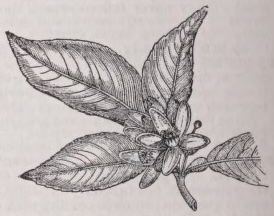
The fruit of a species of Citrus which grows in warm climates. The fruit is round and depressed; it has a rough rind, which when ripe is yellow. This contains a vesicular pulp inclosed in nine cells for seeds. The tree producing oranges grows to the height of ten or twelve feet and bears the same name.
Of or pertaining to an orange; of the color of an orange; reddish yellow; as, an orange ribbon.
1. The fruit of a tree of the genus Citrus (C. Aurantium). It is usually round, and consists of pulpy carpels, commonly ten in number, inclosed in a leathery rind, which is easily separable, and is reddish yellow when ripe.
2. The tree that bears oranges; the orange tree.
3. The color of an orange; reddish yellow.
Orange
Encyclopedia Britannica
ORANGE(Citrus Aurantium), the plant that produces the familiar fruit of commerce, is closely allied to the citron, lemon, and lime, all the cultivated forms of the genus Citrus being sα nearly related that their specific demarcation must be regarded as somewhat doubtful and indefinite. Risso and Poiteau have described eighty kinds of orange (including the bergamots), chiefly differing in the external shape, size, and flavour of the fruit; but all may probably be traced to two well-marked varieties—the Sweet or China Orange and the Bitter Orange or Bigarade,— though several of these modifications seem to indicate crossing with the lemon or citron, if, indeed, they do not rather point to a more remote common origin from a primitive citrine type....
The bitter orange, by some made a sub-species (C. vulgaris'), is a rather small tree, rarely exceeding 30 feet in height. The green shoots are furnished with sharp axillary spines, and alternate evergreen oblong leaves, pointed at the extremity, and with the margins entire or very slightly serrated; they are of a bright glossy green tint, the stalks distinctly winged and, as in the other species, articulated with the leaf. The fragrant white or pale pinkish flowers appear in the summer months, and the fruit, usually round or spheroidal, does not perfectly ripen until the following spring, so that flowers and both green and mature fruit are often found on the plant at the same time. The bitter aromatic rind of the bigarade is rough, and dotted closely over with concave oil-cells; the pulp is acid and more or less bitter in flavour. The sweet orange generally has the shoots destitute of spines, the petioles less distinctly winged, and the leaves more ovate in shape, but chiefly differs in the fruit, the pulp of which is agreeably acidulous and sweet, the rind comparatively smooth, and the oil-cells convex. The ordinary round shape of the sweet orange fruit is varied greatly in certain varieties, in some being greatly elongated, in others much flattened; while several kinds have a conical protuberance at the apex, others are deeply ribbed or furrowed, and a few are distinctly “horned” or lobed, by the partial separation of the carpels. The two sub-species of orange are said by some authorities to reproduce themselves infallibly by seed; and, where hybridizing is prevented, the seedlings of the sweet and bitter orange appear to retain respectively the more distinctive features of the parent plant; but where growing wild for successive generations they show a tendency to degenerate, the progeny of the sweet orange being apt to assume the broadly-winged petioles and spiny shoots of the bigarade.
Though now cultivated widely in most of the warmer parts of the world, and apparently in many completely naturalized, the diffusion of the orange has taken place in comparatively recent historical periods. To ancient Mediterranean agriculture it was unknown; and, though the later Greeks and Romans were familiar with the citron as an exotic fruit, their “Median Apple” appears to have been the only form of the citrine genus with which they were acquainted. The careful researches of Gallesio have proved that India was the country from which the orange spread to western Asia and eventually to Europe. Oranges are at present found wild in the jungles along the lower mountain slopes of Sylhet, Kumaon, Sikkim, and other parts of northern India, and, according to Boyle, even in the Nilgiri Hills; the plants are generally thorny, and present the other characters of the bitter variety, but occasionally wild oranges occur with sweet fruit; it is, however, doubtful whether either sub-species is really indigenous to Hindustan, and De Candolle is probably correct in regarding the Burmese peninsula and southern China as the original home of the orange. Cultivated from a remote period in Hindustan, it was carried to southwestern Asia by the Arabs, probably before the 9th century, towards the close of which the bitter orange seems to have been well known to that people; though, according to Mas'ùdi, it was not cultivated in Arabia itself until the beginning of the 10th century, when it was first planted in Omàn, and afterwards carried to Mesopotamia and Syria. It spread ultimately, through the agency of the same race, to Africa and Spain, and perhaps to Sicily, following everywhere the tide of Mohammedan conquest and civilization. In the 12th century the bigarade was abundantly cultivated in all the Levant countries, and the returning soldiers of the Cross brought it from Palestine to Italy and Provence. An orange tree of this variety is said to have been planted by St Dominic in the year 1200, though the identity of the one still standing in the garden of the monastery of St Sabina at Rome, and now attributed to the energetic friar, may be somewhat doubtful. No allusion to the sweet orange occurs in contemporary literature at this early date, and its introduction to Europe took place at a considerably later period, though the exact time is unknown. It was commonly cultivated in Italy early in the 16th century, and seems to have been known there previously to the expedition of Da Gama (1497), as a Florentine narrator of that voyage appears to have been familiar with the fruit. The importation of this tree into Europe, though often attributed to the Portuguese, is with more probability referred to the enterprise of the Genoese merchants of the 15th century, who must have found it growing abundantly then in the Levant. The prevailing European name of the orange is sufficient evidence of its origin and of the line taken in its migration westward. The Sanskrit designation nagrungo, becoming narungee in Hindustani, and corrupted by the Arabs into ndran i j (Spanish naranja), passed by easy transitions into the Italian aranda (Latinized aurantium), the Romance arangi, and the later Provençal orange. The true Chinese variety, however, was undoubtedly brought by the Portuguese navigators direct from the East both to their own country and to the Azores, where now luxuriant groyes of the golden-fruited tree give a modern realization to the old myth of the gardens of the Hesperides. Throughout China and in Japan the orange has been grown from very ancient times, and it was found diffused widely when the Indian Archipelago was first visited by Europeans. In more recent days its cultivation has extended over most of the warmer regions of the globe, the tree growing freely and producing fruit abundantly wherever heat is sufficient and enough moisture can be supplied to the roots; where night-frosts occur in winter or spring the culture becomes more difficult and the crop precarious.
The orange flourishes in any moderately fertile soil, if it is well drained and sufficiently moist; but a rather stiff loam or calcareous marl, intermingled with some vegetable humus, is most favourable to its growth. Grafting or budding on stocks raised from the seed of some vigorous variety is the plan usually adopted by the cultivator. The seeds, carefully selected, are sown in well-prepared ground, and the seedlings removed to a nursery-bed in the fourth or fifth year, and, sometimes after a second transplantation, grafted in the seventh or eighth year with the desired variety. When the grafts have acquired sufficient vigour, the trees are placed in rows in the permanent orangery. Propagation by layers is occasionally adopted; cuttings do not readily root, and multiplication directly by seed is always doubtful in result, though recommended by some authorities. The distance left between the trees in the permanent plantation or grove varies according to the size of the plants and subsequent culture adopted. In France, when the trunks are from 5 to 6⅜ feet in height, a space of from 16 to 26 feet is left between; but the dwarfer trees admit of much closer planting. In the West Indies and Azores an interval of 24 or even of 30 feet is often allowed. The ground is kept well stirred between the trunks, and the roots manured with well-rotted dung, guano, or other highly nitrogenous matter; shallow pits are sometimes formed above the roots for the reception of liquid or other manures; in dry climates water must be abundantly and frequently supplied. The trees require regular and careful pruning, the heads being trained as nearly as possible to a spherical form. Between the rows melons, pumpkins, and other annual vegetables are frequently raised. In garden culture the orange is often trained as an espalier, and with careful attention yields fruit in great profusion when thus grown. In favourable seasons the oranges are produced in great abundance, from 400 to 1000 being commonly borne on a single plant in full bearing, while on large trees the latter number is often vastly exceeded. The trees will continue to bear abundantly from fifty to eighty years, or even more; and some old orange trees, whose age must be reckoned by centuries, still produce their golden crop; these very ancient trees are, however, generally of the bitter variety. Oranges intended for export to colder climates are gathered long before the deep tint that indicates maturity is attained, the fruit ripening rapidly after picking; but the delicious taste of the mature China orange is never thus acquired, and those who have not eaten the fruit in a perfectly ripe state have little idea of its flavour when in that condition. Carefully gathered, the oranges are packed in boxes, each orange being wrapped in paper, or with dry maize husks or leaves placed between them. The immense quantities of this valuable fruit imported into Britain are derived from various sources, but those kinds in most esteem are the produce of the Azores, whence, in 1878, 410,101 boxes, each holding 400 “St Michael’s” oranges, are said to have been sent to Great Britain alone. Large numbers are also exported to England from Sicily, Portugal, and Spain, and a considerable amount from other Mediterranean countries. North America is largely supplied from Jamaica and the Bahamas; but the extensive and rapidly increasing cultivation of the tree in Florida will probably in a few years supersede the foreign importation. In that State the bitter orange has grown, from an unknown period, in a wild condition, and some of the earlier botanical explorers regarded it as an indigenous tree; but it was undoubtedly brought by the Spanish colonists to the West India Islands, and was probably soon afterwards transplanted to Florida by them or their buccaneering enemies. The climate of Florida seems remarkably adapted for orange culture, and orangeries are becoming yearly more numerous and extensive,—the wild stocks, or those raised from wild seed, being generally employed by the grafter. In the other Gulf States this branch of agricultural industry is pursued to some extent; and in California the orange groves are productive and increasing.
Orange cultivation has been attempted with success in several parts of Australia, especially in New South Wales, where the orange groves near Paramatta yield an abundant colonial supply. The orangeries of Queensland and South Australia are likewise producing well, though, as yet, Australian fruit is chiefly consumed at home. In many of the Pacific Islands the plant has been long established: Tahiti exports oranges largely to San Francisco, and in Fiji the culture promises to become of considerable importance.
Certain varieties of orange deserve mention, from the peculiar character of their fruit. The Mandarin orange of China, sometimes made a distinct species, C. nobilis, is remarkable for its very flat spheroidal fruit, the rind of which readily separates with the slightest pressure; the pulp has a peculiarly luscious flavour when ripe. The small Tangerine oranges, valued for their fine fragrance, are derived from the Mandarin. “Maltese” or “Blood” oranges, much grown in southern Italy, are distinguished by the deep-red tint of the pulp. The Bergamot has been already described (see vol. iii. p. 587). Orange plantations in Europe suffer much at times from a disease called by the French charbon, caused by a fungus (Demathium monophyllιιm), which rapidly spreads over stems, leaves, and green fruit Several insect enemies attack the plant, of which the scale-like Coccus citri is the most injurious in Europe; in the Azores C. Hesperidis takes its place. Cold weather in winter has sometimes proved destructive in Provence, and many plantations were destroyed by the hard frosts of 1789 and 1820.
Besides the widespread use of the fruit as an agreeable and wholesome article of diet, that of the sweet orange, abounding in citric acid, possesses in a high degree the antiscorbutic properties that render the lemon and lime so valuable in medicine; and the free consumption of this fruit in the large towns of England during the winter months has doubtless a very beneficial effect on the health of the people. The juice is sometimes employed as a cooling drink in fevers, as well as for making a pleasant beverage in hot weather; it is likewise an essential ingredient in “orange wine.”
The bitter orange is chiefly cultivated for the aromatic and tonic qualities of the rind, which render it a valuable stomachic. Planted long ago in Andalusia by the Moorish conquerors, it is still extensively grown in southern Spain,—deriving its common English name of “Seville” orange from the abundant groves that still exist around that city, though the plant is now largely cultivated elsewhere. The fruit is imported into Great Britain and the United States in considerable quantities for the manufacture of the favourite confection known as orange marmalade, which is prepared from the pulp and rind, usually more or less mingled with the pulp of the China orange. In medicine the dried peel is largely employed as an aromatic tonic, and often, in tincture and infusion, as a mere vehicle to disguise the flavour of more nauseous remedies. The essential oil of the rind is collected for the use of the perfumer, being obtained either by the pressure of the fresh peel against a piece of sponge, or by the process known as écuclle, in which the skin of the ripe fruit is scraped against a series of points or ridges arranged upon the surface of a peculiarly-shaped dish or broad funnel, when the oil flows freely from the broken cells. Another fragrant oil, called in France essence de petit grain, is procured by the distillation of the leaves, from which also an aromatic water is prepared. The flowers of both sweet and bitter orange yield, when distilled with water, the “oil of Neroli” of the druggist and perfumer, and likewise the fragrant liquid known as “orange - flower water.” The candied peel is much in request by cook and confectioner; the favourite liqueur sold as “curaçoa” derives its aromatic flavour from the rind of the bigarade. The minute immature oranges that drop from the trees are manufactured into “issuepeas”; from those of the sweet orange in a fresh state a sweetmeat is sometimes prepared in France. Orange trees occasionally acquire a considerable diameter; the trunk of one near Nice, still standing in 1789, was so large that two men could scarcely embrace it; the tree was killed by the intense cold of the winter of that year. The wood of the orange is of a fine yellow tint, and, being hard and close-grained, is valued by the turner and cabinetmaker for the manufacture of small articles; it takes a good polish.
Although the bitter “Poma de Orenge” were brought in small quantities from Spain to England as early as the year 1290, no attempt appears to have been made to cultivate the tree in Britain until about 1595, when some plants were introduced by the Carews of Beddington in Surrey, and placed in their garden, where, trained against a wall, and sheltered in winter, they remained until destroyed by the great frost of 1739-40. In the last century the tree became a favourite object of conservatory growth; in the open air, planted against a wall, and covered with mats in winter, it has often stood the cold of many seasons in the southern counties, in such situations the trees occasionally bearing abundant fruit; but in Great Britain the orange can only be regarded as an object of ornamental culture. The trees are usually imported from Italy, where, especially near Nervi, such plants are raised in great numbers for exportation; they are generally budded on the stocks of some free-growing variety, often on the lemon or citron.
For details of orange varieties, cultivation, &c., see Risso and Poiteau, Histoire et culture des Orangers (edited by A. Du Breuil, Paris, 1872); for early history and diffusion, G. Gallesio, Traité du Citrus, Paris, 1811.
ORANGE, a city of France, the chief town of an arrondissement in the department of Vaucluse, is situated 18 miles north of Avignon on the railway from Lyons to Marseilles at some distance from the left bank of the Rhone, in the midst of meadows, orchards, and mulberry plantations, watered by a stream called the Meyne, and overlooked by the majestic summit of Mount Ventose, which lies 22 miles to the east. The district is highly fertile, and the city deals largely in silks, woollens, and fruits, and also till quite recently in wines and madder. The population of the city numbers 6860. Orange is interesting mainly from its Roman remains. The triumphal arch is not only far finer than any other in France, but ranks third in size and importance among those still extant in Europe. Measuring 72 feet in height, 69 feet in width, and 26 feet in depth, it is composed of three arches supported by four Corinthian columns. On three sides it is well preserved, and displays remarkable variety and elegance in its sculptured decorations. To judge from a partly decipherable inscription, the arch seems to have been erected in the reign of Tiberius. It suffered from being used as a fortification in the Middle Ages. Another most imposing structure is the theatre, built against the hill commanding the town. The façade, which is 118 feet high, 340 feet long, and 13 feet thick, is pierced by three square gates surmounted by a range of blind arches and a double row of far-projecting corbels. Of the seats occupied by the spectators—to the number, it might be, of 7000—only the lower ranges remain. By many this theatre is regarded as the most beautiful, or at least the most imposing, of the Roman monuments of France. The princes of Orange made it an outwork of the castle which they erected on the hill, and which was demolished by De Grignan after he had taken the town for Louis XIV. Up to the beginning of the present century it was filled with hovels and stables; these are now quite swept away, and the preservation of the building assured. In the neighbourhood of the theatre traces have been found of a hippodrome capable of containing 20,000 persons; and statues, bas-reliefs, and ruins of an aqueduct also serve to show the importance of the Roman town. Several of the churches at Orange are very old. Notre Dame, the old cathedral, originally erected by the prefect of Gaul, was ruined by the Barbarians, rebuilt in the 11th century, and damaged by the Protestants. A statue of Rambaud II. count of Orange and that of Gasparin the celebrated agriculturist may also be mentioned.
Orange (Arausio), capital of the Cavari, became after Caesar an important Roman colony. Its ramparts and fine buildings were partly destroyed by the Alemanni and Visigoths, and partly ruined by the erections of the Middle Ages. Orange was included in the kingdom of Austrasia, fell into the hands of the Saracens, and was recovered by Charlemagne. It became an independent countship in the 11th century; and Count Bertrand de Baux (d. 1181) received from Frederick I. the title of prince of Orange. On the death of Philibert of Chalons in 1530 the inheritance fell to his sister’s son, René (Renatus) of Nassau Dillenburg, stadholder of the Netherlands, who, dying childless, chose (1544) as his successor his cousin William, afterwards William I. Though Francis I., king of France, whose predecessors had long claimed to be suzerains of the principality, caused it to be declared part of the domain of Provence, Henry II. recognized William’s lights in the treaty of Cateau Cambresis, and “prince of Orange” remained the title of the stadholders from Maurice to William III. In 1672 Louis XIV. seized the principality and handed it over to the count of Auvergne in compensation for his loss of the marquisate of Bergen-op-Zoom confiscated by William; but the claims of the house of Nassau were acknowledged by the peace of Ryswick. On William’s death there were two claimants, John William Friso of Nassau-Dietz, designated heir by William’s will, and Frederick I. king of Prussia, who held that he was nearer of kin and had been appointed by the will of Frederick Henry. Thereupon Louis XIV. declared the principality forfeited to the French crown and bestowed it on the prince of Conti, who also had pretensions. The parlement of Paris decided that this prince should have the dominium utile ; and its finding was confirmed by the treaty of Utrecht, which, however, left the title and coat of arms to the king of Prussia, who is still styled prince of Orange (Prinz von Oranien). John William Friso, however, also took the title, and his descendants, the stadholders and kings of the Netherlands, have all been designated princes of Orange-Nassau.
ORANGE, a city of the United States, in Essex county, New Jersey, 16 miles west of New York by two lines of railway, and connected by tramway with Newark, 3⅜ miles distant. Beautifully situated on rolling ground about 190 feet above the sea, Orange has become a favourite place of residence for New York business men. To the west lies Llewelyn Park, an area of 750 acres, studded with villas and laid out in common; and the summit of Orange Mountain (650 feet), a little farther west, is also occupied with villas. Hat-making is largely carried on in the city. The population was 9348 in 1870 and 13,207 in 1880. In 1860 the township of Orange received a town charter; and in 1872 the town, diminished by East Orange and parts of South and West Orange, was raised to the rank of a city.
9th ed. Encyclopædia Britannica, vol. 17, p. 810 — signed C. P. J.
[2,788 words — estimated reading time: 16 minutes]
[2,788 words — estimated reading time: 16 minutes]
Orange river free state
Encyclopedia Britannica
ORANGE RIVER FREE STATE, an independent republic adjoining the Cape Colony, South Africa (see vol. vi., Plate I.), is bounded on the N. by the Vaal river, S. by the Orange river, E. by the Caledon river and Drakensberg mountains, and W. by a line dividing it from Kimberley and the diamond fields of Griqualand West. The area is 70,000 square miles, and the population in 1880 was 133,518, Of this total 61,022 were whites or of European extraction (mostly Dutch), and 72,496 coloured or of native races....
The country, which has an average elevation of 4500 feet above the sea, consists of a series of extensive undulating plains, bounded or diversified by detached rocky hills, These plains slope from the central watershed northward and southward respectively to the Vaal and Orange rivers, and are intersected at various intervals by the Wilge, Rhen oster, Valsch, Vet, Modder, and Riet rivers, emptying their waters into the Vaal river, and by the Caledon, which joins the Orange river. The southern and eastern districts are covered with luxuriant grasses, affording excellent pasturage for stock. In the western districts the grasses are gradually being supplanted by a dwarf bush vegetation. The river-banks are fringed with willow, mimosa, and other indigenous trees, and shrubs and trees of larger growth are found on the eastern mountain ranges; but generally the country is woodless, and to remedy this Government offers premiums for the encouragement of tree-planting. The geological characteristics are similar to those of the inland districts of Cape Colony. The south-western portion is an extension of the Karroo or lacustrine formation of South Africa, consisting of sandstone and shales intersected by intrusive igneous rocks. In this formation occurs the diamond mine of Jagersfontein, near the village of Fauresmith, which has been worked for several years past. The north-eastern part, again, consists of sandstones and carbonaceous shales resting conformably on the Karroo formation, and containing horizontal coal-seams, classed as of the Triassic period. The coal outcrops in the Kronstad and Heilbron districts are being utilized, In the Drift deposits along some river-beds, such as the Sand, Caledon, and Vaal rivers, there are accumulations of pebbles, consisting of agate, jasper, chalcedony, carnelian, white quartz, garnets, and occasionally diamonds.
The climate is salubrious, and specially remarkable for its dryness. Thousands of wild game formerly occupied the plains of the state, but their numbers and variety have of late greatly diminished, and some have been entirely exterminated. The lion, giraffe, elephant, and rhinoceros are no longer found. But in a few districts there may still be seen considerable herds of antelopes, such as the springbok, blesbok, and wildebeeste or gnu. The resources of the state are agricultural, pastoral, and mineral. The principal occupations of the inhabitants are the breeding of cattle, horses, goats, merino sheep, and ostriches. Agriculture is attended to on a larger or smaller scale according to the capabilities of the various farms, and vineyards and orchards are planted on many properties. The staple articles of export, however, are wool, skins, ostrich feathers, and diamonds, all of which are shipped from the seaports of the Cape Colony and Natal.
Bloemfontein, the capital and seat of government, is situated about the centre of the state, in 28° 56' S. lat. and 26° 18' E. long. It is an agreeable town, with a population of about 3000, and has a handsome range of public offices, where the volksraad or assembly of the people meets, a high court (consisting of a chief-justice and two puisne judges), a municipal burgher council, two banks, two newspapers, two hotels, clubs, a college, schools, and several churches, including the Dutch Reformed church, the Anglican church with a resident bishop, and Wesleyan, Lutheran, and Roman Catholic churches. The Dutch language is officially used in the volksraad and the courts of justice, but English is spoken by the community generally.
The other towns or villages of the state are—Fauresmith, Edenburg, Philippolis, Jacobsdal, Boshoff, Winburg, Hoopstad, Kronstad, Heilbron, Frankfort, Harrismith, Ladybrand, Ficksburg, Bethulie, Bethlehem, Smithfield, Rouxville, and Wepener.
At the commencement of this century the country was inhabited by sections of aboriginal tribes—Bushmen, Korannas, and Bechuanas; and soon afterwards a number of Griquas from the north-west of the Cape Colony came in among them. A chronic state of warfare prevailed between these races. In 1824 nomad farmers from the Colony, seeking pastures for their flocks, crossed the Orange river and settled in the territory. These were followed in 1835-36 by large bodies of Dutch Boer emigrants who left the Colony in order to be beyond British control. They formed a rude government for themselves, and in attempting to exercise authority came into collision with the Griquas, who claimed protection from the Colony, with which they were allied by treaty. The British governor, Sir P. Maitland, intervened in 1845, assisting the Griquas with troops, and defeating the Boers at Zwart Koppies; and, to prevent further collisions, a resident was appointed. In 1848 Governor Sir H. Smith visited the territory, and came to the conclusion that peace could not be maintained among the mixed elements forming the population without the establishment of a regular government. He therefore issued a proclamation, afterwards confirmed by the crown, annexing the territory to the empire under the name of the Orange River British Sovereignty. Thereupon some of the Boers, under their leader Pretorias, took up arms and expelled the British magistrates; but a military force was brought against them by Sir H. Smith in person, and, after a short but sharp encounter at Boomplaats, the Boers were defeated, and the crown’s authority re-established and maintained from that time until towards the close of 1853. During this period many Europeans and colonists of European descent took up their abode in the sovereignty. But disturbances again occurred, arising from long-standing disputes between the native tribes; and, in order to chastise the most powerful of them—the Basutos∙—for certain acts of outrage, Governor Cathcart in 1852 moved a large military expedition against their chief, Moshesh, and the battle of the Berea was fought, after which the chief, on behalf of the tι ’ ibe, gave in his submission. After this expedition the British Government resolved to withdraw from the territory. Sir George Clerk was deputed as a special commissioner to carry out the abandonment of the country; and, notwithstanding the protests of many inhabitants, he formally handed it over to a body of Boer delegates in terms of a convention entered into on the 23d February 1854. They were released from their allegiance, and permitted to constitute an independent republican community of their own, under the title of the “Orange River Free State.” Since that time the government has been in the hands of a president assisted by an executive council, with a volksraad or congress elected by the people, exercising all legislative functions.
I n the south-eastern portion of the State, and entirely surrounded by it, is a small independent native territory, of which the principal village is Thaba-Ncnu, where 10,000 of the Baralong tribe reside, peaceably ruled by their chief according to their own laws.
9th ed. Encyclopædia Britannica, vol. 17, p. 813
[1,201 words — estimated reading time: 7 minutes]
[1,201 words — estimated reading time: 7 minutes]
A species of pear.
The rind of an orange separated from the fruit.
Of the color of an orange.
A woman that sells oranges.
One of a secret society, organized in the north of Ireland in 1795, the professed objects of which are the defense of the regning sovereign of Great Britain, the support of the Protestant religion, the maintenance of the laws of the kingdom, etc.; -- so called in honor of William, Prince of Orange, who became William III. of England.
Orangemen
Encyclopedia Britannica
ORANGEMEN, an association of Irish Protestants, originating and chiefly flourishing in Ulster, but with ramifications in other parts of the United Kingdom, and in the British colonies. Orangemen derive their name from William III., but neglect the example of that tolerant prince. They are enrolled in lodges, and it is said that the initiated can always recognize each other. Much may be learned from their toasts, about which there is no concealment. The commonest form is “the glorious, pious, and immortal memory of the great and good King William, who saved us from popery, slavery, knavery, brass money, and wooden shoes,” with grotesque or truculent additions according to the orator’s taste. The brass money refers to James H.’s finance, and the wooden shoes to his French allies. The final words are often “a fig for the bishop of Cork,” in allusion to Dr Peter Browne, who, in 1715, wrote cogently against the practice of toasting the dead. Orangemen are fond of beating drums and flaunting flags with the legend “no surrender,” in allusion to Londonderry....
Orangeism is essentially political, and may be useful in so far as it reminds Irish Protestants of their origin and of their common rights under the British crown. But its original object was the maintenance of Protestant ascendency, and too much of its spirit still survives. By repeating irritating watchwords, and publicly keeping anniversaries painful to their neighbours, Orangemen have done much to inflame sectarian animosity; if their celebrations were private, little could be said against them. The first regular lodges were founded in 1795, but the system existed earlier. The Brunswick clubs, founded to oppose Catholic emancipation, were sprigs from the original Orange tree. The orange flowers of the Lilium lndbiferum are worn in Ulster on the 1st and 12th July, the anniversaries of the Boyne and Aughrim. Another great day is the 5th of November, when William III. landed in Torbay.
9th ed. Encyclopædia Britannica, vol. 17, p. 813
[320 words — estimated reading time: 2 minutes]
[320 words — estimated reading time: 2 minutes]
An American ranunculaceous plant (Hidrastis Canadensis), having a yellow tuberous root; -- also called yellowroot, golden seal, etc.
A plantation of orange trees.
A place for raising oranges; a plantation of orange trees.
Deep orange-yellow; dark yellow.
No thesaurus entries found for "Orang".
No Bible verses found for "Orang".