2. A long, slender piece of wood; a tall, slender piece of timber; the stem of a small tree whose branches have been removed; as, specifically: (a) A carriage pole, a wooden bar extending from the front axle of a carriage between the wheel horses, by which the carriage is guided and held back. (b) A flag pole, a pole on which a flag is supported. (c) A Maypole. See Maypole. (d) A barber's pole, a pole painted in stripes, used as a sign by barbers and hairdressers. (e) A pole on which climbing beans, hops, or other vines, are trained.
3. A measuring stick; also, a measure of length equal to 5/ yards, or a square measure equal to 30/ square yards; a rod; a perch.
4. Either extremity of an axis of a sphere; especially, one of the extremities of the earth's axis; as, the north pole.
5. A point upon the surface of a sphere equally distant from every part of the circumference of a great circle; or the point in which a diameter of the sphere perpendicular to the plane of such circle meets the surface. Such a point is called the pole of that circle; as, the pole of the horizon; the pole of the ecliptic; the pole of a given meridian.
6. One of the opposite or contrasted parts or directions in which a polar force is manifested; a point of maximum intensity of a force which has two such points, or which has polarity; as, the poles of a magnet; the north pole of a needle.
POLE, Reginald (1500-1558), generally known as Cardinal Pole, was born at Stourton Castle, Staffordshire, March 3, 1500. He was the son of Sir Richard Pole and Margaret, countess of Salisbury. Designed from early youth for the church, he was educated in the Carthusian monastery at Sheen, and at Magdalen College, Oxford. He was admitted to deacon’s orders at the age of sixteen, and at once received high preferment, holding, among other benefices, the deanery of Exeter. He continued his studies at the university of Padua, where he made acquaintance with Erasmus and other prominent men, and, after a visit to Rome in 1525, returned to England. Henry VIII. was eager to keep him at court, but Pole appears to have held aloof from politics until the question of the king’s divorce drew him from his retirement. He was probably from the first opposed to Henry’s policy, but we find him, nevertheless, in 1530, at Paris, charged with the duty of obtaining the decision of the Sorbonne on the question at issue. That decision given, he returned to England, but refused to approve the king’s divorce, or the other measures connected with it. The king, anxious to gain his adhesion, offered him the archbishopric of York, vacant by the death of Wolsey in 1531. After some hesitation, he refused the offer and left the country....
This was the turning-point in his career, and concludes the first of the three periods into which his life may be divided. During the second period, for upwards of twenty years, he lived abroad, the declared and active enemy of the Protestant movement in his own country. After passing a year at Avignon, he took up his residence a second time at Padua. As he had not yet declared himself publicly against Henry, the latter continued favourably disposed towards him, allowing him the revenues of his deanery, and exempting him from the oath of allegiance to Queen Anne’s children. In 1535, however, there came a change. The king sent to ask his formal opinion on the divorce and the ecclesiastical supremacy. Pole’s answer, afterwards published, with considerable additions, under the title Pro Unitate Ecclesiae, was sent to England early in the next year. It contained a vigorous attack upon Henry’s policy and menaced the king with condign punishment at the hands of the emperor and the king of France if he did not return to his allegiance to Rome. Summoned to England to explain himself, he refused to come. Late in 1536 he was made cardinal, and early next year he was sent as papal legate with the object of uniting Charles V. and Francis I. in an attack upon England, which was to coincide with a rising of the Romanists in that country. The terms of peace between England and France making it impossible for him to remain in the latter country (for he was now attainted of high treason), he passed into Flanders, and soon afterwards (August 1537) returned to Rome. A year later (November 1538) he published his book, together with an apology for his own conduct, addressed to Charles V. In 1539, after the bull of excommunication had been issued against Henry VIII., Pole went to Spain in order to urge Charles to attack England. An invasion was threatened but given up, and Pole retired to Carpentras. From 1539 to 1542 he acted as papal legate at Viterbo. In 1543 he was contemplating an expedition to Scotland with an armed force to aid the anti-English party, and in 1545 he was corresponding with the same party and with Charles V. for a joint attack on England. In the same year he went to Trent in disguise, to avoid the danger of seizure on the way, and presided at some of the preliminary meetings of the council. On the death of Henry VIII. he made an attempt to reconcile himself with the English Government, but in vain. In 1549 he was a candidate for the papacy on the death of Paul III., and at one moment was on the point of being elected, but in the end was unsuccessful, and retired to Maguzzano, on the Lake of Garda. When Edward VI. died Polo was engaged in editing his book Pro Unitate Ecclesiae, with an intended dedication to that king.
The accession of Mary opens the third period of his life. The pope at once appointed him legate, and entered into negotiations with the queen. A marriage between her and Pole was at one moment contemplated, but the state of public feeling in England rendered his return impossible, and he was kept waiting for a year in Flanders and Germany. The reaction at length produced a parliament favourable to Rome, and enabled him to return (November 1554). As legate he received the national submission, and pronounced the absolution, accepting at the same time, on behalf of the pope, the demands of parliament with respect to ecclesiastical lands, &c. Next year he was on two occasions a candidate for the papacy, but was twice disappointed. After Philip’s departure, and the death of Gardiner (October 1555), Pole became Mary’s chief adviser, and, with her, must bear the blame of the persecution which followed on the reunion with Rome. On Cranmer’s death (March 1556) he became archbishop of Canterbury, but soon afterwards (May 1557) fell into disgrace with the pope, Paul IV., who was his personal enemy. On the outbreak of war with France, Paul, the political ally of that country, cancelled Pole’s legatine powers and even charged him with heresy. No remonstrances on the part of Mary and Pole himself could induce the pope to retract this sentence, and Pole died (November 18, 1558) at enmity with the power in whose support he had spent his life.
His chief works are Pro Unitate Ecclesiae, ad Henricum VIII. (ed. princ., Rome, n. d. ); Reformatio Angliae (Rome, 1556); De Concilio (Rome, 1562); De summi Pontificis officio et potestate (Louvain, 1569); De Justificatione (Louvain, 1569); Letters, &c. (ed. Quirini, Brescia, 1744).
See Beccadelli, Vita Poli Cardinalis, Venice, 1553, London, 1690; Quirini. “Vita Rieardi Poli,” prefixed to the Letters; Philipps, History of the Life of R. Pole, Oxford, 1764; also Strype’s Memorials; Fronde's History of England; Hook’s Archbishops of Canterbury; &c.
9th ed. Encyclopædia Britannica, vol. 19, p. 330 — signed G. W. P. [1,058 words — estimated reading time: 7 minutes]
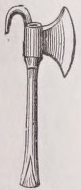
An ax fixed to a pole or handle; or rather a sort of hatchet with a handle about fifteen inches in length, and a point or claw bending downward from the back of its head. It is principally used in actions at sea, to cut away the rigging of the enemy attempting to board; sometimes it is thrust into the side of a ship to assist in mounting the enemy's ship, and it is sometimes called a boarding-ax.
1. A star which is vertical, or nearly so, to the pole of the earth; a lodestar. The northern pole-star is of great use to navigators in the northern hemisphere.
Anciently, a kind of battle-ax with a long handle; later, an ax or hatchet with a short handle, and a head variously patterned; -- used by soldiers, and also by sailors in boarding a vessel.
1. A small European carnivore of the Weasel family (Putorius foetidus). Its scent glands secrete a substance of an exceedingly disagreeable odor. Called also fitchet, foulmart, and European ferret.
2. The zorilla. The name is also applied to other allied species.
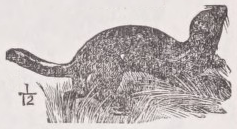
POLECAT. This name is applied to one of the English members of the large Family Mustelidae, which contains besides the Martens, Weasels, Otters, and Badgers (see Mammalia, vol. XV. p. 439, and the separate articles under these names).
In this family the Polecats, while belonging, with the stoats, weasels, and many others, to the nearly cosmopolitan genus Putorius, form by themselves a small group confined to the northern hemisphere, and consisting of four species, of which the best known and most widely distributed, is the common polecat of Europe {Putorius foetidus). This animal, at least so far as its disposition, size, and proportions are concerned, is well known in its domesticated condition as the ferret, which is but a tamedalbino variety of the true polecat. The colour of the latter, however, instead of the familiar yellowish white of the ferret is of a dark brown tint above, and black below, the face being variegated with dark brown and white markings. Its skull is rough, strongly ridged, and altogether of a far more powerful type than those of the stoats, weasels, or martens; the skull of the female is very much smaller and lighter than that of the male. Its fur is long, coarse, and of comparatively small value, and changes its colour very little, if at all, at the different seasons of the year....
The distribution and habits of the common polecat have been well described by Blasius in his Säugethiere Deutschlands, and the following is an abstract of his account. The polecat ranges over the greater part of Europe, reaching northwards into southern Sweden, and in Russia to the region of the White Sea. It does not occur in the extreme south, but is common everywhere throughout central Europe. In the Alps it ranges far above the tree-line during the summer, but retreats in winter to lower ground. In fine weather it lives either in the open air, in holes, fox-earths, rabbit-warrens, under rocks, or in woodstacks; while in winter it seeks the protection of deserted buildings, barns, or stables. During the day it sleeps in its hiding place, sallying forth at night to plunder dovecots and hen-houses. It climbs but little, and shows far less activity than the marten. It feeds ordinarily on small mammals, such as rabbits, hamsters, rats, and mice, on such birds as it can catch, especially poultry and pigeons, and also on snakes, lizards, frogs, fish, and eggs. Its prey is devoured only in its lair, but, even though it can carry away but a single victim, it commonly kills everything that comes in its way, often destroying all the inhabitants of a hen-house in order to gratify its passion for slaughter. The pairing time is towards the end of the winter, and the young, from three to eight in number, are born in April or May, after a period of gestation of about two months. The young, if taken early, may be easily trained, like ferrets, for rabbit-catching. The polecat is very tenacious of life and will bear many severe wounds before succumbing; it is also said to receive with impunity the bite of the adder. Its fetid smell has become proverbial. To this it is indebted for its generic name Putorius (derived, as are also the low Latin putacius, the French putois, and the Italian puzzola, from puteo), as well as the designation foumart (i.e. foul marten), and its other English names fitchet, fitchew. Attempts to account for the first syllable of the word polecat rest entirely on conjecture.
The other species of the polecat group are the following
The Siberian Polecat (Putorius eυersmanni), very like the European in size, colour, and proportions, but with head and back both nearly or quite white, and skull more heavily built and sharply constricted behind the orbits, at least in fully adult individuals. It inhabits the greater part of south-western Siberia, extending from Tibet into the steppes of south-eastern European Russia.
The Black-footed or American Polecat (Putorius nigripes), a native of the central plateau of the United States, and extending southwards into Texas. It is very closely allied to the last species, hut has nevertheless been made the type of a special sub-genus named Cynomyonax, or “King of the Prairie Marmots,” a name which expresses its habit of living in the burrows of, and feeding upon, the curious prairie marmots (Cynomys} of the United.States. An excellent account of this species may be found in Dr Elliott Coues’s Fur-bearing Animals of North America.
Lastly, the Mottled Polecat {Putorius sarmaticus), a rare and peculiar species occurring in southern Russia and south-western Asia, extending from eastern Poland to Afghanistan. It differs from the other polecats both by its smaller size and its remarkable coloration, the whole of its upper parts being marbled with large irregular reddish spots on a white ground, and its underside, limbs, and tail being deep shining black. Its habits, which seem to be very much those of the common polecat, have been studied in Kandahar by Captain Thomas Hutton, who has given a vivid description of them in the Journal of the Asiatic Society of Bengal for 1843.
9th ed. Encyclopædia Britannica, vol. 19, p. 331 [872 words — estimated reading time: 5 minutes]
Poled[Imperfect tense and past participle]Webster's Dictionary 1913
1. Anciently, a magistrate of Athens and Thebes, who had under his care all strangers and sojourners in the city, and all children of parents who had lost their lives in the service of their country.
In Athens, originally, the military commanderin-chief; but, afterward, a civil magistrate who had jurisdiction in respect of strangers and sojourners. In other Grecian cities, a high military and civil officer.
1. Controversial; disputative; intended to maintain an opinion or system in opposition to others; as a polemic treatise, discourse, essay or book; polemic divinity.
2. Engaged in supporting an opinion or system by controversy; as a polemic writer.
1. Of or pertaining to controversy; maintaining, or involving, controversy; controversial; disputative; as, a polemic discourse or essay; polemic theology.
2. Engaged in, or addicted to, polemics, or to controversy; disputations; as, a polemic writer.
The art or practice of disputation or controversy, especially on religious subjects; that branch of theological science which pertains to the history or conduct of ecclesiastical controversy.
An oblique perspective glass contrived for seeing objects that do not lie directly before the eye. It consists of a concave glass placed near a plane mirror in the end of a short round tube, and a convex glass in a hole in the side of the tube. It is called opera-glass, or diagonal opera-glass.
An opera glass or field glass with an oblique mirror arranged for seeing objects do not lie directly before the eye; -- called also diagonal, / side, opera glass.
V. be long, stretch out, sprawl, extend to, reach to, stretch to, make a long arm, "drag its slow length along." render long, lengthen, extend, elongate, stretch, prolong, produce, protract, let out, draw out, spin out|, drawl, enfilade, look along, view in perspective, distend (expand) 194
Adv.lengthwise, at length, longitudinally, endlong, along, tandem, in a line, in perspective, from end to end, from stem to stern, from head to foot, from the crown of the head to the sole of the foot, from top to toe, fore and aft
Adv. on high, high up, aloft, up, above, aloof, overhead, airwind, upstairs, abovestairs, in the clouds, on tiptoe, on stilts, on the shoulders of, over head and ears, breast high, over, upwards, from top to bottom
And two golden rings shalt thou make to it under the crown of it, by the two corners thereof, upon the two sides of it shalt thou make it; and they shall be for places for the staves to bear it withal.
And make two gold rings below the molding on opposite sides to hold the poles used to carry it.
And the incense altar, and his staves, and the anointing oil, and the sweet incense, and the hanging for the door at the entering in of the tabernacle,
the altar of incense with its poles; the anointing oil and fragrant incense; the curtain for the doorway at the entrance to the tabernacle;
And he made two rings of gold for it under the crown thereof, by the two corners of it, upon the two sides thereof, to be places for the staves to bear it withal.
He made two gold rings below the molding on opposite sides to hold the poles used to carry it.
And he made the staves of shittim wood, and overlaid them with gold.
And he made the poles of acacia wood and overlaid them with gold.
This site uses cookies to remember your display preferences (search sources and editions, Bible version, auto-link, images, light/dark theme). No personal data whatsoever is collected. Privacy Policy