
1. The leaves of the tea-tree as dried and imported. There are several kinds of tea as imperial tea hyson and young hyson, called green teas; souchong and bohea, called black teas, etc.
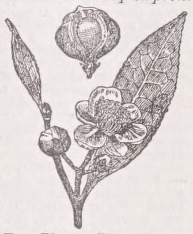
TEA. This important food auxiliary, now in daily use as a beverage by probably one-half of the population of the world, is prepared from the leaves of one or more plants belonging to the natural order TernstVomiaceee. The order includes the well-known ornamental genus of shrubs Camellia, to which indeed the tea-plants are so closely allied that by many systematic writers they are included in the same genus. The tea-plants have been cultivated in China for at least a thousand years....
As is commonly the case with plants which have been long under cultivation, there is much doubt as to specific distinctions among the varieties of tea. Under the name of Tlιea sinensis, Linnaeus originally described tea as a single species; but with fuller knowledge of the Chinese plants he established two species, Thea Bohea and Thea viridis, and it was assumed that the former was the source of black teas, while Thea viridis was held to yield the green varieties. In 1843, however, Mr Robert Fortune found that, although the two varieties of the plant exist in different parts of China, black and green tea are made indifferently from the leaves of the same plant. The teaplant is cultivated in China as an evergreen shrub, which grows to a height of from 3 to 5 feet. The stem is bushy, with numerous and very leafy branches; the leaves are alternate, large elliptical, obtusely serrated, veined, and placed on short channelled foot-stalks. The calyx is small, smooth, and divided into five obtuse sepals. The flowers are white, axillary, and slightly fragrant,—often two or three together on separate pedicels. The corolla has from five to nine petals, cohering at the base. The filaments are short, numerous, and inserted at the base of the corolla; the anthers are large and yellow, the style trifid, and the capsules three-celled and three-seeded.
The virûlis varieties are hardier, and possess larger and brighter green leaves than belong to the Bohea variety. No strictly wild tea-plants have been discovered in China, but an indigenous tea-tree (Thea assamica) is found in Assam, which botanists now incline to regard as the parent species of all cultivated varieties. It differs in many respects from the Chinese plants. The indigenous Assam tea-plant is a tree attaining a height of from 15 to 20 feet, growing in the midst of dense moist jungle and in shady sheltered situations. Its leaves vary considerably in size, form, and venation, being usually smooth, thick, and leathery, lanceolate, ovate lanceolate, or oblong lanceolate. They are variously dotted with pellucid cells containing essential oil, and the number of such cells shown by the leaf is held to be an indication of the quality of tea it will yield. The leaf of the Chinese plant never exceeds 4 inches in length, while that of the Assam tree reaches 9 inches and upwards. The Chinese plant is hardy, and capable of thriving under many different conditions of climate and situation; while the indigenous plant is tender and difficult of cultivation, requiring for its success a close, hot, moist, and equable climate. The characteristic venation of the leaf of the Chinese tea-plant is delineated in fig. 2. In minute structure the leaf presents highly characteristic appearances. The under side of the young leaf is densely covered with fine one-celled thick-walled hairs, about 1 mm. in length and , 015 mm. in thickness. These hairs entirely disappear with increasing age. The structure of the epidermis of the under side of the leaf, with its contorted cells, is represented ( × 160) in fig. 3. A further characteristic feature of the cellular structure of the tea-leaf is the abundance, especially in grown leaves, of large, branching, thickwalled, smooth cells (idioblasts), which, although they occur in other leaves, are not found in such as are likely to be confounded with or substituted for tea. The minute structure of the leaf in section is illustrated in fig. 4.
The cultivated varieties of tea, being comparatively hardy, possess an adaptability to climate excelled among food plants only by the wheat. The limits of actual tea cultivation extend from 39° N. lat. in Japan, through the tropics, to Java, Australia, Natal, and Brazil in the southern hemisphere. The tea-plant will even live in the open air in the south of England, and withstand some amount of frost, when it receives sufficient summer heat to harden its wood. But comparatively few regions are suited for practical tea-growing.
A rich and exuberant growth of the plants is a first essential of successful tea cultivation. This is only obtainable in warm, moist, and comparatively equable climates, where rains are frequent and copious. The climate indeed which favours tropical profusion of jungle growth—still steaming heat—is that most favourable for the cultivation of tea, and such climate, unfortunately, is most prejudicial to the health of Europeans. It was formerly supposed that comparatively temperate latitudes and steep sloping ground afforded the most favourable situations for teaplanting, and much of the disaster which attended the early stages of the tea enterprise in India is traceable to this erroneous conception. Tea thrives best in light friable soils of good depth, through which water percolates freely, the plant being specially impatient of marshy situations and stagnant water. Undulating well-watered tracts, where the rain escapes freely, yet without washing away the soil, are the most valuable for tea gardens. As a matter of fact, many of the Indian plantations are established on hill-sides, after the example of known districts in China, where hill slopes and odd corners are commonly occupied with tea-plants.
According to Chinese legend, the virtues of tea (cha, pronounced in the Amoy dialect te, whence the English name) were discovered by the mythical emperor Chin-nung, 2737 b.c., to whom all agricultural and medicinal knowledge is traced. It is doubtfully referred to in the book of ancient poems edited by Confucius, all of which are previous in date to 550 b.c. A tradition exists in China that a knowledge of tea travelled eastward to and in China, having been introduced 543 a.d. by Bodhidharma, an ascetic who came from India on a missionary expedition, but that legend is also mixed with mythical and supernatural details. But it is quite certain, from the historical narrative of Lo Yu, who lived in the Tang· dynasty (618— 906 A.D.), that tea was already used as a beverage in the 6th century, and that during the 8th century its use had become so common that a tax was levied on its consumption in the 14th year of Tih Tsung (793). The use of tea in China in the middle of the 9th century is known from Arab sources (Reinaud, Relation des Voyages, 1845, p. 40). From China a knowledge of tea was carried into Japan, and there the cultivation was established about the beginning of the 13th century. Seed was brought from China by the priest Miyoye, and planted first in the south island, Kiushiu, whence the cultivation spread northwards till it reached the high limit of 39° N. To the south tea cultivation also spread into Tong-king and Cochin China, but the product in these regions is of inferior quality. Till well into the 19th century it may be said that China and Japan were the only two tea-producing countries, and that the product reached the Western markets only through the narrowest channels and under most oppressive restrictions.
In the year 1826 the Dutch succeeded in establishing tea gardens in Java. At an early period the East India Company of Great Britain, as the principal trade intermediary between China and Europe, became deeply interested in the question of tea cultivation in their Eastern possessions. In 1788 Sir Joseph Banks, at the request of the directors, drew up a memoir on the cultivation of economic plants in Bengal, in which he gave special prominence to tea, pointing out the regions most favourable for its cultivation. About the year 1820 Mr David Scott, one of the Company’s servants, sent to Calcutta from the district of Kuch Behar and Rangpur—the very district indicated by Sir Joseph Banks as favourable for teagrowing—certain leaves, with a statement that they were said to belong to the wild tea-plant. The leaves were submitted to Dr Wallich, Government botanist at Calcutta, who pronounced them to belong to a species of Camellia, and no result followed on Mr Scott’s communication. These very leaves ultimately came into the herbarium of the Linnean Society of London, and have authoritatively been pronounced to belong to the indigenous Assam teaplant. Dr Wallich’s attribution of this and other specimens subsequently sent in to the genus Camellia, although scientifically defensible, unfortunately diverted attention from the significance of the discovery. It was not till 1834 that, overcome by the insistance of Captain Francis Jenkins, who maintained and proved that, called by the name Camellia or not, the leaves belonged to a tea-plant, Dr Wallich admitted “the fact of the genuine tea-plant being a native of our territories in Upper Assam as incontrovertibly proved.” In the meantime a committee had been formed by Lord William Bentinck, the governorgeneral, for the introduction of tea culture into India, and an official had already been sent to the tea districts of China to procure seed and skilled Chinese workmen to conduct operations in the Himalayan regions. The discovery and reports of Captain Jenkins led to the investigation of the capacities of Assam as a tea-growing country by Lord William Bentinck’s committee. Evidence of the abundant existence of the indigenous tea-tree was obtained; and the directors of the East India Company resolved to institute an experimental establishment in Assam for cultivating and manufacturing tea, leaving the industry to be developed by private enterprise should its practicability be demonstrated. In 1836 there was sent to London 1 lb of tea made from indigenous leaves; in 1837 5 lb of Assam tea was sent; in 1838 the quantity sent was twelve small boxes, and ninety-five boxes reached London in 1839. In January 1840 the Assam Company was formed, and thenceforward the cultivation of tea in India was carried on as a private commercial undertaking. The tea districts of India include, in the order of their priority, Assam, Dehra Dun, Kumaun, Darjiling, Cachar, Kangra, Hazaribagh, Chittagong, Tarai, and the Nilgiris (Madras).
Attempts were repeatedly made to introduce tea culture in Ceylon, under both Dutch and British authority. No permanent success was attained till about 1876, when the disastrous effects of the coffee-leaf disease induced planters to give serious attention to tea. Since that period the tea industry has developed in Ceylon with marvellous rapidity, and it has every prospect of taking the first rank among Singalese productions. Tea-planting has also been successfully established in Natal. But beyond the regions above enumerated the industry has never taken root. It has been tried in the West Indies, the Southern States of America, Brazil, Australia, and the south of Europe; but cheap labour is a sine qua non of success. Tea can be picked in China and the British East Indies for two or three pence a day of wages, and it is on such exceedingly moderate outlay that the margin of profit depends.
Tea is more or less cultivated for local consumption in all provinces of China except the extreme north, but the regions from which it is exported are embraced within the provinces in the south-east—Kwang-tung, Full-keen, Keang-se, Che-keang, Keang-su, and Gan-hwuy. Black-tea manufacture belongs to the more southerly portion of these regions, the green-tea country lying to the north. The methods employed in cultivating the plants and in making tea in China differ widely in various districts, and the teas retained for native use—especially the high-class fancy teas which are never seen abroad, and would probably not bear exportation—undergo special manipulation. The teas exported are of three principal classes—black tea, green tea, and brick tea.
In cultivation, the young plants are not ready for picking till they are three years old, by which time they should be well established, throwing out young shoots or “flushes” with vigour and profusion. It is these tender shoots, with leaf-buds and expanding leaves, which alone are gathered for tea manufacture, and the younger the leaf-bud the better is the quality of the tea. According to Chinese statements there are four gatherings of leaves in the year. The first is made early in April, when the young leaf-buds are just unfolding, and these, covered below with their fine silky hairs, are taken for making pekoe or young hyson. The second gathering takes place about the beginning of May, another in July, and the fourth in August and September. On each succeeding occasion the product is less fragrant and valuable, and the final gathering is said to consist of large leaves of little value. These statements do not, however, accord with Indian experience.
The following brief outline of the Chinese tea-making processes is given by Mr Ball {Cultivation and Manufacture of Tea) :—
“The leaves of black tea are exposed to the sun and air on circular trays and treated as hay, during which an incipient saccharine fermentation is supposed to take place in conjunction with a volatile oil. Various modifications of flavour are thus produced by the management of this fermentation; a loss of tannin takes place by the conversion of part of the tannic acid into sugar. During this change the leaves become flaccid, and slightly tinged or spotted with red or brown colouring matter, and give out a peculiar odour, approximating to, or, as some think, identical with, the odour of tea. A certain change in this odour is carefully watched by the workmen, this being an indication that the roasting must not be delayed. It is not necessary to wait till the leaves are spotted with red. They are then roasted in an iron vessel, and afterwards rolled with the hands, to express their juices. The roasting and rolling are repeated so long as any juices can be expressed from the leaves in the act of rolling. Finally, they are dried in sieves placed over a charcoal fire in drying tubes, during which the leaves are occasionally taken from the fire, and turned until completely dried. It is in this last stage of the process that the leaves turn black, though this change of colour is mainly due to the process of manipulation previously to roasting, and not to the action of heat.”
“The leaves of green tea are roasted also in an iron vessel, but as soon as gathered, without any previous manipulation, all heating or fermentation of the leaves being studiously avoided; they are then rolled as black tea, and finally dried in the same vessel in which they have been roasted, by constantly stirring and moving them about. They are also fanned to hasten evaporation, and the drying and formation of the peculiar characteristic colour of this tea, which it gradually acquires in this process, and which resembles the bloom on some fruits."
The colour of genuine green tea is entirely due to the rapid drying of the fresh leaves, which prevents the chlorophyll from undergoing any alteration. The green tea sent out of China is almost invariably faced or glazed with artificial colouring matter, principally with a powdered mixture of gypsum and Prussian blue.
The names distinguishing commercial qualities of tea are almost entirely of Chinese origin. In general they indicate a gradation of qualities from the fine and delicate product of the young leafbud up to the hard and woody expanded and partly-grown leaf. The following list represents the ordinary series of qualities, beginning with the finest :—
Black Tea. — Flowery pekoe, orange pekoe, pekoe, pekoe souchong, souchong, congou, bohea.
Green Tea. —Gunpowder, imperial, hyson, young hyson, hyson skin, caper.
Of these names, pekoe is derived from pak·ho (white hairs), the pekoes showing the fine downy tips of the young buds; souchong is from siaou-chung, little plant or sort; congou {kung-fu), labour; bohea {wu-i), the mountains in Fuh-keen, the centre of the black-tea country; and. hyson {yiι-tsien), before the rains, or tu-dιun, flourishing spring. Many other names occur in the trade denoting teas of special qualities or districts, such as oolong (black dragon) and twankay, from the district of that name in the province of Keang-su. Scented teas also form a special class of Chinese produce. In scenting the finished tea, either black or green is intimately intermixed with odoriferous flowers and left in a heap till the tea is fully impregnated with the odour, when the two substances are separated by sifting, and the tea so scented is immediately packed and excluded from the air.
Brick tea is the special form in which tea is prepared for use throughout the vast tracts of Central Asia. It is made principally from broken leaves, stalks, and fragments of large leaves, compressed into blocks of various sizes. The bricks are of various degrees of compression, some being lightly squeezed into a loose mass and sewed up in cowhide bags, while others form compact resonant cakes, in which all trace of the original leaf structure is lost, with gilt characters impressed in their surface. Brick tea is much in demand over an area greater than the whole of Europe, and by many tribes it is stewed with milk, salt, and butter or other fat and eaten as a vegetable. The Russian factors established in Hoo-pih prepare two sizes of brick tea, which they send off in great quantities through the Kalgan Gate of the Great Wall.
Under European supervision the cultivation and especially the manufacture of tea have in India undergone remarkable improvements. Indeed, the traditional and empirical teaching and processes of China proved a most serious stumblingblock to the progress of the tea industry under Western auspices. The tea-plants now cultivated in India are of three principal classes—the indigenous Assam, the Chinese, and a hybrid between the two. By much crossing and intermixture the gradations from one extreme to the other are almost imperceptible. The best qualities of black teas are made from indigenous and high-class hybrid plants, but these are comparatively tender and require a close humid climate. The hardiness of the Chinese plants is their most important character, for, favourably situated, the Assam plant gives a larger yield of delicate young leaf during the season than any other.
In favourable circumstances the tea-plant “flushes” or sends forth a fresh crop of tender young shoots from twenty to twenty-five times in the course of its growing and picking season of about nine months. The average annual yield per plant is very variable, but may be stated at about one-fifth of a lb of finished tea; and, as each acre of a garden holds 1500 to 1600 mature plants, the yield per acre may be from 300 to 350 lb per annum. The diagram (fig. 5) from Col. Money’s valuable practical treatise on the Culti∙ ration and Manufacture of Tea illustrates the method in which a flush or shoot is picked, aud the portions which go to make special classes of tea. The lines in the diagram show the points at uhιch the shoot may be picked, and it is important that the lowest leaf taken should be so nipped off as to leave the bud in its axil uninjured on the branch, as from it the next flush will then develop. The three leaves at the growing point («, b, c) yield pekoe, and the whole shoot down to and including f gives pekoe souchong. In the order of their age, the individual leaves manufacture into a flowery pekoe, b orange pekoe, c pekoe, d pekoe souchong, c souchong, and /congou. Were the flush further developed another leaf might be taken, which would be classed as bohea, but that is not a quality recognized by Indian growers. It is not, however, the practice to pick or treat leaves separately, the whole flush being manipulated together, and the tea is only separated into qualities by sifting after the manufacturing processes have been completed.
The manufacture of black tea is found to be an essentially simple matter. Many of the processes employed by the Chinese are quite superfluous, and several of the manual operations which bulk largely in the Chinese manufacture, it is found, can with advantage be supplanted by mechanical agency. The whole object of the black-tea manufacturer is to ferment, roll, and dry the leaf, and for that purpose the leaves undergo—(1) withering, (2) rolling, (3) fermenting, and (4) firing or dholing. Between the fermenting and the firing operations it is desirable to expose the leaves to the direct sunlight for an hour or thereby. This cannot always be done, as it is impossible to keep the fermented leaves after they have attained their proper state; nevertheless the best result is always attained in bright weather, when it is possible to expose the fermented leaves to the sun.
The fresh leaves from the garden, as they are brought in to the factory, are withered by being spread...