
25. --Marks and points out each man of us to slaughter.
26. [In this sense, for is now used.]
27. After an adjective, noting the object; as deaf to the cries of distress; alive to the sufferings of the poor. He was attentive to the company or to the discourse.
28. Noting obligation; as duty to God and to our parents.
29. Noting enmity; as a dislike to spiritus liquors.
30. Towards; as, she stretched her arms to heaven.
31. Noting effect or end. The prince was flattered to his ruin. He engaged in a war to this cost. Violent factions exist to the prejudice of the state.
32. Numbers were crowded to death.
33. to as a sign of the infinitive, precedes the radical verb. Sometimes it is used instead of the ancient form, for to noting purpose. David in his life time intended to build a temple. The legislature assembles annually to make and amend laws. The court will sit in February to try some important causes.
34. It precedes the radical verb after adjectives, noting the object; as ready to go; prompt to obey; quick to hear, but slow to censure.
35. It precedes the radical verb, noting the object.
36. The delay of our hopes teaches us to mortify our desires.
37. It precedes the radical verb, noting consequence.
38. I have done my utmost to lead my life so pleasantly as to forget my misfortunes.
39. It notes extent, degree or end. He languishes to death, even to death. The water rises to the highth of twenty feet. The line extends from one end to the other.
40. After the substantive verb, and with the radical verb, it denotes futurity. The construction, we are to meet at ten o'clock, every man at death is to receive the reward of his deeds, is a particular form of expressing future time.
43. To-day, to-night, to-morrow, are peculiar phrases derived from our ancestors. to in the two first, has the sense or force of this; this day, this night. In the last, it is equivalent to in or on; in or on the morrow. The words may be considered as compounds, to-day, to-night, to-morrow, and usually as adverbs. But sometimes they are used as nouns; as, to-day is ours.
44. TO and from, backward and forward. In this phrase, to is adverbial.
45. TO the face, in presence of; not in the absence of.
49. [Note.--In the foregoing explanation of to it is to be considered that the definition given is not always the sense of to by itself, but the sense rather of the word preceding it, or connected with it, or of to in connection with other words. In general, to is used in the sense of moving towards a place, or towards an object, or it expresses direction towards a place, end, object or purpose.]
50. TO is often used adverbially to modify the sense of verbs; as, to come to; to heave to The sense of such phrases is explained under the verbs respectively.
51. In popular phrases like the following, 'I will not come; you shall to or too, a genuine Saxon phrase, to denotes moreover, besides, Latin insuper.
1. The preposition to primarily indicates approach and arrival, motion made in the direction of a place or thing and attaining it, access; and also, motion or tendency without arrival; movement toward; -- opposed to from.
2. Hence, it indicates motion, course, or tendency toward a time, a state or condition, an aim, or anything capable of being regarded as a limit to a tendency, movement, or action; as, he is going to a trade; he is rising to wealth and honor.
3. In a very general way, and with innumerable varieties of application, to connects transitive verbs with their remoter or indirect object, and adjectives, nouns, and neuter or passive verbs with a following noun which limits their action. Its sphere verges upon that of for, but it contains less the idea of design or appropriation; as, these remarks were addressed to a large audience; let us keep this seat to ourselves; a substance sweet to the taste; an event painful to the mind; duty to God and to our parents; a dislike to spirituous liquor.
4. As sign of the infinitive, to had originally the use of last defined, governing the infinitive as a verbal noun, and connecting it as indirect object with a preceding verb or adjective; thus, ready to go, i.e., ready unto going; good to eat, i.e., good for eating; I do my utmost to lead my life pleasantly. But it has come to be the almost constant prefix to the infinitive, even in situations where it has no prepositional meaning, as where the infinitive is direct object or subject; thus, I love to learn, i.e., I love learning; to die for one's country is noble, i.e., the dying for one's country. Where the infinitive denotes the design or purpose, good usage formerly allowed the prefixing of for to the to; as, what went ye out for see? (Matt. xi. 8).
5. In many phrases, and in connection with many other words, to has a pregnant meaning, or is used elliptically.
6. Extent; limit; degree of comprehension; inclusion as far as; as, they met us to the number of three hundred.
7. Effect; end; consequence; as, the prince was flattered to his ruin; he engaged in a war to his cost; violent factions exist to the prejudice of the state.
8. Apposition; connection; antithesis; opposition; as, they engaged hand to hand.
9. Accord; adaptation; as, an occupation to his taste; she has a husband to her mind.
10. Comparison; as, three is to nine as nine is to twenty-seven; it is ten to one that you will offend him.
An obsolete intensive prefix used in the formation of compound verbs; as in to-beat, to-break, to-hew, to-rend, to-tear. See these words in the Vocabulary. See the Note on All to, or All-to, under All, adv.
A paddoc, an animal of the genus Rana, the RanaBufo of Linne; a small clumsy animal, the body warty, thick and disgusting to the sight, but perfectly harmless, and indeed it is said to be useful in gardens by feeding on noxious worms.
Any one of numerous species of batrachians belonging to the genus Bufo and allied genera, especially those of the family Bufonidae. Toads are generally terrestrial in their habits except during the breeding season, when they seek the water. Most of the species burrow beneath the earth in the daytime and come forth to feed on insects at night. Most toads have a rough, warty skin in which are glands that secrete an acrid fluid.
TOAD. This animal belongs to the Anurous division of the Amphibia, and toads and frogs are the only representatives of the Anura or Batrachia indigenous to Britain. To an ordinary observer the toad is proved to be an amphibian by its moist soft skin, an anuran or tailless amphibian by the want of a separate tail. The toad differs from the frog in the following points :—It has no teeth on either of its jaws or on the roof of its mouth, while the frog has a series of fine teeth on the upper jaw and also teeth on the palate; the tongue in both animals is attached in front and free behind, but that of the frog is forked at its free extremity, that of the toad is not; the skin of the toad is rough with large protuberant warts, while that of the frog is smooth; the body of the toad is more globular and puffy than that of the frog; the hind legs in the toad are shorter, and the posterior digits not so completely webbed, the animal being more terrestrial in its habits than the frog. In the toad, as in the frog, there are four digits anteriorly, five posteriorly. The warts of the toad’s skin contain large cutaneous glands, which secrete a thick yellowish fluid with acrid properties, capable of irritating and producing slight inflammation on the human skin. The use of this secretion is probably to protect the toad from being devoured by carnivorous animals. Like other Amphibia, it has a large membranous bladder communicating with the terminal part of the intestine—the allantoic bladder,—in which fluid accumulates, probably from the kidneys, though the ureters do not open directly into the bladder. The toad, when handled or alarmed in any way, ejects the contents of its bladder. Owing to these peculiarities and its appearance, the animal is commonly regarded with loathing, ...and credited with far more poisonous properties than it possesses. In its breeding habits the toad resembles the frog: its eggs are fertilized externally at the moment of extrusion, as in the frog, the parents resorting to the water for the purpose of reproduction. The ova are laid in spring, and are arranged, not in shapeless masses, but in a string containing a double series of eggs adhering by their gelatinous envelopes; the string extends to a length of three or four feet. The tadpoles are similar to those of the frog, but blacker; their metamorphosis takes place in the same manner, the three pairs of external gills being first absorbed and replaced for a time by internal gills, which are in their turn lost, the branchial slits being closed by the coalescence of the opercular membrane with the skin. The metamorphosis is complete in autumn. The toad is carnivorous, feeding on flies and other insects and worms. It hibernates in winter, passing its period of torpidity in holes or burrows in the earth. The finding of toads in a state of hibernation has given rise to stories of their being found in the centre of trunks of trees or imbedded in solid rock. The myth of the jewel in the head (Shakespeare) is probably founded on the brightness of the eyes, in which the iris is flame-coloured.
There are two kinds of toad in Britain,—the Common Toad, which is almost black in colour, and the Natterjack Toad, which is lighter, smaller, and has a bright yellow line along the middle of the back. The length of the common toad is 3∣ inches, of the natter-jack 2f inches. The male natterjack possesses a bladder or vocalsack beneath the throat communicating with the mouth, which acts as a resonator to its voice; its cry is “gluck-gluck.” The vocalsack is absent in the common toad, and only incompletely developed in the Green Toad of the Continent.
In zoological classification the toad belongs to the genus Bufo, first constituted by Laurenti in the Synopsis Reptilium, of which the following diagnosis is given in the Brit. Mus. Ccd. Batr. Sal., 1882:—
Bufo vulgaris, Laurenti, the Common Toad, is thus distinguished. Crown without bony ridges. First finger as long as or longer than the second. Parotids distinct. Tympanum smaller than the eye. Toes half webbed; no tarsal fold; subarticular tubercles of toes double. The species is widely distributed, occurring throughout Europe, Asia, and north-west Africa.
Bufo calamita, Laurenti, the Natter-jack Toad, shows the following differences from B. vulgaris :—toes not half webbed; tympanum rather indistinct; a tarsal fold. It is distributed throughout Europe.
According to Boulenger there are 77 species of Bufo known, of which 35 are confined to the Old World, the rest to the American continent. No species is common to the two great continents. The only other species occurring in Europe besides the two which are found in Britain is Bufo viridis, Laurenti, which ranges throughout Europe, Asia, and North Africa.
9th ed. Encyclopædia Britannica, vol. 23, p. 422 [903 words — estimated reading time: 6 minutes]
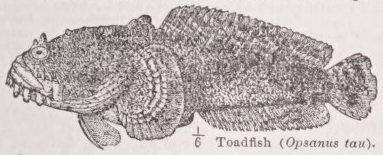
1. Any marine fish of the genus Batrachus, having a large, thick head and a wide mouth, and bearing some resemblance to a toad. The American species (Batrachustau) is very common in shallow water. Called also oyster fish, and sapo.
V. be the cause of, originate, give origin to, give rise, to, give occasion to, cause, occasion, sow the seeds of, kindle, suscitate, bring on, bring to bring pass, bring about, produce, create, set up, set afloat, set on foot, found, broach, institute, lay the foundation of, lie at the root of, procure, induce, draw down, open the door to, superinduce, evoke, entail, operate, elicit, provoke, conduce to, contribute, have a hand in the pie, have a finger in the pie, determine, decide, turn the scale, have a common origin, derive its origin
N. direction, bearing, course, vector, set, drift, tenor, tendency, incidence, bending, trending, dip, tack, aim, collimation, steering steerage, point of the compass, cardinal points, north east, south, west, n by e, ene, ne by n, ne, &c, rhumb, azimuth, line of collimation, line, path, road, range, quarter, line of march, alignment, allignment, air line, beeline, straight shoot
V. tend towards, bend towards, point towards, conduct to, go to, point to, point at, bend, trend, verge, incline, dip, determine, steer for, steer towards, make for, make towards, aim at, level at, take aim, keep a course, hold a course, be bound for, bend one's steps towards, direct one's course, steer one's course, bend one's course, shape one's course, align one's march, allign one's march, to straight, go straight to the point, march on, march on a point, ascertain one's direction, s'orienter, see which way the wind blows, box the compass, take the air line
Adj. directed, directed towards, pointing towards, bound for, aligned, with alligned with, direct, straight, undeviating, unswerving, straightforward, north, northern, northerly, &c. n
Adv. towards, on the road, on the high road to, en avant, versus, to, hither, thither, whither, directly, straight as an arrow, forwards as an arrow, point blank, in a bee line to, in a direct line to, as the crow flies, in a straight line to, in a bee line for, in a direct line for, in a straight line for, in a bee line with, in a direct line with, in a straight line with, in a line with, full tilt at, as the crow flies, before the wind, near the wind, close to the wind, against the wind, windwards, in the wind's eye, through, via, by way of, in all directions, in all manner of ways, quaquaversum, from the four winds
Phr. the shortest distance between two points is a straight line
V. induce, move, draw, draw on, bring in its train, give an impulse, to, inspire, put up to, prompt, call up, attract, beckon, stimulate, spirit up, inspirit, rouse, arouse, animate, incite, foment, provoke, instigate, set on, actuate, act upon, work upon, operate upon, encourage, pat on the back, pat on the shoulder, clap on the back, clap on the shoulder, influence, weigh with, bias, sway, incline, dispose, predispose, turn the scale, inoculate, lead by the nose, have influence with, have influence over, have influence upon, exercise influence with, exercise influence over, exercise influence upon, go round, come round one, turn the head, magnetize, lobby, persuade, prevail with, prevail upon, overcome, carry, bring round to one's senses, bring to one's senses, draw over, win over, gain over, come over, talk over, procure, enlist, engage, invite, court, tempt, seduce, overpersuade, entice, allure, captivate, fascinate, bewitch, carry away, charm, conciliate, wheedle, coax, lure, inveigle, tantalize, cajole, tamper with, bribe, suborn, grease the palm, bait with a silver hook, gild the pill, make things pleasant, put a sop into the pan, throw a sop to, bait the hook, enforce, force, impel, propel, whip, lash, goad, spur, prick, urge, egg on, hound, hurry on, drag, exhort, advise, call upon &c. press, advocate, set an example, set the fashion, keep in countenance, be persuaded &c, yield to temptation, come round, concede, obey a call, follow advice, follow the bent, follow the dictates of, act on principle
Adv. because, therefore, from this motive, from that motive, for this reason, for that reason, for, by reason of, for the sake of, count of, out of, from, as, forasmuch as, for all the world, on principle
Phr. fax mentis incendium gloriae, "temptation hath a music for all ears" "to beguile many and be beguiled by one"
V. effect, effectuate, accomplish, achieve, compass, consummate, hammer out, bring to maturity, bring to perfection, perfect, complete, elaborate, do, execute, make, go through, get through, work out, enact, bring about, bring to bear, bring to pass, bring through, bring to a head, despatch, dispatch, knock off, finish off, polish off, make short work of, dispose of, set at rest, perform, discharge, fulfill, realize, put in practice, put in force, carry out, carry into effect, carry into execution, make good, be as good as one's word, do thoroughly, not do by halves, go the whole hog, drive home, be in at the death, carry through, play out, exhaust, fill the bill, finish, bring to a close, wind up, stamp, clinch, seal, set the seal on, put the seal, give the final touch, to, put the last, put the finishing hand to, put the finishing touches on, crown, crown all, cap, ripen, culminate, come to a head, come to a crisis, come to its end, die a natural death, die of old age, run its course, run one's race, touch the goal, reach the goal, attain the goal, reach, get in the harvest
Phr. the race is run, actum est, finis coronat opus, consummatum est, c'en est fait, it is all over, the game is played out, the bubble has burst, aussitot dit aussitot fait, aut non tentaris aut perfice
N. prosperity, welfare, well-being, affluence, success, thrift, roaring trade, good fortune, smiles of fortune, blessings, godsend, luck, good luck, run of luck, sunshine, fair weather, fair wind, palmy days, bright days, halcyon days, piping times, tide, flood, high tide, saturnia regna, saturnian age, golden time, golden age, bed of roses, fat city, fat of the land, milk and honey, loaves and fishes, made man, lucky dog, enfant gate, spoiled child of fortune, upstart, parvenu, skipjack, mushroom
V.prosper, thrive, flourish, be prosperous, drive a roaring trade, do a booming business, go on well, go on smoothly, go on swimmingly, sail before the wind, swim with the tide, run smooth, run smoothly, run on all fours, rise in the world, get on in the world, work one's way, make one's way, look up, lift one's head, raise one's head, make one's fortune, feather one's nest, make one's pile, flower, blow, blossom, bloom, fructify, bear fruit, fatten, keep oneself afloat, keep one's head above water, hold one's head above water, land on one's feet, light on one's feet, light on one's legs, fall on one's legs, fall on one's feet, drop into a good thing, bear a charmed life, bask in the sunshine, have a good time of it, have a fine time of it, have a run of luck, have the good fortune, to, take a favorable turn, live on the fat of the land, live off the fat of the land, live in clover
Adj. prosperous, thriving, in a fair way, buoyant, well off, well to do, well to do in the world, set up, at one's ease, rich, in good case, in full, in high feather, fortunate, lucky, in luck, born with a silver spoon in one's mouth, born under a lucky star, on the sunny side of the hedge, auspicious, propitious, providential, palmy, halcyon, agreeable, couleur de rose
Adv. prosperously, swimmingly, as good luck would have it, beyond all hope
Phr. one's star in the ascendant, all for the best, one's course runs smooth, chacun est l'artisan de sa fortune, donec eris felix multos numerabis amicos, felicitas multos habet amicos, felix se nescit amari, 'good luck go with thee', nulli est homini perpetuum bonum
V. be free, have scope, have the run of, have one's own way, have a will of one's own, have one's fling, do what one likes, do what one wishes, do what one pleases, do what one chooses, go at large, feel at home, paddle one's own canoe, stand on one's legs, stand on one's rights, shift for oneself, take a liberty, make free with, make oneself quite at home, use a freedom, take leave, take french leave, set free, give a loose to, allow scope, to, give scope, to, give a horse his head, make free of, give the freedom of, give the franchise, enfranchise, affranchise, laisser faire, laisser aller, live and let live, leave to oneself, leave alone, let alone
V. be inglorious, incur disgrace, have a bad name, earn a bad name, put a halter round one's neck, wear a halter round one's neck, disgrace oneself, expose oneself, play second fiddle, lose caste, pale one's ineffectual fire, recede into the shade, fall from one's high estate, keep in the background, be conscious of disgrace, look blue, look foolish, look like a fool, cut a poor figure, cut a sorry figure, laugh on the wrong side of the mouth, make a sorry face, go away with a flea in, one's ear, slink away, cause shame, shame, disgrace, put to shame, dishonor, throw dishonor upon, cast dishonor upon, fling dishonor upon, reflect dishonor upon, be a reproach, to, derogate from, tarnish, stain, blot sully, taint, discredit, degrade, debase, defile, beggar, expel, impute shame to, brand, post, stigmatize, vilify, defame, slur, cast a slur upon, hold up to shame, send to coventry, tread under foot, trample under foot, show up, drag through the mire, heap dirt upon, reprehend, bring low, put down, snub, take down a peg, take down a peg lower, take down a peg or two, obscure, eclipse, outshine, take the shine out of, throw into the shade, cast into the shade, overshadow, leave in the background, put in the background, push into a corner, put one's nose out of joint, put out, put out of countenance, upset, throw off one's center, discompose, disconcert, put to the blush
Adj. disgraced, blown upon, "shorn of its beams", shorn of one's glory, overcome, downtrodden, loaded with shame, in bad repute, out of repute, out of favor, out of fashion, out of countenance, at a discount, under a cloud, under an eclipse, unable to show one's face, in the shade, in the background, out at elbows, down at the elbows, down in the world, inglorious, nameless, renownless, obscure, unknown to fame, unnoticed, unnoted, unhonored, unglorified, shameful, disgraceful, discreditable, disreputable, despicable, questionable, unbecoming, unworthy, derogatory, degrading, humiliating, infra dignitatem, dedecorous, scandalous, infamous, too bad, unmentionable, ribald, opprobrious, errant, shocking, outrageous, notorious, ignominious, scrubby, dirty, abject, vile, beggarly, pitiful, low, mean, shabby base
Adv. to one's shame be it spoken
Int.fie, shame, for shame, proh pudor, o tempora, o mores, ough, sic transit gloria mundi
V. be due, to, be the due, of, have right to, have title to, have claim to, be entitled to, have a claim upon, belong to, deserve, merit, be worthy of, richly deserve, demand, claim, call upon for, come upon for, appeal to for, revendicate, reclaim, exact, insist on, insist upon, challenge, take one's stand, make a point of, require, lay claim to, assert, assume, arrogate, make good, substantiate, vindicate a claim, vindicate a right, fit for, qualify for, make out a case, give a right, confer a right, entitle, authorize, sanctify, legalize, ordain, prescribe, allot, give every one his due, pay one's dues, have one's due, have one's rights, use a right, assert, enforce, put in force, lay under contribution
Adj. having a right to, entitled to, claiming, deserving, meriting, worthy of, privileged, allowed, sanctioned, warranted, authorized, ordained, prescribed, constitutional, chartered, enfranchised, prescriptive, presumptive, absolute, indefeasible, unalienable, inalienable, imprescriptible, inviolable, unimpeachable, unchallenged, sacrosanct, due to, merited, deserved, condign, richly deserved, allowable, lawful, licit, legitimate, legal, legalized, square, unexceptionable, right, equitable, due, en r gle, fit, fitting, correct, proper, meet, befitting, becoming, seemly, decorous, creditable, up to the mark, right as a trivet, just the thing, quite the thing, selon les r gles
Adv.duly, ex officio, de jure, by right, by divine right, jure divino, dei gratia, in the name of
V. respect, regard, revere, reverence, hold in reverence, honor, venerate, hallow, esteem, think much of, entertain respect for, bear respect for, look up to, defer to, have a high opinion of, hold a high opinion of, pay attention, pay respect, to, do honor to, render honor to, do the honors, hail, show courtesy, salute, present arms, do homage to, pay homage to, pay tribute to, kneel to, bow to, bend the knee to, fall down before, prostrate oneself, kiss the hem of one's garment, worship, keep one's distance, make room, observe due decorum, stand upon ceremony, command respect, inspire respect, awe, inspire awe, impose, overawe, dazzle
Adv. in deference to, with all respect, with all due respect, with due respect, with the highest respect, with submission, saving your grace, saving your presence, salva sit reverentia, pace tanti nominis
Int.hail, all hail, esto perpetua, may your shadow never be less, phr, "and pluck up drowned honor by the locks", "his honor rooted in dishonor stood", "honor pricks me on"
Type at least 3 letters to search the Bible, or a reference such as John 3:16.
This site uses cookies to remember your display preferences (search sources and editions, Bible version, auto-link, images, light/dark theme). No personal data whatsoever is collected. Privacy Policy