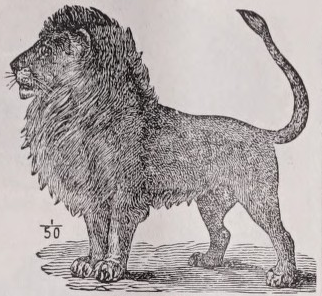
LION. From the earliest historic times few animals have been better known to man than the lion. Its geographical habitat made it familiar to all the races among whom human civilization took its origin, and its strongly marked physical and moral characteristics have rendered it proverbial, perhaps to an exaggerated degree, and have in all ages afforded favourite types for poetry, art, and heraldry.
The literature of the ancient Hebrews abounds in allusions to the lion; and the almost incredible numbers that are stated to have been provided for exhibition and destruction in the Roman amphitheatres (as many as six hundred on a single occasion by Pompey, for example) show how abundant these animals must have been within accessible distance of the capital of the world....
The geographical range of the lion was once far more extensive than at present, even within the historic period covering the whole of Africa, the south of Asia, including Syria, Arabia, Asia Minor, Persia, and the greater part of northern and central Hindustan, and also the south-eastern portion of Europe, as shown by the well-known story told by Herodotus of the attacks by lions on the camels which carried the baggage of the army of Xerxes on its march through the country of the Paeonians in Macedonia. The very circumstantial account of Herodotus shows that the animal at that time ranged through the country south of the Balkans, through Roumania to the west of the river Carasu, and through Thessaly as far south as the Gulf of Lepanto and the Isthmus of Corinth, having as its western boundary the river Potamo and the Pindus mountains. The whole of the evidence relating to the existence of lions in Europe, and to their retreat from that continent shortly before the commencement of the Christian era, has been collected in the article on “Felis spelaea” in Boyd Dawkins and Sanford’s British Pleistocene Mammalia, 1868. Fossil remains attest a still wider range, as it is shown in the same work that there is absolutely no osteological or dental character by which the well-known cave lion (Felis spelaea of Goldfuss), so abundantly found in cave deposits of the Pleistocene age, can be distinguished from the existing Felis leo. There are also remains found in North America of an animal named Felis atrox by Leidy, which the palaeontologists just quoted attribute to the common lion; but, as they are very fragmentary, and as the specific characters by which most of the Felidae are distinguished are more dependent on external than on anatomical conformation, this determination cannot be so absolutely relied upon.
At the present day the lion is found in localities suitable to its habits, and where not exterminated (as it probably was in Europe) by the encroachments of man, throughout Africa from Algeria to the Cape Colony, and in Mesopotamia, Persia, and some parts of the north-west of India. According to Blanford, lions are still very numerous in the reedy swamps bordering the Tigris and Euphrates, and also occur on the west flanks of the Zagros mountains and the oak-clad ranges near Shiraz, to which they are attracted by the immense herds of swine which feed on the acorns. The lion nowhere exists in the table-land of Persia, nor is it found in Bahïchistân. In India it appears now to be confined to the province of Kathiawar in Gujerat, though within the present century its range extended through the north-west parts of Hindustan, from Bahâwaipur and Sind to at least the Jumna (about Delhi), southward as far as Khândesh, and in Central India through the Sagur and Nerbudda territories, Bundelkund, and as far east as Palamau. It was extirpated in Hariâna about 1824. One was killed at Rhyli, in the Dumaoh district, Sagur and Nerbudda territories, so late as in the cold season of 1847-48; and about the same time a few still remained in the valley of the Sind river in Kotah, Central India (Blyth).
The great variations in external characters which different lions present, especially in the colour and the amount of mane, has given rise to the idea that there are several species, or at all events distinct varieties peculiar to different localities. It was at one time supposed, on the authority of Captain Walter Smee, that the lion of Gujerat differed essentially from that of Africa in the absence of mane, but subsequent evidence has not supported this view, which was probably founded upon young specimens having been mistaken for adults. Lions from that district as well as from Babylonia, which have lived in the gardens of the London Zoological Society, have had as fully developed manes as any other of the species. Mr F. C. Selous has shown that in South Africa the so-called black-maned lion and others with yellow scanty manes are found, not only in the same locality, but even among individuals of the same parentage.
The lion belongs to the very natural and distinctly defined group constituting the genus Felis of Linnaeus (for the characters and position of which see article Mammalia), a genus held by Pallas and other philosophical naturalists as a model of what a genus ought to be, although recent writers have divided and subdivided it into as many as thirteen sections, on each of which a new generic term has been imposed. Among these sections is one containing the largest members of the group, and differing from the others in the well-marked anatomical character that the anterior cornu of the hyoid arch is but little ossified, and by the less important one that the pupil of the eye when contracted is a circular hole, instead of a vertical slit as in the cat. The lion agrees with the tiger and the leopard in these respects, but differs from them in its uniform style of colouring, and from all the other Felidae in the arrangement of its hairy covering, the hair of the top of the head, chin, and neck, as far back as the shoulder, being not only very much longer, but also differently disposed from the hair elsewhere, being erect or directed forwards, and so constituting the characteristic ornament called the mane. There is also a tuft of elongated hairs at the end of the tail, one upon each elbow, and in most lions a copious fringe along the middle line of the under surface of the body, wanting, however, in some examples. It must, however, be observed that these characters are peculiar to the adults of the male sex only, and that, even as regards their coloration, young lions show indications of the darker stripes and mottlings so characteristic of the greater number of the members of the genus; just as the young of nearly all the plain-coloured species of deer show for a time the lightcoloured spots which are met with in the adults of only some of the species. The usual colour of the adult lion is yellowish-brown, but it may vary from a deep red or chestnut brown to an almost silvery grey. The mane, as well as the long hair of the other parts of the body, sometimes scarcely differs from the general colour, but it is usually darker and not unfrequently nearly black. The mane begins to grow when the animal is about three years old, and is fully developed at five or six.
In size the lion is only equalled or exceeded by the tiger among the existing Felidae ; though both species present great variations, the largest specimens of the latter appear to surpass the largest lions. A full-sized South African lion, according to Selous, measures slightly less than 10 feet from nose to tip of tail, following the curves of the body. Harris gives 10 feet 6 inches, of which the tail occupies 3 feet. The lioness is about a foot less.
The internal structure of the lion, except in slight details, resembles that of the other Felidae, the whole organization being that of an animal modified to fulfil, in the most perfect degree yet attained, an active, predaceous mode of existence. The teeth especially exemplify the carnivorous type in its highest condition of development. The most important function they have to perform, that of seizing and holding firmly animals of considerable size and strength, violently struggling for life, is provided for by the great, sharp-pointed, and sharp-edged canines, placed wide apart at the angles of the mouth, the incisors between them being greatly reduced in size and kept back nearly to the same level, so as not to interfere with their action. The jaws are short and strong, and the width of the zygomatic arches, and great development of the bony ridges on the skull, give ample space for the attachment of the powerful muscles by which they are closed. In the molar series of teeth the sectorial or scissor-like cutting function is developed at the expense of the tubercular or grinding, there being only one rudimentary tooth of the latter form in the upper jaw, and none in the lower. They are, however, sufficiently strong to break bones of large size. The dental formula is expressed as follows :—incisors ⅞, canines ⅛, premolars ⅜, molars ⅜ = ⅜; total, 30. The tongue is long and flat, and remarkable for the development of the papillae of the anterior part of the dorsal surface, which (except near the edge) are modified so as to resemble long, compressed, recurved, horny spines or claws, which, near the middle line, attain the length of one-fifth of an inch. They give the part of the tongue on which they occur the appearance and feel of a coarse rasp, and serve the purpose of such an instrument in cleaning the flesh from the bones of the animals on which the lion feeds. The vertebral column is composed of seven cervical, thirteen dorsal, seven lumbar, three sacral, and about twenty-six caudal vertebrae. The clavicles are about 3 inches in length, embedded loosely in the muscles, and not directly connected either with the sternum or the scapula. The limbs are digitigrade, the animal resting upon round soft pads or cushions covered with thick, naked, skin, one on the under surface of each of the principal toes, and one larger one of trilobed form, behind these, under the lower ends of the metacarpal and metatarsal bones, which are placed nearly vertically in ordinary progression. The fore feet have five toes, of which the third and fourth are nearly equal and longest, the second being slightly and the fifth considerably shorter. The first or pollex (corresponding to the human thumb) is much shorter than the others, and does not reach to the ground in walking. The hind feet have only four toes, the third and fourth being the longest, the second and fifth somewhat shorter and nearly equal. The first or hallux (or great toe) is represented only by a rudimentary metatarsal bone. The claws are all very large, strongly compressed, very sharp, and exhibit the retractile condition in the highest degree, being drawn backwards and upwards into a cutaneous sheath by the action of an elastic ligament so long as the foot is in a state of repose, but exserted by muscular action when the animal strikes its prey. By this remarkable piece of animal mechanism their edges and points are always kept sharp and unworn.
The habits of the lion in a state of nature are fairly well known from the united observations of numerous travellers and sportsmen who have explored those districts of the African continent in which it is still common. It lives chiefly in sandy plains and rocky places interspersed with dense thorn-thickets, or frequents the low bushes and tall rank grass and reeds that grow along the sides of streams and near the springs where it .dies in wait for the larger herbivorous animals on which it feeds. Although it is occasionally seen abroad during the day, especially in wild and desolate regions, where it is subject to but little molestation, the night is, as in the case of so many other predaceous animals, the period of its greatest activity. It is then that its characteristic roar is chiefly heard, as thus graphically described by Gordon Cumming :—
“One of the most striking things connected with the lion is his voice, which is extremely grand and peculiarly striking. It consists at times of a low deep moaning, repeated five or six times, ending in faintly audible sighs; at other times he startles the forest with loud, deep-toned, solemn roars, repeated in quick succession, each increasing in loudness to the third or fourth, when his voice dies away in five or six low muffled sounds very much resembling distant thunder. At times, and not unfrequently, a troop may be heard, roaring in concert, one assuming the lead, and two, tlιree, or four more regularly taking up their parts, like persons singing a catch. Like our Scottish stags at the rutting season, they roar loudest in cold frosty nights; but on no occasions are their voices to be heard in such perfection, or so intensely powerful, as when two or three troops of strange lions approach a fountain to drink at the same time. When this occurs, every member· of each troop sounds a bold roar of defiance at the. opposite parties; and when one roars, all roar together, and each seems to vie with his comrades in the intensity and power of his voice. The power and grandeur of these nocturnal concerts is inconceivably striking and pleasing to the hunter’s ear.”
“The usual pace of a lion,” C. J. Andersson says, “is a walk, and, though apparently rather slow, yet, from the great length of his body, he is able to get over a good deal of ground in a short time. Occasionally he trots, when his speed is not inconsiderable. His gallop—or rather succession of bounds—is, for a short distance, very fast,— nearly or quite equal to that of a horse. Indeed, unless the steed has somewhat the start when the beast charges, it will be puzzled to escape. Many instances are on record of horsemen who have incautiously approached too near to the lion, prior to firing, who have been pulled down by him before they could get out of harm’s way. Happily, however, the beast soon tires of the exertion of galloping, and unless his first rush succeeds he, for the most part, soon halts and beats a retreat.” “The lion, as with other members of the feline family,” the same writer tells us, “seldom attacks his prey openly, unless compelled by extreme hunger. For the most part he steals upon it in the manner of a cat, or ambushes himself near to the water, or a pathway frequented by game. At such times he lies crouched upon his belly in a thicket until the animal approaches sufficiently near, when, with one prodigious bound, he pounces upon it. In most cases he is successful, but should his intended victim escape, as at times happens, from his having miscalculated ’the distance, he may make a second or even a third bound, which, however, usually prove fruitless, or he returns disconcerted to his hidingplace, there to wait for another opportunity.” His food consists of all the larger herbivorous animals of the country in which he resides,—buffaloes, various kinds of antelopes, zebras, giraffes, or even young elephants or rhinoceroses, though the adults of these latter he dare not attack. In cultivated districts the cattle, sheep, and even human inhabitants are never safe from his nocturnal ravages. He appears, however, as a general rule, only to kill when hungry or attacked, and not for the mere pleasure of killing, as with some other carnivorous animals. He, moreover, by no means limits himself to animals of his own killing, but, according to Selous, often prefers eating game that has been killed by man, even when not very fresh, to taking the trouble to catch an animal himself. All books of African travel and sport abound with stories, many of which are apparently well authenticated, of the lion’s prodigious strength, as exemplified by his being able to drag off a whole ox in his mouth to a long distance, even leaping fences and dykes withit.
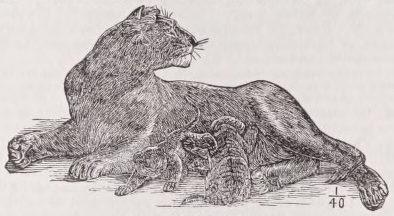
The lion appears to be monogamous, a single male and female continuing attached to each other irrespectively of the pairing season. At all events the lion remains with the lioness while the cubs are young and helpless, and assists in providing her and them with food, and in educating them in the art of providing for themselves. The number of cubs at a birth is from two to four, usually three. They are said to remain with their parents till they are about three years old. The following account by an eyewitness gives a good idea of lion family life:—
“I once had the pleasure of, unobserved myself, watching a lion family feeding. I was encamped on the Black Umfolosi in Zululand, and towards evening, walking out, about half a mile from camp, I saw a herd of zebra galloping across me, and when they were nearly 200 yards off, I saw a yellow body flash towards the leader, and saw him fall beneath the lion’s weight. There was a tall tree about 60 yards from the place, and anxious to see what went on, I stalked up to it, while the lion was still too much occupied to look about him, and climbed up. He had by this time quite killed the beautifully striped animal, but instead of proceeding to eat it, he got up and roared vigorously, until there was an answer, and in a few minutes a lioness, accompanied by four whelps, came trotting up from the same direction as the zebra, which no doubt she had been to drive towards her husband. They formed a fine picture, as they all stood round the carcase, the whelps tearin" it and biting it, but unable to get through the tough skin. Then the lion lay down, and the lioness driving her offspring before her did the same 4 or 5 yards off, upon which he got up, and commencing to eat, had soon finished a hind-leg, retiring a few yards on one side as soon as he had done so. The lioness came up next and tore the carcase to shreds, bolting huge mouthfuls, but not objecting to the whelps eating as much as they could find. There was a good deal of snarling and quarrelling among these young lions, and occasionally a stand-up fight for a minute, but their mother did not take any notice of them, except to give them a smart blow with her paw if they got in her way. . . . There was now little left of the zebra but a few bones, which hundreds of vultures were circling round waiting to pick, while almost an equal number hopped awkwardly about on the ground within 50 or 60 yards of it, and the whole lion family walked quietly away, the lioness leading, and the lion, often turning his head to see that they were not followed, bringing up the rear.”
Though not strictly gregarious, lions appear to be sociable towards their own species, and often are found in small troops, sometimes consisting of a pair of old lions, with their nearly full-grown cubs, but occasionally of adults of the same sex; and there seems to be good evidence that several lions will associate together for the purpose of hunting upon a preconcerted plan. As might be supposed, their natural ferocity and powerful armature are sometimes turned upon one another; combats, often mortal, occur among male lions under the influence of jealousy; and Andersson relates an instance of a quarrel between a hungry lion and lioness over the carcase of an antelope which they had just killed, and which did not seem sufficient for the appetite of both, ending in the lion not only killing, but even devouring his mate. Old lions, whose teeth have become injured with constant wear, often become “man-eaters,” finding their easiest means of obtaining a subsistence in lurking in the neighbourhood of villages, and dashing into the tents at night and carrying off one of the sleeping inmates. Lions differ from most of the smaller Felidae in never climbing trees; indeed, as mentioned before, they are rarely found in forests.
With regard to the character of the lion, those who have had opportunities of observing it in its native haunts differ greatly. The exaggerated accounts of early writers as to its courage, nobility, and magnanimity have led to a reaction, which causes some modern authors to speak of it in language quite the reverse, and to accuse it of positive cowardice and all kinds of meanness. Livingstone goes so far as to say, “nothing that I ever learned of the lion could lead me to attribute to it either the ferocious or noble character ascribed to it...