
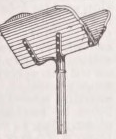
A kind of tray for carrying mortar and brick, used in bricklaying. It is fitted with a handle and borne on the shoulder.
HODGE, Charles (1797-1878), theologian, was born in Philadelphia, December 28, 1797. He was educated at the college of New Jersey in Princeton, where he graduated in 1815, and afterwards at the theological seminary of the Presbyterian Church in the same place, where he continued a student until 1819; in 1820 he became assistant teacher; and in 1822 he was chosen by the general assembly to be professor of Oriental and Biblical literature there. He spent two years on the Continent, from 1826 to 1828, studying under De Sacy in Paris, under Gesenius and Tholuck in Halle, and under Hengstenberg, Neander, and Humboldt in Berlin. In 1840 he was transferred to the chair of didactic and exegetical theology, to which subjects that of polemic theology was added in 1852, and this office he held to the day of his death. In 1825 he established a quarterly publication entitled the Biblical Repertory, designed to furnish translations and reprints of the best contemporaneous foreign essays on theological and religious subjects. On his return from Europe in 1828 he changed it into a vehicle for publishing original theological essays and reviews, and added the words Princeton Review to its title. He secured for it the position of theological organ of the old school division of the Presbyterian Church, and continued its principal editor and contributor until 1868. He contributed over 130 articles on subjects ranging through every department of theology and ecclesiology, and all the great practical, ecclesiastical, moral, and national questions of the day. From 1835 to 1868 he wrote yearly an article reviewing the action of each general assembly, which series has exerted a powerful influence over the current opinion and history of the church to which he belonged. The most important of these ...have been republished in Great Britain and in America, in volumes, under the titles of Hodge’s Essays, Princeton Theological Essays, and Hodge’s Church Polity. He was made doctor of divinity by Rutgers College, N.J., in 1834, moderator of the general assembly (O.S.) in 1846, member of the committee to revise the Book of Discipline of the Presbyterian Church in 1858, and LL.D, by Washington College, Pa., in 1864. April 24, 1872, the fiftieth anniversary of his election to his professorship, was observed in Princeton as his jubilee by between 400 and 500 representatives of his 3000 pupils, when he received congratulatory addresses and letters from all the Presbyterian theological faculties of Scotland and Ireland, and from a majority of those belonging to the various Evangelical churches of America. He continued to instruct his classes uninterruptedly up to the time of his death in Princeton, June 19, 1878. The main characteristics of Hodge were strength and persistence of conviction and of purpose, logical clearness and symmetry of thought and style, energy and effective vigour in the defence of his convictions and in assaults upon what he considered error, sunny cheerfulness of disposition, and humility, tenderness, and gentleness of heart and manner.
Besides his articles in the Princeton Review, he published a Commentary on the Epistle to the Romans, Phila., 1835, abridged 1836, rewritten and enlarged 1866; Constitutional History of the Presbyterian Church in the United States, 2 vols., 1840-41; The Way of Life, 1842; Commentaries on Ephesians, 1856, 1 Corinthians, 1857, 2 Corinthians, 1860; Systematic Theology, probably the best of all modern expositions of Calvinistic dogmatic, 3 vols., 2200 pp., 1871 — 73; What is Darwinism ? 1874; and there have been published since his death Hodge's Church Polity, 1878, and Conference Papers, 1879.
HODGKINSON, Eaton (1789-1861), a distinguished engineer, was the sou of a farmer, and was born at Anderton near Northwich, Cheshire, 26th February 1789. He received his first stimulus to the study of mathematics at the grammar school of Northwich, and this interest was further quickened by the instructions of Dr Dalton at Manchester, whither he had removed in 1811, and where, instead of following his original purpose to study for the church, he was assisting his widowed mother to establish a business. For several years he carried on mechanical researches and experiments, but his first discovery of importance was that of a new form of iron girder, by which a gain of two-fifths in strength was obtained over that formerly in use. After this he carried on investigations of a similar character in conjunction with Sir William Fairbairn, who greatly profited by his suggestions and assistance in some of his more important inventions. In 1840 Hodgkinson communicated a paper to the Royal Society on Experimental Researches on the Strength of Pillars of Cast-iron and other Haterials in recognition of which he in 1841 received the royal medal, and was also elected a fellow. His formulae for solid and hollow pillars soon obtained general adoption in all engineering class-books. Subsequently he was employed by Stephenson to verify the experiments of Fairbairn on wrought-iron tubes, with a view to the construction of the Britannia Bridge; and for his co-operation in this work he received a silver medal at the Paris Exhibition of 1855. In 1847 he was appointed professor of the mechanical principles of engineering in University College, London. In 1848 he was chosen president of the Manchester Philosophical Society, of which he had been a member since 1826, and to which, both previously ...and subsequently, he contributed many of the more important results of his discoveries. For several years he took an active part in the discussions of the Institution of Civil Engineers, of which he was elected an honorary member in 1851. He died at Eaglesfield House, near Manchester, 18th June 1861. The name of Hodgkinson will always be associated with those of Fairbairn and Stephenson, and without his assistance it may safely be affirmed that the most brilliant achievements of both would have been impossible.
HODMEZÖ-VÄSÄRHELY, a corporate town in the county of Csongràd, Hungary, is situated on the lake Hôd, and on the Alföld Railway, about 90 miles S.E. of Budapest, 46° 27' N. lat., 20° 22' E. long. The town is large and rapidly improving, and has many public buildings. Of these the most noteworthy are the townhall, the Roman Catholic, Greek, and Protestant (one Lutheran and two Calvinist) churches, the Jews’ synagogue, the Protestant gymnasium, and the royal law courts. Hôdmezo-Vâsârhely possesses also many elegant private residences, two hospitals, two banks, and several literary institutions, and has a flourishing trade. The soil of the surrounding country is exceedingly fertile, the chief products being wheat, mangcorn, barley, oats, millet, maize, and various descriptions of fruit, especially melons. Extensive vineyards, yielding large quantities of both white and red grapes, skirt the town, which has also a fine public garden. The horned cattle and horses of Hödmezö-Vâsârhely are considered the best in the Alföld; sheep and pigs are also extensively reared. The commune is protected from inundations of the Theiss by an enormous dike, but the town, nevertheless, sometimes suffers considerable damage during the spring floods. In 1870 the population was 49,153, chiefly Magyars.
HODOGRAPH is the name given to a geometrical construction which greatly facilitates the study of kinematical questions. It was invented by Sir William Rowan Hamilton about 1845, and the first account of it, written by him, is to be found in the Proc. R. I. A. for 1846.
The hodograph may be thus defined:—If a point be in motion in any orbit and with any velocity, and if, at each instant, a line be drawn from a fixed point parallel and equal to the velocity of the moving point at that instant, the extremities of these lines will lie on a curve called the hodograph. Let PP 1 P 2 be the path of the moving point, and let OT, OT 1 , OT 2 , be drawn from the fixed point O parallel and equal to the velocities at P, P 1 , P 2 respectively, then the locus of T is the hodograph of the orbit described by P (fig. 1).
From this definition we have the following important fundamental property which belongs to all hodographs, viz., that at any point the tangent to the hodograph is parallel to the direction, and the velocity in the hodograph equal to the magnitude of the resultant acceleration at the corresponding point of the orbit. This will be evident if we consider that, since radii vectores of the hodograph represent velocities in the orbit, the elementary arc between two consecutive radii vectores of the hodograph represents the velocity which must be compounded with the velocity of the moving point at the beginning of any short interval of time to get the velocity at, the end of that interval, that is to say, represents the change of velocity for that interval. Hence the elementary arc divided by the element of time is the rate of change of velocity of the moving-point, or in other words, the velocity in the hodograph is the acceleration in the orbit....
Analytically thus (Thomson and Tait, Nat. Phil.}:— Let x, y, z be the coordinates of P in the orbit, ξ, ∙η, ζ those of the corresponding point T in the hodograph, then t=⅛ w =⅛ —
ς dt ’ 1 dt , * dt ’ therefore dξ - ⅜ ∏∖
<Γ⅛^d 2 y dt i dt i dt 2
Also, if s be the arc of the hodograph, ^-√ θ) ι <
· *
Equation (1) shows that the tangent to the hodograph is parallel to the line of resultant acceleration, and (2) that the velocity in the hodograph is equal to the acceleration.
Every orbit must clearly have a hodograph, and, conversely, every hodograph a corresponding orbit; and, theoretically speaking, it is possible to deduce the one from the other, having given the other circumstances of the motion. We give a few examples :—
1. For uniform motion in a straight line the hodograph is easily seen to be a point.
2. For uniform or variable acceleration in a straight line the hodograph is the line described by a point moving with uniform or variable velocity.
3. For uniform circular motion the hodograph is also a circle. In this case it may be useful to show how the conception of the hodograph leads easily to the ordinary expression for the so-called centrifugal force.
Let P (fig. 2) describe the circumference PP 1 P 2 with uniform velocity v, and from the centre 0 draw OT, OT 1 , OT 2 , &c., equal to each other and parallel to the tangents at P, P 1 . P 2 respectively, then TT 1 T 2 is the hodograph circle. Also let a equal the acceleration of P, which also equals the velocity of T; then, since T describes the hodograph uniformly in the same time that P describes the orbit, we have v OP r . _ v 2
α~^0T - V ' ‘ a ~T' It is evident that the tangent at T is parallel to PO the direction of acceleration at P.
4 . For simple harmonic motion the hodograph is also simple harmonic motion, and similarly for elliptic harmonic motion.
For the former we have s=a cos (nt + e); .∙. ν≈s≈ -na sin (πZ + e) = nα cos (ni+e + ⅜π); which indicates simple harmonic motion with changed amplitude and phase.
5. For parabolic motion the hodograph is a straight line.
Let OF (fig. 3) be the velocity of projection. Resolve it vertically and horizontally; the horizontal component OH is constant, so that the hodograph must be the vertical line FHT. The velocity at any point P of the parabola is evidently represented by the line OT drawn parallel to the tangent at P.
Analytically thus :—If x, y be the coordinates of the moving point and ξ and ∙η those of the hodograph, we have x=0 , ÿ = -/(/being the vertical acceleration);
.∙∙ ξ=0, ή =-/;
. ∙. ξ-c, τj = c'-∕i, which indicates a vertical straight line described with uniform velocity ∕.
6. For central forces the hodograph will vary with the law of acceleration towards the centre. Hamilton showed that, for the Newtonian law of the inverse square of the distance, the hodograph is always a circle, and for that reason he designated that law the law of the circular hodograph.
Assuming the centre of force as origin for the hodograph, we see that, from definition, the tangent and radius vector at any point P of the orbit are respectively parallel to the radius vector and tangent at the corresponding point T of the hodograph (fig. 4). These four lines thus enclose a parallelogram PT, whose shape is constantly changing, although its area is constant, being equal to the constant rectangle YT contained by the velocity and the perpendicular on the tangent. As usual, let TY=φ=Λ. Also the angle between two consecutive tangents to the hodograph is equal to the angle between the corresponding radii vectores of the orbit, and hence/if 0 be the angle between OP and some initial line, and s the arc of the hodograph, the ordinary formula for curvature gives
1 dθ _ 0
ρ ds ~ s ’ but 7 t =r 2 0, and = velocity in hodograph = acceleration in orbit=P (say);
• 1 p = P i p r 2
∙∙∙ p =-F
a most useful expression for the radius of curvature of the hodograph to any central orbit.
If the acceleration vary inversely as the square of the distance, P = - 2 - > where M is the mass at the centre acting upon unit mass in the orbit. Substituting in (3), we get
M . . p = — = constant.
h
Hence, for this law of force, and evidently for it only, the hodograph is a circle.
Assuming that the hodograph is a circle, we can show that the orbit for this law of force must be a conic section. Let CTB (fig. 5) be the hodograph circle, 0 the origin, and H the centre; and let the ratio = e . Draw OP parallel to the tangent at T and, therefore, perpendicular to TG. Take OP such that the parallelogram contained by OP and OT = a constant ≈h. Draw OA perpendicular to CB; and let POA = 0; then,
OP.TG=⅛j
.∙. OP. (TH + HG) = ½J butTH= i >=^, and HG = HO cos 0 = eρ cos 0=-v-cos 0;
Γb
·· 0p fv + e⅞cos0)=Λ;
∖ n> h ∕
• OP=r=-· 1
Μ 1 + e cos 0 Hence the locus of P is a conic section whose semi-parameter is
. If e<l> o is within the circle and. the orbit is an ellipse; if e = l, 0 is on the circumference and the orbit is a parabola; and if e >l, 0 is without the circle and the orbit is an hyperbola.
Two values of the potential, V, can readily be found from the above :—
xτ M . . h .
V = —; but r== 7s ; r 1G
M
.∙. V=∙^. TG=TH . TG.
h
Also, since OGH is a right angle, V = TH . TG = the square of the tangent from T to the circle described on HO as diameter.
A beautiful result connected with the hodograph, and one which has attracted the attention of several of the ablest mathematicians, was communicated by Sir William Hamilton to the Royal Irish Academy in March 1847. It is called the theorem of hodographic isochronism, and is thus stated:—If two circular hodographs, having a common chord, which passes through, or tends towards, a common centre of force, be cut perpendicularly by a third circle, the times of hodographically describing the intercepted arcs will be equal. A purely quaternion proof is given of this theorem by Hamilton in his Elements, and, following the hints given by that method, he has also indicated the following geometrical proof.
Let TMT'M ’, WMW'M' (fig. 6), be the two hodographic circles with centres H and L and common chord MM'. Let P, P', on the common chord produced, be the centres of two circles WTW'T' and BAB ’ A', near each other, which cut the hodographs orthogonally. Let 0 be the centre of force, OZ perpendicular to the tangent at T, and TR, T'R' perpendicular to SX. Also let AT mean the arc AT, and similarly for the other small arcs. Draw PY perpendicular to PT.
From similar triangles THΛ and TPY we have
AT _ PY.
TH “PT ’
also from similar triangles THR and PP ’ Y
TH PU . AT PP' .
TR “PY ' ‘ TH. PT ’
.∙.ΛT-∑⅛S.
Similarly, AT” - --^ T ' R '.
If „ and i' be the times of hodographically describing the arcs AT and A'T' respectively,
. AT M . AT M . AT ... , r . .. . .. 1 . τ , λ “mF 2 " m 2 F*^ " ~Ψ~ (lf v be the p° tentlal at τ >∙
But V = HT .OZ = OP. TR from similar triangles OPZ and THR;
. f M . AT M . PP'. TR Μ. PU
OP 2 . TR 2 OP 2 . TR 3 . PT - OP 3 . PT . TR Similarly, f , _ M . PU. T z R' M . PP'
“OP 2 . T'R' 2 . PT “OP 2 . PT . T'R' ’
I + ι' - M . P P' ( J_ 1 ∣ _ 2M . PP' I TR + T ’ R') OP 2 . PT. ( TR + T'R'1 OU. PT ( 2TR . T'R' I' 2TB T'R'
Now ιi ^, = the harmonic mean between TR and T'R' = QL; • t + t' - 2M rp '
OP 2 . PT . QL ’
From this expression we see that the time of describing the twβ small arcs TA and T'A' is independent of the radius of the hodograph and the distance of its centre from L. Hence it is equal to the time of describing the two arcs BW and B'w. By continuing the process of drawing orthogonale we arrive at the conclusion that the time of describing the whole arc ATT'A' is equal to the time of describing the arc BWW'B'. A very simple analytical proof is given in Tait and Steele’s Dynamics of a Particle. Others not so simple by Cayley and Droop are to be found in the Quarterly Journal of Mathematics. We can only mention that the theorem of Lambert can be deduced from the above theorem of hodographic isochronism without using any property of conic sections.
Sir William Hamilton has observed that we have a good instance of a hodograph in the curve of aberration of a star, which is merely the hodograph of the earth’s annual motion. The fact that this curve is a circle in a plane parallel to the earth’s orbit, abstracted, however, from the general idea of the hodograph, was known long before the date of the hodograph. It will be found clearly stated and proved in Woodhouse’s Astronomy, of date 1821, and from allusions there it appears to have been known even earlier. As an application of the hodograph, Thomson and Tait point out that the heat and light received by a planet from the sun in any time are proportional to the corresponding arc of the hodograph.
See Proc. Roy. Irish Acad., 1846; Hamilton’s Elements of Quaternions·, Tait, Proc. R. S. E., 1867-8; Tait’s Quaternions; Thomson and Tait, Nat. Phil.
HODY, Humphrey (1659-1706), an English divine, was born at Odcombe in Somersetshire in 1659. In 1676 he entered Wadham College, Oxford, of which, having proceeded M.A. in 1682, he became fellow in 1684. Previously he had published in 1680 Dissertatio contra Historiam Aristeae de LXX. Interpretibus, in which he showed that the so-called letter of Aristeas, containing an account of the production of the Septuagint, was the late forgery of a Hellenist Jew originally circulated to lend authority to that version. The dissertation was generally regarded as conclusive, although Vossius published an angry and scurrilous reply to it in the appendix to his edition of Pomponius Mela. In 1689 Hody wrote the “Prolegomena” to the chronicle of John Malala, published at Oxford in 1691. The following year he became chaplain to Stillingfleet, bishop of Worcester, and, on account of his supporting the ruling party in a controversy with Dodwell regarding the nonconforming bishops, he was appointed chaplain to Archbishop Tillotson, an office which he continued to hold under Tenison. In 1698 he was appointed regius, professor of Greek in the university of Oxford, and in 1704 he was promoted to the archdeaconry of Oxford. In 1701 he published History of Englhh Councils and Convocations, and in 1704 in four volumes De Bibliorum textis originalibus, in which he included his original work on the Septuagint, and published a reply to the attack of Vossius. He died 20th January 1706. A work, De Groecis Illustribus, which he left in manuscript, was published in 1742 by Dr Jebb, who prefixed to it a Latin dissertation.