Ches
Webster's Dictionary 1913
pret. of Chese.
CHESHIRE, a maritime county in the north-west of England, is bounded on the N. by the Mersey, which separates it from Lancashire, on the N.E. by Yorkshire, on the E. by Derbyshire and Staffordshire, on the S. by Shropshire and Denbighshire, on the W. by Flintshire, and on the N.W. by the Irish Sea. Its greatest length from east to west is about 48 miles, and its greatest breadth from south to north about 33 miles. It possesses an area of 705,493 statute acres, or 1102 square miles; and its population in 1871 was 561,201 persons (males, 271,033; females, 290,168). Since the first census in 1801, the population has increased by 368,396 persons, or 191 per cent, and since 1851 the increase has amounted to 105,476 persons, or 23 per cent, in twenty years....
The formation of the county is generally flat, with some hills on the east on the Derbyshire and Yorkshire boundary, which extend also to the Staffordshire side. There are also lower hills near Chester and Flintshire, and at Alderley Edge and Beeston insulated hills standing up out of the prevailing level. The principal geological formation is the New Red Sandstone, which occupies nearly the whole of the central and western part of the county. A small patch of lias occurs in the south. The Coal Measures extend along the eastern side on the borders of Staffordshire and Derbyshire, and also are worked on the banks of the Dee below Chester. The principal mineral produce is salt, which is found as rock-salt in mines at Northwich, and is manufactured there and at Winsford, Middlewich, Sandbach, and Lawton, from the brine-springs overlying the rocksalt. Lead and copper are also found, though not in great quantities. Copper was worked at Alderley Edge at an early period, but the works were discontinued until lately, when they have been recommenced.
The flora of the central plain of Cheshire, which represents its most characteristic vegetation, is intermediate between that of the northern and southern counties of Britain. The botany of the high-lands east of Macclesfield is nearly ericetal in its nature, akin to that of the West Riding of Yorkshire, whilst in the west the botany of Wirral shows more variety than that of the Midland region, and is more southern in its character. The curious system of marl-pits, and the frequent inland meres, each of which has a vegetation of its own, render Mid Cheshire pre-eminent among English counties for the development of such species as Carex and Potamogeton. Two rare species may be cited to prove the strong admixture of northern elements in the flora, viz., Arundo stricta at Oakmere and Saxifraga Hirculus, now unfortunately extinct, at Knutsford. As compared with one near or south of London, a Cheshire arable field shows a lamentable paucity of species. A botanist would only in a day’s walk mark 150 species of flowering plants, as against 300 species marked in the same time in Kent or Sussex.
The principal rivers in Cheshire are the Dee, which, rising in the Welsh mountains, forms the boundary between the county and Denbighshire and Flintshire, and ultimately, having formed a wide navigable estuary below Chester, falls into the Irish Sea; the Mersey, which rises in the Yorkshire hills, forms the county boundary along the whole of its northern side, and having given the opportunity for the formation of the ports of Liverpool, Birkenhead, and Runcorn, also fall into the Irish Sea; and the Weaver, which, rising in the south-west of the county, traverses it in a north-westerly course, and being joined by the Dane at Northwich, empties itself into the Mersey at Weston Point. By means of a series of locks, the Weaver has been made navigable for vessels of 200 tons as far as Winsford, and thus furnishes a means of transportation for the salt produced in the locality. The profits of the navigation, which was originally undertaken by a few Cheshire squires, belong to the county, and are paid over annually to the relief of the county rates. At present, in consequence of a large outlay in further deepening and improving the navigation, all payments to the county treasury are suspended, but on an average of late years from £16,000 to £20,000 has been paid over.
Distributed over the surface of the county are small lakes or meres, and it seems to have been a point of honour for the old houses of the gentry to have been built on their banks. Combermere, Tatton, Rostherne, Tabley, Doddington, Marbury, and Mere, with a host of smaller waters, are dotted over the county: whilst nearly in every field are old marl-pits, whence in former days the sole supply of manure for the permanent pastures was obtained.
The climate is temperate and damp; the soil is varied and irregular, but a large proportion of it is a thin-skinned clay. In only one spot of the county is the soil said to be fertile enough to feed a bullock to the acre. The agriculture of the county, which some twenty-five years ago was backward and discreditable, has marvellously improved in the last quarter of the century. The land, which was wet and full of rushes, has been drained; its fertility has been increased by the periodical application of bone-dust; the old crooked fences have been removed or straightened; and the farm-houses and buildings, which were insufficient for the decent accommodation of man and beast, have been replaced on many estates by modern structures well adapted for their purposes. Dairy-farming is the description of agriculture still principally pursued, and in March 1875 there were, according to the Board of Trade returns, 96,170 cows in the county, whose milk if all converted into cheese would have yielded a produce of about 16,000 tons of cheese. But though the tendency to make cheese in some parts of the county still prevails, the influence of the larger population gathered together round the purely agricultural part of the county has greatly diminished the production of the staple article, whilst the competition of American cheese has made the manufacture of all but the best qualities unprofitable. Liverpool, Manchester, Stockport, Macclesfield, the cotton districts in the north-east of the county, and the Staffordshire Potteries on the south-west, all demand a supply of milk, meat, and garden produce, and the facilities of transit afforded by the railways have in many cases already changed, and gradually in many more will change, the character of Cheshire agriculture. Although in some cases the Cheshire tenant-farmer is little more than a labourer owning cows, working as hard as his own labourers, and with as little or less education, yet there are now a large number of farms as well and skilfully cultivated and producing as large produce to the acre (thanks to the facilities of obtaining manure from the larger towns) as any in the United Kingdom.
During the years 1865 and 1866 a mighty calamity swept over this county. The cattle plague, which had in 1745 destroyed 30,000 head of cattle, appeared in the second week of October 1865 on the southern border of the county. Spreading itself there, and breaking out almost simultaneously on the north-west, west, and east, it had by the 21st February 1866 destroyed 36,823 head of stock. On that day an Act of Parliament was passed to authorize slaughter and to give compensation, and in consequence 35,675 cattle were killed. A loan was granted from the Treasury, on the security of the county rate, of £270,000 to pay the compensation for losses after the 22d February, which entails an annual charge on the county rates of £14,583, 14s. lOd. until the year 1896. Although by this terrible loss many individuals were ruined, and for the time great distress was caused, yet on the whole the agriculture of the district was benefited. Landlords discovered that stringent clauses in their leases might safely be modified; tenant-farmers became convinced that cheesemaking was not the whole duty of the agriculturist, and the possibility and even the necessity of new ways of farming, and of the introduction of sheep or feeding-stock, became apparent.
From the agricultural returns for 1875 (which, however, are not complete) it appears that the average acreage devoted in Cheshire to corn crops is exceptionally low, being 16 ’ 2, while the average of all England is 31 - 2. The following table shows the distribution of the acreage in the county, and the numbers of live stock in the years 1872 and 1875 :—
[table]
In the latter year there were 84,981 acres under corn crops, and 31,686 under green crops, both showing a decrease as compared with 1872.
The county is intersected by railways in every direction. At Crewe the London and North-Western Railway divides into three sections, and takes its passengers or goods to Manchester, Liverpool, Chester, and the North. From Stockport and Manchester the Cheshire lines run into the centre of the county and across Delamere Forest to Chester; and there are lines from Chester to Birkenhead, to Manchester, to Shrewsbury, and into the different parts of North and South Wales.
The canals, too, still convey goods from Runcorn and Ellesmere-port to the Staffordshire potteries, and afford means of communication between Manchester, Liverpool, and the interior of the county.
The principal towns are Chester, Birkenhead, Macclesfield, Stockport, Northwich, Crewe, and Congleton. At Stockport the manufacture of hats and cotton is carried on, and Macclesfield and Congleton are the seats of the silk manufacture. At Crewe are situated the great workshops of the London and North Western Railway, and round the station, where in 1841 there was a wooden box to take the tickets and one solitary farmhouse, there is now crowded a population of nearly 30,000 inhabitants. The trade of Northwich and Winsford is the manufacture of salt, by the evaporation of the water from the brine. During the year 1875 it is calculated that 1,500,000 tons of salt were produced, of which 1,000,000 were for export, 350,000 for chemical works, 100,000 for agricultural purposes, and 50,000 for domestic use. In that year there were in Cheshire 1261 salt-pans, employing over 3000 men. About 150 men are engaged in rock-salt mining, and the carriage of salt on the Mersey and Weaver employs at least 1000 men and 500 boys. Steamers are now largely employed in the inland navigation, between thirty and forty being engaged in the carrying trade.
Besides being in part a manufacturing and in part a purely agricultural county, Cheshire, more perhaps than any place except the districts round the metropolis, is the home of business men. The manufacturers of Manchester, the merchants of Liverpool, the gentlemen employed in the pottery trade, all have their villas here. At Alderley and Bowdon near Manchester, in the Wirrall hundred on the banks of the Mersey, at Alsager on the Staffordshire border, are to be found congeries of the dwellings of rich men, which vie in their appointments and surroundings with the houses of the great landowners of the county. Perhaps no stronger proof can be given of this fact than that, in the return lately furnished to the House of Commons of a summary of the returns of owners of land, the number of properties between 1 acre and 10 is reported to be 3166 out of a total number of 23,720, add the average rental per acre is £24, 13s. These proportions are in the whole return for England and Wales exceeded only in the ex-metropolitan parts of Surrey and Middlesex, and in the mining and manufacturing counties of Lancashire and Glamorganshire.
Cheshire is emphatically a county full of large estates. In the return just quoted may be found the fact that the rental of estates between 5000 and 10,000 acres amount to 20 ’ 4 of the total value of the county, a larger percentage than in any English county save one. Of the owners of more than 10,000 acres Lord Tollemache of Helmingham owns 25,380; the marquis of Cholmondeley, 16,842; the duke of Westminster, 15,001; Sir Henry Delves Broughton, 13,832; the Rev. T. France Hayhurst, 10,650; and Lord Crewe, 10,148; whilst Lord Egerton of Tatton, Lord Harrington, Lord Stamford and Warrington, Lord Derby, Sir P. D. Μ, Grey Egerton, Lord Haddington, Lord De Tabley, Lord Delamere, Lord Stanley of Alderley, Lord Kilmorey, Lord Shrewsbury, Mr Legh of Lyme, Mr Leigh of Adlington, Mr R. E. Warburton, Sir Charles Shakerley, and Mr Bromley Davenport make up the seventeen who are returned as owning between 5000 and 10,000 acres each. This list of landowners is composed of men whose names, with one exception, are historic in Cheshire, so small, spite of the neighbourhood of Liverpool and Manchester, have been the transfers of the large estates from their original owners to the capitalists of the present day.
For parliamentary representation the county is divided into East, West, and Mid Cheshire, each of the three sections returning two members to the House of Commons. In East Cheshire the registered electors in 1876 were 6,587; in Mid Cheshire, 8241; and in West Cheshire, 10,178. There are besides represented within the county the boroughs of Macclesfield and Birkenhead, part of the city of Chester, the limits of which extend into Wales, and parts of the boroughs of Warrington, Stockport, Ashton-under-Lyne, and Stalybridge, all of which extend more or less into Lancashire. There is one court of quarter sessions in the county, which holds its meetings alternately at Chester and Knutsford, and is adjourned from one place to the other for the trial of prisoners at intermediate sessions. The rateable value of the county as assessed to the county rates is £2,690,701.
Perhaps no county has advanced more in material prosperity than Cheshire has in the last half-century. In none have more places of public worship, both of the Church of England and of the various Nonconformist bodies, been erected. In none have more schools been built. The wages of the agricultural labourers are high; and from the ranks of that body has the army of engineers, porters, and high-class artificers, who are employed in the manufacturing districts and at Crewe, been largely recruited. Yet still the county is cursed with the sin of drunkenness, and with the evil consequences of that sin, in a fearful degree. Whilst serious crime has decreased steadily there has been an increase of all the light offences.
The history of Cheshire is intimately connected with that of the city of Chester. In the time of King Alfred the present county formed part of the province of Mercia, but it was afterwards separated, and by William the Conqueror it was constituted a county-palatine. William bestowed the earldom on his nephew Hugo Lupus, and the title has belonged since then to the heir-apparent of the English Crown. The palatinate privileges existed intact until the reign of Henry VIII., when they were much curtailed in favour of the Crown, and after the Civil War of the Commonwealth they were almost wholly removed. The county was first represented in Parliament during the reign of Edward VI.
Two Roman roads traversed Cheshire, the north-west branch of Watling Street, running from Chester through Northwicb to Stratford, where it crossed the Mersey into Lancashire, and the Via Devana which entered from Salop and extended to Chester. Many handsome and interesting mansions exist in the county, some of them being admirable specimens of Elizabethan architecture. Among the most noteworthy may be mentioned Bramall Hall near Stockport, Brereton Hall near Sandbach, Crewe Hall, the seat of Lord Crewe, and Eaton Hall, the seat of the duke of Westminster. (a. w. L.)
CHESNE, Andre du. See Duchesne.
CHESNEY, Charles Cornwallis (1826-1876), brevetcolonel in the corps of Royal Engineers, born 29th September 1826, was the third son of Charles Cornwallis Chesney, captain on the retired list of the Bengal Artillery. Educated at Tiverton grammar school and Mount Radford school, Exeter, and afterwards at the Royal Military Academy, Woolwich, he obtained his first commission as second-lieutenant of engineers in 1845, passing out of the academy with distinction at the head of his term. His early service was spent in the ordinary course of regimental duty at home and abroad, and being stationed in New Zealand during the Crimean War, he lost the opportunity of serving in the only considerable military operations in Europe in which the present generation of British soldiers has been engaged, while India, the great school of war for the English army, was until lately closed to officers of the Royal Artillery and Engineers. Among the various reforms in our military system which followed from that war was the impetus given to military education; military history was now for the first time introduced into the course of instruction at our military colleges, and in 1858 Charles Chesney, who had brought himself under notice by an essay on the subject, prepared under a sort of competition invited by the authorities, was appointed professor of military history at Sandhurst. In 1864 Captain Chesney succeeded Colonel Hamley in the corresponding chair at the Staff College. To the admirable teaching of these two officers may be ascribed in great measure the intelligent appreciation of the relation of military history to the practical business of war now manifested throughout the commissioned ranks of the British army; their published writings have been received with great favour on the ...Continent and in America.
Chesney’s first published work was an account of the civil war in Virginia, which went through several editions; and although written in the heat of the struggle, and on the partial information then available, it may still be read with profit. But the work which attained the greatest reputation was his Waterloo Lectures, prepared from the notes of lectures orally delivered at the Staff College. Up to this time the English literature on the Waterloo campaign, although voluminous, was made up of personal reminiscences of actors in the great scene, or of formal records such as Siborne’s accurate but tedious narrative, useful materials for history rather than history itself; the French accounts have mainly taken the form of fiction, the so-called history of Lamartine being as much a work of fancy as the romance of Victor Hugo, while the professedly sober pages of Thiers are not much more to be relied on. In Chesney’s lucid and vigorous account of the momentous struggle, while it illustrates both the strategy and tactics which culminated in the final catastrophe, the mistakes committed by Napoleon are laid bare, and for the first time an English writer is found to point out that the dispositions of the great duke were not wholly faultless. Yet such criticism is in truth the sincerest praise, since to those who, knowing anything of war, know that even the highest combinations are at best a groping in partial darkness, the capacity of a great leader will be more perfectly appreciated by a right estimate of his mistakes than by a blind attribution of infallibihty. And in the Waterloo Lectures the Prussians are for the first time credited by an English pen with their proper share in the victory. On this point there had hitherto been an English as well as a Napoleonic legend. The Waterloo Lectures attracted much attention abroad as well as at home; on the appearance of the French edition, published at Brussels, another account of the campaign, written at the instance of the emperor Napoleon III., and quite in the spirit of the Napoleonic legend, was published immediately afterwards in Paris in a cover to correspond exactly with the Brussels edition, and with the obvious intention that it should circulate in place of the other,—a delicate test of the appreciation of the original on the part of the French Government.
Chesney was for many years a constant contributor to the newspaper press and to periodic literature, devoting himself for the most part to the critical treatment of military operations, and professional subjects generally. Some of his essays on military biography, contributed mainly to the Edinburgh Review, were afterwards published separately. His style is forcible, easy, and eminently clear, his judgment impartial and sagacious, and although his mode of treating military operations may be open to the criticism that it does not make sufficient allowance for the moral element in war—the infirmities of troops and the blunders of generals,—it may be said on the other hand that the whole truth is never told about battles at the time, and cannot be found out afterwards, and that in the long run the less there is of the personal in history, and the broader and more general the statement, the nearer will the historian come to describing what happened.
In 1868 Charles Chesney, who on promotion to field rank had returned to regimental duty, was appointed a member of the Royal Commission on Military Education which sat during that and the following year, under the presidency first of Earl de Grey and afterwards of Lord Dufferin, and to whose recommendations are due the improved organization of our military colleges, and the development of military education throughout the principal military stations of the British army. In 1871, immediately after the conclusion of the Franco-German war, he was sent on a special mission to France and Germany, and furnished to the Government a series of valuable reports on the different siege operations which had been carried out during the war, including especially the two sieges of Paris, and on the condition of the fortresses and military condition and organization of the two powers. These reports were published in a large volume, only a few copies of which have been issued confidentially.
Never seeking regimental or staff preferment, Colonel Chesney never obtained any, but he held at the time of his death a quite unique position in the army, altogether apart from and above his actual place in it. Consulted by officers of all grades on professional matters, his ready and vigorous pen was often placed at the service of the Govern ment to illustrate and defend in the press the different measures of reform lately adopted in military organization; while probably few have done more to raise the intellectual standard of the English army and its estimation in that respect among the more intelligent spirits of foreign armies. Constantly engaged in literary pursuits, he was nevertheless laborious and exemplary in the discharge of his public duties, while managing also to devote a large part of his time to charitable and religious offices. He was abstemious to a fault; and, overwork of both mind and body telling at last on a frail constitution, he died after a short illness on the 19th March 1876, at the age of forty-nine years, to the regret of the whole army, and of a very large circle of friends both within and without the service, to whom he had become endeared in a remarkable degree by his generous, self-denying, and sympathetic disposition. At the time of his death he was serving as Commanding Royal Engineer of the London district.
Colonel Chesneys principal works were:— A Military View of Recent Campaigns in Virginia and Maryland, 1863; Campaigns in Virginia and Maryland, 2d edition, 1865; The Military Resources of Prussia and France, and Recent Changes in the Art of War; Essays by Charles Chesney and Henry Reeve, republished jointly from the Edinburgh Review 1870; Waterloo Lectures, 3d edition, 1874; Essays in Modern Military Biography, reprinted chiefly from the Edinburgh Review, 1874.
TREE, ערמון. This tree, which is mentioned only in Gen. xxx, 37, and Ezek. xxxi, 8, is by the Septuagint and Jerom rendered _plane tree_; and Drusius, Hiller, and most of the modern interpreters render it the same. The name is derived from a root which signifies _nakedness_; and it is often observed of the plane tree that the bark peels off from the trunk, leaving it naked, which peculiarity may have been the occasion of its Hebrew name. The son of Sirach says, “I grew up as a plane tree by the water,” Ecclesiasticus xxiv, 14.
CHESS, simply defined, is an intellectual pastime. It recreates not so much by way of amusement properly so termed, as by taking possession of the mental faculties and diverting them from their accustomed grooves. The cerebral organ, after being much occupied in business, or greatly worried by cares, or in any way beset by painful reflections, finds in the absorbing and abstracting properties of chess that temporary relief which lighter pastimes will not always afford. The reason of this is not far to seek. Cares are caused by looking forward to or apprehending things to come, and, as such, are neutralized by that foresight which the conduct of a game of chess demands. Again, mental perturbations, however much varied, can but be the employment of the imagining and reasoning faculties in the digestion of the particular cause of annoyance or pain; but these same faculties are required, and their exclusive exercise demanded, in providing for the emergencies of the intellectual combat, and in solving the ever varying problems that arise in the course thereof. It is very commonly supposed that chess is a difficult game, whether to acquire or practise. This, however, is a mistake. The moves may be learned in half an hour, and a week’s practice will evoke a sufficient amount of skill to afford pleasure both to the learner and his tutor. The intelligent novice will soon be convinced that an ignorant manipulation of the pieces does not conduce to success, and he will seek for instruction in the right manner of opening the game; the various débuts are after all simple, and he will find no difficulty in acquiring them one after the other. Six months will suffice for this purpose if his understanding be not enslaved by obstinacy, indolence, or self-esteem, and the rest goes with ...his natural capacity. A merely average intelligence is sufficient for a very fair amount of proficiency and strength: while intellect not much above the common mean will suffice (assuming here natural aptitude) to lead right up to the second class of players, viz., those to whom the masters of the game can only concede the small odds of “pawn and move.” Those wishing to improve will find it very beneficial to play upon even terms with players stronger than themselves; for a persistence in taking odds, besides having a discouraging and debilitating effect upon the weaker player, takes the game out of its proper grooves, and tends to produce positions not naturally arising in the ordinary course of the game as developed from the recognized openings. In fact, the reception of odds incapacitates a player from acquiring an insight into the principles of the science of chess, and from comprehending the latent meanings and conceptions upon which combinations and a proper plan of warfare are founded; while, upon the contrary, playing on even terms throws the combatant at once upon his own judgment, and by causing him to study his opponent’s play, leads necessarily to a material improvement in his own style.
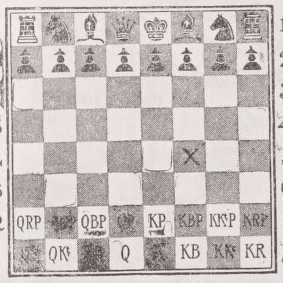
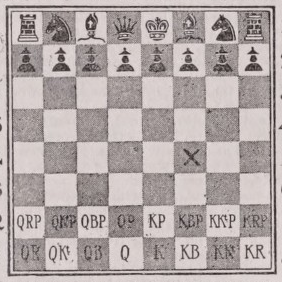
To turn now to the elements of the game. The accompanying diagrams represent chess boards, and it will be perceived that they respectively consist of sixty-four checkered squares
In diagram 1 the chessmen are arranged as they should be at the commencement of the battle, while diagram 2 shows the denomination of the squares according to the English and German systems of notation, to be explained hereafter. Under diagram 1 are the names of the various “^Pieces,” for so the superior officers are termed—each side, white and black, having a king, a queen, two rooks, two knights, and two bishops. The eight common men in front are called Pawns.
Moves of the different Chessmen. —Briefly described, the powers of the various pieces and of the pawns are as follows.
The king may move in any direction—forward, back ward, laterally, or diagonally; but he can move only one square at a time. Under certain conditions he has once in the game a peculiar privilege called castling, which will be explained further on.
The queen moves in any straight or diagonal direction, whether forward, backward, or laterally. There is no limit to her range, except when her progress is stopped by any piece or pawn. She is the most powerful piece on the board, for her action is a union of those of the rook and bishop. At the commencement of the game the queen always stands upon a square of her own colour.
The rooks move in straight lines—forward, backward, or laterally; they cannot move diagonally. Their range is, like the queen’s, unlimited.
The bishops move diagonally in any direction whether backward or forward. They have an unlimited range, with the same exception as before. It is evident that bishops standing originally on differently coloured squares can never meet.
The knights have a mode of moving which it is not easy to describe. Their range is not unlimited, like that of the pieces just noticed, but is restricted in a particular way. They move from one corner of any rectangle of three squares by two to the opposite corner; thus, in diagram 3, the white knight can move to the square occupied by the black one and vice versa. To illustrate the move further, suppose that in diagram 2 a knight stands on the square marked K4 counting from the white side of the board; that knight can move to any of the following squares, viz., to K B 2, Q 2, K Kt 3, Q B 3, K Kt 5, Q B 5, K B 6, and Q 6. The squares which the knight appears to pass over in moving may be occupied by other pieces, but his move has no thing whatever to do with those intervening squares. A knight may thus vault over any piece or pawn, whether adverse or friendly; the knights are the only pieces which possess this privilege. It will be perceived that the locus of the knight, unlike that of the bishop, changes colour at every move.
The king, queen, rooks, and bishops may capture any foeman which stands anywhere within their respective ranges; and the knights can capture the adverse men which stand upon the squares to which they can leap. A capture is effected by the piece which takes occupying the square of the piece which is taken, the latter being then removed from the board. The king cannot capture any man which is protected by another man.
The motions aud capturing powers of the pawns are as follows: —Each pawn for his first move may advance either one or two squares straight forward, but afterwards one square only, and this whether upon starting he exercised his privilege of moving two squares or not. A pawn can never move backwards. He can only capture diagonally,—that is to say, if any adverse piece or pawn stand upon the first diagonal square, either to right or left, such adverse piece or pawn can be captured and removed from the board, the captor taking its place, but a pawn cannot take any man standing directly in front of it. In other words, a pawn moves straight forward except when he captures, in which case he moves diagonally, and for capturing purposes he can only, even for his first move, advance one square. When a pawn arrives at an eighth square, viz., at the extreme limit of the board, he may be promoted, that is to say, he may, at the option of his owner, become a queen, rook, bishop, or knight; and it matters not how many queens or other pieces a player may have on the board at one time.
Check and Checkmate. —The king can never be captured, but when any piece or pawn attacks him, he is said to be “in check,” and the fact of his being so attacked should be announced by the adverse player saying “check,” whereupon the king must move from the square he occupies, or be screened from the check by the interposition of one of his own men, or the attacking piece must be captured. If, however, the king, being thus in check, cannot move to another square without being still in check, and there is no piece or pawn which can be interposed, and the checking piece or pawn cannot be taken, then it is “checkmate,” whereupon the game terminates, the player whose king has been thus checkmated being the loser. The position of the king when in check being the same as that of any piece when exposed to be captured, with the only difference that the king cannot be taken, it follows that the pawn gives check just in the same way that he captures, viz., diagonally. One king cannot give check to the other, nor can a king be moved into check.
Stalemate. —When the king is not in check, but his owner has no move left save such as would place the king in check, this is “stalemate,” and the game is drawn.
Castling. —This is a peculiar move permitted to the king once in the game; it is performed in combination with either the king’s rook or the queen’s rook, and in either case by the king being moved two squares laterally, while the rook is placed on the other side of him. But the king cannot castle after having been moved, nor with a rook that has moved, nor when any piece either white or black stands between him and the rook, nor if he is in check, nor when he has to cross over a square commanded by an adverse piece or pawn; the rook can, however, move from or cross over such a square. It will be perceived that after castling with the king’s rook the latter will occupy the K B square, while the king stands on the K Kt square, and if with the queen’s rook, the latter will occupy the queen’s square while the king stands on the Q B square. This move will easily be understood with the aid of diagram 2.
Taking en Passant. —This is a privilege possessed by any of the pawns under the following circumstances :—If a pawn, say of the white colour, stands upon a fifth square, say upon K 5 counting from the white side, and a black pawn in the supposed case moves to Q 4 or K B4 counting from the black side, the white pawn can take the black pawn “en passant.” For the purposes of such capture the latter is dealt with as though he had only moved to Q 3 or K B 3, and the white pawn taking him diagonally then occupies the square the captured pawn would have reached had he moved but one square.
Drawn Game. —This arises from a stalemate (noticed above), or from either player not having sufficient force wherewith to effect checkmate, as when there are only two kings left on the board, or king and bishop against king, or king and one or even two knights against king. The same consequence follows from either player being able to give perpetual check to the adverse king. There are also cases in which one of the players can call upon the other to give checkmate in fifty moves, the result of failure being that the game is drawn. The right to make this requisition arises in various positions, to explain all of which would take up much space; it is sufficient to say that when, neither side has any pawns left on the board the player with the inferior force may make the fifty moves call Other Chess Terms. —A “minor piece” means either a knight or bishop. “Gaining the exchange” signifies giving a minor piece in exchange for a rook. A “passed pawn” is one that has no adverse pawn either in front or on either of the adjoining files. It may be as well to explain that a “file” is simply a line of squares extending vertically from one end of the board to the other. There are therefore eight files, and they are respectively named after the pieces which occupy the first squares on either side, as, e.g., the “king’s file,” which extends from one king to the other, and so forth. An “open file” is one on which no piece or pawn of either colour is standing. “Gambit” is a word derived from the Italian gambetto, a tripping up of the heels; it is a term used to signify an opening in which a pawn is sacrificed to obtain an attack. An “opening/’ or “début,” is a certain set method of commencing the game; there are regular and irregular openings. A “check by discovery” is given when a player, by moving one of his pieces, checks with another of them. “Double check,” as its name implies, means attacking the king at once with two pieces,—one of the pieces in this case giving check by discovery.
Value of the Pieces. —The relative worth of the chessmen cannot be definitely stated on account of the increase or decrease of their powers according to the position of the game, but striking an average, and taking the pawn as the unit, the following will be an estimate near enough for practical purposes :—pawn 1, bishop 3 , 25, knight 3 - 25, rook 5, queen 9 ’ 50. Three minor pieces may more often than not be advantageously exchanged for the queen. The knight is generally stronger than the bishop in the end game, but two bishops are usually stronger than two knights, more especially in open positions.
Laws. —The laws of chess differ, although not very materially, in different countries. Various steps have been taken, but as yet without success, to secure the adoption of a universally authoritative code. In competitions among English players the particular laws to be observed are specially agreed on,—the regulations most generally adopted being those laid down at length in Staunton’s Chess Praxis, or the modification of the Praxis laws issued in the name of the British Chess Association in 1862.
The following rules may be here indicated. The board must be so placed that each combatant has a white square in his right hand corner. A player touching any of his own men or those of his adversary (except accidentally) without previously saying li j , adoube ,” or “I adjust,” or words to that effect, may be compelled to move or capture (as the case may be) the man so touched; if this cannot be done he must move his king, but if that be likewise impossible, there is then no penalty. If a player make a false or illegal move or capture, he must, at the choice of his opponent, and according to the case, move his own man legally, capture the man legally, or move any other man legally movable. In practice, the usual demand is that the offender shall move his king. After four moves have been made on each side, any such illegality is waived, and the game must be played out as it stands. Should the king be left in check, all the moves subsequently made must be retraced and the check replied to.
Modes of Notation. —The English and German systems of notation (i.e., the manner of describing the moves made in a game) are different. According to the English method each player counts from his own side of the board, and the moves are denoted according to the names of the files and the numbers of the squares. Thus when a player for his first move advances the king’s pawn two squares, it is described as follows :—“I P to K 4;” for the pawn has moved to the fourth square of the king’s file. The following moves of the Giuoco Piano Opening, with the aid of diagram 2, will enable the reader to understand the principles of the British notation, wherein it may also be observed that only the initials of the pieces are now used:— [table]
It is now usual to express the notation as concisely as possible; thus, the third moves of White and Black would be given as 3 B to B 4, because it is clear that only the fourth square of the queen’s bishop’s file is intended. In like manner White’s fourth move would be described as 4 P to B 3, and Black’s fourth move as 4 Kt to B 3. Sometimes instead of the word “takes” a cross is used, thus—6 P × P.
The German notation employs the alphabetical characters a, b, c, cl, e, f, g, and h, proceeding from left to right, and the numerals 1, 2, 3, 4, 5, 6, 7, and 8, running upwards, these being always calculated from the White side of the board (see diagram 2). Thus the White Queen’s Rook’s square is al; the Black Queen’s Rook’s square, α8; the White Queen’s square is c∏; the Black Queen’s square, c?8; the White King’s square, el; the Black King’s square, e8, and so with the other pieces and squares. The German names of the pieces are as follows :—King, König; Queen, Dame; Rook, Thurm; Bishop, Läufer; Knight, Springer; Pawn, Bauer.
The initals only of the pieces are given, the pawns (Bauern) being understood. The Germans use the following signs in their notation, viz.:—for “check” (+); “checkmate ' , (i) ; “takes” (:); “castles on King’s side” (0-0); “castles on Queen’s side” (0-0-0); for “best move” a note of admiration (!); for “weak move” a note of interrogation (î). The Giuoco Piano Opening moves just rendered in the English will now be given in the German notation, which will make the latter easily intelligible :— [table]
Both in the English and German notations the moves are often rendered in a tabular form, thus :—1. - τ ,. v .» r to h. 4
1. ——-∙, the moves above the line being White’s and e7-e5
below the line Black’s.
Illustrative Games. —There are various text-books upon the beginnings and endings of games, to one or other of which the learner should have recourse. Some of them are mentioned further on; but it would be invidious to enter upon any comparison of merits, or to recommend any work in particular. The following are given as indicative illustrations of certain of the leading openings; but, necessarily, no attempt can be made here to impart detailed instruction on this important branch of the game :— [table]
[table]
The position here arrived at is the same as in the Giuoco Piano opening above. [table]
White has for his ninth move three approved continuations, viz., B to Kt 2, P to Q 5, and Kt to B 3. To take one of them,— [table]
The game may be considered about even.
Kina's Kηiaht's Gambit (proper). [table]
Black has the advantage.
Allgaier-Kieseriizki Gambit. [table]
Black has the better game.
Kinds Bishop's Gambit. [table]
Drawn game.
Salvio Gambit. [table]
White has a slight advantage.
Muzio Gambit. [table] [table]
And Black has the better game.
Queen! s Gambit. [table]
[table]
The game is about equal, though White has a somewhat freer position.
The two following games are brilliant specimens of the style of those eminent players, Herr Anderssen and Mr Paul Morphy. The manner in which White in the first game forces the victory, though losing piece after piece, scarcely finds a parallel in the records of chess strategy.
King's Bishop's Gambit. [table]
White gives checkmate in three moves.
Plιilidor's Defence. [table]
And White resigns.
End-Games and Problems. —Considerable attention has been devoted by writers on chess to the examination of end-games, and many of the particular combinations of forces that are apt to occur have been fuUy and carefully analyzed. The study of and taste for problems have become very general in the chess community, especially within the last twenty years; and to minister to the growing public demand for such compositions is now an important function of chess periodicals, and of the numerous serial publications that devote a column to chess. The six problems given below 1 are prize-winners. The solutions (necessarily the leading variations only) will be found at the close of the article, p. 603.
Various Theories as to the Invention of Chess. — The origin of the game of chess is lost in obscurity, a fact which has rather invited than repelled learned speculations on the subject. The invention of the pastime has been variously ascribed to the Greeks, Romans, Babylonians, Scythians, Egyptians, Jews, Persians, Chinese, Hindus, Arabians, Araucanians, Castilians, Irish, and Welsh. Not content with upholding the claims of nations or races, some have endeavoured to fix upon particular individuals as the originators of the game; and, amongst others, the following have found supporters :—Japhet, Shem, King Solomon, the wife of Ravan king of Ceylon, the philosopher Xerxes, the Grecian prince Palamedes, Hermes, Aristotle, the brothers Lydo and Tyrrhene, Semiramis, Zenobia, Attalus who died about 200 b.c., the...