
EY , in old writers, Sax. ig, signifies an isle.
Word of the Day: Catachrestical
Ey
Webster's Dictionary 1913
An interj. of wonder or inquiry.
A young hawk just taken from the nest, not able to prey for itself.
Eyck
Encyclopedia Britannica
EYCK, Van, the name of a family of painters in whose works the rise and mature development of art in western Flanders are represented. Though bred in the valley of the Meuse, they finally established their professional domicile in Ghent and in Bruges.; and there, by skill and inventive genius, they changed the traditional habits of the earlier schools, remodelled the primitive forms of Flemish design, and introduced a complete revolution into the technical methods of execution familiar to their countrymen....
1. Hubert Van Eyck was the oldest and most remarkable of this race of artists. The date of his birth and the records of his progress are lost amidst the ruins of the earlier civilization of the valley of the Meuse. He was born about 1366, at Maeseyck, under the shelter or protection of a Benedictine convent, in which art and letters had been cultivated from the beginning of the 8th century. But after a long series of wars,—when the country became insecure, and the schools which had flourished in the towns decayed,—he wandered to Flanders, and there for the first time gained a name. As court painter to the hereditary prince of Burgundy, and as client to one of the richest of the Ghent patricians, Hubert is celebrated. Here, in middle age, between 1410 and 1420, he signalized himself as the inventor of a new method of painting. Here he lived in the pay of Philip of Charolais till 1421. Here he painted pictures for the corporation, whose chief magistrates honoured him with a state visit in 1424. His principal masterpiece, and the only picture that can be traced to his hand, the Worship of the Lamb, commissioned by Jodocus Vijdts, lord of Bamele, is the noblest creation of the Flemish school, a piece of which we possess all the parts dispersed from St Bavon in Ghent to the galleries of Brussels and Berlin,—one upon which Hubert laboured till he died, leaving it to be completed by his brother. Almost unique as an illustration of contemporary feeling for Christian art, this great composition can only be matched by the Fount of Salvation, in the museum of Madrid. It represents, on numerous panels, Christ on the judgment seat, with the Virgin and St John the Baptist at His sides, hearing the songs of angels, and contemplated by Adam and Eve, and, beneath him, the Lamb shedding His blood in the presence of angels, apostles, prophets, martyrs, knights, and hermits. On the outer sides of the panels are the Virgin and the angel annunciate, the sibyls and prophets who foretold the coming of the Lord, and the donors in prayer at the feet of the Baptist and Evangelist. After this great work was finished it was placed, in 1432, on an altar in St Bavon of Ghent, with an inscription on the framework describing Hubert as “maior qτιo nemo reper-tusf and setting forth, in colours as imperishable as the picture itself, that Hubert began and John afterwards brought it to perfection. John Van Eyck certainly wished to guard against an error which ill-informed posterity showed itself but too prone to foster, the error that he alone had composed and carried out an altarpiece executed jointly by Hubert and himself. His contemporaries may be credited with full knowledge of the truth in this respect, and the facts were equally well known to the duke of Burgundy or the chiefs of the corporation of Bruges, who visited the painter’s house in state in 1432, and the members of the chamber of rhetoric at Ghent, who reproduced the Agnus Dei as a tableau vivant in 1456. Yet a later generation of Flemings forgot the claims of Hubert, and gave the honours that were his due to his brother John exclusively.
The solemn grandeur of church art in the 15th century never found, out of Italy, a nobler exponent than Hubert Van Eyck. His representation of Christ as the judge, between the Virgin and St John, affords a fine display of realistic truth, combined with pure drawing and gorgeous colour, and a happy union of earnestness and simplicity with the deepest religious feeling. In contrast with earlier productions of the Flemish school, it shows a singular depth of tone and great richness of detail. Finished with surprising skill, it is executed with the new oil medium, of which Hubert shared the invention with his brother, but of which no rival artists at the time possessed the secret,—a medium which consists of subtle mixtures of oil and varnish applied to the moistening of pigments after a fashion, only kept secret for a time from guildsmen of neighbouring cities, but uurevealed to the Italians till near the close of the 15th century. When Hubert died on the 18th September 1426, he was buried in the chapel on the altar of which his masterpiece was placed. According to a tradition as old as the 16th century, his arm was preserved as a relic in a casket above the portal of St Bavon of Ghent. During a life of much apparent activity and surprising successes, he taught the elements of his art to his brother John, who survived him.
2. John Van Eyck. The date of his birth is not more accurately known than that of his elder brother, but he was born much later than Hubert, who took charge of him and made him his “disciple.” Under this tuition John learnt to draw and paint, and mastered the properties of colours from Pliny. Later on, Hubert admitted him into partnership, and both were made court painters to Philip of Charolais. After the breaking up of the prince’s household in 1421, John became his own master, left the workshop of Hubert, and took an engagement as painter to John of Bavaria, at that time resident at the Hague as count of Holland. From the Hague he returned in 1424 to take service with Philip, now duke of Burgundy, at a salary of 100 livres per annum, and from that time till his death John Van Eyck remained the faithful servant of his prince, who never treated him otherwise than graciously. He was frequently employed in missions of trust; and following the fortunes of a chief who was always in the saddle, he appears for a time to have been in ceaseless motion, receiving extra pay for secret services at Leyden, drawing his salary at Bruges, yet settled in a fixed abode at Lille. In 1428 he joined the embassy sent by Philip the Good to Lisbon to beg the hand of Isabella of Portugal. His portrait of the bride fixed the duke’s choice. After his return he settled finally at Bruges, where he married, and his wife bore him a daughter, known in after years as a nun in the convent of Maeseyck. At the christening of this child the duke was sponsor, and this was but one of many distinctions by which Philip the Good rewarded his painter’s merits. Numerous altarpieces and portraits now give proof of Van Eyck’s extensive practice. As finished works of art and models of conscientious labour they are all worthy of the name they bear, though not of equal excellence, none being better than those which were completed about 1432. Of an earlier period, a Consecration of Thomas à Becket has been preserved, and may now be seen at Chatsworth, bearing the date of 1421; no doubt this picture would give a fair representation of Van Eyck’s talents at the moment when he started as an independent master, but that time and accidents of omission and commission have altered its state to such an extent that no conclusive opinion can be formed respecting it. The panels of the Worship of the Lamb were completed nine years later. They show that John Van Eyck was quite able to work in the spirit of his brother. He had not only the lines of Hubert’s compositions to guide him, he had also those parts to look at and to study which Hubert had finished. He continued the work with almost as much vigour as his master. His own experience had been increased by travel, and he had seen the finest varieties of landscape in Portugal and the Spanish provinces. This enabled him to transfer to his pictures the charming scenery of lands more sunny than those of Flanders, and this he did with accuracy and not without poetic feeling. We may ascribe much of the success which attended his efforts to complete the altarpiece of Ghent to the cleverness with which he reproduced the varied aspect of changing scenery, reminiscent here of the orange groves of Cintra, there of the bluffs and crags of his native valley. In all these backgrounds, though we miss the scientific rules of perspective with which the Van Eycks were not familiar, we find such delicate perceptions of gradations in tone, such atmosphere, yet such minuteness and perfection of finish, that our admiration never flags. Nor is the colour less brilliant or the touch less firm than in Hubert’s panels. John only differs from his brother in being less masculine and less sternly religious. He excels in two splendid likenesses of Jodocus Vijdts and his wife Catherine Burluuts. The same vigorous style and coloured key of harmony characterizes the small Virgin and Child of 1432 at Ince, and the Madonna, probably of the same date, at the Louvre, executed for Rollin, chancellor of Burgundy. Contemporary with these, the male portraits in the National Gallery, and the Man with the Pinks, in the Berlin Museum (1432-4), show no relaxation of power; but later creations display no further progress, unless we accept as progress a more searching delicacy of finish, counterbalanced by an excessive softness of rounding in flesh contours. An unfaltering minuteness of hand and great tenderness of treatment may be found, combined with angularity of drapery, and some awkwardness of attitude, in a full length portrait couple at the National Gallery (1434), in which a rare insight into the detail of animal nature is revealed in a study of a terrier dog. A Madonna with Saints, at Dresden, equally soft and minute, charms us by the mastery with which an architectural background is put in. The bold and energetic striving of earlier days, the strong bright tone, are not equalled by the soft blending and tender tints of the later ones. Sometimes a crude ruddiness in flesh strikes us as a growing defect, an instance of which is the picture in the museum of Bruges, in w hich Canon Van der Paelen is represented kneeling before the Virgin under the protection of St George (1431). From first to last Van Eyck retains his ability in portrait. Fine specimens are the two male likenesses in the gallery of Vienna (1436), and a female, the master’s wife, in the gallery of Bruges (1439). His death in 1440-41 at Bruges is authentically recorded. He was buried in St Donat. Like many great artists he formed but few pupils. Hubert’s disciple, Jodocus of Ghent, hardly does honour to his master’s teaching, and only acquires importance after he has thrown off some of the peculiarities of Flemish teaching. Petrus Cristus, who was taught by John, remains immeasurably behind him in every thing that relates to art. But if the personal influence of the Van Eycks was small, that of their works was immense, and it is not too much to say that their example, taken in conjunction with that of Van der Weyden, determined the current and practice of painting throughout the whole of Europe north of the Alps for nearly a century, (j. a. c.)
9th ed. Encyclopædia Britannica, vol. 8, p. 814
[1,960 words — estimated reading time: 12 minutes]
[1,960 words — estimated reading time: 12 minutes]
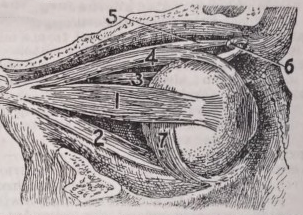
2. The organ of sight or vision; properly, the globe or ball movable in the orbit. The eye is nearly of a spherical figure, and composed of coats or tunics. But in the term eye we often or usually include the ball and the parts adjacent.
3. Sight; view; ocular knowledge; as, I have a man now in my eye In this sense, the plural is more generally used.
4. Before whose eyes Jesus Christ hath been evidently set forth, crucified among you. Galatians 3:1 .
5. Look; countenance.
6. I'll say yon gray is not the morning's eye
7. Front; face.
8. Her shall you hear disproved to your eyes.
9. Direct opposition; as, to sail in the wind's eye
10. Aspect; regard; respect; view.
11. Booksellers mention with respect the authors they have printed, and consequently have an eye to their own advantage.
12. Notice; observation; vigilance; watch.
13. After this jealousy, he kept a strict eye upon him.
14. View of the mind; opinion formed by observation or contemplation.
15. It hath, in their eye no great affinity with the form of the church of Rome.
16. Sight; view, either in a literal or figurative sense.
18. A small hole or aperture; a perforation; as the eye of a needle.
19. A small catch for a hook; as we say, hooks and eyes. in nearly the same sense, the word is applied to certain fastenings in the cordage of ships.
20. The bud of a plant; a shoot.
21. A small shade of color. [Little used.]
22. Red with an eye of blue makes a purple.
23. The power of perception.
24. The eyes of your understanding being enlightened. Ephesians 1:18 .
25. Oversight; inspection.
26. The eye of the master will do more work than both his hands.
27. The eyes of a ship, are the parts which lie near the hawse-holes, particularly in the lower apartments.
28. To set the eyes on, is to see; to have a sight of.
29. To find favor in the eyes, is to be graciously received and treated.
30. A brood; as an eye of pheasants.
To appear; to have an appearance.
1. To fix the eye on; to look on; to view; to observe; particularly, to observe or watch narrowly, or with fixed attention.
2. EYE nature's walks, shoot folly as it flies.
1. A brood; as, an eye of pheasants.
2. The organ of sight or vision. In man, and the vertebrates generally, it is properly the movable ball or globe in the orbit, but the term often includes the adjacent parts. In most invertebrates the years are immovable ocelli, or compound eyes made up of numerous ocelli. See Ocellus.
3. The faculty of seeing; power or range of vision; hence, judgment or taste in the use of the eye, and in judging of objects; as, to have the eye of sailor; an eye for the beautiful or picturesque.
4. The action of the organ of sight; sight, look; view; ocular knowledge; judgment; opinion.
5. The space commanded by the organ of sight; scope of vision; hence, face; front; the presence of an object which is directly opposed or confronted; immediate presence.
6. Observation; oversight; watch; inspection; notice; attention; regard.
7. That which resembles the organ of sight, in form, position, or appearance
9. The scar to which the adductor muscle is attached in oysters and other bivalve shells; also, the adductor muscle itself, esp. when used as food, as in the scallop.
11. The center of a target; the bull's-eye.
12. A small loop to receive a hook; as hooks and eyes on a dress.
13. The hole through the head of a needle.
14. A loop forming part of anything, or a hole through anything, to receive a rope, hook, pin, shaft, etc.; as an eye at the end of a tie bar in a bridge truss; as an eye through a crank; an eye at the end of rope.
15. The hole through the upper millstone.
16. That which resembles the eye in relative importance or beauty.
17. Tinge; shade of color.
To appear; to look.
To fix the eye on; to look on; to view; to observe; particularly, to observe or watch narrowly, or with fixed attention; to hold in view.
Eye
Encyclopedia Britannica
EYE...
THE sense of vision is excited by the influence of light on the retina, the special terminal organ connected with the optic nerve. By excitation of the retina, a change is induced in the optic nerve fibres, aud is conveyed by these to the brain, the result being a luminous perception, or what we call a sensation of light or colour. If light were to act uniformly over the retina, there would be no image of the source of the light formed on that structure, and consequently there would be only a general consciousness of light, without reference to any particular object. One of the first conditions, therefore, of vision for useful purposes is the formation of an image on the retina. To effect this, just as in a photographic camera, refractive structures must be placed in front of the retina which will so bend luminous rays as to bring them to a focus on the retina, and thus produce an image. Throughout the animal kingdom, various arrangements are found for this purpose; but they may be all referred to three types, namely—(1) eye-specks or eye-dots, met with in Medusae, Anneiidae, &c.; (2) the compound eye, as found in insects and crustaceans; and (3) the simple eye, common to all vertebrates. The eyespecks may be regarded simply as expansions of optic nerve filaments, covered by a transparent membrane, but having no refractive media, so that the creature would have the consciousness of light only, or a simple luminous impression, by which it might distinguish light from darkness. The compound eye (an account of which, as met with in the common lobster, will be found under Crustacea, vol. vi. p. 637) consists essentially of a series of transparent cone-like bodies, arranged in a radiate manner against the inner surface of the cornea, with which their bases are united, while their apices are connected with the ends of the optic filaments. As each cone is separated from its neighbours, it admits only a ray of light parallel with its axis, and its apex represents only a portion of the image, which must be made up, like a mosaic-work, of as many parts as there are cones in the eye. When the cones are of considerable length, it is evident, from their form and direction, their apices being directed inwards, that the oblique rays emanating from a luminous surface will be cut off, and that only those rays proceeding along the axis of the cone will produce an effect. Thus distinctness or sharpness of definition will be secured. The size of the visual field will depend on the form of the eye, the outermost cones marking its limits. Consequently the size of the visual field will depend on the size of the segment of the sphere forming its surface. The eyes of many insects have a field of about half a sphere, so that the creature will see objects before and behind it as well as those at the side. On the other hand, in many the eyes have scarcely any convexity, so that they must have a narrow field of vision.
A description of the simple eye will be found in the article Anatomy, vol. i. p. 885 s<p Optically, it consists of a series of refractive media placed in front of the retina by which rays emanating from an external object are brought to a focus on that structure. In this article, we shall consider (1) the physical causes of vision; (2) the optical arrangements of the eye; (3) the specific influence of light on the retina; (4) sensations of colour; (5) the movements of the eyes in vision; and (6) the psychical relations of luminous impressions.
1. Physical Causes of Vision.
A luminous sensation may be excited by various modes of irritation of the retina or of the optic nerve. Pressure, cutting, or electrical shocks may act as stimuli, but the normal excitation is the influence of light on the retina. From a physical point of view, light is a mode of movement occurring in a medium, termed the ether, which pervades all space; but the physiologist studies the operation of these movements on the sentient organism as resulting in consciousness of the particular kind which we term a luminous impression. Outside of the body, such movements have been studied with great accuracy; but the physiological effects depend upon such complex conditions as to make it impossible to state them in the same precise way. Thus, when we look at the spectrum, we are conscious of the sensations of red and violet, referable to its two extremities: the physicist states that red is produced by 392 billions of impulses on the retina per second, and that violet corresponds to 757 billions per second; but he has arrived at this information by inductive reasoning from many facts which have not at present any physiological explanation. We cannot at present trace any connexion, as cause and effect, between 392 billions of impulses on the retina per second and a sensation of red. Below the red and above the violet ends of the spectrum there are vibrations which do not excite luminous sensations. In the first case, below the red, the effect as a sensation is heat; and above the violet the result is that of chemical activity. Thus the method of dispersion of light, as is followed in passing a ray through a prism, enables us to recognize these general facts:—(1) rays below the red excite thermal impressions; (2) from the lower red up to the "middle of the violet, the thermal rays become gradually weaker until they have no effect; (3) from the lower red to the extreme violet, they cause luminous impressions, which reach their greatest intensity in the yellow; and (4) from about the end of the yellow to far beyond the extreme violet, the rays have gradually a less and less luminous effect, but they have the power of exciting such chemical changes as are produced in photography. In general terms, therefore, the lower end of the spectrum may be called thermal, the middle luminous, and the upper actinic or chemical; but the three merge into and overlap one another. It may be observed that the number of vibrations in the extreme violet is not double that of the low red, so that the sensibility of the eye to vibrations of light does not range through an octave. The ultra-violet rays may act on the retina in certain conditions, as when they are reflected by a solution of sulphate of quinine, constituting the phenomenon of fluorescence.
2. Optical Arrangements of the Eye.
(1.) General.— When light traverses any homogeneous transparent medium, such as the air, it passes on in a straight course with a certain velocity; but if it meet with any other transparent body of a different density, part of it is reflected or returned to the first medium, whilst the remainder is propagated through the second medium in a different direction and with a different velocity. Thus we may account for the phenomena of reflection and of refraction, for which see the article Light. Let a b, in fig. 1, be a plane surface of some transparent substance, say a sheet of glass; a ray, c d, perpendicular to the surface, will pass through without refraction; but an oblique ray, e f, will be sent in the direction e h. If the ray e h had passed from a dense into a rarer medium, then the direction would have been e g. It might also be shown that the sine of the angle of incidence always bears a certain ratio to the sine of the angle of refraction; this ratio is termed the index of refraction. Thus, if a ray pass from air into water, the sine of the angle of incidence will have to the sine of the angle of the refraction the ratio of 4: 3, or ⅜.
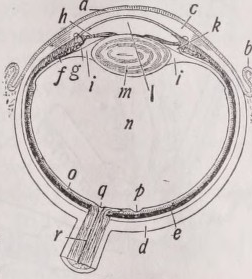
Before a ray of light can reach the retina, it must pass through a number of transparent and refractive surfaces. The eye is a nearly spherical organ, formed of transparent parts situated behind each other, and surrounded by various membranous structures, the anterior part of which is also transparent. The transparent parts are—(1) the cornea; (2) the aqueous humour, found in the anterior chamber of the eye; (3) the crystalline lens, formed by a transparent convex body, the anterior surface of which is less convex than the posterior; and (4) the vitreous humour, filling the posterior chamber of the eye. The ray must therefore traverse the cornea, aqueous humour, lens, and vitreous humour. As the two surfaces of the cornea are parallel, the rays practically suffer no deviation in passing through that structure, but they are bent or refracted during their transmission through the other media.
From the optical point of view, the eye may be regarded as a dioptric system consisting of various refractive media. In such a system, as shown by Gauss, there are six cardinal points, which have a certain relation to each other. These are—
Two focal points: every ray passing through theirs/ focal point becomes, after its refraction, parallel to the axis, and every ray which before refraction is parallel to the axis passes after its refraction to the seco nd focal point; (2) Two principal points: every ray which passes through the first point before refraction passes after refraction through the second, and every ray which passes through any point of a plane elevated on a perpendicular axis from the first principal point (the first principal plane) passes through the corresponding point of an analogous plane raised upon the axis at the second principal point (the second principal plane) ; and (3) Two nodal points, which correspond to the optical centres of the two principal planes just alluded to. The distance of the first principal point from the first focal point is called the anterior focal length, and the term posterior focal length is applied to the distance of the posterior focal point from the second principal point. Listing has given the following measurements in millimetres from the centre of the cornea for the cardinal points in an ideal eye :— [table]
A view of such an ideal eye is shown in fig. 2.
The remaining measurements of such an eye are as follows:— [table]
The optical constants of the human eye may be still further simplified by assuming that the two principal points and the two nodal points respectively are identical. Thus we may construct a reduced eye, in which the principal point is 2 - 3448 mm. behind the cornea, and the nodal point is 7 ’ 4969 mm., having an anterior focal length of 15 mm. and a posterior focal length of 20 mm. The refracting surface, or lens, has a radius of 5 mm., and is 3 mm. behind the cornea; and the index of refraction is that of the aqueous humour, or 1 τ 0 √ 3 .
(2.) The Formation of an Image on the Petina.— This may be well illustrated with the aid of an ordinary photographic camera. If properly focussed, an inverted image will be seen on the glass plate at the back of the camera. It may also be observed by bringing the eye-ball of a rabbit near a candle flame. The action of a leDs in forming an inverted image is illustrated by fig. 3, where the pencil of rays proceeding from a is brought to a focus at α', and those from b at b', consequently the image of a b is inverted as at Ca'. The three characteristic features of the retinal image are—(1) it is reversed; (2) it is sharp and well defined if it be accurately focussed on the retina; and (3) its size depends on the visual angle. If we look at a distant object, say a star, the rays reaching the eye are parallel, and in passing through the refractive media, they are focussed at the posterior focal point,—that is, on the retina. A line from the luminous point on the retina passing through the nodal point is called the line of direction. If the luminous object be not nearer than, say, 60 yards, the image is still brought to a focus on the retina without any effort on the part of the eye. Within this distance, supposing the condition of the eye to be the same as in looking at a star, the image would be formed somewhat behind the posterior focal point, and the effect would be an indistinct impression on the retina. To obviate this, for near distances, accommodation, so as to adapt the eye, is effected by a mechanism to be afterwards described.
When rays, reflected from an object or coming from a luminous point, are not brought to an accurate focus on the retina, the image is not distinct iu consequence of the formation of what are called circles of diffusion, the production of which will be rendered evident by fig. 4. From the point A luminous rays enter the eye in the form of a cone, the kind of which will depend on the pupil. Thus it may be circular, or oval, or even triangular. If the pencil is focussed in front of the retina, as at d i or behind it as at f, or, in other words, if the retina, in place of being at F, be in the positions G or H, there will be a luminous circle or a luminous triangular space, and many elements of the retina will be affected. The size of these diffusion circles depends on the distance from the retina of the point where the rays are focussed: the greater the distance, the more extended will be the diffusion circle. Its size will also be affected by the greater or less diameter of the pupil. Circles of diffusion may be readily studied by the following experiment, usually called the experiment of Scheiner :—
Let C be a lens, and D E F be screens placed behind it; hold in front of the lens a card perforated by two holes A and B, and allow rays from a luminous point a to pass through these holes; the point o on the screen E will be exact focus of the rays emanating from a; if a were removed farther from the lens, the focus would be on t, and if it were brought near to C, the focus would then be on D. The screens F and D show two images of the point α. If, then, we close the upper opening in A B, the upper image m on F, and the lower image η on D, disappear. Suppose now that tlιe retina be substituted for the screens D and F, the contrary will take place, in consequence of the reversal of the retinal image.
i th? e Y e ^* e p1 ac θd a ∙t ο, only one image will be seen; but if it be placed either in the plane of F or D, then two images will be seen, as at m m t or η n ; consequently in either of these planes there ", be circles of diffusion and indistinctness, and only iu the plane E will there be sharp definition of the image,
To understand the formation of an image on the retina, suppose a line drawn from each of its two extremities to the nodal point and continued onwards to the retina, as in fig. 6, where the visual angle is x. It is evident that its size will depend on the size of the object and the distance of the object from the eye. Thus, also, objects of different sizes, c, d, e, in fig. 6, may be included in the same visual angle, as they are at different distances from the eye. The size of the retinal image may obviously be calculated if we know the size of the object, its distance from the nodal point o, and the distance of the nodal point from the posterior focus. Let A be the size of the object, B its distance from the nodal point, and C the distance of o from the retina, or 15 mm.; then the size of the retinal image x = ——. The smallest visual angle in which two distinct points may be observed is 60 seconds; below this, the two sensations fuse into one; and the size of the retinal image corresponding to this angle is.004 mm., nearly the diameter of a single retinal rod or cone. Two objects, therefore, included in a visual angle of less than 60 seconds, appear as one point. A small visual angle is in most eyes a condition of sharpness of definition. With a large angle, objects appear less sharply marked. Acuteness is determined by a few retinal elements, or even only one, being affected. A very minute image, if thrown on a single retinal element, is apparently sufficient to excite it. Thus it is possible to see a brilliant point in an angle even so small as I of a second, and a sharp eye can see a body the -⅛th of a line in diameter, that is, about the ^⅜ σ th part of an inch.
(3.) The Optical Defects of the Eye.— As an optical instrument, the eye is defective; but from habit, and want of attention, its defects are not appreciated, and consequently they have little or no influence on our sensations. These defects are chiefly of two kinds—(1) those due to the curvature of the refractive surfaces, and (2) those due to the dispersion of light by the refractive media.
(a) Aberration of Sj)hericity.— Suppose, as in fig. 7, M A K to be a refractive surface on which parallel rays from L to S impinge, it will be seen that those rays passing near the circumference are brought to a focus at F 1 , and those passing near the centre at F 2 ,—intermediate rays being focussed at N. Thus on the portion of the axis between F 1 and F 2 there will be a series of focal points, and the effect -will be a blurred and bent image. In the eye this defect is to a large extent corrected by the following arrangements :—(1) the iris cuts off the outer and more strongly refracted rays; (2) the curvature of the cornea is more ellipsoidal than spherical, and consequently those farthest from the axis are least deviated; (3) the anterior and posterior curvatures of the lens are such that the one corrects, to a certain extent, the action of the other; and (4) the structure of the lens is such that its power of refraction diminishes from the centre to the circumference, and consequently the rays farthest from the axis are less refracted.
(6) Astigmatism.— Another defect of the eye is due to different meridians having different degrees of curvature. This defect is known as astigmatism. It may be thus detected. Draw on a sheet of white paper a vertical and a horizontal line with ink, crossing at a right angle; at the point of distinct vision, it will be found impossible to see thé lines with equal distinctness at the same time: to see the horizontal line distinctly the paper must be brought near the eye, and removed from it to see the vertical. In the cornea the vertical meridian has a shorter radius of curvature, and is consequently more refractive than the horizontal. The meridians of the lens may also vary; but, as a rule, the asymmetry of the cornea is greater than that of the lens. The optical explanation of the defect will be understood with the aid of fig. 8.
Thus, suppose the vertical meridian C A D to be more strongly curved than the horizontal F A E, the rays which fall on C A D will be brought to a focus G, and those falling on F A E at B. If we divide the pencil of rays at successive points, G, H, I, K, B, by a section perpendicular to A B, the various forms it would present at these points are seen in the figures underneath, so that if the eye were placed at G, it would see a horizontal line a a ∙, if at H, an ellipse with the long axis a a parallel to A B; if at I, a circle; if at K, an ellipse, with the long axis, b c, at right angles to A B; and if at B, a vertical line b c. The degree of astigmatism is ascertained by measuring the difference of refraction in the two chief meridians; and the defect is corrected by the use of cylindrical glasses, the curvature of which, added to that of the minimum meridian, makes its focal length equal to that of the maximum meridian.
(c) Aberration of Refraηgibility.—...
9th ed. Encyclopædia Britannica, vol. 8, p. 816
[13,472 words — estimated reading time: 1.3 hours]
[13,472 words — estimated reading time: 1.3 hours]
Eye
Watson's Biblical & Theological Dictionary
the organ of sight. The Hebrews by a curious and bold metaphor call fountains eyes; and they also give the same name to colours: “And the eye,” or colour, “of the manna was as the eye,” or colour, “of bdellium,” Num. xi, 7. By an “evil eye” is meant, envy, jealousy, grudging, ill-judged parsimony; to turn the eyes on any one, is to regard him and his interests; to find grace in any one’s eyes, Ruth ii, 10, is to win his friendship and good will. “The eyes of servants look unto the hands of their masters,” Psalm cxxiii, 2, to observe the least motion, and obey the least signal. “Their eyes were opened,” Gen. iii, 7, they began to comprehend in a new manner. “The wise man’s eyes are in his head,” Eccles. ii, 14, he does not act by chance. The eye of the soul, in a moral sense, is the intention, the desire. God threatens to set his eyes on the Israelites for evil, and not for good, Amos ix, 4. Nebuchadnezzar recommends to Nebuzaradan that he would “set his eyes” on Jeremiah, and permit him to go where he pleased, Jer. xxxix, 12; xl, 4. Sometimes expressions of this kind are taken in a quite opposite sense: “Behold, the eyes of the Lord are on the sinful kingdom; and I will destroy it,” Amos ix, 8. To be eyes to the blind, or to serve them instead of eyes, is sufficiently intelligible, Job xxix, 15. The Persians called those officers of the crown who had the care of the king’s interests and the management of his finances, the king’s eyes. Eye service is peculiar to slaves, who are governed by fear only; and is to be carefully guarded against by Christians, who ought to serve from a principle of duty and affection, Eph. vi, 6; Col. iii, 22. The lust of the eyes, or the desire of the eyes, comprehends every thing that curiosity, ...vanity, &c, seek after; every thing that the eyes can present to men given up to their passions, 1 John ii, 16. “Cast ye away every man the abomination of his eyes,” Ezek. xx, 7, 8; let not the idols of the Egyptians seduce you. The height or elevation of the eyes is taken for pride, Eccles. xxiii, 5. St. Paul says that the Galatians would willingly have “plucked out their eyes” for him, Gal. iv, 15; expressing the intensity of their zeal, affection, and devotion to him. The Hebrews call the apple of the eye the black daughter of the eye. To keep any thing as the apple of the eye, is to preserve it with particular care, Deut. xxxii, 10: “He that toucheth you, toucheth the apple of mine eye,” Zech. ii, 8; attempts to injure me in the tenderest part, which men instinctively defend. The eye and its actions are occasionally transferred to God: “The eyes of the Lord run to and fro through the whole earth,” Zech. iv, 10; 2 Chron. xvi, 9; Psalm xi, 4. “The eyes of the Lord are in every place, beholding the evil and the good,” Proverbs xv, 3. “The Lord looked down from heaven,” &c. We read, Matthew vi, 22, “The light,” or lamp, “of the body is the eye; if therefore thine eye be single,” simple, clear, ἁπλοῦς, “thy whole body shall be full of light; but if thine eye be evil,” distempered, diseased, “thy whole body shall be darkened.” The direct allusion may hold to a lantern, or lamp, λύχνος; if the glass of it be clear, the light will shine through it strongly; but if the glass be soiled, dirty, foul, but little light will pass through it: for if they had not glass lanterns, such as we use, they had others in the east made of thin linen, &c: these were very liable to receive spots, stains, and foulnesses, which impeded the passage of the rays of light from the luminary within. So, in the natural eye, if the cornea be single, and the humours clear, the light will act correctly; but if there be a film over the cornea, or a cataract, or a skin between any of the humours, the rays of light will never make any impression on the internal seat of sight, the retina. By analogy, therefore, if the mental eye, the judgment, be honest, virtuous, sincere, well-meaning, pious, it may be considered as enlightening and directing the whole of a person’s actions; but if it be perverse, malign, biassed by undue prejudices, or drawn aside by improper views, it darkens the understanding, perverts the conduct, and suffers a man to be misled by his unwise and unruly passions.
The orientals, in some cases, deprive the criminal of the light of day, by sealing up his eyes. A son of the great Mogul was actually suffering this punishment when Sir Thomas Roe visited the court of Delhi. The hapless youth was cast into prison, and deprived of the light by some adhesive plaster put upon his eyes, for the space of three years; after which the seal was taken away, that he might with freedom enjoy the light; but he was still detained in prison. Other princes have been treated in a different manner, to prevent them from conspiring against the reigning monarch, or meddling with affairs of state: they have been compelled to swallow opium and other stupifying drugs, to weaken or benumb their faculties, and render them unfit for business. Influenced by such absurd and cruel policy, Shah Abbas, the celebrated Persian monarch, who died in 1629, ordered a certain quantity of opium to be given every day to his grandson, who was to be his successor, to stupify him, and prevent him from disturbing his government. Such are probably the circumstances alluded to by the prophet: “They have not known nor understood; for he hath shut their eyes that they cannot see; and their hearts that they cannot understand,” Isaiah xliv, 18. The verb טוח, rendered in our version, _to shut_, signifies “to overlay,” “to cover over the surface;” thus, the king of Israel prepared three thousand talents of gold, and seven thousand talents of refined silver, to _overlay_ the walls of the temple, 1 Chron. xxix, 4. But it generally signifies to _overspread_, or daub over, as with mortar or plaster, of which Parkhurst quotes a number of examples; a sense which entirely corresponds with the manner in which the eyes of a criminal are sealed up in some parts of the east. The practice of sealing up the eyes, and stupifying a criminal with drugs, seems to have been contemplated by the same prophet in another passage of his book: “Make the heart of this people fat, and make their ears heavy, and shut their eyes, lest they see with their eyes, and hear with their ears, and understand with their heart, and convert and be healed.”
Deprivation of sight was a very common punishment in the east. It was at first the practice to sear the eyes with a hot iron; but a discovery that this was not effectual, led to the cruel method of taking them out altogether with a sharp-pointed instrument. The objects of this barbarity were usually persons who aspired to the throne, or who were considered likely to make such an attempt. It was also inflicted on chieftains, whom it was desirable to deprive of power without putting them to death. For this reason the hapless Zedekiah was punished with the loss of sight, because he had rebelled against the king of Babylon, and endeavoured to recover the independence of his throne: “Then he put out the eyes of Zedekiah; and the king of Babylon bound him in chains, and carried him to Babylon, and put him in prison till the day of his death,” Jer. lii, 11.
Females used to paint their eyes. The substance used for this purpose is called in Chaldee כהל, _cohol_; by the LXX, ϛίβι. Thus we read of Jezebel, 2 Kings ix, 30, that, understanding that Jehu was to enter Samaria, she decked herself for his reception, and (as in the original Hebrew) “put her eyes in paint.” This was in conformity to a custom which prevailed in the earliest ages. As large black eyes were thought the finest, the women, to increase their lustre, and to make them appear larger, tinged the corner of their eyelids with the impalpable powder of antimony or of black lead. This was supposed also to give the eyes a brilliancy and humidity, which rendered them either sparkling or languishing, as suited the various passions. The method of performing this among the women in the eastern countries at the present day, as described by Russel, is by a cylindrical piece of silver or ivory, about two inches long, made very smooth, and about the size of a common probe; this is wet with water, and then dipped into a powder finely levigated, made from what appears to be a rich lead ore, and applied to the eye; the lids are closed upon it while it is drawn through between them. This blacks the inside, and leaves a narrow black rim all round the edge. That this was the method practised by the Hebrew women, we infer from Isaiah iii, 22, where the prophet, in his enumeration of the articles which composed the toilets of the delicate and luxurious daughters of Zion, mentions “the wimples and the crisping pins,” or bodkins for painting the eyes. The satirist Juvenal describes the same practice:-- _Ille supercilium madida fuligine tinctum Obliqua producit acu, pingitque trementes Attollens oculos._ SAT. ii. “These with a tiring pin their eyebrows dye Till the full arch give lustre to the eye.” GIFFORD. This custom is referred to by Jeremiah, iv, 30:-- “Though thou clothest thyself in scarlet, Though thou adornest thyself with ornaments of gold, Though thou distendest thine eyes with paint, In vain shalt thou set forth thy beauty; Thy paramours have rejected thee.” And Ezekiel, describing the irregularities of the Jewish nation, under the idea of a debauched woman, says, כחלת עיניך, “Thou didst dress thine eyes with cohol;” which the Septuagint render, Ἐϛιϐίζȣ τοὺς ὀφθαλμοὺς σου, “Thou didst dress thine eyes with stibium,” Ezek. xxiii, 40.
The passage, Psalm cxxiii, 2, derives a striking illustration from the customs of the east. The servants or slaves in eastern countries attend their masters or mistresses with the profoundest respect. Maundrell observes, that the servants in Turkey stand round their master and his guests in deep silence and perfect order, watching every motion. Pococke says, that at a visit in Egypt every thing is done with the greatest decency and the most profound silence, the slaves or servants standing at the bottom of the room, with their hands joined before them, watching with the utmost attention every motion of their master, who commands them by signs. De la Motraye says, that the eastern ladies are waited on even at the least wink of the eye, or motion of the fingers, and that in a manner not perceptible to strangers.
Watson's Biblical & Theological Dictionary
[785 words — estimated reading time: 5 minutes]
[785 words — estimated reading time: 5 minutes]
A clearing of the sight.
A feasting of the eyes. [Not in use.]
That hurts the eyes.
Pleasing the eye.
An object of interest to the eye; one worshiped with the eyes.
A servant who attends to his duty only when watched, or under the eye of his master or employer.
1. Service performed only under inspection or the eye of an employer.
2. Not with eye-service as men-pleasers; but in singleness of heart, fearing God. Colossians 3:1 .
1. A simple visual organ found in many invertebrates, consisting of pigment cells covering a sensory nerve termination.
2. An eyelike spot of color.
Marked with spots like eyes.
1. One who sees a thing done; one who has ocular view of any thing.
2. We were eye-witnesses of his majesty. 2 Peter 1:1 .
No thesaurus entries found for "ey".
Type at least 3 letters to search the Bible, or a reference such as John 3:16.