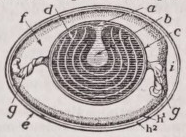
EGG, the name given to the body formed in the female reproductive organs, which, when impregnated by the male element, gives origin to the young of animals. Although differing widely among themselves in form and structure, the eggs of all animals are found to consist of the same essential parts, viz., the germ cell, the yolk, and the yolk membrane, one chief difference between them consisting in the relative quantity of the yolk element present, this apparently depending on the degree of development which the young attain before leaving the egg. Thus birds, which leave the shell in a highly developed state, have in their eggs a large quantity of yolk, besides the albumen or “white,” which is added to the egg before it receives the outer calcaιeous covering and which, along with the yolk, serves as a storehouse of food for the youug chick during the process of incubation. In insects, on the other hand, which leave the egg in the immature condition of larvae, the yolk is comparatively small, as it is also in mammals, whose eggs or ova are exceedingly minute, and which owe the high development they attain before birth to nourishment drawn directly from the parent. The majority of animals are oviparous,— that is, the eggs leave the body of the female and are hatched outside; a few are ovo-viviparous, the eggs being retained in the oviduct until the young are ready to leave; while mammals are viviparous, the young, after leaving the egg, attaining considerable development before birth, in the womb of the female. In oviparous animals the egg, within certain limits, is proportional in size to that of the adult form to which it gives origin; the larger the bird, for example, the larger, as a rule, is the egg. This, however, is not without exceptions; thus the egg of the ...guillemot is as large as that of the eagle, and ten times larger than that of the raven, although guillemot and raven are of nearly equal size.
Owiug to the fluid nature of the contents of eggs, they are generally roundish in form, although in this respect they also offer considerable variety; thus the eggs of owls and of turtles are nearly spherical, those of ducks, crocodiles, and snakes oval, and those of most sea-fowl pear-shaped. The external covering is generally more or less smooth, as in the eggs of birds, but in the case of insects they exhibit the most varied markings, being covered with spines, tubercles, and pits, often symmetrically arranged. Considerable diversity also exists in the composition of the outer covering of the egg in oviparous animals; in snakes and lizards it consists of a parchment-like membrane not unlike the inner coating of a hen’s egg; in birds, turtles, and crocodiles, there is a hard calcareous shell; in cartilaginous fishes, as sharks and rays, the egg in passing through the oviduct is imbedded in a four-sided horny case, from the corners of which tendrils are given off, by which the egg-capsule is moored to floating sea-weed. These, after the escape of the young fish, are often cast upon the shore, where they are familiarly known as “mermaids’ purses.” The external covering of the eggs of osseous fishes, as salmon and trout, is exceedingly tough and elastic, “rebounding,” says Mr Frank Buckland, “from the floor like an india-rubber ball;” and this no doubt prevents them from being crushed in the gravelly beds of the running streams in which they are deposited. The eggs of frogs and toads are surrounded with a tough layer of albuminous substance, which expands in water into a transparent jelly. The eggs of the frog occur in great masses, piled together like miniature cannon balls, while those of the toad are connected together so as to resemble strings of beads. Among many molluscous animals the eggs are provided with an additional covering or nidus, consisting of a leathery pouch or cup, containing a large number of eggs. These capsules are either attached singly, by little stalks, to the rocks as in the common purpura (Purpura lapillus), or are extruded in a compound mass as in the whelk (j5wcc⅛⅛τn undatum). Those of the latter were named by Ellis “sea wash balls,” from being used by the sailors instead of soap to wash their hands, and are common objects on the sea-shore. The greatest variety exists in the number of eggs produced by different animals, and even among forms allied to each other. Thus the common snail produces only from thirty to fifty eggs at a time, while other mollusks, as the whelk, deposit their spawn in tens of thousands. Among insects, the white ant is pre-eminently prolific, the queen being said to lay about sixty eggs in a minute, or upwards of 80,000 in a day, and as this probably continues for two years, it is estimated that the total number of her eggs amounts to fifty millions. Among mollusks the spawn or spat, as it is called, in a single mature oyster, numbers 1,800,000. Among vertebrate animals, fish are the most prolific; the eggs or roe, as they are called, however, often fail to get fertilized by the milt of the male, and great quantities are also eaten by fishes and crustaceans, so that they do not increase so rapidly as might be supposed from the enormous number of their eggs. Thus in trout and salmon there are over a thousand eggs to every pound of their weight. According to Buckland {Fish Culture) a roach weighing f lb was found to contain 480,480 eggs; a herring weighing ⅜ lb, 19,840; a turbot of 8 lb weight, 385,200; and a cod of 20 lb, 4,872,000. Large quantities of the roe of the cod are used in France as food, and also as bait in the sardine fishery. The sturgeon is also exceedingly prolific, the eggs usually forming one-third of the entire weight of the creature; and in Russia these, in a prepared form known as caviare, are much esteemed as a table delicacy. The number of eggs in reptiles and birds is comparatively small, the common English snake depositing 16 to 20 of these in such situations as dung-hills, where they are left to be hatched by the heat generated in the decomposing mass. The crocodile buries about 25 eggs on the muddy banks of the rivers it frequents, and the turtle leaves the ocean to deposit from 150 to 200 on the shores of such oceanic islands as Ascension. The eggs of the crocodile are considered a luxury by the natives along the banks of the Nile, while those of the turtle are regarded as special delicacies by people of more refined tastes. Of birds, the most prolific in eggs are those domesticated forms which have been carefully selected by man for centuries, with a view to the improvement of their egg-laying capacity. The chief of these are the duck, which lays an egg daily during the season extending from March to July, and the barn-door fowl, which produces annually about 120 eggs. The rearing of the latter for egg-producing purposes has now become an important industry in France and Belgium, and in a customs’ return just issued (July 1877) it is stated that eggs were imported into Britain last year to the extent of 753 millions, valued at £2,620,000. The number has increased 41 per cent, since 1872, and it is now nearly seven times what it was in 1856. Besides these, the eggs of the turkey, the guinea fowl, the partridge, and other gallinaceous birds are in great request as articles of food. The eggs of the guillemot are also occasionally offered for sale in our markets, while these and the eggs of other species of seafowl form an important article of food among the western islands and along the north-western sea-coast of Scotland. The largest eggs are those produced by the emu and the ostrich, a single ostrich egg weighing as much as three dozen eggs of the barn-door fowl. These are eaten in Africa both by the natives and by Europeans. From two to five female ostriches are said to deposit their eggs (10 in number) in one nest, and the natives by removing, during the absence of the female, a few of these at a time, taking care not to touch them with their fingers, but using sticks to prevent any taint of their presence being left behind, get them to continue depositing eggs for a considerable time to supply the place of those removed. The shells are used throughout Africa as drinking-cups. The egg of the moa, some specimens of which have been found buried in New Zealand, is much larger than that of the ostrich, measuring in one specimen 10 inches in length and 7 inches broad. A still larger egg has been found fossil in Madagascar, the produce of the extinct aepiornis, and having a capacity equal to that of 148 eggs of the common fowl.
See Hewitson, Coloured Illustrations of the Eggs of British Birds, 8vo, 3d ed., London, 1856; C. F. Morris, A Natural History of the Nests and Eggs of Birds, 3 vols., London; Lefevre, Atlas des oeufs des oiseaux d Europe, 8vo, Paris, 1845; Brewer, North American Oology, 4to, Washington, 1859; Bädeker, Die Eier der Europäischen Vogel, Leipsic, 1863.
EGG, Augustus Leopold (1816-1863), a painter, was born on 2d May 1816, in Piccadilly, London, where his father carried on business as a gun-maker. He had some schooling at Bexley, and was not at first intended for the artistic profession; but, developing a faculty in this line, he entered in 1834 the drawing class of Mr Sass, and in 1835 the school of the Royal Academy. His first exhibited picture appeared in 1837 at the Suffolk Street Gallery. Iu 1838 he began exhibiting in the Academy, his subject being a Spanish Girl; altogether he sent twenty-seven works to this institution. In 1848 he became an associate, and in 1860 a full member, of the Academy. In 1857 he took a leading part in selecting and arranging the modern paintings in the Art-Treasures Exhibition in Manchester. His constitution being naturally frail, he went in 1853, with Dickens and Wilkie Collins, to Italy for a short trip, and in 1863 he visited Algeria. Here he benefited so far as his chronic lung-disease was concerned; but, riding out one day exposed to a cold wind, he caught an attack of asthma, which cut him off on 26th March 1863, at Algiers, near which city his remains were buried.
Egg was a gifted and well-trained painter of genre, chiefly in the way of historical anecdote, or of compositions from the poets and novelists. As years progressed, he developed in seriousness of subject-matter and of artistic treatment; and at the time of his death he might be ranked among our best painters in his particular class—clever, skilled, and observaut—although he had not any marked originality of point of view or of style. Among his principal pictures may be named :—1843, the Introduction of Sir Piercie Shafton and Halbert Glendinning (from Scott’s Monastery); 1846, Buckingham Rebuffed; 1848, Queen Elizabeth discovers she is no longer young; 1850, Peter the Great sees Catharine for the first time; 1854, Charles I. raising the Standard at Nottingham (a study); 1855, the Life and Death of Buckingham; 1857 and 1858, two subjects from Thackeray’s Esmond; 1858, Past and Present, a triple picture of a faithless wife; 1859, the Night before Naseby; 1860, his last exhibited work, the Dinner Scene from The Taming of the Shrew. The National Gallery contains one of his earlier pictures, Patricio entertaining two Ladies, from the Diable Boiteux; it was painted in 1844.
Egg was rather below the middle height, with dark hair and a handsome well-formed face; the head of Peter the Great (in the picture of Peter and Catharine, which may be regarded as his best work, along with the Life and Death of Buckingham) was studied, but of course considerably modified, from his own countenance. He was manly, kind-hearted, pleasant, and very genial and serviceable among brother-artists; social and companionable, but holding mainly aloof from fashionable circles. As an actor he had uncommon talent. He appeared among Dickens’s company of amateurs, in 1852 in Lord Lytton’s comedy Not so Pad as we Seem, and afterwards in Wilkie Collins’s Frozen Deep, playing the humorous part of Job Want.