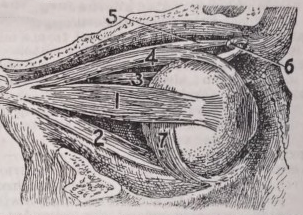
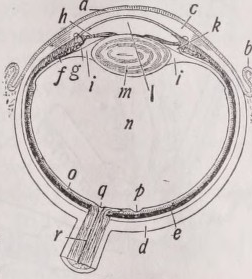
THE sense of vision is excited by the influence of light on the retina, the special terminal organ connected with the optic nerve. By excitation of the retina, a change is induced in the optic nerve fibres, aud is conveyed by these to the brain, the result being a luminous perception, or what we call a sensation of light or colour. If light were to act uniformly over the retina, there would be no image of the source of the light formed on that structure, and consequently there would be only a general consciousness of light, without reference to any particular object. One of the first conditions, therefore, of vision for useful purposes is the formation of an image on the retina. To effect this, just as in a photographic camera, refractive structures must be placed in front of the retina which will so bend luminous rays as to bring them to a focus on the retina, and thus produce an image. Throughout the animal kingdom, various arrangements are found for this purpose; but they may be all referred to three types, namely—(1) eye-specks or eye-dots, met with in Medusae, Anneiidae, &c.; (2) the compound eye, as found in insects and crustaceans; and (3) the simple eye, common to all vertebrates. The eyespecks may be regarded simply as expansions of optic nerve filaments, covered by a transparent membrane, but having no refractive media, so that the creature would have the consciousness of light only, or a simple luminous impression, by which it might distinguish light from darkness. The compound eye (an account of which, as met with in the common lobster, will be found under Crustacea, vol. vi. p. 637) consists essentially of a series of transparent cone-like bodies, arranged in a radiate manner against the inner surface of the cornea, with which their bases are united, while their apices are connected with the ends of the optic filaments. As each cone is separated from its neighbours, it admits only a ray of light parallel with its axis, and its apex represents only a portion of the image, which must be made up, like a mosaic-work, of as many parts as there are cones in the eye. When the cones are of considerable length, it is evident, from their form and direction, their apices being directed inwards, that the oblique rays emanating from a luminous surface will be cut off, and that only those rays proceeding along the axis of the cone will produce an effect. Thus distinctness or sharpness of definition will be secured. The size of the visual field will depend on the form of the eye, the outermost cones marking its limits. Consequently the size of the visual field will depend on the size of the segment of the sphere forming its surface. The eyes of many insects have a field of about half a sphere, so that the creature will see objects before and behind it as well as those at the side. On the other hand, in many the eyes have scarcely any convexity, so that they must have a narrow field of vision.
A description of the simple eye will be found in the article Anatomy, vol. i. p. 885 s<p Optically, it consists of a series of refractive media placed in front of the retina by which rays emanating from an external object are brought to a focus on that structure. In this article, we shall consider (1) the physical causes of vision; (2) the optical arrangements of the eye; (3) the specific influence of light on the retina; (4) sensations of colour; (5) the movements of the eyes in vision; and (6) the psychical relations of luminous impressions.
1. Physical Causes of Vision.
A luminous sensation may be excited by various modes of irritation of the retina or of the optic nerve. Pressure, cutting, or electrical shocks may act as stimuli, but the normal excitation is the influence of light on the retina. From a physical point of view, light is a mode of movement occurring in a medium, termed the ether, which pervades all space; but the physiologist studies the operation of these movements on the sentient organism as resulting in consciousness of the particular kind which we term a luminous impression. Outside of the body, such movements have been studied with great accuracy; but the physiological effects depend upon such complex conditions as to make it impossible to state them in the same precise way. Thus, when we look at the spectrum, we are conscious of the sensations of red and violet, referable to its two extremities: the physicist states that red is produced by 392 billions of impulses on the retina per second, and that violet corresponds to 757 billions per second; but he has arrived at this information by inductive reasoning from many facts which have not at present any physiological explanation. We cannot at present trace any connexion, as cause and effect, between 392 billions of impulses on the retina per second and a sensation of red. Below the red and above the violet ends of the spectrum there are vibrations which do not excite luminous sensations. In the first case, below the red, the effect as a sensation is heat; and above the violet the result is that of chemical activity. Thus the method of dispersion of light, as is followed in passing a ray through a prism, enables us to recognize these general facts:—(1) rays below the red excite thermal impressions; (2) from the lower red up to the "middle of the violet, the thermal rays become gradually weaker until they have no effect; (3) from the lower red to the extreme violet, they cause luminous impressions, which reach their greatest intensity in the yellow; and (4) from about the end of the yellow to far beyond the extreme violet, the rays have gradually a less and less luminous effect, but they have the power of exciting such chemical changes as are produced in photography. In general terms, therefore, the lower end of the spectrum may be called thermal, the middle luminous, and the upper actinic or chemical; but the three merge into and overlap one another. It may be observed that the number of vibrations in the extreme violet is not double that of the low red, so that the sensibility of the eye to vibrations of light does not range through an octave. The ultra-violet rays may act on the retina in certain conditions, as when they are reflected by a solution of sulphate of quinine, constituting the phenomenon of fluorescence.
2. Optical Arrangements of the Eye.
(1.) General.— When light traverses any homogeneous transparent medium, such as the air, it passes on in a straight course with a certain velocity; but if it meet with any other transparent body of a different density, part of it is reflected or returned to the first medium, whilst the remainder is propagated through the second medium in a different direction and with a different velocity. Thus we may account for the phenomena of reflection and of refraction, for which see the article Light. Let a b, in fig. 1, be a plane surface of some transparent substance, say a sheet of glass; a ray, c d, perpendicular to the surface, will pass through without refraction; but an oblique ray, e f, will be sent in the direction e h. If the ray e h had passed from a dense into a rarer medium, then the direction would have been e g. It might also be shown that the sine of the angle of incidence always bears a certain ratio to the sine of the angle of refraction; this ratio is termed the index of refraction. Thus, if a ray pass from air into water, the sine of the angle of incidence will have to the sine of the angle of the refraction the ratio of 4: 3, or ⅜.
Before a ray of light can reach the retina, it must pass through a number of transparent and refractive surfaces. The eye is a nearly spherical organ, formed of transparent parts situated behind each other, and surrounded by various membranous structures, the anterior part of which is also transparent. The transparent parts are—(1) the cornea; (2) the aqueous humour, found in the anterior chamber of the eye; (3) the crystalline lens, formed by a transparent convex body, the anterior surface of which is less convex than the posterior; and (4) the vitreous humour, filling the posterior chamber of the eye. The ray must therefore traverse the cornea, aqueous humour, lens, and vitreous humour. As the two surfaces of the cornea are parallel, the rays practically suffer no deviation in passing through that structure, but they are bent or refracted during their transmission through the other media.
From the optical point of view, the eye may be regarded as a dioptric system consisting of various refractive media. In such a system, as shown by Gauss, there are six cardinal points, which have a certain relation to each other. These are—
Two focal points: every ray passing through theirs/ focal point becomes, after its refraction, parallel to the axis, and every ray which before refraction is parallel to the axis passes after its refraction to the seco nd focal point; (2) Two principal points: every ray which passes through the first point before refraction passes after refraction through the second, and every ray which passes through any point of a plane elevated on a perpendicular axis from the first principal point (the first principal plane) passes through the corresponding point of an analogous plane raised upon the axis at the second principal point (the second principal plane) ; and (3) Two nodal points, which correspond to the optical centres of the two principal planes just alluded to. The distance of the first principal point from the first focal point is called the anterior focal length, and the term posterior focal length is applied to the distance of the posterior focal point from the second principal point. Listing has given the following measurements in millimetres from the centre of the cornea for the cardinal points in an ideal eye :—
[table]
A view of such an ideal eye is shown in fig. 2.
The remaining measurements of such an eye are as follows:—
[table]
The optical constants of the human eye may be still further simplified by assuming that the two principal points and the two nodal points respectively are identical. Thus we may construct a reduced eye, in which the principal point is 2 - 3448 mm. behind the cornea, and the nodal point is 7 ’ 4969 mm., having an anterior focal length of 15 mm. and a posterior focal length of 20 mm. The refracting surface, or lens, has a radius of 5 mm., and is 3 mm. behind the cornea; and the index of refraction is that of the aqueous humour, or 1 τ 0 √ 3 .
(2.) The Formation of an Image on the Petina.— This may be well illustrated with the aid of an ordinary photographic camera. If properly focussed, an inverted image will be seen on the glass plate at the back of the camera. It may also be observed by bringing the eye-ball of a rabbit near a candle flame. The action of a leDs in forming an inverted image is illustrated by fig. 3, where the pencil of rays proceeding from a is brought to a focus at α', and those from b at b', consequently the image of a b is inverted as at Ca'. The three characteristic features of the retinal image are—(1) it is reversed; (2) it is sharp and well defined if it be accurately focussed on the retina; and (3) its size depends on the visual angle. If we look at a distant object, say a star, the rays reaching the eye are parallel, and in passing through the refractive media, they are focussed at the posterior focal point,—that is, on the retina. A line from the luminous point on the retina passing through the nodal point is called the line of direction. If the luminous object be not nearer than, say, 60 yards, the image is still brought to a focus on the retina without any effort on the part of the eye. Within this distance, supposing the condition of the eye to be the same as in looking at a star, the image would be formed somewhat behind the posterior focal point, and the effect would be an indistinct impression on the retina. To obviate this, for near distances, accommodation, so as to adapt the eye, is effected by a mechanism to be afterwards described.
When rays, reflected from an object or coming from a luminous point, are not brought to an accurate focus on the retina, the image is not distinct iu consequence of the formation of what are called circles of diffusion, the production of which will be rendered evident by fig. 4. From the point A luminous rays enter the eye in the form of a cone, the kind of which will depend on the pupil. Thus it may be circular, or oval, or even triangular. If the pencil is focussed in front of the retina, as at d i or behind it as at f, or, in other words, if the retina, in place of being at F, be in the positions G or H, there will be a luminous circle or a luminous triangular space, and many elements of the retina will be affected. The size of these diffusion circles depends on the distance from the retina of the point where the rays are focussed: the greater the distance, the more extended will be the diffusion circle. Its size will also be affected by the greater or less diameter of the pupil. Circles of diffusion may be readily studied by the following experiment, usually called the experiment of Scheiner :—
Let C be a lens, and D E F be screens placed behind it; hold in front of the lens a card perforated by two holes A and B, and allow rays from a luminous point a to pass through these holes; the point o on the screen E will be exact focus of the rays emanating from a; if a were removed farther from the lens, the focus would be on t, and if it were brought near to C, the focus would then be on D. The screens F and D show two images of the point α. If, then, we close the upper opening in A B, the upper image m on F, and the lower image η on D, disappear. Suppose now that tlιe retina be substituted for the screens D and F, the contrary will take place, in consequence of the reversal of the retinal image.
i th? e Y e ^* e p1 ac θd a ∙t ο, only one image will be seen; but if it be placed either in the plane of F or D, then two images will be seen, as at m m t or η n ; consequently in either of these planes there ", be circles of diffusion and indistinctness, and only iu the plane E will there be sharp definition of the image,
To understand the formation of an image on the retina, suppose a line drawn from each of its two extremities to the nodal point and continued onwards to the retina, as in fig. 6, where the visual angle is x. It is evident that its size will depend on the size of the object and the distance of the object from the eye. Thus, also, objects of different sizes, c, d, e, in fig. 6, may be included in the same visual angle, as they are at different distances from the eye. The size of the retinal image may obviously be calculated if we know the size of the object, its distance from the nodal point o, and the distance of the nodal point from the posterior focus. Let A be the size of the object, B its distance from the nodal point, and C the distance of o from the retina, or 15 mm.; then the size of the retinal image x = ——. The smallest visual angle in which two distinct points may be observed is 60 seconds; below this, the two sensations fuse into one; and the size of the retinal image corresponding to this angle is.004 mm., nearly the diameter of a single retinal rod or cone. Two objects, therefore, included in a visual angle of less than 60 seconds, appear as one point. A small visual angle is in most eyes a condition of sharpness of definition. With a large angle, objects appear less sharply marked. Acuteness is determined by a few retinal elements, or even only one, being affected. A very minute image, if thrown on a single retinal element, is apparently sufficient to excite it. Thus it is possible to see a brilliant point in an angle even so small as I of a second, and a sharp eye can see a body the -⅛th of a line in diameter, that is, about the ^⅜ σ th part of an inch.
(3.) The Optical Defects of the Eye.— As an optical instrument, the eye is defective; but from habit, and want of attention, its defects are not appreciated, and consequently they have little or no influence on our sensations. These defects are chiefly of two kinds—(1) those due to the curvature of the refractive surfaces, and (2) those due to the dispersion of light by the refractive media.
(a) Aberration of Sj)hericity.— Suppose, as in fig. 7, M A K to be a refractive surface on which parallel rays from L to S impinge, it will be seen that those rays passing near the circumference are brought to a focus at F 1 , and those passing near the centre at F 2 ,—intermediate rays being focussed at N. Thus on the portion of the axis between F 1 and F 2 there will be a series of focal points, and the effect -will be a blurred and bent image. In the eye this defect is to a large extent corrected by the following arrangements :—(1) the iris cuts off the outer and more strongly refracted rays; (2) the curvature of the cornea is more ellipsoidal than spherical, and consequently those farthest from the axis are least deviated; (3) the anterior and posterior curvatures of the lens are such that the one corrects, to a certain extent, the action of the other; and (4) the structure of the lens is such that its power of refraction diminishes from the centre to the circumference, and consequently the rays farthest from the axis are less refracted.
(6) Astigmatism.— Another defect of the eye is due to different meridians having different degrees of curvature. This defect is known as astigmatism. It may be thus detected. Draw on a sheet of white paper a vertical and a horizontal line with ink, crossing at a right angle; at the point of distinct vision, it will be found impossible to see thé lines with equal distinctness at the same time: to see the horizontal line distinctly the paper must be brought near the eye, and removed from it to see the vertical. In the cornea the vertical meridian has a shorter radius of curvature, and is consequently more refractive than the horizontal. The meridians of the lens may also vary; but, as a rule, the asymmetry of the cornea is greater than that of the lens. The optical explanation of the defect will be understood with the aid of fig. 8.
Thus, suppose the vertical meridian C A D to be more strongly curved than the horizontal F A E, the rays which fall on C A D will be brought to a focus G, and those falling on F A E at B. If we divide the pencil of rays at successive points, G, H, I, K, B, by a section perpendicular to A B, the various forms it would present at these points are seen in the figures underneath, so that if the eye were placed at G, it would see a horizontal line a a ∙, if at H, an ellipse with the long axis a a parallel to A B; if at I, a circle; if at K, an ellipse, with the long axis, b c, at right angles to A B; and if at B, a vertical line b c. The degree of astigmatism is ascertained by measuring the difference of refraction in the two chief meridians; and the defect is corrected by the use of cylindrical glasses, the curvature of which, added to that of the minimum meridian, makes its focal length equal to that of the maximum meridian.
(c) Aberration of Refraηgibility.—...