GRAY, the chief town of an arrondissement in the department of Haute-Saône, is situated on the declivity of a hill on the left bank of the Saône, 37 miles S.W. of Vesoul by rail. Its streets are narrow and steep, but it possesses broad and beautiful quays, and the Allée des Capucins is a fine promenade. The principal buildings are the old castle of the duke of Burgundy, the church in the style of the Renaissance, the communal college (with a library of 15,000 volumes and a natural history museum), the theatre, and the barracks. The town possesses very large flour-mills, and among the other industries are shipbuilding, dyeing, tanning, haircloth-weaving, plaster-casting, and the manufacture of machinery, oils, and starch. There is also a considerable trade in iron, corn, provisions, vegetables, wine, and wood. The population in 1876 was 7305. Gray was founded in the 7th century. Its former defensive works were destroyed by Louis XIV. in 1688. During the Franco-Prussian war General von Werder concentrated his army corps in the town, and held it for a month, making it the point d , appui of movements towards Dijon and Langres, as well as towards Besançon....
GRAY, David (1838-1861), Scottish poet, was the son of a hand-loom weaver, and was born at Merkland, a small village on the banks of the Luggie, about 8 miles from Glasgow, January 29, 1838. His parents, observing his fondness for study and his exceptional cleverness, resolved to educate him for the church, and through their self-denial and his own exertions as a pupil teacher and private tutor, he was able, after receiving the rudiments of education at the parish school of Kirkintilloch, to complete a course of four sessions at the university of Glasgow. It soon, however, became evident that the vision of poetry and world fame had begun to lure him away from the path which his parents’ desires had marked out for him. His most intimate companion at this time was Robert Buchanan, the now well-known poet; and in May 1860 the two agreed to proceed to London, with the indefinite purpose of finding some kind of employment in connexion with literature. Shortly after his arrival in London Gray introduced himself to Mr Monckton Milnes, now Lord Houghton, with whom he had previously corresponded, who, though unsuccessful in his application for a place for Gray’s poem, “The Luggie,” in the Cornhill Magazine, gave him some light literary work. He also showed him great attention when a cold which had seized him assumed the serious form of consumption, and procured him the means of staying for a time in the south of England; but as the disease made rapid progress, an irresistible longing seized Gray to return to Merkland, where he arrived in January 1861, and died on the 3d December following, having the day before had the gratification of seeing a printed specimen copy of his poem The Luggie. He was buried in the Auld Aisle Churchyard, Kirkintilloch, where in 1865 a monument was erected by “friends far and near” to his memory.
The Luggie, the principal poem of Gray, is a kind of reverie in which the scenes and events of his childhood and his early aspirations are mingled with the music of the stream which he celebrates. The series of sonnets In the Shadows, composed during the latter part of his illnese, possess, without the smallest taint of morbidness, a touching and solemn beauty in keeping with the circumstances in which they were written. Most of his poems necessarily bear traces of immaturity, and lines' may frequently be found in them which are mere echoes from Thomson, Wordsworth, or Tennyson, but they possess, nevertheless, the distinct individuality of true genius. They nearly all have a direet or indirect reference to phases of outward nature, and they give evidence of an underlying wealth of imagination and sentiment, of a true and vigorous power of conception, and of a gift of clear and strong, yet subtle and tender, musical utterance, which apparently only required to have been mellowed by time and experience in order to have fashioned a poetry which would have given him an enduring name in English literature.
The Luggie and other Poems, with an introduction by R. Monckton Milnes, and a brief memoir by James Hedderwick, was published in 1862, and a new and enlarged edition of Gray’s Poetical Works, edited by the late Sheriff Glassford Bell, appeared in 1874. See also the “Essay on David Gray,” published originally in Cornhill Magazine, and reprinted in David Gray and other Essays, by Robert Buchanan, 1868, and the poem on David Gray, reprinted therefrom Idyls and Legends of Inverburn.
GRAY, John Edward (1800-1875), a distinguished English naturalist, born at Walsall, Staffordshire, in 1800, was the eldest of the three sons of Mr S. F. Gray, of that town, druggist and writer on botany, author of the Supplement to the Pharmacopoeia, <fcc., and grandson of Mr S. Gray, who translated for Lee the Philosophia Botanica of Linnaeus, and assisted in the composition of the Introduction to Botany. Gray studied at St Bartholomew’s and other hospitals for the medical profession, but was attracted to the more enlivening pursuit of botany, on which he wrote and lectured. At an early age he assisted his father by collecting notes on botany and comparative anatomy and zoology in Sir Joseph Banks’s library at the British Museum, aided by Dr W. E. Leach, assistant-keeper. The systematic synopsis of the Natural Arrangement of British Plants, 2 vols., 1821, was prepared by him, his father writing the preface and introduction only. This work, which introduced the natural system of plants on Jussieu’s plan to the student of English botany, gave offence to the Linnean Society, who rejected Gray’s application for a fellowship in 1822. Chafed at this unmerited rebuff, he turned to the study of zoology, writing on zoophytes, shells, Mollusca, and Papilionidoe, still aided by Dr Leach at the British Museum. In December 1824 Gray obtained the post of assistant in that institution; and from that date to December 1839, when Mr J. G. Children retired from the keepership, he had so zealously applied himself to the study, classification, and improvement of the national collection of zoology that he was selected as the fittest person to be entrusted with its charge. Immediately on his appointment as keeper, Gray took in hand the revision of the systematic arrangement of the collections; scientific catalogues followed in rapid succession; the department was raised in importance; its poverty as well as its wealth became known, and whilst increased grants, donations, and exchanges made good many deficiencies, great numbers of students, foreign as well as English, availed themselves of its resources to enlarge the knowledge of zoology in all its branches. Gray found the representatives of the animal kingdom confusedly huddled together in old Montagu House; and the science of zoology was just then emerging from infancy, with little public support to foster it. But, in spite of numerous obstacles, he worked up the department, within a few years of his appointment as keeper, to such a state of excellence as to make it the rival of the cabinets of Leyden, Paris, and Berlin; and later on it was raised under his management to the dignity of the largest and most complete zoological collection in the world. The extensive acquaintance which he had obtained with practical zoology, his love of the subject, close application, and original views, his skill and accuracy of observation, his readiness to impart the information he had acquired to any one who sought it, and above all his marvellous industry, place Gray in the foremost rank of naturalists. It has been said that he tried to accomplish too much, that he wrote hurriedly and paid little attention to anatomy; but it must be remembered that he laboured for the past generation, not among the one-subject men of the present age. He did his work nobly, though somewhat roughly; and it will ever be appreciated by generous men of science. His eagerness for controversy, and the outspoken plainness with which he asserted his views, sometimes brought him into unpleasant relations with those he had to do with. Of this the catalogue dispute with Panizzi, and the gorilla dispute with Du Chaillu, Owen, and others, are well-known instances. Although seized with paralysis in 1870, Gray continued to discharge the functions of keeper of zoology, and to contribute papers to the Annals of Natural History, his favourite journal, and to the transactions of a few of the learned societies. At Christmas 1874, having completed half a century of official work, he resigned office; and on the 7th of March 1875 this indefatigable naturalist expired.
Gray was elected a fellow of the Royal Society in 1832; in 1852 the honorary degree of doctor of philosophy of the university of Munich was conferred upon him, in recognition of his formation of the largest zoological collection in Europe; and in 1860 the king of Wiirtemberg, desiring to mark the estimation in which he held Gray, who had declined an offer of knighthood, bestowed upon him the gold medal of merit. He was a president of the Entomological Society, vice-president of the Zoological and Microscopical Societies, fellow of the Geographical and Palaeontological Society, in the formation of which he took part; he was president of the Botanical Society, and also a fellow of the Linnean and Geological Societies; he founded the Greenwich Society of Useful Knowledge; and he was an honorary or corresponding member of numerous foreign societies and academies. He was deputy-chairman of the section of the animal and vegetable substances of the Exhibition of 1851, and a juror of the educational section of the Exhibition of 1862. He took an active part in questions of public importance of his day, sueh as slave emancipation, prison discipline, abolition of imprisonment for debt, sanitary and municipal organizations, the decimal system, public education, extension of the opening of public institutions, &c.
Works.—ι)τ Gray commenced to publish in 1820, and continued till the year of his death. He began with an Historical Sketch of thi Improvements in Comparative Anatomy and Zoology in 1819, and ended with a paper “On the Madagascar River-Hog {Ρotamochoerus ∖ and on the skulls of the three species of the genus,” Ann. N. H., xv., 1875. The titles of the books, memoirs, and miscellaneous papers written by him, accompanied by a few notes, fill a privately printed list of 56 octavo pages. The more important of the books, besides those already mentioned, are :— Synopsis of the species of the class Mammalia, 1827 (Griffith’s Cuvier, vol. v.); Illustrations of Indian Zoology, 2 vols., 1830-35; A Synopsis of the species of the class Reptilia, 1830 (Cuvier, ix.); Zoological Miscellany, 1831-45; Synopsis Reptilium, 1831; A Descriptive Catalogue of Recent and Fossil Shells, 1832; Turton’s Manual of the Land and Freshwater Shells of the British Islands (new ed.), 1840; List of the Specimens of Mammalia in the British Museum, 1843; Catalogue of Tortoises, &c., 1844; Systematic Catalogue of British Land and Freshwater Shells, 1844; Catalogue of Specimens of Lizards, 1845; Gleanings from the Menagerie and Aviary at Knowsley Hall (superintended at the request of the late earl of Derby), 1846-50; Zis·i of the genera of recent Mollusca, 1847; List of Csteological Specimens, 1847, of British Sponges, Radiated An imals (Centronics), of British Radiata, separate, 1848; Catalogue of Mollusca, 1849-50; Catalogue of Reptiles (Snakes), 1849; Catalogue of Fish (Chondropterygia), 1850; Catalogue of Mammalia (Cetacea, Seals, Hoofed Quadrupeds), 1850- 1852; Catalogue of Amphibia, 1850; Catalogue of Bivalve Mollusca, 1850-53; List of Fish (Cartilaginous), of British Fish, separate, 1851; List of British Mollusca and Shells, 1851; Catalogue of Echi-nidce or Sea-Eggs, 1851; Catalogue of Phaueropneumona (with L. Pfeiffer), 1852; Catalogue of Fish collected and described by L. T. Gronov, 1854; Catalogue of Shield Rep>tiles, 1855-72; Catalogue of the recent Echinida, 1855; Catalogue of Pulmonata (with L. Pfeiffer), 1855; Guide to the collection of Mollusca, 1856; Catalogue of Apodal Fish, by Dr J. J. Kaup, translated and edited by Gray, 1856; Catalogue of Auriculidce, 1857; Systematic arrangement of figures of Conchifera and Brachiopoda, 1857; List of Mollusca, 1858; Handbook of British Waterweeds, or Algae (with W. Carruthers), 1864; Salisbury’s Genera of Plants, edited by Gray, 1866; Catalogue of Seals and Whales, 1866-71; Synopsis of Species of Starfish, 1866; Synopsis of species of Whales ancl Dolphins, 1868; Catalogue of Carnivorous, Pachydermatous, and Edentate Mammalia, 1869; Catalogue of Monkeys, Lemurs, and Fruit-eating Bats, 1870; Tortoises, Terrapins, and Turtles, 1872 (re-edited); Handlist of Seals, Morses, Sea-Lions, and Sea-Bears, 1874.

[206 words — estimated reading time: 2 minutes]
GRAY- , Thomas (1716-1771), the author of the celebrated Elegy written in a Country Churchyard, was born in Cornhill, London, December 26, 1716. His father, Philip Gray, an exchange broker and scrivener, was a wealthy and nominally respectable citizen; but he treated his family with brutal severity and neglect, and the poet was altogether indebted for the advantages of a learned education to the affectionate care and industry of his mother, whose maiden name was Antrobus, and who, in conjunction with a maiden sister, kept a millinery shop. A brother of Mrs Gray was assistant to the master of Eton, and was also a fellow of Pembroke College, Cambridge. Under his protection the poet was educated at Eton, and thence went to Peterhouse, Cambridge, attending college from 1734 to September 1738. At Eton he had as contemporaries Richard West, son of the lord chancellor of Ireland, and Horace Walpole, son of the triumphant Whig minister, Sir Robert Walpole. West died early in his 26th year, but his genius and virtues and his sorrows will for ever live in the correspondence of his friend. In the spring of 1739 Gray was invited by Horace Walpole to accompany him as travelling companion in a tour through France and Italy. They made the usual tour, and Gray wrote remarks on all he saw in Florence, Rome, Naples, &c. His observations on arts and antiquities, and his sketches of foreign manners, evince his admirable taste, learning, and discrimination. Since Milton, no such accomplished English traveller had visited those classic shores. In their journey through Dauphiné, Gray’s attention was strongly arrested by the wild and picturesque site of the Grande Chartreuse, surrounded by its dense forest of beech and fir, its enormous precipices, cliffs, and cascades. He visited it a ...second time on his return, and in the album of the mountain convent he wrote his famous Alcaic Ode. At Reggio the travellers quarrelled and parted. Walpole took the whole blame on himself. He was fond of pleasure and amusements, “intoxicated by vanity, indulgence, and the insolence of his situation as a prime minister’s son,”—hiä own confession,—while Gray was studious, of a serious disposition, and independent spirit. The immediate cause of the rupture is said to have been Walpole’s clandestinely opening, reading, and resealing a letter addressed to Gray, in which he expected to find a confirmation of his suspicions that Gray had been writing unfavourably of him to some friends in England. A partial reconciliation was effected about three years afterwards by the intervention of a lady, and Walpole redeemed his youthful error by a life-long sincere admiration and respect for his friend. F rom Reggio Gray proceeded to Venice, and thence travelled homewards, attended by a laquais de voyage. He arrived in England in September 1741, having been absent about two years and a half. His father died in November, and it was found that the poet’s fortune would not enable him to prosecute the study of the law. He therefore retired to Cambridge, and fixed his residence at the university. There he continued for the remainder of his life, with the exception of about two years spent in London, when the treasures of the British Museum were thrown open. At Cambridge he had the range of noble libraries. His happiness consisted in study, and he perused with critical attention the Greek and Roman poets, philosophers, historians, and orators. Plato and the Anthologia he read and annotated with great care, as if for publication. He compiled tables of Greek chronology, added notes to Linnaeus and other naturalists, wrote geographical disquisitions on Strabo, and, besides being familiar with French and Italian literature, was a zealous archaeological student, and profoundly versed in architecture, botany, painting, and music. In all departments of human learning, excepting mathematics, he was a master. But it follows that one so studious, so critical, and so fastidious could not be a voluminous writer. A few poems include all the original compositions of Gray— the quintessence, as it were, of thirty years of ceaseless study and contemplation, irradiated by bright and fitful gleams of inspiration. In 1742 Gray composed his Ode to Spring, his Ode on a Distant Prospect of Eton College, and his Ode to Adversity,— productions which most readers of poetry can repeat from memory. H e commenced a didactic poem, On the Alliance of Education and Government, but wrote only about a hundred lines. Every reader must regret that this philosophical poem is but a fragment. It is in the style and measure of Dryden, of whom Gray was an ardent admirer and close student. His Elegy written in a Country Churchyard was completed and published in 1751. In the form of a sixpenny brochure it circulated rapidly, four editions being exhausted the first year, and within the same period it also appeared in three magazines—the Magazine of Magazines for February, the London Magazine for March, and the Grand Magazine of Magazines for April. This popularity surprised the poet. He said sarcastically that it was owing entirely to the subject, and that the public would have received it as well if it had been written in prose. The solemn and affecting nature of the poem, applicable to all ranks and classes, no doubt aided its sale; it required high poetic sensibility and a cultivated taste to appreciate the rapid transitions, the figurative language, and lyrical magnificence of the odes; but the elegy went home to all hearts; while its musical harmony, originality, and pathetic train of sentiment and feeling render it one of the most perfect of English poems. No vicissitudes of taste or fashion have affected its popularity. When the original manuscript of the poem was offered for sale in 1854, it brought the almost incredible sum of £131, The two great odes of Gray, the Progress of Poetry and The Bard, were published in 1757, and were but coldly received. His name, however, stood high, and, on the death of Cibber the same year, he was offered the laureateship, which he wisely declined. He was ambitious, however, of obtaining the more congenial and dignified appointment of professor of modern history in the university of Cambridge, which fell vacant in 1762, and, by the advice of his friends, he made application to Lord Bute, but was unsuccessful. Lord Bute had designed it for the tutor of his son-in-law, Sir James Lowther. No one had heard of the tutor, but the Bute influence was all-prevailing. In 1765 Gray took a journey into Scotland, penetrating as far north as Dunkeld and the Pass of Killiecrankie; and his account of his tour, in letters to his friends, is replete with interest and with touches of his peculiar humour and graphic description. One other poem proceeded from his pen. In 1768 the professorship of modern history was again vacant, and the duke of Grafton bestowed it upon Gray. A sum of £400 per annum was thus added to his income; but his health was precarious—he had lost it, he said, just when he began to be easy in his circumstances. The nomination of the duke of Grafton to the office of chancellor of the university enabled Gray to acknowledge the favour conferred on himself. He thought it better that gratitude should sing than expectation, and he honoured his grace’s installation with an ode. Such occasional productions are seldom happy; but Gray preserved his poetic dignity and select beauty of expression. He made the founders of Cambridge, as Mr Hallam has remarked, “pass before our eyes like shadows over a magic glass.” When the ceremony of the installation was over, the poet-professor went on a tour to the lakes of Cumberland and Westmoreland, and few of the beauties of the lake-country, since so famous, escaped his observation. This was to be his last excursion. While at dinner one day in the college-hall he was seized with an attack of gout in his stomach, which resisted all the powers of medicine, and proved fatal in less than a week. He died on the 30th of July 1771, and was buried, according to his own desire, beside the remains of his mother at Stoke Pogis, near Slough in Buckinghamshire, in a beautiful sequestered village churchyard that is supposed to have furnished the scene of his elegy.
The literary habits and personal peculiarities of Gray are familiar to us from the numerous representations and allusions of his friends. It is easy to fancy the recluse poet sitting in his college-chambers in the old quadrangle of Pembroke Hall. His windows are ornamented with mignonette and choice flowers in China vases, but outside may be discerned some iron-work intended to be serviceable as a fire-escape, for he has a horror of fire. His furniture is neat and select; his books, rather for use than show, are disposed around him. He has a harpsichord in the room. Ina corner of one of the apartments is a trunk containing his deceased mother’s dresses, carefully folded up and preserved. His fastidiousness, bordering upon effeminacy, is visible in his gait and manner,—in his handsome features and small well-dressed person, especially when he walks abroad and sinks the author and hard student in
“the gentleman who sometimes writes for his amusement.” He writes always with a crow quill, speaks slowly and sententiously, and shuns the crew of dissonant college revellers who call him “a prig,” and seek to annoy him. Long mornings of study, and nights feverish from ill-health, are spent in those chambers; he is often listless and in low spirits; yet his natural temper is not desponding, and he delights in employment. He has always something to learn or to communicate, some sally of humour or quiet stroke of satire for his friends and correspondents, some note on natural history to enter in his journal, some passage of Plato to unfold and illustrate, some golden thought of classic inspiration to inlay on his page, some bold image to tone down, some verse to retouch and harmonize. His life is on the whole innocent and happy, and a feeling of thankfulness to the Great Giver is breathed over alL
Various editions of the collected works of Gray have been published. The first, including memoirs of his life and his correspondence, edited by his friend, the Rev. W. Mason, appeared in 1775. It has been often reprinted, ana forms the groundwork of the editions by Mathias (1814) and Mitford (1816). Mr Mitford, in 1843, published Gray’s correspondence with the Rev. Norton Nicholls, and in 1854 his correspondence with Mason, from which Mason had made only a partial selection in bis memoirs of Gray. A second edition of the correspondence with additional notes was published in 1855.
[1,807 words — estimated reading time: 11 minutes]
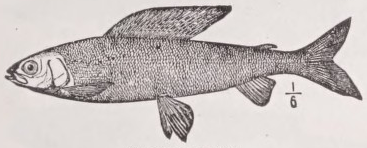
GRAYLINGlThymallus) are fishes belonging to the family of Salmonidae, which resemble the vendace and gwyniad (fioregonus) in having scales of considerable size, and a narrow mouth with very small teeth. They are distinguished by their large, wing-like, dorsal fin. Only a few species are known, which inhabit clear streams of the north of Europe, Asia, and North America. The best known are the “Poisson bleu” of the Canadian voyageurs, and the European species, Thymallus vulgaris (the Asch or Aesche of Germany, Ombre of France, and T emola of Upper Italy). This latter species is esteemed on account of its agreeable colours (especially of the dorsal fin), its well-flavoured flesh, and the sport it affords to anglers. It is very fastidious in the choice of the rivers it inhabits. In England it is found in the Test, the Avon, the Dove, the Lug, the Wye, the Irvon, the Teme, the Clun, the Hodder, the Trent, the Dee, the Wiske, the Wharfe, the Ure, the Ribble, and the Derwent; but it is not found either in Scotland or in Ireland. It is more generally distributed in Scandinavia and Russia, and the mountain streams of central Europe southwards to the Alpine waters of Upper Italy. Specimens attaining to a weight of four pounds are very scarce. See Ichthyology.
[217 words — estimated reading time: 2 minutes]