
the upper side-piece of timber of the body of a cart.
Word of the Day: Catachrestical
2. when men thus rave we may conclude their brains are turned.
4. Have I not cause to rave and beat my breast?
5. To dote; to be unreasonably fond; followed by upon; as, to rave upon antiquity. [Hardly proper.]
1. To wander in mind or intellect; to be delirious; to talk or act irrationally; to be wild, furious, or raging, as a madman.
3. To talk with unreasonable enthusiasm or excessive passion or excitement; -- followed by about, of, or on; as, he raved about her beauty.
To utter in madness or frenzy; to say wildly; as, to rave nonsense.
1. rav'l.
2. To fall into perplexity and confusion.
3. Till by their own perplexities involv'd, they ravel more, still less resolv'd.
5. It will be needless to ravel far into the records of elder times.
7. To be unwoven.
1. rav'l.
4. To untwist; to unweave or unknot; to disentangle; as, to ravel out a twist; to ravel out a stocking.
6. to hurry or run over in confusion. [Not in use.]
1. To become untwisted or unwoven; to be disentangled; to be relieved of intricacy.
2. To fall into perplexity and confusion.
Twisted together; made intricate; disentangled.
One who ravels.
In fortification, a detached work with two faces which make a salient angle, without any flanks, and raised before the counterscarp, of the place. In this it differs from a half moon, which is placed before an angle.
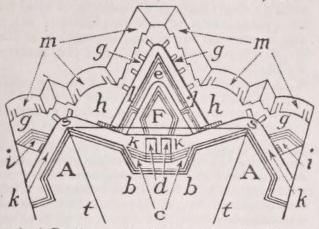
A detached work with two embankments which make a salient angle. It is raised before the curtain on the counterscarp of the place. Formerly called demilune, and half-moon.
Twisting or weaving; untwisting; disentangling.
1. The act of untwisting or of disentangling.
2. That which is raveled out; esp., a thread detached from a texture.
1. ra'ven. [Heb. from its color. But this may be Latin corvus, rapio.]
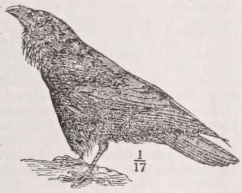
2. A large fowl of a black color, of the genus Corvus.
3. rav'n.
1. rav'n. To prey with rapacity.
2. Benjamin shall raven as a wolf. Genesis 49:1 .
1. rav'n.
3. Our natures do pursue, like rats that raven down their proper bane, a thirsty evil, and when we drink, we die.
5. To obtain by violence.
Of the color of the raven; jet black; as, raven curls; raven darkness.
1. A large black passerine bird (Corvus corax), similar to the crow, but larger. It is native of the northern parts of Europe, Asia, and America, and is noted for its sagacity.
3. Prey; plunder; food obtained by violence.
1. To obtain or seize by violence.
2. To devour with great eagerness.
Raven
Encyclopedia Britannica
RAVEN (Anglo-Saxon Hrsefn, Icelandic Hrafn, Danish Ravn, Dutch Raaf , German Rabe), the largest of the Birds of the Order Passeres ·, and, as already shewn (Ornithology, vol. xviii. p. 49), probably the most highly developed of all Birds....
Quick-sighted, sagacious, and bold, it must have followed the prehistoric fisher and hunter, and generally without molestation from them, to prey on the refuse of their spoils, just as it now waits, with the same intent, on the movements of their successors; while it must have likewise attended the earliest herdsmen, who could not have regarded it with equal indifference, since its now notorious character for attacking and putting to death a weakly animal was doubtless in those days manifested. Yet the Raven is no mere dependant upon man, being always able to get a living for itself; and moreover a sentiment of veneration or superstition has from very remote ages and among many races of men attached to it—a sentiment so strong as often to overcome the feeling of distrust not to say of hatred which its deeds inspired, and, though rapidly decreasing, even to survive in some places until the present day. There is no need to dwell on the association of this bird with well-known characters of history sacred or profane—Noah or Elijah, Odin or Flokki, the last of whom by its means discovered Iceland. The Raven is even said to have played its part in the mythology of the Red Indian; and none can wonder that all this should be so, since, wherever it occurs and more especially wherever it is numerous, as in ancient times and in thinly peopled countries it must have been, its size, appearance, and fearless habits would be sure to attract especial attention. Nor has this attention wholly ceased with the advance of enlightenment, for both in prose and verse, from the time of Shakespeare to that of Poe and Dickens, the Raven has often figured, and generally without the amount of misrepresentation which is the fate of most animals which celebrated writers condescend to notice. Notwithstanding all this, however, the Raven has now fallen upon evil days. The superstitious reverence with which it was once regarded has all but vanished and has been very generally succeeded by persecution, which in many districts has produced actual extirpation, so that it is threatened with extinction, save in the wildest and most unpeopled districts.
The Raven breeds very early in the year, in England resorting to its nest, which is usually an ancient if not an ancestral structure, about the middle or towards the end of January. Therein are laid from five to seven eggs of the common Corvine coloration (see Crow, vol. vi. pp. 617, 618), and the young are hatched before the end of February. In more northern countries the breeding-season is naturally delayed, but everywhere this species is almost if not quite the earliest of birds to enter upon the business of perpetuating its kind. The Raven measures about 26 inches in length, and has an expanse of wing considerably exceeding a yard. Its bill and feet are black, and the same may be said of its whole plumage, but the feathers of the upper parts as well as of the breast are very glossy, reflecting a bright purple or steel-blue. The species inhabits the whole of Europe, and the northern if not the central parts of Asia; but in the latter continent its southern range is not well determined. In America it is, or used to be, found from the shores of the Polar Sea to Guatemala if not to Honduras, but is said hardly to be found of late years in the eastern part of the United States. In Africa its place is taken by three allied but well-differentiated species, two of which ( Corvus umbrvnus, readily distinguished by its brown neck, and C. affinis, having its superior nasal bristles upturned vertically) also occur in South-Western Asia, while the third ( C. leptoηyx or C. tingitanus, a smaller species characterized by several slight differences) inhabits Barbary and the Atlantic Islands. Further to the southward in the Ethiopian Region three more species appear, whose plumage is varied with white —C. seapulatus, C. albicollis, and C. crαssirostris— the first two of small size, but the last rivalling the real Raven in that respect. (a. n.)
9th ed. Encyclopædia Britannica, vol. 20, p. 295
[731 words — estimated reading time: 5 minutes]
[731 words — estimated reading time: 5 minutes]
Raven
Watson's Biblical & Theological Dictionary
עורב, in Chaldee, _orba_, in Syriac, _croac_, in Latin, _corvus_, Gen. viii, 7; Lev. xi, 15; Deut. xiv, 14; 1 Kings xvii, 4, 6; Job xxxviii, 41; Psalm cxlvii, 9; Prov. xxx, 17; Cant. v, 11; Isa. xxxiv, 11; κόραξ, Luke xii, 24; a well known bird of prey. All the interpreters agree that _oreb_ signifies the raven, from _oreb_, “evening,” on account of its colour. Michaëlis, in proposing a question respecting certain birds, says of the _oreb_, “_Il est decidé, que c’est le corbeau; il seroit donc superflu de le demander. Mais je desirerois plus de certitude sur le nom Syriaque des corbeaux_.” [It is settled that this is the raven; it would therefore be superfluous to investigate it. But I could wish more certainty respecting the Syriac name of ravens.] One can hardly doubt that it is taken from the note of this bird. On the decrease of the waters of the flood, so that the tops of the mountains became visible, Noah sent forth out of one of the windows of the ark a raven, a bold and adventurous bird, by way of experiment, to see whether the waters were sunk or abated. Forty days the violent rain had continued; and he might think this, therefore, a likely time for the waters to run off again. In the original text, in the Samaritan, in the Chaldee and Arabic, it is said that the raven “returned” to the ark; but the Greek interpreters, the Syriac, the Latin, and most of the eminent fathers and commentators, say that it did not return any more. Here are great authorities on both sides, but the latter reading, though so contrary in sense to the other, yet in the Hebrew is not very different in the form of the letters, and appears to be the better reading of the two. For if the raven had returned, what occasion had Noah to send forth a dove? Or why did he ...not take the raven in unto him into the ark, as he did afterward the dove? Or why did he not send forth the same raven again, as he did afterward the same dove again? It is not improperly expressed in our translation, that “the raven went forth to and fro,” flying hither and thither, “until the waters were dried up from off the face of the earth.” He found, perhaps, in the higher grounds, some of the carcasses of those who had perished in the deluge. The Prophet Elijah was in his retirement fed by this bird. A writer, indeed, in the Memoirs of Literature, for April, 1710, endeavours to show, from many authors, that there was in the country of Bethschan, in Decapolis, by the brook Cherith or Carith, a little town called Aorabi or Orbo, Judges vii, 25; Isa. x, 6; and he therefore explains the word _orebim_, which, in 1 Kings xvii, 4, we translate “ravens,” of the inhabitants of that village, some of whom, he contends, daily carried bread and flesh to Elijah, who had retired to and lay in a cave in the neighbourhood. On the other hand, Scheuchzer ably vindicates the commonly received opinion. The editor of Calmet, also, in the appendix, under the article _Elijah_, has some pertinent observations on this subject. “We ought to consider,” says he, “1. That Ahab sought Elijah with avidity, and took an oath of every people, no doubt, also, in his dominions, that he was not concealed among its inhabitants; his situation, therefore, required the utmost privacy, even to solitude. 2. That when the brook Cherith was dried up, the prophet was obliged to quit his asylum, which he needed not to have done, had a people been his suppliers, for they could have brought him water as well as food.” In Psalm cxlvii, 9, it is said, “The Lord giveth to the beast his food, and to the young ravens which cry.” And in Job xxxviii, 41, “Who provideth for the raven his food, when his young ones cry unto God, wandering for want of meat?” Job and the psalmist may allude to what is said by some naturalists, that the ravens drive out their young ones early from their nests, and oblige them to seek food for their own sustenance. The same kind Providence which furnishes support to his intelligent offspring is not unmindful of the wants, or inattentive to the desires, of the meanest of his creatures. Lo, the young ravens, from their nest exiled, On hunger’s wing attempt the aerial wild! Who leads their wanderings, and their feast supplies? To God ascend their importuning cries. Christ instructs his disciples, from the same circumstance, to trust in the care and kindness of Heaven: “Consider the ravens; for they neither sow nor reap, neither have storehouse, nor barn; and God feedeth them. How much better are ye than the fowls!” Luke xii, 24. Solomon, speaking of the peculiar regard and veneration due to the worthy persons and salutary instructions of parents, observes, that an untimely fate, and the want of decent interment, may be expected from contrary conduct; and that the leering eye, which throws wicked contempt on a good father, and insolent disdain on a tender mother, shall be dug out of the unburied exposed corpse by the ravens of the valley, and eaten up by the young eagles, Prov. xxx, 17. It was a common punishment in the east, and one which the orientals dreaded above all others, to expose in the open fields the bodies of evil doers that had suffered by the laws of their offended country, to be devoured by the beasts of the field, and the fowls of heaven. The wise man insinuates that the raven makes his first and keenest attack on the eye, which perfectly corresponds with his habits, for he always begins his banquet with that part. Isiodore says of him, _Primo in cadaveribus occulum petit_; [he attacks first the eye of the dead;] and Epictetus, Ὁι μεν κορακες των τετελευτηκοτων τους οφθαλμους λυμαινονται, “the ravens devour the eyes of the dead.” Many other testimonies might be adduced, but these are sufficient to justify the allusion in the proverb. The raven, it is well known, delights in solitude. He frequents the ruined tower or the deserted habitation. In Isaiah, xxxiv, 11, it is accordingly foretold that the raven, with other birds of similar dispositions, should fix his abode in the desolate houses of Edom. In the Septuagint and other versions the Hebrew word for _desolation_ is rendered _raven_. The meaning is, that in those splendid palaces, where the voice of joy and gladness was heard, and every sound which could ravish the ear and subdue the heart, silence was, for the wickedness of their inhabitants, to hold her reign for ever, interrupted only by the scream of the cormorant and the croaking of the raven.
Watson's Biblical & Theological Dictionary
[1,147 words — estimated reading time: 7 minutes]
[1,147 words — estimated reading time: 7 minutes]
A fine quality of sailcloth.
One that ravens or plunders.
1. One who, or that which, ravens or plunders.
Eagerness for plunder. Luke 11:39 .
Ravenna
Encyclopedia Britannica
RAVENNA chief city of an Italian province of the same name, contained 18,571 inhabitants according to the census of 1881. It is situated in the north-east of Italy, in 44º 25' N. 1at. and 12º 12' E. long., about 4 miles from the Adriatic, with which it is now connected by the Cor-sini Canal, the two small rivers Ronco and Montone no longer serving as means of communication between the city and the sea. A railway, 26 miles long, unites Ravenna with Castel Bolognese on the line from Bologna to Rimini.
Ravenna owes both its great historic importance in the past and its comparative dulness and obscurity in the present to the same cause,—its position in an alluvial plain, formed and continually extended by the deposits brought down by a number of small and rapid streams from the neighbouring Apennines. Any one who glances at a map of the north-western corner of the Adriatic will see at once the general character of the coast,—broad lagunes sometimes stretching far inland; flat alluvial plains intersected by endless dykes; numerous rivers (of which the Po is by far the largest and makes the most conspicuous delta) descending from the Apennines or the Alps; and, outside of all, a barrier of islands which have a continual tendency to become adherent to the shore through the new deposits which are brought down, and thus to be turned from islands into low hills. This description suits Venice nearly as well as it suits Ravenna, and the chief difference between these two great historic cities is that the lagunes of Ravenna are about twenty centuries older than those of Venice....
The one transcendent interest of Ravenna to a modern traveller consists in its churches. No other city in the world offers so many and such striking examples of the ecclesiastical architecture of the centuries from the 4th to the 8th. The stylo is commonly called Byzantine, and no doubt from the close connexion of Ravenna with Constantinople considerable influence was exerted by the latter city on the former; but some of the most striking features of the churches of Ravenna—the colonnades, the mosaics, perhaps the cupolas—are not so much Byzantine as representative of early Christian art generally. It is truly said by Mr Freeman:
“The outside of a Ravennese basilica is an unadorned and unattractive pile of brick. If it has any architectural grouping or outline about it, it owes it to the campanile which a later age has added. But if the churches of Ravenna are thus unattractive without, they are emphatically all glorious within. The eye dwells with genuine artistic delight on the long unbroken rows of pillars and arches, their marble shafts, their floriated capitals, sometimes the work of the Christian craftsman, sometimes the spoils of heathendom pressed into the service of the sanctuary. . . . The whole plan of these buildings allows a great field for void spaces; but the void spaces thus left are filled up by these wonderful mosaic paintings which look down upon us as fresh as they were thirteen hundred years back.”
Every traveller to Ravenna is impressed by the vividness of these decorations, which were older when Giotto painted his first fresco than Giotto’s frescos are now; but we can here only allude to the subject, referring the reader to the article Mosaic (vol. xvi. p. 852 sq.).
The following are the most important churches of Ravenna, arranged in the order of the dates generally attributed to them :— [table]
The cathedral (No. 1) has been so much modernized as to have lost its interest; but the baptistery adjoining it, decorated by Bishops Neon and Maximian in the δth and 6th centuries, an octagonal building with mosaics of the apostles on the roof, is still unspoiled. SS. Nazario e Celso (No. 6) is a little building in the form of a Latin cross, and is better known as the mausoleum of Galla Placidia, whose tomb and those of three emperors, her husband, brother, and son, are deposited here. It is surmounted with a cupola surrounded with four semi-domes, on which are depicted figures of the Good Shepherd with His sheep, of evangelists, prophets, &c., and two stags drinking at a fountain. S. Apollinare Nuovo (No. 10) has above the arches of the nave what is perhaps the greatest triumph of mosaic art, two processions of virgins and of martyrs marching, the former from the city of Classis, the latter from the palace of Theodoric, to the Saviour. In the former group Christ sits upon the lap of His mother, and the Magi are interposed between Him and the procession of virgins. In the latter He is enthroned in glory and guarded by four ministrant angels. S. Vitale (No. 11) is doubly interesting as having furnished the model after which Charles the Great built his imperial minster at Aix-la-Chapelle and as containing full-length contemporary portraits in mosaic of Justinian and Theodora, surrounded by ecclesiastics, courtiers, and soldiers of the guard. It is surmounted by a dome, is circular in form, and has eight apsidal chapels all round it, one of which, corresponding to the choir in an ordinary church, is prolonged to about four times the length of the other apses. Unfortunately, only in this choir have the mosaics been preserved, but they are of the highest possible interest. S. Apollinare in Classe (No. 13), once the centre of a busy population of sailors, shopkeepers, and dock-labourers, now stands absolutely alone in a wide and desolate expanse 2 miles from the sea. The decorations of the church have suffered from damp —there are frequently some inches of water on the pavement—but the twenty-four stately marble columns with Corinthian capitals form a magnificent prelude to an apse covered with mosaics, among which is conspicuous a great jewelled cross, symbolizing the Saviour on the Mount of Transfiguration; Moses and Elias lean forth from the clouds on either side, and in the valley below the apostles wait, represented symbolically as sheep. Many mosaic portraits of bishops of Ravenna are on the walls of the church, and a mosaic picture, representing Constantine Pogonatus and his brothers be-stowing a privilegium on Bishop Reparatus about the year 670.
History.— Strabo mentions a tradition that Ravenna was founded by Thessalians, who afterwards, finding themselves pressed on by the Etrurians, called in their Umbrian neighbours and eventually departed, leaving the city to their allies. Throughout the valley of the Po the Gauls took the place of the Etrurians as a conquering power; but Ravenna may possibly have retained its Umbrian character until, about the year 191 b.c., by the conquest of the Boii the whole of this region passed definitely under the dominion of Rome. Either as a colonia or a municipium, Ravenna remained for more than two centuries an inconsiderable city of Gallia Cis-alpina, chiefly noticeable as the place to which Caesar during his ten years’ command in Gaul frequently resorted in order to confer with his friends from Rome. At length under Augustus it suddenly rose into importance, when that emperor selected it as the station for his fleet on “the upper sea.” Two hundred and fifty ships, said Dion (in a lost passage quoted by Jordanes), could ride at anchor in its harbour. Strabo, writing probably a few years after Ravenna had been thus selected as a naval arsenal, gives us a description of its appearance which certainly corresponds more closely with modern Venice than with modern Ravenna. “It is the largest of all the cities built in the lagunes, but entirely composed of wooden houses, penetrated in all directions by canals, wherefore bridges and boats are needed for the wayfarer. At the flow of the tide a large part of the sea comes sweeping into it, and thus, while all the muddy deposit of the rivers is swept away, the malaria is at the same time removed, and by this means the city enjoys so good a sanitary reputation that the Government has fixed on it as a place for the reception and training of gladiators.” On the other hand, good water was proverbially difficult to obtain at Ravenna,—dearer than wine, says Martial, who has two epigrams on the subject. And Sidonius, writing in the 5th century, complains bitterly of the “feculent gruel” (cloacalis puls) which filled the canals of the city, and which gave forth fetid odours when stirred by the poles of the bargemen. The port of Ravenna, situated about 3 miles from the city, was named Classis. A long line of houses called Caesarea connected it with Ravenna, and in process of time there was such a continuous series of buildings that the three towns seemed like one.
The great historical impoi־tance of Ravenna begins early in the 5th century, when Honorius, alarmed by the progress of Alaric in the north of Italy, transferred his court to the city in the lagunes. From this date (c. 402) to the fall of the Western empire in 476 Ravenna was, though not the exclusive, the chief residence of the Roman emperors and the centre of the elaborate machinery of the state. Here Stilicho was slain; here Honorius and his sister Placidia caressed and quarrelled; here Valentinian III. spent the greater part of his useless life; here Majorian w r as proclaimed; here the Little Romulus donned his purple robe; here in the pine-wood outside the city his uncle Paulus received his decisive defeat from Odoacer. Through all these changes Ravenna maintained its character as an impregnable “city in the sea,” not easily to be attacked even by a naval power on account of the shallowness and devious nature of the channels by which it had to be approached. On becoming supreme ruler of Italy Odoacer, like the emperors who had gone before him, made Ravenna his chief place of residence, and here after thirteen years of kingship he shut himself up when Theodoric the Ostrogoth had invaded Italy and defeated him in two battles. Theodorie’s siege of Ravenna lasted for three years (489-492) and was marked by one bloody encounter in the pine-wood on the east of it. The Ostrogoth collected a fleet and established a severe blockade, which at length caused Odoacer to surrender the city. The terms, arranged through the intervention of John, archbishop of Ravenna, were not observed by Theodoric, who, ten days after his entry into the city, slew his rival at a banquet in the palace of the Laurel Grove (15th March 493). Ravenna was Theodoric’s chief place of residence, and the thirty-three years of the reign of the great Ostrogoth (493-526) may probably be considered the time of its greatest splendour. In the eastern part of the city he built for himself a large palace, which probably occupied about a sixth of the space now enclosed within the city walls, or nearly the whole of the rectangle enclosed by Strada di Porta Alberoni on the south, Strada Nuova di Porta Serrata on. the west, and the line of the city walls on the north and east. There still remains close to the first-named street and fronting the Corso Garibaldi a high wall built of square Roman bricks, with pillars and arched recesses in the upper portion, which goes by the name of Palazzo di Teodorico. Freeman, on account of the Romanesque character of the architecture, thinks it probable that it really belongs to the time of the Lombard kings; but at any rate it is of the very early mediré val period, and it marks the spot where part of the Ostrogothic palace once stood. A more memorable and clearly authentic monument of Theodoric is furnished by his tomb, a massive mausoleum in the style of the tomb of Hadrian at Rome, which stands still perfect outside the walls near the north-east corner of the city. It is of circular shape and surmounted by an enormous monolith, brought from the quarries of Istria and weighing more than 300 tons. In this mausoleum Theodoric was buried, but his body was cast forth from it, perhaps during the troublous times of the siege of Ravenna by the imperial troops, and the Rotunda (as it is now generally called) was converted into a church dedicated to the Virgin.
“ [The] immemorial wood Rooted where once the Adrian wave flowed o’er,” is probably true; but there is no evidence that it was in historic time that this change took place. Our conjecture is that the Pineta grew on a large peninsula somewhat resembling the Lido of Venice.
Nine years after the death of Theodoric Justinian sent an army to Italy, nominally in order to avenge the murder of Theodoric’s daughter Amalasuntlia, but in fact to destroy the Gothic monarchy and restore Italy to the empire. Long after the Goths had lost Rome they still clung to Ravenna, till at length, weary of the feebleness and ill-success of their own kin״, Vitiges, and struck with admiration of their heroic conqueror, they offered to transfer their allegiance to Belisarius on condition of his assuming the diadem of the Western empire. Belisarius dallied with the proposal until he had obtained an entrance for himself and his troops within the walls of the capital, and then threw off the mask and proclaimed his inviolable fidelity to Justinian. Thus in the year 540 was Ravenna re-united to the Roman empire. Its connexion with that empire—or, in other words, its dependence upon Constantinople—lasted for more than 200 years, during which period, under the rule of Narses and his successors the exarchs, Ravenna was the seat of Byzantine dominion in Italy. In 728 the Lombard king Luitprand took the suburb Classis; about 752 the city itself fell into the hands of his successor Aistulf, from whom a few years after it was wrested by Pippin, king of the Franks. By this time the former splendour of the city had probably in great measure departed; the alteration of the coast-line and the filling up of the lagunes which make it now practically an inland city had probably commenced, and no historical importance attaches to its subsequent fortunes. It formed part of the Frankish king’s donation to the pope in the middle of the 8th century. It was an independent republic, generally taking the Guelf side in the 13th century, subject to rulers of the house of Polentani in the 14th, Venetian in the 15th (1441), and papal again in the 16th,—Pope Julius II. having succeeded in wresting it from the hands of the Venetians. From this time (1509) down to our own days, except for the interruptions caused by the wars of the French Revolution, Ravenna continued subject to the papal see and was governed by a cardinal legate. In 1859 it w r as one of the first cities to give its vote in favour of Italian unity, and it has since then formed a part of the kingdom of Italy.
At the beginning of the period thus rapidly sketched Charles the Great visited the city and carried off the brazen statue of Theodoric and the marble columns of his palace to his own new palace at Aix-la-Chapelle. More than five centuries later (1320) Dante became the guest of Guido Novello di Polenta, lord of Ravenna, and here he died on the 14th September of the following year. The marble urn containing the body of the poet still rests at Ravenna, where what Byron calls “a little cupola more neat than solemn” has been erected over it. In 1512 the French army under Gaston de Foix fought a fierce báttle with the Spanish, Venetian, and papal troops on the banks of the Ronco about 2 miles from Ravenna. The French were victorious, but Gaston fell in the act of pursuing the enemy. His death is commemorated by the Colonna dei Frances! erected on the spot where he fell. Lord Byron resided at Ravenna for eighteen months in 1820-21, attracted by the charms of the countess Guiccioli.
Literature.— The most important authority for the history of Ravenna is Bishop Agnellus, who wrote about 840, in very bad Latin, the Liber Pontificalis Ecclesix Ravennatis. It is printed in vol. ii. of Muratori’s Per. Ital. Scriptores, but much the best edition is that by Holder-Egger in the Monumenta Germanise Histórica (1878). Rubeus (Hist. Ravennatum IAhri Decern, Venice, 1599) seems to have had access to some authorities besides Agnellus which are now lost. Ciampini (Vetera Monumenta, 1690-99, and Synopsis Histórica, 1693) gives some fair representations of the mosaics, and Quast’s Ravenna (Berlin, 1842) is a careful and well-illustrated monograph. Dr Ricci, in a popular guide, Ravenna e i tntoi Dintorni (187S), has included some of the results of a very careful study of the antiquities of his native city. Professor Freeman’s essay The Goths at Ravenna is the best account in English of the city in its historical connexion, and Mr J. A. Symonds in his Sketches in Italy and Greece has gracefully touched on its picturesque qualities and literary associations.
9th ed. Encyclopædia Britannica, vol. 20, p. 296 — signed T. H.
[2,877 words — estimated reading time: 17 minutes]
[2,877 words — estimated reading time: 17 minutes]
1. Furiously voracious; hungry even to rage; devouring with rapacious eagerness; as a ravenous wolf, lion or vulture.
2. Eager for prey or gratification; as ravenous appetite or desire.
1. Devouring with rapacious eagerness; furiously voracious; hungry even to rage; as, a ravenous wolf or vulture.
2. Eager for prey or gratification; as, a ravenous appetite or desire.
2. A species of sail cloth.
Insanity Roget’s Thesaurus §503
N. disordered reason, disordered intellect, diseased mind, unsound mind, abnormal mind, derangement, unsoundness, psychosis, neurosis, cognitive disorder, affective disorder, insanity, lunacy, madness, mania, rabies, furor, mental alienation, aberration, paranoia, schizophrenia, dementation, dementia, demency, phrenitis, phrensy, frenzy, raving, incoherence, wandering, delirium, calenture of the brain, delusion, hallucination, lycanthropy, brain storm|, vertigo, dizziness, swimming, sunstroke, coup de soleil, siriasis, fanaticism, infatuation, craze, oddity, eccentricity, twist, monomania (caprice) 608, kleptodipsomania, hypochondriasis, melancholia, depression, clinical depression, severe depression, hysteria, amentia, screw loose, tile loose, slate loose, bee in one's bonnet, rats in the upper story, dotage
V. be insane, become insane, lose one's senses, lose one's reason, lose one's faculties, lose one's wits, go mad, run mad, lose one's marbles, go crazy, go bonkers, flip one's wig, flip one's lid, flip out, flip one's bush, rave, dote, ramble, wander, drivel, have a screw loose, have a devil, avoir le diable au corps, lose one's head, render mad, drive mad, madden, dementate, addle the wits, addle the brain, derange the head, infatuate, befool, turn the brain, turn one's head, drive one nuts
Adj. insane, mad, lunatic, loony, crazy, crazed, aliene, non compos mentis, not right, cracked, touched, bereft of reason, all possessed, unhinged, unsettled in one's mind, insensate, reasonless, beside oneself, demented, daft, phrenzied, frenzied, frenetic, possessed, possessed with a devil, deranged, maddened, moonstruck, shatterpated, mad-brained, scatter brained, shatter brained, crackbrained, touched, tetched, off one's head, maniacal, delirious, lightheaded, incoherent, rambling, doting, wandering, frantic, raving, stark staring mad, stark raving mad, wild-eyed, berserk, delusional, hallucinatory, corybantic, dithyrambic, rabid, giddy, vertiginous, wild, haggard, mazed, flighty, distracted, distraught, depressed, agitated, hyped up, bewildered, mad as a march hare, mad as a hatter, of unsound mind, touched in one's head, wrong in one's head, not right in one's head, not in one's right mind, not right in one's wits, upper story, out of one's mind, out of one's wits, out of one's skull, far gone, out of one's senses, out of one's wits, not in one's right mind, fanatical, infatuated, odd, eccentric, hypped, hyppish, spaced out, imbecile, silly, &c. 499
Adv. like one possessed
Phr. the mind having lost its balance, the reason under a cloud, tet exaltee, tet montee, ira furor brevis est, omnes stultos insanire
Speech Roget’s Thesaurus §582
N. speech, faculty of speech, locution, talk, parlance, verbal intercourse, prolation, oral communication, word of mouth, parole, palaver, prattle, effusion, oration, recitation, delivery, say, speech, lecture, harangue, sermon, tirade, formal speech, peroration, speechifying, soliloquy, allocution, conversation, salutatory, screed, valedictory, oratory, elocution, eloquence, rhetoric, declamation, grandiloquence, multiloquence, burst of eloquence, facundity, flow of words, command of words, command of language, copia verborum, power of speech, gift of the gab, usus loquendi, speaker, spokesman, prolocutor, interlocutor, mouthpiece, hermes, orator, oratrix, oratress, demosthenes, cicero, rhetorician, stump orator, platform orator, speechmaker, patterer, improvisatore
V. speak of, say, utter, pronounce, deliver, give utterance to, utter forth, pour forth, breathe, let fall, come out with, rap out, blurt out have on one's lips, have at the end of one's tongue, have at the tip of one's tongue, break silence, open one's lips, open one's mouth, lift one's voice, raise one's voice, give the tongue, wag the tongue, talk, outspeak, put in a word or two, hold forth, make a speech, deliver a speech, speechify, harangue, declaim, stump, flourish, recite, lecture, sermonize, discourse, be on one's legs, have one's say, say one's say, spout, rant, rave, vent one's fury, vent one's rage, expatiate, speak one's mind, go on the stump, take the stump, soliloquize, tell, speak to, talk together, be eloquent, have a tongue in one's head, have the gift of the gab, pass one's lips, escape one's lips, fall from the lips, fall from the mouth
Adj. speaking &c, spoken, oral, lingual, phonetic, not written, unwritten, outspoken, eloquent, elocutionary, oratorical, rhetorical, declamatory, grandiloquent, talkative, ciceronian, nuncupative, tullian
Adv. orally, by word of mouth, viva voce, from the lips of
Phr. quoth he, said he &c, "action is eloquence", "pour the full tide of eloquence along", "she speaks poignards and every word stabs", "speech is but broken light upon the depth of the unspoken ; "to try thy eloquence now 'tis time
Excitation Roget’s Thesaurus §824
N. excitation of feeling, mental excitement, suscitation, galvanism, stimulation, piquance, piquancy, provocation, inspiration, calling forth, infection, animation, agitation, perturbation, subjugation, fascination, intoxication, enravishment, entrancement, pressure, tension, high pressure, unction, impressiveness, trail of temper, casus belli, irritation, passion, thrill, repression of feeling, sensationalism, yellow journalism
V. excite, affect, touch, move, impress, strike, interest, animate, inspire, impassion, smite, infect, stir the blood, fire the blood, warm the blood, set astir, wake, awake, awaken, call forth, evoke, provoke, raise up, summon up, call up, wake up, blow up, get up, light up, raise, get up the steam, rouse, arouse, stir, fire, kindle, enkindle, apply the torch, set on fire, inflame, stimulate, exsuscitate|, inspirit, spirit up, stir up, work up, pique, infuse life into, give new life to, bring new blood, introduce new blood, quicken, sharpen, whet, work upon, hurry on, give a fillip, put on one's mettle, fan the fire, fan the flame, blow the coals, stir the embers, fan into a flame, foster, heat, warm, foment, raise to a fever heat, keep up, keep the pot boiling, revive, rekindle, rake up, rip up, stir the feelings, play on the feelings, come home to the feelings, touch a string, touch a chord, touch the soul, touch the heart, go to one's heart, penetrate, pierce, go through one, touch to the quick, possess the soul, pervade the soul, penetrate the soul, imbrue the soul, absorb the soul, affect the soul, disturb the soul, absorb, rivet the attention, sink into the mind, sink into the heart, prey on the mind, distract, intoxicate, overwhelm, overpower, bouleverser, upset, turn one's head, fascinate, enrapture, agitate, perturb, ruffle, fluster, shake, disturb, startle, shock, stagger, give one a shock, give one a turn, strike all of a heap, stun, astound, electrify, galvanize, petrify, irritate, sting, cut to the heart, cut to the quick, try one's temper, fool to the top of one's bent, pique, infuriate, madden, make one's blood boil, lash into fury, be excited, flush up, flare up, catch the infection, thrill, mantle, work oneself up, seethe, boil, simmer, foam, fume, flame, rage, rave, run mad
Adj. excited, wrought up, up the qui vive, astir, sparkling, in a quiver, in a fever, in a ferment, in a blaze, in a state of excitement, in hysterics, black in the face, overwrought, tense, taught, on a razor's edge, hot, red-hot, flushed, feverish, all of a twitter, in a pucker, with quivering lips, with tears in one's eyes, flaming, boiling over, ebullient, seething, foaming at the mouth, fuming, raging, carried away by passion, wild, raving, frantic, mad, distracted, beside oneself, out of one's wits, ready to burst, bouleverse, demoniacal, lost, eperdu, tempest-tossed, haggard, ready to sink, stung to the quick, up, on one's high ropes, exciting, absorbing, riveting, distracting, impressive, warm, glowing, fervid, swelling, imposing, spirit-stirring, thrilling, high- wrought, soul-stirring, soul-subduing, heart-stirring, heart-swelling, heart-thrilling, agonizing, telling, sensational, hysterical, overpowering, overwhelming, more than flesh and blood can bear, yellow, piquant, spicy, appetizing, provocative, provoquant, tantalizing, eager to go, anxious to go, chafing at the bit
Adv. till one is black in the face
Phr. the heart beating high, the heart going pitapat, the heart leaping into one's mouth, the blood being up, the blood boiling in one's veins, the eye glistening - "in a fine frenzy rolling", the head turned, "when the going gets tough, the tough get going"
Excitability Roget’s Thesaurus §825
N. excitability, impetuosity, vehemence, boisterousness, turbulence, impatience, intolerance, nonendurance, irritability, itching, wincing, disquiet, disquietude, restlessness, fidgets, fidgetiness, agitation, trepidation, perturbation, ruffle, hurry, fuss, flurry, fluster, flutter, pother, stew, ferment, whirl, buck fever, hurry-skurry, thrill, state of excitement, fever of excitement, transport, passion, excitement, flush, heat, fever, heat, fire, flame, fume, blood boiling, tumult, effervescence, ebullition, boiling over, whiff, gust, story, tempest, scene, breaking out, burst, fit, paroxysm, explosion, outbreak, outburst, agony, violence, fierceness, rage, fury, furor, furore, desperation, madness, distraction, raving, delirium, phrensy, frenzy, hysterics, intoxication, tearing passion, raging passion, anger, fascination, infatuation, fanaticism, quixotism, quixotry, tete montee
V. be impatient, not be able to bear, bear ill, wince, chafe, champ a bit, be in a stew, be out of all patience, fidget, fuss, not have a wink of sleep, toss on one's pillow, lose one's temper, break out, burst out, fly out, go off, fly off, fly off at a tangent, fly off the handle, lose one's cool, explode, flare up, flame up, fire up, burst into a flame, take fire, fire, burn, boil, boil over, foam, fume, rage, rave, rant, tear, go wild, run wild, run mad, go into hysterics, run riot, run amuck, battre la campagne, faire le diable a quatre, play the deuce
Adj. excitable, easily excited, in an excitable state, high-strung, irritable, impatient, intolerant, feverish, febrile, hysterical, delirious, mad, moody, maggoty-headed, unquiet, mercurial, electric, galvanic, hasty, hurried, restless, fidgety, fussy, chafing, startlish, mettlesome, high-mettled, skittish, vehement, demonstrative, violent, wild, furious, fierce, fiery, hot- headed, madcap, overzealous, enthusiastic, impassioned, fanatical, rabid, rampant, clamorous, uproarious, turbulent, tempestuous, tumultuary, boisterous, impulsive, impetuous, passionate, uncontrolled, uncontrollable, ungovernable, irrepressible, stanchless, inextinguishable, burning, simmering, volcanic, ready to burst forth, volatile, excited, exciting
King James Bible KJV Bible
Berean Standard Bible BSB Bible
19 KJV and 17 BSB verses contain “rave” — showing the first 20. Show all 23 verses (searchable)
He giveth to the beast his food, and to the young ravens which cry.
He provides food for the animals, and for the young ravens when they call.
Yea, they are greedy dogs which can never have enough, and they are shepherds that cannot understand: they all look to their own way, every one for his gain, from his quarter.
Like ravenous dogs, they are never satisfied. They are shepherds with no discernment; they all turn to their own way, each one seeking his own gain:
There is a conspiracy of her prophets in the midst thereof, like a roaring lion ravening the prey; they have devoured souls; they have taken the treasure and precious things; they have made her many widows in the midst thereof.
The conspiracy of the princes in her midst is like a roaring lion tearing its prey. They devour the people, seize the treasures and precious things, and multiply the widows within her.