1. A contest between nations or states, carried on by force, either for defense, or for revenging insults and redressing wrongs, for the extension of commerce or acquisition of territory, or for obtaining and establishing the superiority and dominion of one over the other. These objects are accomplished by the slaughter or capture of troops, and the capture and destruction of ships, towns and property. Among rude nations, war is often waged and carried on for plunder. As war is the contest of nations or states, it always implies that such contest is authorized by the monarch or the sovereign power of the nation. When war is commenced by attacking a nation in peace, it si called an offensive war and such attack is aggressive. When war is undertaken to repel invasion or the attacks of an enemy, it is called defensive, and a defensive war is considered as justifiable. Very few of the wars that have desolated nations and deluged the earth with blood, have been justifiable. Happy would it be for mankind, if the prevalence of Christian principles might ultimately extinguish the spirit of war and if the ambition to be great, might yield to the ambition of being good.
2. Preparation for war is sometimes the best security for peace.
1. A contest between nations or states, carried on by force, whether for defence, for revenging insults and redressing wrongs, for the extension of commerce, for the acquisition of territory, for obtaining and establishing the superiority and dominion of one over the other, or for any other purpose; armed conflict of sovereign powers; declared and open hostilities.
2. A condition of belligerency to be maintained by physical force. In this sense, levying war against the sovereign authority is treason.
3. Instruments of war.
4. Forces; army.
5. The profession of arms; the art of war.
6. a state of opposition or contest; an act of opposition; an inimical contest, act, or action; enmity; hostility.
WHATEVER definition of the word “army” (see Army) be adopted, the fact that it is a body of men organized for the effective employment of arms is the essence of it. Hence the nature of the most effective organization and employment of armies in active warfare at any given period has always turned upon the nature of the arms in use at the time. The laboratory and workshops of science in recent years have in fact produced and forced on a change in the nature of fighting, of a kind which it is safe to say never entered the mind of any one of the inventors whose skill made it necessary. And yet the change is of such a kind that, though due to the development of very material things, as, for instance, the greater rapidity of fire, the greater range of weapons, and the like, it is much more remarkable in its effect on the spirit of armies and the nature of fighting discipline than in almost any other aspect....
In all periods of war, under all conditions of arms, the moral forces which affect armies have been the great determining factors of victory and defeat. From a date much earlier than the day when Caesar, defeated at Dyrrachium, gained the empire of the world by so acting as to restore the morale of his army before the great contest at Pharsalia, it has been on this nice feeling of the moral pulse of armies that the skill of great commanders has chiefly depended. In that respect there is nothing new in the modern conditions of war. But the sequence by which the development of arms has changed the moral pivot of military power in our own times is so remarkable that it deserves to receive a somewhat careful historical statement at the outset of this article. Unless it is understood the lessons of modern fighting cannot be learnt; for there has not yet occurred a modern war in which the principles of modern fighting, as they are now universally understood among the most thoughtful soldiers of all nations, have been deliberately applied to action, after those principles have been realized and worked out in practice during peace time. And yet it is among the first of these principles that for success in our days careful peace practice, adapted to the actual conditions of fighting, must precede the entry on a campaign. When letters from the seat of war in 1866 brought home to Europe the effect which the breech-loader was producing in determining the contest, the first impression was that of simple consternation. It was supposed that Prussia, by the possession of that weapon alone, had made herself mistress of Europe. Gradually it came to be known that the secret of Prussian power lay, not in her breech-loader alone, but at least as much in her perfect organization. In 1870 her scarcely less startling successes tended for a time to produce an effect almost as blinding upon the eyes of those who watched them. There was a disposition to assume that whatever had been done in the war by the Prussians was, by the deliberate choice and determination of the best and most successful soldiers in Europe, shown to be the best thing that could be done under the circumstances. The exhaustive statement of facts contained in the Prussian official narrative and in the regimental histories, and the evidence of eye-witnesses innumerable, have, however, gradually made it evident that, valuable as the experiences of the 1870 campaign unquestionably are for soldiers of all nations, the Γrussian successes were certainly not due to the carrying out of what are now regarded by the best Prussian officers themselves as the principles of action which ought to determine practice in future wars. But during the course of the war itself the Prussian army, prepared by the soundest peace training to adapt itself to whatever conditions it met with, was continually and progressivelymodifying its practice under the experience of conditions which it had been impossible fully to anticipate.
It is upon the surface of the facts that the extreme loss of life suddenly occasioned at particular points by the effectiveness of the fire of the new weapons, both of artillery and infantry, compelled the gradual abandonment of close formations of men, massed together in dense columns or even in closed lines, and the gradual adoption of what are known as “skirmishing” or open order formations. In other words, when the French fire fell upon the solid columns of the advancing Prussians, the column instinctively scattered. The officers and non-commissioned officers were often lost in very large proportion, and during the actual course of the fighting, without any preconceived idea on the subject, a method of attack was adopted which proceeded by successive swarms of dispersed men taking advantage of such shelter as the ground permitted. The noise of the rapid breech-loader, and the crash of an artillery able to fire much more frequently than in former campaigns, and, moreover, accumulated in much greater masses than had ever been the case before, made words of command inaudible at a distance. Hence it came to pass that small parties of men, once launched into an infantry fight, were virtually beyond all control on the part of superior officers. All that these could do to influence the action was to determine the direction and object of the first attack of each fraction, and then to furnish it with fresh supports at the proper moment, sending them forward in such a way as to cause their blows to be delivered in the most telling direction.
Here then was the great change which had come about, produced, as has been said, by the efficiency of the new weapons, but rendered possible by those changes in the characteristics of the men of whom armies are composed, which had arisen from altogether different circumstances, such as the high educational standard of the Prussian nation, and the introduction into the ranks of highly cultivated classes. The army, at all events in battle, was and could be no longer a mere mechanical weapon in the hands of its commander. If this latter could not infuse into it a spirit of hearty willing co-operation and intelligent subordination, chaos and chaos only must ensue. For the very essence of the old forms of fighting in battle, as they had been inherited from the time of Frederick the Great, and, though modified by Napoleon, had yet in this respect remained the same, was that battle movements were led up to and prepared for by an elaborate system of drill, so arranged that by the issue of predetermined words of command the officer leading at least a division of an army could decide precisely the formation it was to assume and the movements it was to make in battle. Now, though no doubt many of the preliminary movements could still be accomplished in accordance with the old drill, yet, for at least the very mile and a half over which the issue had actually to be fought out, drill had vanished, as far at all events as the infantry were concerned. All effective movements and co-operation depended on perfect organization, and on a training which made every officer and every man know almost instinctively what to do and what decisions to form as each emergency arose. The Germans had in the largest sense perfected their organization, not merely in its form, itself a matter of no small importance, but in its preparedness for battle action. This had been done chiefly by keeping and training together much larger units of command than had ever been organically worked together before. By “organic working” we specifically mean such work as leads each man to know by long habit what the part assigned to him is, and how to contribute his share in bringing about the result desired by his general. In the article Army will be found an exhaustive statement of the successive forms which army organization has assumed at different periods of history. With regard to these forms, representing as they do the condition of an army in a state of rest, suffice it to say that the ancient proverb about new wine and old bottles applies perfectly. It would not have been possible for the Germans to have secured a complete correspondence of working, a unity amid great diversity, without having devised a form of organization which assigned to every man an adequate share of work and of responsibility, by bringing a limited number of men at each step under the authority of one, those so placed in authority being themselves at the next stage, in limited number, also under one man’s authority. But the very idea of organization implies more than this mere perfection of form. It implies also, as animating the whole body, a spirit developed by careful training, a mutual reliance on the certainty of the adherence of all to known principles of action.
The essential change, then, which appears to have come over modern war may be stated thus. Under the conditions of the past, the general in command of an army relied upon its perfection in drill and in formal manoeuvres for enabling him to direct it with success against the weak points of an adversary. Now he must depend instead upon the perfection of its organization and of a training adapted to make each man ready when required to apply sound principles in every emergency, and, above all, as soon as possible voluntarily to place himself under authority again so as to secure unity of action. To summarize this statement in a single sentence, and employing the word organization in the larger sense explained above, the change consists in the substitution of organization for drill as a means of battle-action. In other words, a living organism must take the place of a mechanical instrument.
It will be seen at once that the perfection aimed at, involving as it does not merely a mechanical learning, by rote and drill-sergeant, of required changes of position, is of a much higher order both for the individual man and for the whole body than was the case under the old conditions. On the other hand, it is not possible that the practical performance should so nearly approach the ideal as happened formerly. Hence, great as was the excellence of the Prussian army in 1870 as a whole, yet the more thoroughly that campaign is studied the more manifest will be the mistakes in point of details committed by subordinate actors. It is in the nature of things impossible that this should ever be otherwise under the conditions of war which are now established. When the choice of action in detail is left to so many hands the possibilities of error are multiplied indefinitely.
It is clear from what has been said that a change of the most complete character has come over the very principle by which armies are held together. It is by no means surprising, therefore, that a few soldiers should have arrived at the conclusion that, because of the importance of this change, all past experience of fighting has ceased to be of any importance to him who would understand the principles of war as they exist to-day. On the other hand, others of far higher authority have declared it to be certain that change has only affected that branch of the art of war which is called tactics, and that the other branch, or strategy, is in no way affected. We are not able to subscribe absolutely to either of these statements. But before stating our views it will be convenient to define the terms employed. By strategy we understand “the art of rightly directing the masses of troops towards the object of the campaign.” Of modern tactics no better definition perhaps has ever been given than that of Sir Edward Hamley. After defining the limits of either subject thus—“the theatre of war is the province of strategy, the field of battle is the province of tactics,” he describes the manoeuvres of a modern battle-field as “the quick orderly change of highly trained and flexible masses of men from one kind of formation to another, or their transference from point to point of a battle-field for purposes which become suddenly feasible in the changing course of action.”
It is necessary, in discussing the application of past experience to modern war, to make intelligible the distinction between these two fields of experience, because undoubtedly the changes wrought by time affect the two great parts of the art of war in very different ways and in a very different degree. But in fact there are many parts of the study of tactics which are not strictly included within its province when that is limited to the field of battle. The distinction between the two provinces having been understood as a general idea, it will be seen at once how it has happened that in the varied incidents of warfare it has become necessary to apply the terms “tactics” and “strategy” to other matters. For no army can determine for itself or know beforehand absolutely what will be a field or a day of battle. Hence it is necessary throughout almost the entire course of a campaign to take those precautions and to take into account those considerations which apply properly to the period of actual combat. Thus, though an enemy may in fact be many marches distant, it is necessary to provide against his possible attack, by having some troops always on the alert whilst others are marching with all the ease and security which the protection of these procures for them. It is necessary also in a similar manner to have protection for the repose of an army, and to detail troops for this purpose. All the questions, then, which concern the fixing of “advanced guards” and “rear guards,” which protect the front and rear of an advancing army, and the “outposts,” which protect an army at rest, are usually included in the study of tactics, though in many instances they may have nothing to do with a battle-field. But again, though the campaign —the large field of war which concerns the marches and movements of armies striving against one another to obtain positions of vantage for the actual combat—is the province of strategy, yet it may well happen that on the actual battle-field it is necessary to take account, not only of those circumstances which will help to secure victory in the fight, but of the effect which victory or defeat will have upon the campaign. All these considerations we necessarily regard as “strategical,” even though they occupy our minds on a battle-field.
For it must be emphatically asserted that there does not exist, never has existed, and never, except by pedants, of whom the most careful students of war are more impatient than other soldiers, has there ever been supposed to exist, an “art of war” which was something other than the methodic study of military history. Those who have most assisted in making the study sufficiently methodic to enable it to be of practical profit in their own profession to soldiers for future use, or to historical students in watching the play of mind between great commanders, have been invariably the most emphatic in denouncing all attempts to formulate a systematic series of “rules of war.” Among generals, Mack, the unfortunate Austrian who surrendered at Ulm to Napoleon, and in our own time Count Palikao, who had made himself the laughingstock of the English staff during the advance on Peking, and who was afterwards responsible for bringing about the catastrophe of Sedan, have been the great sticklers for the “rules of war.” At least once Count Palikao, in China, came without his sword to look on at the success of operations which he had denounced as “contrary to every maxim of war.” On the other hand, Sir Edward Hamley, who has done more than any other Englishman to make known to English officers the value of a methodical treatment of the study of campaigns, has most vigorously denounced such talk as this.
“Nothing is more common,” he writes “than to find in writings on military matters reference to the ‘rules of war,’ and assertions such as that some general ‘violated every principle of war,’ or that some other general owed his success to ‘ knowing when to dispense with the rules of war.’ It would be difficult to say what these rules are, or in what code they are embodied; and an inquirer, who is somewhat puzzled, perhaps, to understand how the highest proficiency can be displayed in a science by defiance of its principles, had better resolve to base his own conclusions upon fact and reason alone, when he will probably discover that such criticisms have only very vague ideas for their foundation.”
Jomini, a very eminent authority in his day, though not a little disposed to somewhat exact definition, and perhaps sometimes to over-pedantic statement, has with very little difference expressed the same view. Clausewitz, probably the most profound of all military students, has even more emphatically declared that the theory of the art of war is valuable, just in so far as it assists to guide a man through the vast labyrinth of military experience, and to prepare his mind to be ready to act for itself under the emergencies of actual war; but, he adds, “it must renounce all pretension to accompany him on to the field of battle.” Both he and Jomini agree in asserting that it must have become with him an instinct, almost absorbed into his blood, to be of any value to him. “The wise teacher,” says Clausewitz, “restricts himself to the work of directing and assisting the mental development of his pupil, and does not try to keep him in leading-strings throughout his career.” Thus from all countries those who have come to be accepted as authorities on the study of war, the very men who, if any, ought to be tempted to magnify their office, have criedaloud against the abuse of such study. It is not from them, but from non-military writers like Macaulay, that the notion of some formal code of the rules of war has been derived. Macaulay’s expression about Peterboroughwinning battles by violating the rules of war cannot be characterized otherwise than as worthless rhetoric, not only unsupported, but absolutely contradicted by fact. So thoroughly reasoned and so entirely worked out on a principle were Peterborough’s campaigns that they have in our own day served to guide one of the most brilliant of English soldiers in the conduct of one of his most successful wars. The campaigns by which Colonel Gordon saved China were largely assisted in their conception by his careful study of Peterborough’s generalship in Spain.
On the other hand, it is not from writers on war, but from the greatest generals, that the most emphatic statements have come as to the paramount importance to a soldier of the careful study of past campaigns. The classical instance of the most authoritativedictum on this subject is surrounded by circumstances of dramatic interest. Napoleon in 1813, sitting after dinner surrounded by his marshals, between the first and the second battle of Dresden, was drawn to speak on this subject by Marmont, the one who, in Napoleon’s own judgment and that of others, had himself the most complete knowledge of war as an art. Marmont, observing how difficult it was, during the continued strain of war itself, to improve in its practice, maintaining that rather in peace than in war could war be best studied, said to Napoleon that he thought that Napoleon’s own first campaign in Italy was the most brilliant in its conception of any that he had ever fought; so that sixteen years of high command had hardly made his knowledge of war as an art more perfect. Napoleon at once admitted the truth of this, and in reply said, “Yes; Turenne was the only one of us all who constantly improved in the management of his campaigns as he advanced in years.” This reply is especially remarkable, because Napoleon was not only the greatest captain of his own age, but he was by far the most careful student that the world has known of the great generals of all ages. It is an unanswerable assertion that only by study of the past experience of war has any great soldier ever prepared himself for commanding armies.
It must, however, be always a question how far the circumstances of our own time have so changed as to limit the period within which it is worth while to devote very careful study to the wars of the past. On the one hand, the greater number of officers in any army will never find time exhaustively to study all the great campaigns...
or WARFARE, the attempt to decide a contest or difference between princes, states, or large bodies of people, by resorting to extensive acts of violence, or, as the phrase is, by an appeal to arms. The Hebrews were formerly a very warlike nation. The books that inform us of their wars display neither ignorance nor flattery; but are writings inspired by the Spirit of truth and wisdom. Their warriors were none of those fabulous heroes or professed conquerors, whose business it was to ravage cities and provinces, and to reduce foreign nations under their dominion, merely for the sake of governing, or purchasing a name for themselves. They were commonly wise and valiant generals, raised up by God “to fight the battles of the Lord,” and to exterminate his enemies. Such were Joshua, Caleb, Gideon, Jephthah, Samson, David, Josiah, and the Maccabees, whose names alone are their own sufficient encomiums. Their wars were not undertaken upon slight occasions, or performed with a handful of people. Under Joshua the affair was of no less importance than to make himself master of a vast country which God had given up to him; and to root out several powerful nations that God had devoted to an anathema; and to vindicate an offended Deity, and human nature which had been debased by a wicked and corrupt people, who had filled up the measure of their iniquities. Under the Judges, the matter was to assert their liberty, by shaking off the yoke of powerful tyrants, who kept them in subjection. Under Saul and David the same motives prevailed to undertake war; and to these were added a farther motive, of making a conquest of such provinces as God had promised to his people. Far was it from their intention merely to reduce the power of the Philistines, the Ammonites, the Moabites, the ...Idumeans, the Arabians, the Syrians, and the several princes that were in possession of those countries. In the later times of the kingdoms of Israel and Judah, we observe their kings bearing the shock of the greatest powers of Asia, of the kings of Assyria and Chaldea, Shalmaneser, Sennacherib, Esarhaddon, and Nebuchadnezzar, who made the whole east tremble. Under the Maccabees a handful of men opposed the whole power of the kings of Syria, and against them maintained the religion of their fathers, and shook off the yoke of their oppressors, who had a design both against their religion and liberty. In still later times, with what courage, intrepidity, and constancy, did they sustain the war against the Romans, who were then masters of the world!
We may distinguish two kinds of wars among the Hebrews: some were of obligation, as being expressly commanded by the Lord; but others were free and voluntary. The first were such as God appointed them to undertake: for example, against the Amalekites and the Canaanites, which were nations devoted to an anathema. The others were undertaken by the captains of the people, to revenge some injuries offered to the nation, to punish some insults or offences, or to defend their allies. Such was that which the Hebrews made against the city of Gibeah, and against the tribe of Benjamin, which would support them in their fault; that which David made against the Ammonites, whose king had affronted his ambassadors; and that of Joshua against the kings of the Canaanites, to protect the Gibeonites. Whatever reasons authorize a nation or a prince to make war against another, obtained, likewise, among the Hebrews; for all the laws of Moses suppose that the Israelites might make war, and might defend themselves, against their enemies. When a war was resolved upon, all the people that were capable of bearing arms were collected together, or only part of them, according as the exigence of the existing case and the necessity and importance of the enterprise required. For it does not appear that, before the reign of King David, there were any regular troops or magazines in Israel. A general rendezvous was appointed, a review was made of the people by tribes and by families, and then they marched against the enemy. When Saul, at the beginning of his reign, was informed of the cruel proposal that the Ammonites had made to the men of the city of Jabesh-Gilead, he cut in pieces the oxen belonging to his plough, and sent them through the country, saying, “Whosoever cometh not forth after Saul and Samuel, to the relief of Jabesh-Gilead, so shall it be done unto his oxen,” 1 Sam. xi, 7. In ancient times, those that went to war generally carried their own provisions along with them, or they took them from the enemy. Hence these wars were generally of short continuance; because it was hardly possible to subsist a large body of troops for a long time with such provisions as every one carried along with him. When David, Jesse’s younger son, stayed behind to look after his father’s flocks while his elder brothers went to the wars along with Saul, Jesse sent David to carry provisions to his brothers, 1 Sam. xvii, 13. We suppose that this way of making war prevailed also under Joshua, the Judges, Saul, David at the beginning of his reign, the kings of Judah and Israel who were successors to Rehoboam and Jeroboam, and under the Maccabees, till the time of Simon Maccabæus, prince and high priest of the Jews, who had mercenary troops, that is, soldiers who received pay, 1 Mac. xiv, 32. Every one also provided his own arms for the war. The kings of the Hebrews went to the wars in person, and, in earlier times, fought on foot, as well as the meanest of their soldiers; no horses being used in the armies of Israel before David. The officers of war among the Hebrews were the general of the army, and the princes of the tribes or of the families of Israel, beside other princes or captains, some of a thousand, some of a hundred, some of fifty, and some of ten, men. They had also their scribes, who were a kind of commissaries that kept the muster roll of the troops; and these had others under them who acted by their direction.
Military fortifications were at first nothing more than a trench or ditch, dug round a few cottages on a hill or mountain, together with the mound, which was formed by the sand dug out of it; except, perhaps, there might have sometimes been an elevated scaffolding for the purpose of throwing stones with the greater effect against the enemy. In the age of Moses and Joshua, the walls which surrounded cities were elevated to no inconsiderable height, and were furnished with towers. The art of fortification was encouraged and patronized by the Hebrew kings, and Jerusalem was always well defended, especially Mount Zion. In later times the temple itself was used as a castle. The principal parts of a fortification were, 1. The wall, which, in some instances, was triple and double, 2 Chron. xxxii, 5. Walls were commonly made lofty and broad, so as to be neither readily passed over nor broken through, Jer. li, 58. The main wall terminated at the top in a parapet for the accommodation of the soldiers, which opened at intervals in a sort of embrasures, so as to give them an opportunity of fighting with missile weapons. 2. Towers, which were erected at certain distances from each other on the top of walls, and ascended to a great height, terminated at the top in a flat roof, and were surrounded with a parapet, which exhibited openings similar to those in the parapet of the walls. Towers of this kind were erected, likewise, over the gates of cities. In these towers guards were kept constantly stationed; at least, this was the case in the time of the kings. It was their business to make known any thing that they discovered at a distance; and whenever they noticed an irruption from an enemy, they blew the trumpet, to arouse the citizens, 2 Sam. xiii, 34; xviii, 26, 27; 2 Kings ix, 17–19; Nahum ii, 1; 2 Chron. xvii, 2. Towers, likewise, which were somewhat larger in size, were erected in different parts of the country, particularly on places which were elevated; and these were guarded by a military force, Judges viii, 9,17; ix, 46, 49, 51; Isaiah xxi, 6; Hab. ii, 1; Hosea v, 8; Jer. xxxi, 6. We find, even to this day, that the circular edifices of this sort, which are still erected in the solitudes of Arabia Felix, bear their ancient name of castles or towers. 3. The walls were erected in such a way as to curve inward; the extremities of them, consequently, projected outward, and formed a kind of bastions. The object of forming the walls so as to present such projections, was to enable the inhabitants of the besieged city to attack the assailants in flank. We learn from the history of Tacitus, that the walls of Jerusalem, at the time of its being attacked by the Romans, were built in this manner. These projections were introduced by King Uzziah, B.C. 810, and are subsequently mentioned in Zeph. i, 16. 4. The digging of a fosse put it in the power of the inhabitants of a city to increase the elevation of the walls, and of itself threw a serious difficulty in the way of an enemy’s approach, 2 Sam. xx, 15; Isaiah xxvi, 1; Neh. iii, 8; Psalm xlviii, 13. The fosse, if the situation of the place admitted it, was filled with water. This was the case at Babylon. 5. The gates were at first made of wood, and were small in size. They were constructed in the manner of valve doors, and were secured by means of wooden bars. Subsequently, they were made larger and stronger; and, in order to prevent their being burned, were covered with plates of brass or iron. The bars were covered in the same manner, in order to prevent their being cut asunder; but it was sometimes the case that they were made wholly of iron. The bars were secured by a sort of lock, Psalm cvii, 16; Isaiah xlv, 2.
Previously to commencing war, the Heathen nations consulted oracles, soothsayers, necromancers, and also the lot, which was ascertained by shooting arrows of different colours, 1 Sam. xxviii, 1–10; Isaiah xli, 21–24; Ezek. xxv, 11. The Hebrews, to whom things of this kind were interdicted, were in the habit, in the early part of their history, of inquiring of God by means of Urim and Thummim, Judges i, 1; xx, 27, 28; 1 Sam. xxiii, 2; xxviii, 6; xxx, 8. After the time of David, the kings who reigned in Palestine consulted, according to the different characters which they sustained, and the feelings which they exercised, sometimes true prophets, and sometimes false, in respect to the issue of war, 1 Kings xxii, 6–13; 2 Kings xix, 2, &c. Sacrifices were also offered, in reference to which the soldiers were said to consecrate themselves to the war, Isaiah xiii, 3; Jer. vi, 4; li, 27; Joel iii, 9; Obad. 1. There are instances of formal declarations of war, and sometimes of previous negotiations, 2 Kings xiv, 8; 2 Chron. xxv, 27; Judges xi, 12–28; but ceremonies of this kind were not always observed, 2 Sam. x, 1–12. When the enemy made a sudden incursion, or when the war was unexpectedly commenced, the alarm was given to the people by messengers rapidly sent forth, by the sound of warlike trumpets, by standards floating on the loftiest places, by the clamour of many voices on the mountains, that echoed from summit to summit, Judges iii, 27; vi, 34; vii, 22; xix, 29, 30; 1 Sam. xi, 7, 8; Isaiah v, 26; xiii, 2; xviii, 3; xxx, 17; xlix, 2; lxii, 10. Military expeditions commonly commenced in the spring, 2 Sam. xi, 1, and were continued in the summer, but in the winter the soldiers went into quarters. The firm persuasion that God fights for the good against the wicked, discovers itself in the Old Testament, and accounts for the fact, that, not only in the Hebrew, but also in the Arabic, Syriac, and Chaldaic languages, words, which originally signify justice, innocence, or uprightness, signify likewise victory; and that words, whose usual meaning is injustice or wickedness, also mean defeat or overthrow. The same may be said in respect to words which signify help or aid, inasmuch as the nation which conquered received aid from God, and God was its helper, Psalm vii, 9; ix, 9; xx, 6; xxvi, 1; xxxv, 24; xliii, 1; xliv, 5; lxxv, 3; lxxvi, 13; lxxviii, 9; lxxxii, 8; 1 Sam. xiv, 45; 2 Kings v, 1; Isa. lix, 17; Hab. iii, 8.
The attack of the orientals in battle has always been, and is to this day, characterized by vehemence and impetuosity. In case the enemy sustain an unaltered front, they retreat, but it is not long before they return again with renewed ardour. It was the practice of the Roman armies to stand still in the order of battle, and to receive the shock of their opposers. To this practice there are allusions in the following passages: 1 Cor. xvi, 13; Gal. v, 1; Eph. vi, 14; Phil. i, 27; 1 Thess. iii, 8; 2 Thess. ii, 15. The Greeks, while they were yet three or four furlongs distant from the enemy, commenced the song of war; something resembling which occurs in 2 Chron. xx, 21. They then raised a shout, which was also done among the Hebrews, 1 Sam. xvii, 52; Joshua vi, 6; Isa. v, 29, 30; xvii, 12; Jer. iv, 19; xxv, 30. The war shout in Judges vii, 20, was as follows, “The sword of the Lord and of Gideon.” In some instances it seems to have been a mere yell or inarticulate cry. The mere march of armies with their weapons, chariots, and trampling coursers, occasioned a great and confused noise, which is compared by the prophets to the roaring of the ocean, and the dashing of the mountain torrents, Isa. xvii, 12, 13; xxvii, 2. The descriptions of battles in the Bible are very brief; but although there is nothing especially said, in respect to the order in which the battle commenced and was conducted, there is hardly a doubt that the light-armed troops, as was the case in other nations, were the first in the engagement. The main body followed them, and, with their spears extended, made a rapid and impetuous movement upon the enemy. Hence swiftness of foot in a soldier is mentioned as a ground of great commendation, not only in Homer, but in the Bible, 2 Sam. ii, 19–24; 1 Chron. xii, 8; Psalm xviii, 33. Those who obtained the victory were intoxicated with joy; the shout of triumph resounded from mountain to mountain, Isa. xlii, 11; lii, 7, 8; Jer. 1, 2; Ezek. vii, 7; Nahum i, 15. The whole of the people, not excepting the women, went out to meet the returning conquerors with singing and with dancing, Judges xi, 34–37; 1 Sam. xviii, 6, 7. Triumphal songs were uttered for the living, and elegies for the dead, 2 Sam. i, 17, 18; 2 Chron. xxxv, 25; Judges v, 1–31; Exod. xv, 1–21. Monuments in honour of the victory were erected, 2 Sam. viii, 13; Psalm lx, 1; and the arms of the enemy were hung up as trophies in the tabernacle, 1 Sam. xxxi, 10; 2 Kings xi, 10. The soldiers who conducted themselves meritoriously were honoured with presents, and had the opportunity of entering into honourable matrimonial connections, Joshua xiv; 1 Sam. xvii, 25; xxviii, 17; 2 Sam. xviii, 11. See ARMIES, and ARMS.
WARANGAL, or Worungul, an ancient town in the Nizam’s Dominions, or Hyderabad state, situated 86 miles north-east of Hyderabad city, in 17° 58' N. lat. and 79° 40' E. long., and containing in 1881 a population of 3347. It was the ancient capital of the Hindu kingdom of Telingána, founded by the Narapati Andhras, of which now little remains to denote its former grandeur except the four gateways of the temple of Siva. These are still in a state of tolerable preservation.
9th ed. Encyclopædia Britannica, vol. 24, p. 366 [85 words — estimated reading time: 1 minute]
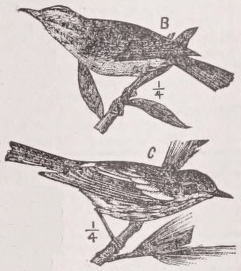
3. The common name of a genus of small birds (Sylvia, ) comprising most of the small woodland songsters of Europe and North America. They feed on insects and are very lively and active. The blue-bird is a species of the genus.
1. One who, or that which, warbles; a singer; a songster; -- applied chiefly to birds.
2. Any one of numerous species of small Old World singing birds belonging to the family Sylviidae, many of which are noted songsters. The bluethroat, blackcap, reed warbler (see under Reed), and sedge warbler (see under Sedge) are well-known species.
3. Any one of numerous species of small, often bright colored, American singing birds of the family or subfamily Mniotiltidae, or Sylvicolinae. They are allied to the Old World warblers, but most of them are not particularly musical.
WARBLER, in ornithology, the name bestowed in 1773 by Pennant (Genera of Birds, p. 35) on the birds removed, in 1769, by Scopoli from the Linnaean genus Motacilla (cf. Wagtail) to one founded and called by him Sylvia,— the last being a word employed by several of the older writers in an indefinite way,—that is to say, on all the species of Motacilla which were not Wagtails. “Warbler” has long been used by English technical writers as the equivalent of Sylvia, and consequently generally applied to all members of the Family Sylviidae thereon raised, which has since been so much subdivided as to include a vast number of genera, while species almost innumerable have from time to time been referred to it....
Until recently ornithologists had come to agree pretty well as to which forms should be considered to belong to the Family Sylviidae, —the “American Warblers” (Mniotiltidae), to be presently considered, being therefromsegregated; but some writers, seeing the difficulty of separating the remainder from the Turdidae (cf. Thrush), tried to get over it by proposing to erect an intermediate Family for the Wheatear (q.v.) and some similar forms, under the name Saxicolidae. In truth the difficulty was thereby doubled, for, if it was before hard to distinguish between Sylviidae and Turdidae, it has since become harder to distinguish on the one hand between Sylviidae and Saxicolidae, and on the other between Saxicolidae and Turdidae. The confusion thus caused is chiefly due to the adoption in a more or less modified form of the views put forth by Sundevall in 1872, and revised by him in 1874 (cf. Ornithology, vol. xviii. p. 38). For him, however, it is to be said that he at least proceeded in a fashion that had long been recognized, and gave reasons, whether good or bad, for the system he propounded; but his imitators have omitted so obvious a requirement, and leave to any one who would use their results the task of discovering how they have been reached. Hence it has been suggested that some of the alterations introduced since Sundevall's time have been purely arbitrary, if indeed they did not proceed from considerations of personal convenience, or occasionally even through mischance. Still the greatest allowance must be made for those who attempt to reduce to order such a multitudinousassemblage of forms—forms which present an almost endless variety of small differentiating characters, pointing in numerous directions—while the essential structure of all is apparently so similar that at present there is no hope of assistance from the anatomist or the morphologist. But the affinity, seeming or real, to the Turdidae does not offer the only difficulty. The resemblance which some other forms, often placed with the Sylviidae, bear to the Timeliidae —the Crateropodidae of some systematists—is equally if not more puzzling. It is admitted by many systematists that the Timeliidae form a group that has been made a “refuge for the destitute,” a group into which genera and species that were troublesome to classify have been thrust; and, as a natural consequence, the limits of such a “Family” or group have scarcely been plausibly defined. It appears that the so-called Timeliidae lead off to other groups, as the Laniidae (cf . Shrike) and what not, aud their existence as a separate “Family” can hardly be taken for a certainty. Again, a small group of birds, almost wholly peculiar to the Australian region, have been sometimes separated as Maluridae, and of these more must be said presently. Lastly, there are certain genera that, though formerly included without hesitation among the Sylviidae, have lately been designated “Fly-catchers,” on grounds, however, that have not been explained.
To deal with this theme in satisfactory detail would require far more space than can here be allowed, for the failures of later systematists would have to be shewn by a series of minute criticisms of a kind that would be only acceptable to specialists, and hardly understood by others than experts. All things then considered, it would seem to be best for our present purpose to regard the “Warblers”—without pledging our faith to the recognition of a “Family” Sylviidae— from the point of view which obtained before the more recent and perplexing (because ill-defined) opinions were introduced, and that aspect is afforded by the scheme furnished by Canon Tristram to Mr Wallace, and by him adopted in his Geographical Distribution of Animals (ii. pp. 257-260); but our limits will only allow us to touch upon a few of the most prominent members in addition to those which have already been or will form the subject of separate articles. In this sense then the first that may be mentioned are those forming a group of more or less aquatic habit, usually called Calamoheripinae but more correctly Acrocepha-linae, the commonest of which in England is the well-knowm Sedgebird or Sedge-Warbler, Acrocephalus schoenobaenus, whose chattering song resounds in summer-time from almost every wet ditch in most parts of Britain. As is the case with so many of its allies, the skulking habits of the bird cause it to be far more often heard than seen; but, with a little patience, it may be generally observed flitting about the uppermost twigs of the bushes it frequents, and its mottled back and the yellowish-white streak over its eye serve to distinguish it from its ally the Reed-Wren or Reed-Warbler, A. streperus, which is clad in a wholly mouse-coloured suit. But this last can also be recognized by its different song, and comparatively seldom does it stray from the reed-beds which are its favourite haunts. In them generally it builds one of the most beautiful of nests, made of the seed-branches of the reed and long grass, wound horizontally round and round so as to include in its substance the living stems of three or four reeds, between which it is suspended at a convenient height above the water, and the structure is so deep that the eggs do not roll out when its props are shaken by the wind. Of very similar habits is the Reed-Thrush or Great Reed-Warbler, A. arundinaceus, a loud-voiced species, abundant on the Continent but very rarely straying to England. Much interest also attaches to the species known as Savi’s Warbler, A. luscinioides, which was only recognized as a constant inhabitant of the Fendistrict of England a few years before its haunts were destroyed by drainage. The last example known to have been obtained in this country was killed in 1856. The nest of this species is peculiar, placed on the ground and formed of the blades of a species of Glyceria so skilfully entwined as to be a very permanent structure, and it is a curious fact that its nests were well known to the sedgecutters of the district which it most frequented, as those of a bird with which they were unacquainted, long before the builder was recognized by naturalists. In coloration the bird somewhat resembles a Nightingale (whence its specific name), and its song differs from that of any of those before mentioned, being a long smooth trill, pitched higher but possessing more tone than that of the Grasshopper-Warbler, A. naevius— the Salicaria locustella of many authors — which is a widely-distributed species throughout the British Isles, not only limited to marshy sites, but affecting also dry soils, inhabiting indifferently many kinds of places where there is tangled and thick herbage, heather, or brushwood. In those parts of England where it was formerly most abundant it was known as the Reeler or Reel-bird, from its song resembling the whirring noise of the reel at one time used by the spinners of wool. The precise determination of this bird—the GrasshopperLark, as it was long called in books, though its notes if once heard can never be mistaken for those of a grasshopper or cricket, and it has no affinity to the Larks—as an English species is due to the discernment of Gilbert White in 1768. In its habits it is one of the most retiring of birds, keeping in the closest shelter, so that it may be within a very short distance of an eager naturalist without his being able to see it,—the olive-colour, streaked with dark brown, of its upper plumage helping to make it invisible. The nest is very artfully concealed in the thickest herbage. The foreign forms of Aquatic Warblers are far too numerous to be here mentioned.
In the scheme already mentioned, a Subfamily Drymoecinae, with 15 genera and nearly 200 species, is recognized. That such a natural group may exist is quite likely, but about its composition and limits much doubt cannot fail to be entertained. If its existence be acknowledged, the remarkable genera Orthοtomus with about 12 aud Cisticola with some 30 species may be fairly admitted as belonging to it. The former includes the Tailor-birds of the Indian region of which all have heard or read, for their habit of sewing together the leaves of plants so as to form a cone in which to build their nests has often been described and the fabric figured. Jerdon (B. India, ir. p. 166) writes of the common Indian Tailor-bird, O. longicauda, that it “makes its nest of cotton, wool, and various other soft materials,” and “draws together one leaf or more, generally two leaves, on each side of the nest, and stitches them together with cotton, either woven by itself, or cotton thread picked up; and, after passing the thread through the leaf, it makes a knot at the end to fix it.” Cisticola, of which one species inhabits the south of Europe, follows the same trade on stems of grass, confining them by stitches above the nest, which assumes a globular form.
In the same group Drymoecinae is placed by some authors the Australian genus Malurus, to which belong the birds known as “Superb Warblers,” and they are not inaptly so named, since in beauty they surpass any others of their presumed allies. Part of the plumage of the cocks in breeding-dress is generally some shade of intense blue, and is so glossy as to resemble enamel, while black, white, chestnut, or scarlet, as well as green and lilac, are also present in one species or another, so as to heighten the effect. But, as already stated, there are systematists who would raise this genus, which contains some 15 species, to the rank of a distinct Family, though on what grounds it is hard to say.
Of the other Subfamilies, Saxicolinae, Sylviinae, and Phylloscopinae, will be conveniently treated under Wheatear, Whitethroat, and [Willow-] Wren (qq . v.), while the Ruticillinae have been already mentioned under Nightingale, Redbreast, and Redstart, and the Accentorinae under [Hedge-] Sparrow.
The birds known as “American Warblers,” forming what has now for a long while been almost universally recognized as a distinct Family, Mniotiltidae, remain for consideration. They possess but nine instead of ten primaries, and are peculiar to the New World. More than 130 species have been described, and these have been grouped in 20 genera or more, of which members of all but three are at least summer-visitants to North America. As a whole they are much more brightly coloured than the Sylviidae (Malurus, if it belongs to them, always excepted); for, though the particular genus Mniotilta (from which, as the fortune of nomenclature will have it, the Family takes its right name) is one of the most abnormal—its colours being plain black and white, and its habits rather resembling those of a Tree-creeper (q.v.)— in other groups chestnut, bluish-grey, and green appear, the last varying from an olive to a saffrontint, and in some groups the yellow predominates to an extent that has gained for its wearers, belonging to the genus Dendroeca, the name of “Golden” Warblers. In the genus Setophaga, the members of which deserve to be called “Fly-catching” λVarblers, the plumage of the males at least presents yellow, orange, scarlet, or crimson. Dr Coues (Key N.-Am. Birds, ed. 2, p. 288), following on the whole the arrangement of Baird, Brewer, and Ridgway (N.-Am. Birds, i. p. 178), separates the whole Family (for which he arbitrarily retains the name Sylvicolidae) into three Subfamilies, Sylvicolinae (= Mniotiltinae), Icteriinae, and Setophaginae, grouping the genera Mniotilta, Parula, and Peucedromus as “Creeping Warblers”; Geolhlypis, Oporornis, and Siurus as “Ground-Warblers”; Protonotaria, Helminthotherus, and Helminthophila as “Worm-eating Warblers”; Setophaga, Cardellina, aud Myiodioctes as “Fly-catching Warblers”; Icteria, which perhaps may not belong to the Family, standing alone; and Dendroeca as “WoodWarblers”
The Mniotiltidae contain forms exhibiting quite as many diverse modes of life as do the Sylviidae. Some are exclusively aquatic in their predilections, others affect dry soils, brushwood, forests, and so on. Almost all the genera arc essentially migratory, but a large proportion of the species of Dendroeca, Setophaga, and especially Basileuterus, seem never to leave their Neotropical home; while the genera Leucopeza , Teretristis, and Microligia, comprising in all but 5 species, are peculiar to the Antilles. The rest are for the most part natives of North America, where a few attain a very high latitude, penetrating in summer even beyond the Arctic Circle, and thence migrate southward at the end of summer or in the fall of the year, some reaching Peril and Brazil, but a few, as, for instance, Parula pitiayumi and Geothlypis velata seem to be resident in the country last named.
To return, in conclusion, to the Sylviidae, or true Warblers, it is to be hoped that before long some competent ornithologist will take on himself the task, necessary if toilsome and perhaps ungrateful, of revising the work that has lately been done upon them and upon the Turdidae, and, setting aside all preconceived notions except that of aiming at the truth, without prejudice fix the limits of the two Families, if Families they be, and at the same time adjust the relations of the hitherto very indefinite group Timeliidae. (a. n.)
9th ed. Encyclopædia Britannica, vol. 24, p. 366 [2,362 words — estimated reading time: 14 minutes]
In farriery, small hard tumors on the backs of horses, occasioned by the heat of the saddle in traveling, or by the uneasiness of its situation; also, small tumors produced by the larvas of the gad fly, in the backs of horses, cattle, etc.
A preparation containing quinine and many other ingredients, often used in the treatment of malarial affections. It was invented by Dr. Warburg of London.
WARBURTON, EliotBartholomew George (1810- 1852), traveller and novelist, born in 1810 near Tullamore, Ireland, made a hit with his first book, The Crescent and the Cross. It was a book of Eastern travel, in Turkey, Syria, Palestine, and Egypt, and fairly divided public attention with Mr Kinglake’s Eothen, which appeared in the same year, 1844. Interest was centred in the East at the time, and Warburton had popular sympathy with him in his eloquentadvocacy of the annexation of Egypt; but, apart from this harmony with the tastes of the time, the traveller had so many adventures, told them with such spirit, described what he saw with such picturesque vigour, and sketched character with such animation and generosity, that the success of the book on its merits was perfectly legitimate. Warburton was an Irishman, with an Irishman’s rhetoric and spirit of adventure, who, after an education at Cambridge, was called to the Irish bar, tried to settle down on his paternal estate, but very soon abandoned the management of his tenants for a life of nobler excitement. His first success as an author tempted him to try again, but he had unhappily a short career, and did not again equal The Crescent and the Cross. His most substantial work was a Memoir of Prince Rupert, published in 1849, enriched with original documents, and written with eloquentpartiality for the subject. This was followed in 1850 by a novel, Reginald Hastings, the scenes of which were laid in the same period of civil war. It was much more commonplace than his travels, and showed no power of construction or felicity in the creation of character. He produced another historical novel, Darien, or The Merchant Prince (1851). The knowledge therein shown of the inhabitants of the isthmus led to his selection by the ...Atlantic and Pacific Company to explore the country and negotiate a treaty with the Indian tribes. He sailed on this mission in the “Amazon,” which perished by fire with nearly all on board on the 4th of January 1852.
His Life of the Earl of Peterborough was published posthumously in 1853. To the Memoirs of Horace Walpole (1851), nominally edited by him, he contributed, as he avowed in the preface, only his advice to the anonymous author and the countenance of his name.
WARBURTON, William (1698-1779), bishop of Gloucester, was the son of the town clerk of Newark, where he was born on December 24, 1698. He was educated at Oakham and Newark grammar schools, but, being intended for his father’s profession, does not seem to have addicted himself especially to the classics, or to have manifested extraordinary proficiency in any study. He lost his father while a boy, and in 1714 he was articled to Mr Kirke, attorney at Great Markham, in Nottinghamshire, and after serving his time with him returned to Newark with the intention of practising as a solicitor. Whether he ever did seems uncertain, but a very short time afterwards he is found studying Latin and Greek under the master of Newark school, who frequently sat up till late at night with his pupil. In 1723 he was ordained deacon by the archbishop of York, and on March 1, 1727, received priest’s orders from the bishop of London. He had occupied the interval in various literary labours, the most important being the notes he contributed to Theobald’s edition of Shakespeare, and an anonymouspamphlet on a question which had arisen concerning the jurisdiction of the Court of Chancery. Warburton had undertaken to answer another anonymouspamphlet, which proved to be the composition of no less a person than Mr Yorke, afterwards Lord Chancellor Hardwicke, and the impression which he made upon his antagonist was evinced by the pains the latter took with his reply. He now received from Sir Robert Sutter the small living of Griesley, in Nottinghamshire, exchanged next year for that of BrantBroughton, in Lincolnshire, and was made an honorary M.A. of Cambridge. Here for eighteen years he spent his time in intense study, the first result of which was his celebrated treatise on the alliance between church and state, published in 1736. The work was probably intended, and certainly admirably adapted, to afford the ministry of the day an excuse for omitting to redeem their promise to the Dissenters of freeing them from the bondage of the Test and Corporation Acts. To this end the test is represented as the only possible means of reconciling the principle of a religious establishment with that of a free toleration, a piece of logic which, now that religious tests are no longer held a qualification for civil office, would excite most opposition where it originally gained most favour. It fully answered its temporary purpose, and equally subserved the author’s real end by gaining him credit at court. It would appear that he only missed immediate preferment by the death of Queen Caroline. His next performance, the famous Divine Legation of Moses Demonstrated on the Principles af a Religious Deist, the first part of which was published in 1738, will long preserve his name as the author of the most daring and ingenious of theological paradoxes. The deists had made the absence of any inculcation of the doctrine of a future life an objection to the divine authority of the Mosaic writings. Warburton boldly admits the fact and turns it against the adversary No human legislator, he contends, would have omitted such a sanction of morality; ergo, the legislation was divine. It may be doubted whether the argument ever convinced any one; and its cogency was not assisted by the multitude of minor paradoxes with which it was interwoven, such as the identification of the scenery of the sixth book of the Aeneid with the exhibitions of the Eleusinian mysteries. But the author’s extraordinary power, learning, and originality were acknowledged on all hands, though he excited censure and suspicion by a circumstance highly honourable to him, his tenderness to the alleged heresies of Conyers Middleton. The second volume of the work appeared in 1741.
Warburton’s next undertaking, though still theological, brought him into the field of general literature. Either in quest of another paradox, or actually unable to recognize the Spinozistic tendency of Pope’s Essay on Man, he entered upon its defence against Crousaz, in a series of articles contributed to The Republic of Letters. Whether Pope had really understood the tendency of his own work has always been a question, but there is no question that he was glad of an apologist, or that Warburton’s jeu d'esprit (for him it was hardly more) in the long run did more for his fortunes than all his erudition. It occasioned a sincere friendship between him and Pope, whom he persuaded to add a fourth book to the Dunciad, and substitute Cibber for Theobald as the hero of the poem. Pope bequeathed him the copyright and the editorship of his works, and contributed even more to his advancement by introducing him to Murray, afterwards Lord Mansfield, who obtained for him the preachership of Lincoln’s Inn, and to RalphAllen, who, says Johnson, “gave him his niece and his estate, and, by consequence, a bishopric.” The marriage took place in 1745, and from that time Warburton resided principally at his father-in-law’s estate at Prior Park, in Gloucestershire, which he inherited on Allen’s death in 1764. In 1747 appeared his edition of Shakespeare, into which, as he expressed it, Pope’s previous edition was melted down. He had previously entrusted notes and emendations on Shakespeare to Sir Thomas Hanmer, whose unauthorized use of them led to a warm controversy. Warburton was further kept busy by the attacks on his Divine Legation from all quarters, by a dispute with Bolingbroke respecting Pope’s behaviour in the affair of Bolingbroke’s Patriot King, and (1750) by a work of more importance in vindication of the alleged miraculousinterruption of the rebuilding of the temple of Jerusalem undertaken by Julian. Here again Warburton shows his habitualintrepidity as a controversialist, and places himself upon ground where few at the present day would care to follow him. His defence of revelation was continued in his View of Bolingbroke's Posthumous Writings (1754), universally allowed to be a most masterly performance Warburton’s manner of dealing with opponents would be in our day considered both insolent and rancorous, but it did him no disservice in his own. In 1757 he was made dean of Bristol, and in 1760 bishop of Gloucester.
Mr Abbey characterizes Warburton as an inactive bishop, and the partial Hurd can say no more than that “he performed the duties of his office with regularity, but further than this he could not prevail with himself to go.” Nor did he ever seek to shine in parliament. He continued, however, active with his pen, so long as the infirmities of age allowed, collecting and publishing his sermons, reprinting his principal works with large additions, toiling to complete the Divine Legation, the last book of which appeared after his death, and writing (1762) a vigorous attack on Methodism under the title of The Doctrine of Grace. Of this work his friend and biographerHurd says, with curious infelicity, “the sect will find a sort of immortality in this discourse.” The reverse has proved true, yet the book ranks among the author’s most powerful productions. He also engaged in a keen controversy with Bishop Lowth on the book of Job, which even his admiringbiographer wishes forgotten. His last important act was to found, in 1768, the Warburtonian lecture, “to prove the truth of revealed religion from the completion of the prophecies in the Old and New Testament which relate to the Christian church, especially to the apostacy of Papal Rome.” “On the right determination of the prophecies relating to Antichrist,” he said, “one might rest the whole truth of the Christian religion,”—another opinion which finds little support in the 19th century. The principal authority for his latter years is his correspondence with his friend Bishop Hurd, an important contribution to the literary history of the period. After the death of his only son in 1776 he fell into a lethargiclanguor, which was terminated by death on June 7, 1779.
Warburton was undoubtedly a great man, but his intellect, marred by wilfulness and the passion for paradox, has effected no result in any degree adequate to its power. He disdained to persuade unless he could at the same time astonish, and in endeavouring to amaze he has failed to convince. None of the propositions with which his name is chiefly connected have found acceptance with posterity, and while abundantly demonstrating his own learning he has failed to make any considerable addition to the stock of human knowledge, or to leave any signal mark on the history of opinion. He was rather a gladiator than a warrior, an exhibitor of brilliant fence leading to no definite end. Though always faithful to his convictions, he argued for victory rather than truth, and wasted upon advocacy powers which would have produced great results if they had been employed in serious and dispassionate investigation. His rude and arrogant style of controversy deserved and received severe reprehension; it was at all events free from pettiness and malignity; and his faults were in general those of an aspiring and magnanimous nature. He was a warm and constant friend, and gave many proofs of gratitude to his benefactors. As an editor and critic he displayed much force of mind, but his standard of research was not high, and his literary taste was that of the 18th century.
9th ed. Encyclopædia Britannica, vol. 24, p. 367 [387 words — estimated reading time: 3 minutes]
2. Whose gates he found fast shut, he living wight to ward the same--
3. [In this sense, ward is obsolete, as we have adopted the French of the same word, to guard. We now never apply ward to the thing to be defended, but always to the thing against which it is to be defended. We ward off a blow or dagger, and we guard a person or place.]
4. To defend; to protect.
5. Tell him it was a hand that warded him from thousand dangers. [Obs. See the remark, supra.]
WARD, Edward Matthew (1816-1879), history and genre painter, was born at Pimlico, London, in 1816. Among his early boyish efforts in art was a series of clever illustrations to the Rejected Addresses of his uncles Horace and James Smith, which was followed soon afterwards by designs to some of the papers of Washington Irving. In 1830 he gained the silver palette of the Society of Arts; and in 1835, aided by Wilkie and Chantrey, he entered the schools of the Royal Academy, having in the previous year contributed to its exhibition his portrait of Mr O. Smith, the comedian, in his character of Don Quixote. In 1836 he went to Rome, where in 1838 he gained a silver medal from the Academy of St Luke for his Cimabue and Giotto, which in the following year was exhibited at the Royal Academy. The young artist now turned his thoughts to fresco-painting, which he studied under Cornelius at Munich. In 1843 he forwarded his BoadiceaAnimating the Britons previous to the Last Battle against the Romans to the competition for the decoration of the Houses of Parliament,—a work upon which he was afterwards engaged, having in 1853 been directed by the fine art commissioners to execute eight subjects in the corridor of the House of Commons. The success of his Dr Johnson in Lord Chesterfield’s Ante-Room—now in the National Gallery, along with the Disgrace of Lord Clarendon (the smaller picture) (1846), the South Sea Bubble (1847), and James II. receiving the News of the Landing of the Prince of Orange (1850)—secured his election as an associate of the Royal Academy in 1847, and in 1855 he gained full academic honours. Among the more important of his other works may be named Charlotte Corday Led to Execution (1852), the Last Sleep of Argyll (1854), the Emperor of the French Receiving the Order of the Garter (1859), painted for the queen, the Antechamber at Whitehall during the Dying Moments of Charles II. (1861), Dr Johnson’s First Interview with John Wilkes (1865), and the Royal Family of France in the Temple, painted in 1851, and usually considered the artist’s masterpiece. For several years before his death Ward suffered from ill-health and mental depression, which led to temporary aberration of intellect. He died at Windsor, on January 15, 1879.
Ward’s pictures have been extremely popular, and the engravings which reproduce so many of them have had a wide circulation. His works are generally interesting in subject; they tell their story with point and clearness, are correct and learned in costume, and full of observation and character. In purely technical qualities, in lighting, tone, colour, and draughtsmanship, they are more frequently open to exception.
WARD, James (1769-1859), animal painter and engraver, was born in Thames Street. London, on October 23, 1769. At the age of twelve he was bound apprentice with J. Raphael Smith, but he received little attention and learnt nothing from this engraver. He was afterwards instructed for over seven years by his elder brother, William Ward, and he engraved many admirable plates, among which his Mrs Billington, after Reynolds, occupies a very high place. He presented a complete set of his engravings, in their various states, numbering three hundred impressions, to the British Museum. While still a youth he made the acquaintance of George Morland, who afterwards married his sister; and the example of this artist’s works induced him to attempt painting. His early productions were rustic subjects in the manner of Morland, which were frequently sold as the work of the more celebrated painter. His Bull-Bait, an animated composition, introducing many figures, attracted much attention in the Royal Academy of 1797. A commission from Sir John Sinclair, president of the new agricultural society, to paint an Alderney cow led to much similar work, and turned Ward’s attention to animal-painting, a department in which he achieved his highest artistic successes, his renderings of cattle being unrivalled in the English school, and worthy to rank with the pictures of the great animalpainters of Holland. His Landscape with Cattle, acquired for the National Gallery at a cost of £1500, was painted in 1820-22 at the suggestion of West, in emulation of the Bull of Paul Potter at The Hague. His Boa Serpent Seizing a Horse was executed in 1822, and his admirable Grey Horse, shown in the Old Masters’ Exhibition of 1879, dates from 1828. Ward also produced portraits, and many landscapes like the Gordale Scar and the Harlech Castle in the National Gallery. Sometimes he turned aside into the less fruitful paths of allegory, as in his unsuccessful Pool of Bethesda (1818), and Triumph of the Duke of Wellington (1818). He was a frequent contributor to the Royal Academy and the British Institution, and in 1841 he collected one hundred and forty examples of his art, and exhibited them in his house in Newman Street. He was elected an Associate of the Royal Academy in 1807, and a full member in 1811, and died at Cheshunt on the 23rd of November, 1859.
Ward compiled an autobiography, of which an abstract was published in the Art Journal in 1849.
WARD, William (1766-1826), mezzotint-engraver, an elder brother of James Ward (see above), was born in London in 1766. He was the most distinguished pupil of J. Raphael Smith, and executed a great part of many of the plates which bear the name of that excellent engraver. In 1795 he began to exhibit in the Royal Academy, of which in 1814 he was elected an associate engraver. He also held the appointment of mezzotintengraver to the prince regent and the duke of York. He executed six plates after Reynolds, engraved many of the works of his brother-in-law, George Morland, and his mezzotints after Andrew Geddes, which include the full-lengths of Sir David Wilkie and of Patrick Brydone, are of great merit. His engravings are full of artistic spirit, and show fine feeling for colour; and they are excellently tender and expressive in their rendering of flesh. He died suddenly at Mornington Place, on December 1, 1826.
9th ed. Encyclopædia Britannica, vol. 24, p. 369 [3 words — estimated reading time: 1 minute]
N. warfare, fighting, hostilities, war, arms, the sword, mars, bellona, grim visaged war, horrida bella, bloodshed, appeal to arms, appeal to the sword, ordeal of battle, wager of battle, ultima ratio regum, arbitrament of the sword, battle array, campaign, crusade, expedition, operations, mobilization, state of siege, battlefield, theater of operations, warpath, art of war, tactics, strategy, castrametation, generalship, soldiership, logistics, military evolutions, ballistics, gunnery, chivalry, gunpowder, shot, battle, tug of war, service, campaigning, active service, tented field, kriegspiel, kriegsspiel, fire cross, trumpet, clarion, bugle, pibroch, slogan, war-cry, war-whoop, battle cry, beat of drum, rappel, tom-tom, calumet of war, word of command, password, watchword, passage d-armes, war to the death, war to the knife, guerre a mort, guerre a outrance, open war, internecine war, civil war
V. arm, raise troops, mobilize troops, raise up in arms, take up the cudgels, take up arms, fly to arms, appeal to arms, fly to the sword, draw the sword, unsheathe the sword, dig up the hatchet, dig up the tomahawk, go to war, wage war, 'let slip the dogs of war', cry havoc, kindle the torch of war, light the torch of war, raise one's banner, raise the fire cross, hoist the black flag, throw away, fling away the scabbard, enroll, enlist, take the field, take the law into one's own hands, do battle, give battle, join battle, engage in battle, go to battle, flesh one's sword, set to, fall to, engage, measure swords with, draw the trigger, cross swords, come to blows, come to close quarters, fight, combat, contend, battle with, break a lance with, raise the jolly roger, run up the jolly roger, serve, see service, be on service, be on active service, campaign, wield the sword, shoulder a musket, smell powder, be under fire, spill blood, imbrue the hands in blood, on the warpath, carry on war, carry on hostilities, keep the field, fight the good fight, fight it out, fight like devils, fight one's way, fight hand to hand, sell one's life dearly, pay the ferryman's fee
Adv. flagrante bello, in the thick of the fray, in the cannon's mouth, at the sword's point, at the point of the bayonet
Int. vae victis, to arms, to your tents o israel, phr, the battle rages, a la guerre comme a la guerre, bis peccare in bello non licet, jus gladii, "my voice is still for war", "'tis well that war is so terrible, otherwise we might grow fond of it", "my sentence is for open war", "pride, pomp, and circumstance of glorious war", "the cannons have their bowels full of wrath", "the cannons . . .spit forth their iron indignation", "the fire-eyed maid of smoky war", silent leges inter arma, si vis pacem para bellum
That these made war with Bera king of Sodom, and with Birsha king of Gomorrah, Shinab king of Admah, and Shemeber king of Zeboiim, and the king of Bela, which is Zoar.
went to war against Bera king of Sodom, Birsha king of Gomorrah, Shinab king of Admah, Shemeber king of Zeboiim, and the king of Bela (that is, Zoar).
And Laban said to Jacob, What hast thou done, that thou hast stolen away unawares to me, and carried away my daughters, as captives taken with the sword?
Then Laban said to Jacob, “What have you done? You have deceived me and carried off my daughters like captives of war!
And the keeper of the prison committed to Joseph’s hand all the prisoners that were in the prison; and whatsoever they did there, he was the doer of it.
And the warden put all the prisoners under Joseph’s care, so that he was responsible for all that was done in the prison.
The keeper of the prison looked not to any thing that was under his hand; because the LORD was with him, and that which he did, the LORD made it to prosper.
The warden did not concern himself with anything under Joseph’s care, because the LORD was with Joseph and gave him success in whatever he did.
Come on, let us deal wisely with them; lest they multiply, and it come to pass, that, when there falleth out any war, they join also unto our enemies, and fight against us, and so get them up out of the land.
Come, let us deal shrewdly with them, or they will increase even more; and if a war breaks out, they may join our enemies, fight against us, and leave the country.”
And it came to pass, when Pharaoh had let the people go, that God led them not through the way of the land of the Philistines, although that was near; for God said, Lest peradventure the people repent when they see war, and they return to Egypt:
When Pharaoh let the people go, God did not lead them along the road through the land of the Philistines, though it was shorter. For God said, “If the people face war, they might change their minds and return to Egypt.”
Hearken now unto my voice, I will give thee counsel, and God shall be with thee: Be thou for the people to God-ward, that thou mayest bring the causes unto God:
Now listen to me; I will give you some advice, and may God be with you. You must be the people’s representative before God and bring their causes to Him.
And Moses said unto the LORD, The people cannot come up to mount Sinai: for thou chargedst us, saying, Set bounds about the mount, and sanctify it.
But Moses said to the LORD, “The people cannot come up Mount Sinai, for You solemnly warned us, ‘Put a boundary around the mountain and set it apart as holy.’”
This site uses cookies to remember your display preferences (search sources and editions, Bible version, auto-link, images, light/dark theme). No personal data whatsoever is collected. Privacy Policy