
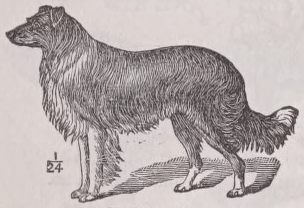
The Scotch shepherd dog. There are two breeds, the rough-haired and smooth-haired. It is remarkable for its intelligence, displayed especially in caring for flocks.
COLLIER, Arthur (1680-1732), metaphysician and divine, was born at the rectory of Langford Magna, near Sarum, on 12th October 1680. There is no account of his childhood and early youth; but it is probable that, after receiving some rudimentary instruction at home, he went to one of the grammar schools at Salisbury. He entered at Pembroke College, Oxford, in July 1697 and remained there till October in the following year, when he and his brother William became members of Balliol together. His father died in 1697, and as the family owned the advowson of Langford Magna, it was arranged, after some difficulties raised by Burnet, then bishop of Salisbury, that the benefice should be held by a clergyman until Arthur was old enough to be inducted. » He was accordingly presented to the benefice in 1704, and continued in it till his death in 1732. Although a bold speculator in theology, his sermons intended for his parish show no traces of his peculiar notions, and he seems to have been faithful in the discharge of his duty. He was often in pecuniary difficulties, from which at last he was obliged to free himself by selling the reversion of Langford rectory to Corpus Christi College, Oxford, a misfortune which his biographer attributes to his “habits of abstruse speculation, which seem to have unfitted him for all considerations of worldly prudence.” Collier’s philosophical opinions took shape early in his mind. They grew out of a diligent study of the writings of Descartes and Malebranche. Norris of Bemerton, a neighbouring clergyman, also strongly influenced him by his Essay on the Ideal World. It is remarkable that Collier makes no reference to Locke, nor shows the least sign of having any knowledge of his works. As early as 1703 Collier seems to have become convinced ...of the non-existence of an external world. There is among his MSS., under date January 1708, an outline of an essay in three chapters on the question whether the visible world is external or not. In 1712 he wrote two essays, which are still in manuscript, one on substance and accident, and the other termed Clavis Philosophica. The work on which his philosophical reputation depends appeared in 1713, under the title Clavis Universalis, or a New Inquiry after Truth, being a Demonstration of the Non-Existence or Impossibility of an External World. It has been favourably mentioned by Reid, Stewart, and others, was frequently referred to by the Leibnitzians, and was translated into German by Professor Eschenbach in 1756. Berkeley’s Principles of Knowledge and his Theory of Vision preceded it by three and four years respectively. Although there is no evidence that they were known to Collier before the publication of his book, a passage in a letter written by him in March 1713-14 proves that he was acquainted in some measure with Berkeley’s opinions at that date. In this letter and other four, which are given in Benson’s Memoirs of Collier (1837), there are some further remarks in defence of his philosophical views; but they are merely a repetition of the arguments in the Clavis. These are grounded on two presuppositions—first, the utter aversion of common sense to any theory of representative perception; and second, the opinion which Collier held in common with Berkeley, and Hume afterwards, that the difference between imagination and sense perception is only one of degree. The former is the basis of the negative part of his argument; the latter supplies him with all the positive account he has to give, and that is meagre enough. The Clavis consists of two parts. After some introductory remarks, iu which he explains that he will use the term “external world” in the sense of absolute, self-existent, independent matter, and fences the position he is to occupy against sundry possible misinterpretations, he attempts in the first part to prove that the visible world is not external, by showing—first, that the seeming externeity of a visible object is no proof of real externeity, and second, that a visible object, as such, is not external. The image of a centaur seems as much external to the mind as any object of sense; and since the difference between imagination and perception is only one of degree, God could so act upon the mind of a person imagining a centaur, that he would perceive it as vividly as any object can be seen. Descartes and his school affirm that certain objects of sense, as sounds, smells, <fcc., exist only in their respective faculties, although no one can doubt that they seem to exist altogether without them. The same philosophers agree that light and colours, which are allowed to be objects properly visible, are not external. Still they seem to be so. The delusions of the insane and the visions of inspired men are further instances of seeming externality which is not real. So is the familiar case of objects seen in a looking-glass. A number of similar illustrations are used to prove the second proposition, that a visible object, as such, is not external. If we assume, for instance, that there is an external moon, it cannot be the same as the visible moon, for this is ever-changing and is never bigger than a trencher; but the real moon is some thousands of miles in diameter. Berkeley uses the same argument in his Álciskhron (1732). Then, too, the Aristotelian and the Cartesian forms of representative perception agree in holding that the true object of vision is not the external reality. The author concludes his first part by replying to objections based on the universal consent of men, on the assurance given by touch of the extra existence of the visible world, and on the truth and goodness of God (Descartes), which would be impugned if our senses deceived us. Collier argues naively that if universal consent means the consent of those who have considered the subject, it may be claimed for his view. He thinks with Berkeley that objects of sight are quite distinct from those of touch, and that the one therefore cannot give any assurance of the other ∙ and he asks the Cartesians to consider how far God’s truth and goodness are called in question by their denial of the externality of the secondary qualities. The second part of the book is taken up with a number of metaphysical arguments to prove the impossibility of an external world. The pivot of this part is the logical principle of contradiction. From the hypothesis of an external world a series of antinomies are deduced, such as that the world is both finite and infinite, is movable and immovable, &c.; and finally, Aristotle and various other philosophers are quoted, to show that the external matter they dealt with, as mere potentiality, is just nothing at all. Among other uses and consequences of his treatise, Collier thinks it furnishes an easy refutation of the Romish doctrine of transubstantiation. If there is no external world, the distinction between substance and accidents vanishes, and these become the sole essence of material objects, so that there is no room for any change whilst they remain as before. Sir William Hamilton thinks that the logically necessary advance from the old theory of representative perception to idealism was stayed by anxiety to save this miracle of the church; and he gives Collier credit for being the first to make the discovery. Professor Ueberweg, on the other hand, is of opinion that idealism and the miracle of the eucharist may be reconciled by regarding substance not as substrate supporting the accidents, but as intelligible essence; so that when in the religious act the body and blood of Christ are conjoined with the bread and wine, these cease to be essential and become accidents, and a different substance is present. But in that form of idealism which recognizes an intelligible essence there must be such a necessary connection between essence and phenomenon as would require the presence of new phenomena along with the new essence. Still it must have been some deeper cause than concern for the church dogma that retarded idealism. Until philosophers could be broughtto reflect on the meaning of such notions as externality, cause, <tc., it was inevitable that they should continue striving to justify the belief in an external material world. Collier’s blank denial would not have turned the stream. It needed a more subtle thinker to divert it into the course which it afterwards followed.
Collier’s book possesses an interest for the student of philosophy on account of the resemblance between his views and those of his contemporary Berkeley.. Both were impelled to philosophize by their dissatisfaction with the theory of representative perception. Both have the feeling that it is inconsistent with the common sense of mankind, which will insist that the very object perceived is the sole reality, and both claim to substitute for the theory held in favour, and vainly sought to be demonstrated by their predecessors, another that will meet the demands of common sense. They equally affirm that the so-called representative image is the sole reality, aud discard the unperceiving material cause of the philosophers as an unthinkable monstrosity. Of objects of sense, they say, their esse is percipi. But Collier never got beyond a bald assertion of the fact, while Berkeley addressed himself to an explanation of it, which gave him ever profounder matter for philosophical reflection all his days. The thought of a distinction between direct and indirect perception never dawned upon Collier’s mind. He could only meet the doctrine of the representationists, therefore, with a flat negation. To the question how all matter exists in dependence on percipient mind he could only reply, “Just how my reader pleases, provided it be somehow.” As cause of our sensations and ground of our belief in externality, he substituted for an unintelligible material substance an equally unintelligible operation of divine power. But his illustrious contemporary gave a fresh start to philosophy by his exposition of the association between visual and tactual sensations; and his glimpses, faint at first, gradually grew more distinct of an intelligible order in the universe. Collier’s book exhibits no traces of a scientific development. In the first part, which may be compared with Berkeley’s Theory oj Vision, he merely brings together a few instances of visual experience, which throw discredit upon the popular opinion. . The most that can be said about him is that he was an intelligent student of Descartes and Malebranche, and had the ability to apply the results of his reading to the facts of his experience. He starts no original conception, contributes nothing to the development of philosophy. The latter half of his book reads like the ingenious quibbling of the schoolmen. In philosophy he is a curiosity, and nothing more. His biographer tries to make out that the Clavis fell flat on the English public in comparison with the reception accorded to Berkeley’s writings, on account of its inferiority in point of style. No doubt it is immensely inferior in that respect; but the crudeness of Collier’s thought had quite as much to do with his failure to gain a hearing. Hamilton allows greater sagacity to Collier than to Berkeley, for not vainly attempting to enlist men’s natural belief against the hypothetical realism of the philosophers. But Collier did so as far as his light enabled him. He appealed to the popular conviction that the proper object of sense is the sole reality, although he despaired of getting men to give up their belief in its externality. He moreover distinctly asserted that nothing but prejudice prevented them from doing so; and there is little doubt that if it had ever occurred to him, as it did to Berkeley, to explain the genesis of the notion of externality, he would have been more hopeful of commending his theory to the popular mind. What.Collier simply denied Berkeley tried to explain, and therein lies that real difference between the two writers which accounts for the comparative oblivion that has been the fate of the one, and justifies the place assigned to the other in the history of philosophy.
In a curious discourse on Genesis i. 1, which Collier published in 1730, under the modest title, A Specimen of a True Philosophy, we have a jumble of his theological views and his philosophical opinions. Inasmuch as we are often told in Scripture that God created all things in and by the Son, the aρχ∙f ∣ of the passage commented on must refer to the only begotten Son of God. If then we exist in God, because we are made by Him, as St Paul says, “in him we live, and move, and have our being,” we must believe that we exist mor,e immediately in the Son, being told, as in the text, that God made us and all things by and in His Son. Christ, the aρχh of the whole creation, must needs be in some sense the subject or object of all that is called science. Things, however, do not exist immediately in Christ, but at various distances and projections from II im. Everything in particular is in its own proper or immediate apχh or substance; but all these terminate in one, the Son of God, the substance of the whole creation. This interpretation.of the passage is corroborated by the conclusion reached in the Glavis Universalis; for it is there proved that the visible or material world exists immediately in the mind of the percipient, and hence the meaning of the text must be that mind or spirit is the αρχ⅛ in which God created the heaven and the earth. As the objects of sense exist immediately in the mind, so the mind exists immediately in the Son of God; and thus the ladder of being is completed in this Specimen of a True Philosophy. TheLogology, oraTreatise on the Logos, in Seven Sermons on John i. 1, 2, 3, and 14, was published in 1732, the year of Collier’s death. It further applies his theory of inexistence to the Son, who is said to be in the Father, as men are in Him, and material objects are in them. The Son is the “mean proportional” between God and us. Collier was heterodox in regard to the incarnation, as well as the Trinity, maintaining “that the pre-existent Word, or Son of God, was not united to a created human soul or spirit, but was himself the man called Jesus and the Christ. ’ '
See Benson’s Memoirs of the Life and Writings of Arthur Collier, 1837; Parr’s Metaphysical Tracts by English Philosophers of the Eighteenth, Century, 1837; T ennem.a.nn’a History of Philosophy; Hamilton’s Discussions; Professor Fraser’s edition of Berkeley s Works.
COLLIER, Jeremy (1650-1726), a learned English nonjuring divine, born at Stow-cum-Quy, Cambridgeshire, in 1650, and was educated at Caius College, Cambridge. His first appointment was to the small rectory of Ampton, near Bury St Edmunds, which, after six years, he resigned in order to proceed to London, where in 1685 he was made lecturer of Gray’s Inn. The change of Government at the Revolution, however, soon rendered the public exercise of his function impracticable. He was committed to Newgate for writing in favour of the dethroned monarch, and again on a charge of carrying on a treasonable correspondence with the enemies of the popular movement; but he was released on both occasions without trial, by the intervention of his friends. So far did he carry his scruples at this period, that he submitted to confinement rather than make a tacit acknowledgment of the jurisdiction of the court by accepting his liberty upon bail. In the two following years he continued to harass the Government by his publications; but for his boldness in granting absolution at their execution to Sir John Friend and Sir William Perkins, who had attempted the assassination of William, he was obliged to flee, and for the rest of his life continued under sentence of outlawry. When the storm had blown over he returned to London, and employed his leisure in literary works, which were less political in their tone. In 1697 appeared the first volume of his Essays on Several Moral Subjects, to which a second was added in 1705, and a third in 1709. All three series enjoyed great popularity at the time of their appearance. It was in 1798, however, that Collier produced the book by which he is best known, and for which he has been most justly praised, the famous Short View of the Immorality and Profaneness of the English Stage. Its publication involved him in a lengthened controversy with Congreve, Vanbrugh, and the other wits of the day. The book abounds in hypercriticism and in useless display of learning, neither intrinsically valuable nor conducive to the argument. Yet, in the words of Macaulay, who gives an admirable account of the discussion in bis essay on the Comic Dramatists of the Restoration, “when all deductions have been made, great merit must be allowed to the work. There is hardly any book of that time from which it would be possible to select specimens of writing so excellent and so various.” The Short View was followed by a Defence, a Second Defence, and a Farther Vindication, and in 1703 by Mr Collier's Dissuasive from the Playhouse, in a Letter to a Person of Quality. The fight lasted in all some ten years; but Collier had right on his side, and triumphed; and the reformation of the English stage, so greatly needed, may be said to date from the publication of the Short View. From 1701 to 1721 Collier was employed in the translation and publication (in six volumes folio) of Moreri’s Dictionnaire Historique, and in the compilation and issue of the two volumes folio of his own Ecclesiastical History of Great Britain. The latter work was attacked by Burnet and others, but the author showed himself as keen a controversialist as ever. Many attempts were made to shake his fidelity to the lost cause of the Stuarts, but he continued indomitable to the end. His last work was a volume of Practical Discourses, published in 1725. He died April 26, 1726.