
Alt. of Crane
Word of the Day: Catachrestical
Cranach
Encyclopedia Britannica
CRANACH, Lucas (1472-1553), one of the representative painters of Germany at the time of the Reformation, was born at Cronach in Upper Franconia, and learnt the art of drawing from his father. It has not been possible to trace his descent or the name of his parents. We are not informed as to the school in which he was taught, and it is a mere guess that he took lessons from the South German masters to whom Mathew Grunewald owed his education. But Grunewald practised at Bamberg and Aschaffenburg, and Bamberg is the capital of the diocese in wshich Cronach lies. According to Gunderam, the tutor of Cranach’s children, Cranach signalized his talents as a painter before the close of the 15th century. He then drew upon himself the attention of the elector of Saxony, who attached him to his person in 1504. The records of Wittenberg confirm Gunderam’s statement to this extent that Cranach’s name appears for the first time in the public accounts on the 21th of June 1501, when he drew 50 gulden for the salary of half a year, as pictor ducalis. The only clue to Cranach’s settlement previous to his Wittenberg appointment is afforded by the knowledge that he owned a house at Gotha, and that Barbara Brengbier, his wife, was the daughter of a burgher of that city. Of his skill as an artist we have sufficient evidence in a picture dated 1504 (Fiedler collection at Berlin), preserved till lately in the Sciarra Colonna Palace at Rome. But as to the development of his manner prior to that date we are altogether in ignorance. In contrast with this obscurity is the light thrown upon Cranach after 1501. We find him active in several branches of his profession,—sometimes a mere housepainter, more frequently producing portraits and altarpieces, a designer on wood, an engraver of ...copper-plates, and draughtsman for the dies of the electoral mint. Early in the days of his official employment he startled his master’s courtiers by the realism with which he painted still life, game, and antlers on the walls of the country palaces at Coburg and Lochau; his pictures of deer and wild boar were considered striking, and the duke fostered his passion for this form of art by taking him out to the hunting field, where he sketched “his grace” running the stag, or Duke John sticking a boar. Before 1508 he had painted several altar-pieces for the Schlosskirche at Wittenberg in competition with Dürer, Burgkmair, and others; the duke and his brother John were portrayed in various attitudes, and a number of the best woodcuts and copper-plates were published. Great honour accrued to Cranach when he went in 1509 to the Netherlands, and took sittings from the Emperor Maximilian and the boy who afterwards became Charles V. Till 1508 Cranach signed his works with the initials of his name. In that year the elector gave him the winged snake as a motto, and this motto or Kleinod, as it was called, superseded the initials on all his pictures after that date. Somewhat later the duke conferred on him the monopoly of the sale of medicines at Wittenberg, and a printer’s patent with exclusive privileges as to copyright in Bibles. The presses of Cranach were used by Luther. His chemist’s shop was open for centuries, and only perished by fire in 1871. Relations of friendship united the painter with the Reformers at a very early period; yet it is difficult to fix the time of his first acquaintance with Luther. The oldest notice of Cranach in the Reformer’s correspondence dates from 1520. In a letter written from Worms in 1521, Luther calls him his gossip, warmly alluding to his “Gevatterin,” the artist’s wife. His first engraved portrait by Cranach represents an Augustine friar, and is dated 1520. Five years later the monk dropped the cowl, and Cranach was present as “one of the council” at the betrothal festival of Luther and Catherine Bora. The death at short intervals of the Electors Frederick and John (1525 and 1532) brought no change in the prosperous situation of the painter; he remained a favourite with John Frederick I., under whose administration he twice (1537 and 1540) filled the office of burgomaster of Wittenberg. But 1547 witnessed a remarkable change in these relations. John Frederick was taken prisoner at the battle of Mühlberg, and Wittenberg was subjected to stress of siege. As Cranach wrote from his house at the corner of the market-place to the Grand-Master Albert of Brandenburg at Königsberg to tell him of John Frederick’s capture, he showed his attachment by saying, “I cannot conceal from your Grace that we have been robbed of our dear prince, who from his youth upwards has been a true prince to us, but God will help him out of prison, for the Kaiser is bold enough to revive the Papacy, which God will certainly not allow.’’ During the siege Charles bethought him of Cranach, whom he remembered from his childhood, and summoned him to his camp at Pistritz. Cranach came, reminded his majesty of his early sittings as a boy, and begged on his knees for kind treatment to the Kurfürst. Three years afterwards, when all the dignitaries of the empire met at Augsburg to receive commands from the emperor, and when Titian at Charles’s bidding came to take the likeness of Philip of Spain, John Frederick asked Cranach to visit the Swabian capital; and here for a few months he was numbered amongst the household of the captive elector, whom he afterwards accompanied home in 1552. He died at Weimar, in October 1553.
The oldest extant picture of Cranach, the Rest of the Virgin during the Flight in Egypt, marked with the initials L.C., and the date of 1504 (Mr Fiedler, Berlin), is by far the most graceful creation of his pencil. It is enlivened by a host of angels ministering in the pleasantest way to the wants of the infant Saviour. The scene is laid on the margin of a forest of pines, and discloses the habits of a painter familiar with the mountain scenery of Thuringia. There is more of gloom in landscapes of a later time; and this would point to a defect in the taste of Cranach, whose stag hunts (Moritzburg, Madrid, Labouchere collection) are otherwise not unpleasing. Cranach’s art in its prime was doubtless influenced by causes which but slightly affected the art of the Italians, but weighed with potent consequence on that of the Netherlands and Germany. The business of booksellers who sold woodcuts and engravings at fairs and markets in Germany naturally satisfied a craving which arose out of the paucity of wall-paintings in churches and secular edifices. Drawing for woodcuts and engraving of copper-plates became the occupation of artists of note, and the talents devoted in Italy to productions of the brush were here monopolized for designs on wood, or on copper. We have thus to account for the comparative unproductiveness as painters of Dürer and Holbein, and at the same time to explain the shallowness apparent in many of tho later works of Cranach; but we attribute to the same cause also the tendency in Cranach to neglect effective colour and light and shade for strong contrasts of flat tint. Constant attention to mere contour and to black and white appears to have affected his sight, and caused those curious transitions of pallid light into inky grey which often characterize his studies of flesh; whilst the mere outlining of form in black became a natural substitute for modelling and chiaroscuro. There are, no doubt, some few pictures by Cranach in which the flesh-tints display brightness and enamelled surface, but they are quite exceptional. As a composer Cranach was not greatly gifted. His ideal of the human shape was low; but he showed some freshness in the delineation of incident, though he not unfrequently bordered on coarseness. His copper-plates and woodcuts are certainly the best outcome of his art; and the earlier they are in date the more conspicuous is their power. Striking evidence of this is the St Christopher of 1506, or the plate of Elector Frederick praying before the Madonna (1509). It is curious to watch the changes which mark the development of his instincts as an artist during the struggles of the Reformation. At first we find him painting Madonnas. His first woodcut (1505) represents the Virgin and three saints in prayer before a crucifix. Later on he composes the marriage of St Catherine, a series of martyrdoms, and scenes from the Passion. After 1517 he illustrates occasionally the old gospel themes, but he also gives expression, to some of the thoughts of the Reformers. In a picture of 1518 at Leipsic, where a dying man offers “his soul to God, his body to earth, and his worldly goods to his relations,” the soul rises to meet the Trinity in heaven, and salvation is clearly shown to depend on faith and not on good works. Again sin and grace become a familiar subject of pictorial delineation. Adam is observed sitting between John the Baptist and a prophet at the foot of a tree. To the left God produces the tables of the law, Ad un and Eve partake of the forbidden fruit, the brazen serpent is reared aloft, and punishment supervenes in the shape of death and the realm of Satan. To the right, the Conception, Crucifixion, and Resurrection symbolize redemption, and this is duly impressed on Adam by John the Baptist, who points to the sacrifice of the crucified Saviour. There are two examples of this composition in the Galleries of Gotha and Prague, both of them dated 1529. One of the latest pieces with which the name of Cranach is connected is that which Cranach’s son completed in 1555, and which is now in the cathedral of Weimar. It represents Christ in two forms, to the left trampling on Death and Satan, to the right crucified, with blood flowing from the lance wound. John the Baptist points to the suffering Christ, whilst the blood stream falls on the head of Cranach, and Luther reads from his book the words, “The blood of Christ cleanseth from all sin.” Cranach sometimes composed gospel subjects with feeling and dignity. The Woman taken in Adultery at Munich is a favourable specimen of his skill, and various repetitions of Christ receiving little children show the kindliness of his disposition. But ho was not exclusively a religious painter. He was equally successful, and often comically naive, in mythological scenes, as where Cupid, who has stolen a honeycomb, complains to Venus that he has been stung by a bee (Weimar, 1530, Berlin, 1534), or where Hercules sits at the spinning-wheel mocked by Omphale and her maids. Humour and pathos are combined at times with strong effect in pictures such as the Jealousy (Augsburg, 1527, Vienna, 1530), where women and children are huddled into telling groups as they watch the strife of men wildly fighting around them. Very realistic must have been a lost canvas of 1545, in which hares were catching and roasting sportsmen. In 1546, possibly under Italian influence, Cranach composed the Fons Juventutis of the Berlin Gallery, executed by his son, a picture in which hags are seen entering a Renaissance fountain, and are received as they issue from it with all the charms of youth by knights and pages.
Cranach’s chief occupation was that of portrait-painting, and we are indebted to him chiefly for the preservation of the features of all the German Reformers and their princely adherents. But he sometimes condescended to depict such noted followers of the Papacy as Albert (Kur-Mainz) of Brandenburg, Anthony Granvelle, and the duke of Alva. A dozen of likenesses of Frederick III. and his brother John are found to bear the date of 1532. It is characteristic of Cranach’s readiness, and a proof that he possessed ample materialior mechanical reproduction,that he received payment at Wittenberg in 1533 for “sixty pairs of portraits of the elector and his brother” in one day. Amongst existing likenesses wo should notice as the best that of Albert, elector of Mainz, in the Berlin museum, and that of John, elector of Saxony, in the museum of Weimar.
Cranach had three sons, all artists :—John Lucas, who died at Bologna in 1536; Hans Cranach, whose life is obscure; and Lucas, born in 1515, who died in 1586. General von Cranach, now commanding the fortress of Cologne, is one of the last descendants of the painter of Wittenberg.
See Heller, Leben und Werke Lukas Cranachs (1821), and Scliuchard, Lukas CranaAιs des Aeltern Leben und Werke (3 vols. 1851-71).
9th ed. Encyclopædia Britannica, vol. 6, p. 543 — signed J. A. C.
[2,150 words — estimated reading time: 13 minutes]
[2,150 words — estimated reading time: 13 minutes]
1. The liberty of using a crane, as for loading and unloading vessels.
2. The money or price paid for the use of a crane.
of Cranberry
A species of Vaccinium; a berry that grows on a slender, bending stalk. Its botanical name is oxycoccus, [sour berry, ] and it is also called moss-berry, or moor-berry, as it grows only on peat-bogs or swampy land. The berry when ripe is red, and of the size of a small cherry or of the hawthorn berry. These berries form a sauce of exquisite flavor, and are used for tarts. The cranberry of the United States is a distinct species, the V. Macrocarpon. [The common pronunciation, cramberry, is erroneous.]
Cranberry
Encyclopedia Britannica
CRANBERRY, the fruit of plants of the genus Oxycoccus, natural order Vacciniaceae. 0. palustris, the common cranberry plant, is found in marshy land in northern and central Europe and North America. Its stems are wiry, creeping, and of varying length; the leaves are evergreen, dark and shining above, glaucous below, revolute at the margin, ovate, lanceolate, or elliptical in shape, and not more than half an inch long; the flowers, which appear in May or June, are small and pedunculate, and have a four-lobed, rose-tinted corolla, purplish filaments, and anther-cells forming two long tubes; the berries ripen in August and September; they are pear-shaped and about the size of currants, are crimson in colour, and often spotted, and have an acid and astringent taste. The American species, 0. macrocarpus, is found wild from Maine to the Carolinas. It attains a greater size than 0. palustris, and bears bigger anâ finer berries, which are of three principal sorts, the cherry or round, the bugle or oblong, and the pear or bell-shaped, and vary in hue from light pink to dark purple, or may be mottled red and white. It was first cultivated in England for the sake of its fruit by Sir Joseph Banks. 0. erectus is a species indigenous to Virginia and California, and is remarkable for the excellent flavour of its berry....
Air and moisture are the chief requisites for the thriving of the cranberry plant. It is cultivated in America on a soil of peat or vegetable mould, free from loam and clay, and cleared of turf, and having a surface layer of clean sand. The sand, which needs renewal every two or three years, is necessary for the vigorous existence of the plants, and serves both to keep the underlying soil cool and damp, and to check the growth of grass and weeds. The ground must be thoroughly drained, and should be provided with a supply of water and a dam for flooding the plants during winter to protect them from frost, and occasionally at other seasons to destroy insect pests; but the use of springwater should be avoided. The flavour of the fruit is found to be improved by growing the plants in a soil enriched with well-rotted dung, and by supplying them with less moisture than they obtain in their natural habitats. Propagation is effected by means of cuttings, of which the wood should be wiry in texture, and the leaves of a greenish - brown colour. In America, where, in the. vicinity of Cape Cod, Massachusetts, the cultivation of the cranberry commenced early in the present century, wide tracts of waste land have been utilized for that purpose,—low, easily flooded, marshy ground, worth originally not more than from $10 to $20 an acre, having been made to yield annually $200 or $300 worth of the fruit per acre. The yield varies between 50 and 400 bushels an acre, but 100 bushels, or about 35 barrels, is estimated to be the average production when the plants have begun to bear well. In .1871 there were in New* Jersey about 2000 acres in fruiting, which in the previous year had produced 150,000 bushels of cranberries, and 4000 acres more had been prepared and planted. A total of 75,000 barrels was obtained in 1869 in the States and Territories of America. Cranberries should be gathered when ripe and dry, otherwise they do not keep well. The darkest-coloured berries are those which are most esteemed. The picking of the fruit begins in New Jersey in October, at the close of the blackberry and whortleberry season, and often lasts until the coming in of cold weather. From 3 to 4 bushels a day may be collected by good workers. New York, Philadelphia, Boston, and Baltimore are tho leading American markets for cranberries, whence they arc exported to the West Indies, England, and France in great quantities. England was formerly supplied by Lincolnshire and Norfolk with abundance of the common cranberry, which it now largely imports from Sweden and Russia. The fruit is much used for pies and tarts, and also for making an acid summer beverage. The Mount Ida berry, cowberry, or red whortleberry, Vaccinium Vitis idaea, is sometimes sold for the cranberry. The Tasmanian and the Australian cranberries are the produce respectively of Λstroloma lιumifusum and Lissantlιe saρida, plants of the order Epacridaceae.
See Trowbridge, The Cranberry Culturist, Newhaven, U.S., 1869; Report of the. Commissioner of Agriculture for 1869, Washington, 1870; Report of the American Institute of New York for 1869-70, Albany, 1870.
9th ed. Encyclopædia Britannica, vol. 6, p. 545
[769 words — estimated reading time: 5 minutes]
[769 words — estimated reading time: 5 minutes]
Cranbrook
Encyclopedia Britannica
CRANBROOK, a town of England, in the county of Kent, six miles south of the Staplehurst station, on the South-Eastern Railway. It has a fine church dedicated to St Dunstan, which is remarkable for a baptistery in which the ceremony used to be administered by immersion. As the central town of the agricultural district called the Weald of Kent, it carries on a pretty extensive trade in malt, hops, and general goods; but its present condition is in striking contrast to the activity it displayed from the 14th to the 17th century, when it was one of the principal seats of the broadcloth manufacture. In the neighbourhood are the ruins of the old mansion house of Sissinghurst, or Saxen-lιurst, built by Sir John Baker in the time of Edward VI., and interesting as the birthplace of Sir Richard Baker the chronicler. Population of the parish in 1871, 4331.
9th ed. Encyclopædia Britannica, vol. 6, p. 546
[151 words — estimated reading time: 1 minute]
[151 words — estimated reading time: 1 minute]
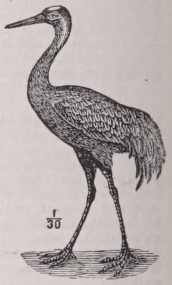
1. A migratory fowl of the genus Ardea, belonging to the grallic order. The bill is straight, sharp and long, with a furrow from the nostrils towards the point; the nostrils are linear, and the feet have four toes. These fowls have long legs, and a long neck, being destined to wade and seek their food among grass and reeds in marshy grounds. The common crane is about four feet in length, of a slender body, with ash-coloured feathers.
1. A measure for fresh herrings, -- as many as will fill a barrel.
2. A wading bird of the genus Grus, and allied genera, of various species, having a long, straight bill, and long legs and neck.
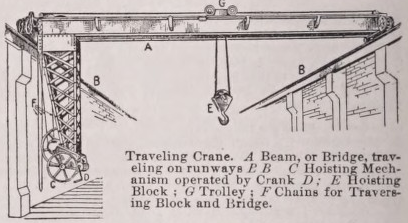
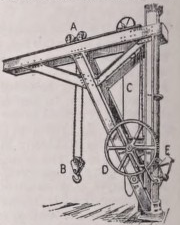
3. A machine for raising and lowering heavy weights, and, while holding them suspended, transporting them through a limited lateral distance. In one form it consists of a projecting arm or jib of timber or iron, a rotating post or base, and the necessary tackle, windlass, etc.; -- so called from a fancied similarity between its arm and the neck of a crane See Illust. of Derrick.
4. An iron arm with horizontal motion, attached to the side or back of a fireplace, for supporting kettles, etc., over a fire.
to reach forward with head and neck, in order to see better; as, a hunter cranes forward before taking a leap.
1. To cause to rise; to raise or lift, as by a crane; -- with up.
2. To stretch, as a crane stretches its neck; as, to crane the neck disdainfully.
Crane
Encyclopedia Britannica
CRANE (in Dutch, Kraan; Old German, Kraen; cognate, as also the Latin Grus, and consequently the French Grue and Spanish Grulla, with the Greek yιpavofi), the Grus communis or G, cinerea of ornithologists, one of the largest Wading-birds, and formerly a native of England, where Turner, in 1544, said that he had very often seen its young (“earum pipiones saepissime υidιJ. Notwithstanding the protection afforded it by sundry Acts of Parliament, it has long since ceased from breeding in this country. Sir T. Browne (oδ. 1682) speaks of it as being found in the open parts of Norfolk in winter. In Ray’s time it was only known as occurring at the same season in large flocks in the fens of Lincolnshire and Cambridgeshire; and though mention is made of Cranes’ eggs and young in the fendaws passed at a court held at Revesby in 1780, this was most likely but the formal repetition of an older edict; for in 1768 Pennant wrote that after the strictest inquiry he found the inhabitants of those counties to be wholly unacquainted with the bird, and hence concluded that it had forsaken our island. The Crane, however, no doubt then appeared in Britain, as it does now, at uncertain intervals and in unwonted places, showing that the examples occurring here (which usually meet the hostile reception commonly accorded to strange visitors) have strayed from the migrating bands whose movements have been remarked from almost the earliest ages. Indeed, the Crane’s aerial journeys are of a very extended kind; and on its way from beyond the borders of the Tropic of Cancer to within the Arctic Circle, or on the return-voyage, its flocks may be descried passing overhead at a marvellous height, or halting for rest and refreshment on the wide meadows that border some great river, while the ...seeming order with which its ranks are marshalled during flight lias long attracted attention. The Crane takes up its winter-quarters under tho burning sun of Central Africa and India, but early in spring returns northward. Not a few examples reach the chill polar soils of Lapland and Siberia, but some tarry in the south of Europe and breed in Spain, and, it is supposed, in Turkey. The greater number, however, occupy the intermediate zone and pass the summer in Russia, North Germany, and Scandinavia. Soon after their arrival in these countries the flocks break up into pairs, whose nuptial ceremonies are accompanied by loud and frequent trumpet-ings, and the respective breeding-places of each are chosen.
The nest is formed with little art on the ground in large open marshes, where the herbage is not very high—a tolerably dry spot being selected and used apparently year after year. Here the eggs, which are of a rich brown colour with dark spots, and always two in number, are laid. The young are able to run soon after they are hatched, and are at first clothed with tawny down. In the course of the summer they assume nearly the same grey plumage that their parents wear, except that the elongated plumes, which in the adults form a graceful covering of the hinder parts of the body, are comparatively undeveloped, and the clear black, white, and red (the last being due to a patch of papillose skin of that colour) of the head and neck are as yet indistinct. During this time they keep in the marshes, but as autumn approaches the different families unite by the rivers and lakes, and ultimately form the enormous bands which after much more trumpeting set out on their southward journey.
The Crane’s power of uttering the sonorous and peculiar trumpet-like notes, of which mention has been made, is commonly and perhaps correctly ascribed to the formation of its trachea, which on quitting the lower end of the neck passes backward between the branches of the furcula and is received into a hollow space formed by the bony walls of the carina or keel of the sternum. Herein it makes three turns, and then runs upwards and backwards to the lungs. The apparatus on the whole much resembles that found in the Whooping Swans {Cygnus musicus, C. buccinator, and others), though differing in some not unimportant details; but at the same time somewhat similar convolutions of the trachea occur in other birds which do not possess, so far as is known, the faculty of trumpeting. The Crane emits its notes both during flight and while on the ground. In the latter case the neck and bill are uplifted and the mouth kept open during the utterance of the blast, which may be often heard from birds in confinement, especially at the beginning of the year.
As usually happens in similar cases, the name of tho once familiar British species is now used in a general sense, and applied to all others which are allied to it. Though by many systematists placed near or even among the Herons, there is no doubt that the Cranes have only a superficial resemblance and no real affinity to the Ardeidae. In fact the Gruidae form a somewhat isolated group. Professor Huxley has included them together with the RalUdce in his Geranomorphae; but a more extended view of their various characters would probably assign them rather as relatives of the Bustards—not that it must bo thought that the two families have not been for a very long time distinct. Grus, indeed, is a very ancient form, its remains appearing in the Miocene of France and Greece, as well as in the Pliocene and Post-pliocene of North America. In France, too, during the “Reindeer Period” there existed a huge species—the G. primigenia of Μ. Alphonse Milne-Edwards—which has doubtless been long extinct. At the present time Cranes inhabit all the great zoogeographical Regions of the earth, except the Neotropical, and some sixteen or seventeen species are discriminated. In Europe, besides the G. communis already mentioned, we have as an inhabitant that which is generally known as the Numidian or Demoiselle-Crane {G. virgo), distinguished from every other by its long white ear-tufts. This bird is also widely distributed throughout Asia and Africa, and is said to have occurred in Orkney as a straggler. The eastern part of the Palaearctic Region is inhabited by four other species that do not frequent Europe {G. antigone, G. japonensis, G. monachus, and G.
letιcogeranus), cí which the last is perhaps the finest of tho family, with nearly the whole plumage of a snowy white. The Indian Region, besides being visited in winter by four of the species already named, has two that are peculiar to it (G. torquata and G. indica — both commonly confounded under the name of G. antigone). The Australian Region possesses a large species known to the colonists as the “Native Companion ” (G. australis)·, while the Nearctic is tenanted by three species (G. americana, G. canadensis, and G. fraterculus ), to say nothing of the possibility of a fourth (G. schlegeli), a little-known and somewhat obscure bird, finding its habitat here. In the Ethiopian Region we have two species (G. paradisea and G. carunculatd) which do not occur out of Africa, as well as two others forming the group known as “Crowned Cranes ”—differing much from other members of the family, and justifiably placed in a separate genus, Balearica. One of these (B. pavonina) inhabits Northern and Western Africa, while the other (B. regulorum) is confined to the eastern and southern parts of that continent.
With regard to the literature of this species, a paper “On the Breeding of the Crane in Lapland” (Ibis, 1859, p. 191), by the late M’r John Wolley, is one of the most pleasing contributions to natural history ever written, and an admirably succinct account of all the different species was communicated by the late Mr Blyth to The Field newspaper in 1873 (vol. xl. p. 631, vol. xli. pp. 7, 61, 136,∙ 189, 248, 384, 408, 418), which it is much to be regretted has not since been published in a more accessible form; while a beautiful picture representing a flock of Cranes, resting by the Rhine, during one of their annual migrations, is to be found in Mr Wolf’s Zoological Sketches.
CRANE, a machine for raising and lowering heavy weights, and removing them from one place to another. Its chief parts are the jib, an inclined or horizontal beam at the end of which the weight is suspended; the upright crane post or stalk, on which the crane turns; the stay, beneath and supporting the jib; the barrel, round which the chain attached to the weight is coiled; and the winch, pinion, and handles. In place of a stay, chains or tensionbars above the jib are commonly employed; the latter at their upper end form eyes for the pivot of the sheave, or are pinned to the socket of the jib; below they are fixed to the cast-iron framing that carries the wheel-work. To prevent the acceleration of the movement of descending weights brakes are employed, in one form of which a lever causes friction by bringing a piece of wood, strengthened with iron, into contact with a plain wheel attached to the barrel of the crane. The winch handle has given it a radius of about 18 inches, and its centre is placed at 3 feet or 3 feet 2 inches from the ground; the limit of the average stress on it to be allowed for each labourer, working constantly at the rate of 220 feet a minute, has been found to be 1Õ lb. The length of the journals of the axles is made l⅛ to 2 times their diameter, which must be proportionate to the torsion of the wheels to be resisted. The diameter of the axles of the crane-barrel, if of cast-iron, should be proportional to tho cube root of the strain upon them in cwts; if of wrought iron, to τ 9 τ ths of the same. The chain or rope ought not to be worked with more than one-half the weight which it is estimated to be capable of bearing, The strength of the jib varies almost directly as the fourth power of its diameter, and inversely as the square of its length. In cranes for lifting great weights the jib may be made to rest against a circular rail let into masonry, instead of bearing against the crane post. The ends of the jib should not be rounded, but should be cut square, so as to lie evenly against the iron sockets into which they fit. In iron cranes the post is a hollow pillar of cast-iron, fixed by means of cross-shaped framings of the same material into a block of masonry; the jib is oí iron, or of wood with terminal sockets of that metal. A crane at Earl Grey’s Dock, Dundee Harbour, when worked by eight men, is capable of lifting 30 tons; it can be moved round by one man by the application of horizontal gearing; its total weight is not above 60 tons. The double crane for wharfs and pier-heads is framed and braced so as to balance exactly when turned on its pivot. In another double crane, used in the building of breakwaters, one jib is employed in laying, while the other lifts a stone. The derrick is a temporary crane consisting of a spar supported by guys or stays; in this crane the iron beam or derrick can, by raising or lowering, be set at any required angle.
The cranes in general use in the earlier part of the last century were primitive contrivances worked by means of a large hollow wheel, within which a man walked -forwards or backwards according as goods were to be raised or lowered; the jib of the crane was fixed on a pivot, so as to turn round about ∣ths of a circle. After this a simpler form, still in use, was introduced, with the wheel fixed on a portion of the jib projecting behind the crane post. One of the first examples of traversing cranes was erected by Mr Rennie in the Mahogany Sheds at the West India Docks. For this kind of crane a railway is constructed on parallel frames of timber reaching across the roof of a building, and on this is a carriage supported on wheels, and capable, therefore, of being moved backwards or forwards by means of the machinery attached to it. The chain that bears the weight is connected with the carriage, and hangs down between the two lines of rails. By making the framework supporting the railway movable, as well as the carriage, goods can be transported in any required direction. The frames of railway traversing cranes are composed of two triangular timber structures, mounted on strong wheels; these by toothed wheels and pinions are caused to move along the railroad on which they are placed. At one time vacuum cranes were employed, to work which small oscillating cylinders, similar to those of high-pressure steam engines, were put in communication with a receiver exhausted of air by steam pumps. Afterwards steam came to be applied immediately as the motive power of cranes. In the direct-acting steam crane, the crane post itself is the steam cylinder, and the steel wire rope for lifting the load constitutes the piston-rod; to turn the crane round, steam is admitted to a cylinder beneath and forming part of the bed-plate. The first crane worked by pistons acted on by water-power was established at Newcastle-on-Tyne in 1846. Reservoirs at great heights for providing water-pressure can be dispensed with by the use of Sir W. Armstrong’s accumulator, an apparatus consisting of a cast-iron cylinder in which the water supplied by an engine is pressed upon by a loaded plunger. The excess of water pumped into the accumulator at any time is employed in raising the plunger; this, on reaching a certain height, begins to close a throttle-valve in the steam-pipe of the engine, and thus lessens its rate, until fresh demands are made upon the contents of the accumulator. The water discharged by the cranes may be led by a return-pipe to a cistern over the engine room, in order again to supply the force-pumps. To avoid jerks and concussions owing to the momentum of the jib after the closing of the water passages, a clack-valve is provided which opens up into the supply-pipe whenever the pressure in the cylinder of the hydraulic press becomes greater than that in the accumulator. The tubular cranes of Fairbairn are made of wrought-iron plates riτetted together. The jib, which is curved, is rectangular in crosssection, and tapers upwards to its extremity, and below the ground to a considerable depth, where it terminates in a shoe of cast-iron on which the crane revolves. The plates forming the edges of the jib are connected by means of angle iron, and those of its convex or upper side by chain rivetting. The curvature of the jib allows of the raising of weights to its highest point. The chain-barrels and the spindles for the tvheel-gearing are preferably inclosed within the jib.
See Mechanic and Engineer's Magazine, vol. ii. 2d ser. pp. 169, 190; Glynn, Rud. Treatise on the Construction of Cranes and Machinery, 1865; Laboulaye, Dictionnaire des Arts et Manuf., s.v. “Grue;” Cresy, Ency. of Civil Engineering.
9th ed. Encyclopædia Britannica, vol. 6, p. 546 — signed A. N.
[1,386 words — estimated reading time: 8 minutes]
[1,386 words — estimated reading time: 8 minutes]
Crane
Watson's Biblical & Theological Dictionary
In Isaiah xxxviii, 14, and Jer. viii, 7, two birds are mentioned, the סיס and the עגור. The first in our version is translated _crane_, and the second _swallow_; but Bochart exactly reverses them, and the reasons he adduces are incontrovertible. Aristophanes curiously observes, that “it is time to sow when the crane migrates clamouring into Africa; she also bids the mariner suspend his rudder and take his rest, and the mountaineer to provide himself with raiment;” and Hesiod, “When thou hearest the voice of the crane, clamouring annually from the clouds on high, recollect that this is the signal for ploughing, and indicates the approach of showery winter.” Where do the cranes or winding swallows go, Fearful of gathering winds and falling snow? Conscious of all the coming ills, they fly To milder regions and a southern sky. PRIOR. The Prophet Jeremiah mentions this bird, thus intelligent of the seasons by an instinctive and invariable observation of their appointed times, as a circumstance of reproach to the chosen people of God, who, although taught by reason and religion, “knew not the judgment of the Lord.”
Watson's Biblical & Theological Dictionary
[186 words — estimated reading time: 2 minutes]
[186 words — estimated reading time: 2 minutes]
An insect of the genus Tipula, of many species. The mouth is a prolongation of the head; the upper jaw is arched; the palpi are two, curved and longer than the head; the proboscis is short.
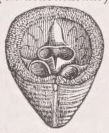
The crushing of a child's head, as with the cranioclast or craniotomy forceps in cases of very difficult delivery.
Of or pertaining to the cranium and face; as, the craniofacial angle.
The doctrine or science of determining the properties or characteristics of the mind by the conformation of the skull.
The science of the form and characteristics of the skull.
Receptacle Roget’s Thesaurus §191
N. receptacle, inclosure, recipient, receiver, reservatory, compartment, cell, cellule, follicle, hole, corner, niche, recess, nook, crypt, stall, pigeonhole, cove, oriel, cave, capsule, vesicle, cyst, pod, calyx, cancelli, utricle, bladder, pericarp, udder, stomach, paunch, venter, ventricle, crop, craw, maw, gizzard, breadbasket, mouth, pocket, pouch, fob, sheath, scabbard, socket, bag, sac, sack, saccule, wallet, cardcase, scrip, poke, knit, knapsack, haversack, sachel, satchel, reticule, budget, net, ditty bag, ditty box, housewife, hussif, saddlebags, portfolio, quiver, chest, box, coffer, caddy, case, casket, pyx, pix, caisson, desk, bureau, reliquary, trunk, portmanteau, band-box, valise, grip, grip sack, skippet, vasculum, boot, imperial, vache, cage, manger, rack, vessel, vase, bushel, barrel, canister, jar, pottle, basket, pannier, buck-basket, hopper, maund|, creel, cran, crate, cradle, bassinet, wisket, whisket, jardiniere, corbeille, hamper, dosser, dorser, tray, hod, scuttle, utensil, brazier, cuspidor, spittoon, cistern, vat, caldron, barrel, cask, drum, puncheon, keg, rundlet, tun, butt, cag, firkin, kilderkin, carboy, amphora, bottle, jar, decanter, ewer, cruse, caraffe, crock, kit, canteen, flagon, demijohn, flask, flasket, stoup, noggin, vial, phial, cruet, caster, urn, epergne, salver, patella, tazza, patera, pig gin, big gin, tyg, nipperkin, pocket pistol, tub, bucket, pail, skeel, pot, tankard, jug, pitcher, mug, pipkin, galipot, gallipot, matrass, receiver, retort, alembic, bolthead, capsule, can, kettle, bowl, basin, jorum, punch bowl, cup, goblet, chalice, tumbler, glass, rummer, horn, saucepan, skillet, posnet|, tureen, beaker, flask, erlenmeyer flask, florence flask, round-bottom flask, graduated cylinder, test tube, culture tube, pipette, pasteur pipette, disposable pipette, syringe, vial, carboy, vacuum flask, petri dish, microtiter tray, centrifuge tube, bail, beaker, billy, canakin, catch basin, catch drain, chatti, lota, mussuk, schooner, spider, terrine, toby, urceus, plate, platter, dish, trencher, calabash, porringer, potager, saucer, pan, crucible, glassware, tableware, vitrics, compote, gravy boat, creamer, sugar bowl, butter dish, mug, pitcher, punch bowl, chafing dish, shovel, trowel, spoon, spatula, ladle, dipper, tablespoon, watch glass, thimble, closet, commode, cupboard, cellaret, chiffonniere, locker, bin, bunker, buffet, press, clothespress, safe, sideboard, drawer, chest of drawers, chest on chest, highboy, lowboy, till, scrutoire|, secretary, secretaire, davenport, bookcase, cabinet, canterbury, escritoire, etagere, vargueno, vitrine, chamber, apartment, room, cabin, office, court, hall, atrium, suite of rooms, apartment, flat, story, saloon, salon, parlor, by-room, cubicle, presence chamber, sitting room, best room, keeping room, drawing room, reception room, state room, gallery, cabinet, closet, pew, box, boudoir, adytum, sanctum, bedroom, dormitory, refectory, dining room, salle-a-manger, nursery, schoolroom, library, study, studio, billiard room, smoking room, den, stateroom, tablinum, tenement, bath room, bathroom, toilet, lavatory, powder room, john, jakes, necessary, loo, men's room, ladies' room, rest room, [fixtures: see 653 (uncleanness)], attic, loft, garret, cockloft, clerestory, cellar, vault, hold, cockpit, cubbyhole, cook house, entre-sol, mezzanine floor, ground floor, rez-de-chaussee, basement, kitchen, pantry, bawarchi-khana, scullery, offices, storeroom, lumber room, dairy, laundry, coach house, garage, hangar, outhouse, penthouse, lean-to, portico, porch, stoop, stope, veranda, patio, lanai, terrace, deck, lobby, court, courtyard, hall, vestibule, corridor, passage, breezeway, ante room, ante chamber, lounge, piazza, conservatory, greenhouse, bower, arbor, summerhouse, alcove, grotto, hermitage, lodging, bed, carriage
Adj. capsular, saccular, sacculated, recipient, ventricular, cystic, vascular, vesicular, cellular, camerated, locular, multilocular, polygastric, marsupial, siliquose, siliquous, 1, general dimensions
King James Bible KJV Bible
Berean Standard Bible BSB Bible
2 KJV and 1 BSB verses contain “Cran”
Yea, the stork in the heaven knoweth her appointed times; and the turtle and the crane and the swallow observe the time of their coming; but my people know not the judgment of the LORD.
Even the stork in the sky knows her appointed seasons. The turtledove, the swift, and the thrush keep their time of migration, but My people do not know the requirements of the LORD.