
KAN
Word of the Day: Catachrestical
A singular animal found in New Holland, resembling in some respects the opossum. It belongs to the genus Didelphis. It has a small head, neck and shoulders, the body increasing in thickness to the rump. The fore legs are very short, useless in walking, but used for digging or bringing food to the mouth. The hind legs, which are long, are used in moving, particularly in leaping.
KananÚr
Encyclopedia Britannica
KANANÚR, or Cannanore, a town, seaport, and cantonment in Malabar district, Madras, India, 11° 51' 12" N. lat., 75° 24' 44" E. long., with a population in 1871 of 10,265. The sea-borne trade in 1875-76 amounted to £220,244 value of imports, and £115,248 of exports. Anglican, German, and Roman Catholic missions are established in the town. Kananùr belonged to the Kalahasti or Cherakal râjâs till the invasion of Malabar by Hyder AIL In 1498 a Portuguese colony was planted there by Cabral, and seven years later a factory was established by Vasco da Gama. In 1656 the Dutch effected a settlement and built the present fort, which fell into the hands of the Mysore troops in 1766. In 1784 Kananιir was captured by the British, and the reigning princess became tributary to the East India Company. From 1791 it has been the principal British military station on the Malabar coast.
9th ed. Encyclopædia Britannica, vol. 13, p. 834
[160 words — estimated reading time: 1 minute]
[160 words — estimated reading time: 1 minute]
Kanauj
Encyclopedia Britannica
KANAUJ, an ancient city in Farrukhabad district, North-Western Provinces, India, 27° 2' 30" N. lat., 79° 58' E. long., with a population in 1872 of 17,093, viz., 10,864 Hindus and 6229 Mahometans. Kanauj in early times formed the capital of a great Aryan kingdom, and the Gupta dynasty extended their sway over a large portion of Upper India. The prosperity of the city dates from a prehistoric period, and seems to have culminated about the 6th century. In 1018 it fell before Mahmιid of Ghazni, and again in 1194 before Muhammad Ghori. The existing ruins extend over the lands of five villages, and occupy a semicircle fully 4 miles in diameter. Among the antiquities the shrine of Râjâ Jaipâl ranks first in interest The great mosque, which bears the name of Site’s Kitchen, also dates back to Hindu times. Hinduism in Lower Bengal dates its legendary origin from a Brâhman migration southwards from this city, about 800 or 900. To this day all Brâhmans in the lower provinces trace their descent from one or other of the five Brâhman emigrants from Kanauj.
9th ed. Encyclopædia Britannica, vol. 13, p. 835
[192 words — estimated reading time: 2 minutes]
[192 words — estimated reading time: 2 minutes]
Kandahar
Encyclopedia Britannica
KANDAHAR, the largest city in Afghanistan, is situated in 31° 37' N. lat. and 65° 43' E. long., at a height of 3400 feet above the sea. It is 370 miles distant from Herat on the north-west, by Girishk and Farrah,—Girishk being 75 miles, and Farrah 225 miles from Kandahar. From Cabul, on the north-east, it is distant 315 miles, by Khelat-i-Ghilzai and Ghazni,—Khelat-i-Ghilzai being 85 miles, and Ghazni 225 miles from Kandahar. To the Pishin valley the distance is about 110 miles, and from Pishin to India the three principal routes measure approximately as follows :—by the Zhôb valley to Dera Ismail Khan, 300 miles; by the Béri valley to Dera Ghazi Khan, 275 miles; by Quetta and the Bolân to Dadur, 125 miles; and by Chappar and Nari (the proposed railway route) to Sibi, 120 miles. Sibit is connected by rail with the rest of India. Immediately round the city is a plain, highly cultivated and well populated to the south and west; but on the north-west this plain is barren, and is bounded by a double line of rough and precipitous hills, rising to about 1000 feet above its general level, and breaking its dull monotony with irregular lines of scarped precipices, crowned with fantastic pinnacles and peaks. To the north-west these hills form the watershed between the valleys of the Argandab and the Tarnak, until they are lost in the mountain masses of the Hazarajat,—a wild region inhabited by tribes of Tartar origin, which effectually shuts off Kandahar from communication with the north. On the south-west they lose themselves in the sandy desert of Registan, which wraps itself round the plain of Kandahar, and forms another impassable barrier....
But there is a break in these hills,—a gate, as it were, to the great high road between Herat and India; and it is this gate which the fortress of Kandahar so effectually guards, and to which it owes its strategic importance. Other routes there are, open to trade, between Herat and northern India, either following the banks of the Hari Rud, or, more circuitously, through the valley of the Helmand to Cabul; or the line of hills between the Argandab and the Tarnak may be crossed close to Khelat-i-Ghilzai; but of the two former it may be said that they are not ways open to the passage of Afghan armies owing to the hereditary bitterness of hostility existing between the Eimâk and Hazâra tribes and the Afghans generally, while the latter is not beyond striking distance from Kandahar. The one great high road from Herat and the Persian frontier to India is that which passes by Farrah and crosses the Helmand at Girishk. Between Kandahar and India new and feasible means of communication are being discovered with every geographical search into the intermediate country. To the north-west, and parallel to the long ridges of the Tarnak watershed, stretches the great road to Cabul, the same which was traversed by Nott in 1842, and by Stewart and, more recently, by Roberts in 1880. Between this and the direct route to Pishin is a road, well known, though never yet traversed by a British force, which leads through Maruf to the Kundar river and the Guleri Pass into the plains of Hindustan at Dera Ismail Khan. This is the most direct route to northern India, but it involves the passage of some rough country, where lies the great watershed between the basins of the Helmand and the Indus. But the best known road from Kandahar to India is that which stretches across the series of open stony plains interspersed here and there with rocky hills of irregular formation leading to the foot of the pass across the Kojak range, on the far side of which from Kandahar lies the valley of Pishin. The passage of the Kojak involves a rise and fall of some 2300 feet, but an excellent road now crosses the pass. The proposed line of railway to Kandahar follows an easier but comparatively waterless route, turning the Kojak at Gwaja (about 25 miles southwest of the Kojak Pass), and involving no serious gradients. Between the Pishin valley and India are several routes, all more or less open to a force equipped for mountain warfare, of which the best known are the Bolân and the Chappar (or Nari) passes from the plateau of Afghanistan to the plains of Sind at Jacobabad; and the Zhôb and the Béri valley routes leading through the Sulimani range to Dera Ismail and Dera Ghazi Khan respectively. The Bori valley was the line followed by Sir M. Biddulph in 1879, and it diverges but slightly from that known as the Thal-Chotiali route. Thus Kandahar becomes a sort of focus of all the direct routes converging from the wide-stretching western frontier of India towards Herat and Persia, and the fortress of Kandahar gives protection on the one hand to trade between Hindustan and Herat, and on the other it lends to Cabul security from Herat invasion.
Kandahar is approximately a square-built city, surrounded by a wall of about 3∣ miles circuit, and from 25 to 30 feet high, with an average breadth of 15 feet. Outside the wall is a ditch 10 feet deep. The city and its defences are entirely mud-built, with no pretensions to architectural beauty. There are four main streets crossing each other nearly at right angles, the central “chouk” being covered with a dome. These streets are wide and bordered with trees, and are flanked by shops with open fronts and verandahs much after the universal fashion of the East. There are no buildings of any great pretension in Kandahar, a few of the more wealthy Hindus occupying the best houses. The tomb of Ahmed Shah is the only attempt at monumental architecture. This, with its rather handsome cupola, and the twelve minor tombs of Ahmed Shah’s children grouped around, contains a few good specimens of fretwork and of inlaid inscriptions. The four streets of the city divide it into convenient quarters for the accommodation of its mixed population of Duranis, Ghilzais, Parsiwans, and Kakuris, numbering in all some 30,000 souls. Of these the greater proportion are the Parsiwans (chiefly Kizilbashes).
It is reckoned that there are 1600 shops and 182 mosques in the city. The mullas of these mosques are generally men of considerable power. The walls of the city, are pierced by the four principal gates of “Cabul,” “Shikarpur,” “Herat/’ and the “Idgah,” opposite the four main streets, with two minor gates, called the Top Khana and the Bardurani respectively, in the western half of the city. The Idgah gate passes through the citadel, which is a square built enclosure with sides of about 260 yards in length. The flank defences of the main wall are insufficient; indeed there is no pretence at scientific structure about any part of the defences; but the site of the city is well chosen for defence, and the water supply (drawn by canals from the Argandab or derived from wells) is good.
About 4 miles west of the present city, stretched along the slopes of a rocky ridge, and extending into the plains at its foot, are the ruins of the old city of Kandahar as it existed until it was sacked and plundered by Nadir Shah in 1738. From the top of the ridge a small citadel overlooks the half-buried ruins. On the northeast face of the hill forty steps, cut out of solid limestone, lead upward to a small, dome-roofed recess, which contains some interesting Persian inscriptions cut in relief on the rock, recording particulars of the history of Kandahar, and defining the vast extent of the kingdom of the emperor Baber. Popular belief ascribes the foundation of the old city to Alexander the Great.
Although Kandahar has long ceased to be the seat of government, it is nevertheless by far the most important trade centre in Afghanistan, and the revenues of the Kandahar province assist largely in supporting the chief power at Cabul. There are no manufactures or industries of any importance peculiar to Kandahar, but the long lines of bazaars display goods from England, Russia, Hindustan, Persia, and Turkestan, embracing a trade area as large probably as that of any city in Asia. The customs and town dues together amount to a sum equal to the land revenue of the Kandahar province, which is of considerable extent, stretching to Pul-i-Sangin, 10 miles south of Khelat-i-Ghilzai on the Cabul side, to the Helmand on the west, and to the Hazara country on the north. Although Farrah has been governed from Kandahar since 1863, its revenues are not reckoned as a part of those of the province. The land revenue proper is assessed in grain, the salaries of Government officials, pay of soldiers, &c., being disbursed by “barats” or orders for grain at rates fixed by Government, usually about 20 per cent, above the city market prices. The land revenue for the year 1877-78 amounted to 640,000 rupees English. English goods imported from Kurrachee pay upwards of 18 per cent, on their value at Kandahar. By the time they are exposed for sale at Herat they pay upwards of 28 per cent, ad valorem. Nevertheless the greater part of the English goods sold at Herat are imported by Kurrachee and Kandahar—a fact which testifies to the great insecurity of trade between Meshhed and Herat. Some of the items included as town dues are curious. For instance, the tariff on animals exposed for sale includes a charge of 5 per cent, ad valorem on slave girls, besides a charge of 1 rupee per head. The kidney fat of all sheep and the skins of all goats slaughtered in the public yard are perquisites of Government, the former being used for the manufacture of soap, which, with snuff, is a Government monopoly. The imports consist chiefly of English goods, indigo, cloth, boots, leather, sugar, salt, iron, and copper, from Hindustan, and of shawls, carpets, “barak” (native woollen cloth), postins (coats made of skins), shoes, silks, opium, and carpets from Meshhed, Herat, and Turkestan. The exports are wool, cotton, madder, cummin seed, asafoetida, fruit, silk, and horses. The system of coinage is also curious: 105 English rupees are melted down, and the alloy extracted, leaving 100 rupees worth of silver; 295 more English rupees are then melted, and the molten metal mixed with the 100 rupees silver; and out of this 808 Kandahari rupees are coined. As the Kandahari rupee is worth about 8 annas (half an English rupee) the Government thus realizes a profit of 1 per cent. Government accounts are kept in “Kham” rupees, the “Kham” being worth about five-sixths of a Kandahari rupee; in other words, it about equals the franc, or the Persian “keran.” Immediately to the south and west of Kandahar is a stretch of well-irrigated and highly cultivated country, but it is the valley of the Argandab that possesses the chief local wealth of agriculture, and which, from the luxuriant abundance of its orchards and vineyards, offers the most striking scenes of landscape beauty. The wide extent of the pomegranate fields forms a striking feature in the valley,—the pomegranates of Kandahar, with its “sirdar” melons and grapes, being unequalled in quality by any in the East. The vines are grown on artificial banks, probably for want of the necessary wood to trellis them,—the grapes being largely exported in a semi-dried state. Fruit, indeed, besides being largely exported, forms the chief staple of the food supply of the inhabitants throughout Afghanistan. The art of irrigation is so well understood that the water supply is at times exhausted, no river water being allowed to run to waste. The plains about Kandahar are chiefly watered by canals drawn from the Argandab near Baba-wali, and conducted through the same gap in the hills which admits the Herat road. The amount of irrigation and the number of water channels form a considerable impediment to the movement of troops, not only immediately about Kandahar, but iu all districts where the main rivers and streams are bordered by green bands of cultivation. Irrigation by “karez” is also largely resorted to. The karez is a system of underground channelling which usually taps a sub-surface water supply at the foot of some of the many rugged and apparently waterless hills which cover the face of the country. The broad nullahs which seam their sides frequently possess a supply of water some distance below the surface which can be tapped by boring. The water is not brought to the surface, but is carried over long distances by an underground channel or drain, which is constructed by sinking shafts at intervals along the required course, and connecting the shafts by tunnelling. The general agricultural products of the country are wheat, barley, pulse, fruit, madder, asafoetida, lucerne, clover, and tobacco.
Of the mineral resources of the Kandahar district not much is known, but an abandoned gold mine exists about 2 miles north of the town. Some general idea of the resources of the Kandahar district may be gathered from the fact that it supplied the British troops with everything except luxuries during the entire period of occupation in 1879-81; and that, in spite of the great strain thrown on those resources by the presence of the two armies of Ayub Khan and of General Roberts, and after the total failure of the autumn crops and only a partial harvest the previous spring, the army was fed without great difficulty until the final evacuation, at one-third of the prices paid in Quetta for supplies drawn from India.
Kandahar has a stormy history. Sultan Mahmud of Ghazni took it in the 11th century from the Afghans who then held it. In the beginning of the 13th century it was taken by Jenghiz Khan, and in the 14th by Timur. In 1507 it was captured by the emperor Baber, but shortly afterwards it fell again into Afghan hands, to be retaken by Baber in 1521. Baber’s son, Humayun, agreed to cede Kandahar to Persia, but failed to keep his word, and the Persians besieged the place unsuccessfully. Thus it remained in the possession of the Moghuls till 1625, when it was taken by Shah Abbas. Aurungzebe tried to take it in 1649 with 5000 men, but failed. Another attempt in 1652 was equally unsuccessful. It remained in Persian possession till 1709, when it was taken by the Afghans, but was retaken after a two years’ siege by Nadir Shah. Nadir Shah was assassinated in 1749, and immediately on hearing the news of his death Ahmed Shah (Abdalli) seized Nadir Shah’s treasure at Kandahar, and proclaimed himself king, with the consent, not only of the Afghans, but, strange to say, of the Hazaras and Baluchis as well. He at once changed the site of the city to its present position, and thus founded the Afghan kingdom, with modern Kandahar as its capital. Ahmed Shah died in 1773, and was succeeded by his son Taimur, who died in 1793, and left the throne to his son Zaman Shah. This prince was deposed by his half brother Mahmud, who was in his turn deposed by Shah Suja, the full brother of Zaman Shah. After a .short reign Shah Suja was compelled to abdicate from his inability to repress the rising power of Fatteh Khan, a Barakzai chief, and he took refuge first with Runjit Singh, who then ruled the Punjab, and finally secured the protection of British power. . Afghanistan was now practically dismembered. Mahmud was reinstated by Fatteh Khan, whom he appointed his vizier, and whose nephews, Dost Mahommed Khan and Kohn dil Khan, he placed respectively in the governments of Cabul and Kandahar. Fatteh Khan was barbarously murdered by Kamran (Mahmud’s son) near Ghazni in 1818; and in retaliation Mahmud himself was driven from power, and the Barakzai clan secured the sovereignty of Afghanistan. While Dost Mahommed held Cabul, Kandahar became temporarily a sort of independent chiefship under two or three of his brothers. In 1839 the cause of Shah Suja was actively supported by the British. Kandahar was occupied, and Shah Suja reinstated on the throne of his ancestors. Dost Mahommed was defeated near Cabul, and after surrender to the British force, was deported into Hindustan. The British army of occupation in southern Afghanistan continued to occupy Kandahar from 1839 till the autumn of 1842, when General Nott marched on Cabul to meet Pollock’s advance from Jalalabad. The cantonments near the city, built by Nott’s division, were repaired and again occupied by the British army in 1879, when Shere Ali was driven from power by the invasion of Afghanistan, nor were they finally evacuated till the spring of 1881. (T. H. H.*)
9th ed. Encyclopædia Britannica, vol. 13, p. 835
[2,843 words — estimated reading time: 17 minutes]
[2,843 words — estimated reading time: 17 minutes]
Kandy
Encyclopedia Britannica
KANDY, a town of Ceylon, formerly the capital of a kingdom of the same name, situated towards the heart of the island, at a height of 1713 feet above the sea, 74f miles by rail from Colombo. It lies round the margin of an artificial lake constructed by the last king of Kandy in 1806, and is beautifully surrounded by hills. The most striking objects of interest are the temples (of which twelve are Buddhist and four Brahman), the tombs of the Kandian kings, and the various buildings of the royal residence, partly allowed to fall into disrepair, partly utilized by the Government. Of the temples the Dalada Malagawa is worthy of particular mention; it claims, as the name indicates, to be in possession of a Buddha tooth. Kandy is the seat of a Government agent and of a district judge, and regular sessions of the criminal court are held in the town. As a municipality (constituted in 1865, and divided into five wards in 1871) it is governed by a body of eight councillors. Among the public buildings and institutions are the Government house or pavilion, erected in 1824, the planters’ association, two libraries, an industrial school, and Trinity College, established in 1857, and reopened in 1871 after being closed for six years. The Church Missionary Society, to which the college owed its existence, began its labours in 1818....
Kandy was occupied by the Portuguese in the 16th century and by the Dutch in 1763; but in both instances the native kings succeeded in shaking off the foreign yoke. The British got possession of the place in 1803, but the garrison afterwards capitulated and were massacred, and it was not till 1814-15 that the king was defeated and dethroned. The British authority was formally established by the convention of March 2, 1815. In 1848, owing to an attempt at rebellion, the town was for a time under martial law.
9th ed. Encyclopædia Britannica, vol. 13, p. 837
[321 words — estimated reading time: 2 minutes]
[321 words — estimated reading time: 2 minutes]
Kane
Encyclopedia Britannica
KANE, Elisha Kent (1820-1857), American traveller, scientist, and arctic explorer, was born in Philadelphia, on February 3, 1820, the eldest of seven children. His father was judge of the eastern district of Philadelphia, and through both parents he inherited a mixture of Irish, English, Scotch, and Dutch blood. In his boyhood, in spite of feebleness of body, he was remarkable for his activity, vivacity, and energy. While still at school he showed a fondness for out-door pastime and enterprise, and a decided leaning towards scientific pursuits. Having chosen civil engineering as a profession, he entered the university of Virginia, where he continued to show his taste for science, especially chemistry, mineralogy, and physical geography. A violent attack of heart disease, however, which stuck to him to the end of his life, induced him to abandon engineering and devote himself to the study of medicine. He obtained his doctor’s degree in 1842, having already acquired a reputation in physiological research. In 1843 Kane entered the U.S. navy as surgeon, and was appointed to the “Brandywine,” commissioned to carry Mr Webster as U.S. minister to China. While the vessel remained at Rio Janeiro the restless and eager Kane made a journey to the skirts of the Andes and explored their geology. Leaving the ship again at Bombay, he indulged his irrepressible exploring proclivities by a journey up country, rejoining his ship at Ceylon. On his arrival at his destination, Macao, he provided a substitute for his post in the embassy, crossed and explored the island of Luzon, visited the mysterious volcano of Tael, and, amid many difficulties, descended its steep crater, bringing up with him specimens of its lava. Finally resigning his position on the embassy, he practised for a ...time at Whampoa, where he was stricken down by rice fever. In August 1844 he left China, and, returning by India (where he visited the Himalayas), Persia, Syria, Egypt, Greece, Austria, Germany, and Switzerland, reached home in 1846. In May of that year he was ordered to the west coast of Africa, where he visited the kingdom of Dahomey, and caught the African fever, which told severely on his constitution. On his return in April 1847, he exchanged the naval for the military service, and was sent to join the U.S. army in Mexico, where he had some extraordinary adventures in endeavouring to reach his destination, and where he was again laid down with fever. In February 1849 he was presented with a sword by the city of Philadelphia, and in the same year made a visit to the Mediterranean and afterwards to the West Indies. On the fitting out of the first Grinnell expedition, in 1850, to search for Sir John Franklin, Kane was appointed surgeon and naturalist under Lieutenant De Haaven, who commanded the two ships, the “Advance” and “Rescue.” The expedition left New York on May 22d; and after an absence of sixteen months, during nine of which the ships were ice-bound, they returned without having found any trace of the missing vessels. Kane was in feeble health, but worked on at his narrative of the expedition, which was published in 1854, under the title of The U.S Grinnell Expedition in Search of Sir John Franklin. He also read a paper at the American Geographical Society on an “Open Polar Sea,” a chimaera which was to play so important and delusive a rôle in subsequent Arctic explorations. Kane was determined not to give up the search for Franklin, but Government refused all help. In spite of feeble health, he travelled through the States lecturing to obtain funds, and gave up his pay for twenty months. Mr Grinnell again came to the rescue, with the brig “Advance,” which was equipped with the help of Mr Peabody and some of the learned societies. It sailed in the end of June 1853, and on August 23d reached 78° 4Γ in Rensselaer Bay, off the coast of Greenland, where it remained fast during the whole time the expedition was out. During the first winter a sledge party was sent out, and reached 79° 50', though at the expense of terrible sufferings. During the second winter the expedition suffered greatly from want of food and fuel, as well as from scurvy. Still Kane carried on with incessant diligence his scientific observations—magnetic, meteorological, astronomical, and tidal; and the results were afterwards published in the Smithsonian Contributions to Knowledge, vols, x,-xiii., 1858. One of the most notable incidents of this expedition was the journey made by Morton, one of the staff, up Kennedy Channel, as far as Cape Independence, in 81° 22' N. lat., whence he saw what he and Kane firmly believed to be an “open polar sea.” No doubt a large area of open water was seen, but a permanent open sea in this direction has long ago been proved a myth, though doubtless the constant shiftings of the ice often leave considerable areas of water uncovered at continually shifting points. After the endurance of the greatest hardships, it was finally resolved to abandon the ship, which was done on May 17, 1855, Upernivik being reached after many difficulties on August 5. Kane reached home in October in good health, and set himself at once to write the narrative of his expedition, which was published in 1856. In October of the same year he left Philadelphia for England in search of health. From England he went to Cuba, where he died at Havana on February 16, 1857, at the early age of thirtyseven. Between his first and second arctic voyages, Kane made the acquaintance of the Fox family, the celebrated spiritualists. With one of the daughters, Margaret Fox, he carried on a lengthened correspondence, which was afterwards published by the lady, who declares that they were privately married before Kane left for England. Notwithstanding his weak health, Kane was a man of restless activity and high intelligence, but much of that activity appears to have been wasted. He certainly did a vast amount of work during his short life, but will bς remembered mainly for his chivalrous and self-sacrificing but fruitless search for Franklin, during which he appreciably advanced our knowledge of the Arctic area, and made important contributions to physics and biology.
See, besides the works mentioned above, Biography of E. K. Kane, by William Elder, 1858; Life of E. K. Kane and other American Explorers, by S. Μ. Smucker; The Love-Life of Hr Kane, containing the Correspondence and a History of the Engagement and Secret Marriage between E. K. Kane and Margaret Fox, New York, 1866; “Discoveries of Dr Kane,” in Jour, of the Roy. Geog. Soc., vol. xxviii., reprinted in R. G. S. Arctic Papers of 1875.
9th ed. Encyclopædia Britannica, vol. 13, p. 837
[1,128 words — estimated reading time: 7 minutes]
[1,128 words — estimated reading time: 7 minutes]
Kaneff
Encyclopedia Britannica
KANEFF, or Kanieff, a town of Russia, in the Kieff government, on the Dnieper, 141 miles south-east of Kieff. The population, which in 1863 was returned as 6838, was about 8000 in 1879; but neither the trade nor the industry of the place is of importance.
Vsevolod of Kieff founded a church at Kanieff in 1144, and in the latter part of the same century the place was the annual rendezvous of the forces collected to give protection to the merchant ships returning from» Greece. In 1880 Poniatoffski, to whom it had passed from Stanislaus Augustus, gave the revenues of the town and the site of the royal court to the prior of the Basilians, who assigned them to the Kaneff schools of the brotherhood. The administration of the Boguslaff district was transferred to Kaneff in 1837, and in 1844 the district took the name of that town.
9th ed. Encyclopædia Britannica, vol. 13, p. 838
[149 words — estimated reading time: 1 minute]
[149 words — estimated reading time: 1 minute]
Any one of numerous species of jumping marsupials of the family Macropodidae. They inhabit Australia, New Guinea, and adjacent islands, They have long and strong hind legs and a large tail, while the fore legs are comparatively short and feeble. The giant kangaroo (Macropus major) is the largest species, sometimes becoming twelve or fourteen feet in total length. The tree kangaroos, belonging to the genus Dendrolagus, live in trees; the rock kangaroos, of the genus Petrogale, inhabit rocky situations; and the brush kangaroos, of the genus Halmaturus, inhabit wooded districts. See Wallaby.
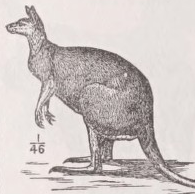
Kangaroo
Encyclopedia Britannica
KANGAROO. When Captain Cook, during his first memorable voyage of discovery, was detained, for the purpose of refitting his ship at Endeavour river, on the north-east coast of Australia, a strange-looking animal, entirely unknown to them, was frequently seen by the ship’s company; and it is recorded in the annals of the voyage that, on the 14th of July 1770, “Mr Gore, who went out this day with his gun, had the good fortune to kill one of the animals which had been so much the subject of our speculation, . . . and which is called by the natives kanguroo,” a name which, though it does not appear to be now known to any of the aboriginal tribes of the country, has been adopted for this animal in all European languages, with only slight modifications of spelling. With the exception of a passing glimpse in the beginning of the same century by the Dutch traveller Bruyn of some living examples of an allied species, to be referred to presently, this was the first introduction to the civilized world of any member of a group of animals now so familiar. The affinities of the species, skins of which were brought home by Captain Cook and subsequent voyagers, were recognized by Schreber as nearer to the American opossums (then the only known marsupials) than to any other mammals with which zoologists were acquainted, and consequently it was placed by him, in his great work on the Mammalia, then in the course of publication, in the genus Didelphis, with qiqantea for a specific designation,—the latter having been bestowed upon it by Zimmerman under the impression that it was a huge species of jerboa. Soon afterwards (1791) Dr Shaw very properly formed a new genus for its reception, which he named Macropus, in allusion to the peculiar length of its hind foot. By the name thus ...formed, Macropus giganteus, this kind of kangaroo has ever since been known in zoological literature.
Further explorations in Australia and the neighbouring islands have led to the discovery of a very considerable number of species, which are now included in the family Macropodidae, one of the subdivisions of the order Marsupialia, ioτ the characters of which see Mammalia.
The Macropodidae, or kangaroos, taken as a whole, form a very well marked family, easily distinguished from the remaining members of the order by their general conformation, and by peculiarities in the structure of their limbs, teeth, and other organs. They vary in size from that of a sheep down to a small rabbit. The head, especially in the larger species, is small, compared with the rest of the body, and tapers forward to the muzzle. The shoulders and fore limbs are feebly developed, and the hind limbs of disproportionate strength and magnitude, which gives them a peculiarly awkward appearance when moving about on all fours, as they occasionally do when feeding. Rapid progression is, however, performed only by the powerful hind limbs, the animal covering the ground by a series of immense bounds, during which the fore part of the body is inclined forwards, and balanced by the long, strong, and tapering tail, which is carried horizontally backwards. When not moving they often assume a perfectly upright position, the tail aiding the two hind legs to form a sort of supporting tripod, and the front limbs dangling by the side of the chest. This position gives full scope for the senses of sight, hearing, and smell to warn of the approach of enemies, from which they save themselves by their bounding flight. The fore paws have five distinct digits, each armed with a strong, curved claw. The foot of the hind limb is quite different, and very peculiar in construction, being extremely long and narrow, and (with only one, lately discovered, exception) without any hallux or great toe. It consists mainly of one very large and strong toe, corresponding to the fourth of the human or other typically developed foot, ending in a strong curved and pointed claw. Close to the outer side of this lies a smaller fifth digit, and to the inner side two excessively slender toes (the second and third), bound together almost to the extremity in a common integument. The two little claws of these toes, projecting together from the skin, may be of use in scratching and cleaning the fur of the animal, but the toes must have quite lost all connexion with the functions of support or progression.
The dental formula, when completely developed, is incisors ⅜, canines ⅜, premolars - ∣ , molars ⅛ on each side, giving a total of thirty-four teeth. The three incisors of the upper jaw are arranged in a continuous arched series, and have crowns with broad cutting edges; the first or middle incisor is often larger than the others. Corresponding to these in the lower jaw is but one tooth on each side, but it is of great size, procumbent or directed horizontally forwards, narrow, lanceolate, pointed, and with sharp edges. Owing to the laxity of the union of the two rami of the lower jaw at the symphysis, in many species the two lower incisors can be made to work together like the blades of a pair of scissors, a very remarkable arrangement not known to occur in other mammals. The canines are absent or rudimentary, always so in the lower jaw, and often deciduous at an early age in the upper jaw. The premolars are compressed, with cutting longitudinal edges, the anterior one is always deciduous, being lost about the time the second one replaces the milk molar, so that both premolars are never found iu place and use in the same individual. The true molars have quadrate crowns, provided with two strong transverse ridges, or with four obtuse cusps. In Macropus giganteus and its immediate allies, both premolars and one or two of the anterior true molars are shed during the lifetime of the animal, so that in old examples only the two posterior molars and the incisors are found in place. The milk dentition, as in other marsupials, is confined to a single molar tooth on each side of each jaw, the other molars and incisors being never changed. The dentition of the kangaroos, functionally considered, thus consists of sharp-edged incisors, most fully developed near the median line of the mouth, for the purpose of cropping the various kinds of herbage on which they feed, and ridged and tuberculated molars for crushing it, there being no tusks or canines for offensive or defensive purposes.
The number of vertebrae is—in the cervical region 7, dorsal 13, lumbar 6, sacral 2, caudal varying according to the length of the tail, but generally from 21 to 25. In the fore limb the clavicle and the radius and ulna are well developed, allowing of considerable freedom of motion of the hand. The pelvis has large epipubic or “marsupial” bones. The femur is short, and the tibia and fibula of great length, as is the foot, the whole of which is applied to the ground when the animal is at rest in the upright position.
The stomach is of large size, and very complex, its walls being puckered up by longitudinal muscular bands into a great number of sacculi, like those of the human colon. The alimentary canal is long, and the caecum well developed. All the species have a marsupium or pouch formed by a fold of the skin of the abdomen, covering the mammary glands with their four nipples. In this pouch the young (which, as in other marsupials, leave the uterus in an extremely small and imperfect condition) are placed as soon as they are born; there their growth and development proceeds; and to it they resort temporarily for the purpose of shelter, concealment, or transport, for some time after they are able to run and jump about the ground and feed upon the same herbage which forms the nourishment of the parent. During the early period of their sojourn in the pouch, the blind, naked, helpless young creatures (which in the great kangaroo scarcely exceed an inch in length) are attached by their mouths to the nipple of the mother, and are fed by milk injected into their stomach by the contraction of the muscle covering the mammary gland. In this stage of their existence the respiratory organs are modified much as they are permanently in the Cetacea, the elongated upper part of the larynx projecting into the posterior nares, and so maintaining a free communication between the lungs and the external surface, independently of the mouth and gullet, thus averting all danger of suffocation while the milk is passing down the latter passage.
The kangaroos are all vegetable feeders, browsing on grass and various kinds of herbage, the smaller species also eating roots. They are naturally timid, inoffensive creatures, but the larger ones when hard pressed will turn and defend themselves, sometimes killing a dog by grasping it in their fore paws, and inflicting terrible wounds with the sharp claws of their powerful hind legs, sustaining themselves meanwhile upon the tail. The great majority are inhabitants of Australia and Tasmania, forming one of the most prominent and characteristic features of the fauna of these lands, and in the scenery of the country, as well as the economy of nature, performing the part of the deer and antelopes of other parts of the world, which are entirely wanting in Australia. They were very important sources of food-supply to the natives, and are hunted by the colonists, both for sport and with a view to their destruction, on account of the damage they naturally do in consuming the grass, now required for feeding cattle and sheep. Notwithstanding this, they have in some districts increased in numbers, owing to the suppression of their former enemies, the aborigines and the dingo or native dog. A few species are found in New Guinea and the adjacent islands, which belong, in the zoological sense, to the Australian province, beyond the bounds of which none have been found either existing or in a fossil state.
The Macropodidae are divided into two well-marked sections—(1) the true kangaroos {Macroρodimse), and (2) a group consisting of smaller animals, commonly called rat-kangaroos, or (improperly) “kangaroo-rats,” or sometimes potoroos.
I. In the Macropodinae (see fig. 3) the cutting edges of the upper incisors are nearly level, or the first pair but slightly longer than the others. The canines are rudimentary and often wanting. The premolars are usually not longer (from before backwards) than the true molars, and less compressed than in the next section. The crowns of the molars have always two prominent transverse ridges. The fore limbs are small with subequal toes, armed with strong, moderately long, curved claws. Hind limbs very long and strongly made. Head small, with more or less elongated muzzle. Ears generally rather long and ovate.
Upwards of thirty species of this group have been described, and many attempts have been made to subdivide it into smaller groups or genera for the convenience of arrangement and description, but these have generally been based upon such trivial characters that it is preferable to speak of most of them as sections of the genus Macropus, reserving generic rank only to two forms somewhat aberrant both in structure and geographical distribution. According to this arrangement the genera will be as follows :—
1. Macropus, Shaw, divided into the following sections or subgenera. A. Macropus proper, of which the type is Μ. giganteus, spoken of at the beginning of this article as having been discovered in 1770 by the first English explorers of Australia. It is the common great kangaroo, called “boomer,” “forrester,” or “old man” by the colonists, and frequents the open grassy plains of the greater part of eastern Australia and Tasmania. Some closely allied species or perhaps local varieties, Μ. ocydromus, Μ. f uliginosus, and Μ. melanops, are found in southern and western Australia. B. Os-phranter, Gould, distinguished from the above by the naked muffle, includes some very large and handsome species, which principally dwell in rocky mountain ranges, as the great red kangaroo, Μ. rufus, Μ. antilopinus, and Μ. robustus. C. Halmatwnιs, F. Cuv. The kangaroos of this section have also the muffle naked, but they are rather smaller species, frequenters of forests and dense impenetrable brushes and scrubs, and hence often called brush kangaroos, though a native name “wallaby” is now generally applied to them. There are many species, of which Μ. bennettii, Μ. ruficollis, Μ. ualabatus, Μ. dorsalis, Μ. agilis, Μ. derbianus, Μ. thetidis, Μ. billardieri are the best known. Μ. brachyurus is remarkable for its comparatively short and slender tail and small ears. The earliest known species of kangaroo, referred to before, Μ. brunii (Schreber), may perhaps belong to this section. Several examples were seen by Bruyn in 1711 living in captivity in the garden of the Dutch governor of Batavia, and described and figured in the account of his travels {Reizen over Moskovie, &c.) under the name of “Filanfler.” It was quite lost sight of, and its name even transferred by S. Müller to another species (now known as Dorcopsis miilleri, Schlegel) until rediscovered in 1865 by Rosenberg, who sent a series of specimens to the Leyden Museum from the islands of Aru and Great Key, thus determining its true habitat. Quite recently three other species of true kangaroo have been discovered out of Australia :— Μ. papzιanus, Peters, from the eastern extremity of New Guinea, near Yule Island; Μ. crassipes, Pierson-Ramsay, from near Port Moresby; and Μ. browni, Pierson-Ramsay, from New Ireland. D. Onyclwyalea, Gould, with a hairy muffle and long and slender tail, furnished with a horny nail-like organ at the apex. Μ. unguifer, Μ. fraenatus, and Μ. lunatms. E. Lagorchestes, Gould, hare-kangaroos, a group of small hare-like animals, great leapers and swift runners, which mostly affect the open grassy ridges, particularly those of a stony character, sleeping in forms or seats like the common hare. Their limbs are comparatively small, their claws sharp and slender, and their muffle clothed with velvet-like hairs. Μ. fasciatus, Μ. lcρoroides, Μ. hirsutus, Μ. conspicillatus, &c. F. Petrogale, Gray. These differ from all the others in having the tail cylindrical and bushy towards the apex instead of tapering. The muffle is naked, the hind foot comparatively short and stout, and densely clothed with coarse hairs, the nails short. These are the “rock kangaroos,” making their retreats in caverns and crevices, leaping with surprising agility from one narrow ledge to another, and browsing upon the scanty herbage that the neighbourhood of such situations affords. Μ. xanthoρus, Μ. penicillatus, Μ. lateralis, Μ. concinnus, Μ. brachyotus, Μ. inornatus, &c.
2. Dendrolagus, Sal. Muller. —A genus formed for the reception of two species, D. ursinus and Z>. inustus, commonly known as ‘ ‘ tree kangaroos,” both inhabitants of New Guinea, and which differ greatly from all the foregoing in being chiefly arboreal in their habits, climbing with facility among the branches of large trees, and feeding on the bark, leaves, and fruit. In accordance with this habit their hinder limbs are comparatively shorter than in tire true kangaroos, and their fore limbs are longer and more robust, and have very strong curved and pointed claws. These differ from all the preceding, and agree with the next genus, in some details of the structure of the molar teeth, and in the circumstance that the fur of the back of the neck is directed forwards or in a reverse position to that of the remainder of the coat.
3. JDorcopsis, S. Muller.—Of this genus two species are at present known, both from New Guinea, D. mulieri, and another lately discovered by D’Albertis, D. luctuosa. . In some respects they resemble the last, but they differ from them and all the other Macropo∙ dinae, and agree with the next section, in the great size and peculiar form of the premolar teeth.
II. The second section or sub-family, the Hypsiprymninae (see fig. 4), have the first upper incisor narrow, curved, and much exceeding the others in length. Upper canines always persistent, flattened, blunt, and slightly curved. Premolars of both jaws always with large, simple, compressed crowns, with a nearly straight or slightly concave free cutting edge, both outer and inner surfaces usually marked by a series of parallel, vertical grooves and ridges. Molars with quadrate crowns, having a blunt, conical cusp at each corner, the fourth notably smaller than the third, sometimes rudimentary or absent. Fore feet narrow; three middle toes considerably exceeding the first and fifth in length; their claws long, compressed, and but slightly curved. Hind feet as in Macropus. Tail long, sometimes partially prehensile, being used for carrying bundles of grass with which they build their nests.
The potoroos or rat-kangaroos are all small animals, none of them exceeding a common rabbit in size. They inhabit Australia and Tasmania, are nocturnal, and feed on the leaves of various kinds of grasses and other plants, as well as roots and bulbs, which they dig up with their fore paws. About ten species are known, presenting a considerable range of diversity in minor characters, and admitting of being grouped in four principal sections, which may perhaps be allowed the rank of genera. These are
1. Hypsipryrnnus, liliger.—Head long and slender. Auditory bull® somewhat inflated. Ridges on premolars few and perpendicular. Large palatine foramina. Tarsus short. Muffle naked. H. murinus, H. apicalis, H. gilberti, H. platyops.
2. Bettongia, Gray. Head comparatively short and broad. Auditory bull® much inflated. Tarsus long. Large palatine foramina. Ridges on premolars numerous and oblique. Muffle naked. B. penicillatus, B. cuniculus, B. gairnardii, B. ogilbyi, B. grayii, B. campestris, &c.
3. Aepyprymnus, Garrod.—Head short and broad. Auditory bull® not inflated. No palatine foramina. Tarsus long. Muffle hairy. Ae. rufescens.
4. Hypsiprymnodon, Pierson-Ramsay.—Distinguished from all <jther members of the family by possessing a small prehensile hallux or first toe, without nail. It is, therefore, a form of great interest, as showing a structure of foot connecting that of the kangaroos with that of the phalangers. The single known species, H. moschatus, Ramsay, has been lately discovered in north-east Australia. It was described almost simultaneously by Owen under the name of Pleopus nudicaudatus.
In seeking among the other marsupials for the nearest allies to the kangaroos, using this word in the comprehensive sense as above, two most striking points in their organization must be borne in mind, the structure of the hind foot and the dentition. Of the former the essential peculiarity is the great predominance of the fourth digit, and the remarkable character of the second and third, which while retaining a considerable length, are of extreme tenuity, and buried up to the claws in a common integument. Such a structure of foot is quite unknown out of the marsupial order, but in that order it is found in the Phalangistidae in a very modified form, associated with a large opposable hallux, and a broad sole of the foot,, appropriate for climbing trees; and again, in almost the’ same form as in the kangaroos, in the ground-dwelling Peramelidae, which in their dentition and digestive organs are so widely different. The Australian carnivorous marsupials, Dasyuridae, and the American opossums or Didelphidae, show no trace of this singular conformation. It is therefore only with the former families, the Phalan- gistidae and the Peramelidae, that the kangaroos are allied by this character.
The chief peculiarity of the dentition consists in the presence of three pairs of incisors in the upper jaw, the first or middle one of which is generally the largest, opposed to a single pair in the lower jaw, strong, sharp, and procumbent. These are followed by an interval, in which may be, in the upper jaw only, a canine, but always so small, as to be of little functional importance. The premolars are compressed and cutting, and the true molars ridged or tuberculated. Such a dentition is found among the Phalangistidae alone of existing marsupials. In this respect the Peramelidae are completely separated from the kangaroos, their numerous small incisors, large canines, and cuspidated molars resembling those of the Dasyuridae and Didelphidae. On the whole then, the kangaroos and the phalangers are groups most nearly allied in essential characters, having both dentition and extremities formed upon the same fundamental type, though with modifications of the latter to suit their respective terrestrial and arboreal habits.
Remains of numerous extinct species of true kangaroos, many of them of much larger size than any now existing, are abundant in the Pleistocene deposits of Australia, and have been described and figured by Professor Owen in the Philosophical Transactions. Hitherto they have been found in no other part.of the world. Other animals of gigantic size, the Diprotodon, as large as a rhinoceros, and the Nototherium, but little inferior, with dentition of the same general type, but the structure of whose feet is not yet known, lived with these kangaroos in the same land. An extraordinary modification...
9th ed. Encyclopædia Britannica, vol. 13, p. 838
[4,605 words — estimated reading time: 30 minutes]
[4,605 words — estimated reading time: 30 minutes]
Kanizsa
Encyclopedia Britannica
KANIZSA, Nagy(fe., “Great”), a market-town of Hungary, in the trans-Danubian county of Zala, lies 31 miles north-north-east of Kopreinitz, and at the junction of the lines of railway from Sopron (Oedenburg) and Székesfehérvâr (Stuhlweissenburg), 46° 28' N. lat., 17° 0' E. long. Among the public and other buildings are a fine Roman Catholic church, a Franciscan monastery, a Piarist gymnasium, a town-hall, royal and magisterial courts of law, and the usual Government offices. In the neighbourhood are distilleries and brick-making factories. The markets periodically held in the town are much frequented, and the trade in grain, horned cattle, and pigs is generally brisk. The population at the end of 1880 was 18,393.
Nagy-Kanizsa once ranked as the second fortress of Hungary, and consequently played an important part during the wars with the Turks, who, having gained possession of it in 1600, held it until near the close of the 17th century. In 1690, after a siege of two years, it was recovered by the Austrian and Hungarian forces. Its reversion to Hungary was ratified by the treaty of Carlowitz (1699). In 1702 the fortifications were destroyed, and there are now but few traces of their former existence.
9th ed. Encyclopædia Britannica, vol. 13, p. 842
[209 words — estimated reading time: 2 minutes]
[209 words — estimated reading time: 2 minutes]
Kankakee
Encyclopedia Britannica
KANKAKEE, the chief city and county seat of Kankakee county, Illinois, U.S., is situated on the north bank of the Kankakee river, 56 miles south of Chicago. It is the centre of a very rich and fertile farming district, and has a large trade in agricultural produce. It has fine water-power, and, being within easy reach of extensive coal-fields and deposits of bog-iron ore, does a large manufacturing business. The population of the city and township in 1880 was 5652.
9th ed. Encyclopædia Britannica, vol. 13, p. 842
[84 words — estimated reading time: 1 minute]
[84 words — estimated reading time: 1 minute]
Kano
Encyclopedia Britannica
KANO, a town of central Africa, at the head of a province of the kingdom of Sokoto, about 230 miles east of Sokoto and 360 miles west of Kuka. The circuit of the walls is upwards of 15 English miles; but little more than a third of the enclosed area was actually occupied at the time of Barth’s visit. The oldest part of the town is that which lies at the foot of the hill Dalâ (120 feet), and from this the inhabited portion stretches south for 2∣ miles to the walls. To the south of the great market-place lies a deep pond, Jakara, upwards of a mile and a half in length. Two kinds of dwelling-houses are common—square-shaped clay-built structures with flat roofs, and round huts with conical tops. The population, estimated at 30,000, consists of Fellatah, Kanuri (Bornuese), Houssas, and Nupe. Commerce and manufactures go hand in hand, and every family has its share in each. Cotton cloth, woven‘and dyed in the town, forms a chief article of trade; and to this may be added sandals and shoes, twisted leather straps, and jebiras (purses of a peculiar make), kola-nuts, and slaves. About 20,000 loads of natron pass through the town in a year from Bornu to Nupe.
See Clapperton’s Travels, vol. ii.; and. Barth, Travels in North and Central Africa, vol ii. The latter gives a sketch plan of Kano.
9th ed. Encyclopædia Britannica, vol. 13, p. 842
[243 words — estimated reading time: 2 minutes]
[243 words — estimated reading time: 2 minutes]
A tribe of Indians allied to the Winnebagoes and Osages. They formerly inhabited the region which is now the State of Kansas, but were removed to the Indian Territory.
Kansas
Encyclopedia Britannica
KANSAS, the central State of the American Union, lies between 37° and 40° N. lat. and between 94° 38'and 102° W. long. It is bounded on the N. by Nebraska, on the E. by Missouri, on the S. by Indian territory, and on the W. by Colorado. The State is nearly rectangular in shape, with a breadth of about 210 miles from north to south, and a length of 400 miles from east to west. It contains an area of 81,318 square miles, or 52,043,520 acres....
Kansas is an undulating plain, gently sloping from west to east, at an average of nearly 7 feet per mile. There is also an inclination from north to south, as indicated by the course of the rivers, which flow southerly as well as easterly, but never northerly or westerly, except for short distances from local causes. The mouth of the Kansas river, at the east line of the State, is 750 feet above the sea-level; the average altitude of the western boundary is about 3500 feet. The broad prairie surface is diversified by an endless succession of valleys and woodlands. The great central valley is traversed by the Kansas or Kaw river, which, inclusive of the Smokyhill branch, extends the entire length of the State. Lateral valleys on the north are formed by the Saline, Solomon, Republican, and Blue rivers, and other smaller streams. Another broad valley is formed in the southern half of the State by the Arkansas river, with lateral valleys on the north, traversed by the Walnut, Little Arkansas, Pawnee Fork, and other streams. The southeastern portion contains the important Neosho valley, and the smaller valleys of the Osage and Verdigris. In the extreme south-west and along the southern boundary are the valley of the Cimarron, and a network of the southern tributaries of the Arkansas. Numerous small affluents of the Missouri enrich and diversify the north-eastern quarter of the State. The streams of Kansas are usually fed by perennial springs, and, as a rule, the eastern and middle portions of the State are well watered. The western part is more elevated, and water is less abundant.
Geology and Minerals.— τ Pav surface presents three distinct geological sections. The eastern portion of the State belongs to the Carboniferous system, in which are found inexhaustible beds of valuable bituminous coal, often at shallow depths or cropping out on the surface. The central portion belongs to the Triassic formation, witl magnesian limestone, ferruginous sandstone, and gypsum as the representative rocks. Magnesian limestone, knowr as dolomite, is especially plentiful along the Blue. Republican, and Neosho rivers and their tributaries. This beautiful stone, resembling white, grey, and cream-coloured marble, is exceedingly useful for building purposes. Il crops out in the bluffs in endless quantities, and is easily worked. The wèstern portion of the State belongs to the Cretaceous formation, in which chalks and a species ol native quicklime are very prominent in the river bluffs. The white and cream-coloured chalks are much used foi building purposes, but the blue is usually too soft foi exposure to the weather. The quicklime as quarried from the bluffs slakes perfectly, and with sand makes a fairly good mortar, without calcination or other previous prépara tions, Lead-mines are extensively worked in the south eastern portion of the State, and prosperous towns and cities are growing up in connexion with these mines. Ir the central region, salt is produced from wells, and appears in occasional marshes. Salt industries are carried on al Solomon City, near the mouth of the Solomon river, and an excellent brine is obtained at Junction City. The sail of the south-west is found in beds and dry incrustations, varying in thickness from a few inches to 2 feet. The salts of Kansas are remarkably free from lime and other im∙
purities. Gypsum is found in beautiful crystalline form in extensive quarries, but it has not been much utilized. The lignite found near the Colorado line makes a valuable domestic fuel.
Climate.— The climate of Kansas is exceptionally salubrious. Extremes of heat and cold occur, as in all open prairie countries, but as a rule the winters are dry and mild, while the summer heats are tempered by the perpetual prairie breezes. The summer nights are invariably cool and refreshing. The mean annual temperature at Fort Riley for twenty-three years ending December 1874 has been 53°. The highest temperature there during the same period was 98° and the lowest 12° below zero. The average annual rainfall at the city of Lawrence for six years (1875-1880) was 32 ’ 68 inches, the heaviest rainfalls occurring in May, June, July, and August, the lightest in November, December, January, and February.
Soil.— The soil of the upland prairies is generally a deep rich clay loam, of a dark colour. The bottom lands near the streams are a black sandy loam; and the intermediate lands, or “second bottoms,” show a rich and deep black* loam, containing very little sand. These soils are all easily cultivated, free from stones, and exceedingly productive. There are exceptional spots on the upland prairies composed of stiff clay, not as easily cultivated, but very productive when properly managed and enriched. In the early history of the country the prairies were covered with the short “buffalo grass,” very nutritious for pasturage, on which immense herds of buffalo and other animals subsisted, but utterly unfit for hay. With the disappearance of the buffalo, and as the country is settled and cultivated, the short buffalo grass gives place to the tall blue stem and other bladed grasses valuable alike for pasture and for hay. Timber is abundant along the streams in the eastern section of the State, but is less plentiful in the central portion, and very scarce in some parts of the west. The varieties of timber embrace oak, elm, black walnut, cottonwood, mulberry, box, elder, willow, hickory, sycamore, white ash, and other hard and soft woods.
Agriculture.— The farm products of 1880 were as follows :— Indian com, 101,420,718 bushels; winter wheat, 23,507,223; spring wheat, 1,772,661; rye, 676,507; oats, 11,483,796; barley, 287,057; buckwheat, 43,455; Irish potatoes, 4,919,227; sweet potatoes, 391,196; castor beans, 558,974; flax seed, 1,245,279; sorghum syrup, 3,787,585 gallons; cotton, 142,517 tt>; hemp, 635,8721b; millet and Hungarian hay, 629,084 tons; Timothy hay, 79,634 tons; hay from wild or native grasses, 798,707 tons; clover pasture, 5927 acres; blue grass pasture, 38,259 acres; native grass pasture, 901,125 acres; produce of market gardens to the value of $449,797.
The bright climate and pure atmosphere are admirably adapted to the growth of the apple, pear, peach, plum, grape, and cherry. The smaller fruits also, with scarce an exception, flourish finely. Trees never suffer from sodden or water-soaked roots, and very seldom from the winter’s cold, when reasonable judgment and care have been exercised in selecting and managing the grounds. At a national exhibition in Philadelphia in 1869 the great gold medal of the National Pomological Society was awarded to Kansas “for a collection of fruits unsurpassed for size, perfection, and flavour;” and similar awards have been made to Kansas fruits at later exhibitions. In November 1872 the American Institute, at its great show, awarded a diploma for 190 varieties of apples grown in Kansas, as the largest and handsomest exhibited. At the International Exhibition at Philadelphia in 1876, Kansas exhibited ninety-six varieties of apples, and received the diploma of the centennial commission. Estimates based on the tables of 1877 indicate that the number of bearing trees now in the State (1881) is about as follows :—2,500,000 apple, 100,000 pear, 8,000,000 peach, 200,000 plum, and 1,000,000 cherry trees. The planting of trees is still on the increase, and the older orchards are very profitable. The same is true of vineyards and plantations of small fruits.
Live Stock.— The wide prairies, with their nutritious grasses for hay and grazing and their never-failing springs of pure water, make the State a very paradise to the herdsman and stock-raiser. The following are the statistics for 1880 :—horses, 367,589; mules and asses, 58,303; milch cows, 366,640; other homed cattle,748,672; sheep, 426,492; swine, 1,281,630; value of animals slaughtered and sold for slaughter, $12,700,045; value of poultry and eggs sold, $531,550; wool (clip of 1878), 289,644 lb; wool (1879), 1,194,453 lb; honey (produce of 1879), 370,398 lb; wax (1879), 10,949 tt>. The great herds of buffalo which formerly overran the plains have disappeared, the elk is gone, and deer and other game are less plentiful than formerly. There remain, however, the rabbit, hare, turkey, prairie hen, quail, and the usual variety of migratory water-fowl, to gratify the sportsman. The numerous streams are well supplied with fish of choice varieties and of unusually large size, Manufactures.— There is perhaps no tract of country of equal extent better supplied with available water power than Kansas. The streams are fed by living springs, and the inclination of the country insures uniformly rapid currents. Most of the streams maintain a good flow of water in the driest seasons, and in case of heavy rains many of them “underflow” the adjacent bottom lands, saturating the permeable substratum of the country with the surplus water, which in time drains out and feeds the subsiding streams. This feature is particularly true of the Saline, Solomon, and Smokyhill rivers. The Smokyhill river has not risen above the banks of its deep channel at Junction City since 1869, while at the lowest stages it is capable of driving large flouring-mills, having half a dozen sets of burrs. A dam on the Kansas river at Lawrence supplies a water-power capable of developing a great manufacturing centre. In 1870 there were one hundred and ten improvements of water-power in the state. Estimates based on the latest statistics now place the number of utilized mill sites at about three hundred, where flouring-mills, saw-mills, planing-mills, and woollen-mills run the entire year, with very little hindrance from either high or low water. In the eastern section of the State, where coal is plentiful, steam-power is much used, especially in the manufacture of iron. At Leavenworth there are manufactories of iron bridges, engines, boilers, stoves, railroad iron; and miners’ tools. There are also manufactories of waggons, carriages, carpets, soaps, paints, and cement, at Leavenworth, Fort Scott, Lawrence, Columbus, Ottawa, and other places. At Topeka, Parsons, Armstrong, and Argentine there are rolling mills and railroad repair shops, while planing-mills, tanneries, cheese factories, and pork-packing establishments are found in various localities.
Transport and Trade.— There ar’e numerous railroads in the State, with an aggregate length of completed track of 3104 miles. The central branch in the north and the Union Pacific (Kansas division) near the centre traverse the northern half of the State from east to west, in nearly parallel lines,—the latter extending by its connexions to San Francisco. The Atchison, Topeka, and Santa Fe line passes from the north-east to the south-west, extending through to the Pacific coast; and the Missouri Pacific (Kansas division), by uniting with the Texas Central, connects the richest portion of Kansas with the Gulf of Mexico at Galveston. Other lines in connexion with these facilitate the internal commerce of the State. Kansas has an eastern front of 150 miles on the Missouri river, which is navigable for steamboats of all sizes. The internal rivers of the State are not utilized for commercial purposes, though the Kansas was formerly considered navigable to Fort Kiley, near the mouth of the Republican river, and steamboats have ascended the Smokyhill to the mouth of the Saline, about 50 miles farther west. By means of these railroads and the Missouri river immense quantities of wheat, corn, cattle, and swine are sent from Kansas to the eastern markets; flour is sent south, south-west, and west, and butter, poultry, and eggs, with large quantities of vegetables, hay, and garden produce, to the western mining regions.
Education.— The public schools are liberally endowed and supported. Two sections of land (1280 acres) are set apart in each congressional district for school fund purposes. There are in the State 5242 public school buildings, and the value of public school property is $4,633,044. The teachers employed number 6707. The pupils of school age are estimated from statistics of 1875 at 230,000, about half of whom are in actual attendance. The annual expenditure for ⅛chool purposes, estimated from statistics of 1875, is 1,500,000. The State supports a university at Lawrence, and. a normal school at Emporia; and the agricultural college at Manhattan is endowed by the general Government. There are also State institutions for the education of the blind, and the deaf and dumb, and for the care of the insane. A reform school for juvenile offenders is being built at the State capital.
Religion.— All the usual religious denominations are represented, owning church property to the amount of $2,511,520.
Administration.— In Kansas, as in all the States of the American Union, the government is vested in three departments, legislative, executive, and judicial. The governor is elected for a term of two years. The legislature consists of a senate and house of representatives. The members of the house are elected for two years, and members of the senate for four. The judiciary consists of a State supreme court and subordinate district courts. The judges are all elected by a direct vote of the people.
Population.— The following table gives the population at the last three census enumerations, with the number of inhabitants pef square mile at each period :—
[table]
The State is divided into 104 counties. The following are the largest towns, with population in 1880 Leavenworth, 16,550; Topeka, 15,451; Atchison, 15,106; Lawrence, 8511; Wyandotte, 6149; Fort Scott, 5372; Wichita, 4911; Emporia, 4632; Parsons, 4196; Ottawa, 4032. Topeka, the State capital, is advantageously situated, and is one of the most flourishing towns in the State.
History.— Kansas belongs to that immense tract of country, purchased by the American Government from France in 1803, known as the Louisiana purchase. Prior to 1854 it was in the hands of various Indian tribes, some native, and others which had been removed from the older States. It was organized and opened for settlement as a territory by Act of Congress in May 1854, in the midst of a heated contest on the slavery question. . The slaveholders and the friends of freedom at once began a vigorous contest for the occupancy and control of the new territory, and thus it was that Kansas became the vanguard in the great struggle which resulted in the overthrow of slavery in the United States. Before the formal beginning of the war, societies were organized by the rival settlers and their friends in the States on both sides of the slavery question, and even rival legislatures were elected and convened. The discussions frequently resulted in personal violence, and the greatest excitement prevailed till the breaking out of the civil war. Kansas was admitted into the Union as a State in January 1861, and took an active part in furnishing troops for the suppression of the rebellion. The State was frequently invaded, and the city of Lawrence was sacked and burned in August 1863. Since the overthrow of slavery, Kansas has shared fully in the general progress of the country. (J. D.+)
9th ed. Encyclopædia Britannica, vol. 13, p. 842
[2,626 words — estimated reading time: 16 minutes]
[2,626 words — estimated reading time: 16 minutes]
Kansas city
Encyclopedia Britannica
KANT, Immanuel (1724-1804). So far as changes of external fortune are concerned, the life of the greatest philosopher of the 18th century presents little or nothing of interest. Born in humble circumstances, he passed a quiet and almost undisturbed existence within the narrow limits of his native place. Education, both of school and university, he obtained at Königsberg, and during a prolonged academic activity in that retired Prussian town he gave forth the works which have exercised such influence on European thought that, in the estimation of the best historical judges, they may be placed on a level with the great events of the French Revolution as the most important factors in determining the characteristic features of 19th century culture. A biography of Kant can be little more than a record of the successive phases of his literary activity....
The family of Kant was of Scotch extraction, the grandfather of the philosopher having been an emigrant from Scotland who had settled, first at Memel, and afterwards at Tilsit. The name Cant, as it was originally spelled, is not uncommon in the north of Scotland, whence the family is said to have come, and it is not perhaps mere fancy to trace in some of the ethical doctrines of the critical philosophy and in the personal character of its author some of the prominent features of Scottish nationality. The father of the philosopher carried on the business of a saddler in Königsberg, and in that town, on the 22d April 1724, was born Immanuel, the fourth of a large family, most of whom died at an early age. Königsberg was then somewhat noted as a stronghold of what is known as Pietism, a phase of religious thought and life which had in Germany, as elsewhere, too much that was unpleasing, but which nevertheless was capable of exercising a powerful influence for good on the development of a really strong and ample character. “Say what you will of Pietism,” writes Kant to his friend Rink, “no one can deny the real worth of the characters which it formed; they possessed the highest that man can possess —a peace, a cheerfulness, an inner harmony with self, which was disturbed by no passion.” To influences of this kind Kant was subjected in his early years, partly from his mother, for whose memory he ever cherished the warmest affection and regard, partly from his excellent friend and patron, Schulz, the director of the Collegium Fredericianum in Königsberg, and afterwards professor of theology in the university. At the Collegium Fredericianum Kant was entered in his tenth year, with the definite view of proceeding to the theological courses of the university. His inclination at this time, determined probably by the high character of his teachers, was towards classics, and he was recognized, with his schoolfellow, the afterwards celebrated David Ruhnken, as among the most competent and promising classical scholars of the college. His taste for the greater Latin authors, particularly Lucretius, was never lost, and he acquired through his school training an unusual facility in Latin composition. With Greek authors he does not appear to have been equally familiar.
During his university course, which began in 1740, Kant was principally attracted towards mathematics and physics, doubtless through the influence of Knutzen, who then, as extraordinary professor, lectured on most branches of mathematics and also on philosophy. The lectures on classics do not seem to have satisfied Kant, and, though he attended Schulz’s courses on theology, and even preached on one or two occasions, he appears finally to have given up the intention of entering the church. The last years of his university studies were much disturbed by the straitened means of his family, and he was compelled to have recourse to private teaching of the humblest kind. The death of his father, in 1746, destroyed his hopes of remaining at the university until he should have obtained some subordinate academic post. Much against his inclination he undertook the office of private tutor, and for nine years acted in this capacity in various families in the immediate neighbourhood of Königsberg. Although the life was not one which Kant would have chosen, and one for which he was not specially qualified—as he used to say regarding the excellent precepts of his Pedagogics, he was never able to apply them—yet it gave him an extended knowledge of the world, and added to his other accomplishments the grace and polish of refined society, which he displayed ever afterwards to a degree somewhat unusual in a philosopher by profession.
In 1755 Kant returned to Königsberg as tutor in the family of Count Kayserling. By the kindness of a friend named Richter, he was enabled again to take up his university career, and in autumn of that year he graduated as doctor and qualified as “Privatdocent.” Two of the theses publicly defended on the occasion are printed in his works; an address, on the easier and harder styles of philosophical exposition, has not been publishe'd. For fifteen years he continued to labour in this subordinate position, his fame as writer and lecturer steadily increasing. On two occasions he was disappointed in the hope of obtaining a professorship in his own university, but during this time, as in later years, he refused all offers that would have withdrawn him from Königsberg. The only academic preferment received by him during the lengthy probation was the post of underlibrarian, to which he was appointed in 1766. His lectures, at first mainly upon physics, gradually expanded until nearly all descriptions of philosophy were included under them. A most interesting programme of his courses on metaphysics, logic, ethics, and physical geography for the session 1765-66 has been printed in his works (i. 289- 299). The history of his literary activity during this period will be given in connexion with the notice of his writings.
In 1770 he obtained the chair of logic and metaphysics at Königsberg, and delivered as his inaugural address the dissertation De Mundi Sensibilis et Iηtelligibilis Forma et Principiis. Eleven years later appeared the Kritik of Pure Reason, the work towards which he had been steadily advancing, and of which all his later writings are developments.
In 1783 he published the Prologomena, intended as an introduction to the Kritik, which had been found to stand in need of some explanatory comment. A second edition of the Kritik, with some modifications, appeared in 1787, after which it remained unaltered.
In spite of its frequent obscurity, its novel terminology, and its declared opposition to prevailing systems, the Kantian philosophy made rapid progress in Germany. In the course of ten or twelve years from the publication of the Kritik of Pure Reason, it was expounded in all the leading universities, and it even penetrated into the schools of the Church of Rome. Such men as Schulze in Königsberg, Kiesewetter in Berlin, Jakob in Halle, Born and Heydenreich in Leipsic, Reinhold and Schmid in Jena, Buhle in Göttingen, Tennemann in Marburg, and Snell in Giessen, with many others, made it the basis of their philosophical teaching, while theologians like Tieftrunk, Stäudlin, and Ammon -eagerly applied it to Christian doctrine and morality. Young men flocked to Königsberg as to a shrine of philosophy. The Prussian Government even undertook the expense of their support. Kant was hailed by some as a second Messiah. He was consulted as an oracle on all questions of casuistry,—as, for example j on the lawfulness of inoculation for the small-pox. This universal homage for a long time left Kant unaffected; it was only in his later years that he spoke of his system as the limit of philosophy, and resented all further progress. He still pursued his quiet round of lecturing and authorship, and contributed from time to time papers to the literary journals. Of these, among the most remarkable was his review of Herder’s Philosophy of History, which greatly exasperated that author, and led to a violent act of retaliation some years after in his Metakritik of Pure Reason. Schiller at this period in vain sought to engage Kant upon his Horen. He remained true to the Berlin Journal, in which most of his criticisms appeared.
In 1792 Kant, in the full height of his reputation, was involved in a painful collision with the Government on the question of his religious doctrines. Wöllner had replaced Von Zedlitz as minister of spiritual affairs, and, in an age peculiarly lax and heterodox, an unwise attempt was made to apply a rigid censorship to works of philosophical theology. It was not wonderful that the philosophy of Kant had excited the declared opposition of all adherents of historical Christianity, since its plain tendency was towards a moral rationalism, and it-could not by any process of interpretation be reconciled to the literal doctrines of the Lutheran Church. It would have been much better to permit his exposition of the philosophy of religion to enjoy the same literary rights as his earlier works, since Kant could not be interdicted without first silencing a multitude of theologians who were at least equally separated from positive Christianity. The Government, however, judged otherwise; and after the first part of his book, On Religion within the Limits of Reason alone, had appeared in the Berlin Journal, the publication of the remainder, which treats in a more rationalizing style of the peculiarities of Christianity, was forbidden. Kant, thus shut out from Berlin, availed himself of his local* privilege, and, with the. sanction of the theological faculty of his own university, published the full work in Königsberg. The Government, who were probably as much influenced by hatred and fear of the French Revolution, of which Kant was supposed to be a partisan, as by love of orthodoxy, resented the act; and a secret cabinet order was received by him intimating the displeasure of the king, Frederick William II., and exacting from him a pledge not to lecture or write at all on religious subjects in future. With this mandate Kant, after a struggle, complied, and kept his engagement till 1797, when the death of the king, according to his construction of his promise, set him free. This incident, however, produced a very unfavourable effect on his spirits. He withdrew in 1794 from society; next year he gave up all his classes but one public lecture on logic or metaphysics; and in 1797, before the removal of the interdict on his theological teaching, he ceased altogether his public labours, after an academic course of forty-two years. He previously, in the same year, finished his treatises on the Metaphysics of Ethics, which, with his Anthropology, completed in 1798, were the last considerable works that he revised with his own hand. His Lectures on Logic, on Physical Geography, on Paedagogics, were edited during his lifetime by his friends and pupils. By way of asserting his right to resume theological disquisition, he also issued in 1798 his Strife of the Faculties, in which all the strongest points of his work on religion were urged afresh, and the correspondence that had passed between himself and his censors was given to the world.
From the date of his retirement from the chair Kant declined in strength, and gave tokens of intellectual decay. His memory began to fail, and a large work at which he wrought night and day, on the connexion between physics and metaphysics, was found to be only a repetition of his already published doctrines. After 1802, finding himself attacked with a weakness in the limbs, attended with frequent fits of falling, he mitigated a little the Spartan severity of his life, and also consented to receive medical advice. A constant restlessness oppressed him; his sight gave way; his conversation became an extraordinary mixture of metaphors; and it was only at intervals that gleams of his former power broke out, especially when some old chord of association was struck in natural science or physical geography. A few days before his decease, with a great effort he thanked his medical attendant for his visits in the words, “I have not yet lost my feeling for humanity.” On the 12th of February 1804, he breathed his last, having almost completed the eightieth year of his age.
It is superfluous to characterize the genius of Kant; but a few words may be added as to his personal appearance and habits of life, study, and teaching. His stature was small, and his appearance feeble. He was little more than 5 feet high; his breast was almost concave, and, like Schleiermacher, he was deformed in the right shoulder. His hair was light, his complexion fresh, his forehead high and square, while his eye of light blue showed an expression of unusual depth and power. His senses were quick and delicate; and, though of weak constitution, he escaped, by strict regimen, all serious illness till the close of life.
His life was arranged with mechanical regularity; and, as he never married, he kept the habits of his studious youth to old age. His man-servant awoke him summer and winter at five o’clock; and, on being appealed to on one occasion, testified that Kant had not once failed in thirty years to respond to the call. After rising he studied for two hours, then lectured other two, and spent the rest of the forenoon, till one, at his desk. He then dined at a restaurant, which* he frequently changed, to avoid the influx of strangers, who crowded to see and hear him— till in later years his growing means enabled him to invite a friend or two daily to his own home. This was his only regular meal; and, as he loved the ducere caenam of the Romans, he often prolonged the conversation till late in the afternoon. He then walked out for at least an hour in all weathers, and spent the evening in lighter reading, except an hour or two devoted to the preparation of his next day’s lectures, after which he retired between nine and ten to rest. The furniture of his house was of the simplest character; and, though he left a considerable sum, the produce of his writings, to his relatives, he indulged in no luxury, and was a pattern of that superiority to fashion and appearance so often met within the literary life of Germany. In his earlier years he often spent his evenings in general society, where his overflowing knowledge and conversational talents made him the life of every party. He was especially intimate with the families of two English merchants of the name of Green and Motherby, where he found many opportunities of meeting ship-captains, and other travelled persons, and thus gratifying his passion for physical geography. This social circle included also the celebrated Hamann—the Magus or Wizard of the North—the friend of Herder and Jacobi, who was thus a mediator between Kant and these philosophical adversaries.
Kant’s reading was of the most extensive and miscellaneous kind. He cared comparatively little for the history of speculation, being in this department more a discoverer than a scholar. But his acquaintance with books of science, general history, travels, and belles lettres was boundless. He was well versed in English literature, chiefly of the age of Queen Anne, and had read English philosophy from Locke to Hume, and the Scottish school. He was at home in Voltaire and Rousseau, but had little or no acquaintance with the French sensational philosophy. He was familiar with all German literature up to the date of his Kritik, but ceased to follow it in its great development by Goethe and Schiller. It was his habit to obtain books in sheets from his publishers Kanter and Nicolovius; and he read over for many years all the new works in their catalogue, in order to keep abreast of universal knowledge. He was excessively fond of newspapers and works on politics; aiìd this was the only kind of reading that could interrupt his studies in philosophy.
As a lecturer, Kant avoided altogether that rigid style in which his books were written, and which was only meant for thinkers by profession. He sat behind a low desk, with a few jottings on slips of paper, or text-books marked on the margin, before him, and delivered an extemporaneous address, opening up the subject by partial glimpses, and with many digressions and interspersed anecdotes or familiar illustrations, till a complete idea of it was presented. His voice was extremely weak, but sometimes rose into eloquence, and always commanded perfect silence. Like Adam Smith, he fixed his eye on one student, and marked by his countenance whether the lecture was understood. The least irregularity in the appearance or dress of this selected hearer disconcerted him; and the story is well known of the missing button, which defeated a lecture. Though kind to his students, he refused on principle to remit their fees, as this, he thought, would discourage independence. It was another principle that his chief exertions should be bestowed on the intermediate class of talent, as the geniuses would help themselves, and the dunces were beyond remedy. Hence he never delivered his deeper doctrines, such as are found in his Kritik, from the chair. His other avocations allowed him little personal intercourse with his numerous hearers, and he often complained of the want of lively sympathy and ascertained progress inseparable from such a system.
Simple, honourable, truthful, kind-hearted, and high-minded as Kant was in all moral respects, he was somewhat deficient in the region of sentiment. He had little enthusiasm for the beauties of nature, and indeed never sailed out into the Baltic, or travelled more than 40 miles from Königsberg. Music he disregarded, and all poetry that w as more than sententious prose. His ethics have been reproached with some justice as setting up too low an ideal for the female sex. Though faithful in a high degree to the duties of friendship, he could not bear to visit his friends in sickness, and after their death he repressed all allusion to their memory. His engrossing intellectual labours no doubt tended somewhat to harden his character; and in his zeal for rectitude of purpose he forgot the part which affection and sentiment must ever play in the human constitution. Those who count these defects most grave will yet find much to admire in the lofty tone of his character, and in the benevolence which could thus express itself: “Whoever will suggest to me a good action left undone, him will I thank, though he suggest it even in my last hour !”
This brief notice of his life may appropriately close with Herder’s beautiful sketch of Kant’s character, all the more interesting that it was written in 1795, after their quarrel: —“I have had the good fortune to know a philosopher who was my teacher. In the vigour of life he had the same youthful gaiety of heart that now follows him I believe into old age. His open forehead, built for thought, was the seat of imperturbable cheerfulness and joy; the most pregnant discourse flowed from his lips; wit, humour, and raillery came to him at will, and his instructions had all the charm of an entertainment. With the same easy mastery with which he tested the doctrines of Leibnitz, Wolf, Baumgarten, Crusius, and Hume, or pursued the discoveries of Newton, Kepler, and other lights of science, he also took up the current writings of Rousseau, such as the Émile or Héloise, or any new phenomenon of the natural world, and from the criticism of each came back to the impartial study of nature, and to the enforcement of the dignity of man. History in all its branches, natural science, physics, mathematics, and experience were the materials that gave interest to his lectures and his conversation; nothing worthy of study was to him indifferent; no faction or sect, no selfishness or vanity, had for him the least attraction, compared with the extension and elucidation of truth. He excited and pleasantly impelled us to mental independence; despotism was foreign to his nature. This man, whom I name with the deepest gratitude and respect, is Immanuel Kant; his image rises before me surrounded with pleasing recollections !”
The Writings of Kant.
From the preceding sketch of Kant’s academic activity it must be evident that he combined in a quite unusual degree knowledge of physical science with speculative acuteness and devotion to the special work of philosophy. No other thinker of modern times has been throughout his work so penetrated with the fundamental conceptions of physical science; no other has been able to hold with such firmness the balance between empirical and speculative ideas. Beyond all question much of the influence which the critical philosophy has exercised and continues to exercise must be ascribed to this characteristic feature in the training of its great author.
The early writings of Kant are almost without exception on questions of physical science. It was only by degrees that philosophical problems began to engage his attention, and that...
9th ed. Encyclopædia Britannica, vol. 13, p. 844
[17,365 words — estimated reading time: 1.7 hours]
[17,365 words — estimated reading time: 1.7 hours]
Kant
Encyclopedia Britannica
KANT, Immanuel (1724-1804). So far as changes of external fortune are concerned, the life of the greatest philosopher of the 18th century presents little or nothing of interest. Born in humble circumstances, he passed a quiet and almost undisturbed existence within the narrow limits of his native place. Education, both of school and university, he obtained at Königsberg, and during a prolonged academic activity in that retired Prussian town he gave forth the works which have exercised such influence on European thought that, in the estimation of the best historical judges, they may be placed on a level with the great events of the French Revolution as the most important factors in determining the characteristic features of 19th century culture. A biography of Kant can be little more than a record of the successive phases of his literary activity....
The family of Kant was of Scotch extraction, the grandfather of the philosopher having been an emigrant from Scotland who had settled, first at Memel, and afterwards at Tilsit. The name Cant, as it was originally spelled, is not uncommon in the north of Scotland, whence the family is said to have come, and it is not perhaps mere fancy to trace in some of the ethical doctrines of the critical philosophy and in the personal character of its author some of the prominent features of Scottish nationality. The father of the philosopher carried on the business of a saddler in Königsberg, and in that town, on the 22d April 1724, was born Immanuel, the fourth of a large family, most of whom died at an early age. Königsberg was then somewhat noted as a stronghold of what is known as Pietism, a phase of religious thought and life which had in Germany, as elsewhere, too much that was unpleasing, but which nevertheless was capable of exercising a powerful influence for good on the development of a really strong and ample character. “Say what you will of Pietism,” writes Kant to his friend Rink, “no one can deny the real worth of the characters which it formed; they possessed the highest that man can possess —a peace, a cheerfulness, an inner harmony with self, which was disturbed by no passion.” To influences of this kind Kant was subjected in his early years, partly from his mother, for whose memory he ever cherished the warmest affection and regard, partly from his excellent friend and patron, Schulz, the director of the Collegium Fredericianum in Königsberg, and afterwards professor of theology in the university. At the Collegium Fredericianum Kant was entered in his tenth year, with the definite view of proceeding to the theological courses of the university. His inclination at this time, determined probably by the high character of his teachers, was towards classics, and he was recognized, with his schoolfellow, the afterwards celebrated David Ruhnken, as among the most competent and promising classical scholars of the college. His taste for the greater Latin authors, particularly Lucretius, was never lost, and he acquired through his school training an unusual facility in Latin composition. With Greek authors he does not appear to have been equally familiar.
During his university course, which began in 1740, Kant was principally attracted towards mathematics and physics, doubtless through the influence of Knutzen, who then, as extraordinary professor, lectured on most branches of mathematics and also on philosophy. The lectures on classics do not seem to have satisfied Kant, and, though he attended Schulz’s courses on theology, and even preached on one or two occasions, he appears finally to have given up the intention of entering the church. The last years of his university studies were much disturbed by the straitened means of his family, and he was compelled to have recourse to private teaching of the humblest kind. The death of his father, in 1746, destroyed his hopes of remaining at the university until he should have obtained some subordinate academic post. Much against his inclination he undertook the office of private tutor, and for nine years acted in this capacity in various families in the immediate neighbourhood of Königsberg. Although the life was not one which Kant would have chosen, and one for which he was not specially qualified—as he used to say regarding the excellent precepts of his Pedagogics, he was never able to apply them—yet it gave him an extended knowledge of the world, and added to his other accomplishments the grace and polish of refined society, which he displayed ever afterwards to a degree somewhat unusual in a philosopher by profession.
In 1755 Kant returned to Königsberg as tutor in the family of Count Kayserling. By the kindness of a friend named Richter, he was enabled again to take up his university career, and in autumn of that year he graduated as doctor and qualified as “Privatdocent.” Two of the theses publicly defended on the occasion are printed in his works; an address, on the easier and harder styles of philosophical exposition, has not been publishe'd. For fifteen years he continued to labour in this subordinate position, his fame as writer and lecturer steadily increasing. On two occasions he was disappointed in the hope of obtaining a professorship in his own university, but during this time, as in later years, he refused all offers that would have withdrawn him from Königsberg. The only academic preferment received by him during the lengthy probation was the post of underlibrarian, to which he was appointed in 1766. His lectures, at first mainly upon physics, gradually expanded until nearly all descriptions of philosophy were included under them. A most interesting programme of his courses on metaphysics, logic, ethics, and physical geography for the session 1765-66 has been printed in his works (i. 289- 299). The history of his literary activity during this period will be given in connexion with the notice of his writings.
In 1770 he obtained the chair of logic and metaphysics at Königsberg, and delivered as his inaugural address the dissertation De Mundi Sensibilis et Iηtelligibilis Forma et Principiis. Eleven years later appeared the Kritik of Pure Reason, the work towards which he had been steadily advancing, and of which all his later writings are developments.
In 1783 he published the Prologomena, intended as an introduction to the Kritik, which had been found to stand in need of some explanatory comment. A second edition of the Kritik, with some modifications, appeared in 1787, after which it remained unaltered.
In spite of its frequent obscurity, its novel terminology, and its declared opposition to prevailing systems, the Kantian philosophy made rapid progress in Germany. In the course of ten or twelve years from the publication of the Kritik of Pure Reason, it was expounded in all the leading universities, and it even penetrated into the schools of the Church of Rome. Such men as Schulze in Königsberg, Kiesewetter in Berlin, Jakob in Halle, Born and Heydenreich in Leipsic, Reinhold and Schmid in Jena, Buhle in Göttingen, Tennemann in Marburg, and Snell in Giessen, with many others, made it the basis of their philosophical teaching, while theologians like Tieftrunk, Stäudlin, and Ammon -eagerly applied it to Christian doctrine and morality. Young men flocked to Königsberg as to a shrine of philosophy. The Prussian Government even undertook the expense of their support. Kant was hailed by some as a second Messiah. He was consulted as an oracle on all questions of casuistry,—as, for example j on the lawfulness of inoculation for the small-pox. This universal homage for a long time left Kant unaffected; it was only in his later years that he spoke of his system as the limit of philosophy, and resented all further progress. He still pursued his quiet round of lecturing and authorship, and contributed from time to time papers to the literary journals. Of these, among the most remarkable was his review of Herder’s Philosophy of History, which greatly exasperated that author, and led to a violent act of retaliation some years after in his Metakritik of Pure Reason. Schiller at this period in vain sought to engage Kant upon his Horen. He remained true to the Berlin Journal, in which most of his criticisms appeared.
In 1792 Kant, in the full height of his reputation, was involved in a painful collision with the Government on the question of his religious doctrines. Wöllner had replaced Von Zedlitz as minister of spiritual affairs, and, in an age peculiarly lax and heterodox, an unwise attempt was made to apply a rigid censorship to works of philosophical theology. It was not wonderful that the philosophy of Kant had excited the declared opposition of all adherents of historical Christianity, since its plain tendency was towards a moral rationalism, and it-could not by any process of interpretation be reconciled to the literal doctrines of the Lutheran Church. It would have been much better to permit his exposition of the philosophy of religion to enjoy the same literary rights as his earlier works, since Kant could not be interdicted without first silencing a multitude of theologians who were at least equally separated from positive Christianity. The Government, however, judged otherwise; and after the first part of his book, On Religion within the Limits of Reason alone, had appeared in the Berlin Journal, the publication of the remainder, which treats in a more rationalizing style of the peculiarities of Christianity, was forbidden. Kant, thus shut out from Berlin, availed himself of his local* privilege, and, with the. sanction of the theological faculty of his own university, published the full work in Königsberg. The Government, who were probably as much influenced by hatred and fear of the French Revolution, of which Kant was supposed to be a partisan, as by love of orthodoxy, resented the act; and a secret cabinet order was received by him intimating the displeasure of the king, Frederick William II., and exacting from him a pledge not to lecture or write at all on religious subjects in future. With this mandate Kant, after a struggle, complied, and kept his engagement till 1797, when the death of the king, according to his construction of his promise, set him free. This incident, however, produced a very unfavourable effect on his spirits. He withdrew in 1794 from society; next year he gave up all his classes but one public lecture on logic or metaphysics; and in 1797, before the removal of the interdict on his theological teaching, he ceased altogether his public labours, after an academic course of forty-two years. He previously, in the same year, finished his treatises on the Metaphysics of Ethics, which, with his Anthropology, completed in 1798, were the last considerable works that he revised with his own hand. His Lectures on Logic, on Physical Geography, on Paedagogics, were edited during his lifetime by his friends and pupils. By way of asserting his right to resume theological disquisition, he also issued in 1798 his Strife of the Faculties, in which all the strongest points of his work on religion were urged afresh, and the correspondence that had passed between himself and his censors was given to the world.
From the date of his retirement from the chair Kant declined in strength, and gave tokens of intellectual decay. His memory began to fail, and a large work at which he wrought night and day, on the connexion between physics and metaphysics, was found to be only a repetition of his already published doctrines. After 1802, finding himself attacked with a weakness in the limbs, attended with frequent fits of falling, he mitigated a little the Spartan severity of his life, and also consented to receive medical advice. A constant restlessness oppressed him; his sight gave way; his conversation became an extraordinary mixture of metaphors; and it was only at intervals that gleams of his former power broke out, especially when some old chord of association was struck in natural science or physical geography. A few days before his decease, with a great effort he thanked his medical attendant for his visits in the words, “I have not yet lost my feeling for humanity.” On the 12th of February 1804, he breathed his last, having almost completed the eightieth year of his age.
It is superfluous to characterize the genius of Kant; but a few words may be added as to his personal appearance and habits of life, study, and teaching. His stature was small, and his appearance feeble. He was little more than 5 feet high; his breast was almost concave, and, like Schleiermacher, he was deformed in the right shoulder. His hair was light, his complexion fresh, his forehead high and square, while his eye of light blue showed an expression of unusual depth and power. His senses were quick and delicate; and, though of weak constitution, he escaped, by strict regimen, all serious illness till the close of life.
His life was arranged with mechanical regularity; and, as he never married, he kept the habits of his studious youth to old age. His man-servant awoke him summer and winter at five o’clock; and, on being appealed to on one occasion, testified that Kant had not once failed in thirty years to respond to the call. After rising he studied for two hours, then lectured other two, and spent the rest of the forenoon, till one, at his desk. He then dined at a restaurant, which* he frequently changed, to avoid the influx of strangers, who crowded to see and hear him— till in later years his growing means enabled him to invite a friend or two daily to his own home. This was his only regular meal; and, as he loved the ducere caenam of the Romans, he often prolonged the conversation till late in the afternoon. He then walked out for at least an hour in all weathers, and spent the evening in lighter reading, except an hour or two devoted to the preparation of his next day’s lectures, after which he retired between nine and ten to rest. The furniture of his house was of the simplest character; and, though he left a considerable sum, the produce of his writings, to his relatives, he indulged in no luxury, and was a pattern of that superiority to fashion and appearance so often met within the literary life of Germany. In his earlier years he often spent his evenings in general society, where his overflowing knowledge and conversational talents made him the life of every party. He was especially intimate with the families of two English merchants of the name of Green and Motherby, where he found many opportunities of meeting ship-captains, and other travelled persons, and thus gratifying his passion for physical geography. This social circle included also the celebrated Hamann—the Magus or Wizard of the North—the friend of Herder and Jacobi, who was thus a mediator between Kant and these philosophical adversaries.
Kant’s reading was of the most extensive and miscellaneous kind. He cared comparatively little for the history of speculation, being in this department more a discoverer than a scholar. But his acquaintance with books of science, general history, travels, and belles lettres was boundless. He was well versed in English literature, chiefly of the age of Queen Anne, and had read English philosophy from Locke to Hume, and the Scottish school. He was at home in Voltaire and Rousseau, but had little or no acquaintance with the French sensational philosophy. He was familiar with all German literature up to the date of his Kritik, but ceased to follow it in its great development by Goethe and Schiller. It was his habit to obtain books in sheets from his publishers Kanter and Nicolovius; and he read over for many years all the new works in their catalogue, in order to keep abreast of universal knowledge. He was excessively fond of newspapers and works on politics; aiìd this was the only kind of reading that could interrupt his studies in philosophy.
As a lecturer, Kant avoided altogether that rigid style in which his books were written, and which was only meant for thinkers by profession. He sat behind a low desk, with a few jottings on slips of paper, or text-books marked on the margin, before him, and delivered an extemporaneous address, opening up the subject by partial glimpses, and with many digressions and interspersed anecdotes or familiar illustrations, till a complete idea of it was presented. His voice was extremely weak, but sometimes rose into eloquence, and always commanded perfect silence. Like Adam Smith, he fixed his eye on one student, and marked by his countenance whether the lecture was understood. The least irregularity in the appearance or dress of this selected hearer disconcerted him; and the story is well known of the missing button, which defeated a lecture. Though kind to his students, he refused on principle to remit their fees, as this, he thought, would discourage independence. It was another principle that his chief exertions should be bestowed on the intermediate class of talent, as the geniuses would help themselves, and the dunces were beyond remedy. Hence he never delivered his deeper doctrines, such as are found in his Kritik, from the chair. His other avocations allowed him little personal intercourse with his numerous hearers, and he often complained of the want of lively sympathy and ascertained progress inseparable from such a system.
Simple, honourable, truthful, kind-hearted, and high-minded as Kant was in all moral respects, he was somewhat deficient in the region of sentiment. He had little enthusiasm for the beauties of nature, and indeed never sailed out into the Baltic, or travelled more than 40 miles from Königsberg. Music he disregarded, and all poetry that w as more than sententious prose. His ethics have been reproached with some justice as setting up too low an ideal for the female sex. Though faithful in a high degree to the duties of friendship, he could not bear to visit his friends in sickness, and after their death he repressed all allusion to their memory. His engrossing intellectual labours no doubt tended somewhat to harden his character; and in his zeal for rectitude of purpose he forgot the part which affection and sentiment must ever play in the human constitution. Those who count these defects most grave will yet find much to admire in the lofty tone of his character, and in the benevolence which could thus express itself: “Whoever will suggest to me a good action left undone, him will I thank, though he suggest it even in my last hour !”
This brief notice of his life may appropriately close with Herder’s beautiful sketch of Kant’s character, all the more interesting that it was written in 1795, after their quarrel: —“I have had the good fortune to know a philosopher who was my teacher. In the vigour of life he had the same youthful gaiety of heart that now follows him I believe into old age. His open forehead, built for thought, was the seat of imperturbable cheerfulness and joy; the most pregnant discourse flowed from his lips; wit, humour, and raillery came to him at will, and his instructions had all the charm of an entertainment. With the same easy mastery with which he tested the doctrines of Leibnitz, Wolf, Baumgarten, Crusius, and Hume, or pursued the discoveries of Newton, Kepler, and other lights of science, he also took up the current writings of Rousseau, such as the Émile or Héloise, or any new phenomenon of the natural world, and from the criticism of each came back to the impartial study of nature, and to the enforcement of the dignity of man. History in all its branches, natural science, physics, mathematics, and experience were the materials that gave interest to his lectures and his conversation; nothing worthy of study was to him indifferent; no faction or sect, no selfishness or vanity, had for him the least attraction, compared with the extension and elucidation of truth. He excited and pleasantly impelled us to mental independence; despotism was foreign to his nature. This man, whom I name with the deepest gratitude and respect, is Immanuel Kant; his image rises before me surrounded with pleasing recollections !”
The Writings of Kant.
From the preceding sketch of Kant’s academic activity it must be evident that he combined in a quite unusual degree knowledge of physical science with speculative acuteness and devotion to the special work of philosophy. No other thinker of modern times has been throughout his work so penetrated with the fundamental conceptions of physical science; no other has been able to hold with such firmness the balance between empirical and speculative ideas. Beyond all question much of the influence which the critical philosophy has exercised and continues to exercise must be ascribed to this characteristic feature in the training of its great author.
The early writings of Kant are almost without exception on questions of physical science. It was only by degrees that philosophical problems began to engage his attention, and that...
9th ed. Encyclopædia Britannica, vol. 13, p. 844 — signed R. AD.
[17,365 words — estimated reading time: 1.7 hours]
[17,365 words — estimated reading time: 1.7 hours]
Alt. of Kantism
No thesaurus entries found for "Kan".
King James Bible KJV Bible
Berean Standard Bible BSB Bible
3 KJV and 3 BSB verses contain “Kan”
The border went out from Tappuah westward unto the river Kanah; and the goings out thereof were at the sea. This is the inheritance of the tribe of the children of Ephraim by their families.
From Tappuah the border went westward to the Brook of Kanah and ended at the Sea. This was the inheritance of the clans of the tribe of Ephraim,