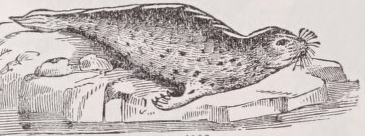
SEAL. In the article Mammalia (vol. xv. p. 442) will be found a general account of the distinguishing characteristics of the animals constituting the sub-order Pinnipedia of the order Carnivora, and their divisions into families and genera. It only remains to give some further details respecting those members of the group to which the term “seal” is properly restricted (the sub-family Phocinae), especially those which inhabit the British coasts....
Although seals swim and dive with the greatest ease, often remaining as much as a quarter of an hour or more below the surface, and are dependent for their sustenance entirely on living prey captured in the water, all the species frequently resort to sandy beaches, rocks, or icefloes, either to sleep or to bask in the sun, and especially for the purpose of bringing forth their young. The latter appears to be the universal habit, and, strange as it may seem, the young seals—of some species at least—take to the water at first very reluctantly, and have actually to be taught to swim by their parents. The number of young produced is usually one annually, though occasionally two. They are at first covered with a coat of very thick, soft, nearly white fur, and until it falls off they do not usually enter the water. This occurs in the Greenland and grey seal when from two to three weeks old, but in the common seal apparently much earlier. One of this species born in the London Zoological Gardens had shed its infantile woolly coat and was swimming and diving about in its pond within three hours after its birth. The movements of the true seals upon the ground or ice are very different from those of the Otariae or eared seals, which walk and run upon all four feet, the body being raised as in the case of ordinary quadrupeds. The hinder limbs (by which mainly they propel themselves though the water) are on land always perfectly passive, stretched backwards, with the soles of the feet applied to each other, and often raised to avoid contact with the ground. Sometimes the fore limbs are equally passive, being placed close to the sides of the body, and motion is then effected by a shuffling or wriggling action produced by the muscles of the trunk. When, however, there is any necessity for a more rapid mode of progression, the animals use the fore paws, either alternately or simultaneously, pressing the palmar surface on the ground and lifting and dragging the body forwards in a succession of short jumps. In this way they manage to move so fast that a man has to step out beyond a walk to keep up with them; but such rapid action costs considerable effort, and they very soon become heated and exhausted. These various modes of progression appear to be common to all species as far as has been observed.
Most kinds of seals are gregarious and congregate, especially at the breeding season, in immense herds. Such is the habit of the Greenland seal (Phoca groenlandica), which resorts in the spring to the ice-floes of the North Sea, around Jan Mayen Island, where about 200,000 are killed annually by the crews of the Scotch, Dutch, and Norwegian sealing vessels. Others, like the common seal of the British islands (Phoca vitulina), though having a wide geographical range, are never met with in such large numbers or far away from land. This species is stationary all the year round, but some have a regular season of migration, moving south in winter and north in summer. They are usually harmless, timid, inoffensive animals, though, being polygamous, the old males often fight desperately with each other, their skins being frequently found covered with wounds and scars. They are greatly attached to their young, and remarkably docile and easily trained when in captivity; indeed, although there would seem little in the structure or habits of the seal to fit it by nature to be a companion of man, there is perhaps no wild animal which attaches itself so readily to the person who takes care of and feeds it. They appear to have much curiosity, and it is a very old and apparently well-attested observation that they are strongly attracted by musical sounds. Their sense of smell is very acute, and their voice varies from a harsh bark or grunt to a plaintive bleat. Seals feed chiefly on fish, of which they consume enormous quantities; some, however, subsist largely on crustaceans, especially species of Gammarus, which swarm in the northern seas, also on molluscs, echinoderms, and even occasionally sea-birds, which they seize when swimming or floating on the water.
Although the true seals do not possess the beautiful under-fur (“seal-skin” of the furriers) which makes the skin of the sea-bears or Otariae so precious, their hides are still sufficiently valuable as articles of commerce, together with the oil yielded by their fat, to subject them to a devastating persecution, by which their numbers are being continually diminished (see below, p. 581 sq.).
Two species of seals only are met with regularly on the British coasts, the common seal and the grey seal. The common seal (Phoca vitulina) is a constant resident in all suitable localities round the Scottish, Irish, and English coasts, from which it has not been driven away by the molestations of man. Although, naturally, the most secluded and out-of-the-way spots are selected as their habitual dwelling-places, there are few localities where they may not be occasionally met with. Within the writer’s knowledge, one was seen not many years ago lying on the shingly beach at so populous a place as Brighton, and another was lately caught in the river Welland, near Stamford, 30 miles from the sea. They frequent bays, inlets, and estuaries, and are often seen on sandbanks or mudflats left dry at low tide, and, unlike some of their congeners, are not found on the ice-floes of the open sea, nor, though gregarious, are very large numbers ever seen in one spot. The young are produced at the end of May or beginning of June. They feed chiefly on fish, and the destruction they occasion among salmon is well known to Scottish fishermen. The common seal is widely distributed, being found not only on the European and American coasts bordering the Atlantic Ocean but also in the North Pacific. It is from 4 to 5 feet in length, and variable in colour, though usually yellowish grey, with irregular spots of dark brown or black above and yellowish white beneath. The grey seal (Halichoerus grypus) is of considerably larger size, the males attaining when fully adult a length of 8 feet from nose to end of hind feet. The form of the skull and the simple characters of the molar teeth distinguish it generically from the common seal. It is of a yellowish grey colour, lighter beneath, and with dark grey spots or blotches, but, like most other seals, is liable to great variations of colour according to age. The grey seal appears to be restricted to the North Atlantic, having been rarely seen on the American coasts, but not farther south than Nova Scotia; it is chiefly met with on the coasts of Ireland, England, Scotland, Norway and Sweden, including the Baltic and Gulf of Bothnia, and Iceland, though it does not appear to range farther north. It is apparently not migratory, and its favourite breeding places are rocky islands, the young being born in the end of September or beginning of October.
Other species of seals inhabiting the northern seas, of which stragglers have occasionally visited the British coasts, are the small ringed seal or “floe-rat” of the sealers (Phoca hispida), the Greenland or harp seal (Phoca groenlandica), the hooded or bladder-nosed seal (Cystophora cristata), and possibly the Bearded seal (Phoca barbata), though of the last there is no certain evidence. The general characters and geographical distribution of the remaining species of the group are indicated in the article Mammalia, vol. xv. p. 442. (w. h. f.) Seal Fisheries.
From a commercial point of view seals may be divided into two groups, —hair seals and fur seals. The former are valued for the oil they yield and for their skins, which are converted into leather, and the latter for their skins alone. The fur seals are provided with a dense soft under-fur like velvet and a quantity of long loose exterior hair, which has to be removed in dressing the hides. Hair seals are either entirely without under-fur or possess it in too small a quantity to render the skins of much commercial value as furs. The two groups correspond to the two divisions of eared seals and earless seals described above (see also vol. xv. pp. 442-443). Hair Seals.— The principal hair seal fisheries are those of Newfoundland and Labrador (area about 200 miles), the Gulf of St Lawrence, Jan Mayen and the adjacent seas, Nova Zembla, the White Sea and Arctic Ocean, the Caspian, and the North and South Pacific. The first-named is by far the most important. To the immense icefields borne past these shores during the spring months great herds of seals resort for the purpose of bringing forth and suckling their young. These are usually produced in the last week of February and increase rapidly in size. When born they weigh about 5 ft; in four weeks the fat beneath the skin has increased to a depth of 3 to 4 inches, and with the adhering skin weighs from 40 to 50 lb. At this age the animals are in the best condition for being taken, as the oil then yielded is of the best quality. They remain on the ice attended by their dams for about six weeks, when they begin to take to the water, and it becomes much more difficult to capture them. When a floe containing young seals is reached, the hunters take to the ice armed with a pole or “gaff,” having a hook at one end and shod with iron at the other. A blow on the nose from this quickly despatches the animal; by means of the “scalping-knife” the skin with the fat adhering is then rapidly detached. The fat and skins are rolled into bundles and dragged to the ship. When the ship reaches port the skins are separated from the fat and salted for export to Great Britain, where they are converted into leather. Of late years furriers have succeeded in converting a few of the finer skins into ladies’ tippets. The fat was formerly thrown into huge vats, where its own weight and the heat of the sun extracted the oil, but in the improved modern process the fat is ground into minute pieces by machinery and then steamed; the oil, after being exposed for a time in glass-covered tanks to the action of the sun’s rays, is barrelled for exportation. The greater part of it goes tβ England, where it is largely employed both as an illuminant and as a lubricant. It is also used for tanning purposes and in the manufacture of the finer kinds of soap.
From 8000 to 10,000 men embark annually from Newfoundland on this pursuit. The steamers, which are rapidly superseding sailing vessels, are stoutly timbered, sheathed with iron and wood, and provided with iron-plated stems; they carry from 150 to 300 men each, and make two, and sometimes when very successful even three, trips in the season. From 20 to 25 steamships in all are engaged in this industry, 6 of these being from Dundee, Scotland. The Dundee vessels arrive in Newfoundland in February and there ship their crews; at the close of the sealing season they proceed to the northern whale fishery and return home in October. A “close time” for seals is now established by law. Sailing vessels cannot clear for this fishery before 1st March, nor can steamers before 10th March. After the young seals have taken to the water, the steamers in their second trips engage in the pursuit of the old breeding seals till the middle or end of May. These are taken either by shooting them or clubbing them when congregated in herds on the ice. This practice, which is most injurious to the fishery, has of late been partially abandoned, by an agreement among the owners of vessels not to continue operations beyond 30th April. The failures and disappointments of the voyage are numerous, many vessels returning to port with few seals or even with none. The prizes, however, are so enormous that there is no hesitation in embarking capital in the enterprise. It is no uncommon event for a steamer to return two or three weeks after leaving port laden to the gunwale with seals. As many as 42,000 have been brought in by a single steamer, the value at two and a half dollars per seal being $105,000 (£21,875). The men on board the steamers share one-third of the proceeds of the voyage among them; the remainder goes to the owners who equip and provision the vessels. In sailing vessels the men get one-half the proceeds. The number of seals taken annually ranges from 350,000 to 500,000. In the three years 1877, 1878, and 1881 the average take was 436,413, valued at £213,937. Between 1881 and 1886 the returns fell below this average owing to the heavy ice, which comparatively few vessels succeeded in penetrating. The large number of young seals which escaped during these years will improve the fishery in the future.
In the seas around Newfoundland and Labrador there are four species of seals,—the bay seal, the harp, the hood, and the square flipper. The first of these frequents the mouths of rivers and harbours and is never found on the ice. The harp, so called from a curved line of dark spots on its back making a figure somewhat resembling an ancient harp, is by far the most numerous, and is par excellence the seal of commerce. The hoods, which owe their na m e to a bag or hood on the nose of the males, which they can inflate at pleasure for protection, are much larger than the harps, but their oil is not of such good quality. But few square flippers are taken; they are large seals from 12 to 16 feet in length, and are believed to be identical with the great Greenland seals. The seals frequenting these seas are migratory. In May, attended by their young, they commence their northerly movements to the Greenland seas, where they spend two or three months, and in September begin their southerly migration, moving along the coast of Labrador, feeding in its fiords and bays. One division passes through the Straits of Belle Isle into the Gulf of St Lawrence, the other along the east coast of Newfoundland. By the close of the year they reach the Great Banks, their southern headquarters, and early in February commence their northerly movement to meet the ice on which their young are to be brought forth.
The Newfoundland fishery was of slight importance till the beginning of the 19th century. At first the seals were taken in nets; the next method was shooting them from large boats, which left shore about the middle of April. Afterwards small schooners were employed, and a rapid expansion of the fishery followed. Over 100 of these small vessels used to leave the port of St John’s, and as many more the ports of Conception Bay. In 1795 the whole catch of seals was but 5000. In 1805 it reached 81,000; in 1815,126,000; in 1822, 306,983. The largest catches on record were in 1830, when 558,942 seals were taken; in 1831, 686,836; 1843, 651,370; and in 1844, 685,530. The following table shows the number of seals taken in some recent years :— [table]
Of late years an increasing number of steamers from St John’s have resorted to the Gulf of St Lawrence as well as small sailing vessels from the southern ports of Newfoundland. A few residents of the Magdalen Islands also pursue the seals on the Gulf ice, and the Canadians carry on a seal fishery along the shore by means of nets both in spring and autumn. The nets are made of strong hempen cord, some of them very large and costing with the anchors and gear as much as £1500 each. This fishery is carried on from Blanc Juberlis Bay to Cape Whittle. The number taken averages about 70,000 to 80,000.
Next in importance is the seal fishery carried on between Greenland, Spitzbergen, and the island of Jan Mayen,—between 68° and 74° N. lat. and 3° E. and 17° W. long. In most years, however, the seals are taken mainly in the vicinity of Jan Mayen. The fishery is carried on by the British, Norwegians, Swedes, Danes, and Germans. The number taken by the British vessels about equals that taken by all the others together. The species taken are the same as on the Newfoundland coast, the harp or saddleback and the hood or bladder-nose. The breeding season is about three weeks later than in the case of the Newfoundland seals, the young being brought forth between the 16th and the 22d of March. The method of capture is almost the same as that of the Newfoundland hunters. Steamers are now almost exclusively employed. The only British ports now engaged in the enterprise are Dundee and Peterhead. During the twelve years 1873 to 1885 the number of British vessels taking part in it was from 14 to 21, the number of men varying from 900 to 1200, and the number of seals taken ranging from 35,000 to 75,000. The total number of seals taken by these vessels during the ten years ending 1884 was 452,013. Formerly, from 1500 to 2700 men were employed, and the number of seals taken ranged from 50,000 to 125,000. The decline has been largely caused by the reckless and barbarous way in which the fishery has been conducted, the practice of seal-hunters of all nations having been to reach the seals soon after the young were born, and then to watch for the mothers as they came to suckle them and shoot them without mercy, leaving the young to die in thousands of starvation on the ice. The consequence is that the herds are not now a twentieth part of their former size. Newfoundland hunters, on the other hand, do not disturb the seals till they are grown and about to leave their mothers, the old seals not being killed till a later date. By an international treaty between England and Norway—the two nations most interested—a “close season” has been established in the Jan Mayen fishery. The Dundee and Peterhead steamers are chiefly manned by Shetlanders, who are taken on board at Lerwick. The vessels make the ice from the 15th to the 20th March and commence the chase in the destructive way already described. They follow up the capture of the young seals in April, when they are better worth taking. Then they proceed to separate the skins from the fat. The former are salted on board, and the fat is stowed in tanks. In May the pursuit of the old seals on the ice commences and continues till the 16th, when it is time to proceed to the whale fishery. The oil is not manufactured till the vessels reach home late in the autumn. As the blubber undergoes decay in the tanks, the oil is not so good in quality as that made in Newfoundland from the fresh fat.
The Jan Mayen fishery commenced in 1840. In that year 13 British vessels and 650 men engaged in it, and 17,300 seals were taken. The Norwegians and other nationalities also took part in it. Steamers were introduced in 1858. The following table shows the growth and decline of the fishery :— [table]
The Norwegian vessels are all steamers, sheathed with wood and iron, the crews averaging forty-six men. They belong principally to Tönsberg, but Tromsö also sends out a number of small vessels to hunt adult seals. The total annual product has reached $300,000. Over twenty Norwegian and Swedish steamers are engaged in this fishery. Since about the year 1873 or 1874 the Norwegians and Swedes have discovered a new fishing-ground for adult seals off the coast of Greenland between Iceland and Cape Farewell. It is carried on in the months of June and July. The seals taken are all of the hood kind. At one time the Jan Mayen fishery averaged 200,000 seals annually among all the nationalities engaged. It does not now exceed 120,000 to 130,000.
The Danes, the Eskimo, and the half-breeds carry on a seal-fishery off the western coast of Greenland between Cape Farewell and 79° N. lat. The seals taken are chiefly the floe or spotted seal and the square flipper. Rink, in his Greenland, estimates the annual number taken at 89,000, but at present it...

[5,462 words — estimated reading time: 35 minutes]
The ancient Hebrews wore their seals or signets, in rings on their fingers, or in bracelets on their arms, as is now the custom in the east. Haman sealed the decree of King Ahasuerus against the Jews with the king’s seal, Esther iii, 12. The priests of Bel desired the king to seal the door of their temple with his own seal. The spouse in the Canticles, viii, 6, wishes that his spouse would wear him as a signet on her arm. Pliny observes, that the use of seals or signets was rare at the time of the Trojan war, and that they were under the necessity of closing their letters with several knots. But among the Hebrews they are much more ancient. Judah left his seal as a pledge with Tamar, Gen. xxxviii, 25. Moses says, Deut. xxxii, 34, that God keeps sealed up in his treasuries, under his own seal, the instruments of his vengeance. Job says, ix, 7, that he keeps the stars as under his seal, and allows them to appear when he thinks proper. He says also, “My transgression is sealed up in a bag,” Job xiv, 7. When they intended to seal up a letter, or a book, they wrapped it round with flax, or thread, then applied the wax to it, and afterward the seal. The Lord commanded Isaiah to tie up or wrap up the book in which his prophecies were written, and to seal them till the time he should bid him publish them, Isaiah viii, 16, 17. He gives the same command to Daniel, xii, 4. The book that was shown to St. John the evangelist, Rev. v, 1; vi, 1, 2, &c, was sealed with seven seals. It was a rare thing to affix such a number of seals; but this insinuated the great importance and secrecy of the matter. In civil contracts they generally made two originals: one continued open, and was kept by him for whose interest the contract was made; the other was sealed and deposited in some ...public office.
[344 words — estimated reading time: 2 minutes]
BOOK, mentioned Isa. xxix, 11, and the book sealed with seven seals, in the Revelation v, 1–3, are the prophecies of Isaiah and of John, which were written in a book, or roll, after the manner of the ancients, and were sealed, which figure truly signifies that they were mysterious: they had respect to times remote, and to future events; so that a complete knowledge of their meaning could not be obtained till after what was foretold should happen, and the seals, as it were taken off. In old times, letters, and other writings that were to be sealed, were first wrapped round with thread or flax, and then wax and the seal were applied to them. To read them, it was necessary to cut the thread or flax, and to break the seals.
[134 words — estimated reading time: 1 minute]
SEALING WAX. In mediaeval times, when the principal use of sealing wax was for attaching the impression of seals to official documents, the composition used consisted of a mixture of Venice turpentine, beeswax, and colouring matter, usually vermilion. The preparation now employed contains no wax. Fine red stationery sealing wax is composed of about seven parts by weight of shellac, four of Venice turpentine, and three to four of vermilion. The resins are melted together in an earthenware pot over a moderate fire, and the colouring matter is added slowly with careful stirring. The mass when taken from the fire is poured into oiled tin moulds the form of the sticks required, and when hard the sticks are polished by passing them rapidly over a charcoal fire, or through a spirit flame, which melts the superficial film. For the brightest qualities of sealing wax bleached lac is employed, and a proportion of perfuming matter—storax or balsam of Peru— is added. In the commoner qualities considerable admixtures of chalk, carbonate of magnesia, baryta white, or other earthy matters are employed, and for the various colours appropriate mineral pigments. In inferior waxes ordinary resin takes the place of lac, and the dragon gum of Australia (from Xanthorrhoea hastilis) and other resins are similarly substituted. Such waxes, used for bottling, parcelling, and other coarser applications, run thin when heated, and are comparatively brittle, whereas fine wax should soften slowly and is tenacious and adhesive.
[242 words — estimated reading time: 2 minutes]
SEALKOTE. See Sialkot.
[3 words — estimated reading time: 1 minute]
SEALS (Gr. σφρaγiς, Lat. sigillum). During the mediaeval period the importance of seals was very great, as they were considered the main proofs of the authenticity of all sorts of documents, both public and private. That is much less the case now, the written signature being thought a safer guarantee of genuineness. In order to make illicit use or imitation of a seal difficult, the seal itself was usually locked up and guarded with special care, and in the case of royal personages or corporate bodies was often made a very complicated work of art, which it would have been almost impossible to copy exactly. One very curious precaution that was adopted is still in use with the corporate seal of the monasteries of Mount Athos. The circular matrix is divided into four quarters, each of which is kept by one of the four epistatai or ruling monks; the four pieces are joined by a key-handle, which remains in the custody of the secretary. Thus it is only when all five guardians of the various parts of the matrix meet together that the complete seal can be stamped on any document. The device on the Mount Athos seal is a half-length figure of the Madonna and Child, and the imprint is made by blackening the matrix in the flame of a lamp and then pressing it on the paper or vellum itself. Mediaeval seals were applied in two different ways: in one the stamp was impressed in wax run on the surface of the document (Fr. plaqué or en placard); in the other the wax impression was suspended by cord or strips of parchment (Fr. pendant). The latter method was necessarily used with metal seals or bullae (see below)....
For the sake of greater security in the case of plaqué seals, it was a common practice from the 12th century onwards, or even earlier, to make a cross cut in the vellum of the document, the corners of which were then turned back, thus forming a square opening, over which the wax seal was stamped; the turned-up corners helped to hold the wax in its place, and the aperture allowed a second matrix to be applied at the back. This was usually a smaller private seal called a secretum.
Thus, for example, an abbot would use on the front of a document the large corporate seal of his community, and on the back would stamp his personal seal as a secretum. Till the 12th century pure white beeswax was generally used, after that wax coloured green or red. The use of shellac or other harder materials, such as modern sealing-wax, is of recent date. Thus it was usual to protect the soft wax seals by some sort of “fender,” often a wreath of rushes or plaited strips of paper twisted round it; another method much employed in the 15th century was to cover the seal with leaves of oak, bay, or beech. Pendant seals were often encased in boxes of wood or cuir bouilli, which in some cases are very richly decorated. From the 13th to the 15th century original royal documents are usually on fine vellum and have green seals hung by many-coloured silk and gold thread, while office copies are on coarser vellum and have white seals hung by parchment strips. In England an important official, called the clerk of the chafe-wax, an office which still exists, was entrusted with the duty of softening the wax for state seals over a chafing-brazier. Two different methods of sealing documents, either closed or open for inspection, are recorded in the legal terms “letters secret” and “letters patent.”
Owing to the enormous number of mediaeval seals which still exist, and their frequently great historical and artistic importance, it is necessary to adopt some method of classification, especially for large collections, such as that of the British Museum, which contains about 25,000 specimens, and the very important one of the Society of Antiquaries. The chief classes are these:—(1) Ecclesiastical.— (a ) Seals belonging to offices, such as those of popes, bishops, abbots, deans, &c.; (b) common seals of corporate bodies, such as chapters, religious colleges, monasteries, and the like; (c ) official seals without the name of the officer; (d) personal seals, with or without a name. (2) Lay.— (a ) Royal seals, including those of queens and royal princes; (b ) official seals in the name of the sovereign or a state official; (c ) common seals of corporate bodies, such as towns, universities, guilds, schools, hospitals, &c.; (d ) personal seals (not being royal) with effigies, heraldry, merchants’ marks, or other devices, with or without a name, or with name only, or with legend only.
French Royal Seals. — The earliest and most complete series of seals is that of the French kings. The Carlovingian and Merovingian monarchs mostly used antique gems or pastes,—portrait heads being selected and a legend added in the metal setting of the matrix. Charlemagne used a head of Jupiter Serapis, Pippin the Short that of the Indian Dionysus. The British Museum possesses a seal of Odo or Eudes, king of France (888-898), impressed from a fine Greek gem of the 3d century b.c., with a portrait of Seleucus IV. The oldest existing matrix is that of Lothaire I. (c. 817), now preserved at Aix-la-Chapelle, attached to an altar-cross. It is an oval intaglio in rock crystal, with a laureated portrait and the legend + XPE . ADIVVA. hlotharivm . REG.; it is not an antique, but is of contemporary Byzantino-Rhenish work. Till the time of Louis VI. (1108-1137) these seals were plaqué, but he introduced pendant seals about 1108; and counter-seals at the back were first used by Louis VII. (1137-80). The grand series of round seals with an enthroned figure of the king begins with the Capet Henry I. (1031-60). The king holds a sceptre in one hand and a flower in the other. Those of the queens are frequently of a pointed oval form, with a standing portrait figure holding a flower in each hand. In the 13th and 14th centuries the French royal seals were elaborate works of art, with a finely draped figure of the king seated under a rich canopy on a throne, decorated with lions’ or eagles’ heads; the king holds a sceptre in each hand. The queens’ seals, of a round or pointed oval form, are also very beautiful, with a graceful figure standing between two shields under a rich canopy. After the 15th century there was a rapid decadence in the royal seals, and in the 17th and 18th centuries they were of the most tasteless style, far worse than those used in England at the same date.
English Royal Seals.— This, which is on the whole the most beautiful of all royal series, begins with the seal of Edward the Confessor (see fig. 1). The great seal of William the Norman and his successors was not plaqué, like the earlier ones, but pendant; it has on one side an enthroned figure of a king copied from contemporary French seals, and on the reverse the king on horseback armed with spear and shield. These two ways of representing the sovereign have been used on all the royal seals of England down to the present day. By degrees greater elaboration of ornament was introduced into the throne and its canopy. In Edward III.’s time niches with minute statuettes of saints were added at the sides of the obverse. The climax of magnificence was reached in the reign of Henry V. On the obverse of his seal the king sits holding the orb and sceptre; the gorgeous canopy contains statuettes of the Virgin and two saints, and at each side are three rows of statuettes in minute canopied niches, each row two tiers high; about fifteen minute figures of saints and angels are introduced into the design. On the reverse is the king on horseback, bearing a sword and shield; the horse, going at full speed, is clothed with richly embroidered heraldic drapery, and on its head and on the king’s is a lion crest. After Henry V. the seals began to decrease in magnificence, and in the reign of Henry VII. the new taste of the Renaissance began to supplant the pure Gothic of the earlier seals. In the time of Philip and Mary both sovereigns appear together, seated under canopies, or riding side by side. The great seal of the Commonwealth is a marvel of ugliness. On the obverse is a perspective view of the interior of the House of Commons, and on the reverse a map of Great Britain and Ireland. Cromwell’s seal has an equestrian portrait of himself, and its reverse the arms of the Commonwealth between a lion and a dragon as supporters. Little is noticeable about the seals of succeeding sovereigns; that of Victoria is minutely cut, but is very poor as a work of art.
Other English Seals.— Gilt bronze was the commonest material for large seals, but other metals were used, such as gold, silver, and lead, also jet and ivory, especially before the Norman Conquest. Rock crystal, carnelian, and sard were the favourites among the hard stones cut for matrices. Large seals were usually either round or of a pointed oval form (as in figs. 2 and 3); the small secreta were sometimes square, triangular, or hexagonal, as well as round or oval. The most elaborate and beautiful of all were those of religious corporations, such as the chapter seals of monasteries. These are among the most exquisite works of art that the Middle Ages produced, especially during the 14th century, and exceed in delicacy of workmanship and elaboration of design the finest seals of all other classes, not excepting those of the sovereigns. Fig. 2 shows the common seal of Boxgrove priory (Sussex), the matrix of which is now in the British Museum. On one side is a figure of the Virgin enthroned, and on the reverse a representation of the west front of the priory church, with open tracery and niches containing minute statuettes. This elaborate matrix is made up of four distinct pieces of gilt bronze, and to form the perfect seal must have been a work requiring considerable skill and patience. The reverse was formed by two stamps used on two separate plaques of softened wax: one of these formed the background with the various statuettes, and the second was used to stamp the open tracery work of the front of the church; the latter when hard was fitted on to the impression of the background, and thus a sort of miniature model of the church was made, with its statues and the inner planes of the façade seen through the open tracery work,—the effect being extremely rich and delicate. When the finished obverse and reverse had been fitted together, the legend was added on their edges by means of the fourth piece of the matrix,—a strip of bronze with letters cut into it on both its edges; first one side and then the other of this strip was pressed against the rim of the wax seal, which thus received the impression of the complete legend all round its edge. The seal of Southwark priory, also of the 14th century, is even more elaborate, as both sides have open tracery separately applied, and thus the matrix consists of five distinct pieces. Many of the bishops’ seals, though less complicated in design, are of equal beauty to those of the chapters. The common design has a standing figure under a richly decorated canopy. Fig. 3 shows a very beautiful example, the seal of Richard, bishop of Durham. The standing figure of the bishop in mass vestments is modelled with wonderful skill and shows extreme taste in the treatment of the drapery; the legend is s[igillum] ricardi . dei . gra . dvnelmensis . epi. A great variety of sacred subjects occur on ecclesiastical seals in addition to single figures of patron saints; the most frequent were perhaps the Crucifixion, the Annunciation, the Coronation of the Virgin, and the Virgin enthroned in Heaven; small figures of kneeling worshippers were often added. Fig. 4 shows one of the most magnificent of this class, with, in the centre, a figure of the Virgin in glory, between St Nicholas and Henry VI., each under a very rich canopy; at the sides are shields charged with England and France, and France (modern) alone, held by two monks. This very beautiful work of art dates about the year 1443. In the 15th century the ecclesiastical seals began to fall off in richness and beauty, and after the Reformation were of little artistic value. Very handsome seals were used by lay corporations, especially the municipalities of towns. These last frequently have a careful representation of the town itself, with its circuit of walls or that of its chief castle or cathedral, and thus often afford valuable evidence as to the form of its defences and principal buildings. Fig. 5 shows a fine example, 3 inches in diameter, —the corporate seal of Rochester, made in the 13th century; it has a minute representation of the keep of Rochester Castle, surrounded by an outer circuit wall and a moat. On one of the turrets of the gateway is a sentinel blowing a signal horn; legend, sigillvm . CIVIVM . ROFENSIS. The reverse has the same legend repeated round the scene of the Crucifixion of St Andrew. Other corporation seals are covered with small figures under elaborate canopy work, much like those of the ecclesiastical foundations.
Seals of hospitals are often designed in a similar way, with a representation of the hospital building very minutely treated. In the 15th century seals began to be designed in a rather pictorial style, which, though very graceful, is inferior to the earlier and more architectonic class. Very magnificent seals were used by state officials: those of the lord high admiral of England are especially fine, from the beautiful form of the ship on the obverse. Fig. 6 shows that of the earl of Huntingdon, who was lord high admiral in the reign of Henry VIII. In design it resembles those of the admirals of the previous century. On the sails are embroidered the royal arms of England. Among private seals those of powerful barons are often large and very beautifully cut. Fig. 7 shows a silver matrix, now in the British Museum, which is remarkable for the great beauty of its workmanship. Its legend is SIGILLVM . ROBERTI . filii . Walterl On it an armed knight, of the time of Henry III., is riding over a dragon, whose tail ends in a scroll of very beautiful conventional foliage, modelled with the greatest spirit and delicacy. A common and graceful form of private seal in the 13th and 14th centuries has simply a shield with the owner’s arms on a diapered background, the whole enclosed with in many-cusped tracery. Fig. 8 shows an example of a fine Graeco-Roman gem, —a carnelian engraved with a female head, full face. The 14th-century owner of this has added a metal setting with the words capvt . MARIE . MAGDALENE, to give it a sacred meaning. The legends of private seals or secreta were often chosen in allusion to their use; common phrases are “clausa secreta tego,” or “lecta lege, tecta tege.” Many ingenious devices were practised to enable the same matrix to give two or more different varieties of impression. In some cases the border with the legend was so contrived as to slide up the handle, so that the seal could be made either with or without an inscription. Others had the border made to revolve on a swivel, so as to supply two different legends; and the magnificent monastic seals (as that shown in fig. 2) were arranged so as to give a perfect seal without the use of the elaborate open tracery. In the 15th and 16th centuries merchants and handicraftsmen frequently employed devices connected with their trade—either some tool or badge or an arbitrary sign used as a trade-mark; or a rebus of the owner’s name was used, such as a bolt and a tun (cask) for the name Bolton. The use of seals by the humbler classes was more common in England than abroad; even bondsmen sometimes had seals, both before and after the Norman Conquest. Seals of other countries mostly followed the same fashions as those of England, though of course varying in design and workmanship with each country. On the whole, the English seals were superior during their best period (the 14th century) to those of any other country, though matrices of great beauty were produced in both Germany and France. In Italy less care and skill were usually spent on seals, partly owing to the greater use of metal bullae for important charters.
Metal Bullae.— These are necessarily not plaqué but pendant, and are held usually by cords passed through a hole in the seal. Lead was the metal most commonly used, but some sovereigns had bullae struck in silver or gold, either as a mark of their own dignity or to confer special honour on the recipient of a charter. An extant letter from Petrarch to Charles IV. thanks that emperor for a diploma of the rank of count, and especially for the honour shown to him by the attachment of gold bullae to the document. Lead bullae were also used by various ecclesiastical dignitaries, from patriarchs to bishops, but were rarely used by ecclesiastics of lower rank. In some cases, however, especially in Sicily and Byzantium, bullae were used by laymen of very moderate rank. A large number of fine papal bullae exist dating from the 7th century onwards. Since the time of Pope Paschal II. they have borne heads of St Peter and St Paul; previously they had such simple devices as crosses or stars, with the name of the pontiff. Another early series of bullae begins in the 8th century with the bullae of the patriarchs of Byzantium. Those of the doges of Venice exist in large numbers, bearing figures of St Mark and the reigning doge kneeling before him. Existing bullae of Charlemagne have a rude profile portrait crowned with a diadem, and on the reverse the monogram of karolvs arranged in the form of a cross.
Consult, in addition to the works named above, Thulemarius, De Bulla Aurea, Frankfort, 1724; Römar-Büchner, Die Siegel der deutsch. Kaiser, Frankfort, 1851; Vossberg, Gesch. der der Russischen Siegel, Berlin, 1843; Melly, Siegel-Kunde des Mittelalters, Vienna, 1846; Heineecius, De Sigillis, Frankfort, 1709; Lepsius, Sphragistische Aphorismen, Halle, 1842-43; Caulfield, Sigilla Ecclesiae Hibernicae, London, 1853; and more especially various articles in the Gaz. des Beaux-Arts, Archaeologia, Archaeological Journal, and Proceedings of other antiquarian societies.
[3,158 words — estimated reading time: 19 minutes]