
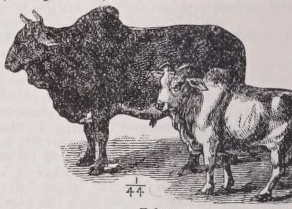
A variety of the common ox, with a hump on the shoulders. It is found in the East Indies and resembles the bos Indicus, or Indian ox, but is very small, being sometimes little larger than a dog.
ZEBULUN (זבולון), one of the twelve tribes of Israel, derived, according to Gen. xxx. 20, from the sixth son of Leah. The verse offers two etymologies of the name, from the roots ZBD, “give,” and ZBL, “inhabit.” The form Zα βoυλωv (LXX.), with d in the last syllable, agrees with the vocalization of the adjective זבול׳י, “Zebuionite.” The country of Zebulun lay in the fertile hilly country to the north of the plain of Jezreel, which forms the first step towards the mountains of Asher and Naphtali, and included the goodly upland plain of Battauf. The description of its boundaries in Josh. xix. 10 sq. contains few names that can be identified with any certainty: Chislothtabor is apparently the modern Iksâl, a little to the west of Tabor, Daberath the modern Dabûrîya, at the foot of Tabor, Gath-hepher (A.V. Gittah-hepher) the village of Al-Meshhed, and Remmon Rummâna. Thus the eastern boundary laid down in Conder and Kitchener’s reduced Ordnance Survey map comes too near the Lake of Tiberias. The west boundary is not defined in Josh. xix., but should agree with the somewhat vague east boundary of Asher in verse 27. At one period Zebulun must have reached the sea and bordered on Phoenician territory (Gen. xlix. 13, Deut. xxxiii. 18, 19). In the latter passage allusion is made to a feast upon a sacred mountain (Mount Tabor ?) held by Zebulun and Issachar in common, and to the wealth these tribes derived from commerce by sea. Zebulun had a chief part in the war with Sisera (Jud. iv. 6); it furnished one of the judges, Elon the Zebulonite (Jud. xii. 11, 12); and the prophet Jonah, who foretold the victories of Jeroboam II., came from the town of Gath-hepher (2 Kings xiv. 25). The captivity of the northern tribes under Tiglath Pileser (2 Kings ...xv. 29) appears to have included Zebulun (Isa. ix. 1 [viii. 23]). Nazareth lay within the territory of Zebulun, but is not mentioned in the Old Testament.
the sixth son of Jacob and Leah, Gen. xxx, 20. He was born in Mesopotamia, about A. M. 2256. His sons were Sered, Elon, and Jahleel, Gen. xlvi, 14. Moses acquaints us with no particulars of his life; but Jacob, in his last blessing, said of Zebulun, “Zebulun shall dwell at the haven of the sea; and he shall be for a haven of ships; and his border shall be unto Zidon,” Gen. xlix, 13. His portion extended along the coast of the Mediterranean Sea, one end of it bordering on this sea, and the other on the sea of Tiberias, Joshua xix, 10, &c. In the last words of Moses, he joins Zebulun and Issachar together, saying, “Rejoice Zebulun, in thy going out, and Issachar in thy tents. They shall call the people unto the mountain, there shall they offer sacrifices of righteousness. For they shall suck of the abundance of the seas, and of treasures hid in the sand,” Deut. xxxiii, 18; meaning, that these two tribes being at the greatest distance north, should come together to the temple at Jerusalem, to the holy mountain, and should bring with them such of the other tribes as dwelt in their way; and that being situated on the coast of the Mediterranean Sea, they should apply themselves to trade and navigation, and to the melting of metals and glass, denoted by those words, “treasures hid in the sand.” The river Belus, whose sand was very fit for making glass, was in this tribe. When the tribe of Zebulun left Egypt, it had for its chief Eliab the son of Elon, and comprehended fifty-seven thousand four hundred men able to bear arms, Num. i, 9–30. In another review thirty-nine years afterward, this tribe amounted to sixty thousand five hundred men of age to bear arms, Num. xxvi, 26, 27. The tribes of Zebulun and Naphtali distinguished themselves in the war of Barak and ...Deborah against Sisera, the general of the armies of Jabin, Judges iv, 5, 6, 10; v, 14, 18. It is thought these tribes were the first carried into captivity beyond the Euphrates by Pul and Tiglath Pileser, kings of Assyria, 1 Chron. v, 26. They had also the advantage of hearing and seeing Jesus Christ in their country, oftener and longer than any other of the twelve tribes, Isa. ix, 1; Matthew iv, 13, 15.