
A short ridge connecting two higher elevations or mountains; the pass over such a ridge.
Word of the Day: Catachrestical
Col-
Webster's Dictionary 1913
A prefix signifying with, together. See Com-.
One who labors with another; an associate in labor.
A vessel with a bottom perforated with little holes for straining liquors. In America, this name is given, I believe, exclusively to a vessel of tin, or other metal. In Great Britain, the name is given to vessels, like sieves, made with hair, osiers or twigs.
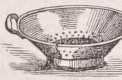
A utensil with a bottom perforated with little holes for straining liquids, mashed vegetable pulp, etc.; a strainer of wickerwork, perforated metal, or the like.
The act of straining, or purifying liquor, by passing it through a perforated vessel.
The complement of the latitude, or the difference between any latitude and ninety degrees.
The act of straining; the matter strained.
The process of straining; the matter strained; a strainer.
Colberg
Encyclopedia Britannica
COLBERG, or Kolberg, a fortified seaport town of Prussia, in the former province of Pomerania, and the government of Köslin, on the right bank of the Persante, which falls into the Baltic about a mile below the town. It has a handsome market-place, adorned since 1864 with a statue of Frederick William IV.; and there are several pretty extensive suburbs, of which the most important is the Munde, in great measure the growth of the present century. The principal buildings are the cathedral of St Mary’s, one of the most remarkable churches in Pomerania, dating from 1316, the council-house erected after the plans of Zwirner, the citadel, and the aqueduct by which the town is supplied with water. Colbergalso possesses several hospitals, a workhouse, a house of correction, an orphan asylum, a gymnasium, a preparatory school of navigation, and an exchange. Its bathing establishments are largely frequented and attract a considerable number of summer visitors. Woollen cloth and spirits are manufactured; there is an extensive salt-mine in the neighbouring Zillenberg; the salmon and lamprey fisheries are important; and a fair amount of commercial activity is maintained. Population in 1872, 13,106....
Colberg was the seat of a bishop as early as the 10th century, though it not long after lost this distinction. Till 1277 it was the chief town of the Cassubian Wends, and after that date it ranked as the most important place in the episcopal principality of Karnin, with which it passed in 1648 to Brandenburg. In the Thirty Years’ War it was captured by the Swedes, after a protracted siege in 1631; and in the Seven Years’ War it was one of the centres of the conflict. In 1758 it withstood the attacks of General Palmb'ach and his army of 10,000 men, and in 1760 it held out against the Russian and Swedish forces, both by sea and land, till it was relieved by the advance of Werner; but in 1761 it was compelled by famine to yield to Romanzoff after a four months’ investment and violent bombardment. In 1807 it was surrounded by 18,000 men under the command of Feulié, Loison, and Mortier; but the burgher Nettelbeck within and the free-fighter Schill without succeeded in defending it till the peace of Tilsit brought the war to a close.
9th ed. Encyclopædia Britannica, vol. 6, p. 121
[391 words — estimated reading time: 3 minutes]
[391 words — estimated reading time: 3 minutes]
Colbert
Encyclopedia Britannica
COLBERT, Jean Baptiste (1619-1683), one of the greatest among the great statesmen of France, was born on the 29th of August 1619, at Rheims, where his father and grandfather were merchants. He claimed to be the descendant of a noble Scottish family, but those who have investigated the matter have almost without exception decided against the pretension. His youth is said to have been spent in a Jesuit college, in the office of a Parisian banker, and in that of a Parisian notary, Chapelain, the father of the poet. But the first fact on which we can rely with confidence is that, when not yet twenty, he obtained a post in the war-office, by means of the influence that he possessed through the marriage of one of his uncles to the sister of Mic∙lιel Le Tellier, the secretary of state for war. During some years he was employed in the inspection of troops and other work of the kind, but at length his ability, his extraordinary energy, and his untiring laboriousness induced Le Tellier to make him his private secretary. These qualities, combined, it must be confessed, with a not over-delicate readiness to seize every opportunity of advancement, soon brought Colbert both wealth and influence. In 1647 we find him receiving the confiscated goods of his uncle Pussort, in 1648 obtaining 40,000 crowns with his wife Marie Charron, in 1649 appointed councillor of state....
It was the period of the wars of the Fronde; and in 1651 the triumph of the Condé family drove Cardinal Mazarin from Paris. Colbert, now aged thirty-two, was engaged to keep him acquainted with what should happen in the capital during his absence. At first Colbert’s position was far srom satisfactory; for the close wary Italian treated him merely as an ordinary agent. On one occasion, for example, he offered him 1000 crowns. The gift was refused somewhat indignantly; and by giving proof of the immense value of his services, Colbert gained all that he desired. His demands were not small; for, with an ambition mingled, as his letters show, with strong family affection, he aimed at placing all his relatives in positions of affluence and dignity; and many a rich benefice and important public office was appropriated by him to that purpose. For these favours, conferred upon him by his patron with no stinted hand, his thanks were expressed in a most remarkable manner; he published a letter defending the cardinal from the charge of ingratitude which was often -brought against him, by enumerating the benefits that he and his family had received from him (April 1655). Colbert obtained, besides, the higher object of his ambition; the confidence of Mazarin, so far as it was granted to any one, became his, and he was intrusted with matters of the gravest importance. In 1659 he was giving directions as to the suppression of the revolt of the gentry which threatened in Normandy, Anjou, and Poitou, with characteristic decision arresting those whom he suspected and arranging every detail of their trial, the immediate and arbitrary destruction of their castles and woods, and the execution of their chief, Boíinesson. In the same year we have evidence that he was already planning his great attempt at financial refoim. His earliest tentative was the drawing up of a mémoire to Mazarin, showing that of the taxes paid by the people not one-half reached the king. The paper also contained an attack upon the superintendent, Fouquet, who, first recommended to Le Tellier by Colbert himself, had since developed into the most shameless of extortioners; and being opened by tl.c postmaster of Paris, who happened to be a spy of Fouquet’s, it gave rise to a bitter quarrel, which, however, Mazarin repressed during his lifetime.
In 1661 the death of Mazarin allowed Colbert to take the first place in the administration. It was some time before he assumed official dignities; but in January 1664 he obtained the post of superintendent of buildings; in 1665 he was made controller-general; in 1669 he became minister of the marine; and he was also appointed minister of commerce, the colonies, and the king’s palace. In short, he soon acquired power in every department except that of war.
A great financial and fiscal reform at once claimed all his energies. This he saw was the first step toward raising France to the lofty position he intended her to occupy. The country was in economic chaos. Those who had the fiscal administration in their hands, from the superintendent to the meanest of the tax-farmers, robbed and misappropriated almost as they pleased. The Government loans were arranged, not so as to be most advantageous to the state, but so as most to aggrandize the individuals who were interested in them. Not only the nobility, but many others who had no legal claim to exemption, paid no taxes; the weight of the burden fell on the wretched country-folk. Colbert sternly and fearlessly set about his task. Supported by the young king, Louis X1V., he aimed the first blow at the greatest of the extortioners—the bold and powerful superintendent, Fouqaet. He was accused of high treason, not without sufficient grounds, for it was known that he had prepared to meet an arrest formerly contemplated by an appeal to force. The most minutely careful precautions were taken by Colbert for his seizure, and he was tried before a specially prepared chamber of justice. Nevertheless the trial was protracted during three years, and the sentence passed was not death but banishment. The Government, however, carried out its plans. The superintendent was safely disposed of in the state prison of Pignerol; just disgrace fell upon Councillor d’Ormesson and the other judges who had averted the punishment Fouquet richly deserved; and many minor officials, convicted of peculation, were treated with great severity, some being banished, some sent to the galleys, some even hanged.
The office of superintendent and many others dependent upon it being abolished the supreme control of the finances was vested in a royal council. The sovereign was its president; but Colbert, though for four years he only possessed the title of intendant, was its ruling spirit, great personal authority being conferred upon him by the king. The career on which Colbert now entered must not be judged without constant remembrance of the utter rottenness of the previous financial administration. His ruthlessness in this case, dangerous precedent as it was, was perhaps necessary; individual interests could not be respected. Guilty officials having been severely punished, the fraudulent creditors of the Government remained to be dealt with. Colbert’s method was simple. Some of the public loans were totally repudiated, and from others a percentage was cut off, which varied, at first according to his own decision, and afterwards according to that of the council which he established to examine all claims against the state.
Much more serious difficulties met his attempts to introduce equality in the pressure of the taxes on the various classes. To diminish the number of the privileged was impossible, but false claims to exemption were firmly resisted, and the unjust direct taxation was lightened by an increase of the indirect taxes, from which the privileged could not escape. The mode of collection was at the same time immensely improved.
Order and economy being thus introduced into the working of the government, the country, according to Colbert’s vast yet detailed plan, was to be enriched by commerce. Manufactures were fostered in every way he could devise. New industries were established, inventors protected, workmen invited from foreign countries, French workmen absolutely prohibited to emigrate. To maintain the character of French goods in foreign markets, as well as to afford a guarantee to the home consumer, the quality and measure of each article were fixed by law, breach of the regulations being punished by public exposure of the delinquent and destruction of the goods, and, on the third offence, by the pillory. But whatever advantage resulted from this rule was more than compensated by the disadvantages it entailed. The production of qualities which would have suited many purposes of consumption was prohibited, and the odious supervision which became necessary involved great waste of time and a stereotyped regularity which resisted all improvements. And other parts of Colbert’s scheme deserve still less equivocal condemnation. By his firm maintenance of the corporation system, each industry remained in the hands of certain privileged bourgeois; in this way, too, improvement was greatly discouraged; while to the lower classes opportunities of advancement were closed. With regard to international commerce Colbert was equally unfortunate in not being in advance of his age; the tariffs he published were protective to an extreme. The interests of internal commerce were, however, wisely consulted. Unable to abolish the duties on the passage of goods from province to province, he did what he could to induce the provinces to equalize them. The roads and canals were improved. The great canal of Languedoc was planned and constructed by Biquet under his patronage. To encourage trade with the Levant, Senegal, Guinea, and other places, privileges were granted to companies; but, like the more important East India Company, all were unsuccessful. The chief cause of this failure, as well as of the failure of the colonies, on which he bestowed so much watchful care, was the narrowness and rigidity of the Government regulations.
-The greatest and most lasting of Colbert’s achievements was the establishment of the French marine. The royal navy owed all to him, for the king thought only of military exploits. For its use, Colbert reconstructed the works and arsenal of Toulon, founded the port and arsenal of Rochefort, and the naval schools of Rochefort, Dieppe, and Saint-Malo, and fortified, with some assistance from Vauban (who, however, belonged to the party of his rival Luvois), among other ports those of Calais, Dunkirk, Brest, and Havre. To supply it with recruits he invented his famous system of classes, by which each seaman, according to the class in which he was placed, gave six months’ service every three or four or five years. For three months after his term of service he was to receive half-pay; pensions were promised; and, in short, everything was done to make the navy popular. There was one department, however, that was supplied with men on a very different principle. Letters exist written by Colbert to the judges requiring them to sentence to the oar as many criminals as possible, including all those who had been condemned to death; and the convict once chained to the bench, the expiration of his sentence was seldom allowed to bring him release. Mendicants also, against whom no crime had been proved, contraband dealers, those who had been engaged in insurrections, and others immeasurably superior to the criminal class, nay, innocent men—Turkish, Russian, and negro slaves, and poor Iroquois Indians, whom the Canadians were ordered to entrap—were pressed into that terrible service. By these means the benches of the galleys were filled, and Colbert took no thought of the long unrelieved agony borne by those who filled them.
Nor was the mercantile marine forgotten. Encouragement was given to the building of ships in France by allowing a premium on those built at home, and imposing a duty on those brought from abroad; and as French workmen were forbidden to emigrate, so French seamen were forbidden to serve foreigners on pain of death.
Even ecclesiastical affairs, though with these he had no official concern, did not altogether escape Colbert’s attention. He took a subordinate part iu the struggle between the king and Rome as to the royal rights over vacant bishoprics; and he seems to have sympathized with the proposal that was made to seize part of the wealth of the clergy. In his hatred of idleness, he ventured to suppress no less than seventeen fêtes, and he had a project for lessening the number of those devoted to clerical and monastic life, by fixing the age for taking the vows some years later than was then customary. With heresy he was at first unwilling to interfere, for he was aware of the commercial value of the Huguenots; but when the king, under the influence of Mme. de Maintenon, resolved to make all France Catholic, he followed his Majesty, and urged his subordinates to do all that they could to promote conversions.
In art and literature Colbert took much interest. He possessed a remarkably fine private library, which he delighted to fill with valuable manuscripts from every part of Europe where France had placed a consul. He has the honour of having founded the Academy of Sciences (now called the Institut de France), the Observatory, which he employed Perrault to build and brought Cassini from Italy to superintend, the Academies of Inscriptions and Medals, of Architecture, and of Music, the French Academy at Rome, and Academies at Arles, Soissons, Nîmes, and many other towns, and he reorganized the Academy of Painting and Sculpture which Richelieu had established. He was a member of the French Academy; and one very characteristic rule, recorded to have been proposed by him with the intention of expediting the great Dictionary, in which he was much interested, was that no one should be accounted present at any meeting unless he arrived before the hour of commencement and remained till the hour for leaving. In 1673 he presided over the first exhibition of the works of living painters; and he enriched the Louvre with hundreds of pictures and statues. He gave many pensions to men of letters, among whom we find Molière, Corneille, Racine, Boileau, Huet, and Varillas, and even foreigners, as Huyghens, Vossius the geographer, Carlo Dati the Dellacruscan, and Heinsius the great Dutch scholar. There is evidence to show that by this munificence he hoped to draw out praises of his sovereign and himself; but this motive certainly is far from accounting for all the splendid, if in some cases specious, services that he rendered to literature, science, and art.
Indeed to everything that concerned the interests of France Colbert devoted unsparing thought and toil. Besides all that has been mentioned, he found time to do something for the better administration of justice (the codification of ordinances, the diminishing of the number of judges, the reduction of the expense and length of trials), for the establishment of a superior system of police, and even for the improvement of the breed of horses and the increase of cattle. As superintendent of public buildings he enriched Paris with boulevards, quays, and triumphal arches; he relaid the foundation-stone of the Louvre, and brought Bernin from Rome to be its architect; and he erected its splendid colonnade upon the plan of Claude Perrault, by whom Bernin had been replaced. He was not permitted, however, to complete the work, being compelled to yield to the king’s preference for residences outside Paris, and to devote himself to Marly and Versailles.
Amid all these public labours his private fortune was never neglected. While he was reforming the finances of the nation, and organizing its navy, he always found time to direct the management of his smallest farm. He died a millionaire, and left fine estates all over France. For his eldest son, who was created Marquis de Seignelay, he obtained the reversion of the office of minister of marine; his second son became archbishop of Rouen; and a third son, the Marquis d’ Ormoy, became superintendent of buildings.
In estimating the value of Colbert’s ministry, two distinct questions must be considered—What its results would have been in the absence of counteracting influences, over which he had no control, and what they actually were. To the first it may be answered that France, peace ful, enriched by a wide-spread commerce, and freed from the weight of taxes, alikeheavy and intrinsicallymischievous, would probably have developed powers that would have enabled her to throw aside what was harmful in his policy, and possibly to attain liberty without the frenzied struggle of the Revolution. To the second question a very different reply must be given. What the great “ministre de la paix” built up was torn down, even as he built it, to erect the unholy fabric of his master’s military glory. The war department was in the hands of Colbert’s great rival, Luvois; and to every appeal for peace Louis was deaf. He was deaf also to all the appeals against the other forms of his boundless extravagance which Colbert, with all his deference towards his sovereign, bravely ventured to make.
Thus it came about that, only a few years after he had commenced to free the country from the weight of the loans and taxes which crushed her to the dust, Colbert was forced to heap upon her a new load of loans and taxes more heavy than the last. Henceforth his life was a hopeless struggle, and the financial and fiscal reform which, with the great exception of the establishment of the navy, was the most valuable service to France contemplated by him. came to nought.
Depressed by his failure, deeply wounded by the king’s favour for Luvois, and worn out by overwork, Colbert’s strength gave way at a comparatively early age. In 1680 he was the constant victim of severe fevers, from which he recovered for a time through the use of quinine prescribed by an English physician. But in 1683, at the age of sixty-four, he was seized with a fatal illness, and on the 6th of September he expired. It was said that he died of a broken heart, and a conversation with the king is reported in which Louis disparagingly compared the buildings of Versailles, which Colbert was superintending, with the works constructed by Luvois in Flanders. He took to bed,Jt is true, immediately afterwards, refusing to receive all messages from the king; but his constitution was utterly broken before, and a post-mortem examination proved that he had been suffering from stone. His body was interred in the secrecy of night, for fear of outrage from the Parisians, by whom his name was cordially detested.
Colbert was a great statesman, who did much for France, and would have done vastly more had it been possible. Yet his insight into political science was not deeper than that of his age; nor did he possess that superiority in moral qualities which would have inspired him to bring in a reign of purity and righteousness. His rule was a very bad example of over-government. In popular liberty he did not believe; the parliaments and the States-G eneral received no support from him. The technicalities of justice he never allowed to interfere with his plans; justice herself he sometimes commanded to stay her course, and beware of crushing any friend of his who happened to lie in her way. He trafficked in public offices for the profit of Mazarin and in his own behalf. He caused the suffering of thousands in the galleys; he had no ear, it is said, for the cry of the suppliant. There was indeed a more human side to his character, as is shown in his letters, full of wise advice and affectionate care, to his children, his brothers, his cousins even. Yet to all outside he was “the man of marble.” To diplomacy he never pretended; persuasion and deceit were not the weapons he employed; all his work was carried out by the iron hand of authority. He was a great statesman in that he conceived a magnificent yet practicable scheme for making France first among nations, and in that he possessed a matchless faculty for work, neither shrinking from the vastest undertakings nor scorning the most trivial details.
Numerous vies and éloges of Colbert have been published; but the most thorough student of his life and administration was Pierre Clement, member of the Institute, who in 1846 published his Vie de Colbert, and in 1861 the first of the 9 vols, of the Lettres, instructions, et mémoires de Colbert. The historical introductions prefixed to each of these volumes have been published by Mme. Clement under the title of the Histoire de Colbert et de son administration (1874). Among Colbert’s papers are Mémoires sur les affaires de finance de France (written about 1663), a fragment entitled Particularités secrètes delà vie du Roy, and other accounts of the earlier part of the reign of Louis XIV.
9th ed. Encyclopædia Britannica, vol. 6, p. 121 — signed T. M. W.
[3,442 words — estimated reading time: 20 minutes]
[3,442 words — estimated reading time: 20 minutes]
A kind of lace worn by women.
A kind of lace.
Colchester
Encyclopedia Britannica
COLCHESTER, a market-town, municipal and parliamentary borough, and river-port of England, in the county of Essex, 51 miles from London by the Great Eastern Railway, on the Colne, which is there crossed by three bridges. The town within the walls forms an oblong of about 108 acres; but new streets stretch far beyond these limits. Large alterations have taken place since the accession of Queen Victoria: the Middle Row and various other districts have been abolished or rebuilt; the streets have been repaved, and a new supply of water obtained for the town. Of the buildings in Colchester of interest for their antiquity the first is the castle or keep, which occupies an area of 21,168 square feet (or nearly twice that of the White Tower of London), and thus forms the largest specimen extant of this department of Norman architecture. It was founded in 12th century by Eudo, the steward of...
Henry I., to whom the town was also indebted for the Benedictine abbey of St John’s now almost totally demolished. Of the churches the oldest is St Peter’s, which like several others has been restored within recent years; the remains of the church of St Botolph’s priory, founded in the early part of the 12th century, present fine examples of Norman workmanship; and St James’s, St Giles’s, and St Leonard’s at the Hythe are all of antiquarian interest. The last preserves some early frescoes. The present century has added largely to the number of the churches and chapels, and many of the newer buildings are not unworthy of the town in which they stand. Of secular structures the most important are the town hall, the county police station (formerly the county jail), the borough jail, the theatre, two corn exchanges, the Eastern Counties asylum for idiots and imbeciles, the Essex and Colchester hospital, and the assembly rooms. The town possesses a free grammarschool, in connection with which is a scholarship at St John’s College, Cambridge; it has also a literary institute with a library attached, a literary, a medical, and other societies. Colchester is the centre of a large agricultural district, and has very extensive corn and cattle markets. Baize was formerly the principal manufacture; but this has been superseded by silk, more especially the kind employed for umbrellas. The minor industrial establishments include flour-mills, vinegar-works, foundries, engineering-works, rope-yards, printing offices, and lime-works. The import and export trade is conducted at the suburb of Hythe, to which vessels of 150 tons can come up the river. In 1874 the value of the imports was £48,367, and of the exports £9173. The oyster fishery, for which the town has been famous for centuries, is not so extensive as it once was; but it is still carried on under the control of the Colchester town council, and measures are taken for its maintenance and development. The borough, which returns two members to parliament, has an area of 11,314 acres; the population was in 1871 26,343, an increase since 1861 of 2534, and since 1801 of 14,823. Colchester is the head-quarters of the Eastern Military District.
That Colchester occupied the site of some important Roman city was all along abundantly evident; but it is only within the present century that it has been definitively identified with Camulodunum. This Roman settlement was established by Claudius, to assist in the reduction of the fierce Silurians; but its existence was jeopardized by the sudden rise of the Iceni to avenge the wrongs of Boadicea. The colonists were massacred, their houses burned, and the site left a mass of ruins. The Roman general, Suetonius Paullinus, however, soon after recovered possession of the place; strong fortifications were erected, and the colony soon attained a high degree of prosperity. To the present day the walls then erected remain almost intact, and form one of the noblest specimens of Roman architecture in the island. Minor antiquities—such as Samian pottery, coins, articles of ornament—occur in the greatest profusion; and, both within the city and in the neighbourhood, numerous villas have been discovered, with tesselated pavements, hypocausts, and baths. The coins belong to all periods, down to the secession of the Romans from the island?. On the arrival of the Saxons the old name of Camulodunum gave place to that of Colneceastor, or the Castnun on the Colne, which is still preserved in the present modification. In 921 the town was recovered from the Danes by Edward tho Elder, and its fortifications were strengthened. At the time of the Domesday Book it was a place of decided importance, and in the reign of Edward III. it sent five ships and 140 seamen to the siege of Calais. In 1348 and 1360 it was ravaged by the plague, which again visited it in the dreadful year of 1665. Meanwhile it was the scene of a memorable siege; having in 1648 declared for the Royalists, it was captured by Fairfax, after an investment of eleven weeks, its gallant defenders, Sir C. Lucas and Sir C. Lisle, were put to death, and the castle was dismantled. See Morant’s Essex; Rev. Henry Jenkins’s “Observations on the Site of Camulodunum” in vol. xxix. of the Archaeologia, 1842, and the same author’s Colchester Castle built as a Temple of Claudius Ccεsar, 1852; Rev. Edward A. Cutts’s Colchester Castle not a Roman Temple, 1853.
COLCHESTER, Charles Abbot, Lord (1757-1829), born at Abingdon, was the son of Dr John Abbot, rector of All Saints, Colchester, and, by his mother’s second marriage, half-brother of the famous Jeremy Bentham. From Westminster School, Charles Abbot passed to Christ Church College, Oxford, where be gained the chancellor’s medal for Latin verse and the Vinerian Scholarship. In 1795, after having practised twelve years as a barrister, and published a treatise proposing the incorporation of the judicial system of Wales with that of England, he was appointed to the office previously held by his brother of clerk of the rules in the King’s Bench; and in June of the same year he was elected member of parliament for Helston, through the influence of the duke of Leeds. In 1796 Abbot commenced his career as a reformer in parliament, by obtaining the appointment of two committees,—the one to report on the arrangements which then existed as to temporary laws or laws about to expire, the other to devise methods for the better publication of new statutes. To the latter committee, and a second committee which he proposed some years later, it is owing that copies of new statutes were thenceforth sent to all magistrates and municipal bodies. To Abbot’s efforts were also due the establishment of the Royal Record Commission, the reform of the system which allowed the public money to lie for some time at long interest in the hands of the public accountants, and, most important of all, the Act for taking the first census, that of 1801. On the formation of the Addington ministry in March 1801, Abbot became chief secretary and privy seal for Ireland; and in the February of the following year he was chosen speaker of the House of Commons—a position which he held with universal satisfaction till 1817, when an attack of erysipelas compelled him to retire. In response to an address of the Commons, he was raised to the peerage as Baron Colchester, with a pension of £4000, of which £3000 was to be continued to his heir. On the 8th May 1829, he died of erysipelas. His speeches against the Roman Catholic claims were published in 1828.
9th ed. Encyclopædia Britannica, vol. 6, p. 123
[914 words — estimated reading time: 6 minutes]
[914 words — estimated reading time: 6 minutes]
Colchicum
Encyclopedia Britannica
COLCHICUM, the Meadow Saffron, or Autumn Crocus (Colchicum autumnale), is a perennial plant of the natural order Melanthaceae or Colchicaceae, found wild in rich moist meadow-land in England and Ireland, in Middle and Southern Europe, and in the Swiss Alps. It has palepurple flowers, rarely more than three in number; the perianth is funnel-shaped, and produced inferiorly into a long slender tube, in the upper part of which the six stamens are inserted. The ovary is three-celled, and lies at the bottom of this tube. The leaves are three or four in number, flat, lanceolate, erect, and sheathing; and there is no stem. Propagation is by the formation of corms from the parent bulb, and by seeds. The latter are numerous, round, reddish-brown, and of the size of black mustardseeds. The bulb of the meadow-saffron attains its full size in June or early in July. A smaller bulb is then formed from the old one, close to its root; and this in September and October produces the crocus-like flowers. In the succeeding January or February it sends up its leaves, together with the ovary, which perfects its seeds during the summer. The young corm, at first about the diameter of the flower-stalk, grows continuously, till in the following July it attains the size of a small apricot. The parent bulb remains attached to the new one, and keeps its form and size till April in the third year of its existence, after which it decays. In some cases a single corm produces several new plants during its second spring by giving rise to immature corms....
Colchicum owes its medicinal properties to an alkaloid, named colchicine, which is present in all parts of the plant. It was discovered by Pelletier and Caventon, and was identified as distinct from veratrine by Geiger and Hesse in 1833. According to Oberlin, colchicine is a complex body, containing a crystallizable neutral substance, colchiceine. Hübler assigns to colchicine the formula C 17 H 19 NO 5 , and considers it to be isomeric with colchiceine (Arch, der Pharm., tom. cxi. 194; Journ. de Pharm. et de Chim., tom. ii. 490, 4th ser). It is an intensely bitter body, soluble in alcohol and water, but insoluble in ether, and is a powerful poison, small quantities causing violent vomiting and purging; tannin, which precipitates it from solution, has been recommended as an antidote for it. Colchicine is present in smaller quantity in the seeds than in the bulbs; and in the latter, according to Stolze, it is more abundant in spring than in autumn; Shroff, however, states that the corms for medicinal use should be collected after or during the time of flowering. The preparations of colchicum employed as medicine are the extract, made by macerating dried shreds of the bulbs in sherry or acetic acid, the expressed juice of the bulbs, purified and concentrated by heating, straining, and evaporation at a temperature below 160° Fahr., and an alcoholic tincture of the seeds. Whether swallowed or injected into the veins colchicum acts as an irritant of the stomach and intestines and a nervine sedative; small doses stimulate the secreting and excreting functions, but when continued they impair the appetite, and much disturb the stomach. Large quantities produce vomiting, profuse perspiration, heat in the abdomen, considerable reduction of the rate of the pulse, and dysenteric symptoms, and may cause death from exhaustion.
Colchicum was known to the Greeks under the name of KoKχεκAv, from Koλχiv, or Colchis, a country in which the plant grew; and it is described by Dioscorides as a poison. In the 17th century the corms were worn by some of the German peasantry as a charm against the plague. The drug was little used till 1763, when Baron Storck of Vienna introduced it for the treatment of dropsy. In febrile diseases it was first extensively employed by Mr Haden. As a specific for gout colchicum was early employed by the Arabs; and the preparation known as eau médicinale, much resorted to in the last century for the cure of gout, owes its therapeutic virtues to colchicum; but general attention was first directed by Sir Everard Home to the use of the drug in gout. Full doses are apt to provoke sickness and diarrhoea, but give immediate relief from the sufferings caused by arthritic disease; whereas small quantities are not effectual for several days. According to Dr A. B, Garrod, the beneficial effects of colchicum are not explicable either by its purgative properties, or by its sedative influence on the vascular system; nor is there evidence that it produces any of its effects by causing an increase in the elimination of urea and uric acid by the kidneys. Dr Graves considers that colchicum operates in gout by lessening the formation of uric acid in the system.
Colchicum may often be employed in acute rheumatism, in the treatment of bronchitis, asthma, eruptions of the skin, and of dyspepsia in gouty patients; also as a cholagogue instead of mercurials. The “hermodactyl” of ancient writers is supposed to be the same as the modern drug of that name, which consists of the corms of a species of colchicum.
See Christison, Treatise on Poisons, 4th ed., pp. 381-6 (1845); Fliick⅛er and Hanbury, Pharmacographia, p. 636 (1874); Garrod, Gout and Rheumatic Gout, 3d ed. chap. xi. (1876); English Botany, ed. J.T. Boswell Syme, 3d ed., vol. lx p. 225 (1869); Balfour, Class Book of Botany, 3d ed., p. 931 (1871). On Colchicine, see Watts’s Chemical Dictionary, vol. i.; Wurtz, Dictionnaire de Chimie, t. ii.
9th ed. Encyclopædia Britannica, vol. 6, p. 124
[937 words — estimated reading time: 6 minutes]
[937 words — estimated reading time: 6 minutes]
Colchis
Encyclopedia Britannica
COLCHIS, in ancient geography, a nearly triangular district of Asia Minor, at the eastern extremity of the Black Sea, was bounded on the N. by the Caucasus, which separated it from Asiatic Sarmatia, E. by Iberia and the Montes Moschici, S. by Armenia and part of Pontus j and W. by the Euxine. The ancient district is represented by the modern province of Mingrelia, and part of Abasia. The name of Colchis is first found applied to this country by the Greek poets Aeschylus and Pindar. It was celebrated in Greek mythology as the destination of the Argonauts, the residence of Medea, and the special domain of sorcery. At a remote period it seems to have been incorporated with the Persian empire, though the inhabitants ultimately erected their territory into an independent state; and in l this condition it was found by Alexander the Great, when he invaded Persia. From this time till the era of the Mithridatic wars nothing is known of the history of Colchis. At the time of the Roman invasion it seems to have paid a nominal homage to Mithridates, and to have been ruled over by Machares, the second son of that monarch. On the defeat of Mithridates by Pompey, it became a Roman province. After the death of Pompey, Pharnaces, the son of Mithridates, rose in rebellion against the Roman yoke, subdued Colchis and Armenia, and made head, though but for a short time, against the Roman arms. After this Colchis was incorporated with Pontus, and the Colchians are not again alluded to in ancient history till the 6th century, when, along with the Abasei, they joined Chosroes I., king of Persia, in his war against Justinian. Colchis was inhabited by a number of tribes whose settlements lay chiefly along the shore of the Black Sea. The chief of these were the Lazi, Moschi, Apsidae, Abasci, ...Sagadae, Suani, and Coraxi. These tribes differed so completely in language and appearance from the surrounding nations, that the ancients themselves originated various theories to account for the phenomenon. Herodotus, for example, believed them to have sprung from the relics of the army of Sesostris, and thus identified them with tho Egyptians. Though this theory was not generally adopted by the ancients, it has been defended, but not with complete success, by some modern writers. From the first-named of these tribes, the Lazi, the country was latterly known as Terra Lazica.
9th ed. Encyclopædia Britannica, vol. 6, p. 125
[404 words — estimated reading time: 3 minutes]
[404 words — estimated reading time: 3 minutes]
1. The brown red oxyd of iron which remains after the distillation of the acid from sulphate of iron; used for polishing glass and other substances. It is called by artists crocus, or crocus martis.
2. The sulphate of iron is called colcothar or chalcite, when the calcination has been carried so far as to drive off a considerable part of the acid.
1. Not warm or hot; gelid, frigid; a relative term. A substance is cold to the touch, when it is less warm then the body, and when in contact, the heat of the body passes from the body to the substance; as cold air; a cold stone; cold water. It denotes a greater degree of the quality than cool.
3. Having cold qualities; as a cold plant.
4. Frigid; wanting passion, zeal ro ardor; indifferent; unconcerned; not animated, or easily excited into action; as a cold spectator; a cold Christian; a cold lover, or friend; a cold temper.
5. Thou art neither cold nor hot. Revelation 3:15 .
6. Not moving; unaffecting; not animated; not able to excite feeling; spiritless; as a cold discourse; a cold jest.
7. Reserved; coy; not affectionate, cordial or friendly; indicating indifference; as a cold look; a cold return of civilities; a cold reception.
8. Not heated by sensual desire.
9. Not hasty; not violent.
10. Not affecting the scent strongly.
11. Not having the scent strongly affected.
1. The sensation produced in animal bodies by the escape of heat, and the consequent contraction of the fine vessels. Also, the cause of that sensation. Heat expands the vessels, and cold contracts them; and the transition from an expanded to a contracted state is accompanied with a sensation to which, as well as to the cause of it, we give the denomination of cold Hence cold is a privation of heat, or the cause of it.
2. A shivering; the effect of the contraction of the fine vessels of the body; chilliness, or chillness.
3. A disease; indisposition occasioned by cold; catarrh.
2. Lacking the sensation of warmth; suffering from the absence of heat; chilly; shivering; as, to be cold.
5. Unwelcome; disagreeable; unsatisfactory.
6. Wanting in power to excite; dull; uninteresting.
7. Affecting the sense of smell (as of hunting dogs) but feebly; having lost its odor; as, a cold scent.
8. Not sensitive; not acute.
9. Distant; -- said, in the game of hunting for some object, of a seeker remote from the thing concealed.
10. Having a bluish effect. Cf. Warm, 8.
11. The relative absence of heat or warmth.
12. The sensation produced by the escape of heat; chilliness or chillness.
13. A morbid state of the animal system produced by exposure to cold or dampness; a catarrh.
To become cold.
1. Having cold blood.
2. Without sensibility, or feeling.
1. Having cold blood; -- said of fish or animals whose blood is but little warmer than the water or air about them.
2. Deficient in sensibility or feeling; hard-hearted.
3. Not thoroughbred; -- said of animals, as horses, which are derived from the common stock of a country.
Wanting passion or feeling; indifferent.
Wanting passion or feeling; indifferent.
Want of feeling or sensibility.
No thesaurus entries found for "coL".
King James Bible KJV Bible
Berean Standard Bible BSB Bible
87 KJV and 147 BSB verses contain “coL” — showing the first 20. Show all 193 verses (searchable)
And he removed that day the he goats that were ringstraked and spotted, and all the she goats that were speckled and spotted, and every one that had some white in it, and all the brown among the sheep, and gave them into the hand of his sons.
And Jacob did separate the lambs, and set the faces of the flocks toward the ringstraked, and all the brown in the flock of Laban; and he put his own flocks by themselves, and put them not unto Laban’s cattle.
Now Israel loved Joseph more than all his children, because he was the son of his old age: and he made him a coat of many colours.
Now Israel loved Joseph more than his other sons, because Joseph had been born to him in his old age; so he made him a robe of many colors.
And let them gather all the food of those good years that come, and lay up corn under the hand of Pharaoh, and let them keep food in the cities.
Under the authority of Pharaoh, let them collect all the excess food from these good years, that they may come and lay up the grain to be preserved as food in the cities.
And he gathered up all the food of the seven years, which were in the land of Egypt, and laid up the food in the cities: the food of the field, which was round about every city, laid he up in the same.
During those seven years, Joseph collected all the excess food in the land of Egypt and stored it in the cities. In every city he laid up the food from the fields around it.
And Joseph gathered up all the money that was found in the land of Egypt, and in the land of Canaan, for the corn which they bought: and Joseph brought the money into Pharaoh’s house.
And the priest shall look on the plague, after that it is washed: and, behold, if the plague have not changed his colour, and the plague be not spread; it is unclean; thou shalt burn it in the fire; it is fret inward, whether it be bare within or without.
And Moses took the redemption money of them that were over and above them that were redeemed by the Levites:
So Moses collected the redemption money from those in excess of the number redeemed by the Levites.