1. The act of casting; a throw; the thing thrown; the form or state of throwing; kind or manner of throwing.
2. The distance passed by a thing thrown; or the space through which a thing thrown may ordinarily pass; as, about a stones cast Luke 22:41 .
3. A stroke; a touch.
4. This was a cast of Woods politics.
5. Motion or turn of the eye; direction, look or glance; a squinting.
6. Thy let you see by one cast of the eye.
7. A throw of dice; hence, a state of chance or hazard.
8. It is an even cast whether the army should march this way or that way.
9. Hence the phrase, the last cast is used to denote that all is ventured on one throw, or one effort.
10. Form; shape.
11. A heroic poem in another cast
12. A tinge; a slight coloring, or slight degree of a color; as a cast of green. Hence, a slight alteration in external appearance.
13. The native hue of resolution is sickliedoer with the pale cast of thought. Shak.
14. Manner; air; mien; as, a peculiar cast of countenance. This sense implies, the turn or manner of throwing; as, the neat cast f verse.
15. A flight; a number of hawks let go at once.
16. A small statue of bronze.
17. Among founders, a tube of wax, fitted into a mold, to give shape to metal.
18. A cylindrical piece of brass or copper, slit in two lengthwise, to form a canal or conduit, in a mold, for conveying metal.
19. Among plumbers, a little brazenfunnel, at one end of a mold, for casting pipes without sodering, by means of which the melted metal is poured into the mold.
21. In Hindoostan, a tribe or class of the same rank or profession; as the cast of Bramins, or priests; of rajahs, or princes; of choutres, or artificers; and of parias, or poor people. Or according to some writers, of Bramins; of cuttery, or soldiers; of shuddery, or merchants; and of wyse, or mechanics.
22. The four casts of the Hindoos are the Brahmins or sacred order; the Chechteres or soldiers and rulers; the Bice, Vaissya, or husbandmen and merchants; and the Sooders, Sudras, or laborers and mechanics.
7. Stuff is said to cast or warp, when it alters its flatness or straightness.
8. Note. cast like throw and warp, implies a winding motion.
9. In seamens language, to fall off, or incline, so as to bring the side of a ship to the wind; applied particularly to a ship riding with her head to the wind, when her anchor is first loosened.
26. To lay aside, as unfit for use; to reject; as a garment.
27. To make to preponderate; to throw into one scale, for the purpose of giving it superior weight; to decide by a vote that gives a superiority in numbers; as, to cast the balance in ones favor; a casting vote or voice.
28. To throw together several particulars, to find the sum; as, to cast accounts. Hence, to throw together circumstances and facts, to find the result; to compute; to reckon; to calculate; as, to cast the event of war.
29. To cast and see how many things there are which a man cannot do himself.
41. To cast by, to reject; to dismiss or discard with neglect or hate, or as useless.
42. To cast down, to throw down; to deject or depress the mind.
43. Why art thou cast down, O my soul. Psalms 42:5 .
44. To cast forth, to throw out, or eject, as from an inclosed place; to emit, or send abroad; to exhale.
45. To cast off, to discard or reject; to drive away; to put off; to put away; to disburden. Among huntsmen, to leave behind, as dogs; to set loose, or free. Among seamen, to loose, or untie.
46. To cast out, to send forth; to reject or turn out; to throw out, as words; to speak or give vent to.
Highly carbonized iron, the direct product of the blast furnace; -- used for making castings, and for conversion into wrought iron and steel. It can not be welded or forged, is brittle, and sometimes very hard. Besides carbon, it contains sulphur, phosphorus, silica, etc.
CASTAGNO, Andrea del (1390-1457), a painter of the Florentine School, was born in 1396, probably at Castagno, in the district of Mugello, and died in August 1457. He imitated Masaccio and the naturalists of his time in boldness of attitude, but was deficient in grace aud colouring. His name has for about four centuries been burdened with the heinous charge of murd⅛r; it was said that he treacherouslyassassinated his colleague, Domenico Veneziano, in order to monopolize the then recent secret of oil painting as practised in Flanders by the Van Eycks. This charge is now at last a proved untruth; Domenico died four years after Andrea. The latter is commonly called “Andrea (or Andreino) degl’ Impiccati” (of the Hanged Men); this was in consequence of his being commissioned in 1435 to paint, in the Palazzo del Podesta in Florence, the fallen leaders of the Peruzzi and Albizzi —not (as currently said) the men of the Pazzi conspiracy, an event which did not occur until 1478, long after this painter’s death. One of his principal works now extant (most of them have perished) is the equestrian figure of Nicola di Tolentino, in the cathedral of Florence.
9th ed. Encyclopædia Britannica, vol. 5, p. 186 [199 words — estimated reading time: 2 minutes]
CASTALIA, or Fons Castalius, a celebrated fountain in Greece, now called the Fountain of St John, which rises at the foot of Mount Parnassus, in the neighbourhood of Delphi. It was sacred to Apollo and the Muses, and its water was used in the religious purifications of the “Pythian Pilgrims.” From its connection with the Muses, it is frequently referred to both by classical and by modern poets as a source of inspiration. For further details see Delphi.
9th ed. Encyclopædia Britannica, vol. 5, p. 186 [78 words — estimated reading time: 1 minute]
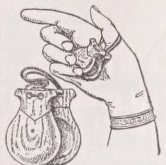
An instrument of music formed of small concave shells of ivory or hard wood, shaped like spoons, placed together, fastened to the thumb and beat with the middle finger. This instrument is used by the Spaniards, Moors and Bohemians, as an accompaniment to their dances, sarabands and guitars.
Two small, concave shells of ivory or hard wood, shaped like spoons, fastened to the thumb, and beaten together with the middle finger; -- used by the Spaniards and Moors as an accompaniment to their dance and guitars.
CASTANOS, Don Francisco Xavier de(c. 1756- 1852), duke of Baylen, a Spanish general, who served in the Peninsular War, was born at Madrid. The exact year of his birth is not known, but it was probably about 1756. He was the son of a military officer; at the age of twelve he had received a commission as captain; and, while still very young, he was sent to study the art of war at the court of Frederick the Great. His first success was at Baylen, where, on the 22d of July 1808, 18,000 French under Dupont surrendered to him. It is, however, said that the chief credit in this engagement is due to the Swiss, Aloys Reding. In November of the same year, Castanos was defeated at Tudela; and during the rest of the war he occupied subordinate positions. He, however, distinguished himself at Vitoria, and was placed at the head of the army which was sent to assist the Allies in 1815; and till his death, which took place on the 24th September 1852, he held a high political position, being senator and guardian to Queen Isabella.
9th ed. Encyclopædia Britannica, vol. 5, p. 186 [190 words — estimated reading time: 2 minutes]
CASTE. There are not many forms of social organization on a large scale to which the name Caste has not been applied in a good or in a bad sense. Its Portuguese origin simply suggests the idea of family; but before the word came to be extensively used in modern European languages, it had been for some time identified with the Brahmanic division of Hindu society into classes. The corresponding Hindu word is varηa, or colour, and the words gati, kula, gotra, praυara, and karaηa are also used with different shades of meaning. Wherever, therefore, a writer has seen something which reminds him of any part of the extremely indeterminate notion, Indian caste, he has used the word, without regard to any particular age, race, locality, or set of social institutions. Thus Palgrave maintains that the colleges of operatives, which inscriptions prove to have existed in Britain during the Roman period, were practically castes, because by the Theodosian code the son was compelled to follow the father’s employment, and marriage into a family involved adoption of the family employment. But these collegia opificum seem to be just the forerunners of the voluntary associations for the regulation of industry and trade, the Frith-gilds, and Craftgilds of later times, in which, no doubt, sons had great advantages as apprentices, but which admitted qualified strangers, and for which intermarriage was a matter of social feeling. The history of the formation of guilds shows, in fact, that they were really protests against the authoritative regulation of life from without aud above. In the Saxon period, at any rate, there was nothing resembling caste in the strict sense. “The ceorl who had thriven so well as to have five hides of land rose to the rank of a thegn; his wergild became 1200 ...shillings; the value of his oath and the penalty of trespass against him increased in proportion; his descendants in the third generation became gesithcund. Nor was the character of the thriving defined; it might, so far as the terms of the custom went, be either purchase, or inheritance, or the receipt of royal bounty. The successful merchant might also thrive to thegn-right. The thegn himself might also rise to the rank, the estimation, and status of an earl.” It has been said that early German history is, as regards this matter, in contrast with English, and that true castes are to be found in the military associations (Genossenschaften) which arose from the older class of Dienstmannen, and in which every member—page, squire, or knight—must prove his knightly descent; the Bauernstand, or rural non-military population; the Bürgerstand, or merchant-class. The ministry of the Roman Catholic Church, was, however, never restricted by blood relation. There is no doubt that at some time or other professions were in most countries hereditary. Thus Prescott tells us that in Peru, notwithstanding the general rule that every man should make himself acquainted with the various arts, “there were certain individuals carefully trained to those occupations which minister to the wants of the more opulent classes. These occupations, like every other calling and office in Peru, always descended from father to son. The division of castes was in this particular as precise as that which existed in Hindustan or Egypt.” Again, Zurita says that in Mexico no one could carry on trade except by right of inheritance, or by public permission. The Fiji carpenters form a separate caste, and in the Tonga Islands all the trades, except tattoo-markers, barbers, and club-carvers are hereditary,—the separate classes being named matabooles, mooas, and tooas. Nothing is more natural than that a father should teach his son his handicraft, especially if there be no organized system of public instruction; it gives the father help at a cheap rate, it is the easiest introduction to life for the son, and the custom or reputation of the father as a craftsman is often the most important legacy he has to leave. The value of transmitted skill in the simple crafts was very great; and what was once universal in communities, still survives in outlying portions of communities which have not been brought within the general market of exchange. But so long as this process remains natural, there can be no question of caste, which implies that the adoption of a new profession is not merely unusual, but wrong and punishable. Then, the word caste has been applied to sacred corporations. A family or a tribe is consecrated to the service of a particular altar, or all the altars of a particular god. Or a semi-sacred class, such as the Brehons or the Bards, is formed, and these, and perhaps some specially dignified professions, become hereditary, the others remaining free. Thus in Peru, the priests of the Sun at Cuzco transmitted their office to their sons; so did the Quipu-camayoc, or public registrars, and the amantas and lιarαvecs, the learned men and singers. Benjamin Constant has ventured on the ambitious generalization that in the South, as in Judaea and Mexico, such corporations were hereditaιy, but that in the North and West they were in general elective. In many countries political considerations, or distinctions of race, have prevented intermarriage between classes. Take, for example, the patricians and the plebeians at Rome, or the Sτrαpτιfiται, Λaκωv∈ς, or τrcρlocκoL, and the Είλωτες at Sparta. In Guatemala it was the law that if any noble married a plebeian woman he should be degraded to the caste of mazequal, or plebeian, and be subject to the duties and services imposed on that class, and that the bulk of his estate should be sequestered to the king. In Malagasy marriage is strictly forbidden between the four classes of Nobles, Hovas, Zarahovas, and Andevos,— the lowest of whom, however, are apparently mere slaves. All nations have at one time opposed themselves to marriage with foreigners, known chiefly as enemies ∙ and all nations have oppressed, industrially and politically, the races whom they have conquered. In one sense slavery might be called the lowest of castes, because in most of its actual forms it does permit some small customary rights to the slave. In another sense, the marriage of the queen’s daughter with a commoner might be described as an infraction of caste rule.
Besides the forms of caste we have mentioned, these are many isolated communities which resemble one another in the fact that their members constantly intermarry, and which generally devote themselves to some one particular trade or industry. This “endogamy” seems to be characteristic of early social arrangements, and therefore the existing specimens of endogamous societies in Europe and Asia do not exhibit any high form of civilization. Among others may be mentioned the descendants of the “Bounty” mutineers, who still occupy Pitcairn Island ∙ a community of Javans, near Surabaya, on the Tengger Hills, numbering about 1200 persons, distributed in about forty villages, and still following the ancient Hindu religion; the inhabitants of various fishing villages in Great Britain, such as Itchinferry near Southampton, Portland Island, Bentham in Yorkshire, Mousehole and Newlyn in Mountsbay, Cornwall, Boulmer near Alnwick (where almost all the inhabitants are called Stephenson, Stanton, or Stewart), Burnmouth, Ross, and (to some extent) Eyemouth in Berwickshire, Boyndie in Banffshire, Rathen in Aberdeenshire, Buckhaven in Fifeshire, Port-mahomack and Balnabruach in Easter Ross. In France may be mentioned the commune of Batz, near Le Broisic in Loire-Inférieure; many of the central cantons of Brétagne; the singular society called Foréatines supposed to be of Irish descent, and living between St Armand and Bourges; the sailor population of Pauillac (Gironde), Granville, Arromanches, Portel (near Boulogne), and other fishing villages; the Republic of Andorre in the Pyrenees; the papermakers of Angoumois, Limousin, and Auvergne, whose trade seems to have doomed them to an hereditary weakness of constitution; the Marans of Auvergne, a race of Spanish converted Jews, accused of introducing syphilis into France; the Hautponnais and Lyzelards of St Omer, who have also a separate Flemish dialect; the Burins and Sermoyers, chiefly cattle-breeders, scattered over the department of Ain and the arrondissement of Bourg en Bresse. The Vaquéros, shepherds in the Asturias Mountains; the Jewish Chuetas of Majorca; the Petits-Créoles or Petits-Blancs, descendants of the original French settlers in Réunion, are also good examples of what biologists call “in-and-in breeding,” as opposed to lf crossing.” On a larger scale the Icelanders, the ancient Samaritans (now almost extinguished, see Times, 4th April 1874), and the great and prosperous Jewish nañon, may be called castes, so far as intermarriage is concerned. It must not be imagined, however, that this is a general characteristic of a certain stage of social development. “Exogamy,” or the rule requiring either absolutely or in certain circumstances marriage with a stranger, is recognized very widely even by modern tribes, especially in Asia; and both these conditions of things seem to have been preceded by a primitive state, in which the relations of the sexes were promiscuous. This is illustrated in the case of the Thlinkeets, or Kolosches, who inhabit the coasts and islands from Mt. St Elias to the River Nass. This singular tribe, which has an elective chief and systematic slavery (chiefly supplied from the Flatheads of Oregon), is divided into two castes, the Wolf and the Raven, the symbols of which appear on their houses, boats, robes, and shields. The Wolf caste is subdivided into the bear, eagle, dolphin, shark, and alca; the Raven, into frog, goose, sea lion, owl, and salmon. “The young Wolf warrior must seek his mate among the Ravens; and while celebrating his nuptials one day, he may on the next be called to fight his father-in-law over some hereditary feud.” Similarly, the Kutchin tribe of the Tinneh family, inhabiting the Yukon, Tananah, and Peel river-valleys, have a singular system of totems. There are three castes; and persons of the same caste are not allowed to marry each other. The mother gives caste to the children, so that as the fathers die off the caste constantly changes. It also happens that when a child is named, the father adopts that name and drops his own. The system prevents civil war.
Caste in India is a question of more than historical interest. It is the great difficulty in the way of Government in framing laws and in governing the army, of native religious reformers in attacking the Brahmanic superstitions, and of the Protestant missionaries, who are unable to offer in the British society of India a sympathizing aud protecting caste in place of that which it costs the convert so much to leave. Probably owing to the extent of our Indian Empire, and the great varieties of caste custom which prevail, one hears very conflicting accounts and opinions of the institution. Writers such as Robertson and Dubois have regarded it as the great safeguard of social tranquillity, and therefore as the indispensable condition of the progress in certain arts and industries which the Hindus have undoubtedly made. Others, such as James Mill, denounce it as now at least a great political blunder, fatal to free competition, and opposed to individual happiness. The latter view assumes a state of facts which is denied by Mr Colebrooke, one of the highest authorities on Indian matters. Writing in 1798 he says, after pointing out that any person unable to earn a subsistence by the exercise of his profession may follow the trade of a lower caste or even of a higher; “Daily observation shows even Brahmans exercising the menial profession of a Sudra. We are aware that every caste forms itself into clubs or lodges, consisting of the several individuals of that caste residing within a small distance, and that these clubs or lodges govern themselves by particular rules or customs or by-laws. But though some restrictions and limitations, not founded on religious prejudices, are found among their by-laws, it may be received as a general maxim that the occupation appointed for each tribe is entitled merely to a preference. Every profession, with few exceptions, is open to every description of persons; and the discouragement arising from religious prejudices is not greater than what exists in Great Britain from the effects of municipal and corporation laws. In Bengal the numbers of people actually willing to apply to any particular occupation are sufficient for the unlimited extension of any manufacture.” This is corroborated by Elphinstone, who states that, during a long experience of India, he never heard of a single case of degradation from caste; and it is illustrated by the experience of the British army, in which men of all castes unite.
The popular notion of modern caste is that it involves certain restrictions on marriage, on profession, and on social intercourse, especially that implied in eating and drinking together. But how far intermarriage is permitted, what are the effects of a marriage permitted but looked on as irregular, what are the penalties of a marriage forbidden, whether the rules protecting trades and occupations are in effect more than a kind of unionism grown inveterate through custom, by what means caste is lost, and in what circumstances it may be regained,—these are questions on which very little real or definite knowledge exists. It is very remarkable that the Vedas, on which the whole structure of Brahmanic faith and morals professes to rest, give no countenance to the later regulations of caste. The only passage bearing on the subject is in the Purusha Sukta, the 90th Hymn of the 1 Oth Book of the Rigveda Sanhita. “When they divided man, how many did they make him? What was his mouth I what his arms? what are called his thighs and feet 1 The Brahmana was his mouth, the Raganya was made his arms, the Vaisya became his thighs, the Sudra was born from his feet.” Haug finds in this a subtleallegory that the Brahmans were teachers, the Kshatriyas the warriors of mankind. But this is opposed to the simple and direct language of the Vedic hymns, and to the fact that in the accounts of creation there the origin of many things besides classes of men is attributed in the same fanciful manner to parts of ths divine person. It is in the Puranas and the Laws of Manu, neither of which claims direct inspiration, where they differ from the letter of the Veda, that the texts are to be found on which all that is objectionable in caste has been based. Even in the VishnuPurana, however, the legend of caste speaks of the four classes as being at first “perfectly inclined to conduct springing from religious faith.” It is not till after the whole human race has fallen into sin that separate social duties are assigned to the classes. The same hymn speaks of the evolution of qualities of Brahma. Sattva, or goodness, sprang from the mouth of Brahma; Rajas, or passion, came from his breast; Tamas, or darkness, from his thighs; others he created from his feet. For each one of these gunas, or primitive differences of quality, a thousand couples, male and female, have been created, to which the distinct heavens, or places of perfection of Prajapati, Indra, Maruts, and Gandharvas are assigned. To the gunas are related the yugas, or ages: 1st, the Krita, or glorious age of truth and piety, in which apparently no distinctions, at least no grades of excellence were known; 2d, the Treta, or period of knowledge: 3d, the Dvapara, or period of sacrifice; 4th, the Kali, or period of darkness. Bunsen supposes there may be an historical element in the legend that Pururava, a great conqueror of the Treta age founded caste. The yugas are hardly periods of historical chronology, but there is no doubt that the Vayu Purina assigns the definite origin of caste to the Treta period. “The perfect beings of the first age, some tranquil, some fiery, some active, and some distressed, were again born in the Treta, as Brahmans, <fcc., governed by the good and bad actions performed in former births.” The same hymn proceeds to explain that the first arrangement did not work well, and that a second was made, by which force, criminal justice, and war were declared to be the business of the Kshatriyas; officiating at sacrifices, sacred study, and the receipt of presents to belong to the Brahmans; traffic, cattle, and agriculture to the Vaisyas; the mechanical arts and service to the Sudras. The Ramayanahymn suggests that in the four great periods the castes successively arrive at the state of dharma or righteousness. Thus, a Sudra cannot, even by the most rigorous self-mortification, become righteous in the period proper to the salvation of the Vaisyas. As the hymn speaks in the Dvapara age, it speaks of the salvation of Sudras as future, and not yet possible. Wholly in opposition to the story of a fourfold birth from Brahma is the legend that the castes sprang from Manu himself, who is removed by several generations of gods and demi-gods from Brahma. Then, again, the Santiparvan alleges that the world, at first entirely Brahmanic, was separated into castes merely by the evil works of man. Castehood consists in the exercise of certain virtues or vices. Munis, or persons born indiscriminately, frequently rise to the caste of Brahmans, and the offspring of Brahmans sinks to a lower level. The serpent observes: “If a man is regarded by you as being a Brahman only in consequence of his conduct, then birth is vain, until action is shown.” But this change of caste takes place only through a second birth, and not during the life which is spent in virtue. Another poetical conception of caste birth is expressed in the Harivansa. The Brahmans were formed from an imperishable element (Akshara), the Kshatriyas from a perishable element (Kshara), the Vaisyas from alteration, and the Sudras from a modification of smoke. The general result of the foregoing texts is that there are several contradictory accounts of the origin of caste, and that these are for the most part unintelligible. Caste is described as a late episode in creation, and as born from different parts of different gods, from the mortalManu, from abstract principles, and from non-entity. It is also described as coeval with creation, as existing in perfection during the Krita period, and subsequently falling into sin. It is also said that only Brahmans existed at first, the others only at later periods. Then the rationalistic theories of the Santiparvan upset the very foundation of caste; viz., hereditary transmission of the caste character. It seems clear that when the Vedas were composed, many persons who were not Brahmans acted as priests, and saints, the “preceptors of gods,” by their “austere fervour,” rose from a lower rank to the dignity of Brahmanhood. Originally, indeed, access to the gods by prayer and sacrifice was open to all classes of the community. Ás the Brahmans grow in political importance, they make religion an exclusive and sacred business. We find them deciding questions of succession to the throne, and enforcing their decisions. While in the earlier literature there are several instances of Brahmans receiving instruction from the hands of Kshatriyas, in the Puranas and Manu death is made to overtake Kshatriyas who are not submissive to the Brahmans; and in one case Visvamitra, the son of Gadhi, actually obtains Brahmanhood as a reward for his submission. It seems certain that many of the ancient myths were expressly manufactured by the Brahmans to show their superiority in birth and in the favour of Heaven to the Kshatriyas,—a poetical effect which is sometimes spoiled by their claiming descent from their rivals. This brings us to a consideration of the theories which have been started to account for the appearance of Brahmanic caste, as it is stereotyped in the Laws of Manu. James Mill, who invariably underestimated the influence on history of “previous states of society,” has suggested that the original division must have been the work of some inspired individual, a legislator or a social reformer, who perceived the advantages which would result from a systematic division of labour. The subordination of castes he accounts for by the superstitious terror and the designing lust of power which have so frequently been invoked to explain the natural supremacy of the religious class. Because the ravages of war were dreaded most after the calamities sent by heaven, he finds that the military class properly occupy the second place. This arrangement he apparently contemplates as at no time either necessary or wholesome, and as finally destroyed by the selfishjealousies of caste, and by the degradations which the multiplication of trades made inevitable. Heeren and Klaproth have contended that the division into castes is founded on an original diversity of race, and that the higher castes are possessed of superior beauty. The clear complexion and regular features of the Brahmans are said to distinguish them as completely from the Sudras as the Spanish Creoles were distinguished from the Peruvians. “The high forehead, the stout build,...
CASTEL, Louis Bertrand (1688-1757), a learned mathematician, was born at Montpellier in 1G88, and entered the order of the Jesuits in 1703. At first he was a student of literature, but he afterwards devoted himself entirely to mathematics and natural philosophy. He wrote several scientific works, that which attracted most attention at the time being his Optique des Couleurs, or treatise on the melody of colours. He endeavoured to illustrate the subject by a clavecin oculaire, or ocularharpsichord; but the treatise and the illustration were quickly forgotten. He also published a critical account of the system of Sir Isaac Newton in French.
9th ed. Encyclopædia Britannica, vol. 5, p. 192 [104 words — estimated reading time: 1 minute]
CASTELSARRASIN, a town of France, capital of an arrondissement, in the department of Tarn et Garonne, situated on the Songuine or Azine, near its influx into the Garonne, 12 miles west of Montauban. The walls which formerly surrounded the town have been converted into promenades. It has manufactures of serges and other woollen stuffs, hats, and leather, and some trade in corn grown in the vicinity. The town is said by some investigators to receive its name from the erection of its castle by the Saracens, but according to others the present form of the word is only a corruption of Castel sur Azine. The Parliament of Toulouse took refuge within the town in 1595. Population in 1872, 3064.
9th ed. Encyclopædia Britannica, vol. 5, p. 193 [120 words — estimated reading time: 1 minute]
CASTEL VETRANO, a town of Sicily, near the southeast extremity of the island, 12 miles east of Mazzara, in the province of Trapani. It is well and regularly built, and has a population of about 20,000, many of whom are hereditary tenants of the dukes of Monteleone, who have a palace in the town. Near it are the ruins of the ancient city Selinus, which was destroyed by the Carthaginians 409 B.c.
9th ed. Encyclopædia Britannica, vol. 5, p. 193 [74 words — estimated reading time: 1 minute]
CASTEL-A-MARE, or Castellamare, a city and seaport of Italy, on the Gulf of Naples, 15 miles by rail southeast of the city of that name. It is situated on the lower slopes of Monte Sant’ Angelo (the ancient Mons Gaurus), and along a sheltered beach, commanding an extensive view of the Bay of Naples from Vesuvius to Misenum. It stands near the site of the ancient Stabioe, which was destroyed by Sulla in the social war, but continued to exist as a small place till 79 ad., when it was overwhelmed along with Pompeii and Herculaneum by the great eruption of Vesuvius, and became for ever celebrated as the death-scene of the elder Pliny. The castle, from which the city takes its name, was erected by Frederick II., surrounded by walls and towers in the 13th century by Charles I. of Anjou, and strengthened by additional fortifications by Alphonse I. of Aragon. Castel-a-mare is the seat of a bishopric, and has a royal palace, a cathedral, several churches and convents, a military hospital, barracks, a handsome quay, a royal arsenal, and a dockyard, where the large ships of the Neapolitan navy were formerly built. In shipbuilding it still ranks second of the Italian towns; and there are manufactures of linen, silk and cotton goods, and leather. The port is small, and divided by two forts. The hill immediately above the town is covered with villas and casinos. The royal casino of Quisisana, originally built by Charles II. of Anjou, was restored by Ferdinand I. of Naples. It is more remarkable for its fine prospect than for its magnificence as a palace. Population about 26,000....
CASTEL-A-MARE, a seaport town of Sicily, on a bay to which it gives its name, in the province of Trapani, and about 30 miles west of Palermo. It occupies the site of the port of the ancient Segesta, which lay about six miles distant, and it still carries on a considerable export trade in wine, fruit, grain, and timber. Population 11,280.
9th ed. Encyclopædia Britannica, vol. 5, p. 193 [280 words — estimated reading time: 2 minutes]
CASTELL, Edmund (c. 1606-1685), a learned English Orientalist, was born about 1606, at Hatley, in Cambridgeshire. At the age of fifteen he entered Emmanuel College, Cambridge, but he afterwards changed his residence to St John’s, where he enjoyed the use of a valuable library. His great work was the compiling of his Lexicon Ueptaglotton Hebraicum, Chaldaicum, Syriacum, Samaritanum, Aethiopicum, Arabicum,et Persicum (London, 1669). Over this book he spent eighteen years, working (if we may accept his own statement) from sixteen to eighteen hours a day; he employed fourteen assistants, and by an expenditure of £12,000 brought himself to poverty, for his lexicon, though full of the most unusual learning, did not find purchasers. His loss was partly compensated by a number of preferments, including a prebend at Canterbury, and the professorship of Arabic at Cambridge. Castell also lent the aid of his erudition to the preparation of Dr Walton’s well-known Polyglott Bible. His MSS. he bequeathed to the University of Cambridge.
9th ed. Encyclopædia Britannica, vol. 5, p. 193 [167 words — estimated reading time: 1 minute]
Adv. to a small extent, on a small scale, a little bit, a wee bit, slightly, imperceptibly, miserably, wretchedly, insufficiently, imperfectly, faintly, passably, pretty well, well enough, partially, in part, in a certain degree, to a certain degree, to a certain extent, comparatively, some, rather in some degree, in some measure, something, somewhat, simply, only, purely, merely, at least, at the least, at most, at the most, ever so little, as little as may be, tant soit peu, in ever so small a degree, thus far, pro tanto, within bounds, in a manner, after a fashion, so to speak, almost, nearly, well-nigh, short of, not quite, all but, near upon, close upon, peu s'en faut, near the mark, within an ace of, within an inch of, on the brink of, scarcely, hardly, barely, only just, no more than, about, thereabouts, somewhere about, nearly, say, be the same, be little more or less, no ways, no way, no wise, not at all, not in the least, not a bit, not a bit of it, not a whit, not a jot, not a shadow, in no wise, in no respect, by no means, by no manner of means, on no account, at no hand
Phr. dare pondus idonea fumo, magno conatu magnas nugas, "small sands the mountain, moments make the year", quantity by comparison with a similar object
V.depress, lower, let down, take down, let down a peg, take down a peg, cast, let drop, let fall, sink, debase, bring low, abase, reduce, detrude, pitch, precipitate, overthrow, overturn, overset, upset, subvert, prostate, level, fell, cast down, take down, throw down, fling down, dash down, pull down, cut down, knock down, hew down, raze, raze to the ground, rase to the ground, trample in the dust, pull about one's ears, sit, sit down, couch, squat, crouch, stoop, bend, bow, courtesy, curtsy, bob, duck, dip, kneel, bend the knee, bow the knee, bend the head, bow the head, cower, recline
Adj. depressed, at a low ebb, prostrate, detrusive
V. appear, be visible, become visible, seem, look, show, present the appearance of, wear the appearance of, carry the appearance of, have the appearance of, bear the appearance of, exhibit the appearance of, take the appearance of, take on the appearance of, assume the appearance, present the semblance of, wear the semblance of, carry the semblance of, have the semblance of, bear the semblance of, exhibit the semblance of, take the semblance of, take on the semblance of, assume the semblance of, look like, cut a figure, figure, present to the view, show
Adv. apparently, to all seeming, to all appearance, ostensibly, seemingly, as it seems, on the face of it, prima facie, at the first blush, at first sight, in the eyes of, to the eye
N.rejection, repudiation, exclusion, refusal, declination v, reject, set aside, lay aside, give up, decline, exclude, except, pluck, spin, cast, repudiate, scout, set at naught, fling to the winds, fling to the dogs, fling overboard, fling away, cast to the winds, cast to the dogs, cast overboard, cast away, throw to the winds, throw to the dogs, throw overboard, throw away, toss to the winds, toss to the dogs, toss overboard, toss away, send to the right about, disclaim, discard, (have done with) 678
Adj. rejected, reject, rejectaneous|, rejectious|, not chosen, to be thought of, out of the question
N. plan, scheme, design, project, proposal, proposition, suggestion, resolution, motion, precaution, deep-laid plan, system, organization, germ, sketch, skeleton, outline, draught, draft, ebauche, brouillon, rough cast, rough draft, draught copy, copy, proof, revise, drawing, scheme, schematic, graphic, chart, flow chart (representation) 554, forecast, program(me), prospectus, carte du pays, card, bill, protocol, order of the day, list of agenda, bill of fare, base of operations, platform, plank, slate, ticket, role, policy, contrivance, invention, expedient, receipt, nostrum, artifice, device, pipelaying, stratagem, trick, alternative, loophole, shift, last shift, measure, step, stroke, stroke of policy, master stroke, trump card, court card, cheval de bataille, great gun, coup, coup d'etat, clever stroke, bold stroke, good move, good hit, good stroke, bright thought, bright idea, intrigue, cabal, plot, conspiracy, complot, machination, subplot, underplot, counterplot, schemer, schemist, schematist|, strategist, machinator, projector, artist, promoter, designer, conspirator, intrigant
V. plan, scheme, design, frame, contrive, project, forecast, sketch, devise, invent, set one's wits to work, spring a project, fall upon, hit upon, strike out, chalk out, cut out, lay out, map out, lay down a plan, shape out a course, mark out a course, predetermine, concert, preconcert, preestablish, prepare, hatch, hatch a plot concoct, take steps, take measures, cast, recast, systematize, organize, arrange, digest, mature, plot, counter-plot, counter-mine, dig a mine, lay a train, intrigue
Adj.planned, strategic, strategical, planning, prepared, in course of preparation, under consideration, on the tapis, on the carpet, on the floor
V. deliver, hand, pass, put into the hands of, hand over, make over, deliver over, pass over, turn over, assign dower, present, give away, dispense, dispose of, give out, deal out, dole out, mete out, fork out, squeeze out, pay, render, impart, communicate, concede, cede, yield, part with, shed, cast, spend, give, bestow, confer, grant, accord, award, assign, intrust, consign, vest in, make a present, allow, contribute, subscribe, furnish its quota, invest, endow, settle upon, bequeath, leave, devise, furnish, supply, help, administer to, afford, spare, accommodate with, indulge with, favor with, shower down upon, lavish, pour on, thrust upon, tip, bribe, tickle the palm, grease the palm, offer, sacrifice, immolate
Come now therefore, and let us slay him, and cast him into some pit, and we willsay, Some evil beast hath devoured him: and we shall see what will become of his dreams.
“Come now, let us kill him and throw him into one of the pits. We can say that a vicious animal has devoured him. Then we shall see what becomes of his dreams!”
And Reuben said unto them, Shedno blood, but cast him into this pit that is in the wilderness, and lay nohand upon him; that he might rid him out of their hands, to deliver him to his father again.
“Do not shed his blood. Throw him into this pit in the wilderness, but do not lay a hand on him.” Reuben said this so that he could rescue Joseph from their hands and return him to his father.
When Pharaoh shall speak unto you, saying, Shew a miraclefor you: then thou shalt say unto Aaron, Take thy rod, and cast it before Pharaoh, and it shall become a serpent.
“When Pharaoh tells you, ‘Perform a miracle,’ you are to say to Aaron, ‘Take your staff and throw it down before Pharaoh,’ and it will become a serpent.”
And Moses and Aaron went in unto Pharaoh, and they did so as the LORD had commanded: and Aaron cast down his rod before Pharaoh, and before his servants, and it became a serpent.
So Moses and Aaron went to Pharaoh and did just as the LORD had commanded. Aaron threw his staff down before Pharaoh and his officials, and it became a serpent.
And the LORD turned a mighty strong west wind, which took away the locusts, and cast them into the Red sea; there remained not one locust in all the coasts of Egypt.
And the LORD changed the wind to a very strong west wind that carried off the locusts and blew them into the Red Sea. Not a single locust remained anywhere in Egypt.
And he cried unto the LORD; and the LORD shewed him a tree, which when he had cast into the waters, the waters were made sweet: there he made for them a statute and an ordinance, and there he proved them,
And Moses cried out to the LORD, and the LORD showed him a log. And when he cast it into the waters, they were sweetened. There the LORD made for them a statute and an ordinance, and there He tested them,
There shall nothing cast their young, nor be barren, in thy land: the number of thy days I will fulfil.
No woman in your land will miscarry or be barren; I willfulfill the number of your days.
This site uses cookies to remember your display preferences (search sources and editions, Bible version, auto-link, images, light/dark theme). No personal data whatsoever is collected. Privacy Policy