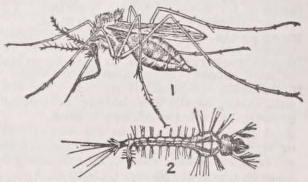
Any one of various species of gnats of the genus Culex and allied genera. The females have a proboscis containing, within the sheathlike labium, six fine, sharp, needlelike organs with which they puncture the skin of man and animals to suck the blood. These bites, when numerous, cause, in many persons, considerable irritation and swelling, with some pain. The larvae and pupae, called wigglers, are aquatic.
MOSQUITO (sometimeswritten “Mosquita”), a Spanish word signifying “little fly,” is a name popularly applied to certain annoyingdipterous insects, and, strictly speaking, it should probably be used only for species of Culicidae (and for the genus Culex in particular), for which “gnat” is the English synonym; but in many countries it is by almost common consent applied to all small dipterous insects that suck human blood, and therefore includes what we know as “sand-flies,” “midges,” <fcc., of the genera Ceratopogon, Simulium, and others. By Englishmen a distinction is often falsely drawn between “mosquito” and “gnat,” the former being supposed to represent an insect native chiefly of hot climates, whereas the latter is their own too-well-known pest. In effect the terms are really synonymous, and any actual difference can only be specific. In very hot seasons we not uncommonly hear alarming reports of mosquitoes having made their appearance in London and elsewhere in the British Isles, and means whereby they were imported are often suggested,— the real facts of the case being that extra heat may render the native species more annoying, or that it causes a bodily condition in which their bites are more severely felt. The “mosquitoes” of high northern latitudes may be species both of Culex and Simulium....
Accounts of the numbers of these insects in tropical countries and in high latitudes, and of their irritating attacks, are to be met with—seldom exaggerated—in most books of travel. Even in Britain the annoyance caused by gnats is very great, and in marshy districts often unendurable, especially to new-comers, for it seems probable that the insects really attack a visitor more furiously than they do the natives of the district, but, on the other hand, the latter may be more indifferent to their assaults. In some subjects even the “piping” by which a hungrygnat announces its presence has most distressing effects. In high latitudes they are driven off by anointing the body with fish-oil; and in hot climates “mosquito curtains” are part of the ordinary bed-furniture. It is only the female that bites; and, as it is but a very small proportion of them that can ever taste human blood or that of any warm-blooded animal, blood would not appear to be essential to their welfare. It has been suggested that warm blood may have an influence on the ova, but it cannot be supposed that the eggs of those multitudes of individuals that never get a chance to taste blood are necessarily infertile; everything tends to prove the opposite.
Of late mosquitoes have been accused of playing a hitherto unsuspected part in the dissemination of certain entozoic diseases. According to the researches of Drs Manson and Cobbold and others, it appears certain that the insects, in sucking the blood of persons who are hosts of the entozoon known as Filaria sanguis-kominis, take these parasites into their own system, and it is believed that they afterwards (by their death and otherwise) contaminate drinking water with them, and thus convey the entozoa into the blood of persons previously unaffected.
Mosquitoes are aquatic in their early stages. The female deposits her eggs in boat-shaped masses on the surface of the water. The larvae are very active, and have a peculiar jerking motion; the last segment is furnished with a respiratory apparatus, the form of which probably varies according to the species, but it is usually a long tube, the extremity of which can be exposed to the external air. Thepupae are also active (contrary to the condition in most dipterous pupae), and are odd-looking creatures owing to the great development of the thoracic region; the respiratory apparatus is in the thorax in this state, the extremity of the body having two swimming-plates; the pupae do not eat, but their activity is very great.
No notice of the mosquito or gnat would be complete without an explanation of the mouth-parts by which it is enabled to cause such extreme irritation. When these parts are closed one upon the other the whole looks like a long proboscis; but in reality this consists of seven distinct slender pieces separated to the base, viz.— the labium, two maxillae, two mandibles, the lingua, and the labrum. The nomenclature of the mouth-parts varies with different authors. G. Dimmock (Anatomy of the Mouth-parts and of the Sucking-apparatus of some Diptera), the latest investigator of this complex apparatus, states that the labium has for function, for the most part, the protection of the fine setae which form the true piercing organ of Culex. In the female of Culex the protective sheath is formed by ttfe labium alone. When the mosquito has found a place which suits it for piercing—for it often tides different places on our skin before deciding on one—it plants its labellae firmly upon the spot, and a moment later the labium is seen to be flexing backwards in its middle; the seta·, firmly grouped together, remain straight and enter the skin. When the setae have entered to nearly their full length, the labium is bent double beneath the body of the insect. When the mosquito wishes to withdraw the setae it probably first withdraws the two barbedmaxillae beyond the other setae, that is, so that their barbs or papillae will be kept out of action by the mandibles and hypopharynx; then it readily withdraws the setae, perhaps aiding their withdrawal by the muscles of the labium, for during the process of extracting the setae from the skin, while they are slowly sinking back into the groove upon the upper side of the straighteninglabium, the mosquito keeps the labellae pressed firmly upon the skin. The withdrawal of blood is effected by means of a pumping apparatus at the base of the mouth-parts. As no investigator appears to have been able to detect a poison gland, it has been considered that the irritation caused by the bite of a mosquito was solely of mechanical origin; but the extreme irritation and its duration have not caused this idea to be commonly accepted. Dimmock avows his belief that there is use made of a poisonous saliva. In the male of Culex the mouth-parts vary considerably from those of the female,—a conspicuous point of difference being that in this sex the mandibles are absent, and the maxillae are not barbed.
About 35 species of Culex (mosquito or gnat) have been described as inhabiting Europe, and about 130 from the rest of the world, but their differentiation is involved in great difficulty and uncertainty, and it is probable that the number of true species may be very much less. A species from Cuba has received the name Culex mosquito ; but there is not one species that specially deserves the name more than another from a popular point of view, nor from a scientific point of view is there any difference between a mosquito and a gnat.
9th ed. Encyclopædia Britannica, vol. 16, p. 866 [1,168 words — estimated reading time: 7 minutes]
Phr. faenum habet in cornu, 3, special sympathetic affections
No Bible verses found for "MOSQUITO".
This site uses cookies to remember your display preferences (search sources and editions, Bible version, auto-link, images, light/dark theme). No personal data whatsoever is collected. Privacy Policy