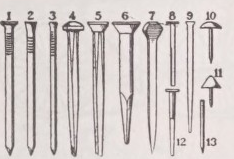
3. The horny substance growing at the end of the human fingers and toes.
4. A small pointed piece of metal, usually with a head, to be driven into a board or other piece of timber, and serving to fasten it to other timber. The larger kinds of instruments of this sort are called spikes; and a long thin kind with a flattish head, is called a brad.
5. A stud or boss; a short nail with a large broad head.
6. A measure of length, being two inches and a quarter, or the 16th of a yard.
7. On the nail in hand; immediately; without delay or time of credit; as, to pay money on the nail
8. To hit the nail on the head, to hit or touch the exact point.
3. The terminal horny plate on the beak of ducks, and other allied birds.
4. A slender, pointed piece of metal, usually with a head, used for fastening pieces of wood or other material together, by being driven into or through them.
5. To fasten with a nail or nails; to close up or secure by means of nails; as, to nail boards to the beams.
The nail of Jael’s tent with which she killed Sisera, is called יתד; it was formed for penetrating earth, or other hard substances, when driven by sufficient force, as with a hammer, &c; it includes the idea of strength. The orientals, in fitting up their houses, were by no means inattentive to the comfort and satisfaction arising from order and method. Their furniture was scanty and plain; but they were careful to arrange the few household utensils they needed, so as not to encumber the apartments to which they belonged. Their devices for this purpose, which, like every part of the structure, bore the character of remarkable simplicity, may not correspond with our ideas of neatness and propriety; but they accorded with their taste, and sufficiently answered their design. One of these consisted in a set of spikes, nails, or large pegs fixed in the walls of the house, upon which they hung up the movables and utensils in common use that belonged to the room. These nails they do not drive into the walls with a hammer or mallet, but fix them there when the house is building; for if the walls are of brick, they are too hard, or if they consist of clay, too soft and mouldering, to admit the action of the hammer. The spikes, which are so contrived as to strengthen the walls, by binding the parts together, as well as to serve for convenience, are large, with square heads like dice, and bent at the ends so as to make them cramp irons. They commonly place them at the windows and doors, in order to hang upon them, when they choose, veils and curtains, although they place them in other parts of the room, to hang up other things of various kinds. The care with which they fixed these nails, may be inferred, as well from the important purposes they were meant to serve, as from ...the promise of the Lord to Eliakim: And I will fasten him as a nail in a sure place,” Isa. xxii, 23. It is evident from the words of the prophet, that it was common in his time to suspend upon them the utensils belonging to the apartment: Will men take a pin of it to hang any vessel thereon?” Ezek. xv, 3. The word used in Isaiah for a nail of this sort, is the same which denotes the stake, or large pin of iron, which fastened down to the ground the cords of their tents. These nails, therefore, were of necessary and common use, and of no small importance in all their apartments; and if they seem to us mean and insignificant, it is because they are unknown to us, and inconsistent with our notions of propriety, and because we have no name for them but what conveys to our ear a low and contemptible idea. It is evident from the frequent allusions in Scripture to these instruments, that they were not regarded with contempt or indifference by the natives of Palestine. Grace has been shown from the Lord our God,” said Ezra, to leave us a remnant to escape, and to give us a nail in his holy place,” Ezra ix, 8; or, as explained in the margin, a constant and sure abode. The dignity and propriety of the metaphor appear from the use which the Prophet Zechariah makes of it: Out of him cometh forth the corner, out of him the nail, out of him the battle bow, out of him every oppressor together,” Zech. x, 4. The whole frame of government, both in church and state, which the chosen people of God enjoyed, was the contrivance of his wisdom and the gift of his bounty; the foundations upon which it rested, the bonds which kept the several parts together, its means of defence, its officers and executors, were all the fruits of distinguishing goodness: even the oppressors of his people were a rod of correction in the hand of Jehovah, to convince them of sin, and restore them to his service.
NAILS. A nail is a headed pin or spike of metal, commonly of iron. The primary and principal use of nails is in wood work (joinery and carpentery), but they are also employed in upholstery, shoemaking, saddlery, slating, sheet-metal working, horse-shoeing, and numerous other trades. The consumption in all civilized communities is enormous, but it is exceptionally great where timber houses and wooden erections generally prevail, as in the United States of America, and in many British colonies. Size, form of head, nature of point, and special uses all give names to different classes of nails. Thus we have the names tacks, sprigs, and brads for very small nails; rose, clasp, and clout, according to the form of head; and flat points or sharp points according to the taper of the spike. Arranged according to the manner in which they are manufactured, nails may fall into four principal classes: —(1) ordinary or hand-wrought nails; (2) machine-wrought and cut nails; (3) wire or French nails; and (4) cast nails. The nailerhandicraft was at one time a great industry in the country around Birmingham, and to this day in conjunction with chain-making it constitutes an important though declining trade. It is essentially a family industry, carried on in the meanest of workshops, with a very few simple blacksmith’s tools and appliances. The nails are forged from nail-rods heated in a small smith’s hearth, hammered on a low anvil, the nail length cut off on a chisel attached to the anvil, and the head formed by dropping the spike into a hole in a “bolster” of steel, from which enough of the spike is left projecting to form the head, which is variously flattened out. The head, in the case of clasp nails, is formed with two strokes of the hammer, while rose nails require four ...blows. The heads of the larger-sized nails are made with the aid of an “oliver” or mechanical hammer, and for ornamental or stamped heads “swages” or dies are employed. The conditions of life and labour among the hand nailers in England are exceedingly unsatisfactory: married women and young children of both sexes are set to work long hours in small filthy sheds attached to their dwellings, and their employment is controlled by middlemen or nail-masters, who supply them with the nail-rods and pay for work done, sometimes in money and sometimes in kind on the truck system. The handicraft is, however, an expiring industry, as machine-wrought and cut nails are rapidly supplanting most corresponding kinds of handmade nails. Horse nails alone continue to be made in large measure by hand labour (at St Ninians near Stirling, as well as in the Birmingham district). These are made from the finest Swedish charcoal iron, hammered out to a fine sharp point. They must be tough and homogeneous throughout, so that there may be no danger of their breaking over and leaving portions sunk in the hoof. The credit of perfecting machinery for the making of nails belongs to American inventors, and by numerous stages the nail-making machines have arrived at a high degree of efficiency. Of late years mild steel, such as the plates employed for shipbuilding, has been largely used for machine-made nails. Without much detail it would be impossible to convey an idea of how the machine, fed with heated (to black heat only) strips of metal having a breadth and thickness sufficient for the nail to be made, shears off by means of its slicer the “nailblank,” which, falling down, is firmly clutched at the neck till a heading die moving with sufficient force strikes against its upper end and forms the head, and the nail now completed is liberated, passing out through an inclined shoot. In the case of large nails the taper of the shank and point is secured by the sectional form to which the strips are rolled; brads, sprigs, and small nails, on the other hand, are cut from uniform strips in an angular direction from head to point, the strip being turned over after each blank is cut so that the points and heads are taken from opposite sides alternately, and a uniform taper on two opposite sides of the nail, from head to point, is secured. The machines turn out nails with wonderful rapidity, varying with the size of the nails produced from about 100 to 1000 per minute. Wire or French nails are made from round wire, which is unwound, straightened, cut into lengths, and headed by a machine the same in principle as the pin-making apparatus (see Pins), but the pointing is accomplished by the pressure of dies in the same manner as the head is formed. Cast nails, which are cast in sand moulds by the ordinary process, are used principally for horticultural purposes, and the hob-nails or tackets of shoemakers are also cast.
9th ed. Encyclopædia Britannica, vol. 17, p. 165 [825 words — estimated reading time: 5 minutes]
V. be long, stretch out, sprawl, extend to, reach to, stretch to, make a long arm, "drag its slow length along." render long, lengthen, extend, elongate, stretch, prolong, produce, protract, let out, draw out, spin out|, drawl, enfilade, look along, view in perspective, distend (expand) 194
Adv.lengthwise, at length, longitudinally, endlong, along, tandem, in a line, in perspective, from end to end, from stem to stern, from head to foot, from the crown of the head to the sole of the foot, from top to toe, fore and aft
V. retain, keep, hold fast one's own, hold tight one's own, hold fast one's ground, hold tight one's ground, clinch, clench, clutch, grasp, gripe, hug, have a firm hold of, secure, withhold, detain, hold back, keep back, keep close, husband, reserve, have in stock, have on hand, keep in stock, entail, tie up, settle
Then Jael Heber’s wife took a nail of the tent, and took an hammer in her hand, and went softly unto him, and smote the nail into his temples, and fastened it into the ground: for he was fastasleep and weary. So he died.
But as he lay sleeping from exhaustion, Heber’s wife Jael took a tent peg, grabbed a hammer, and went silently to Sisera. She drove the peg through his temple and into the ground, and he died.
And, behold, as Barak pursued Sisera, Jael came out to meet him, and said unto him, Come, and I will shew thee the man whom thou seekest. And when he came into her tent, behold, Sisera lay dead, and the nail was in his temples.
When Barak arrived in pursuit of Sisera, Jael went out to greet him and said to him, “Come, and I will show you the man you are seeking.” So he went in with her, and there lay Sisera dead, with a tent peg through his temple.
She put her hand to the nail, and her right hand to the workmen’s hammer; and with the hammer she smote Sisera, she smote off his head, when she had pierced and stricken through his temples.
She reached for the tent peg, her right hand for the workman’s hammer. She struck Sisera and crushed his skull; she shattered and pierced his temple.
And David prepared iron in abundance for the nails for the doors of the gates, and for the joinings; and brass in abundance without weight;
David provided a large quantity of iron to make the nails for the doors of the gateways and for the fittings, together with more bronze than could be weighed
And now for a little space grace hath been shewed from the LORD our God, to leave us a remnant to escape, and to give us a nail in his holy place, that our God may lighten our eyes, and give us a little reviving in our bondage.
But now, for a brief moment, grace has come from the LORD our God to preserve for us a remnant and to give us a stake in His holy place. Even in our bondage, our God has given us new life and light to our eyes.
In that day, saith the LORD of hosts, shall the nail that is fastened in the sure place be removed, and be cut down, and fall; and the burden that was upon it shall be cut off: for the LORD hath spoken it.
In that day, declares the LORD of Hosts, the peg driven into a firm place will give way; it will be sheared off and fall, and the load upon it will be cut down.” Indeed, the LORD has spoken.
So the carpenter encouraged the goldsmith, and he that smootheth with the hammer him that smote the anvil, saying, It is ready for the sodering: and he fastened it withnails, that it should not be moved.
The same hour was the thing fulfilled upon Nebuchadnezzar: and he was driven from men, and did eat grass as oxen, and his body was wet with the dew of heaven, till his hairs were grown like eagles feathers, and his nails like birds’ claws.
At that moment the sentence against Nebuchadnezzar was fulfilled. He was driven away from mankind. He ategrass like an ox, and his body was drenchedwith the dew of heaven, until his hair grew like the feathers of an eagle and his nails like the claws of a bird.
Then I would know the truth of the fourth beast, which was diverse from all the others, exceeding dreadful, whose teeth were of iron, and his nails of brass; which devoured, brake in pieces, and stamped the residue with his feet;
Then I wanted to know the true meaning of the fourth beast, which was different from all the others—extremely terrifying—devouring and crushingwithironteeth and bronze claws, then trampling underfoot whatever was left.
The other disciples therefore said unto him, We have seen the Lord. But he said unto them, Except I shall see in his hands the print of the nails, and put my finger into the print of the nails, and thrust my hand into his side, I will not believe.
So the other disciples told him, “We have seen the Lord!” But he replied, “Unless I see the nail marks in His hands, and put my finger where the nails have been, and put my hand into His side, I will never believe.”
As a nail sticketh fast between the joinings of the stones; so doth sin stick close between buying and selling.
This site uses cookies to remember your display preferences (search sources and editions, Bible version, auto-link, images, light/dark theme). No personal data whatsoever is collected. Privacy Policy