
To look with one eye. [Not used.]
Word of the Day: Catachrestical
Peebles
Encyclopedia Britannica
PEEBLES, a midland county of Scotland, is bounded N. and N.E. by Midlothian, E. and S.E. by Selkirk, S. by Dumfries, and W. by Lanark. Its outline is somewhat irregular, the greatest length from north to south being about 30 miles, the greatest breadth about 20, and the smallest about 10. The area is 226,899 acres, or about 355 square miles.
From the fact that the county lies within the upper valley of the Tweed, it is sometimes known as Tweeddale. The surface consists of a succession of hills broken by the vale of the Tweed, which in some parts attains considerable breadth, and by the narrow valleys forming the courses of numerous “waters” and smaller streams. The lowest point above sea-level is about 450 feet, but the hills generally vary in height from 900 to 1500 feet, while several attain an altitude considerably over 2000 feet. The highest summits are Broad Law (2754 feet), Cramait Craig (2723 feet), and Dollar Law (2680 feet). The hills for the most part are rounded in form. The scenery is thus generally devoid of very striking or picturesque features, and its quiet pastoral character has a pleasing effect, while the exuberant plantations which clothe the sides and summits of the hills in the neighbourhood of the Tweed, with the well-cultivated fields adjoining its banks, lend to this district an aspect of rich luxuriance....
The Tweed has its source in a small fountain named Tweed’s Well at the base of a hill on the south-western border called Tweed’s Cross, from the farther side of which flow the Annan and the Clyde. It rises about 1300 feet above sea-level, and, with waters of sparkling clearness and purity, justly entitling it to the name of the “silver Tweed,” flows with rapid course north-eastwards to the town of Peebles, receiving continual accessions from mountain streamlets, the principal being the Biggar Water from the west at Drumelzier, the Lyne from the north-west at Lyne, the Manor Water from the south near Edderston, and the Eddlestone Water from the north at Peebles. After passing Peebles the river bends in a more easterly direction, receiving, before it leaves the county, the Quair Water from the south and the Leithen from the north. The Megget Water flows eastwards into St Mary’s Loch, which forms, for a very short distance, the south-eastern boundary of the county with Selkirkshire. The Medwin Water separates a portion of the south-western boundary of Linton parish from Lanarkshire. Peebles is, perhaps, more resorted to by anglers than any other county in Scotland, and it would be difficult to find anywhere else in the kingdom, within an equal area, so many streams and rivers affording such good sport and so unhampered by restrictions. Apart from St Mary’s Loch, on the borders of the county, there are no sheets of water of much extent.
Geology.— Peeblesshire is included in the Silurian tableland of southern Scotland, and consists chiefly of Upper Silurian rocks, having generally a north-western dip. The strata have been thrown into great flexures by volcanic action, and are frequently mingled with igneous rocks, such as trap, felspar, and porphyry. In the valley of the Tweed, where there is a great anticlinal flexure, slates with thin beds of anthracite are found, and also limestone. In a slate-quarry near Traquair graptolites, trilobites, and shells are met with, but nowhere else in the county have fossils been discovered. There are evidences of glacial action in the rounded forms of the hills, the frequent groovings along their flanks, and the large number of striated boulders. In the northern part of the county, in the parishes of Linton and Newlands, the Silurian rocks dip beneath the Carboniferous strata of the West of Scotland coal-field. In Peeblesshire the strata consist of sandstone and coal-beds. Ironstone is also found, and lead-ore occurs in thin beds near the Leithen. Limestone and marl are abundant, and at Stobo there is a quarry of excellent blue slate.
Climate, Soil, and Agriculture.— In the uplands the climate, though colder than that of the Lothians, is generally pure and dry, and remarkably healthy. The average rainfall is about 29 inches. On the summits and slopes of the hills frequent showers occur when it is quite fair in the valleys. The reflexion of the “slanters” on the hillsides sometimes greatly increases the heat in the valleys and assists the early ripening of the crops. The character of the soil varies considerably, moss, gravel, and clay being all represented. The flat lands consist generally of rich loam, composed of sand and clay.
As may be supposed from its hilly character, the county is pastoral rather than agricultural. The old system of small farms is nearly completely broken up, the average size of the holdings being now about 200 acres of arable land, with pasturage for 600 to 800 sheep attached. According to the agricultural returns of 1883, of the total area only 42,433 acres, or a little less than a fifth, were under cultivation, corn crops occupying 9832 acres, green crops 5716, rotation grasses 12,078, and permanent pasture 14,763. There were 10,177 acres under woods, 11 acres of market-gardens, and 6 of nursery-grounds. The most common rotation of crops is a six-course shift of (1) turnips, (2) barley or oats, (3), (4), and (5) grass or pasture, and (6) oats. The principal crops are oats, which in 1883 occupied 8797 acres, or about nine-tenths of the total area under corn crops, and turnips, for which the soil is specially well adapted, and which occupied 4679 acres, or about four-fifths of the total area under green crops. Horses in 1883 numbered 1142, cattle 5664, and sheep 192,122. The horses are frequently Clydesdales, and many are bred in the county. The most common breed of cattle in the county is a cross between Ayrshire and shorthorns, the cows being principally Ayrshire. Yorkshire calves and stirks are occasionally bought for feeding. The pasture, on account of the hilly character of the land, is better adapted for sheep than for cattle. On the green grassy pasture Cheviots and half-breds are the sheep most commonly preferred, and the heathery ranges are stocked with blackfaced. Crosses of blackfaced, Cheviot, and half-bred ewes with Leicestershire rams are common.
According to the latest return, the land was divided among 708 proprietors, possessing 232,410 acres, with an annual valuation of £142,614, the annual average value per acre being about 12s. 3d. Of the owners, 532, or about 75 per cent., possessed less than one acre each. The following possessed over 5000 acres each :—earl of Wemyss and March, 41,247; Sir G. G. Montgomerie, 18,172; Sir J. Murray Nasmyth, 15,485; John Miller, 13,000; James Tweedie, 11,151; trustees of the late earl of Traquair, 10,778; Colonel James M i Kenzie, 9403; Sir Robert Hay, 9155; Sir W. H. G. Carmichael, 8756; John White, 6366; George Graham Bell, 6600; James Wolfe Murray, 5108.
Manufactures.— Although the county has the advantage of convenient railway communication both by the North British and Caledonian systems, and possesses also abundant water-power, the only textile industries are the weaving of tweeds and shawls at Peebles and Innerleithen. The other manufactures are connected with the immediate wants of an agricultural population.
Administration and Population.— The county includes sixteen parishes, and one royal burgh, the county town. Along with the neighbouring county of Selkirk it forms a parliamentary county, which returns one member to parliament. Within the last fifty years the population of Peebles has increased about one-third, and, while in the first decade, between 1831 and 1841, there was a decrease from 10,578 to 10,499, the rate of increase has since then augmented in every succeeding decade. In 1861 the population amounted to 11,408, in 1871 to 12,330, and in 1881 to 13,822, of whom 6626 were males and 7196 females. In 1831 females were in a minority, being only 5236 to 5342 males. The county includes two towns, Peebles (3495) and Innerleithen (2313), and two villages, Walkerbum (1026) and West Linton (434). The town population in 1881 numbered 5808, the village 1460, and the rural 6554.
History and Antiquities.— There are a great number of British remains, including five circular British camps and numerous sepulchral tombs, where many cists and stone coffins have been discovered, sometimes containing armillae of gold, and stone axes and hammers. The standing-stones of Tweedsmuir and the remarkable earthen terraces on the hillsides, especially at Purvis Hill near Innerleithen and at Romanno, also deserve notice. The only important Roman remains are traces of a camp on the Lyne, which some suppose to be the Coria of Ptolemy. The district was included in the old kingdom of Northumbria, and passed to the kingdom of Scotland in the 11th century. By David I. it was made a <leanery in the archdeaconry of Peebles, and it was subsequently included in the diocese of Glasgow. About the middle of the 12th century it was placed under the jurisdiction of two sheriffs, one of whom was settled at Traquair and the other at Peebles. There are a considerable number of old castles, some of special interest, as Neid path Castle on the Tweed, about a mile west from Peebles, originally a Norman keep, built about the time of David I., and enlarged for a baronial residence by the Hays, who came into possession of it in the 15th century; Horsburgh Castle, a picturesque ruin near Innerleithen, once the seat of the Horsburghs, hereditary sheriffs-depute of Peebles; and the mansion-house or palace of Traquair, frequently resided in by the Scottish kings when they came to hunt in Ettrick Forest.
See Pennecuick, Description of Tweeddale, 1715; W. Chambers, History of Peeblesshire, 1864.
Peebles, the county town of Peeblesshire, is finely situated at the junction of the Eddlestone Water and the Tweed, and on the North British and Caledonian Railways, 22 miles south of Edinburgh. The new town, consisting of a main street (High Street) with several streets diverging, is situated on the south side of the Eddlestone Water; and the old town, consisting now of only a small number of houses, is on the north side; while a number of villas cover the elevated ground on the south of the Tweed. The Tweed is crossed by a bridge of five arches, lately widened and improved, and the Eddlestone Water by two bridges. Among the modern public buildings are. the town-hall, the corn exchange, and the hydropathic establishment. At the beginning of the present century Peebles possessed manufactures of fine cottons, but the industry is now discontinued. The town possesses woollen mills and meal and flour mills; it is also a centre of agriculture and has attractions as a summer residence. The population in 1801 was 2088, which had increased in 1831 to 2750, and, although in 1871 it had diminished to 2631, by 1881 it had increased to 3495. The population of the royal burgh in 1881 was 2609.
⅛ The castle of Peebles had disappeared about the beginning of the 18th century, and its site is now occupied by the parish church. There are still, however, numerous antique architectural relics, including some portions of the old town wall; the ruins of the church of the Holy Cross, founded in 1261, and of St Andrew’s parish church, founded in 1195, both in the old town; vaulted cellars of the 16th and 17th centuries, situated in a close behind Mungo Park’s laboratory, and built for security against Border freebooters. Queensberry Lodge, formerly the town residence of the duke of Queensberry, a building in the old style of Scottish domestic architecture, was purchased by the late William Chambers of Edinburgh, and, after being fitted up as a public reading-room, museum, and gallery of art, was presented by him to his native town under the name of the Chambers’ Institution (opened in 1859). The ancient cross of Peebles now occupies the centre of the courtyard of the institution.
Peebles was at a very early period a favourite residence of Scottish kings, who came to hunt in the neighbouring Ettrick Forest It received its original charter in all probability from Alexander III., who built and endowed the church of the Holy Cross, and also founded a monastery for red friars. It was created a royal burgh in 1367. In 1545 the town and the ancient churches were destroyed by Protector Somerset, and in 1604 it suffered severely from accidental fire. Its charter was extended by James VI., but after the union of the English and the Scottish crowns it lost its early importance.
9th ed. Encyclopædia Britannica, vol. 18, p. 451
[2,141 words — estimated reading time: 13 minutes]
[2,141 words — estimated reading time: 13 minutes]
Blind of one eye. [Not used.]
Peekskill
Encyclopedia Britannica
PEEKSKILL, a manufacturing village of the United States in Cortlandt township, Westchester county, New York, lies on the east bank of the Hudson, 43 miles above New York city, with which it has communication by rail and (in summer) by river. Besides iron-smelting, it carries on the manufacture of railings, stoves, and fire-bricks. A church, dating from 1767, and the Van Cortlandt mansion are among its principal buildings. Incorporated in 1816, Peekskill had 6560 inhabitants in 1870 and 6893 in 1880.
9th ed. Encyclopædia Britannica, vol. 18, p. 452
[83 words — estimated reading time: 1 minute]
[83 words — estimated reading time: 1 minute]
1. The skin or rind of any thing; as the peel of an orange.
1. To strip off skin, bark or rind without a cutting instrument; to strip by drawing or tearing off the skin; to bark; to flay; to decorticate. When a knife is used, we call it paring. Thus we say, to peel a tree, to peel an orange; but we say, to pare an apple to pare land.
2. In a general sense, to remove the skin, bark or rind, even with an instrument.
1. A small tower, fort, or castle; a keep.
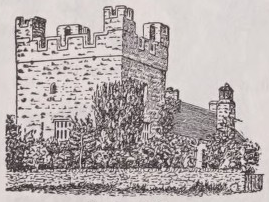
2. A spadelike implement, variously used, as for removing loaves of bread from a baker's oven; also, a T-shaped implement used by printers and bookbinders for hanging wet sheets of paper on lines or poles to dry. Also, the blade of an oar.
3. The skin or rind; as, the peel of an orange.
2. To strip off the skin, bark, or rind of; to strip by drawing or tearing off the skin, bark, husks, etc.; to flay; to decorticate; as, to peel an orange.
Peel
Encyclopedia Britannica
PEEL, Sir Robert (1788-1850), twice prime minister and for many years the leading statesman of England, was born 5th February 1788 in a cottage near Chamber Hall, the seat of his family, in the neighbourhood of Bury (Lancashire),—Chamber Hall itself being at the time under repair. He was a scion of that new aristocracy of wealth which sprang from the rapid progress of mechanical discovery and manufactures in the latter part of the 18th century. His ancestors were Yorkshire yeomen in the district of Craven, whence they migrated to Blackburn in Lancashire. His grandfather, Robert Peel, first of Peelfold, and afterwards of Brookside, near Blackburn, was a calico printer, who, appreciating the discovery of his townsman Hargreaves,took to cotton-spinning with the spinning-jenny and grew a wealthy man. His father, Robert Peel, third son of the last-named, carried on the same business at Bury with still greater success, in partnership with Mr Yates, whose daughter Ellen he married. He made a princely fortune, became the owner of Drayton Manor and member of parliament for the neighbouring borough of Tamworth, was a trusted and honoured, as well as ardent, supporter of Pitt, contributed magnificently towards the support of that leader’s war policy, was rewarded with a baronetcy, and founded a rich and powerful house, on whose arms he emblazoned, and in whose motto he commemorated, the prosperous industry from which it sprang. The example and precepts of the father took early effect upon his eldest son, whom from the first he destined and prepared to serve his country in public life. At Harrow, according to the accounts of his contemporaries, Peel was a steady industrious boy, the best scholar in the school, fonder of solitary walks than of the games of his companions, but ...ready to help those who were duller than himself, and not unpopular among his fellows. At Christ Church, where he entered as a gentleman commoner, he studied hard, and was the first who, under the new examination statutes, took a first class both in classics and in mathematics. His examination for his B.A. degree in 1808 was an academical ovation in presence of a numerous audience, who came to hear the first man of the day; and a relation who was at Oxford at the time has recorded that the triumph, like both the triumphs and reverses of after life, was calmly borne. From his classical studies Robert Peel derived not only the classical, though somewhat pompous, character of his speeches and the Latin quotations with λvhich they were often happily interspersed, but something of his lofty ideal of political ambition. Nor did he ever cease to love these pursuits of his youth; and in 1837, when elected lord rector of Glasgow university, in his inaugural speech he passed a glowing eulogy on classical education. To his mathematical training, which was then not common among public men, he no doubt owed in part his method, his clearness, his great power of grasping steadily and working out difficult and complicated questions. His speeches show that, in addition to his academical knowledge, he was well versed in English literature, in history, and in the principles of law. While reading hard he did not neglect to develop his tall and vigorous frame, and fortify his strong constitution, by manly exercises; and, though he lost his life partly through his bad riding, he was always a good shot and an untiring walker after game. Sprung from the most religious class of English society, he grew up and remained through life a religious man, and from that source drew deep conscientiousness and tranquillity under all difficulties and in all fortunes. His Oxford education confirmed his attachment to the Protestant Church of England. His practical mind remained satisfied with the doctrines of his youth; and he never showed that he had studied the great religious controversies, or that he understood the great religious movements of his day.
In 1809, being then in his twenty-second year, he was brought into parliament for the close borough of Cashel, which he afterwards exchanged for Chippenham, and commenced his parliamentary career under the eye of his father, then member for Tamworth, who fondly saw in him the future leader of the Tory party. Pitt, Fox, and Burke were gone. Sheridan shone with an expiring ray. But in that House of Commons sat Wilberforce, Windham, Tierney, Grattan, Perceval, Castlereagh, Plunkett, Romilly, Mackintosh, Burdett, Whitbread, Horner, Brougham, Parnell, Huskisson, and, above all, George Canning. Lord Palmerston entered the house at the same time, and Lord John Russell a few years afterwards. Among these men young Peel had to rise. And he rose, not by splendid eloquence, by profound political philosophy, or by great originality of thought, but by the closest attention to all his parliamentary duties, by a study of all the business of parliament, which made him at length familiar with the whole range of public questions and public interests, and by a style of speaking which, owing its force not to high flights of oratory, but to knowledge of the subject in hand, clearness of exposition, close reasoning, and tact in dealing with a parliamentary audience, backed by the character and position of the speaker, improved with his information, practice, station, and experience till it gave him an unrivalled command over the House of Commons. The Tory party was then all-powerful at home; while abroad Europe was at the feet of Napoleon. But Napoleon’s fortune was about to turn; and, with the close of the struggle against revolutionary France, political progress in England was soon to resume the march which that struggle had arrested. Young Peel’s lot, however, was cast, through his father, with the Tory party. In his maiden speech in 1810, seconding the address, he defended the Walcheren expedition, which he again vindicated soon afterwards against the report of Lord Porchester’s committee. It is said that even then Lord Liverpool discerned in him a dangerous tendency to think for himself, and told his father that he must be put at once into the harness of office. At all events he began official life as Lord Liverpool’s private secretary, and shortly afterwards, in 1811, was made under-secretary for the colonies by Perceval. In 1812 he was transferred by Lord Liverpool to the more important but unhappy post of secretary for Ireland. There he was engaged till 1817 in maintaining, by insurrection Acts and other repressive measures, English and Protestant ascendency over a country heaving with discontent, teeming with conspiracy, and ever ready to burst into rebellion. A middle course between Irish parties was impossible. Peel became, by the necessity of his situation, “Orange Peel,” and plied the established engines of coercion and patronage with a vigorous hand. At the same time, it was his frequent duty to combat Grattan, Plunkett, Canning, and the other movers and advocates of Catholic emancipation in the House of Commons. He, however, always spoke on this question with a command of temper wonderful in hot youth, with the utmost courtesy towards his opponents, and with warm expressions of sympathy and even of admiration for the Irish people. Nor was the ground he took against the Catholics that of religious principle never to be abandoned, but that of political expediency, which political necessity might overcome. He also, thus early, did his best to advocate and promote secular education in Ireland as a means of reconciling sects and raising the character of the people. He materially improved the conduct of ordinary business in his office, and gave great satisfaction to merchants and others with whom he had to deal. But his greatest service to Ireland as secretary was the institution of the regular Irish constabulary, nicknamed after him “Peelers,” for the protection of life and property in a country where both were insecure. His moderation of tone did not save him from the violent abuse of O’Connell, whom he, young, hot-tempered (though his temper was generally under control), and sensitive on the point of honour, was ill advised enough to challenge,—an affair which covered them both with ridicule. In 1817 he obtained the highest parliamentary distinction of the Tory party by being elected member for the university of Oxford,—an honour for which he was chosen in preference to Canning on account of his hostility to Catholic emancipation, Lord Eldon lending him his best support. In the following year he resigned the Irish secretaryship, of the odious work of which he had long been very -weary, and remained out of office till 1822. But he still supported the ministers with official zeal, even in the question of the “Peterloo massacre.” In the affair of Queen Caroline, however, he stood somewhat aloof, disapproving some steps taken by the Government, and sensitive to popular opinion; and when Canning retired on account of this affair Peel declined Lord Liverpool’s invitation to take the vacant place in the cabinet. During this break in his tenure of office he had some time for reflexion, which there was enough in the aspect of the political world to move. But early office had done its work. It had given him excellent habits of business, great knowledge, and a high position; but it had left him somewhat stiff, somewhat punctilious, somewhat too cold and reserved to win the hearts of those whose confidence he might command, and somewhat over anxious for formal justifications when he might well have left the essential patriotism and probity of his conduct to the judgment of men of honour and the heart of the people. At the same time he was no pedant in business; in corresponding on political subjects he loved to throw off official forms and communicate his views with the freedom of private correspondence; and, where his confidence was given, it was given without reserve.
At this period he was made chairman of the bullion committee on the death of Horner. He was chosen for this important office by Huskisson, Ricardo, and their fellow-economists, who saw in him a mind open to conviction, though he owed hereditary allegiance to Pitt’s financial policy, .and had actually voted with his Pittite father for a resolution of Lord Liverpool’s Government denying the existence of any depreciation in the paper currency. The choice proved judicious. Peel was converted to the currency doctrines of the economists, and proclaimed his conversion in a great speech on the 24th of May 1819, in which he moved and carried four resolutions embodying the recommendations of the bullion committee in favour of a return to cash payments. This laid the foundation of his financial reputation, and his co-operation with the economists tended to give a liberal turn to his commercial principles. In the course he took he somewhat diverged from his party, and particularly from his father, who remained faithful to Pitt’s depreciated paper, and between whom and his schismatic son a solemn and touching passage occurred in the debate. The author of the Cash Payments Act had often to defend his policy, and he did so with vigour. The Act is sometimes said to have been hard on debtors, including the nation as debtor, because it required debts to be paid in cash which had been contracted in depreciated paper; and Peel, as heir to a great fundholder, was even charged with being biassed by his personal interests. But it is answered that the Bank Restriction Acts, under which the depreciated paper had circulated, themselves contained a provision for a return to cash payments six months after peace.
In 1820 Peel married Julia, daughter of General Sir John Floyd, who bore him five sons and two daughters. Three of his sons, Robert, Frederick, and Arthur, have followed him in holding parliamentary office, the youngest being now (1884) speaker of the House of Commons; while another, William, the sailor, has run a bright course in another sphere, and found a glorious grave. The writers who have most severely censured Sir Robert Peel as a public man have suspended their censures to dwell on the virtues and happiness of his private and domestic life. He was not only a most loving husband and father but a true and warm-hearted friend. In Whitehall Gardens or at Drayton Manor he gladly opened his mind, wearied -with the cares of state, to the enjoyments of a circle in which it was his pleasure and his pride to gather some of the most distinguished intellects of the day. He indulged in free and cheerful talk, in which he showed a keen sense of the ridiculous, and a dry sarcastic humour, which often broke out also in his speeches in the House of Commons. He sought the conversation of men of science; he took delight in art, and was a great collector of pictures; he was fond of farming and agricultural improvements; he actively promoted useful works and the advancement of knowledge; he loved making his friends, dependants, tenants, and neighbours happy. And, cold as he was in public, even to those whom he desired to win, yet in his gay and social hour few men whose minds were so laden could be more bright and genial than Sir Robert Peel.
In 1822 Peel consented to strengthen the enfeebled ministry of Lord Liverpool by becoming home secretary; and in that capacity he had again to undertake the office of coercing the growing discontent in Ireland, of which he remained the real administrator, and had again to lead in the House of Commons the opposition to the rising cause of Catholic emancipation. In 1825, being defeated on the Catholic question in the House of Commons, he wished to resign office, but Lord Liverpool pleaded that his resignation would break up the Government. He found a happier and more congenial task in reforming and humanizing the criminal law, especially those parts of it which relate to offences against property and offences punishable by death. The five Acts in which Peel accomplished this great work, the first step towards a complete and civilized code, as well as the great speech of 9th March 1826, in which he opened the subject to the House, will form one of the most solid and enduring monuments of his fame. Criminal law reform was the reform of Romilly and Mackintosh, from the hands of the latter of whom Peel received it. But the masterly bills in which it was embodied were the bills of Peel,—not himself a creative genius, but, like the founder of his house, a profound appreciator of other men’s creations, and unrivalled in the power of giving them practical and complete effect. This great measure, beyond the sphere of party, was probably also another step in the emancipation of Peel’s mind.
In 1827 the Liverpool ministry was broken up by the fatal illness of its chief, and under the new premier, George Canning, Peel, like the duke of Wellington and other high Tory members of Lord Liverpool’s cabinet, refused to serve. Canning and Peel were rivals; but we need not interpret as mere personal rivalry that which was certainly, in part at least, a real difference of connexion and opinion. Canning took a Liberal line, and was supported by many of the Whigs; the seceders were Tories, and it is difficult to see how their position in Canning’s cabinet could have been otherwise than a false one. Separation led to public coolness and occasional approaches to bitterness on both sides in debate. But there seems no ground for exaggerated complaints against Peel’s conduct. Canning himself said to a friend that “Peel was the only man who had behaved decently towards him.” Their private intercourse remained uninterrupted to the end; and Canning’s sop afterwards entered public life under the auspices of Peel. The charge of having urged Catholic emancipation on Lord Liverpool in 1825, and opposed Canning for being a friend to it in 1827, made against Sir Robert Peel in the fierce com-law debates of 1846, has been withdrawn by those who made it.
In January 1828, after Canning’s death, the duke of Wellington formed a Tory Government, in which Peel was home secretary and leader of the House of Commons. This cabinet, Tory as it was, did not include the impracticable Lord Eldon, and did include Huskιsson and three more friends of Canning. Its policy was to endeavour to stave off the growing demand for organic change by administrative reform, and by lightening the burdens of the people. The civil list was retrenched with an unsparing hand, the public expenditure was reduced lower than it had been since the Revolutionary war, and the import of corn was permitted under a sliding scale of duties. Peel also introduced into London the improved system of police which he had previously established with so much success in Ireland. But the tide ran too strong to be thus headed. First the Government were compelled, after a defeat in the House of Commons, to acquiesce in the repeal of the Test and Corporation Acts, Peel bringing over their High Church supporters, as far as he could, through Dr Lloyd, bishop of Oxford, his tutor at Christ Church, and now his beloved friend and the partner of his counsels in political matters affecting the interests of the church. Immediately afterwards the question of Catholic emancipation was brought to a crisis by the menacing power of the Catholic Association and the election of O’Connell for the county of Clare. Peel expressed to the duke of Wellington his conviction that the Catholic question must be settled. The duke consented. The consent of the king, which could scarcely have been obtained except by the duke and Peel, was extorted, withdrawn (the ministers being out for a few hours), and again extorted; and on the 5th of March 1829 Peel proposed Catholic emancipation in a speech of more than four hours, which was listened to with unflagging attention, and concluded amidst cheers which were heard in Westminster Hall. The apostate was overwhelmed with obloquy. Having been elected for the university of Oxford as a leading opponent of the Catholics, he had thought it right to resign his seat on being converted to emancipation. His friends put him again in nomination, but he was defeated by Sir R. H. Inglis, though the great majority of distinction and intellect was on his side. He took refuge in the close borough of Westbury, whence he afterwards removed to Tamworth, for which he sat till his death. Catholic emancipation was forced on Peel by circumstances; but it was mainly owing to him that the measure was complete, and based upon equality of civil rights. This great concession, however, did not save the Tory Government. The French Revolution of July 1830 gave fresh strength to the movement against them, though, schooled by the past, they promptly recognized King Louis Philippe. The parliamentary reform movement was joined by some of their offended Protestant supporters. The duke of Wellington committed them fatally against all reform, first by cashiering Huskisson for voting in favour of giving the forfeited franchise of East Retford to Birmingham, and then by a violent anti-reform declaration in the House of Lords. The elections went against them on the demise of the crown; they were compelled, by popular feeling, to put off the king’s visit to the city; they were beaten on Sir H. Parnell’s motion for a committee on the civil list, and resigned.
While in office, Peel succeeded to the baronetcy, Drayton Manor, and a great estate by the death of his father 3d May 1830. The old man had lived to see his fondest hopes fulfilled in the greatness of his son; but he had also lived to see that a father must not expect to. fix his son’s opinions,—above all, the opinions of such a son as Sir Robert Peel, and in such an age as that which followed the French Revolution.
The ability and obstinacy of Sir Robert Peel’s resistance to the Reform Bill won back for him the allegiance of his party. His opposition was resolute, but it was temperate, and not such as to inflame the fierce passions of the time, delay the return of civil peace, or put an insurmountable barrier between his friends and the more moderate among their opponents. Once only he betrayed the suppressed fire of his temper, in the historical debate of the 22d April 1831, when his speech was broken off by the arrival of the king to dissolve the parliament which had thrown out reform. He refused to join the duke of Wellington in the desperate enterprise of forming a Tory Government at the height of the storm, when the Grey ministry had gone out on the refusal of the king to promise them an unlimited creation of peers. By this conduct he secured for his party the full benefit of the reaction which he no doubt knew was sure to ensue. The general election of 1832, after the passing of the Reform Bill, left him with barely 150 followers in the House...
9th ed. Encyclopædia Britannica, vol. 18, p. 452
[6,500 words — estimated reading time: 40 minutes]
[6,500 words — estimated reading time: 40 minutes]
Peele
Encyclopedia Britannica
PEELE, George (1558-1598), was one of the group of university poets with whom Shakespeare entered into competition at the beginning of his career. His exact age has been ascertained and the facts of his life diligently searched out by Mr Dyce, the editor of his works. It appears from a deposition made by him at Oxford that he was twenty-five years old in 1583. He took his bachelor’s degree at Oxford in 1577, and his master’s degree two years afterwards. Before he reached middle age, Peele was “driven to extreme shifts” for a living, and he became so notorious for disreputable practical jokes that a body of “merrie conceited jests” was fathered upon him; but he began life brilliantly. He was “a noted poet at the university.” He married a woman of property. When a distinguished foreigner was entertained at Christ Church with elaborately-mounted plays and pageants, Peele was entrusted with the superintendence of the show. He was complimented in Latin pentameters on his translation of one of the plays of Euripides. He wrote The Arraignment of Paris, a bright little comedy with pretty songs, for representation before Queen Elizabeth. This was published in 1584; and in 1587 his friend Nash declared him to be “the chief supporter of pleasance now living, the atlas of poetry, and primus verborum artifex T From this brilliant height the reckless poet quickly slid down to a much less respectable position, and acquired renown of a different kind by his clever tricks on creditors, tavern-keepers, and “croshabells.” He began to write for the common players, whose ingratitude to gentlemen of education was bitterly deplored by his friend Greene. Of these productions the following have been preserved and edited by Mr Dyce :— The Chronicle History of Edward I. ...(published in 1593); The Battle of Alcazar (1594); The Old Wived Tale (1595); David and Bethsabe (1599); Sir Clyornon and Sir Clamydes (1599). These plays, which are very different in kind, testify to Peele’s versatility and adroitness, but do not entitle him to much consideration either as a poet or as a dramatist. Quickness of wit and fancy and a certain neatness of versification are their highest qualities. As Peele lived through the transition from the first tentative essays to the full maturity of the great Elizabethan drama, his works have an historical interest as showing what an ingenious man of culture could do with the common stock of theatrical characters, situations, and imagery. His comedies are often pretty, but his tragedies are inflated and preposterous.
9th ed. Encyclopædia Britannica, vol. 18, p. 457
[426 words — estimated reading time: 3 minutes]
[426 words — estimated reading time: 3 minutes]
1. One that peels, strips or flays.
1. One who peels or strips.
2. A pillager.
Stripping off skin or bark; plundering.
1. A round-edged, or hemispherical, end to the head of a hammer or sledge, used to stretch or bend metal by indentation.
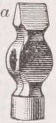
2. The sharp-edged end of the head of a mason's hammer.
To draw, bend, or straighten, as metal, by blows with the peen of a hammer or sledge.
1. First appearance; as the peep of day.
3. The cry of a chicken.
1. To begin to appear; to make the first appearance; to issue or come forth from concealment, as through a narrow avenue.
2. I can see his pride
3. PEEP through each part of him.
4. When flowers first peeped--
6. A fool will peep in at the door.
7. Thou are a maid and must not peep
2. First outlook or appearance.
2. To begin to appear; to look forth from concealment; to make the first appearance.
1. PEE'P-HOLE
3. In familiar language, the eye.
No thesaurus entries found for "PEE".
King James Bible KJV Bible
Berean Standard Bible BSB Bible
6 KJV and 6 BSB verses contain “PEE”
And he set the rods which he had pilled before the flocks in the gutters in the watering troughs when the flocks came to drink, that they should conceive when they came to drink.
Then he set the peeled branches in the watering troughs in front of the flocks coming in to drink. So when the flocks were in heat and came to drink,
My skin is black upon me, and my bones are burned with heat.
My skin grows black and peels, and my bones burn with fever.
And my hand hath found as a nest the riches of the people: and as one gathereth eggs that are left, have I gathered all the earth; and there was none that moved the wing, or opened the mouth, or peeped.
Son of man, Nebuchadrezzar king of Babylon caused his army to serve a great service against Tyrus: every head was made bald, and every shoulder was peeled: yet had he no wages, nor his army, for Tyrus, for the service that he had served against it:
“Son of man, Nebuchadnezzar king of Babylon caused his army to labor strenuously against Tyre. Every head was made bald and every shoulder made raw. But he and his army received no wages from Tyre for the labor they expended on it.