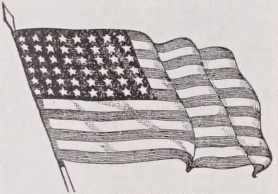
FLAG. It is probable that almost as soon as men began to collect together for common purposes some kind of conspicuous object was used, as the symbol of the common sentiment, as the rallying point of the common force. In military expeditions where any degree of organization and discipline prevailed, objects of such a kind would be necessary to mark out the lines and stations of encampment, and to keep in order the different bands when marching or in battle. And, in addition to all this, it cannot be doubted that flags or their equivalents have often served, by reminding men of past resolves, past deeds, past heroes, to rally to enthusiasm those sentiments of espιfit de corps, of family pride and honour, of personal devotion, patriotism, or religion, upon which, as well as upon good leadership, discipline, and numerical force, success in warfare depends....
Among the remains of that people which has left the earliest traces of civilization, the records of the forms of objects used as ensigns are frequently to be found. From their carvings and paintings, supplemented by ancient writers, it appears that the several companies of the Egyptian army had their own particular standards. These were formed of such objects as there is reason to believe were associated in the minds of the men with feelings of awe and devotion. Sacred animals, boats, emblems, or figures, a tablet bearing a king’s name, fan and feathershaped symbols, were raised on the end of a staff as standards, and the office of bearing them was looked upon as one of peculiar privilege and honour (fig. 1). Some-vshat similar seem to have been the customs of the Assyrians and Jews. Among the sculptures unearthed by Layard and others at Nineveh, only two different designs have been noticed for standards; one is of a figure drawing a bow and standing on a running bull, the other of two bulls running in opposite directions (fig. 2). These, says Layard, Mr Birch supposes may resemble the emblems of war and peace which were attached to the yoke of Darius’s chariot. They are borne upon and attached to chariots, which method of bearing these objects was the custom also of the Persians, and prevailed during the Middle Ages. No representations of Egyptian or Assyrian naval standards have been found, but the sails of ships were embroidered and ornamented with devices, which was also a custom during the Middle Ages. In both Egyptian and Assyrian examples, the staff bearing the emblem is frequently ornamented immediately below with flag-like streamers. Rabbinical writers have assigned the different devices of the different Jewish tribes, but the authenticity cf their testimony is extremely doubtful. Banners, standards, and ensigns are frequently mentioned in the Bible. “Everyman of the children of Israel shall pitch by his standard, with the ensign of their father’s house” (Num.
ii. 2). “Who is she that looketh forth as the morning, fair as the moon, clear as the sun, and terrible as an army with banners?” (Cant. vi. 10). See also Num. ii. 10, x. 14; Ps. XX. ö, lx. 4; Cant. ii. 4; Is. v. 26, x. 18, lix. 19; Jer. iv. 21.
The Persians bore an eagle fixed to the end of a lance, and also represented the sun, as their divinity, upon their standards, which appear to have been formed of some kind of textile, and were guarded with the greatest jealousy by the bravest men of the army. The Carian soldier who slew Cyrus, the brother of Artaxerxes, was allowed the honour of carrying a golden cock at the head of the army, it being the custom of the Carians to wear that bird as a crest on their helmets. The North American Indians carried poles fledged with feathers from the wings of eagles, and similar customs seem to have prevailed among other semi-savage peoples.
The Greeks bore a piece of armour on a spear in early times; afterwards the several cities bore sacred emblems or letters chosen for their particular associations,—the Athenians the olive and the owl, the Corinthians a pegasus, the Thebans a sphinx, in memory of Oedipus, the Messenians their initial Μ, and the Lacedaemonians A. A purple dress was placed on the end of a spear as the signal to advance. The Dacians carried a standard representing a contorted serpent, while the dragon was the military sign of many peoples,—of the Chinese, Dacians, and Parthians among others,—and was probably first used, by the Romans as the ensign of barbarian auxiliaries (see fig· 3 )∙
The question of the signa militaria of the Romans is a wide and very important one, having direct bearing on the history of heraldry, and on the origin of national, family, and personal devices. With them the custom was reduced to system. “Each century, or at least each maniple,” says Meyrick, “had its proper standard and standard-bearers.” In the early days of the republic a handful of hay was borne on a pole, whence probably came the name manipulus. The forms of standards in later times were very various; sometimes a cross piece of wood was placed at the end of a spear and surmounted by the figure of a hand in silver, below round or oval discs, with figures of Mars or Minerva, or in later times portraits of emperors or eminent generals (fig. 3). Figures of animals, as the wolf, horse, bear, and others, were borne, and it was not until after the time of Marius that the eagle became the special standard of the legion; the vexillum was a square piece of cloth fastened to a piece of wood fixed crosswise to the end of a spear, somewhat resembling the mediaeval gonfalon. The labarum of later emperors was similar in shape and fixing, and after Constantine bore the monogram of Christ (fig. 5, A). The Roman standards were guarded with religious veneration in the temples at Rome; and the reverence of this people for their ensigns was in proportion to their superiority to other nations in all that tends to success in war. It was not unusual for a general to order a standard to be cast into the ranks of the enemy, to add zeal to the onset of his soldiers by exciting them to recover what to them was perhaps the most sacred thing the earth possessed. The Roman soldier swore by his ensign.
Although in earlier times drapery was occasionally used for standards, and was often appended as ornament to those of other material, it was probably not until the Middle Ages that it became the special material of military and other ensigns; and perhaps not until the practice of heraldry had attained to definite nomenclature and laws does anything appear which is in the modern sense a flag.
The Bayeux tapestry, commemorating the Norman conquest of England, contains abundant representations of the flags of the period borne upon the lances of the knights of William’s army. They appear small in size, and pointed, frequently indented into three points, and bearing pales, crosses, and roundels. One, a Saxon pennon, is triangular, and roundly indented into four points; one banner is of segmental shape and rayed, and bears the figure of a bird which has been supposed to represent the raven of the warflag of the Scandinavian vikings (fig. 4). These flags and their charges are probably not really significant of the people bearing them; for even admitting that personal devices were used at the time, the figures may have been placed without studied intention, and so give the general figure only of such flags as happened to have come under the observation of the artists. The figures are probably rather ornamental and symbolic than strictly heraldic,—that is, personal devices, for the same insignia do not appear on the shields of the several bearers. The dragon standard which he is known to have borne is placed near Harold; but similar figures appear on the shields of Norman warriors, which fact has induced a writer in the Journal of the Archaeological Association (vol. xiii. p. 113) to suppose that, on the spears of the Saxons, they represent only trophies torn from the shields of the Normans, and that they are not ensigns at all. Standards in form much resembling these dragons appear on the arch of Titus and the Trajan column as the standards of barbarians.
At the battle of the Standard in 1138, the English standard was formed of the mast of a ship, having a silver pyx at the top, and bearing three sacred banners, dedicated severally to St Peter, St John of Beverley, and St Wilfred of Ripon, the whole being fastened to a wheeled vehicle. Representations of three-pointed, cross-bearing pennons are found on seals of as early date as the Norman era, and the warriors in the first crusade bore three-pointed pennons. It is possible that the three points with the three roundels and cross, which so often appear on these banners, have some reference to the faith of the bearers in the Trinity and in the crucifixion, for in contemporary representations of Christ’s resurrection and descent into hell he bears a three-pointed banner with cross above. The triple indentation so common on the flags of this period has been supposed to be the origin of one of the honourable ordinaries—the pile.
The powerful aid of religion seems ever to have been sought to give sanctity to national flags, and the origin of many can be traced to a sacred banner, as is notably the case with the oriflamme of France. The banner of William the Conqueror was sent to him by the pope, and the early English kings fought under the banners of Edward the Confessor and of St Edmund; while the clumsily blended crosses of St George, St Andrew, and St Patrick still form the national ensign of the three united kingdoms of England, Scotland, and Ireland, whose patron saints they severally were. More secular characters were, however, not uncommon. In 1244 Henry III. gave order for a “dragon to be made in fashion of a standard, of red silk sparkling all over with fine gold, the tongue of which should be made to resemble burning fire and appear to be continually moving, and the eyes of sapphires or other suitable stones. The Siege of Carlaverock, an Anglo-Norman poem of the 14th century, describes the heraldic bearings on the banners of the knights present with Edward I. at the siege of that fortress. Of the king himself the writer says—
“En sa bannière trois luparte De or tin estoient mis en rouge;” and he goes on to describe the kingly characteristics these may be supposed to symbolize. A MS. in British Museum (one of Sir Christopher Barker’s Heraldic Collection, Hart 4632) gives drawings of the standards of English kings from Edward III. to Henry VIII., which are roughly but artistically coloured.
The terms for describing a flag are the same as those applied in heraldry to the corresponding parts of a shield. The part of a flag furthest from the point of suspension is cιlled the “fly.” The principal varieties of flags borne during the Middle Ages were the pennon, the banner, and the standard; guydhommes, banderolls, pennoncells, streamers, <fcc., may be considered as minor varieties. The pennon (fig. 5, B) was a small personal ensign, pointed or swallow-tailed, borne below the lance-head of its owner, and charged with his armorial bearings in such a manner that they were in true position when the lance was held horizontally for action. It was a strictly personal flag, and was borne by every knight. Pennons were sometimes charged with the cross of St George in place of the personal bearings. A manuscript of the 16th century (Harl. 2358) in the British Museum, which gives minute particulars as to the size, shape, and bearings of standards, banners, pennons, guidhommes, pencells, &c., says—“A pennon must be two and a half yards long, made round at the end, and conteyneth the armes of the owner,” and warns that “from his standard or streamer a man may flee, but not from his banner or pennon bearing his arms,”
The banner (fig. 5, C) was generally about square in form, charged in a manner exactly similar to the shield of the owner, and borne by knights bannerets, and all above them in rank. The rank of knights bannerets was higher than that of ordinary knights, and they could be created on the field of battle only. It was the custom, after a battle, for the king or commander in person to honour a knight who had distinguished himself in the conflict, by tearing off the fly of his knightly pennon, thus creating it a banner and its bearer a banneret. The banner was not a personal ensign but that of a troop. Every baron, who in time of war had furnished the proper number of men to his liege, was entitled to charge with his arms the banner which they followed.
The standard (fig. 5, D) was a large, long flag, gradually tapering towards the fly, varying in size according to the rank of the owner, and generally divided fesse-wise. The shape was not, however, by any means uniform during the Middle Ages, nor were there any definite rules as to its charges It seems to have been first used by Edward III., the head of whose standard was charged as his shield of arms, and the fly powdered with fleurs-de-lis and lions. The Tudor manuscript mentioned above says of the royal standard of that time—“The standard to be sett before the king’s pavillion or tente, and not to be borne in battayle; to be in length eleven yards.” “Every standard and guydon to have in the chief the cross of St George, the beast or crest with his devyce and word, and to be slitt at the end.” The standard was always borne by an eminent person, aud that of Henry V. at Agincourt is supposed to have been carried upon a car, and to have preceded the king. The guidon borne by a leader of horse “must be two yards and a half or three yards long, and therein shall no armes be put, but only the man’s crest, cognizance, and devyce.” A streamer was a long, tapering flag, and “shall stand in the top of a ship or in the forecastle, and therein be put no armes but a man’s conceit or devyce, and may be of length 20, 30, 40, or 60 yards, and is slitt as well as a guydhomme or standard.” A pencil was a small streamer-like flag borne by an esquire.
The present royal standard of England was hoisted on the Tower, January 1, 1801, and is thus described:— Quarterly: first and fourth, gules, three lions passant gardant, in pale, or, for England; second, or, a lion rampant, gules, within a double tressure, flory counter flory of the last, for Scotland; third, azure, a harp or, stringed argent, for Ireland. On an escutcheon of pretence were charged the arms of the sovereign’s German dominions; but after the accession of Queen Victoria these were removed. This flag is displayed at the main whenever the sovereign or a member of the royal family is on board a ship, and is also hoisted over the royal residence. The Admiralty flag stands next to this in importance, and is red charged, fesse-wise, with an anchor and cable. The national ensign of the United Kingdom, the Union Jack, is the not altogether admirable result of an attempt to combine the several ensigns of the three countries. St George had long been the patron saint of England, and his banner, argent, a cross gules, its national ensign (fig. 6, A). St Andrew in the same way was the patron saint of Scotland, and his banner, azure, a saltire argent, the national ensign of Scotland (fig. 6, B), On the union of the two crowns, James I. issued a proclamation that “all subjects of this isle and the kingdom of Great Britain should bear in the main-top the red cross commonly called St George’s cross and the white cross commonly called St Andrew’s cross, joined together according to the form made by our own heralds.” This was the first Union Jack (fig. 6, D). After the union with Ireland in 1801 a new ensign was ordered to be prepared which should combine the cross of St Patrick, a saltire gules on a field argent (fig. 6, C), with the other two. The result was the “meteor flag of England,” the present Union Jack (fig. 6, E). It seems to have been produced in considerable contempt of heraldic rules, but excites no less enthusiasm, respect, and obedience on that account. The flag of the lord lieutenant of Ireland is the Union Jack, having in .the centre a blue shield charged with a golden harp.
The flags of the United States of America were very various before and after the Declaration of Independence; and even after the introduction of the stars and stripes, these underwent many changes in the manner of their arrangement before taking the position at present established. Historical events have also caused great changes in the standards and national ensigns of France. The ancient kings bore the blue hood of St Martin upon their standards, and this was succeeded by the oriflamme, which, originally, was simply the banner of the abbey of St Denis At what precise period it became the sacred banner of all France is not known, and even its appearance is very differently described in different writers. Guillaume Guiart in his chronicle says—
“Oriflambe est une bannière De cendal roujoiant et simple Sanz portraiture d’autre affaire.”
The oriflamme was succeeded in the 15th century by the white standard powdered with fleurs-de-lis, which itself gave place to the standard of the empire, and is the “cornette blanche” for which Chambord contends. The imperial standard was blue, bearing a golden eagle, and powdered with golden bees. The tricolor was introduced at the time of the Revolution, and is divided vertically into three parts, coloured blue, white, and red—the red to the fly, and the white in the middle. The origin of this flag and its colours is a disputed question. It is said by some to have been intended to combine the colours of the St Martin’s banner, of the oriflamme, and of the white flag of the Bourbons; by others the colours are said to be those of the city of Paris; and other authorities assert that the flag is copied from the shield of the Orleans family as it appeared after Philip Égalité had knocked off the fleurs-de-lis. The present standards and ensigns of existing states are shown in Plate 1
In the British army the standards of the cavalry are the same in colour as the regimental facings; they bear the insignia, cipher, number, and honours of the regiment, and are richly ornamented. Those of the household cavalry bear on a crimson field the royal insignia. The colours of each infantry regiment are two in number—the queen’s colour and the regimental colour. The former is the Union Jack variously charged, the latter is in colour like the regimental facings, and is charged with the honours, <fcc., of the corps. The queen’s colour of the-foot guards, however, is crimson, and its regimental colour the Union Jack. The royal artillery and the rifles have no colours.
Until 1864 the ships of the British navy bore three different ensigns. In that year, however, her Majesty prescribed the discontinuance of the division of flag officers into those of the red, blue, and white squadrons, and ordered that the white ensign, with its broad and narrow pendants, should be thenceforward established as the colours of the royal naval service, reserving the use of the red and blue colours for special occasions. The white flag with St George’s cross is borne by admirals, vice-admirals, and rear-admirals on their respective masts. The blue ensigu is borne by ships in the service of public offices, and also under certain restrictions by such ships as are commanded by officers of the naval reserve. The red ensign is borne by all other British ships. Yacht clubs are allowed, however, certain privileges; they mostly carry the blue ensign with characteristic burgees. An admiral’s flag is displayed at the main, a vice-admiral’s at the fore, and a rear-admiral’s at the mizen truck. Flag officer is another name for admiral, and the flag ship in a fleet is the one carrying the admiral’s flag.
At sea the striking of the flag denotes surrender, and the flag of one country being placed over that of another denotes the victory of the former. A yellow flag denotes quarantine. The universally understood flag of truce is pure white.
Flags would obviously suggest themselves for use as siguals, and have no doubt always more or less served for the purpose. The numerical...