
The female of any kind of fowl; but it is particularly applied to the female of the domestic fowl of the gallinaceous kind, or as sometimes called, the barn-door fowl.
Word of the Day: Catachrestical
Hen
Watson's Biblical & Theological Dictionary
ὄρνις, 2 Esdras i, 30; Matt. xxiii, 37; Luke xiii, 34. In these last two passages our Saviour exclaims, “O Jerusalem, Jerusalem, how often would I have gathered thy children together, even as a hen gathereth her chickens under her wings, and ye would not!” The metaphor here used is a very beautiful one. When the hen sees a bird of prey coming, she makes a noise to assemble her chickens, that she may cover them with her wings from the danger. The Roman eagle was about to fall upon the Jewish state; our Lord invited them to himself in order to guard them from threatened calamities: they disregarded his invitations and warnings, and fell a prey to their adversaries. The affection of the hen to her brood is so strong as to have become proverbial. There is a beautiful Greek epigram in the Anthologia, which affords a very fine illustration of the affection of this bird in another view. It has been thus translated:-- “Beneath her fostering wing the hen defends Her darling offspring, while the snow descends; And through the winter’s day unmoved defies The chilling fleeces and inclement skies; Till vanquish'd by the cold and piercing blast, True to her charge she perishes at last.” Plutarch, in his book _De Philostorgiâ_, represents this parental attachment and care in a very pleasing manner: “Do we not daily observe with what care the hen protects her chickens; giving some shelter under her wings, supporting others upon her back, calling them around her, and picking out their food; and if any animal approaches that terrifies them, driving it away with a courage and strength truly wonderful?”
Watson's Biblical & Theological Dictionary
[276 words — estimated reading time: 2 minutes]
[276 words — estimated reading time: 2 minutes]
Hen ry vi
Encyclopedia Britannica
HEN RY VI. (1421-1471), king of England, only son of Henry V. and Catherine of France, was born on December G, 1421, and was therefore only eight months old at his father’s death. He can hardly be said ever to have reigned, for his long minority passed into another kind of tutelage, during which the influence of his wife and favourites prepared the way for civil war. Ten years of anarchy culminated in his dethronement, and ten years more of wandering and imprisonment fill the interval between that event and his death. The chief interest of the first thirty years of his life lies in watching the decay of English power in France; that of the last twenty is to be found in the civil wars which resulted from the misgovernment of the preceding period. Although the English had lost some ground towards the end of Henry V.’s reign, their position, when the duke of Bedford undertook the task of continuing his brother’s work, was very favourable. They held the north and centre of France, while Burgundy held the eastern districts. The alliance with Duke Philip was strengthened by a marriage between his sister Anne and the duke of Bedford. The Scotch king, James I., was released from captivity, in order that England might be relieved from danger on that side. Thus strengthened, Bedford was able to apply himself vigorously to the conquest of France, towards which the battle of Verneuil (1424) was an important step. But the English cause had already received its first great blow in the marriage of the duke of Gloucester with Jacqueline of Hainault, which destroyed the good understanding between Burgundy and England. Bedford for the time managed to stave off the quarrel, and after renewing his union with Burgundy, laid siege to Orleans, the key of southern France. The capture of ...the town seemed certain, when the appearance of Joan of Arc turned the scale. The relief of Orleans (1429) was followed by other French successes, and by the coronation of Charles VII. at Rheims. The capture of Joan did little for England, for the spirit she had inspired survived her loss, and her death (May 1431) only nerved the French to fresh efforts. It was in vain that Bedford had Henry crowned at Paris (December 17, 1431). · The young king remained in France nearly two years (April 1430 to February 1432), but his presence did not turn the tide of French success. On the side of England the supply of men and money was falling short, while on that of France a new type of commanders was coming to the front, who were not inclined to repeat the disastrous blunders of Crécy and Agincourt. The death of Bedford’s wife (November 1432) broke the link that bound Burgundy to England, and negotiations for peace were set on foot. These culminated in a great congress at Arras (July 1435), but the demands of the two countries were found incompatible, and the war was renewed. Bedford’s death (September 14, 1435) finally destroyed all hope of recovery in France. Burgundy at once made peace with Charles VII., and the English commanders who succeeded Bedford were constantly defeated. Paris was retaken, Normandy overrun. Repeated efforts on the part of England led only to further exhaustion. Meanwhile negotiations for peace had been continued at intervals, and led in 1414 to a truce, during which Henry was married (April 22, 1445) to Margaret, daughter of René of Anjou. It was hoped that this marriage, together with the cession of Anjou and M line, would lead to a permanent peace, and save Normandy and Guienne. But though Anjou and Maine were actually surrendered in 1448, the truce was broken next year, and before the end of 1450 the whole of Normandy was lost. In 1451 Guienne was reconquered by the French, and in 1453 Calais alone remained to England. The war was practically at an end.
Its conclusion coincides with the period when the two parties that divided England were just about to appeal to arms. The civil war was in great measure the result of the defeats abroad, as those defeats themselves were in part the consequence of discord at home. Quarrels between the chief members of the reigning house were the origin of its weakness; financial embarrassment, a divided foreign policy, and a feeble administration brought disgrace on the king and his advisers; family feuds and a long tale of mutual injuries added bitterness to political differences. Eventually an outburst of popular discontent kindled the train so long prepared, and the champion of order and good government began a struggle in which the original objects were soon lost sight of, and which ended only with the death of the king whose innocent imbecility had caused the disorder. To check the rivalry of Henry’s uncle, the duke of Gloucester, and his great-uncle, Cardinal Beaufort, was beyond the power of the council. Bedford alone could appease the quarrel, and Bedford’s presence in England meant disaster in France. The quarrel between them and their adherents was complicated by the existence of the Lollards, and the question of peace or war. In both matters Gloucester, as persecutor of the Lollards and head of the war-party, appears to have taken the more popular side. The coronation of the young king at Westminster (November 6, 1429) put a formal end to the regency of Bedford and Gloucester, but not to the intrigues of the latter. The House of Commons was unable to interfere with any effect; the Lords were mostly engaged on one side or the other. The death of Bedford removed the only guarantee of peace, and Gloucester attacked Beaufort with more virulence than ever after his brother’s death. In the midst of these troubles Henry VI. came of age (1442). Had he been a great statesman, he would have found an almost hopeless task before him. But, unfit as he felt himself to be, he naturally shrunk from politics, and was much more intent on completing his foundations at Eton and Cambridge than on healing the disorders of his country. The work of government was left mainly in the hands of Cardinal Beaufort and the earl of Suffolk, who did their best to secure peace with France. On the other side the dukes of Gloucester and York headed the opposition, and took up the cry of reform, with the object of infusing vigour into the government at home and abroad. Suffolk, however, won a great victory in the truce with France (1444); and through the young queen Margaret, whose marriage was chiefly due to his exertions, he obtained complete influence over the king. The suspicious death of Gloucester (1447), followed in six weeks by the death of his rival Beaufort, together with the appointment of York to the governorship of Ireland, left Suffolk master of the situation. But such a position could not be long maintained in the face of the odium which always attaches to a favourite, and the complete failure of his foreign policy brought about his fall (1450). The king in vain attempted to save him, and by so doing shared his unpopularity, while the partial concessions he made to the demands of the rebels under Jack Cade only postponed the inevitable outbreak. The duke of York now made himself the mouthpiece of popular discontent. When the final loss of France had exhausted the country’s patience, and the birth of an heir to the throne had destroyed his hope of the succession, he took advantage of Henry’s mental derangement to claim the protectorate (1453). It was granted him early next year, but in 1455 the king recovered his senses, and York was deprived of power. Unable to endure this he marched on London, and on May 22, 1455, the Wars of the Roses began in the battle of St Albans. The effect of the battle was to bring the queen to the front as the leader of the royalists, and to make the quarrel between her and York irreconcilable. During the four years of uneasy quiet which followed the first collision, Henry tried hard to keep the peace. But all his efforts were vain. When the struggle broke out anew, and the Yorkists won the battle of Northampton, he was forced to consent to an arrangement by which his son w as excluded from the succession and York recognized as heir to the kingdom (1460). The settlement was of short duration. York himself lost his life at Wakefield, but his son seized the crown and was acknowledged king (March 4, 1461). The battle of Towton brought the struggle to an end for ten years, and the capture of Henry in 1465 seemed to secure Edw ard IV. on the throne. Five years later a sudden revolution hurled him from it, and restored the wretched prisoner for a while to liberty, but the battle of Barnet destroyed his hopes again. He had time to know that his son had died at Tewkesbury, that his> wife was a prisoner, and that his cause was finally lost, before death released him from captivity on May 21, 1471. Gentle, pure, and generous, full of good intentions, enthu> siastic in the cause of religion and learning, he was utterly without the qualities which were indispensable to a mediaeval king, and he paid the penalty of incapacity in a miserable death and in the destruction of his house. But this very incapacity was an element of the utmost importance in the history of his time. The weakness of his character made him the puppet of contending factions, and his well-meant but misguided efforts to govern England as a constitutional king led only to anarchy and the temporary downfall of the constitution.
Original Authorities for the above three reigns.— Thomas of Walsingham, Hist. Anglicana, and Ypodigma Neustrioe; Annales Henrici Quarti ; Continuatio Eulogii Historiarum ; Chronique de JVaurin; Annals of St Alban's Abbey, by John of Amundeshaιn and John Whethamstede; Royal and Historical Letters (Henry I Vf, Capgrave’s Chronicle of England, and Liber de Illustribus Henricis; Memorials of Henry V. (Redman, &c.); Letters, Ac., illustrative of the reign of Henry VI.; Political Poems. All the above, are published in the Rolls series. Also, Henrici V. Reg. Angl. Gcsta (Eng. Hist. Soc. ); lives of Henry V., by T. Livius Forojuliensis and Thomas Elmham (ed. Hearne); English Chronicle of the reigns of Henry IV., &c., and Letters of Margaret of Anjou, &c. (both in Camd. Soc.); Chronicles of Hardyng, Otterbourιιe, Adam of Usk, Fabyan, Hall; the Paston Letters (pd. Gairdner); Original Letters illustrative of Eng. Hist. (ed. Ellis); Rolls of Parliament·, Proceedings, Ac., of the Privy Council (ed. Nicolas).
Modern Authorities.— Besides those already given above, Nicolas’s History of the Battle of Agincourt ; Gairdner’ & Preface to the Paston Letters.
9th ed. Encyclopædia Britannica, vol. 11, p. 660 — signed G. W. P.
[1,818 words — estimated reading time: 11 minutes]
[1,818 words — estimated reading time: 11 minutes]
An umbelliferous plant (Caucalis daucoides).
A plant, the Hyoscyamus, of several species. The roots, leaves and seeds are poisonous.
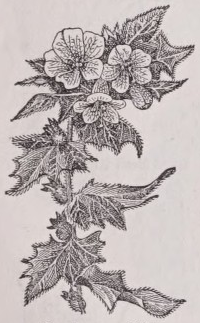
A plant of the genus Hyoscyamus (H. niger). All parts of the plant are poisonous, and the leaves are used for the same purposes as belladonna. It is poisonous to domestic fowls; whence the name. Called also, stinking nightshade, from the fetid odor of the plant. See Hyoscyamus.
Henbane
Encyclopedia Britannica
HENBANE (in French, jusquiaume, from the Greek hyoscyamus, or hog’s-bean; in Italian, giusquiamo; and in German, Schwarzes Bilsenkraut, Hühnertod, Saubohne, and Zigeτvner-Korη or “gipsies’ corn ”) is the common name of the Hyoscyamus niger, a Solanaceous plant indigenous to Britain, found wild in waste places, on rubbish about villages and old castles, and cultivated for medical use at Mitcham and other places in Surrey, and in Bedfordshire, Cambridgeshire, and Hereford. It occurs also in central and southern Europe and in western Asia, and has long been naturalized in the United States. There are two forms of the plant, an annual and a biennial, which spring indifferently from the same crop of seed,—the one growing on during summer to a height of from 1 to 2 feet, and flowering and perfecting seed; the other producing the first season only a tuft of radical leaves, which disappear in winter, leaving underground a thick fleshy root, from the crown of which arises in spring a branched flowering stem, usually much taller and more vigorous than the flowering stems of the annual plants. The biennial form is that which is considered officinal. The radical leaves of this biennial plant spread out flat on all sides from the crown of the root; they are ovate-oblong, acute, stalked, and more or less incisely-toothed, of a greyish-green colour, and covered with viscid hairs; these leaves perish at the approach of winter. The flowering stem pushes up from the root-crown in spring, ultimately reaching from 3 to 4 feet in height, and as it grows becoming branched, and furnished with alternate sessile leaves, which are stem-clasping, oblong, unequally-lobed, clothed with glandular clammy hairs, and of a dull grey-green, the whole plant having a powerful nauseous odour. ...The flowers are shortly-stalked, the lower ones growing in the fork of the branches, the upper ones sessile in one-sided leafy spikes which are rolled back at the top before flowering, the leaves becoming smaller upwards and taking the place of bracts. The flowers have an urceolate calyx which persists around the fruit and is strongly veined, with five stiff, broad, almost prickly lobes; these, when the soft matter is removed by maceration, form very elegant specimens when associated with leaves prepared in a similar way. The corollas are obliquely funnel-shaped, of a dirty yellow or buff, marked with a close reticulation of purple veins. The capsule opens transversely by a convex lid, and contains numerous seeds. Both the leaves and the seeds are employed in pharmacy. The Mahometan doctors of India are accustomed to prescribe the seeds. Henbane yields a poisonous alkaloid, hyoscyamine, which is stated to have properties almost identical with those of atropine, from which it differs in being more soluble in water. It is usually obtained in an amorphous, scarcely ever in a crystalline state. Its properties have been investigated in Germany by Husemann, Schroff, Höhn, &c. Höhn finds its chemical composition expressed by C 18 H 28 N 2 O 3 . (Compare Hellmann, Beiträge zur Kenntniss der physiolog. Wirkung des Hyoscyamins, <tc., Jena, 1874.) In small and repeated doses henbane has been found to have a tranquillizing effect upon persons affected by severe nervous irritability. In poisonous doses it causes loss of speech, distortion, and paralysis. In the form of extract or tincture it is a valuable remedy in the hands of a medical man, either as an anodyne, a hypnotic, or a sedative. The extract of henbane is rich in nitrate of potassium and other inorganic salts. The smoking of the seeds and capsules of henbane is noted in books as a somewhat dangerous remedy adopted by country people for toothache. Accidental poisoning from henbane occasionally occurs, owing sometimes to the apparent edibility and wholesomeness of the root.
9th ed. Encyclopædia Britannica, vol. 11, p. 650
[640 words — estimated reading time: 4 minutes]
[640 words — estimated reading time: 4 minutes]
3. A kind of hawk.
1. hens.
2. From this place.
3. Arise, let us go hence John 14:31 .
4. I will send thee far hence to the Gentiles. Acts 22:21 .
5. From this time; in the future; as a week hence; a year hence
6. From this cause or reason, noting a consequence, inference or deduction from something just before stated.
7. HENCE perhaps it is, that Solomon calls the fear of the Lord, the beginning of wisdom.
8. It sometimes denotes an inference or consequence, resulting from something that follows.
9. Whence come wars and fightings among you?
10. Come they not hence even from your lusts-- James 4:1 .
11. From this source or original.
12. All other faces borrowed hence--
13. HENCE signifies from this, and from before hence is not strictly correct. But from hence is so well established by custom, that it may not be practicable to correct the use of the phrase.
14. HENCE is used elliptically and imperatively, for go hence; depart hence; away; be gone.
15. HENCE , with your little ones.
16. HENCE , as a verb, to send off, as used by Sidney, is improper.
1. From this place; away.
2. From this time; in the future; as, a week hence.
3. From this reason; as an inference or deduction.
4. From this source or origin.
To send away.
1. hens'forth. From this time forward.
2. I never from thy side henceforth will stray.
From this time forward; henceforward.
hensfor'ward. From this time forward; henceforth.
From this time forward; henceforth.
A page; a servant.
A page; a servant.
1. HENCH'MAN
2. HEND
3. HENDEC'AGON, noun [Gr. eleven, and an angle.] In geometry, a figure of eleven sides, and as many angles.
2. Friendly; civil; gentle; kind.
A plane figure of eleven sides and eleven angles.
A hydrocarbon, C11H24, of the paraffin series; -- so called because it has eleven atoms of carbon in each molecule. Called also endecane, undecane.
Pertaining to a line of eleven syllables.
A metrical line of eleven syllables.
A metrical line of eleven syllables.
Henderson
Encyclopedia Britannica
HENDERSON, Alexander (1583-1646), a celebrated Scottish ecclesiastic, was born in 1583. He was educated at the university of St Andrews, where he -was appointed professor of rhetoric and philosophy and questor of the faculty of arts in 1610. A year or two after this he was presented to the living of Leuchars by Archbishop Glad-stanes. As Henderson was forced upon his parish by an archbishop, and as he was known to sympathize with Episcopacy, his settlement was at first extremely unpopular; but he subsequently changed his views, and became a Presbyterian in doctrine and church government, and one of the most esteemed ministers in Scotland. He early made his mark as a church leader, and took an active part in petitioning against Episcopal innovations. On the 1st of March 1638 the public signing of the “National Covenant” began in Greyfriars Church, Edinburgh. Henderson is mainly responsible for this document; and he seems always to have been applied to when any manifesto of unusual ability was required. In July of the same year he proceeded to the north, to debate on the “Covenant” with the famous Aberdeen doctors; but he was not well received by them. “The voyd church was made fast, and the keys keeped by the magistrate,” says Baillie. Henderson’s next public appearance was in the famous Assembly which met in Glasgow on the 21st of November 1638. He was chosen moderator by acclamation, being, as Baillie says, “incomparablie the ablest man of us all for all things.” The marquis of Hamilton was the king’s commissioner; and, when the Assembly insisted on proceeding with the trial of the bishops, he formally dissolved the meeting under pain of treason. Nothing daunted, however, they sat till the 20th of December, deposed all the Scottish bishops, ...excommunicated a number of them, repealed all acts favouring Episcopacy, and reconstituted the Scottish Kirk on thorough Presbyterian principles. During the sitting of this Assembly it was carried by a majority of seventy-five votes that Henderson should be transferred to Edinburgh. He had been at Leuchars for about twenty-three years, and was extremely reluctant to leave it. λVhile Scotland and England were preparing for the “First Bishops’ War,” Henderson drew up two papers, entitled respectively— The Remonstrance of the Nobility, and Instructions for Defensive Arms. The first of these documents he published himself; the second was published against his wish by Corbet, a deposed minister. The “First Bishops’ War” did not last long. At the Pacification of Birks the king had virtually to grant all the demands of the Scots. In the negotiations for peace Henderson was one of the Scottish commissioners, and made a very favourable impression on the king. In 1640 Henderson was elected by the town council rector of Edinburgh university—an office to which he was annually re-elected till his death. The Pacification of Birks had been wrung from the king; and the Scots, seeing that he was preparing for the “Second Bishops’ War,” took the initiative, and pressed into England so vigorously that Charles had again to yield everything. The maturing of the treaty of peace took a considerable time; and Henderson was again active in the negotiations, first at Ripon, and afterwards at London. While he was in London he had a personal interview with the king, with the view of obtaining assistance for Edinburgh university from the money formerly applied to the support of the bishops. On Henderson’s return to Edinburgh in July 1641, the Assembly was sitting at St Andrews. To suit the convenience of the parliament, however, it removed to Edinburgh; and Henderson was elected moderator of the Edinburgh meeting. In this Assembly he proposed that “a confession of faith, a catechism, a directory for all the parts of the public worship, and a platform of government, wherein possibly England and we might agree,” should be drawn up. This was unanimously approved of, and the laborious undertaking was left in Henderson’s hands; but the “notable motion” did not lead to any immediate results. During Charles’s second state-visit to Scotland, in the autumn of 1641, Henderson acted as his chaplain, and managed to get the funds, formerly belonging to the bishopric of Edinburgh, applied to the metropolitan university. In 1642 Henderson was engaged in corresponding with England on ecclesiastical topics; and, shortly afterwards, he went to Oxford to mediate between the king and his parliament; but his mission proved a failure. A memorable meeting of the General Assembly was held in August 1643. Henderson was elected moderator for the third time. He presented a draft of the famous “Solemn League and Covenant,” which was received with great enthusiasm. Unlike the “National Covenant” of 1638, which applied to Scotland only, this document was common to the two kingdoms. Henderson, Baillie, Rutherford, and others were sent up to London to represent Scotland in the Assembly at Westminster. The “Solemn League and Covenant,” after undergoing some slight alterations, passed the two Houses of Parliament and the Westminster Assembly, and thus became law for the two kingdoms. By means of it Henderson has had an extraordinary influence on the history of Great Britain. As Scottish commissioner to the Westminster Assembly, he was in England from August 1643 till August 1646; and the action of the Scottish commissioners gave a fresh impulse to English Presbyterianism. Early in 1645 Henderson was sent to Uxbridge to aid the commissioners of the two parliaments in negotiating with the king; but nothing came of the conference. In 1646 the king joined the Scottish army; and, after retiring with them to Newcastle, he sent for Henderson, and discussed with him the two systems of church government in a number of papers. Meanwhile Henderson was failing in health. He sailed to Scotland, and eight days after his arrival died on the 19th of August 1646. He was buried in Greyfriars Churchyard, Edinburgh; and his death was the occasion of national mourning in Scotland. An absurd story was at once invented to the effect that, after recanting to the king’s views, he had died of remorse. A document was forged, purporting to be a “Declaration of Mr Alexander Henderson;” and, although this paper was disowned, denounced, and shown to be false in the General Assembly of August 1648, the fiction was used by Clarendon, and still finds a place in professedly historical compilations.
Henderson is one of the greatest men in the history of Scotland, and, next to Knox, is certainly the most famous of Scottish ecclesiastics. He had great political genius; and his statesmanship was so influential that “he was,” as Professor Masson well observes, “a cabinet minister without office.” He has made a deep mark on the history, not only of Scotland, but of England; and the existing Presbyterian Churches in Scotland are largely indebted to him for the forms of their dogmas and their ecclesiastical organization. He is thus justly considered the second founder of the Reformed Church in Scotland.
For further information about Henderson reference may be made to M i Crie ’ s Life of Alexander Henderson, 1846; Alton’s Life and Times of Alexander Henderson, 1836; The Letters and Journals of Robert Baillie, 1841-2 (an exceedingly valuable work, from an historical point of view); Burton’s History of Scotland·, Masson’s Life of Drummond of Hawthornden∙, and, above all, Masson’s Life of Milton.
HENDERSON, Ebenezer, Scottish dissenting minister and theological and miscellaneous writer, was born at the Linn near Dunfermline, November 17, 1784, and died at Mortlake, May 17, 1858. He was the youngest son of an agricultural labourer, and after three years’ schooling spent some time at watchmaking and as a shoemaker’s apprentice. In 1803 he joined Mr Robert Haldane’s theological seminary, and in 1805 was selected to accompany the Rev. John (afterwards Dr) Paterson to India; but as the East India Company would not allow British vessels to convey missionaries to India, Henderson and his colleague went to Denmark to await the chance of a passage to Serampore. Being unexpectedly delayed, they ultimately decided to settle in Denmark, and in 1806 Henderson was fixed at Elsinore. From this time till about 1817 he was engaged in encouraging the distribution of Bibles in the Scandinavian countries, and in the course of his labours he visited Sweden and Lapland (1807-8), Iceland (1814-15), and the mainland of Denmark and part of Germany (1816). During most of this time he was an agent of the British and Foreign Bible Society. In 1818, after a visit to England, he travelled in company with Dr Paterson through Russia as far south as Tiflis, but, instead of settling as was proposed at Astrakhan, he had to retrace his steps, having resigned his connexion with the Bible Society. In 1822 he was invited by Prince Alexander Galitzin to assist the Russian Bible Society in translating the Scriptures into various languages spoken in the Russian empire. After twenty years of foreign labour Henderson returned to England, and in 1825 was appointed tutor of the Mission College, Gosport. In 1830 he succeeded Dr William Harrison as theological lecturer and professor of Oriental languages in Highbury Congregational College, and though in 1850, on the amalgamation of the colleges of Homerton, Coward, and Highbury, he was excluded from office through age, he was pastor in 1852-53 of a chapel at Mortlake. His last work was a translation of the book of Ezekiel. Henderson was a man of great linguistic attainment: in the course of his labours he made himself more or less acquainted, not only with the ordinary languages of scholarly accomplishment and the various members of the Scandinavian group, but also with Hebrew, Syriac, Ethiopie, Russian, Arabic, Tatar, Persic, Turkish, Armenian, Manchoo, Mongolian, and Coptic. He organized the first Bible Society in Denmark (1814), and paved the way for several others. In 1817 he was nominated by the Scandinavian Literary Society a corresponding member; and in 1840 he was made D.D. by the university of Copenhagen. He was honorary secretary for life of the Religious Tract Society, and one of the first promoters of the British Society for the Propagation of the Gospel among the Jews. The records of his travels in Iceland (1818) were valuable contributions to our knowledge of that island. His other principal works are Biblical Researches and Travels in Russia (1826), Divine Inspiration (1836), and annotated translations of Isaiah (1840, 1857), the twelve minor prophets (1845), and Jeremiah (1851).
See Memoirs of Ebenezer Henderson, by Thulia S. Henderson (his daughter), London, 1859.
9th ed. Encyclopædia Britannica, vol. 11, p. 651 — signed T. GI.
[1,232 words — estimated reading time: 8 minutes]
[1,232 words — estimated reading time: 8 minutes]
A figure, when two nouns are used instead of a noun and an adjective.
Animal Roget’s Thesaurus §366
N. animal, animal kingdom, fauna, brute creation, beast, brute, creature, critter, wight, created being, creeping thing, living thing, dumb animal, dumb creature, zoophyte, mammal, bird, reptile, amphibian, fish, crustacean, shellfish, mollusk, worm, insect, arthropod, microbe, microbe, animalcule, alligator, crocodile, saurian, dinosaur, snake, serpent, viper, eft, asp, aspick, frog, toad, trout, bass, tuna, muskelunge, sailfish, sardine, mackerel, ant, mosquito, bee, honeybee, tardigrade, spider, biped, quadruped, flocks and herds, live stock, domestic animals, wild animals, game, ferae naturae, beasts of the field, fowls of the air, denizens of the sea, black game, black grouse, blackcock, duck, grouse, plover, rail, snipe, horse, cattle, kine, ox, bull, bullock, cow, milch cow, calf, heifer, shorthorn, sheep, lamb, lambkin, ewe, ram, tup, pig, swine, boar, hog, sow, steer, stot, tag, teg, bison, buffalo, yak, zebu, dog, cat, dog, hound, pup, puppy, whelp, cur, mongrel, house dog, watch dog, sheep dog, shepherd's dog, sporting dog, fancy dog, lap dog, toy dog, bull dog, badger dog, mastiff, blood hound, grey hound, stag hound, deer hound, fox hound, otter hound, harrier, beagle, spaniel, pointer, setter, retriever, newfoundland, water dog, water spaniel, pug, poodle, turnspit, terrier, fox terrier, skye terrier, dandie dinmont, collie, feline, puss, pussy, grimalkin, gib cat, tom cat, fox, reynard, vixen, stag, deer, hart, buck, doe, roe, caribou, coyote, elk, moose, musk ox, sambar, bird, poultry, fowl, cock, hen, chicken, chanticleer, partlet, rooster, dunghill cock, barn door fowl, feathered tribes, feathered songster, singing bird, dicky bird, canary, warbler, finch, aberdevine, cushat, cygnet, ringdove, siskin, swan, wood pigeon, vermin, varmint, pest
Adj. animal, zoological equine, bovine, vaccine, canine, feline, fishy, piscatory, piscatorial, molluscous, vermicular, gallinaceous, rasorial, solidungulate, soliped
Woman Roget’s Thesaurus §374
N. woman, she, her, female, petticoat, # feminality, muliebrity, womanhood, womankind, the sex, the fair, fair sex, softer sex, weaker vessel, dame, madam, madame, mistress, mrs. lady, donna belle, matron, dowager, goody, gammer, frau, frow, vrouw, rani, good woman, good wife, squaw, wife, matronage, matronhood, bachelor girl, new woman, feminist, suffragette, suffragist, nymph, wench, grisette, girl, sissy, betty, cot betty, cotquean, henhussy, mollycoddle, muff, old woman, hen, bitch, sow, doe, roe, mare, she goat, nanny goat, tabita, ewe, cow, lioness, tigress, vixen, gynecaeum, estrogen, oestrogen, consanguinity, paternity, lesbian, dyke
V. feminize
Adj. female, she-, feminine, womanly, ladylike, matronly, maidenly, wifely, womanish, effeminate, unmanly, gynecic, gynaecic
Phr. "a perfect woman nobly planned", "a lovely lady garmented in white", das ewig-weibliche zieht uns hinan, "earth's noblest thing, a woman perfected", es de vidrio la mujer, "she moves a goddess and she looks a queen", "the beauty of a lovely woman is like music", varium et mutabile semper femina, "woman is the lesser man"
Pron. she, her, hers
King James Bible KJV Bible
Berean Standard Bible BSB Bible
81 KJV and 11 BSB verses contain “HEN” — showing the first 20. Show all 83 verses (searchable)
And the man said, They are departed hence; for I heard them say, Let us go to Dothan. And Joseph went after his brethren, and found them in Dothan.
“They have moved on from here,” the man answered. “I heard them say, ‘Let us go to Dothan.’” So Joseph set out after his brothers and found them at Dothan.
And Joseph took an oath of the children of Israel, saying, God will surely visit you, and ye shall carry up my bones from hence.
And Joseph made the sons of Israel take an oath and said, “God will surely attend to you, and then you must carry my bones up from this place.”
And the LORD said unto Moses, Yet will I bring one plague more upon Pharaoh, and upon Egypt; afterwards he will let you go hence: when he shall let you go, he shall surely thrust you out hence altogether.
Then the LORD said to Moses, “I will bring upon Pharaoh and Egypt one more plague. After that, he will allow you to leave this place. And when he lets you go, he will drive you out completely.
And Moses took the bones of Joseph with him: for he had straitly sworn the children of Israel, saying, God will surely visit you; and ye shall carry up my bones away hence with you.
Moses took the bones of Joseph with him because Joseph had made the sons of Israel swear a solemn oath when he said, “God will surely attend to you, and then you must carry my bones with you from this place.”
And the LORD said unto Moses, Depart, and go up hence, thou and the people which thou hast brought up out of the land of Egypt, unto the land which I sware unto Abraham, to Isaac, and to Jacob, saying, Unto thy seed will I give it:
Then the LORD said to Moses, “Leave this place, you and the people you brought up out of the land of Egypt, and go to the land that I promised to Abraham, Isaac, and Jacob when I said, ‘I will give it to your descendants.’
And he said unto him, If thy presence go not with me, carry us not up hence.
“If Your Presence does not go with us,” Moses replied, “do not lead us up from here.
Even all that the LORD hath commanded you by the hand of Moses, from the day that the LORD commanded Moses, and henceforward among your generations;
all that the LORD has commanded you through Moses from the day the LORD gave them and continuing through the generations to come—
And the LORD said unto me, Arise, get thee down quickly from hence; for thy people which thou hast brought forth out of Egypt have corrupted themselves; they are quickly turned aside out of the way which I commanded them; they have made them a molten image.
And the LORD said to me, “Get up and go down from here at once, for your people, whom you brought out of Egypt, have corrupted themselves. How quickly they have turned aside from the way that I commanded them! They have made for themselves a molten image.”
But he shall not multiply horses to himself, nor cause the people to return to Egypt, to the end that he should multiply horses: forasmuch as the LORD hath said unto you, Ye shall henceforth return no more that way.
But the king must not acquire many horses for himself or send the people back to Egypt to acquire more horses, for the LORD has said, ‘You are never to go back that way again.’
And those which remain shall hear, and fear, and shall henceforth commit no more any such evil among you.
Then the rest of the people will hear and be afraid, and they will never again do anything so evil among you.
And command ye them, saying, Take you hence out of the midst of Jordan, out of the place where the priests’ feet stood firm, twelve stones, and ye shall carry them over with you, and leave them in the lodging place, where ye shall lodge this night.
and command them: ‘Take up for yourselves twelve stones from the middle of the Jordan where the priests were standing, carry them with you, and set them down in the place where you spend the night.’”
I also will not henceforth drive out any from before them of the nations which Joshua left when he died:
I will no longer drive out before them any of the nations Joshua left when he died.
Depart not hence, I pray thee, until I come unto thee, and bring forth my present, and set it before thee. And he said, I will tarry until thou come again.
Please do not depart from this place until I return to You. Let me bring my offering and set it before You.” And the LORD said, “I will stay until you return.”
And Naaman said, Shall there not then, I pray thee, be given to thy servant two mules’ burden of earth? for thy servant will henceforth offer neither burnt offering nor sacrifice unto other gods, but unto the LORD.
“If you will not,” said Naaman, “please let me, your servant, be given as much soil as a pair of mules can carry. For your servant will never again make a burnt offering or a sacrifice to any other god but the LORD.
Where are the gods of Hamath, and of Arpad? where are the gods of Sepharvaim, Hena, and Ivah? have they delivered Samaria out of mine hand?
Where are the gods of Hamath and Arpad? Where are the gods of Sepharvaim, Hena, and Ivvah? Have they delivered Samaria from my hand?