1. OR , a termination of Latin nouns, is a contraction of vir, a man, or from the same radix. The same word vir, is in our mother tongue, wer, and from this we have the English termination er.
2. It denotes an agent, as in actor, creditor. We annex it to many words of English origin, as in lessor, as we do er to words of Latin and Greek origin, as in astronomer, laborer. In general, or is annexed to words of Latin, and er to those of English origin.
1. A connective that marks an alternative. 'You may read or may write; ' that is, you may do one of the things at your pleasure, but not both. It corresponds to either. You may either ride to London, or to Windsor. It often connects a series of words or propositions, presenting a choice of either. He may study law or medicine or divinity, or he may enter into trade.
2. OR sometimes begins a sentence, but in this case it expresses an alternative with the foregoing sentence. Matthew 7:4 and 9.
3. In poetry, or is sometimes used for either.
4. For thy vast bounties are so numberless, that them or to conceal or else to tell is equally impossible.
5. OR is often used to express an alternative of terms, definitions or explanations of the same thing in different words. Thus we say, a thing is a square, or a figure under four equal sides and angles.
6. OR ever. In this phrase, or is supposed to be a corruption of ere.
A particle that marks an alternative; as, you may read or may write, -- that is, you may do one of the things at your pleasure, but not both. It corresponds to either. You may ride either to London or to Windsor. It often connects a series of words or propositions, presenting a choice of either; as, he may study law, or medicine, or divinity, or he may enter into trade.
2. OR'ACLE, noun [Latin oraculum, from oro, to utter.]
3. Among pagans, the answer of a god or some person reputed to be a god, to an inquiry made respecting some affair of importance, usually respecting some future event, as the success of an enterprise or battle.
4. The deity who gave or was supposed to give answers to inquiries; as the Delphicoracle.
5. The place where the answers were given.
6. Among christians, oracles, in the plural, denotes the communications, revelations or messages delivered by God to prophets. In this sense it is rarely used in the singular; but we say, the oracles of God, divine oracles, meaning the Scriptures.
7. The sanctuary or most holy place in the temple, in which was deposited the ark of the covenant. 1 Kings 6:1 .
8. Any person or place where certain decisions are obtained.
9. Any person reputed uncommonly wise, whose determinations are not disputed, or whose opinions are of great authority.
10. A wise sentence or decision of great authority.
1. The answer of a god, or some person reputed to be a god, to an inquiry respecting some affair or future event, as the success of an enterprise or battle.
2. Hence: The deity who was supposed to give the answer; also, the place where it was given.
3. The communications, revelations, or messages delivered by God to the prophets; also, the entire sacred Scriptures -- usually in the plural.
4. The sanctuary, or Most Holy place in the temple; also, the temple itself.
5. One who communicates a divine command; an angel; a prophet.
6. Any person reputed uncommonly wise; one whose decisions are regarded as of great authority; as, a literary oracle.
7. A wise sentence or decision of great authority.
ORACLE. It was a universal belief in the ancient world that there is a capacity in the human mind to divine the will of God (μαντικόν τι ή ψυχή, Plato, Plu∕edr., 242 C). This capacity is not equally developed in all men, and, practically, a very few persons, in whom it is strong, are distinguished from the mass as ∕Λαvτ∈ts. These are able to understand the methods by which the gods reveal their intentions to men. There occur cases where the gods speak directly to men, where a divine voice is heard issuing its commands or warnings, but these instances are confined, except in a few remarkable historical cases (such as the appearance of Pan to the Athenian messenger, i . 30 b.c., Herod., vi. 105), to the heroic age and to epic oetry. Setting these aside, we find that the divine will was revealed to the interpreting medium in two ways—by inspiration and by signs. In the former case the divine influence overpowers the soul of the medium and takes entire possession of it for the time. The medium cannot himself bring on a revelation, but is at rare intervals affected by the power of the god, his consciousness ceases, and the god speaks through him words which he is himself unable to control or even to understand. So, for example, the prophetes of Apollo Ptoios gave a response in the Carian language, which no one except the questioner could understand (Herod., viii. 135). The second method of revelation, by signs, required a distinct art of interpretation; certain events, phenomena in the heavens or in bird or animal life, the conduct of sacrificial animals and the appearance presented by their entrails, <fcc., presaged the will of the god to him who possessed the art of interpreting them. The second method was called artificial (∈vτ∈χpoς), in ...opposition to the first, which is direct and artless (ατ∈χvos).
In every case the revelation of the divine will is dependent on the direct act of the god; he affects the soul of the pavτL<i when and where he pleases; he sends, when he chooses, the signs from which his intentions can be inferred. There was, however, a belief that at certain places the god gave revelations more frequently than at others. Such places were generally characterized by some marked physical feature. At these places there were established regular institutions, with a staff of priests and prophets, to which the neighbours resorted for counsel; the Latin term “oracle” (in Greek μαντεία, χρ^σττ/ρια) is the general name. With regard to these institutions we have to consider (1) their method of interpretation, in so far as this is not most naturally given under the articles treating of the particular localities, and (2) their rank and influence among the Greeks.
1. The methods of interpretation varied greatly. Even at the same oracle several methods were often practised side by side. In the most primitive the spirits of the dead appeared and conversed directly with the inquirer. This method was rare in Greece; but an undoubtedly good example is recorded (Herod., v. 92) in Thesprotia, where Periander sent to consult the shade of his wife Melissa; a Biblical instance is the apparition of the shade of Samuel to Saul. The visit of Odysseus to the lower world is obviously a mere poetical version of the consultation of a Boeotian oracle of Tiresias, where the hero spoke directly to his devotees. In the oracle of Trophonius at Lebadea in Boeotia the method of inquiry was certainly modelled after the idea of a descent to the infernal world. Beside the oracle were the two springs of Memory and Oblivion, which, according to the mystic teaching, were the two fountains of the lower world. The inquirer descended into an underground place, and, it is said, saw such sights that he never smiled again. This method belonged to a very primitive stage of Greek history; and it is certain that Greek religion in general, and many oracles in particular, had experienced a long development before the time which we know best. Probably this method was originally more widely practised than we can actually trace.
The common method of revelation in hero-oracles, and in the oracles of some gods, was through dreams. Herooracles were certainly in their earliest form simply oracles of the dead; the word iypωs is a generic term for a dead man. We can trace occasional survivals of the most primitive form of the hero-oracle. The person who seeks advice goes to sleep over the actual grave, and the dead man appears in a dream. A type of the usual method, which was called “incubation” or tγκoiμηστς, is the oracle of Amphiaraus near Oropus, beside the spring where the hero had risen from the earth to become a god. The inquirer, after abstaining from wine for three days and from all food for twenty-four hours, slept in the temple on the skin of a ram which he had sacrificed. The oracles of Gaea or Ge are closely connected with those of the dead and of heroes. The Earth is giver of responses, as being the home of the dead, who sleep in her womb, but who can be called forth to give counsel to their descendants living on earth. Earth-oracles also belong to a primitive stage of Hellenic religion, and had in historical times either given place to oracles of more developed Hellenic type or occupied a very secondary position. In Olympia it is probable that the oracle of Gaea was the oldest institution, and it is universally recognized in ancient and modern times that the Delphic oracle originally belonged to the same goddess. Probably the cleft in the earth in the Delphic adyton was originally conceived as the passage of communication between the dead under the earth and the living on its surface. A uniform tradition (Paus., x. 5, 3; Aesch., Cho., 1 sq.} recognizes one most important fact: in the progress of Greek history, as religious thought developed, there was a progressive development in the character of the Delphic oracle. Gaea was replaced by Themis, a more moralized conception of the Earth-goddess, as the incarnation of natural order and law; but Apollo, the highest creation of Hellenic religion, finally occupies Delphi as the prophet and counsellor of his people. The oracles of Apollo work through inspiration. In Delphi the seer was a woman, Pythia, who was thrown into a state of ecstaticfrenzy by the influence of a vapour ascending from a cleft in the earth within the adyton, and while in this state uttered words and cries which contained the answer of Apollo. All the methods of interpretation by signs were practised at different oracles in Greece; even in Apolline oracles, such as the Delphic, the artificial method was employed along with that by inspiration.
2. The original purpose of the oracles was not to foretell the future, but to give counsel as to conduct in doubtful and difficult situations. In cases where human prudence and skill seemed to fail, recourse was had to the oracle, and the god gave advice to his people. Now it was the universal practice that the priests should take the answers, usually incoherent and unintelligible, of the seers and reduce them to form, often metrical; practically the oracles were worked by the priests, and it is obvious that their character depended entirely on the character of the priests and of the nation as a whole. The influence of the oracles could be good only so long as the priests were not only honest and of lofty intentions, but also in a more advanced intellectual position than the people. In the early age of Greek history, when there was no education except what was to be gained by wide intercourse, the priests of such an oracle as Delphi occupied a most advantageous position. To Delphi as the γ∙i}s <γc<∕>αλos, the central point of the civilized world, came embassies from every Greek city, and even from great non-Greek states such as Lydia and Phrygia. It was a knot where every strand in civilized life was united. In accordance with this we find that almost all the great lawgivers and sages of the 8th and 7th centuries B.c. were in close relation with the Delphic oracle. All questions of colonization were referred to the oracle, and it is due a good deal to this central guiding influence that the overflow of the teeming population of Greece was directed so systematically. It is instructive to compare the position of the oracles in Greece with those of the kindred races of Asia Minor. In the latter country the god is supreme over his people, the government is a pure theocracy, and the priests, as interpreters of the divine will, are absolute masters of the servants of the god. In Greece it is wholly different. In both cases the oracles are the creation of the national genius,—in Asia Minor Oriental and stationary, in Greece living and progressive. In the earliest time we can trace the influence of the oracles discouraging the relentless blood-feud, distinguishing classes of murder, and allowing purification and expiation in suitable cases. They make the sanctity of oaths between man and man a special duty; Apollo regards even hesitation to keep a pledge as already a sin (Herod., vi. 86; cf. i. 159). They are the centre of unions or amphictyonies which bind their members to observe certain duties and show mercy to their fellow-members; and Delphi, as the oracle of an amphictyony including great part of Greece, had an important share in promoting that ideal unity of the whole country which, though never realized, yet floated always before the Greek mind. The oracles did something towards uniting the efforts of Greeks against foreigners, and towards spreading Greek influence abroad in a systematic way.
As education became more general the qualification of superior knowledge necessary to the proper working of the oracles was more difficult to keep up. At the same time the growth of political life in the states intensified their mutual enmities, and made it impossible for the oracles to maintain an attitude of perfect justice, neutrality, and superiority. Though the custom continued till a late period in Greek history that each state should consult the oracle in difficulties, yet complaints of partiality become frequent. Concurrently with the degradation in this respect there grew a demoralization in the whole tone of the oracles: they were consulted by all in the most trivial matters. It became an object to the priests to facilitate the access of votaries who contributed to the wealth of the temple. Whereas originally the Delphic oracle spoke only once a year, the number of days on which it was open to inquirers was gradually increased; and other oracles in like manner turned their attention to the wants of every applicant. In Dodona a large number of leaden tablets have been discovered containing the questions addressed to the god by inquirers; they range in date from the end of the 5th century b.c. onwards, and do not give any very high idea of the kind of difficulties in which the god was asked to advise his worshipper.
See Carapanos, Dodone, also an important article in Fleckeisen’s Jahrbücher for 1883. The most complete work on oracles is Bouchy Leclerc’s Histoire de la divination dans Γ antiquité. (W. Μ. RA.)
9th ed. Encyclopædia Britannica, vol. 17, p. 808 [1,914 words — estimated reading time: 11 minutes]
denotes something delivered by supernatural wisdom; and the term is also used in the Old Testament to signify the most holy place from whence the Lord revealed his will to ancient Israel, 1 Kings vi, 5, 19–21, 23. But when the word occurs in the plural number, as it mostly does, it denotes the revelations contained in the sacred writings of which the nation of Israel were the depositaries. So Moses is said by Stephen to have received the lively oracles” to give unto the Israelites. These oracles contained the law, both moral and ceremonial, with all the types and promises relating to the Messiah which are to be found in the writings of Moses. They also contained all the intimations of the divine mind which he was pleased to communicate by means of the succeeding prophets who prophesiedbeforehand of the coming and of the sufferings of the Messiah with the glory that should follow. The Jews were a highly privileged people in many and various respects, Rom. ix, 4, 5; but the Apostle Paul mentions it as their chief advantage that unto them were committed the oracles of God,” Romans iii, 2. What nation,” says Moses, is there that hath statutes and judgments so righteous as all this law which I set before you this day?” Deut. iv, 8. The psalmist David enumerates their excellent properties under various epithets; such as the law of the Lord, his testimony, his statutes, his commandments, his judgments, &c. Their properties are extolled as perfect, sure, right, pure, clean, true, and righteous altogether; more to be desired than much fine gold; sweeter than honey and the honey comb. Their salutary effects are all mentioned; such as their converting the soul, making wise the simple, rejoicing the heart, enlightening the eyes; and the keeping of them is connected with ...a great reward, Psalm xix. The hundred and nineteenthPsalm abounds with praises of the lively oracles, the word of the living God; it abounds with the warmest expressions of love to it, of delight in it, and the most fervent petitions for divine illumination in the knowledge of it. Such was the esteem and veneration which the faithful entertained for the lively oracles under the former dispensation, when they had only Moses and the prophets; how, then, ought they to be prized by Christians, who have also Christ and his Apostles!
Among the Heathen the term _oracle_ is usually taken to signify an answer, generally couched in very dark and ambiguous terms, supposed to be given by demons of old, either by the mouths of their idols, or by those of their priests, to the people, who consulted them on things to come. _Oracle_ is also used for the demon who gave the answer, and the place where it was given. Seneca defines oracles to be enunciations by the mouths of men of the will of the gods; and Cicero simply calls them, _deorum oratio_, the language of the gods. Among the Pagans they were held in high estimation; and they were consulted on a variety of occasions pertaining to national enterprises and private life. When they made peace or war, enacted laws, reformed states, or changed the constitution, they had in all these cases recourse to the oracle by public authority. Also, in private life, if a man wished to marry, if he proposed to take a journey, or to engage in any business of importance, he repaired to the oracle for counsel. Mankind have had always a propensity to explorefuturity; and conceiving that future events were known to their gods, who possessed the gift of prophecy, they sought information and advice from the oracles, which, in their opinion, were supernatural and divine communications. The institution of oracles seemed to gratify the prevalent curiosity of mankind, and proved a source of immense wealth, as well as authority and influence, to those who had the command of them. Accordingly, every nation, in which idolatry has subsisted, had its oracles, by means of which imposture practised on superstition and credulity. The principal oracles of antiquity are, that of Abæ, mentioned by Herodotus; that of Amphiaraus, at Oropus in Macedonia; that of the Branchidæ at Didymeum; that of the camps at Lacedæmon; that of Dodona; that of Jupiter Ammon; that of Nabarca in the country of the Anariaci, near the Caspian Sea; that of Trophonius, mentioned by Herodotus; that of Chrysopolis; that of Claros, in Ionia; that of Amphilochus at Mallos; that of Petarea; that of Pella in Macedonia; that of Phaselides in Cilicia; that of Sinope in Paphlagonia; that of Orpheus’s head at Lesbos, mentioned by Philostratus. But of all oracles, the oracle of Apollo Pythius at Delphi was the most celebrated; this was consulted in the dernier resort by most of the princes of those ages.
Most of the Pagan deities had their appropriate oracles. Apollo had the greatest number: such as those of Claros, of the Branchidæ, of the suburbs of Daphne at Antioch, of Delos, of Argos, of Troas, Æolis, &c, of Baiæ in Italy, and others in Cilicia, in Egypt, in the Alps, in Thrace, at Corinth, in Arcadia, in Laconia, and in many other places enumerated by Van Dale. Jupiter, beside that of Dodona and some others, the honour of which he shared with Apollo, had one in Bœotia under the name of Jupiter the Thunderer, and another in Elis, one at Thebes and at Meroe, one near Antioch, and several others. Æsculapius was consulted in Cilicia, at Apollonia, in the isle of Cos, at Epidaurus, Pergamos, Rome, and elsewhere. Mercury had oracles at Patras, upon Hæmon, and in other places; Mars, in Thrace, Egypt, and elsewhere; Hercules, at Cadiz, Athens, in Egypt, at Tivoli, in Mesopotamia, where he issued his oracles by dreams, whence he was called Somnialis. Isis, Osiris, and Serapis delivered in like manner their oracles by dreams, as we learn from Pausanias, Tacitus, Arrian, and other writers; that of Amphilochus was also delivered by dreams; the ox Apis had also his oracle in Egypt. The gods, called Cabiri, had their oracle in Bœotia. Diana, the sister of Apollo, had several oracles in Egypt, Cilicia, Ephesus, &c. Those of fortune at Præneste, and of the lots at Antium are well known. The fountains also delivered oracles, for to each of them a divinity was ascribed: such was the fountain of Castalia at Delphi, another of the same name in the suburbs of Antioch, and the prophetic fountain near the temple of Ceres in Achaia. Juno had several oracles: one near Corinth, one at Nysa, and others at different places. Latona had one at Butis in Egypt; Leucothea had one in Colchis; Memnon in Egypt; Machaon at Gerania in Laconia; Minerva had one in Egypt, in Spain, upon mount Ætna, at Mycenæ and Colchis, and in other places. Those of Neptune were at Delphos, at Calauria, near Neocesarea, and elsewhere. The nymphs had theirs in the cave of Corycia. Pan had several, the most famous of which was that in Arcadia. That of the Palici was in Sicily. Pluto had one at Nysa. Saturn had oracles in several places, but the most famous were those of Cumæ in Italy, and of Alexandria in Egypt. Those of Venus were dispersed in several places, at Gaza, upon Mount Libanus, at Paphos, in Cyprus, &c. Serapis had one at Alexandria, consulted by Vespasian. Venus Aphacite had one at Aphaca between Heliopolis and Byblus. Geryon, the three-headed monster slain by Hercules, had an oracle in Italy near Padua, consulted by Tiberius; that of Hercules was at Tivoli, and was given by lots, like those of Præneste and Antium. The demi-gods and heroes had likewise their oracles, such were those of Castor and Pollux at Lacedæmon, of Amphiaraus, of Mopsus in Cilicia, of Ulysses, Amphilochus, Sarpedon in Troas, Hermione in Macedonia, Pasiphäe in Laconia, Chalcas in Italy, Aristæus in Bœotia, Autolycus at Sinope, Phryxus among the Colchi, Zamolxis among the Getæ, Hephæstion the minion of Alexander, and Antinous, &c.
The responses of oracles were delivered in a variety of ways: at Delphi, they interpreted and put into verse what the priestess pronounced in the time of her furor. Mr. Bayle observes that at first this oracle gave its answers in verse; and that it fell at length to prose, upon the people’s beginning to laugh at the poorness of its versification. The Epicureans made this the subject of their jests, and said, in raillery, it was surprising enough, that Apollo, the god of poetry, should be a much worse poet than Homer, whom he himself had inspired. By the railleries of these philosophers, and particularly by those of the Cynics and Peripatetics, the priests were at length obliged to desist from the practice of versifying the responses of the Pythia, which, according to Plutarch, was one of the principal causes of the declension of the oracle of Delphos. At the oracle of Ammon, the priests pronounced the response of their god; at Dodona, the response was issued from the hollow of an oak; at the cave of Trophonius, the oracle was inferred from what the suppliant said before he recovered his senses; at Memphis, they drew a good or bad omen, according as the ox Apis received or rejected what was presented to him, which was also the case with the fishes of the fountain of Limyra. The suppliants, who consulted the oracles, were not allowed to enter the sanctuaries where they were given; and, accordingly, care was taken that neither the Epicureans nor Christians should come near them. In several places, the oracles were given by letters sealed up, as in that of Mopsus, and at Mallus in Cilicia. Oracles were frequently given by lot, the mode of doing which was as follows: the lots were a kind of dice, on which were engraven certain characters or words, whose explanations they were to seek on tables made for the purpose. The way of using these dice for knowing futurity, was different, according to the places where they were used. In some temples, the person threw them himself; in others, they were dropped from a box; whence came the proverbial expression, The lot is fallen.” This playing with dice was always preceded by sacrifices and other customary ceremonies. The ambiguity of the oracles in their responses, and their double meaning, contributed to their support.
Ablancourt observes, that the study or research of the meaning of oracles was but a fruitless thing; and that they were never understood till after their accomplishment. Historians relate, that Crœsus was tricked by the ambiguity and equivocation of the oracle:
Κροισος Ἁλυν διαβας μεγαλην αρχην καταλυσει.
Thus rendered in Latin:
_Crœsus Halym superans magnam pervertet opum vim._”
[If Crœsus cross the Halys he will overthrow a great empire.]
Thus, if the Lydian monarch had conquered Cyrus, he overthrew the Assyrian empire; if he himself was routed, he overturned his own. That delivered to Pyrrhus, which is comprised in this Latin verse,
_Credo equidem Æacidas Romanos vincere posse_,”
[I believe indeed that the sons of Æacus the Romans will conquer,]
had the same advantage; for, according to the rules of syntax, either of the two accusatives may be governed by the verb, and the verse be explained, either by saying the Romans shall conquer the Æacidæ, of whom Pyrrhus was descended, or those shall conquer the Romans. When Alexander fell sick at Babylon, some of his courtiers who happened to be in Egypt, or who went thither on purpose, passed the night in the temple of Serapis, to inquire if it would not be proper to bring Alexander to be cured by him. The god answered, it was better that Alexander should remain where he was. This in all events was a very prudent and safe answer. If the king recovered his health, what glory must Serapis have gained by saving him the fatigue of the journey! If he died, it was but saying he died in a favourable juncture after so many conquests; which, had he lived, he could neither have enlarged nor preserved. This is actually the construction they put upon the response; whereas had Alexander undertaken the journey, and died in the temple, or by the way, nothing could have been said in favour of Serapis. When Trajan had formed the design of his expedition against the Parthians, he was advised to consult the oracle of Heliopolis, to which he had no more to do but send a note under a seal. That prince, who had no great faith in oracles, sent thither a blank note; and they returned him another of the same kind. By this Trajan was convinced of the divinity of the oracle. He sent back a second note to the god, in which he inquired whether he should return to Rome after finishing the war he had in view. The god, as Macrobius tells the story, ordered a vine, which was among the offerings of his temple, to be divided into pieces, and brought to Trajan. The event justified the oracle; for the emperor dying in that war, his bones were carried to Rome, which had been represented by that broken vine. As the priests of that oracle knew Trajan’s design, which was no secret, they happily devised that response, which, in all events, was capable of a favourable interpretation, whether he routed and cut the Parthians in pieces, or if his army met with the same fate. Sometimes the responses of the oracles were mere banter, as in the case of the man who wished to know by what means he might become rich, and who received for answer from the god, that he had only to make himself master of all that lay between Sicyon and Corinth. Another, wanting a cure for the gout, was answered by the oracle, that he was to drink nothing but cold water.
There are two points in dispute on the subject of oracles; namely, whether they were human, or diabolical machines; and whether or not they ceased upon the publication or preaching of the Gospel. Most of the fathers of the church supposed that the devil issued oracles; and looked on it as a pleasure he took to give dubious and equivocal answers, in order to have a handle to laugh at them. Vossius allows that it was the devil who spoke in oracles; but thinks that the obscurity of his answers was owing to his ignorance as to the precise circumstances of events. That artful and studied obscurity in which the answers were couched, says he, showed the embarrassment the devil was under; as those double meanings they usually bore provided for their accomplishment. Where the thing foretold did not happen accordingly, the oracle, forsooth, was misunderstood. Eusebius has preserved some fragments of a philosopher, called Œnomaus; who, out of resentment for his having been so often fooled by the oracles, wrote an ample confutation of all their impertinencies: When we come to consult thee,” says he to Apollo, “if thou seest what is in futurity, why dost thou use expressions that will not be understood? Dost thou not know, that they will not be understood? If thou dost, thou takest pleasure in abusing us; if thou dost not, be informed of us, and learn to speak more clearly. I tell thee, that if thou intendest an equivoque, the Greek word whereby thou affirmedst that Crœsus should overthrow a great empire was ill chosen; and that it could signify nothing but Crœsus’s conquering Cyrus. If things must necessarily come to pass, why dost thou amuse us with thy ambiguities? What doest thou, wretch as thou art, at Delphi? employed in muttering idle prophecies!” But Œnomaus is still more out of humour with the oracle, for the answer which Apollo gave the Athenians, when Xerxes was about to attack Greece with all the strength of Asia. The Pythian declared, that Minerva, the protectress of Athens, had endeavoured in vain to appease the wrath of Jupiter; yet that Jupiter, in complaisance to his daughter, was willing the Athenians should save themselves within wooden walls; and that Salamis should behold the loss of a great many children, dear to their mothers, either when Ceres was spread abroad, or gathered together. Here Œnomaus loses all patience with the god of Delphi. This contest,” says he, “between father and daughter is very becoming the deities! It is excellent, that there should be contrary inclinations and interests in heaven. Poor wizard, thou art ignorant whose the children are that Salamis shall see perish; whether Greeks or Persians. It is certain they must be either one or the other; but thou needest not to have told so openly, that thou knewest not which. Thou concealest the time of the battle under those fine poetical expressions, ‘either when Ceres is spread abroad, or gathered together;’ and wouldest thou cajole us with such pompous language? Who knows not, that if there be a sea fight, it must either be in seed time or harvest? It is certain it cannot be in winter. Let things go how they will, thou wilt secure thyself by this Jupiter, whom Minerva is endeavouring to appease. If the Greeks lose the battle, Jupiter proved inexorable to the last; if they gain it, why then Minerva at length prevailed.”
It is a very general opinion among the more learned, that oracles were all mere cheats and impostures; either calculated to serve the avaricious ends of the Heathen priests, or the political views of the princes. Bayle says positively, they were mere human artificers, in which the devil had no hand. He was strongly supported by Van Dale and Fontenelle, who have written expressly on the subject. Father Balthus, a Jesuit, wrote a treatise in defence of the fathers with regard to the origin of oracles; but without denying the imposture of the priests, often blended with the oracles. He maintains the intervention of the devil in some predictions, which could not be ascribed to the cheats of the priests alone. The Abbé Banier espouses the same side of the question, and objects that oracles would not have lasted so long, and supported themselves with so much splendour and reputation, if they had been merely owing to the forgeries of the priests. Bishop Sherlock, in his Discourses concerning the Use and Intent of Prophecy,” expresses his opinion, that it is impious to disbelieve the Heathen oracles, and to deny them to have been given out by the devil; to which assertion, Dr. Middleton, in his Examination,” &c, replies, that he is guilty of this impiety, and that he thinks himself warranted to pronounce from the authority of the best and wisest of the Heathens themselves, and the evidence of plain facts, which are recorded of those oracles, as well as from the nature of the thing itself, that they were all mere imposture, wholly invented and supported by human craft, without any supernatural aid or interpositionwhatsoever. He alleges, that Cicero, speaking of the Delphic oracle, the most revered of any in the Heathen world, declares, that nothing was become more contemptible, not only in his days, but long before him; that Demosthenes, who lived about three hundred years earlier, affirmed of the same oracle, in a public speech to the people of Athens, that it was gained to the interests of King Philip, an enemy to that city; that the Greek historians tell us, how, on several other occasions, it had been corrupted by money, to serve the views of particular persons and parties, and the prophetess sometimes had been deposed for bribery and lewdness; that there were some great sects of philosophers, who, on principle, disavowed the authority of all oracles; agreeably to all which Strabo tells us, that divination in general and oracles had been in high credit among the ancients, but in his days were treated with much contempt; lastly, that Eusebius also, the great historian of the primitive church, declares, that there were six hundred writers among the Heathens themselves who had publicly written against the reality of them. Plutarch has a treatise on the ceasing of some oracles; and Van Dale, a Dutch physician, has a volume to prove they did not cease at the coming of Christ; but that many of them ceased long before, and that others held till the fall of Paganism, under the empire of Theodosius the Great, when Paganism being dissipated, these institutions could no longer subsist. Van Dale was answered by a German, one Mœbius, professor of theology at Leipsic, in 1685. Fontenelleespoused Van Dale’s system, and improved upon it in his History of Oracles;” and showed the weakness of the argument used by many writers in behalf of Christianity, drawn from the ceasing of oracles. Cicero says, the oracles became dumb in proportion as people, growing less credulous, began to suspect them for cheats. Plutarch alleges two reasons for the ceasing of oracles:...
ORAN (Arabic, Wahrân), the chief town of the department and military division which form the western part of the French colony of Algeria, lies at the head of a bay on the Mediterranean, in 35° 44' N. lat., and almost on the meridian of Greenwich. The population of the town in 1881 was 58,530; that of the commune, including town and suburbs, 59,377. In 1876, when the total for the town, besides 3728 in prisons, hospitals, &c. (5030 in 1881), was 45,640, 11,047 were French, 4948 Jews, 4782 natives, and 24,863 foreigners. The town is cut in two by the ravine of Oued Rekhi, now partly covered over by boulevards and buildings. West of the ravine lies the port, and above this the old Spanish town with the ancient citadel looking down on it. On the east side the modern castle and the modern town (built since the Spanish occupation) rise like an amphitheatre, and here, too, are the Moorish houses of the Jews’ quarter. Taken altogether, Oran has the shape of a triangle, the sea forming the base, and the angles at north-west, north-east, and south being respectively the Fort de la Moune, the modern castle, and Fort St André. Ramparts and forts are mainly of Spanish construction; to the east they have been rebuilt since the French occupation in advance of their old position. Of the six gates, three are on the west side, two on the south, and one on the east. The modern castle was formerly the seat of the beys of Oran; it is now occupied by the general in command of the military division, and also serves as barracks, and accommodates most of the military departments. The old castle was the residence of the Mohammedan rulers previous to the Spanish conquest, and continued to be the residence of the governors of the town up to the earthquake of 8th and 9th October 1790. The ...portion of the building which still remains is used as barracks and a military prison. Immediately behind, the Mourdjadjo hill rises to a height of 1900 feet; on the way up are passed Fort St Grégoire, the votive chapel commemorative of the cholera of 1849, and Fort Santa Cruz, crowning at a height of 1312 feet the summit of the Aidour. Lastly, Fort de la Moune (so called from the monkeys which are said to have haunted the neighbourhood) rises between the sea and the road from Oran to Mers al-Kebir. In the Spanish town the streets are steep, sometimes even becoming stairs; the “places” are mere widenings of the street. In the French town the streets are well laid out and fit for carriages, and there are various public squares, notably the Place d’Armes; the houses too, in spite of the risk from earthquakes, are built in the French style, several stories high. It is only in the Jews’ quarter that the houses are of a peculiar type,—one-storied, with white-washed or red-washed walls, and enclosing an inner court shaded by a vine. Oran is the see of a bishopric dependent on the archbishopric of Algiers. The cathedral (St Louis) is an ancient mosque which has successively been a Roman Catholic chapel, a synagogue, and again a Catholic church according as the town changed hands. The last restoration was in 1839. A fine picture representing the landing of St Louis at Tunis deserves to be mentioned. The grand mosque (in Rue Philippe) was erected at the end of last century in commemoration of the expulsion of the Spaniards, and with money paid as ransom for Christian slaves. The minaret is one of the prettiest in Algeria. Other mosques have been utilized for military purposes. Permanent quarters have not yet been assigned to the prefecture, the courts of justice, and other civil offices; the bank alone occupies a building of an imposing character. The military hospital contains 1400 beds. Oran is well supplied with water; and a number of beautiful promenades greatly increase its attractions. The main peculiarity of the streets is the mixture of races, each with its own type and costume. Arabs, Spaniards, and Turks, successive masters of the town, have all left descendants; and with these are mingled black-gabardined Jews, Spanish immigrants of recent date in Andalusian garb, French soldiers of all branches of the service, Moors with nonchalantgait, and negroes, who serve as porters and day-labourers for the community. The negroes occupy a whole village on the outskirts of the town. While industrially of no importance, Oran is admirably situated for commerce. From Cartagena to Oran is the shortest passage between Europe and Algeria, and there is regular communication with Marseilles, Cette, and Port Vendres in France, with Barcelona, Valencia, Cartagena, Malaga, and Gibraltar in Spain, and with the various ports on the Barbary coast. A railroad (261 miles) runs to Algiers and is joined at Perregaux by the line from Arzeu to Saida and the Kreider, which serves the high halfa (esparto) plateaus. There is also a railway to Sidi Bel-Abbés. Previous to the French occupation there was no port at Oran, vessels anchoring at Mers al-Kebir at the north-west entrance of the bay. Mers al-Kebir is now reserved for the navy, and a harbour of 60 acres has been constructed by means of a pier 3280 feet long from Fort de la Moune, and two cross piers. A geographical society was founded at Oran in 1878.
If Oran was not already occupied in the time of the Romans, its foundation must be ascribed to the Andalusian seamen who settled there in the beginning of the 10th century. Rapidly rising into importance, it was taken and retaken, pillaged and rebuilt, by the various conquerors of northern Africa. Almoravides, Almolιades, and Merinides succeeded each other, and in the space of half a century the town changed hands nine times. At length, in the latter half of the 15th century, it was subject to the sultans of Tlemcen, and reached the height of its prosperity. Active commerce was maintained with the Venetians, the Pisans, the Genoese, the Marseillese, and the Catalans, who imported the produce of their looms, glass-wares, tin-wares, and iron, and received in return ivory, ostrich feathers, gold-dust, tanned hides, grain, and negro slaves from the interior of Africa. Admirable woollen cloth and splendid arms were locally manufactured. The magnificence of its mosques and other public buildings, the number of its schools, and the extent of its warehouses shed lustre on the city; but wealth and luxury began to undermine its prosperity, and its ruin was hastened by the piracy to which the Moorish refugees from Spain betook themselves. Animated by the patriotic enthusiasm of Cardinal Ximenes, the Spaniards determined to put a stop to those expeditions which were carrying off their countrymen, destroying their commerce, and even ravaging their country. Mers al-Kebir fell into their hands on 23d October 1505, and Oran in May 1509. The latter victory, obtained with but trifling loss, was stained by the massacre of a third of the Mohammedan population. From 6000 to 8000 prisoners, 60 cannon, engines of war, and a considerable booty from the wealth accumulated by piracy fell into the hands of the conquerors. Cardinal Ximenes introduced the Catholic religion, with its churches, convents, Inquisition, &c., and also restored and extended the fortifications. Oran became the penal settlement of Spain, but neither the convicts nor the noblemen in disgrace who were also banished thither seem to have been under rigoroussurveillance; fêtes, games, bull-fights, &c., were held. Meanwhile the Turks had become masters of Algeria, and expelled the Spaniards from all their possessions except Oran. The bey, finally settling at Mascara, watched his opportunity; and at length, in 1708, the weakness of Spain and the treason of the count of VeraCruz obliged the city to capitulate. The Spaniards recovered possession in 1732, but found the maintenance of the place a burden rather than a benefit, all the neighbouring tribes having ceased to have dealings with the Christians. The earthquake of 1790 furnished an excuse for withdrawing their forces. Commencing by twenty-two separate shocks at brief intervals, the oscillations continued from 8th October to 22d November. Houses and fortifications were overthrown, and a third of the garrison and a great number of the inhabitants perished. Famine and sickness had begun to aggravate the situation when the bey of Mascara appeared before the town with 30,000 men. By prodigies of energy the Spanish commander held out till August 1791, when, having made terms with the dey of Algiers, he was allowed to set sail for Spain with his guns and ammunition. The bey Mohammed took possession of Oran in March 1792, and made it his residence instead of Mascara. On the fall of Algiers the bey placed himself under the protection of the conquerors. The French army entered the town 4th January 1831, and took formal possession on the 17th of August.
9th ed. Encyclopædia Britannica, vol. 17, p. 809 [1,516 words — estimated reading time: 9 minutes]
1. The satyr or great ape (Simia satyrus, ) an animal with a flat face and deformed resemblance of the human form. These animals walk erect like man, feed on fruits, sleep on trees, and make a shelter against inclemencies of the weather. They grow to the height of six feet, are remarkable strong, and wield weapons with the hand. They are solitary animals, inhabiting the interior of Africa and the isles of Sumatra, Borneo and Java.
2. The orang-outang is found only in S. Eastern Asia. The African animal resembling it, is the chimpanzee (Simiatroglodytes.)
The fruit of a species of Citrus which grows in warm climates. The fruit is round and depressed; it has a rough rind, which when ripe is yellow. This contains a vesicularpulp inclosed in nine cells for seeds. The tree producing oranges grows to the height of ten or twelve feet and bears the same name.
1. The fruit of a tree of the genus Citrus (C. Aurantium). It is usually round, and consists of pulpy carpels, commonly ten in number, inclosed in a leatheryrind, which is easily separable, and is reddish yellow when ripe.
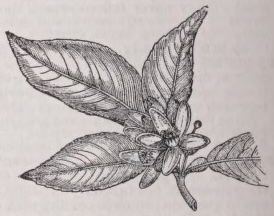
ORANGE(Citrus Aurantium), the plant that produces the familiar fruit of commerce, is closely allied to the citron, lemon, and lime, all the cultivated forms of the genus Citrus being sα nearly related that their specific demarcation must be regarded as somewhat doubtful and indefinite. Risso and Poiteau have described eighty kinds of orange (including the bergamots), chiefly differing in the external shape, size, and flavour of the fruit; but all may probably be traced to two well-marked varieties—the Sweet or China Orange and the Bitter Orange or Bigarade,— though several of these modifications seem to indicate crossing with the lemon or citron, if, indeed, they do not rather point to a more remote common origin from a primitive citrine type....
The bitter orange, by some made a sub-species (C. vulgaris'), is a rather small tree, rarely exceeding 30 feet in height. The green shoots are furnished with sharp axillary spines, and alternate evergreen oblong leaves, pointed at the extremity, and with the margins entire or very slightly serrated; they are of a bright glossy green tint, the stalks distinctly winged and, as in the other species, articulated with the leaf. The fragrant white or pale pinkish flowers appear in the summer months, and the fruit, usually round or spheroidal, does not perfectly ripen until the following spring, so that flowers and both green and mature fruit are often found on the plant at the same time. The bitter aromaticrind of the bigarade is rough, and dotted closely over with concave oil-cells; the pulp is acid and more or less bitter in flavour. The sweet orange generally has the shoots destitute of spines, the petioles less distinctly winged, and the leaves more ovate in shape, but chiefly differs in the fruit, the pulp of which is agreeablyacidulous and sweet, the rind comparatively smooth, and the oil-cells convex. The ordinary round shape of the sweet orange fruit is varied greatly in certain varieties, in some being greatly elongated, in others much flattened; while several kinds have a conical protuberance at the apex, others are deeply ribbed or furrowed, and a few are distinctly “horned” or lobed, by the partial separation of the carpels. The two sub-species of orange are said by some authorities to reproduce themselves infallibly by seed; and, where hybridizing is prevented, the seedlings of the sweet and bitter orange appear to retain respectively the more distinctive features of the parent plant; but where growing wild for successive generations they show a tendency to degenerate, the progeny of the sweet orange being apt to assume the broadly-winged petioles and spiny shoots of the bigarade.
Though now cultivated widely in most of the warmer parts of the world, and apparently in many completely naturalized, the diffusion of the orange has taken place in comparatively recent historical periods. To ancient Mediterranean agriculture it was unknown; and, though the later Greeks and Romans were familiar with the citron as an exotic fruit, their “Median Apple” appears to have been the only form of the citrine genus with which they were acquainted. The careful researches of Gallesio have proved that India was the country from which the orange spread to western Asia and eventually to Europe. Oranges are at present found wild in the jungles along the lower mountain slopes of Sylhet, Kumaon, Sikkim, and other parts of northern India, and, according to Boyle, even in the Nilgiri Hills; the plants are generally thorny, and present the other characters of the bitter variety, but occasionally wild oranges occur with sweet fruit; it is, however, doubtful whether either sub-species is really indigenous to Hindustan, and De Candolle is probably correct in regarding the Burmese peninsula and southern China as the original home of the orange. Cultivated from a remote period in Hindustan, it was carried to southwestern Asia by the Arabs, probably before the 9th century, towards the close of which the bitter orange seems to have been well known to that people; though, according to Mas'ùdi, it was not cultivated in Arabia itself until the beginning of the 10th century, when it was first planted in Omàn, and afterwards carried to Mesopotamia and Syria. It spread ultimately, through the agency of the same race, to Africa and Spain, and perhaps to Sicily, following everywhere the tide of Mohammedan conquest and civilization. In the 12th century the bigarade was abundantly cultivated in all the Levant countries, and the returning soldiers of the Cross brought it from Palestine to Italy and Provence. An orange tree of this variety is said to have been planted by St Dominic in the year 1200, though the identity of the one still standing in the garden of the monastery of St Sabina at Rome, and now attributed to the energeticfriar, may be somewhat doubtful. No allusion to the sweet orange occurs in contemporary literature at this early date, and its introduction to Europe took place at a considerably later period, though the exact time is unknown. It was commonly cultivated in Italy early in the 16th century, and seems to have been known there previously to the expedition of Da Gama (1497), as a Florentinenarrator of that voyage appears to have been familiar with the fruit. The importation of this tree into Europe, though often attributed to the Portuguese, is with more probability referred to the enterprise of the Genoese merchants of the 15th century, who must have found it growing abundantly then in the Levant. The prevailing European name of the orange is sufficient evidence of its origin and of the line taken in its migration westward. The Sanskrit designation nagrungo, becoming narungee in Hindustani, and corrupted by the Arabs into ndran i j (Spanish naranja), passed by easy transitions into the Italian aranda (Latinized aurantium), the Romance arangi, and the later Provençal orange. The true Chinese variety, however, was undoubtedly brought by the Portuguese navigators direct from the East both to their own country and to the Azores, where now luxuriant groyes of the golden-fruited tree give a modern realization to the old myth of the gardens of the Hesperides. Throughout China and in Japan the orange has been grown from very ancient times, and it was found diffused widely when the Indian Archipelago was first visited by Europeans. In more recent days its cultivation has extended over most of the warmer regions of the globe, the tree growing freely and producing fruit abundantly wherever heat is sufficient and enough moisture can be supplied to the roots; where night-frosts occur in winter or spring the culture becomes more difficult and the crop precarious.
The orange flourishes in any moderately fertile soil, if it is well drained and sufficiently moist; but a rather stiff loam or calcareous marl, intermingled with some vegetable humus, is most favourable to its growth. Grafting or budding on stocks raised from the seed of some vigorous variety is the plan usually adopted by the cultivator. The seeds, carefully selected, are sown in well-prepared ground, and the seedlings removed to a nursery-bed in the fourth or fifth year, and, sometimes after a second transplantation, grafted in the seventh or eighth year with the desired variety. When the grafts have acquired sufficient vigour, the trees are placed in rows in the permanent orangery. Propagation by layers is occasionally adopted; cuttings do not readily root, and multiplication directly by seed is always doubtful in result, though recommended by some authorities. The distance left between the trees in the permanent plantation or grove varies according to the size of the plants and subsequent culture adopted. In France, when the trunks are from 5 to 6⅜ feet in height, a space of from 16 to 26 feet is left between; but the dwarfer trees admit of much closer planting. In the West Indies and Azores an interval of 24 or even of 30 feet is often allowed. The ground is kept well stirred between the trunks, and the roots manured with well-rotted dung, guano, or other highly nitrogenous matter; shallow pits are sometimes formed above the roots for the reception of liquid or other manures; in dry climates water must be abundantly and frequently supplied. The trees require regular and careful pruning, the heads being trained as nearly as possible to a spherical form. Between the rows melons, pumpkins, and other annual vegetables are frequently raised. In garden culture the orange is often trained as an espalier, and with careful attention yields fruit in great profusion when thus grown. In favourable seasons the oranges are produced in great abundance, from 400 to 1000 being commonly borne on a single plant in full bearing, while on large trees the latter number is often vastly exceeded. The trees will continue to bear abundantly from fifty to eighty years, or even more; and some old orange trees, whose age must be reckoned by centuries, still produce their golden crop; these very ancient trees are, however, generally of the bitter variety. Oranges intended for export to colder climates are gathered long before the deep tint that indicates maturity is attained, the fruit ripening rapidly after picking; but the delicious taste of the mature China orange is never thus acquired, and those who have not eaten the fruit in a perfectly ripe state have little idea of its flavour when in that condition. Carefully gathered, the oranges are packed in boxes, each orange being wrapped in paper, or with dry maize husks or leaves placed between them. The immense quantities of this valuable fruit imported into Britain are derived from various sources, but those kinds in most esteem are the produce of the Azores, whence, in 1878, 410,101 boxes, each holding 400 “St Michael’s” oranges, are said to have been sent to Great Britain alone. Large numbers are also exported to England from Sicily, Portugal, and Spain, and a considerable amount from other Mediterranean countries. North America is largely supplied from Jamaica and the Bahamas; but the extensive and rapidly increasing cultivation of the tree in Florida will probably in a few years supersede the foreign importation. In that State the bitter orange has grown, from an unknown period, in a wild condition, and some of the earlier botanical explorers regarded it as an indigenous tree; but it was undoubtedly brought by the Spanish colonists to the West India Islands, and was probably soon afterwards transplanted to Florida by them or their buccaneering enemies. The climate of Florida seems remarkably adapted for orange culture, and orangeries are becoming yearly more numerous and extensive,—the wild stocks, or those raised from wild seed, being generally employed by the grafter. In the other Gulf States this branch of agricultural industry is pursued to some extent; and in California the orange groves are productive and increasing.
Orange cultivation has been attempted with success in several parts of Australia, especially in New South Wales, where the orange groves near Paramatta yield an abundant colonial supply. The orangeries of Queensland and South Australia are likewise producing well, though, as yet, Australian fruit is chiefly consumed at home. In many of the Pacific Islands the plant has been long established: Tahiti exports oranges largely to San Francisco, and in Fiji the culture promises to become of considerable importance.
Certain varieties of orange deserve mention, from the peculiar character of their fruit. The Mandarin orange of China, sometimes made a distinct species, C. nobilis, is remarkable for its very flat spheroidal fruit, the rind of which readily separates with the slightest pressure; the pulp has a peculiarly luscious flavour when ripe. The small Tangerine oranges, valued for their fine fragrance, are derived from the Mandarin. “Maltese” or “Blood” oranges, much grown in southern Italy, are distinguished by the deep-red tint of the pulp. The Bergamot has been already described (see vol. iii. p. 587). Orange plantations in Europe suffer much at times from a disease called by the French charbon, caused by a fungus (Demathium monophyllιιm), which rapidly spreads over stems, leaves, and green fruit Several insect enemies attack the plant, of which the scale-like Coccus citri is the most injurious in Europe; in the Azores C. Hesperidis takes its place. Cold weather in winter has sometimes proved destructive in Provence, and many plantations were destroyed by the hard frosts of 1789 and 1820.
Besides the widespread use of the fruit as an agreeable and wholesome article of diet, that of the sweet orange, abounding in citric acid, possesses in a high degree the antiscorbutic properties that render the lemon and lime so valuable in medicine; and the free consumption of this fruit in the large towns of England during the winter months has doubtless a very beneficial effect on the health of the people. The juice is sometimes employed as a cooling drink in fevers, as well as for making a pleasant beverage in hot weather; it is likewise an essential ingredient in “orange wine.”
The bitter orange is chiefly cultivated for the aromatic and tonic qualities of the rind, which render it a valuable stomachic. Planted long ago in Andalusia by the Moorish conquerors, it is still extensively grown in southern Spain,—deriving its common English name of “Seville” orange from the abundant groves that still exist around that city, though the plant is now largely cultivated elsewhere. The fruit is imported into Great Britain and the United States in considerable quantities for the manufacture of the favourite confection known as orange marmalade, which is prepared from the pulp and rind, usually more or less mingled with the pulp of the China orange. In medicine the dried peel is largely employed as an aromatictonic, and often, in tincture and infusion, as a mere vehicle to disguise the flavour of more nauseousremedies. The essential oil of the rind is collected for the use of the perfumer, being obtained either by the pressure of the fresh peel against a piece of sponge, or by the process known as écuclle, in which the skin of the ripe fruit is scraped against a series of points or ridges arranged upon the surface of a peculiarly-shaped dish or broad funnel, when the oil flows freely from the broken cells. Another fragrant oil, called in France essence de petit grain, is procured by the distillation of the leaves, from which also an aromatic water is prepared. The flowers of both sweet and bitter orange yield, when distilled with water, the “oil of Neroli” of the druggist and perfumer, and likewise the fragrant liquid known as “orange - flower water.” The candiedpeel is much in request by cook and confectioner; the favourite liqueur sold as “curaçoa” derives its aromatic flavour from the rind of the bigarade. The minute immature oranges that drop from the trees are manufactured into “issuepeas”; from those of the sweet orange in a fresh state a sweetmeat is sometimes prepared in France. Orange trees occasionally acquire a considerable diameter; the trunk of one near Nice, still standing in 1789, was so large that two men could scarcely embrace it; the tree was killed by the intense cold of the winter of that year. The wood of the orange is of a fine yellow tint, and, being hard and close-grained, is valued by the turner and cabinetmaker for the manufacture of small articles; it takes a good polish.
Although the bitter “Poma de Orenge” were brought in small quantities from Spain to England as early as the year 1290, no attempt appears to have been made to cultivate the tree in Britain until about 1595, when some plants were introduced by the Carews of Beddington in Surrey, and placed in their garden, where, trained against a wall, and sheltered in winter, they remained until destroyed by the great frost of 1739-40. In the last century the tree became a favourite object of conservatory growth; in the open air, planted against a wall, and covered with mats in winter, it has often stood the cold of many seasons in the southern counties, in such situations the trees occasionally bearing abundant fruit; but in Great Britain the orange can only be regarded as an object of ornamental culture. The trees are usually imported from Italy, where, especially near Nervi, such plants are raised in great numbers for exportation; they are generally budded on the stocks of some free-growing variety, often on the lemon or citron.
For details of orange varieties, cultivation, &c., see Risso and Poiteau, Histoire et culture des Orangers (edited by A. Du Breuil, Paris, 1872); for early history and diffusion, G. Gallesio, Traité du Citrus, Paris, 1811.
ORANGE, a city of France, the chief town of an arrondissement in the department of Vaucluse, is situated 18 miles north of Avignon on the railway from Lyons to Marseilles at some distance from the left bank of the Rhone, in the midst of meadows, orchards, and mulberry plantations, watered by a stream called the Meyne, and overlooked by the majestic summit of Mount Ventose, which lies 22 miles to the east. The district is highly fertile, and the city deals largely in silks, woollens, and fruits, and also till quite recently in wines and madder. The population of the city numbers 6860. Orange is interesting mainly from its Roman remains. The triumphal arch is not only far finer than any other in France, but ranks third in size and importance among those still extant in Europe. Measuring 72 feet in height, 69 feet in width, and 26 feet in depth, it is composed of three arches supported by four Corinthian columns. On three sides it is well preserved, and displays remarkable variety and elegance in its sculptured decorations. To judge from a partly decipherable inscription, the arch seems to have been erected in the reign of Tiberius. It suffered from being used as a fortification in the Middle Ages. Another most imposing structure is the theatre, built against the hill commanding the town. The façade, which is 118 feet high, 340 feet long, and 13 feet thick, is pierced by three square gates surmounted by a range of blind arches and a double row of far-projecting corbels. Of the seats occupied by the spectators—to the number, it might be, of 7000—only the lower ranges remain. By many this theatre is regarded as the most beautiful, or at least the most imposing, of the Roman monuments of France. The princes of Orange made it an outwork of the castle which they erected on the hill, and which was demolished by De Grignan after he had taken the town for Louis XIV. Up to the beginning of the present century it was filled with hovels and stables; these are now quite swept away, and the preservation of the building assured. In the neighbourhood of the theatre traces have been found of a hippodrome capable of containing 20,000 persons; and statues, bas-reliefs, and ruins of an aqueduct also serve to show the importance of the Roman town. Several of the churches at Orange are very old. Notre Dame, the old cathedral, originally erected by the prefect of Gaul, was ruined by the Barbarians, rebuilt in the 11th century, and damaged by the Protestants. A statue of Rambaud II. count of Orange and that of Gasparin the celebrated agriculturist may also be mentioned.
Orange (Arausio), capital of the Cavari, became after Caesar an important Roman colony. Its ramparts and fine buildings were partly destroyed by the Alemanni and Visigoths, and partly ruined by the erections of the Middle Ages. Orange was included in the kingdom of Austrasia, fell into the hands of the Saracens, and was recovered by Charlemagne. It became an independent countship in the 11th century; and Count Bertrand de Baux (d. 1181) received from Frederick I. the title of prince of Orange. On the death of Philibert of Chalons in 1530 the inheritance fell to his sister’s son, René (Renatus) of Nassau Dillenburg, stadholder of the Netherlands, who, dying childless, chose (1544) as his successor his cousin William, afterwards William I. Though Francis I., king of France, whose predecessors had long claimed to be suzerains of the principality, caused it to be declared part of the domain of Provence, Henry II. recognized William’s lights in the treaty of Cateau Cambresis, and “prince of Orange” remained the title of the stadholders from Maurice to William III. In 1672 Louis XIV. seized the principality and handed it over to the count of Auvergne in compensation for his loss of the marquisate of Bergen-op-Zoom confiscated by William; but the claims of the house of Nassau were acknowledged by the peace of Ryswick. On William’s death there were two claimants, John William Friso of Nassau-Dietz, designated heir by William’s will, and Frederick I. king of Prussia, who held that he was nearer of kin and had been appointed by the will of Frederick Henry. Thereupon Louis XIV. declared the principality forfeited to the French crown and bestowed it on the prince of Conti, who also had pretensions. The parlement of Paris decided that this prince should have the dominium utile ; and its finding was confirmed by the treaty of Utrecht, which, however, left the title and coat of arms to the king of Prussia, who is still styled prince of Orange (Prinz von Oranien). John William Friso, however, also took the title, and his descendants, the stadholders and kings of the Netherlands, have all been designated princes of Orange-Nassau.
ORANGE, a city of the United States, in Essex county, New Jersey, 16 miles west of New York by two lines of railway, and connected by tramway with Newark, 3⅜ miles distant. Beautifully situated on rolling ground about 190 feet above the sea, Orange has become a favourite place of residence for New York business men. To the west lies Llewelyn Park, an area of 750 acres, studded with villas and laid out in common; and the summit of Orange Mountain (650 feet), a little farther west, is also occupied with villas. Hat-making is largely carried on in the city. The population was 9348 in 1870 and 13,207 in 1880. In 1860 the township of Orange received a town charter; and in 1872 the town, diminished by East Orange and parts of South and West Orange, was raised to the rank of a city.
9th ed. Encyclopædia Britannica, vol. 17, p. 810 — signed C. P. J. [2,788 words — estimated reading time: 16 minutes]
Type at least 3 letters to search the Bible, or a reference such as John 3:16.
This site uses cookies to remember your display preferences (search sources and editions, Bible version, auto-link, images, light/dark theme). No personal data whatsoever is collected. Privacy Policy