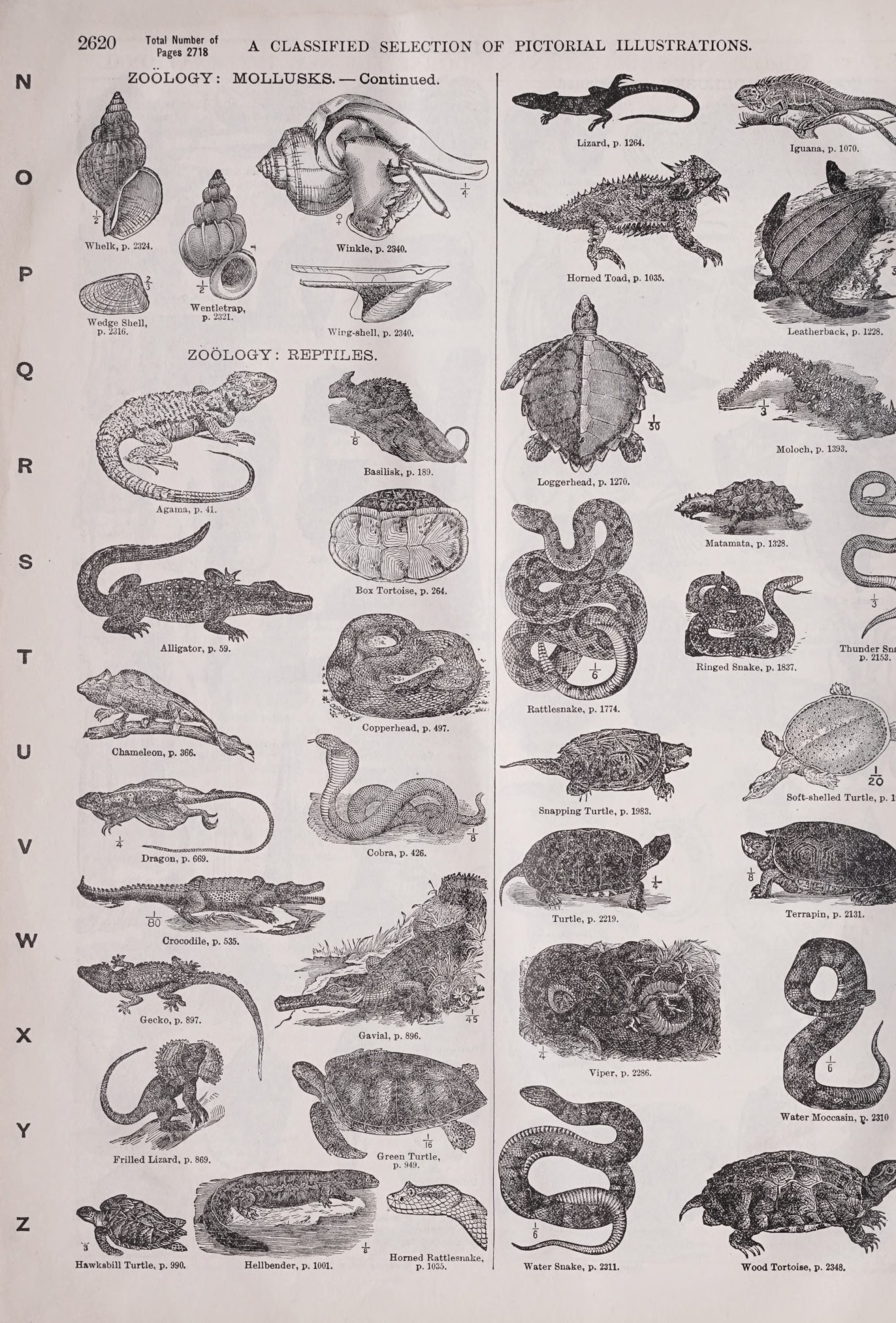
REPTILES
ANTELINAeAN writers comprised the animals which popularly are known as Tortoises and Turtles, Crocodiles, Lizards and Snakes, Frogs and Toads, Newts and Salamanders, under the name of Oviparous Quadrupeds or four-limbed animals which lay eggs. Linnaeus, desirous of giving expression to the extraordinary fact that many of these animals pass part of their life in the water and part on land, substituted the name of Amphibia for the ancient term. Subsequent French naturalists (Lyonnet and Brisson ) considered that the creeping mode of locomotion was a more general characteristic of the class than their amphibious habits, and consequently proposed the scarcely more appropriate name of Reptiles.
As naturalists gradually comprehended the wide gap existing between Frogs, Toads, ¿c., on the one hand, and the other Oviparous Quadrupeds on the other, they either adopted the name of Batrachia for the former and that of Amphibia for the latter, or they restricted the term Amphibia to Batrachians, calling the remainder of these creatures Reptiles. Thus the term Amphibia , as used by various authors, may apply (1) to all the various animals mentioned, or (2) to Batrachians only—and thus it has been used in the article Amphibia in the present work. The term Reptiles is used (1) by some for all the animals mentioned above, and (2) by others, as in the present article, for the same assemblage of animals after the exclusion of Batrachians. Other terms more or less synonymous with Amphibians and Reptiles in their different senses have been used by the various systematists, as we shall see hereafter....
Equally varying are the limits of the term “Saurians,” which occurs so frequently in every herpetological treatise. At first it comprised living Crocodiles and Lizards only, with which a number of fossil forms were gradually associated. As the characters and affinities of the latter became better known, some of them were withdrawn from the Saurians, and at present it is best to abandon the term altogether.
History and Literature.
a. The General Subject.
By some feature of their organization or some peculiarity in their economy Reptiles have always forced themselves upon the observation of man or excited his imagination, so that certain kinds are mentioned in the earliest written records or have found a place among the fragments of the oldest relics of human art. Such evidences of a popular knowledge of Reptiles, however, form no part of a succinct review of the literature of the subject such as it is proposed to give here. We distinguish in it five periods :—(1) the Aristotelian; (2) the Linnaean (formation of a class Amphibia , in which Reptiles and Batrachians are mixed); (3) the period of the elimination of Batrachians as one of the Reptilian orders (Brongniart); (4) that of the separation of Reptiles and Batrachians as distinct subclasses; (5) that of the recognition of a class Reptilia as part of the Sauropsida (Huxley).
1. The Aristotelian Period. —As in other branches of Ar zoology, we have to start with Aristotle, who was the first to deal with the Reptiles known to him as members of a distinct portion of the animal kingdom, and to point out the characteristics by which they resemble each other and differ from other vertebrate and invertebrate animals. As the plan of his work, however, was rather that of a comparative treatise of the anatomical and physiological characters of animals than their systematic arrangement and definition, his ideas about the various groups of Reptiles are not distinctly expressed, but must be gleaned from the terms which lie employs. And even when we make due allowance for the fact that we are in possession of only a part of his writings, we cannot but perceive that he paid less attention to the study of Reptiles than to that of other classes; this is probably due to the limited number of kinds with which he could be acquainted from the fauna of his own country, and to which only very few extra-European forms, like the Crocodile, were added from other sources. And, whilst we find in some respects a most remarkable accuracy of knowledge, there is sufficient evidence that lie neglected every-day opportunities of information, as if Reptiles had not been a favourite study. Thus, lie has not a single word about the metamorphoses of Batrachians, which he treats of in connexion with Reptiles.
Aristotle makes a clear distinction between the scute or scale of a Reptile, which he describes as <£oXts, and that of a Fish, which lie designates as Xen-is. He mentions Reptiles (1) as oviparous quadrupeds with scutes, viz., Saurians and Chelonians; (2) as oviparous apodals, viz., Snakes; (3) as oviparous quadrupeds without scutes, viz., Batrachians. He considered the first and second of these three groups as much more nearly related to each other than to the third. He says: —
“The genus of Snakes resembles that of Lizards, nearly all the characters being common to both, if the Lizard be conceived of as prolonged and without legs. They possess scutes, and are similar to Lizards above and below, but they lack testicles; and, like Fishes, they possess two excretory ducts which coalesce, and the uterus is large and bipartite. In other respects their internal parts are like those of Lizards, save that all the intestines are long and narrow. The tongue is narrow, long, black, and very exsertile. It is a peculiarity of Snakes and Lizards that they possess a bifid tongue; but the points of the tongue of Snakes are fine like hairs. All Snakes are “carcharodont” (have acute teeth); they have as many ribs as there are days in the month, viz., 30. Some say that Snakes recover the loss of an eye; the tail is reproduced in Lizards and Snakes when cut off,” &c.
Thus accurate statements and descriptions are sadly mixed with errors and stories of, to our eyes, the most absurd and fabulous kind. The most complete accounts are those of the Crocodile (chiefly borrowed from Herodotus) and of the Chameleon, which Aristotle evidently knew from personal observation, and which he had dissected himself. The other Lizards mentioned by him are the common Lizards ( σαύρα ), the common Seps (χαλκίς or ζιγνίς), and the Gecko (άσ־καλ αβωτης or κορΒνλος). Of Snakes (of which he generally speaks as οφίζ) he knew the Yipers («fyi9 or εχιδνα), the common Snake ( v8po <;), and the Blindworm (τνφλίνης οφις), which he regards as a Snake; he further mentions the Egyptian Cobra and Dragons (δράκων)—North-African Serpents of fabulous size. Of Chelonians he describes in a perfectly recognizable manner Land Tortoises (χελώνη), Freshwater Turtles (έμνς), and Marine Turtles (χελώνη η θαλαττία).
Passing over eighteen centuries we find the knowledge of Reptiles to have remained as stationary as other branches of natural history, perhaps even more so. The Reptile fauna of Europe was not extensive enough to attract the energy of a Belon or Rondelet; popular prejudice and the difficulty of preserving these animals deterred from their study; nor was the mind of man sufficiently educated not to give implicit credence to the fabulous tales with which every account of Reptiles in the 15th and 16th centuries was replete. The art of healing, however, was developing into a science based upon rational principles, and consequently not only those Reptiles which formed part of the materia medica but also the venomous Snakes became objects of study to the physician. Snakes, and especially the Viper, were treated of in distinct divisions of general works, or in separate monographs. It is true that these treatises were written less with the view of elucidating the natural history of the animals than with that of describing their poisonous nature and indicating the manner in which they should be used as medicaments, the majority of the writers being ignorant of the structure of the venom-apparatus, and of the distinction between non-venomous and venomous Snakes.
Nothing can show more clearly the small advance made by herpetology in this long post-Aristotelian period than a glance at the celebrated work, De Differentiis Animalium Libri decern (Paris, 1552), by Edward Wotton (1492-1555). Wotton treats of the Reptiles which he designates as Quadrupedes oviparx et Serpentes in the sixth book of his work. They form the second division of the Quadrupedes qux sanguinem habent, and are subdivided in the following “genera” :—
Crocodilus etscincus (cap. cv.); Testudinum genera (cvi.); Ran-arum genera (cvii.); Lacertx (cviii.); Salamandra et seps quad-rupee (cix.); Stellio (cx.); Chamxleo (cxi.); Serpentes (cxii.), a general account, the following being different kinds of Serpents: —Hydrus et alii quidam serpentes aquatiles (cxiii.); Serpentes terrestres et primo aspidum genera (cxiv.); Vipera, dipsas, cerastes, et hammodytes (cxv. ); Hxmorrlius, sepedon, seps, cenchris, et cenchrites (cxvi.); Basiliscus et alii quidam serpentes quorum venenum remedio caret (cxvii.); Draco, amphishxna, et alii quidam serpentes quorum morsus minus affert periculi (cxviii.).
As regards the treatment of the subject, Wotton’s work might with propriety be termed “Aristoteles redivivus.” The plan is the same, and the observations of the Greek naturalist are faithfully, sometimes literally, reproduced. It is surprising that even the Reptiles of his native country were most imperfectly known to the author.
A new impetus for the cultivation of the study of natural history was given through the observations and writings of travellers in India, Africa, and America. With the enlargement of geographical knowledge that of Reptiles was also advanced, as is sufficiently apparent from the large encyclopaedic works of Gesner, Aldrovandi, and J ohnston. The last-named author especially, who published the various portions of his natural history in the middle of the 17th century, was able to embody in his compilations notices of numerous Reptiles observed by Francisco Hernandez in Mexico and by Marcgrave and Piso in Brazil. As the author had no definite idea of the Ray-Linnsean term “species,” it is not possible to give the exact number of Reptiles mentioned in his work. But it may be estimated at about fifty, not including some marine fishes and fabulous creatures. He figures (or rather reproduces the figures of) about forty,—some species being represented by several figures.
2. Linnxan Period: Formation of a Class Amphibia .— Within the century which succeeded these compilatory works (1650-1750) fall the labours which prepared the w r ay for and exerted the greatest influence on Ray and Linnaeus. Although original researches in the field ol herpetology were limited in extent and in number, the authors had freed themselves from the purely literary oi scholastic tendency. Men were no longer satisfied wit! reproducing and commenting on the writings of their predecessors; the pen was superseded by the eye, the micro scope, and the knife, and statements were tested by experiment. This spirit of the age manifested itself, sc far as the Reptiles are concerned, in Chara’s and Redi’s admirable observations on the Yiper, in Major’s and Val lisnieri’s detailed accounts of the anatomy of the Chamte leon, in the researches of Jacob.eus into the metamor phoses of the Batrachians and the structure of Lizards, ir Dufay’s history of the development of the Salamander (foi Batrachians are invariably associated with Reptiles proper) in Tyson’s description of the anatomy of the Rattlesnake <fec. The natural history collections formed by institution! and wealthy individuals now contained not merely skin! of Crocodiles or Serpents stuffed and transformed into i shape to correspond with the fabulous descriptions of tin ancient dragons; but, with the discovery of alcohol as i means of preserving animals, Reptiles entire or dissectec were exhibited for study; and no opportunity was lost o obtaining them from travellers or residents in foreigr countries. Fossils also were now acknowledged to be re mains of animals which had lived before the flood, anc some of them were recognized as those of Reptiles.
The contributions to a positive knowledge of the anima kingdom became so numerous as to render the need of £ methodical arrangement of the abundance of new facts more and more pressing. Of the two principal systematic attempts made in this period the first ranks as one of the most remarkable steps of the progress of natural history whilst the second can only be designated as a signal failure, which ought to have been a warning to all those who in aftei years classified animals in what is called an “artificial system.” As the latter attempt, originating with Klein (1685-1759), did not exercise any further influence on herpetology, it will be sufficient to have merely mentioned it. John Ray (1628-1705) had recognized the necessity of introducing exact definitions for the several categories into which the animals had to be divided, and he maintained that these categories ought to be characterized by the structure of animals, and that all zoological knowledge had to start from the “ species” as its basis. His definition of Reptiles as “animalia sanguinea pulmofie respirantia cor unico tantum ventriculo instructum habentia ovipara” fixed the class in a manner which was adopted by the naturalists of the succeeding hundred and fifty years. Nevertheless, Ray was not a herpetologist; he never made these animals his special study, as is evident from the way in which he subdivides the class, as well as from his imperfect treatment of the species. His knowledge of Reptiles is chiefly derived from the researches of others, from whose accounts, however, everything not based upon reliable demonstration is critically excluded. He begins with a chapter treating of Frogs (Dana, with two species), Toads ( Bufo , with one species), and Tortoises
( Testudo, with fourteen species). The second group comprises the Lacertse, twenty-live in number, and includes the Salamander and Newts; and the third the Serpentes, nine species, among which the Limbless Lizards are enumerated.
Except in so far as he made known and briefly characterized a number of Reptiles, our knowledge of this class was not advanced by Linn.eus. His notions as to the relation of the various types among themselves and to the other vertebrates were the same as those of Ray, and the progress made by herpetology in the various editions of the Systema Nature¿ is therefore of a merely formal character. That Linnaeus associated in the 12th edition cartilaginous and other Fishes with the Reptiles under the name of Amphibia Nantes was the result of some misunderstanding of an observation by Garden, and is not to be taken as a premonitory token of the recent discoveries of the relation between Batrachians and Fishes. Linnaeus places Reptiles, which he calls Amphibia , as the third class of the animal kingdom; he divides the genera thus :—
Order 1. Reptiles. —Tcstudo (15 species); Rana (17 sp.); Draco (2 sp.); Lacerta (48 sp., including 6 Batrachians).
Order 2. Serpentes. — Crotalus (5 species); Boa (10 sp.); Coluber (96 sp.); Anguis (15 sp.); Arnphisbxna (2 sp.); Csecilia (2sp.).
None of the naturalists who under the direction or influence of Linnaeus visited foreign countries possessed any special knowledge of or predilection for the study of Reptiles; all, however, contributed to our acquaintance with tropical forms, or transmitted well-preserved specimens to the collections at home, so that Gmelin, in the 13th edition of the Systema Natures, was able to enumerate three hundred and seventy-one species.
The man who, with the advantage of the Linnaean method, first treated of Reptiles monograpliically, was Laurenti. In a small book he proposed a new division of these animals, of which some ideas and terms have survived into our times, characterizing the orders, genera, and species in a much more precise manner than Linnaeus, giving, for his time, excellent descriptions and figures of the species of his native country. Laurenti might have become for herpetology what Artedi was for ichthyology, but his resources were extremely limited. He himself complains that he had no literary intercourse with foreign naturalists, and access to but a few works (he especially mentions Seba’s Thesaurus) and one collection only,
The circumstance that Chelonians are entirely omitted from his Synopsis seems due rather to the main object with which he engaged in the study of herpetology, viz., that of examining and distinguishing Reptiles reputed to be poisonous, and to want of material, than to his conviction that Tortoises should be relegated to another class. He divides then the class into three orders :—
T. Salientia, with the genera Pipa, Bufo, Rana, Hyla, and one species of “Proteus,” viz., the larva of Pseudisparadoxa.
Gradientia, the three first genera of which are Tailed Batrachians, viz., two species of Proteus (one being the P. anguinus), Triton, and Salamandra ; followed by true Saurians— Caudiverbera, Gecko, Cha.mselco, Iguana, Basiliscus, Draco, Cordylus, Crocodilus, Scincus, Stellio, Seps.
3. Serpentia, among which ho continues to keep Amphisbsena, Csecilia, and Anguis, but the large Linnaean genus Coluber is divided into twelve, chiefly from the scutellation of the head and form of the body.
The work concludes with an account of the experiments made by Laurenti to prove the poisonous or innocuous nature of those Reptiles of which he could obtain living specimens.
The next general work on Reptiles is by Lacépède. It appeared in the years 1788 and 1790 under the title Histoire Naturelle des Quadrupèdes Ovipares et des Serpens (Paris, 2 vols. 4to). Although as regards treatment of details and amount of information this work far surpasses the modest attempt of Laurenti, it show's no advance towards a more natural division and arrangement of the genera. The author depends entirely on conspicuous external characters, and classifies the Reptiles into (1) oviparous quadrupeds with a tail, (2) oviparous quadrupeds without a tail, (3) oviparous bipeds ( Chirotes and Pseudopus), (4) Serpents,—an arrangement in which the old confusion of Batrachians and Reptiles and the imperfect definition of Lizards and Snakes are continued, and which it is worthy of remark we find also adopted in Cuvier’s Tableau Élémentaire de l’Histoire Naturelle des Animaux (1798), and nearly so by Latreille in his Histoire Naturelle des Reptiles (Paris, 1801, 4 vols. 12mo). Lacépède’s monograph, however, remained for many years deservedly the standard work on Reptiles, on account of the ability with which the author collected all reliable information on the various species, and on account of the facilities which it afforded for determining them. The numerous plates with which the work is illustrated are, for the time, well drawn, and the majority readily recognizable.
3. The Period of Elimination of Batrachians as one of the Reptilian Orders. —A new period for herpetology com- mences with Alex. Brongniart, who in 1799 first recognized the characters by which Batrachians differ from the other Reptiles, and by which they form a natural passage to the class of Fishes. Csecilia (as also Langaha and Acrochordus) is left by Brongniart with hesitation in the order of Snakes, but Newts and Salamanders henceforth are no more classed with Lizards. He leaves the Batrachians, however, in the class of Reptiles as the fourth order. The first order comprises the Chelonians, the second the Saurians (including Crocodiles and Lizards), the third the Ophidians—terms which have been adopted by all succeeding naturalists. Here, however, Brongniart’s merit on the classification of Reptiles ends, the definition and disposition of the genera remaining much the same as in the works of his predecessors.
The activity in France in the field of natural science I was at this period, in spite of the political disturbances, so great that only a few years after Lacépède’s work another, almost identical in scope and of the same extent, appeared, viz., the Histoire Naturelle Générale et Particulière des Reptiles of F. M. Daudin (Paris, 1802-3, 8 vols. 8vo). Written and illustrated with less care than that by Lacépède, it is of greater importance to the herpetologists of the present day, as it contains a considerable number of generic and specific forms described for the first time. Indeed, at the end of the work, the author states that he has examined more than eleven hundred specimens, belonging to five hundred and seventeen species, all of which he has described from nature. The system adopted is that of Brongniart, giving to the work a character by which the modern herpetologist is most favourably impressed. The genera are well defined, but ill arranged; it is, however, noteworthy that Csecilia takes now its place at the end of the Ophidians, and nearest to the succeeding order of Batrachians.
The next step in the development of the herpeto-logical system was the natural arrangement of the genera. This involved a stupendous amount of labour; by a careful thorough examination of all the types of Reptiles then known, reliable characters had to bo discovered, and by means of the principle of the subordination of characters the genera had to be grouped into families within Brongniart’s orders. Although many isolated contributions were made by various workers, this task could be successfully undertaken and completed in the Paris Museum only, in which, besides Seba’s and Lacepede’s collections, many other herpetological treasures from other museums had been deposited by the victorious generals of the empire, and to which through Cuvier’s reputation objects from every part of the world were attracted in a more peaceful...
[51,127 words — estimated reading time: 4.9 hours]