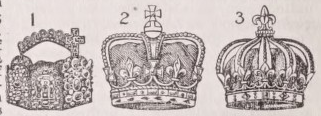
CROWN, a circular ornament worn around the head. The name is applied, at present, only to the head-dress worn by kings or emperors as a badge of their dignity. Originally it was of much wider meaning. The simplest and earliest form of the crown appears to have been a fillet or band, tied about the head, and serving for use, as well as ornament, by keeping up the hair. The name of crown is also given to garlands of leaves or branches, worn by the guests at private banquets, and on almost auy occasion of more than common festivity. It was natural that those who wished to mark a distinction between themselves and their fellow-men should adopt a head-dress differing from that in general use, just as they adopted different and distinctive garments. In countries governed by a king, a special head-dress was, at a very early period, one of the recognized symbols of royalty. A very simple form of the royal crown was a diadem or fillet of gold fastened round the head and tied behind. This by degrees became more and more elaborate in its structure and ornament, and assumed a variety of forms, in most of which the original diadem is to be traced, just as the diadem itself is a clear advance of the original ribbon or garland.
Crowns are often mentioned in Scripture; but the term was applied to other ornaments for the head besides those worn exclusively by royal personages. For example, the head-dress of the Jewish high-priest—a linen band with a plate of gold fastened in front—is also called a crown....
Among the kings of Egypt and of the East crowns were in common use. The crowns of the Ptolemies were, in general, plain fillets of gold encircling the head, but we find them sometimes making use of the more ornate radiated crown. The Seleucidae of Syria used the plain golden fillet. But the crowns of the Oriental kings have usually been much more ornate, sometimes of very massive construction, and profusely adorned with pearls and gems.
In the republics of historical Greece and Rome the crown long continued in use in its first and most simple form. There is no mention made by Homer of the crown as a royal distinction, nor does he seem to have known it at all except as an ornamental wreath or garland. The most celebrated crowns among the Greeks were the wreaths gained at the great inter-Hellenic games, by the victors in the races and athletic contests. In the course of later Athenian history, we find crowns of gold frequently bestowed in recognition of distinguished public services. It was by Alexander the Great, and the successors of Alexander, that the crown was first worn in Greece as the symbol of royal rank. The form used was generally that of a simple band of gold.
The early Roman kings are commonly represented with plain bands of gold encircling their heads. During the historical period of Roman history, besides the crown in private use at feasts and funerals, there were several kinds of crowns bestowed for public services, and indeed in recognition of almost any kind of honourable distinction. These were frequently so designed in shape or material as to be symbolical of the service they commemorated. The corona muralis, for instance, was a crown of gold, decorated with turrets, given to him who had first scaled the walls of a besieged place; the corona vallaris, decorated with pales, to him who had first forced an intrenchment; the corona navalis, decorated in general with little figures of the prows of ships, to him who had gained a signal victory at sea. The corona obsidionalis, given to a general who had delivered a Roman army from blockade, was a crown of grass or herbs plucked at the spot where this important service had been rendered. The crowns of the Roman emperors were of several forms, regulated by the fancy of the wearer, from the simple golden fillet to the radiated crown which marked an admitted claim to divine honours.
In the nations of modern Europe crowns have always been in general use among personages of the highest rank. The most remarkable are the papal and the imperial crowns. The papal crown is a lofty uncleft mitre, encircled by three coronets rising one above the other, surmounted by a ball and cross, and with ribbons at each side, similar to those of the mitre of an Italian bishop. This form of crown was first assumed by Pope Benedict ΣII., 1344.
The crowns that are most celebrated in connection with the imperial dignity are the Imperial crown proper, the German crown, and the Italian or Lombard crown. The first of these was of gold, rising into a semicircle above the head, surmounted by a small cross, and adorned with pearls and precious stones. The second is always spoken of as the silver crown, but it appears from the evidence of eyewitnesses that its material was, in fact, gold. The third was known as the iron crown, though it appears that the only iron in it was one of the nails used or said to have been used at the crucifixion, and that in this case too the rest of the material was gold. It was with this, or with a later imitation of it, that Napoleon I. was crowned as king of Italy at Milan in 1805. The Imperial crown, now in use in the empires of the Continent, in its form is very remarkable, being cleft somewhat after the mauuer of a mitre, having also the general contour of a modern convex mitre in its elevated part which rises above the golden leafage that heightens the gemmed circlet. In the open space between the two divisions formed by the cleft a single arch rises, surmounted by a mound and cross.
The English royal crown has gradually grown up from its early simple form into various aspects of elaborate splendour. Before the Norman Conquest the headdress which appears to have been habitually worn by the Anglo-Saxon princes was a fillet of pearls; their coins, however, and illuminations in MSS. of their era,, show them to have been by no means unfamiliar with a nearer approach to a true crown, in the form of a radiated diadem. The great seals, the coinage, monumental effigies, and various other contemporary representations, supply a complete series of examples of the crown in its varieties of design and enrichment, from the time < f the Conqueror.
In addition to several modifications in both the treatment and the grouping of the adornments of the regal circlet, tho English crown has undergone a completo change in the character of the figures with which the circlet has been heightened; and it also has had its original aspect of an open crown completely altered by its enriched circlet being arched over with jewelled bands of gold, when the diadem thus inclosed was surmounted by a mound and cross.
The crown worn by William I. and his successors was a plain circlet heightened with four spikes having trefoilheads (fig. 1). Henry I. appears to have enriched the circlet with gems (fig. 2), and on his great seal the trefoils of his father’s crown assume a form resembling that of fleurs-de-lys. The effigies of Henry II., Richard I., John, and their queens, show the crown to have made such an advance in the dignity of its aspect as is shown in fig. 3. The crowns of Richard and Berengaria, however, have four large leaves only heightening the circlets, while the crowns of Henry, Alianore, John, and Isabella have four smaller leaves alternating with the fo√*r larger ones. The crown of Henry III. has a plain circlet heightened with trefoils, a slightly raised point intervening between each pair of the leaves (fig. 4). A similar crown was worn by Edward I., the trefoil-leaves being alternately large and comparatively small. The truly beautiful crown of Edward II. (fig. 5), as it is represented in his effigy, was formed of four large and as many smaller leaves of a deeply serrated type, rising with graceful curves from the jewelled circlet, and having eight small flowers alternating with the leaves. This form of crown appears to have remained unchanged during the reigns of Edward III. and Richard II.
It would seem from the crown, fig. 6, sculptured with elaborate care upon the head of his effigy at Canterbury, that Henry IV. determined to distinguish the accession of a Lancastrian prince by displaying an unprecedented magnificence in the emblem of his sovereignty. The splendidly jewelled circlet of this crown is heightened with eight large and rich leaves, and as many true fleurs-de-lys—their first appearance on an English crown,—the whole alternating with sixteen small clusters of pearls, three in each. The famous “Harry crown,” of which this may be assumed to be a faithful representation, was broken up and employed as security for the loan required by Henry V., when he was about to embark on his expedition to France; but the costly fragments are recorded to have been redeemed in the 8th and 9th years of Henry VI. The arched crown in its earliest form (fig. 7), was introduced by Henry V.; and, with the arches crosses, which from the time of Henry VI. always have been crosses pâtées, appeared to supersede the earlier foliage upon the circlet. The arches at different periods have varied both in number and in contour. At first they were elevated almost to a point; then they were somewhat depressed at their intersection; still later this depression was increased, the arches themselves thus having an ogee contour, as in fig. 13; and finally, in the coronation crown of Queen Victoria (fig. 16), the arches, which bend over almost at right angles, are flattened where the mound rests on them at their intersection. The crown of Henry VI. appears to have had three arches, or six semi-arches; and there are the same number in the crown that ensigns the hawthorn-bush badge of Henry VII. The crown of Edward IV. had two arches, or four semi-arches; and a crown arched in the same manner (fig. 9) appears on the great seal of Richard III. Both arched and open crowns are represented in sculpture, illuminations, and other works, until the close of the reign i f Edward IV.; and, occasionally, as late as the reign of Henry VIII. a royal shield displays an unarched crown. Whatever other changes or modifications the English crown may have experienced since the time of Henry V., the circlet has always been heightened with alternate crosses pâtées and fleurs-de-lys, with some minor accessories of jewels; also, when the crown has two arches, each of the four semi-arches always has risen from within one of the crosses upon the circlet. Edward IV. sometimes has his royal shield of arms ensigned with an open crown, its circlet heightened with eight crosses and eight fleurs-de-lys. Upon his seal as earl of Chester, the same sovereign has the circlet of his open crown heightened with fleurs-de-lys only, alternating with small clusters of pearls (fig. 8). The crown actually worn by Henry VII. appears, from his monument at Westminster, to have had two arches, its circlet being heightened with four crosses and four fleurs-de-lys. A similar crown (fig. 9) appears on the great seal of Henry VIII. During the reigns of Edward VI., Mary, and Elizabeth, the crown experienced no change; but in her great seal Elizabeth is represented wearing a small diadem having eight semi-arches. In fig. 11, drawn from the royal achievement of Henry VII., sculptured with great spirit above the south entrance to King’s College Chapel, Cambridge, the royal motto is inscribed upon the circlet. The interior of the same noble building is enriched with numerous other splendid crowns executed in full relief. In these examples of the crowns of Tudor sovereigns there are four crosses and as many fleurs-de-lys; it must be added, however, that eight crosses and the same number of fleurs-de-lys are commonly represented, though certainly only as variations from the more authoritative number, on Tudor crowns. The form of arches shown iu fig. 12 for the first time appears upon the great seal of Edward VI.
The crown of the Stuart sovereigns, the first kings of Great Britain, James I. and Charles I., had four arches, each of the eight semi-arches springing from the alternating crosses and fleurs-de-lys of the circlet (fig. 10). This crown, described to have been formed of massive gold, weighing 7 δ> 6 oz,, and valued at £1110, was in 1649 broken up and defaced, with other royal insignia. The crown made for Charles II. (fig. 13), and also worn by James 11., William III., and Anne, closely resembled an earlier type; and, indeed, it differed only in its proportions from the crown of more recent times (fig. 14),—the crown of Her Majesty’s immediate predecessors on the throne, which still forms a part of the regalia of the British empire. The crown (fig. 16), made for the coronation of Queen Victoria, has its entire surface completely covered with jewels, —its circlet, crosses, fleurs-de-lys, arches, and mound being alike in displaying varieties of the same precious constructive materials. This coronation crown is lined with a cap of violet velvet, in accordance with a usage that first appeared upon the great seal of Henry VIII; but in all the earlier crowns the caps were of crimson or purple velvet. It only remains to direct attention to the form, fig. 15, under which, with Her Majesty’s sanction, the crown of Queen Victoria is represented, happily for its effective appearance without any cap or lining, on all occasions of the ordinary use of the symbol of regal dignity and power.
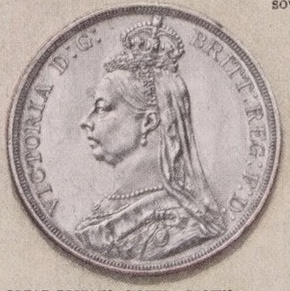
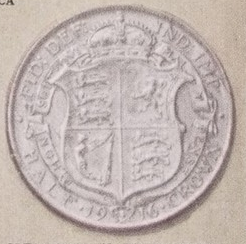
The crown introduced into the English coinage by Henry VII I. in both gold and silver, bears a crowned rose and crowned shield of arms, with the royal cipher. The silver crown of Edward VI. has the king on horseback and the royal shield; but that of Elizabeth substitutes a crowned bust for the equestrian figure. In both these silver coins the royal shield is charged in pretence with a floriated cross, which, extending beyond the shield, divides the legend into four parts. The crown of Charles II. has four crowned shields of England, Scotland, France, and Ireland in cross. The crown of recent years, that bears the device of St George and the dragon, strangely represents the Christian champion under the aspect of a nude classic warrior armed with a sword, instead of his appearing in mediaeval armour, and piercing his adversary with a lance. See Heraldry. (c. b.)
is a term properly taken for a cap of state worn on the heads of sovereign princes, as a mark of regal dignity. In Scripture there is frequent mention made of crowns; and the use of them seems to have been very common among the Hebrews. The high priest wore a crown, which was girt about his mitre, or the lower part of his bonnet, and was tied about his head. On the forepart was a plate of gold, with these words engraven on it: “Holiness to the Lord,” Exod. xxviii, 36; xxix, 6. New-married persons of both sexes wore crowns upon their wedding day, Cant., iii, 11; and, alluding to this custom, it is said that when God entered into covenant with the Jewish nation, he put a beautiful crown upon their head, Ezekiel xvi, 12. The first crowns were no more than a bandelet drawn round the head, and tied behind, as we see it still represented on medals, &c. Afterward, they consisted of two bandelets; by degrees they took branches of trees of divers kinds, &c; at length they added flowers; and Claudius Saturninus says there was not any plant of which crowns had not been made. There was always a difference, either in matter or form, between the crowns of kings and great men, and those of private persons. The crown of a king was generally a white fillet bound about his forehead, the extremities whereof being tied behind the head, fell back on the neck. Sometimes they were made of gold tissue, adorned with jewels. That of the Jewish high priest, which is the most ancient of which we have any description, was a fillet of gold placed upon his forehead, and tied with a ribbon of a hyacinth colour, or azure blue. The crown, mitre, and diadem, royal fillet and tiara, are frequently confounded. Crowns were bestowed on kings and princes, as the principal marks of their dignity. David ...took the crown of the king of the Ammonites from off his head: the crown weighed a talent of gold, and was moreover enriched with jewels, 2 Sam. xii, 30; 1 Chron. xx, 2. The Amalekite who valued himself on killing Saul, brought this prince’s crown unto David, 2 Sam. i, 10. The crown was placed upon the head of young King Josiah, when he was presented to the people, in order to be acknowledged by them, 2 Chron. xxiii, 11. Baruch says that the idols of the Babylonians wore golden crowns, Baruch vi, 9. Queens, too, wore diadems among the Persians. King Ahasuerus honoured Vashti with this mark of power; and, after her divorce, the same favour was granted to Esther, chap. ii, 17. The elders, in Rev. iv, 10, are said to “cast their crowns before the throne.” The allusion is here to the tributary kings dependent upon the Roman emperors. Herod took off his diadem in the presence of Augustus, till ordered to replace it. Tiridates did homage to Nero by laying the ensigns of royalty at the foot of his statue. Pilate’s guard platted a crown of thorns, and placed it on the head of Jesus Christ, Matt. xxvii, 29, with an intention to insult him, under the character of the king of the Jews. See _Thorn_. In a figurative sense, a crown signifies honour, splendour, or dignity, Lam. v, 16; Phil. iv, 1; and is also used for reward, because conquerors, in the Grecian games, were crowned, 1 Corinthians ix, 25.