HAWAIIAN or SANDWICH ISLANDS, The, a group of eight inhabited and four uninhabited islands in the North Pacific Ocean, lying between 18° 54' and 22° 2' N. lat. and 155° and 161° W. long. The group has a trend of about N. 64° W., which is nearly the trend of all the Pacific groups. From Honolulu, the capital, on Oahu, the distance to San Francisco is 2100 miles; to Auckland, New Zealand, 3810 miles; to Sydney, New South Wales, 4481 miles; to Yokohama, 3440 miles; to Hongkong, 4893 miles; to Tahiti, 2380 miles. The first of the names by which the group is designated above is taken from that of the largest island Hawaii, and is the name adopted by the inhabitants. The other name was given to it by Captain Cook the discoverer, in honour of the earl of Sandwich, first lord of the Admiralty at the time of the discovery....
History.— These islands, the most important Polynesian group in the North Pacific, were discovered by Captain Cook in 1778. He was received by the natives with many demonstrations of astonishment and delight; and offerings and prayers were presented to him by their priest in one of the temples; and though in the following year he was killed by a native when he landed in Kealakeakua bay in Hawaii, his bones were preserved by the priests and continued to receive offerings and homage from the people, until the abolition of idolatry. At the time of Cook’s visit each island had its chief. On the death of the chief who ruled Hawaii at that time there succeeded one named Kamehameha, who appears to have been a man of quick perception and great force of character. M τ hen Vancouver visited the islands in 1792, this chief being desirous of possessing a vessel on the European model, the keel of one was laid down for him. Ten or twelve years later Mr Turnbull found him with 20 vessels of from 25 to 50 tons which traded amongst the islands, and he afterwards purchased others from foreigners. Having encouraged a warlike spirit in his people and introduced firearms, Kamehameha attacked and overcame the chiefs of the other islands one after another, until he became undisputed master of the whole group. He encouraged trade with foreigners, and derived from its profits a large increase of revenue as well as the means of consolidating his power. He died in 1819, and was succeeded by his son, a mild and well-disposed prince, but destitute of his father’s energy. One of the first acts of Kamehameha II. was to abolish tabu and idolatry through out the islands. Some disturbances were caused thereby, but the insurgents were defeated and the peace of the islands has been scarcely broken since. In 1820 missionaries arrived from America and commenced their labours at Honolulu. A short time afterwards the British Government presented a small schooner to the king, and this afforded an opportunity for the Rev William Ellis, the well-known English missionary, to visit Honolulu, along with a number of Christian natives from the Society Islands. Finding the language of the two groups nearly the same, Mr Ellis, who had spent several years in the southern islands, was able to assist the American missionaries in reducing the Hawaiian language to a written form. In 1824 the king and queen of these islands paid a visit to England, and both died there of measles. For many years the Hawaiians have continued to advance steadily in intelligence, resources, and civilization, but their progress has been at times interrupted by the conduct of the officers of foreign powers. On one occasion a British officer went so far as to take possession of Oahu and establish a commission for its government; and French officers abrogated the laws, dictated treaties, and by force of arms established the Roman Catholic religion in the country. The act of the British officer was disavowed by his superiors as soon as known; and these outrages led to a representation on the part of the native sovereign to the Governments of Great Britain, France, and the United States of America, and the independence of the islands was guaranteed by these powers in 1844. Kalakaua, the reigning monarch (1880), was elected king by ballot on Lunalilo’s death without heirs in 1874. The heir to the throne is a sister of the king, Lelia Kamakacha, and is married to an American.
Inhabitants.— By the census taken in December 1878 the population of the whole group amounted to 57,985 persons, instead of 56,897 as in 1873. The number of natives of pure Hawaiian race was 44,088, of half castes 3 420, Chinese 5916, Americans (U.S.) 1276, British 883, Portuguese 430, Germans 272, French 81, other foreigners 666, and Hawaiians born of foreign parents 947.
The natives belong to the Malayo-Polynesian race. Their reddish-brown skin has been compared to the hue of tarnished copper. The hair, usually raven black, is straight or at most wavy; the beard is thin, the face broad, the profile not prominent, the nose rather flattened, and the lips thick. The bulk of the population are of moderate stature, but the chiefs and the women of their families are remarkable for height.
“The inhabitants of these islands,” says Mr Ellis, “are, considered physically, amongst the finest races in the Pacific, bearing the strongest resemblance to the New Zealanders in stature, and in their well-developed muscular limbs. The tattooing on their bodies is less artistic than that of the New Zealanders, and much more limited than among some of the other islanders. They are also more hardy and industrious than those living nearer the equator. This in all probability arises from their salubrious climate, and the comparative sterility of their soil, rendering them dependent upon the cultivation of the ground for the yam, the arum, and the sweet potato, their chief articles of food. Though, like all undisciplined races, the Sandwich Islanders have proved deficient in firm and steady perseverance, they manifest considerable intellectual capability. Their moral character, when first visited by Europeans, was not superior to that of other islanders; and, excepting when improved and preserved by the influences of Christianity, it has suffered much from the vices of intemperance and licentiousness introduced by foreigners. Polygamy prevailed among the chiefs and rulers, and women were subject to all the humiliations of the tabu system, which subjected them to many privations, and kept them socially in a condition of inferiority to the other sex. Infanticide was practised to some extent, the children destroyed being chiefly females. Though less superstitious than the Tahitians, the idolatry of the Sandwich Islanders was equally barbarous and sanguinary, as, in addition to the chief objects of worship included in the mytħ-ology of the other islands, the supernatural beings supposed to reside in the volcanoes and direct the action of subterranean fires rendered the gods objects of peculiar terror. Human sacrifices were slain on several occasions, and vast offerings presented to the spirits supposed to preside over the volcanoes, especially during the periods of actual eruptions. The requisitions of their idolatry were severe, and its rites cruel and bloody. Grotesque and repulsive wooden figures, animals, and the bones of chiefs were the objects of worship. Human sacrifices were offered whenever a temple was to be dedicated, or a chief was sick, or a war was to be undertaken; and these occasions were frequent. The apprehensions of the people with regard to a future state were undefined, but fearful. The lower orders expected to be slowly devoured by evil spirits, or to dwell with the gods in burning mountains. The several trades, such as that of the fisherman, the tiller of the ground, and the builder of canoes and houses, had each their presiding deities. Household gods were also kept, which the natives worshipped in their habitations. One merciful provision, however, had existed from time immemorial, and that was sacred inclosures, places of refuge into which those who fled in time of war, or from any violent pursuer, might enter and be safe. To violate their sanctity was one of the greatest crimes of which a man could be guilty.”
In the former state of society the habits of the people were extremely licentious; men were living with several wives, and women with several husbands. Female virtue was an unknown thing, and there is no native word for it. This state of things has, however, been greatly altered by the exertions of the missionaries.
As regards cannibalism, it appears that the heart and liver of the human victims offered in the temples were eaten as a religious rite, and that the same parts of any prominent warrior slain in battle were devoured by the victor chiefs in the belief that they would thereby inherit the valour of the dead man. When, on the death of the great warrior Kamehameha I., the chiefs assembled to deliberate what should be done with his body, one suggested that they should eat it, but this did not find favour with the others.
The Hawaiians are a good-tempered, light-hearted, and pleasure-loving race. They have many games and sports, and the women spend much time in making flower garlands. Both sexes are passionately fond of riding, almost every one being in possession of a horse. They delight to be in the water, and swim with remarkable skill and ease. In the exciting sport of surf swimming, which always astonishes strangers, they balance themselves whilst standing or sitting on a small board which is carried landwards on the curling i crest of a great roller.
In spite of moral and material progress—better food, better clothing, improved dwellings, and many other advantages of civilization—the race is dying out, and, indeed, is threatened with extinction in the course of a few years, Captain Cook estimated the number of natives at 400,000; in 1823 the American missionaries calculated them to be only 142,000; the census of 1832 showed the population to be 130,313; and the census of 1878 proved that the number of natives was no more than 44,088. To account for this it is said that the blood of the race has become poisoned by the introduction of foreign diseases. The women are much less numerous than the men; and the married ones have few children at the most; two out of three have none. Moreover the mothers appear to have little maternal instinct, and there is consequently a negleαt of the offspring. Whilst the Hawaiians are decreasing, the Chinese are coming in large numbers, and threaten iu time to take their place. To counteract this, as well as to supply the pressing need for labourers, the Government has considered many schemes for introducing other immigrants. Polynesians from other islands have been brought over, and a considerable number of Portuguese have come from Madeira.
The language is a branch of the widely-diffused Malayo-Polynesian tongue; and Hawaiians and New-Zealanders, although occupying the most remote regions north and south at which any of their race have been found, can understand each other without much difficulty. This language is soft and harmonious, being highly vocalic in structure. The only consonants are k, l, m, n, and p, which with the gently aspirated h, the five vowels, and the vocalic w, make up all the letters in use. The letters r and t have been suppressed of late years in favour of l and k, so that, for example, taro, the former name of the Colocasia plant, is now kalo. The language was not reduced to a written form until after the arrival of the missionaries.
In the days of idolatry the only dress worn by the men was a narrow strip of cloth wound round the loins and passed between the legs. Women wore a short petticoat made of tapa (cloth prepared from the inner bark of the paper mulberry), which reached from the waist to the knee. But now the common class of men wear a shirt and trousers, whilst the better class are attired in the European fashion. The women are clad universally in the holoka, a loose white or coloured garment with sleeves reaching from the neck to the feet. A coloured handkerchief is twisted round the head or a straw hat is worn. Both sexes delight iu adorning themselves with garlands (jleis) of flowers and necklaces of coloured seeds.
The natives derive their sustenance chiefly from pork and fish both fresh and dried, and from the kalo {Colocasia esculenta), the banana, sweet potato, yam, bread-fruit, and cocoa-nut. The root of the kalo affords the national dish called poi ; after having been baked and well beaten on a board with a stone pestle it is made into a paste with water and then allowed to ferment fora few days, when it is fit to eat. There was formerly a particular breed of dog which, after being fed exclusively on poi, was considered a great delicacy. The filthy liquor called awa or kaτva is still relished by the natives, and though it is only allowed to be made under licence, it is often prepared clandestinely.
The native dwellings are constructed of wood, or more frequently are huts thatched with grass at the sides and top. What little cooking is. undertaken is done outside. The oven consists of a hole in the ground in which a fire is lighted and stones made hot; and the fire having, been removed, the food is wrapped up in leaves and placed in the hole beside the hot stones and covered up until ready.
Leprosy is prevalent amongst the natives, and the Government has established a settlement on the island of Molokai where all persons found to be affected with the disease are kept entirely isolated from the healthy part of the community. The lepers number about 800.
Agriculture and Commerce.— Large capital has been embarked, chiefly by Americans, in the production of sugar, the soil and climate being well suited to the cane in those localities where the water supply is ample. There are between 60 and 70 sugar estates, and more are being planted. The principal difficulty is the want of labour. The average yield of sugar per acre is 2⅜ tons, whilst in some favoured spots as much as 7 tons has been obtained. In 1878 the exports of sugar amounted to 17,187 tons. Rice is also largely cultivated, 2455 tons having been exported in the same year. Coffee is produced only to a small extent. Arrow-root is prepared from the root of the Tacca pinnatifida. The kalo plant {Colocasia esculenta) is extensively grown in wet places. It is said that a patch of kalo measuring 40 feet square yields sufficient food for a native for a whole year; a square mile of it would therefore support 17,000 persons. Maize and wheat are raised, and flour is manufactured. Pine apples, oranges, mangoes, custard apples, guavas, and many other fruits have been introduced, and flourish in gardens. A silky fibre called pulu, growing on the crown of treefern stems belonging to the genus Cibotium, is exported in large quantities to America, where it is used for stuffing cushions.
The owners of sheep are few, but they have large flocks, and the wool exported in 1878 amounted to 523,000 lb. Some districts are well suited for cattle raising. The wild cattle on the mountains—a very inferior breed, descended from some left by Captain Vancouver —are shot or taken with the lasso for the sake of their hides, which are exported in large quantities. In one island 11,000 were killed in a single year. The natives used to entrap them by digging pits near pools of water, and it was through falling into one of these pits that Douglas, the botanical collector, met his death by being gored by a bull.
Owing to their geographical position the commercial development of the islands has advanced even more rapidly than the material improvement in the circumstances of the people. A treaty of commerce was concluded in 1876 between the United States and the Hawaiian Islands, under which the manufactures of the former and the chief productions of the latter are reciprocally allowed to enter duty free. This treaty has been of great benefit to the islands, more especially by stimulating the cultivation of the sugar cane. The principal exports are sugar, rice, coffee, hides, skins, tallow, and wool. In 1878 the total amount of exports reached the value of about 3,500,000 dollars, whilst the value of imports amounted to about 3,000,000 dollars. The United States are by far the largest customers for the articles exported, and supply the great bulk of the imported goods. In 1878 there were 54 vessels registered under the Hawaiian flag, of which 11 were engaged in whaling and foreign trades, whilst 43 were coasters, making a total of 8000 tons. In 1878, besides the mail steamers, 216 merchant vessels of various foreign nations entered the Hawaiian ports.
Many good roads have been made, and railways have been projected; a telegraph line was opened in 1878 between Wailuku and Lahaina in Maui (40 miles), and has since been extended; considerable capital has been brought in by foreigners; and the price of land is rising. A Government survey of the islands is in progress.
Climate and Meteorology.— The climate in general is warm but very salubrious. The temperature is equable and the sky usually cloudless. The N. E. trades blow for nine months; and the leeward coast, being protected by high mountains, is refreshed by regular land and sea breezes. During January, February, and March the wind blows strongly from the S. W.; and at this season an unpleasant hot damp wind from the equatorial region occasionally makes itself felt. Very much more rain falls on the windward side of the principal islands than on the leeward. Thus at Hilo, on the east coast of Hawaii, the usual rainfall is said to amount to 80 inches, and in some years to more than twice that quantity, whilst at Honolulu on the south coast of Oahu, out of the reach of the windward rains, the mean annual rainfall for the five years ending 187'7 varied from 32’30 to 46 - 40 inches, the. average being about 38. The mean annual temperature at the same place for the same period was 75° Fahr. The mean temperature of the coldest month during the five years was 62 3 Fahr., and that of the hottest month 81° Fahr. Strong gales blow once or twice during the winter, but destructive hurricanes are entirely unknown.
Zoology.— When Cook arrived at the islands he found only hogs, dogs, and rats. There is a day-flying bat; a small lizard is found, but no other reptiles. Cattle, goats, and hogs at the present day run wild upon the mountains in the larger islands, and do much damage to the woods. As to the birds, fifty-three species have been enumerated by Mr Sanford Dole in Proceedings of Boston Soc. of Natural History {cf. Sclater’s paper in Ibis, 1871), but it is thought that many more species remain to be discovered in the mountain districts. In former times the chiefs exacted as a tax from the people the gay feathers of certain species {Drepanus and Moho}, and employed them to ornament their state robes, only one of which is now in existence, and that is kept with the greatest care for the king’s use on state occasions. Mr Dole’s list includes of Falconidae 2 species, Strigidoe 1, Promeropidee 10, Meliphagidae 4, Turdidoe 2, Ampelidoe 1, Corvidae 1, Fringillidae 5, Charadridoe 2, Scolopacidae 3, Ardeidaef Rallidae 5, Anatidoe 3, Procellaridae 2, Laridoe 5, and Pelicanidae 3. One of the Rallidoe, now nearly extinct, is remarkable for having rudimentary wings, like the moa of New Zealand, hidden in long, loose, hairy feathers. Dr Otto Finsch, who visited Honolulu in 1879, says that the native birds, as well as the native plants, are being ousted by introduced species. The house sparrow from Europe and the maina ( κ Acridotheres tristis ?) and the turtle-dove ( Turtur chinensis) from China are almost the only birds to be seen in and about the town; and in order to obtain specimens of indigenous species he had to go far inland. (See Proceed. Roy. Geog. Soc., Jan. 1880.)
Botany.— The ravines and mountain slopes on the windward side of the larger islands contain much forest growth, whilst the leeward uplands and plains are comparatively bare. Amongst the more remarkable forms are a Pamlanus, or screw pine, and the Aleurites, or candle-nut tree, so named from the natives stringing together the kernels, which are very oily, and so making a candle. Sandalwood, formerly plentiful, has been exhausted. The cocoa-nut palm grows in abundance on the coast. For the following valuable notes on the flora, we are indebted to Dr William Hillebrand, who for many years stu<lied the subject on the spot with the view of publishing a complete work upon...

[8,088 words — estimated reading time: 50 minutes]
HAWARDEN, a market-town of Flintshire, North Wales, 8 miles S.W. of Chester, is a clean and tolerably well-built place, situated on an eminence commanding an extensive prospect. It lies in the midst of a coal district, and near it are valuable clay-beds. Coarse earthenware, drainingtiles, and fire-clay bricks form the chief manufactures of the district. The family of Maude derive the title of viscount from the town. Population (1871) of the township, 6782; of the parish (including Saltney), 8683. In the neighbourhood is Hawarden Castle, built in 1752, and added to and altered in the Gothic style in 1814; it stands near the ruins of the old castle of that name which was granted by the Conqueror to his nephew Hugh Lupus, and which after many vicissitudes came into the possession of Serjeant Glynne, lord chief-justice of England under Cromwell. On the death in 1874 of Sir Stephen R. Glynne, the last of a line of baronets, the castle passed to his brother-in-law the eminent statesman Mr W. E. Gladstone.
[178 words — estimated reading time: 2 minutes]
HAWES, Stephen, a minor English poet of the 16th century. Neither the date of his birth nor that of his death has been ascertained, and all the known facts of his life may be stated in a few lines. He was probably a member of a Suffolkshire family, studied at Oxford, with what success we can only conjecture, travelled in England, Scotland, and France, and having acquired the reputation of a man of culture was appointed groom of the chamber to King Henry VII. He was still alive in January 1520-21, as appears by an entry, Item to Mr Hawse for his play vj li. xiii s. iiij d. Of the play thus mentioned nothing further is known. The writer’s chief work was The Historie of Graunde Amour and la Bell Pucell, called the Pastime of Pleasure, conteyning the Knowledge of the Seven Sciences and the Course of Man’s Life, a long allegorical poem in the style of Lydgate. Its general method may be guessed from such a heading as How Science first sent him to Gramer where he was receyved by Dame Coηgruitie and, though it must be confessed that portions of the poem are better both in matter and in workmanship than might be expected, it is now of interest almost exclusively because, in Warton’s words, it is “almost the only effort of imagination and invention which had appeared in our poetry since Chaucer.” Probably written about 1506, and first printed, it is said, hy Wynkyn de Worde, it afterwards went through several editions (J. Wayland, 1554; Richard Tottel, 1555; J. Waley, 1559); a reprint of Tottel’s was made for the Percy Society in 1842. Among the minor poems attributed to Hawes it is sufficient to mention his Conversyon of Swerers and his Joyful Medytacyon to all Englonde of Kyηge Henry the Eight. The former, a dry didactic production, was printed by Wynkyn de Worde ...(1509 1) and William Copland (1551). Of the latter the only copy preserved is among Bishop More’s books in the public library of the university of Cambridge. Both were edited for the Abbotsford Club by David Laing (1854). For further details see Hazlitt’s edition of Warton’s History of English Poetry (1874), and the Percy and Abbotsford reprints.
HAWES, William (1785-1846), an English musician of some merit, is remembered chiefly by the fact that through his instrumentality Weber’s Der Freischütz was for the first time performed in England. This event took place July 24, 1824, and led eventually to Weber’s removal to London. Hawes was born in London in 1785, and was for eight years (1793-1801) a chorister of the Chapel Royal, where he studied music chiefly under Dr Ayrton. He subsequently held various musical posts, being in 1817 appointed master of the children of the Chapel Royal. He also, in conjunction with Welsh, carried on the business of a music publisher, and was for many years musical director of the Lyceum Theatre, then devoted to English opera. It was in the last-named capacity that he introduced Weber’s masterpiece, at first slightly curtailed, but soon afterwards in its entirety. Winter’s Interrupted Sacrifice, Mozart’s Cosi fan Tutte, Marschner’s Vampyre, and other important works were also brought out under his auspices. Hawes also wrote or compiled the music for numerous pieces, none of which however has survived or deserves mention. Better were his glees and madrigals, of which he published several collections. He also superintended a new edition of the celebrated Triumph of Oriana. Hawes died February 18, 1846.
[384 words — estimated reading time: 3 minutes]
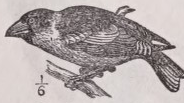
HAWFINCH, a bird so called from the belief that the fruit of the hawthorn (Cratoegus Oxyacantha) forms its chief food, the Loxia coccothraustes of Linnaeus, and the Coccothraustes vulgaris of modern ornithologists, one of the largest of the I inch family {FmngiUidοe'), and found over nearly the whole of Europe, in Africa north of the Atlas, and in Asia from Palestine to Japan. It was formerly thought to be only an autumnal or winter-visitor to Britain, but later experience has proved that, though there may very likely be an immigration in the fall of the year, it breeds in nearly all the English counties to Yorkshire, and abundantly in those nearest to London. There seems also to be good reason for supposing that it is yearly extending its range in the British Islands. In coloration it bears some resemblance to a Chaffinch, but its much larger size and enormous beak make it easily recognizable, while on closer inspection the singular bill-hook form of some of its wingfeathers will be found to be very remarkable. Though not uncommonly frequenting gardens and orchards, in which as well as in woods it builds its nest, it is exceedingly shy in its habits, so as seldom to afford opportunities for observation. As the genus Coccothraustes is now commonly restricted, it includes but this single species,—the Japanese form, at one time regarded as distinct, being considered by the latest authorities to be inseparable. (a. n.)
[244 words — estimated reading time: 2 minutes]
HAWICK, a municipal and parliamentary borough of Roxburghshire in Scotland, 10 miles S.W. of Jedburgh, and 53 miles S.S.E. of Edinburgh by rail, is situated on the south bank of the Teviot at its junction with the Slitrig, a wild and irregular stream that flows through the town. A handsome bridge, spanning the Teviot, connects Hawick with the manufacturing village cf Wilton, which is practically a suburb. The town is fairly well built, the main street being broad and well paved. The ancient tower of the barons of Drumlanrig is now occupied as an inn; and many of the older houses testify by their massive proportions to the former dangers of Hawick’s position as a border town. The tower was the only building not burned down in 1570 by the earl of Sussex. The parish church of St Mary has succeeded one mentioned in the Chronicle of Melrose as having been consecrated in 1214,—a fact which speaks for the antiquity of the town. Additional testimony is afforded by the Moathill at one end of the town, an earthen mound of great antiquity, about 30 feet high. The present town-charter, granted in 1537 by a baron of Drumlanrig, was confirmed in 1545 by Queen Mary during a residence in the town. Hawick, with Wilton, was in 1868 erected into a parliamentary burgh, uniting with Galashiels and Selkirk in sending a member to parliament. The municipal government is vested in a town council, consisting of a provost, four magistrates, and ten councillors. The exchange, built in 1865, contains a free public library. Hawick possesses a very complete system of underground drainage, in connexion with purification works,—this being the first experiment of the kind on a large scale in Scotland....
The manufactures of Hawick are mentioned in the burgh records so far back as 1640, but they must have been flourishing for some time before that, as the weavers already formed an important part of the population. The weavers then worked each for himself, executing his private orders; and it is not till the middle of the following century that a number of looms under one employer are heard of. Linen was at first the chief article of manufacture, but woollen plaidings were also made. Wool was also spun and sold to be manufactured elsewhere. A carpet factory was begun in 1752, and the manufacture of linen tapes or inkle started a few years afterwards, but both industries became extinct towards thebeginning of the present century. The manufacture of tweeds is the most important industry of Hawick. In this branch the annual turn-over is about £800,000; while in the whole woollen trade it is about £2,000,000.· The manufacture of hosiery, to which the town owes so much of its prosperity, was introduced in 1771, when four looms, employing six men and five women, produced annually about 2400 pairs of coarse stockings. Hawick has gradually become the chief seat of this trade in Scotland. Some of the yarn spun at Hawick is sent to England and to other parts of Scotland to be woven; while the merino yarn used for the finer goods is chiefly obtained from Pleasley and Nottingham. Besides the staples, tweeds and hosiery, Hawick manufactures shawls, plaids, blankets, gloves, and leather. There are also an oil-work, for extracting oil from the soapy refuse of the fulling-mills, an iron-foundry, and a factory-engineering establishment. The population of the burgh in 1871 was 11,356; in 1879 it was estimated at about 15,000.
[595 words — estimated reading time: 4 minutes]
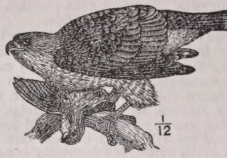
HAWK (Anglo-Saxon, Hafoc), a word of somewhat indefinite meaning, being often used to signify all diurnal Birds-of-prey which are neither Vultures nor Eagles, and again more exclusively for those of the remainder which are not Buzzards, Falcons, Harriers, or Kites. Even with this restriction it is comprehensive enough, and will include more than a hundred species, which have been arrayed in genera varying in number from a dozen to above a score, according to the fancy of the systematizer. Speaking generally, Hawks may be characterized by possessing comparatively short wings and long legs, a bill which begins to decurve directly from the cere (or soft bare skin that covers its base), and has the cutting edges of its maxilla (or upper mandible) sinuated but never notched. To these may be added as characters, structurally perhaps of less value, but in other respects quite as important, that the sexes differ very greatly in size, that in most species the irides are yellow, deepening with age into orange or even red, and that the immature plumage is almost invariably more or less striped or mottled with heart-shaped spots beneath, while that of the adults is generally much barred, though the old males have in many instances the breast and belly quite free from markings. Nearly all are of small or moderate size—the largest among them being the Gos- Hawk (vol. X. p. 788) and its immediate allies, and the male of the smallest, Accipiter times, is not bigger than a Song-Thrush. They are all birds of great boldness in attacking a quarry, but if foiled in the first attempt they are apt to leave the pursuit. Thoroughly arboreal in their habits, they seek their prey, chiefly consisting of birds (though reptiles and small mammals are also taken), among trees or bushes, patiently ...waiting for a victim to shew itself, anl gliding upon it when it appears to be unwary with a rapid swoop, clutching it in their talons, and bearing it away to eat it in some convenient spot.
It is of course impossible here to enter into details of the numerous forms which, notwithstanding the limitation above adopted, are to be called Hawks, or to describe the distinguishing characters, so far as any have been given, of the different groups or sections into which it has pleased systematic ornithologists to break them up, since hardly any two are agreed in the latter respect. There is at the outset a difference of opinion as to the scientific name which the largest and best known of these sections should bear—some authors terming it Nisus, and others, who seem to have the most justice on their side, Accipiter. In Europe there are two species—first, A. nisus, the common Sparrow-Hawk, which has a wide distribution from Ireland to Japan, extending also to northern India, Egypt, and Algeria, and secondly, A. δreviyes (by some placed in the group Micro- nisus and by others called an Astur), which only appears in the south-east, and the adjoining parts of Asia Minor and Persia. In North America the place of the former is taken by two very distinct species, a small one, A. fuscus, usually known in Canada and the United States as the Sharp-shinned Hawk, and Stanley’s or Cooper’s Hawk, A. cooperi (by some placed in another genus, Cooperastur), which is larger and has not so northerly a range. In South America there are four or five more, including A. tinus, before mentioned as the smallest of all, while a species not much larger, A. miηullus, together with several others of greater size, inhabits South Africa. Madagascar and its neighbouring islands have three or four species sufficiently distinct, and India has A. badius. A good many more forms are found in South-eastern Asia, in the Indo-Malay Archipelago, and in Australia three or four species, of which A. cirrhocephalus most nearly represents the Sparrow-Hawk of Europe and Northern Asia, while A. radiatus and A. approximans shew some affinity to the Cos-Hawks (Astur) with which they are often classed. The differences between all the forms above named and the much larger number here unnamed are such as can be only appreciated by the specialist, and could not possibly be pointed out within the limits of this article. It may be observed in conclusion that the so-called “Sparrow-Hawk” of New Zealand (Hieracidea) does not belong to this group of birds at all, and by many authors has been deemed akin to the Falcons. For Hawking, see Falconry. (a. n.)
[768 words — estimated reading time: 5 minutes]
נץ, from the root נצה, _to fly_, because of the rapidity and length of flight for which this bird is remarkable, Lev. xi, 16; Deut. xiv, 15; Job xxxix, 26. _Naz_ is used generically by the Arabian writers to signify both falcon and hawk; and the term is given in both these senses by Meninski. There can be little doubt that such is the real meaning of the Hebrew word, and that it imports various species of the falcon family, as jer-falcon, goshawk, and sparrow-hawk. As this is a bird of prey, cruel in its temper, and gross in its manners, it was forbidden as food, and all others of its kind, in the Mosaic ritual. The Greeks consecrated the hawk to Apollo; and among the Egyptians no animal was held in so high veneration as the ibis and the hawk. Most of the species of hawk, we are told; are birds of passage. The hawk, therefore, is produced, in Job xxxix, 26, as a specimen of that astonishing instinct which teaches birds of passage to know their times and seasons, when to migrate out of one country into another for the benefit of food, or a warmer climate, or both. The common translation does not give the full force of the passage: “Doth the hawk fly by thy wisdom?” The real meaning is, “Doth she know, through thy skill or wisdom, the precise period for taking flight, or migrating and stretching her wings toward a southern or warmer climate?” The passage is well rendered by Sandys:-- “Doth the wild haggard tower into the sky, And to the south by thy direction fly?” Her migration is not conducted by the wisdom and prudence of man, but by the superintending and upholding providence of the only wise God.
[297 words — estimated reading time: 2 minutes]
HAWKE, Edward Hawke, Baron (1705-1781), an English admiral, was the son of a barrister and was born in 1705. He entered the navy at an early age, and in 1733 became commander of the “Wolf.” In the engagement off Toulon in 1744, he broke from the line of battle in order to engage the “Poder,” and although he succeeded in causing her to strike her colours, his breach of discipline was punished by dismissal from the service. He was, however, almost immediately restored by the king’s commands, and in 1747 was promoted to the rank of rear-admiral of the white. In October of the same year he was sent in command of a squadron intended to intercept a fleet of merchant vessels bound for the West Indies under a convoy of nine men-of-war, and coming up with them on the 14th of the month near the isle of Aix, he succeeded after a severe struggle in capturing six of the men-of-war, but darkness coming on before the close of the contest the whole of the merchant vessels escaped. For his victory Hawke was created a knight companion of the Bath. In December of the same year he was chosen member of parliament for Bristol. In May 1748 he became vice-admiral of the blue, and in January 1755 admiral of the white. In the following year he succeeded Admiral Byng as commander of the fleet in the Mediterranean, but arrived too late to succour Minorca; and in none of the commands which he subsequently held did he have an opportunity of distinguishing himself till 1759, when he took charge of a squadron sent to cruise off Brest. On the morning of the 20th November he sighted the French fleet under Admiral Conflans off Belleisle, and notwithstanding that the French, trusting to their knowledge of the rocks and shallows, retired towards the shore, he determined to engage them, which he ...did with such impetuosity that their fleet was only saved from total destruction by the approach of nightfall. As it was, more than half their vessels were either disabled, captured, or driven on shore. For this brilliant victory, gained in such circumstances of difficulty and danger, with the loss of only two vessels, Hawke received the thanks of the House of Commons and a pension of £2000 per annum. In 1765 he was appointed vice-admiral of Great Britain and first lord of the admiralty. In 1776 he was raised to the peerage by the title of Baron Hawke of Towton. He died at Shepperton, Middlesex, 17 th October 1781.
[436 words — estimated reading time: 3 minutes]
HAWKESWORTH, John (c. 1715-1773), an author of the last century, was born in London, according to one account in 1715, but according to another in 1719. He is said to have been apprenticed first to a clockmaker and afterwards to an attorney, but at any rate he was indebted for the education requisite for the prosecution of a literary career chiefly to his own perseverance. In 1744 he succeeded Dr Johnson as compiler of the parliamentary debates for the Gentleman’s Magazine. Eight years later he started in company with Johnson, Bathurst, and Warton a periodical called the Adventurer. This journal had a great success, and ran to 140 numbers, of which 70 were from the pen of Hawkesworth himself. On account of what was regarded as its powerful defence of morality and religion, Hawkesworth was rewarded by the archbishop of Canterbury with the degree of LL.D. In 1761 he published a volume of fairy tales, and an edition of Swift’s works and letters, with a life prefixed which Johnson has referred to in highly laudatory terms in his Lives of the Poets. The reputation he obtained by these and other works was such that he was commissioned by Captain Cook to edit hÏ3 papers relative to his first voyage. The work appeared in 1773 in three volumes, and as a reward of his labours Hawkesworth received from the Government the sum of £6000. His descriptions of the manners and customs of the New World were, however, regarded by many critics as hurtful to the interests of morality, and the severity of their strictures is said to have hastened his death, which took place November 17, 1773. He was buried at Bromley in Kent, where a monument has been erected to his memory. Hawkesworth was a close imitator of Johnsen both in style and thought, but his independent literary talent is ...considerable.
[316 words — estimated reading time: 2 minutes]