PIGALLE, Jean Baptiste (1714-1785), French sculptor, was born at Paris on 26th January 1714. Although he failed to obtain the Great Prize, after a severe struggle he entered the Academy and became one of the most popular sculptors of his day. His earlier work, such as Child with Cage (model at Sèvres) and Mercury Fastening his Sandals (Berlin, and lead cast in Louvre), is less commonplace in character than that of his maturer years, but his statue of Voltaire (Institut) and his tombs of Comte d’Harcourt (Notre Dame) and of Marshal Saxe (Lutheran church, Strasburg) are good specimens of French sculpture in the 18th century. He died on 21st August 1785.
See Tarbe, Vie et oeuv. de Pigalle ; Suard, Éloge de Pigallc; Mélanges de littérature ; Dussieux, Les artistes français à l'étranger-, Barbet de Jouy, Sculptures mod. Louvre.
9th ed. Encyclopædia Britannica, vol. 19, p. 84 [143 words — estimated reading time: 1 minute]
PIGAULT-LEBRUN, Charles Antoine Guillaume, sometimes called Pigault de l’Épinoy (1753-1835), the chief fiction writer of the first empire, and the most popular light novelist of France before Paul de Kock, was born at Calais (he is said to have traced his pedigree on the mother’s side to Eustache de St Pierre) on April 8, 1753. His youth was decidedly stormy. He twice carried off young ladies of some position, and was in consequence twice imprisoned by lettre de cachet. His first love, a Miss Crawford, the daughter of an English merchant whose office Pigault had entered, died almost immediately after her elopement; the second, Mademoiselle de Salens, he married. Besides his commercial and criminal experiences, he was a soldier in the queen’s guards, an actor, and a teacher of French. At the breaking out of the great war he re-enlisted and fought at Valmy. It should be said, however, that the romantic incidents of his life are differently related by different authorities, and are open to not a little suspicion. Although he had tried dramatic writing, he does not seem to have attempted prose fiction till he was forty, but from that time he was a fertile writer of novels for nearly thirty years. In his old age he took to graver work, and executed an abridgment of French history in eight volumes, besides some other work. His Oeuvres Complètes were published in twenty volumes between 1822 and 1824. He died on July 24, 1835. Pigault’s numerous novels, though still occasionally reprinted, are not much read; and none of them is much better or worse than any other. Their style is insignificant, and their morality very far from severe. But Pigault deserves the credit, such as it is, of being almost the first writer of numerous light novels calculated to hit, and which ...succeeded in hitting, the taste of his day. Nor was he by any means without wit. As almost the father of a kind of literature which has since developed itself enormously, and which, whatever may be its intrinsic merits, has maintained and increased its popularity for a century, Pigault-Lebrun deserves a certain place in literary history.
9th ed. Encyclopædia Britannica, vol. 19, p. 84 [368 words — estimated reading time: 3 minutes]
A fowl of the genus Columba, of several species, as the stock dove, the ring dove, the turtledove, and the migratory or wild pigeon of America. The domestic pigeon breeds in a box, often attached to a building, called a dovecot or pigeon-house. The wild pigeon builds a nest on a tree in the forest.
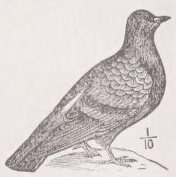
PIGEON, French Pigeon, Italian Piccione and Pipione, Latin Pipio, literally a nestling-bird that pipes or cries out, a “Piper ”—the very name now in use among Pigeon-fanciers. The word Pigeon, doubtless of Norman introduction as a polite term, seems to bear much the same relation to Dove, the word of Anglo-Saxon origin, that mutton has to sheep, beef to ox, veal to calf, and pork to bacon; but, as before stated (Dove, vol. vii. p. 379), no sharp distinction can be drawn between the two, and the collective members of the group Columbx are by ornithologists ordinarily called Pigeons. Perhaps the best known species to which the latter name is exclusively given in common speech is the Wild Pigeon or Passenger-Pigeon of North America, Ectopistes migratorius, which is still plentiful in many parts of Canada and the United States, though no longer appearing in the countless numbers that it did of old, when a flock seen by Wilson was estimated to consist of more than 2230 millions. The often-quoted descriptions given by him and Audubon of Pigeon-haunts in the then “back woods” of Kentucky, Ohio, and Indiana need not here be reproduced. That of the latter was declared by Water ton to be a gross exaggeration if not an entire fabrication; but the critic would certainly have changed his tone had he known that, some hundred and fifty years earlier, Passenger-Pigeons so swarmed and ravaged the colonists’ crops near Montreal that a bishop of his own church was constrained to exorcise them with holy water, as if they had been demons. The rapid and sustained flight of these Pigeons is also as well-established as their former overwhelming abundance—birds having been killed in the State of New York whose crops contained undigested grains of rice that must have been not long ...before plucked and swallowed in South Carolina or Georgia. The Passenger-Pigeon is about the size of a common Turtle-Dove, but with a long, wedge-shaped tail. The male is of a dark slate-colour above, and purplish-bay beneath, the sides of the neck being enlivened by gleamingviolet, green, and gold. The female is drab-coloured above and dull white beneath, with only a slight trace of the brilliant neck-markings.
Among the multitudinous forms of Pigeons very few can here be noticed. A species which seems worthy of attention as being one that might possibly repay the trouble of domestication, if any enterprising person would give it the chance, is the Wonga-wonga or White-fleshed Pigeon of Australia, Leucosarcia picata, a bird larger than the Ring-Dove, of a slaty-blue colour above and white beneath, streaked on the flanks with black. It is known to breed, though not very freely, in captivity, and is said to be excellent for the table. As regards flavour, however, those who have been so fortunate as to eat them declare that the Fruit-Pigeons of the genus Treron (or Vinago of some authors) and its allies surpass all birds. These inhabit tropical Africa, India, and especially the Malay Archipelago; but the probability of domesticating any of them is very remote. Hardly less esteemed are the Pigeons of the genus Ptilopus and its kindred forms, which have their headquarters in the Pacific Islands, though some occur far to the westward, and also in Australia. Among them are found the most exquisitely-coloured of the whole Family. There may be mentioned the strange Nicobar Pigeon, Caloenas, an inhabitant of the Indian Archipelago, not less remarkable for the long lustrous hackles with which its neck is clothed than for the structure of its gizzard, which has been described by Prof. Flower {Proc. Zool. Society, 1860, p. 330), though this peculiarity is matched or even surpassed by that of the same organ in the Phaenorrhina goliath, of New Caledonia {Rev. de Zoologie, 1862, p. 138) and in the Carpophaga latrans of Fiji. In this last the surface of the epithelial lining is beset by horny conical processes, adapted, it is believed, for crushing the very hard fruits of Onocarpus vitiensis on which the bird feeds {Proc. Zool./Society, 1878, p. 102). The modern giants of the group, consisting of about half a dozen species of the genus Goura and known as
Crowned-Pigeons, belong to New Guinea and the neighbouring islands, but want of space forbids further notice of their characteristics, of which the most conspicuous are their large size and the reticulated instead of scutellated covering of their “tarsi.”
A very distinct type of Pigeon is that represented by Didunculus strigirostris, the “Manu-mea ” of Samoa, still believed by some to be the next of kin to the Dodo (vol. vii. p. 321), but really presenting only a superficial resemblance in the shape of its bill to that effete form, from which it differs osteologically quite as much as do other Pigeons {Phil. Transactions, 1869, p. 349). It remains to be seen whether the Papuan genus Otidiphaps, oi which several species are now known, may not belong rather to the Didunculidae than to the true Columbidae (see Ornithology, vol. xviii. p. 46).
At least 500 species of Pigeons have been described, and many methods of arranging them suggested. That by Garrod {Proc. Zool. Society, 1874, pp. 249-259) is one of the most recent; but, for reasons before assigned (vol. xviii. p. 40), it is not satisfactory. Temminck’s great work on the group with its continuation by Μ. Florent-Provost, already mentioned (vol. xviii. p. 11), is of course wholly out of date, as also Selby’s more modest Natural History of the Columbidae (forming vol. ix. of Jardine’s Naturalist's Library). Schlegel’s catalogue of the specimens contained in the museum at Leyden {Museum des Pays-Bas, livr. 10, 1873) contains much useful information, but a new monograph of the Pigeons, containing all the recent discoveries, is much wanted. (a. n.)
9th ed. Encyclopædia Britannica, vol. 19, p. 84 [991 words — estimated reading time: 6 minutes]
A small compartment in a desk or case for the keeping of letters, documents, etc.; -- so called from the resemblance of a row of them to the compartments in a dovecote.
And he said unto him, Take me an heifer of three years old, and a she goat of three years old, and a ram of three years old, and a turtledove, and a young pigeon.
And the LORD said to him, “Bring Me a heifer, a goat, and a ram, each three years old, along with a turtledove and a young pigeon.”
And if he be not able to bring a lamb, then he shall bring for his trespass, which he hath committed, two turtledoves, or two young pigeons, unto the LORD; one for a sin offering, and the other for a burnt offering.
If, however, he cannot afford a lamb, he may bring to the LORD as restitution for his sin two turtledoves or two young pigeons—one as a sin offering and the other as a burnt offering.
But if he be not able to bring two turtledoves, or two young pigeons, then he that sinned shall bring for his offering the tenth part of an ephah of fine flour for a sin offering; he shall put no oil upon it, neither shall he put any frankincensethereon: for it is a sin offering.
But if he cannot afford two turtledoves or two young pigeons, he may bring a tenth of an ephah of fine flour as a sin offering. He must not put olive oil or frankincense on it, because it is a sin offering.
And when the days of her purifying are fulfilled, for a son, or for a daughter, she shall bring a lamb of the first year for a burnt offering, and a young pigeon, or a turtledove, for a sin offering, unto the door of the tabernacle of the congregation, unto the priest:
When the days of her purification are complete, whether for a son or for a daughter, she is to bring to the priest at the entrance to the Tent of Meeting a year-old lamb for a burnt offering and a young pigeon or a turtledove for a sin offering.
And if she be not able to bring a lamb, then she shall bring two turtles, or two young pigeons; the one for the burnt offering, and the other for a sin offering: and the priest shall make an atonement for her, and she shall be clean.
But if she cannot afford a lamb, she shall bring two turtledoves or two young pigeons, one for a burnt offering and the other for a sin offering. Then the priest will make atonement for her, and she will be clean.’”
And on the eighth day he shall take to him two turtledoves, or two young pigeons, and come before the LORD unto the door of the tabernacle of the congregation, and give them unto the priest:
On the eighth day he is to take two turtledoves or two young pigeons, come before the LORD at the entrance to the Tent of Meeting, and give them to the priest.
And on the eighth day she shall take unto her two turtles, or two young pigeons, and bring them unto the priest, to the door of the tabernacle of the congregation.
On the eighth day she is to take two turtledoves or two young pigeons and bring them to the priest at the entrance to the Tent of Meeting.
And the swine, because it divideth the hoof, yet cheweth not the cud, it is unclean unto you: ye shall not eat of their flesh, nor touch their dead carcase.
Although they chew the cud, they do not have a divided hoof. They are unclean for you, as well as the pig; though it has a divided hoof, it does not chew the cud. It is unclean for you. You must not eat its meat or touch its carcass.
He that killeth an ox is as if he slew a man; he that sacrificeth a lamb, as if he cut off a dog’s neck; he that offereth an oblation, as if he offered swine’s blood; he that burneth incense, as if he blessed an idol. Yea, they have chosen their own ways, and their soul delighteth in their abominations.
Whoever slaughters an ox is like one who slays a man; whoever sacrifices a lamb is like one who breaks a dog’s neck; whoever presents a grain offering is like one who offers pig’s blood; whoever offers frankincense is like one who blesses an idol. Indeed, they have chosen their own ways and delighted in their abominations.
And he said unto them, Go. And when they were come out, they went into the herd of swine: and, behold, the whole herd of swine ran violently down a steep place into the sea, and perished in the waters.
“Go!” He told them. So they came out and went into the pigs, and the whole herdrushed down the steep bank into the sea and died in the waters.
And they that kept them fled, and went their ways into the city, and told every thing, and what was befallen to the possessed of the devils.
Those tending the pigs ran off into the town and reported all this, including the account of the demon-possessed men.
This site uses cookies to remember your display preferences (search sources and editions, Bible version, auto-link, images, light/dark theme). No personal data whatsoever is collected. Privacy Policy