
RIC ,
Word of the Day: Catachrestical
A plant of the genus Oryza, and its seed. The calyx is a bivalvular uniflorous glume; the corol bivalvular, nearly equal, and adhering to the seed. There is only one species. This plant is cultivated in all warm climates, and the grain forms a large portion of the food of the inhabitants. In America, it grows chiefly on low moist land, which can be overflowed. It is a light food, and said to be little apt to produce acidity in the stomach. Indeed it seems intended by the wise and benevolent Creator to be the proper food of men in warm climates.
Ricardo
Encyclopedia Britannica
RICARDO David (1772-1823), a celebrated political economist, was born at London 19th April 1772. He was the third son of his father, a Jewish gentleman of Dutch birth, whose family, it is said, had formerly resided in Portugal. The elder Ricardo bore an honourable character, and was a successful member of the Stock Exchange. The son was placed for two years at a commercial school in Holland, and at the age of fourteen entered his father’s office, where he showed much aptitude for business. About the time when he attained his majority he abandoned the Hebrew faith, and conformed to the Anglican Church, a change which seems to have been connected with his marriage to Miss Wilkinson, which took place in 1793. In consequence of the step thus taken he was separated from his family and thrown on his own resources. His ability and uprightness were known, and he at once entered on such a successful career in the profession to which he had been brought up that at the age of twenty-five, we are told, he was already rich. He now began to occupy himself with scientific pursuits, and gave some attention to mathematics as well as to chemistry and mineralogy; but, having met with Adam Smith’s great work in 1799 at Bath, whither he had gone for his wife’s health, he threw himself with ardour into the study of political economy....
His first publication (1809) was The High Price of Bullion a Proof of the Depreciation of Bank Notes. This tract was an expansion of a series of articles which the author had contributed to the Morning Chronicle. It gave a fresh stimulus to the controversy, which had for some time been discontinued, respecting the resumption of cash payments. Ricardo argued that the premium on bullion and the unfavourable state of the exchanges could only be explained by the depreciation of the inconvertible paper money then in circulation, which had fallen 2δ per cent, below the value of specie in consequence of its over-issue. A committee to consider the whole question, commonly known as the Bullion Committee, was nominated by the House of Commons in February 1810. Amongst the members were Francis Horner, who was appointed chairman, Alexander Baring (afterwards Lord Ashburton), William Huskisson, and Henry Thornton, author of the well known Inquiry into the Nature and Effects of the Paper Credit of Great Britain (1802). The report, which was presented to parliament in June of the same year, was the joint production of Horner, Huskisson, and Thornton. It asserted the same views which Ricardo had put forward, and recommended the repeal of the Bank Restriction Act. Notwithstanding this, the House of Commons of the following year, on the motion of Mr Vansittart (afterwards Lord Bexley), declared in the teeth of the facts that paper had undergone no depreciation, and negatived Horner’s resolutions founded on the report of the committee. One of the strongest opponents of Ricardo’s opinions was Mr Bosanquet; he published in 1811 a pamphlet entitled Practical Observations on the Report of the Bullion Committee, and this drew forth from Ricardo an elaborate reply. Both this tract and its predecessor attracted much attention. They propound no new economic principles, but are based on the doctrines of Smith. They do not give such a systematic and complete view of the subject as Huskisson’s well-known tract (The Question respecting the Depreciation of the Currency Stated and Examined, 1810), but they are well reasoned, and, as to their main conclusions, convincing. It has, however, been maintained that there were features of the case which Ricardo did not sufficiently take into account, especially the demand for bullion created by the necessity of meeting the foreign payments of England, which, in consequence of the Continental system, could not be otherwise discharged.
In 1811 he made the acquaintance of James Mill, whose introduction to him arose out of the publication of Mill’s tract entitled Commerce Defended. The conversation of Ricardo’s new friend seems to have largely influenced his views; Bentham indeed declared him to be Mill’s intellectual child; but, whilst Mill doubtless largely affected his political ideas, he was, on his side, under obligations to Ricardo in the purely economic field; Mill said in 1823 that he himself and J. R. M i Culloch were Ricardo’s disciples, and, he added, his only genuine ones.
In 1815, when the Corn Laws were under discussion, he published his Essay on the Influence of a Low Price of Corn on the Profits of Stock. This was directed against a recent tract by Malthus entitled Grounds of an Opinion on the Policy of Restraining the Free Importation of Foreign Corn. The reasonings of the essay are based on the theory of rent which has often been called by the name of Ricardo; but the author distinctly states that it was not due to him. “In all that I have said concerning the origin and progress of rent I have briefly repeated, and endeavoured to elucidate, the principles which Malthus has so ably laid down on the same subject in his Inquiry into the Nature and Progress of Rent.” We now know that the theory had been fully stated, before the time of Malthus, by Anderson; it is in any case clear that it was no discovery of Ricardo. Even the conception of the soils of a country as comparable to a series of machines of different original powers, though capable of improvement by the application of capital, is quoted from Malthus. Ricardo states in this essay a set of propositions, most of them deductions from the theory of rent, which are in substance the same as those afterwards embodied in the Principles, and regarded as characteristic of his system, such as that increase of wages does not raise prices; that profits can be raised only by a fall in wages and diminished only by a rise in wages; and that profits, in the whole progress of society, are determined by the cost of the production of the food which is raised at the greatest expense. It does not appear that, excepting the theory of foreign trade, anything of the nature of fundamental doctrine, as distinct from the special subjects of banking and taxation, is laid down in the Principles which does not already appear in this tract. We find in it, too, the same exclusive regard to the interest of the capitalist class, and the same identification of their interest with that of the whole nation, which are generally characteristic of his writings. “Rent,” he says, “is in all cases a portion of the profits previously obtained on the land,” a proposition by which, for the sake, it is to be feared, of creating a political prejudice, he obscures his own doctrine that true rent can never be a part of profit; and he alleges what is in a sense true, but has a most invidious effect,—that “the interest of the landlord is always opposed to the interest of every other class in the community,” though the existence of a distinct landlord class is by no means a necessity, and the owner of rent, which somebody must own, could not, even by entirely remitting it, alter the price of food, or increase the profits of the capitalist, except by presenting him with a gift to which he has no economic claim. At the close of the tract he endeavours to show in opposition to Malthus that the danger of dependence on foreign supply for a large part of our food, and the losses on invested capital which would result from a legislative change, could not be so serious as to counterbalance the advantages arising from a free importation.
Both parts of this proposition are probably true; but he does not establish the first in a very satisfactory manner.
In the Proposals for an Economical and Secure Currency (1816) he first disposes of the chimera of a currency without a specific standard, and pronounces in favour of a single metal, with a preference for silver, as the standard. He then puts forward a scheme which had been already briefly indicated in the appendix to the 4th edition (1811) of his High Price of Bullion. This was that the bank should be obliged to deliver on demand, not coin, but uncoined bullion or gold standard bars, in exchange for its notes, whenever the notes presented together for payment reached a moderate fixed amount. The consequence would be that, all the smaller payments being made in the cheap medium, paper, the country would enjoy the profit derivable from the metallic currency used as a capital; the wear of the coinage, too, would be prevented, and a saving thus effected. By this method the public would secure itself against any variations in the value of the currency beyond those to which the standard itself is necessarily subject; and, at the same time, the circulation would be carried on in the least expensive way. Thus, whilst the use of the precious metals as the medium of exchange was, in the earlier stages of social life, one of the most important steps towards the improvement of commerce and the advancement of civilization, it is proposed to us, and on grounds which it is difficult to gainsay, to banish them once more from such employment in almost all the internal transactions of a country. A kindred revolution, tending to the further elimination of metallic money, Jevons has spoken of as “a return to barter”; but that expression is misleading, for in the modern system of settlement by writing off liabilities against each other a metallic standard is always supposed, and lies at the basis of every transaction, whereas in the primitive method of dealing commodities were directly compared. Ricardo’s plan was in operation for some time, but was then given up on the ground, urged by the bank, of the frequent forgery of one pound notes, and the consequent necessity of replacing them with coin—a very insufficient reason, as experience demonstrates, though a good argument in favour of such an improved manufacture of notes as would effectually defeat fraudulent imitation. In a later tract (Plan for a National Bank) Ricardo proposes that one pound notes should be confined to the country districts. The general plan has been objected to on the ground that it would not provide for a sufficient metallic reserve to meet sudden emergencies arising from the necessity of foreign payments.
Ricardo’s chief work, Principles of Political Economy and Taxation, appeared in 1817. A full account of the general theory expounded in this treatise has been given under Political Economy; a very brief statement must here suffice. The fundamental doctrine is that, on the hypothesis of free competition, exchange value is determined by the labour expended in production,—a proposition not new, nor, except with considerable limitation and explanation, true, and of little practical use, as “amount of labour” is a vague expression, and the thing intended is incapable of exact estimation. Ricardo’s theory of distribution has been briefly enunciated as follows:—“(1) the demand for food determines the margin of cultivation; (2) this margin determines rent; (3) the amount necessary to maintain the labourer determines wages; (4) the difference between the amount produced by a given quantity of labour at the margin and the wages of that labour determines profit.” These theorems are too absolutely stated, and require much modification to adapt them to real life. His theory of foreign trade has been embodied in the two propositions—“(1) international values are not determined in the same way as domestic values; (2) the medium of exchange is distributed so as to bring trade to the condition it would be in if it were conducted by barter.” His views on currency and banking will be gathered from the present article.
A considerable portion of the work is devoted to a study of taxation, which requires to be considered as a part of the problem of distribution. A tax is not always paid by those on whom it is imposed; it is therefore necessary to determine the ultimate, as distinguished from the immediate, incidence of every form of taxation. Smith had already dealt with this question; Ricardo develops and criticizes his results. The conclusions at which he arrives are deduced from the theory of rent and from the assumptions of a uniform rate of profits and of a rate of wages coincident with the necessary subsistence of the labourer. They are in the main as follows :—a tax on raw produce falls on the consumer, but will also diminish profits; a tax on rents on the landlord; taxes on houses will be divided between the occupier and the ground landlord; taxes on profits will be paid by the consumer, end taxes on wages by the capitalist. These propositions of course participate in the infirmity of the premises from which they are deduced, or must at least be taken with limitations corresponding to those to which the premises are subject. Ricardo adopts and even extols as a “golden maxim” the shallow dictum of Say, that “the very best of all plans of finance is to spend little, and the best of all taxes is that which is of least amount.”
In 1819 Ricardo, having retired from business and become a landed proprietor, entered parliament as member for Portarlington. He was at first diffident and embarrassed in speaking, but gradually overcame these difficulties, and was heard with much attention and deference, especially when he addressed the house on economic questions. He probably contributed in a considerable degree to bringing about the change of opinion on the question of free trade which ultimately led to the legislation of Sir Robert Peel on that subject.
In 1820 he contributed to the supplement of the Ency∙ clopaedia Britannica (6th ed.) an Essay on the Funding System. In this, besides giving an historical account (founded on Dr Robert Hamilton’s valuable work On the National Debt, 1813, 3d ed., 1818) of the several successive forms of the sinking fund, he urges that nations should defray their expenses, whether ordinary or extraordinary, at the time when they are incurred, instead of providing for them by loans; and, not believing that the system of a sinking fund would ever be consistently and perseveringly carried out, he maintains that the national debt should be paid off by a tax on property—an operation which he thought might be completed in tw τ o or three years during peace. Thus, by a single effort we might, he says, get rid of those great sources of demoralization, the customs and the excise, and our commerce would be freed from “all the vexatious delays and interruptions which our present artificial system imposes upon it.”
In 1822 he published a tract On Protection to Agriculture, which is an able application to controversy of the general principles laid down in his systematic work. Its arguments and conclusions are therefore subject to the same limitations which those fundamental principles require. He does not advocate an absolutely free importation of corn, but proposes, in consideration of the special burdens on agriculture, to impose on the foreign commodity a duty equivalent to the exclusive taxes imposed on home growers, as well as to allow a drawback on exportation equal to the duty. The only point of much interest in the tract, apart from the question of protection, is the assertion of the doctrine that a high rate of interest is beneficial to a country—a view curiously opposed to that held by Child and others in the 17th century. “Profits and interest,” he says, “cannot be too high. Nothing contributes so much to the prosperity and happiness of a country as high profits.” It seems to follow that, the productiveness of labour being given, wages cannot be too low, which can only be true on the supposition, tacitly assumed by Ricardo in many places, that wages coincide with the cost of the labourer’s maintenance. The proposition, too, appears to lead to economic pessimism, for, according to his own doctrines, the rate of profits must inevitably decline in the course of the history of any society.
In his Plan for the Establishment of a National Bank, published posthumously in 1824, he proposes that the issue of the paper currency should be taken out of the hands of the Bank of England, and vested in commissioners appointed by the Government, but not removable except on an address from one or both Houses of Parliament. These functionaries should in no case lend money to the ministers of the crown, who, when they wanted it, should raise it by taxation or have recourse to the general market. The commissioners would act as bankers to all the public departments, but would be precluded from fulfilling the same office for any corporation or individual whatever. Their great business would be to regulate the issue of paper by the price of bullion, so as to keep the value of the former equal to that of the coins it would represent. The tract describes in detail the measures to be adopted for the introduction and working of the new system. A certain step towards realizing the objects of this scheme, though on different lines from Ricardo’s, was taken in Sir Robert Peel’s Act of 1844, by which the discount business of the bank was separated from the issue department.
Ricardo died on the 11th September 1823, at his seat (Gatcomb Park) in Gloucestershire. He was only fifty-one years of age, and there had been nothing in his general health to give rise to apprehension; the cause of death was a cerebral affection resulting from disease of the ear. He was much regretted, as he had been highly esteemed, both in public and private life. His character is represented in very favourable colours by those who knew him best. He is described as modest, candid, and ever open to conviction,—as affectionate in his family, steady in his friendships, and generous and kind in his wider personal relations. James Mill, who was intimately acquainted with him, says (in a letter to Napier of November 1818) that he knew not a better man, and on the occasion of his death published a highly eulogistic notice of him in the Morning Chronicle. A lectureship on political economy, to exist for ten years, was founded in commemoration of him, M'Culloch being chosen to fill it.
In forming a general judgment respecting Ricardo, we must have in view not so much the minor writings, to which this article has been in great part devoted, as the Principles, in which his economic system is expounded as a whole. By a study of this work we are led to the conclusion that he was an economist only, not at all a social philosopher in the wider sense, like Adam Smith or John Mill. He had great acuteness, but little breadth. For any large treatment of moral and political questions he seems to have been alike by nature and preparation unfitted; and there is no evidence of his having had any but the most ordinary and narrow views of the great social problems. His whole conception of human society is material and mechanical, the selfish principle being regarded, after the manner of the Benthamites, as omnipotent, not merely in practical economy, but, as appears from his speech on the ballot and his tract on reform, in the whole extent of the social field. Roscher calls him “ein tiefer Menschenkenner”; it would be difficult to characterize him more inaptly. The same writer remarks on his “capitalistic” tone, which, he says, becomes “mammonistic”
in some of his followers; but the latter spirit is already felt as the pervading atmosphere of Ricardo’s works. He shows no trace of that hearty sympathy with the working classes which breaks out in several passages of the Wealth of Nations; we ought, perhaps, with Held, to regard it as a merit in Ricardo that he does not cover with fine phrases his deficiency in warmth of social sentiment. The idea of the active capitalist having any duties towards his employes never seems to occur to him; the labourer is, in fact, merely an instrument in the hands of the capitalist, a pawn in the game he plays. His principal work is the ultimate expression of what Comte calls “l’ignoble métaphysique qui prétend étudier les lois générales de l’ordre matériel en l’isolant de tout autre.” Against such a picture of industrial life as a mere sordid struggle of conflicting interests contemporary socialism is the necessary, though formidable, protest; and the leaders of that movement have eagerly seized his onesided doctrines and used them for their own ends.
He first introduced into economics on a great scale the method of deduction from a priori assumptions. The conclusions so arrived at have often been treated as if they were directly applicable to real life, and indeed to the economic phenomena of all times and places. But the truth of Ricardo’s theorems is...
9th ed. Encyclopædia Britannica, vol. 20, p. 533 — signed J. K. I.
[3,946 words — estimated reading time: 25 minutes]
[3,946 words — estimated reading time: 25 minutes]
Riccati
Encyclopedia Britannica
RICCATI James, Count (1676—1754), a celebrated Italian mathematician, was born at Venice, May 8, 1676, and died at Treviso, April 15, 1754. He studied at the university of Padua, where he graduated in 1696. Riccati was deeply read in history, belles lettres, architecture, and poetry—in fact, was a highly cultivated man; his favourite pursuits, however, were scientific, and his authority on all questions of practical science was referred to by the senate of Venice. He corresponded with many of the European savants of his day, and contributed largely to the Acta Eruditorum of Leipsic. He was offered the presidency of the academy of science of St Petersburg; but this high distinction lie declined, preferring the leisure and independence of life in Italy. Riccati’s name is best known and will be preserved by mathematicians in connexion with his celebrated problem called Riccati’s equation, published in the Acta Eruditorum, September 1724. A very valuable and complete account of this equation and its various transformations has been recently given by Mr J. W. L. Glaisher, F.R.S., in the Transactions of the Royal Society (1881, pp. 759-829).
After Riccati’s death his works were collected by his sons and published in four volumes. His sons, Vincenzo (1707-1775) and Giordano (1709-1790), inherited his talents. The former was professor of mathematics at Bologna, and published, among other works, a large treatise on the calculus. Giordano w τ as distinguished both as a mathematician and an architect.
9th ed. Encyclopædia Britannica, vol. 20, p. 535
[248 words — estimated reading time: 2 minutes]
[248 words — estimated reading time: 2 minutes]
Ricci
Encyclopedia Britannica
RICCI Matteo (1552-1610), is eminent as practically the founder of Christian missions in modern China.
He was born of a noble family at Macerata in the March of Ancona on 7th October 1552, two months before Francis Xavier, burning with the desire to carry his message into China, died at its gates. After some education at a Jesuit college in his native town, Ricci, at the age of sixteen, was sent by his father to study law at Rome. But the youth had already contemplated entering the Jesuit Company, and this purpose he accomplished about 1571, without informing his father, of whose opposition he was aware, until the step had been taken. The father instantly started for Rome, but was stopped by illness, and abandoned opposition.
In 1577 Ricci and several other Italian students of noble birth offered themselves for the East Indian missions; and Ricci, without visiting his family to take leave, proceeded to Portugal. His comrades were Rudolfo Acquaviva, Nicolas Spinola, Francesco Pasio, and Michele Ruggieri, all afterwards, like Ricci himself, famous in the Jesuit annals. They arrived at Goa in September 1578. After four years spent in India, Ricci was summoned to the task of opening China to evangelization....
Several attempts had been made by Xavier, and since his death, to introduce the church into China,—as by Melchior Nunes of the Jesuit society operating from Sanchian in 1555; by Gaspar da Cruz, a Dominican, in that or the following year; by the Augustinians under Martin Herrada, 1575; and in 1579 by the Franciscans led by Pedro d’Alfaro; but all these attempts proved abortive. In 1571 a house of the Jesuits had been set up at Macao (where the Portuguese were established in 1557), but their attention was then occupied with Japan, and it was not till the arrival at Macao of Alessandro Valignani on a visitation in 1582 that work in China was really taken up. For this object he had obtained the services first of M. Ruggieri and then of Ricci. After various disappointments they found access to Chau-king-fu on the Si-Kiang or West River of Canton, where the viceroy of the two provinces of Kwang-tung and Kwang-si then had his residence, and by favour of this personage they were enabled to establish themselves, and there spent several years. Their proceedings were very cautious and tentative; they excited the curiosity and interest of even the more intelligent Chinese by their clocks, their globes and maps, their books of European engravings, and by Ricci’s knowledge of mathematics, including dialling and the like, and the projection of maps. They conciliated some influential friends, and their reputation spread pretty widely in China. This was facilitated by the Chinese system of transfer of public officers from one province of the empire to another, and in the later movements of the missionaries they frequently met with one and another of their old acquaintances in office, who were more or less well disposed. Eventually troubles arose at Chau-king which compelled them to seek a new locality; and in 1589, with the viceroy’s sanction, they migrated to Chang-chau in the northern part of Kwang-tung, not far from the well known Meiling Pass.
During his stay here Ricci was convinced that a mistake had been made in adopting a dress resembling that of the bonzes, thus identifying the missionaries with a class who were the objects either of superstition or of contempt. With the sanction of the visitor it was ordered that in future the missionaries should adopt the costumes of Chinese literates. And, in fact, they before long adopted Chinese manners altogether.
Chang-chau, as a station, did not prove a happy selection, but it was not till 1595 that an opportunity occurred of travelling northward. We cannot follow Ricci’s movements in detail, or the vicissitudes of favour and trouble which attended his plans. The latter were, on the whole, never very grave. For some time his residence was at Nan-chang-fu, the capital of Kiang-si; but in 1598 he was enabled to proceed under favourable conditions to Nanking, and thence, for the first time, to Peking, which had all along been the goal of his missionary ambition. But circumstances were not then propitious, and the party had to return to Nanking. The fame of the presents which they carried had, however, reached the court, and the Jesuits were summoned north again, and on the 24th January 1601 they entered the capital. Wan-lieh, the emperor of the Ming dynasty, in those days lived in seclusion, and saw no one but his women and the eunuchs. But the missionaries were summoned to the palace; their presents were immensely admired; and the emperor had the curiosity to send for portraits of the fathers themselves.
They obtained a settlement, with an allowance for subsistence, in Peking, and from this time to the end of his life Ricci’s estimation among the Chinese was constantly increasing, as was at the same time the amount of his labours. Visitors, who were never turned away, thronged the mission residence incessantly; inquiries coming to him from all parts of the empire, from strangers as well as acquaintances, respecting the doctrines which he taught, or the numerous Chinese publications which he issued, had to be answered. This in itself was a great burden, as Chinese composition, if wrong impressions are to be avoided, demands extreme care and accuracy. As head of the mission, which now had four stations in China, he also devoted much time to answering the letters of the priests under him, a matter on which he spared no pains or detail. The new converts had to be attended to—always welcomed, and never hustled away. Besides these came the composition of his Chinese books, the teaching of his people, and the maintenance of the record of the mission history which had been enjoined upon him by the general of the order, and which he kept up to the most recent dates. Thus his labours were wearing and incessant. In May 1610 he broke down, and after an illness of eight days died on the 11th of that month, aged fifty-eight. His coadjutor Pantoja applied to the emperor for a burying-place outside the city. This, after due consideration by the boards concerned, was granted, with the most honourable official testimonies to the reputation and character of Ricci; and a large building in the vicinity of the city was at the same time bestowed upon the mission for their residence.
Ricci’s character, his acquirements, and the use he made of them were certainly worthy of all honour. We do not know what amount of success in conversion had rewarded his labours during his life, hut some eminent and creditable converts there were, and his work was the foundation of the considerable spread which the Roman Catholic Church has since attained in China. When the missionaries of other Roman Catholic orders made their way into China, some twenty years after the death of Ricci, they found great fault with the manner in which certain Chinese practices had been dealt with by the Jesuits, a matter in which Ricci’s action and policy had given the tone to the mission in China,—though in fact that tone was rather inherent in the Jesuit system than the outcome of individual character, for controversies of an exactly parallel nature arose two generations later in southern India, between the Jesuits and Capuchins, regarding what were called “Malabar rites.” The controversy thus kindled in China burned for considerably more than a century with great fierceness, and we can herfc, in connexion with the career of Ricci, but indicate its existence. The chief points of controversy were (1) the lawfulness and expediency of certain terms employed by the Jesuits in naming God Almighty, such as Tien, “Heaven,” and Shang-ti, “Supreme Ruler” or “Emperor,” instead of Tien-Chu, “Lord of Heaven,” and in particular the erection of inscribed tablets in the churches, on which these terms were made use of; (2) in respect to the ceremonial offerings made in honour of Confucius, and of personal ancestors, which Ricci had recognized as merely “civil” observances; (3) the erection of tablets in honour of ancestors in private houses; and (4), more generally, sanction and favour accorded to ancient Chinese sacred books and philosophical doctrine, as not really trespassing on Christian faith.
Probably no European name of past centuries is so well known in China as that of Li-ma-teu, the form in which the name of our missionary (,β⅛-cci Mat-teo') was adapted to Chinese usage, and by which he appears in Chinese records. The works which he composed in Chinese are numerous; a list of them (apparently by no means complete, however) will be found in Kivclier’s China Illustrata, and also in Abel Rémusat’s Nouveaux Mélanges Asiatiques (ii. pp. 213-215). They are said to display an aptitude for clothing ideas in a Chinese dress very rare and remarkable in a foreigner. One of the first which attracted attention and reputation among Chinese readers was a Treatise upon Friendship, in the form of a dialogue containing short and pithy paragraphs; this is stated in the De Expeditione to have been suggested during Ricci’s stay at Nan-chang by a conversation with the prince of Kien-ngan, who asked questions regarding the laws of friendship in the West.
In the early part of his residence at Peking, when enjoying constant intercourse with scholars of high position, Ricci brought out the Tien-chu shih-i, or “Veritable doctrine of the Lord of Heaven,” which deals with the divine character and attributes under eight heads. “This work,” says Mr A. Wylie, “contains some acute reasoning in support of the propositions laid down, but the doctrine of faith in Christ is very slightly touched upon. The teachings of Buddhism are vigorously attacked, whilst the author tries to draw a parallel between Christianity and the teachings of the Chinese literati.”
In 1604 Ricci completed the Erh-shih-wu yen, a series of short articles of moral bearing, but exhibiting little of the essential doctrines of Christianity. Chi-jên shih ρien is another of his productions, completed in 1608, and consisting of a record of ten conversations held with Chinese of high position. The subjects are :— (1) Years past no longer ours; (2) Man a sojourner on earth; (3) Advantage of frequent contemplation of eternity; (4) Preparation for judgment by such contemplation; (5) The good man not desirous of talking; (6) Abstinence, and its distinction from the prohibition to take life; (7) Self-examination and self-reproof inconsistent with inaction; (8) Future reward and punishment; (9) Prying into futurity hastens calamity; (10) Wealth with covetousness more wretched than poverty with contentment. To this work is appended a translation of eight European hymns, with elucidations, written in 1609.
Some of the characteristics briefly indicated here may have suggested, though probably they are far from justifying, the bitterness of attacks made upon Ricci’s theology, long after he had been in his grave, by some of the opponents of the Jesuits in the controversies to which we have referred. An example of these is found in the work called Anecdotes sur l'État de Religion dans la Chine, Paris, 1733-35, the author of which (Abbé Villers) speaks of the T'ien-ehu shih-i in this fashion—“The Jesuit was also so ill versed in the particulars of the faith that, as the holy bishop of Conon, Monsgr. Maigrot, says of him, one need merely read his book on the true religion to convince oneself that he had never imbibed the first elements of theology”. . . . The writer goes on to say other things even much more bitter.
Ricci’s pointed attacks on Buddhism, and the wide circulation of his books, called forth the opposition of the Buddhist clergy.
One of the ablest who took their part was Chu-hang, a priest of Hang-chau, who had abandoned the literary status for the Buddhist cloister. He wrote three articles against the doctrine of the missionaries. These were brought to Ricci’s notice in an ostensible tone of candour by Yu-chun-he, a high mandarin at the capital. This letter, with Ricci’s reply, the three Buddhist declamations, and Ricci’s confutation, were published in a collected form by the Christian Sen-Kwang-K’e.
Another work of Ricci’s which attracted attention was the Hsi-kuo fa, or “Art of Memory as practised in the West.” Ricci was himself a great, expert in memoria techniea, and astonished the Chinese by his performances in this line. He also wrote or edited various Chinese works on geography, the celestial and terrestrial spheres, geometry, and arithmetic. And the detailed history of the mission was drawn out by him, which after his death was brought home by P. Nicolas Trigault, and published at Augsburg, and in a complete form at Lyons a year later under the name De Expeditione Christiana aρud Sinas Suscepta, ab Soe. Jesu, Ex P. Mat. Ricci ejusdem Societatis Commentariis, in which Trigault himself added a large amount of interesting matter respecting China and the Chinese.
Among the scientific works of his time which Ricci took with him into China, there was a fine set of maps, which at first created great interest, but disgust afterwards when the Chinese came to perceive the insignificant place assigned therein to the “Middle Kingdom,” thrust, as it seemed, into a corner, instead of being set in the centre of the world like the gem in a ring. Ricci, seeing their dissatisfaction, set about constructing a map of the hemisphere on a great scale, so adjusted that China, with its subject states, filled the central area, and, without deviating from truth of projection, occupied a large space in proportion to the other kingdoms gathered round it. All the names were then entered in Chinese calligraphy. This map obtained immense favour, and was immediately engraved at the expense of the viceroy, and widely circulated.
In the accompanying cut we have endeavoured to realize this Jesuitical map, as we fear it must be called. The projection we have adopted is a perspective of the hemisphere, as viewed from a point at the distance of one diameter from the surface, and situated on the production of the radius which passes through the intersec tion of 115° E.
long. (Green wich) with 30°
N. lat. Some thing pretty near this must have been Li-
ma-teu’s projec tion. With a vertex much more distant the desired effect would be impaired, and with one nearer neither of the poles would be seen, whilst the exaggeration of China would have been too gross for a professed representation of the hemisphere.
The chief facts of Ricci's career are derived from Trigault; some contemporary-works on the rites controversy have also been consulted; in the notice of Ricci's Chinese writings valuable matter has been derived from Notes on Chinese Literature by Mr Λ. wylie, an indefatigable scholar, and perhaps our only contemporary who can speak of these from actual examination. The projection of the sphere by the present writer appeared in the (now defunct) Geographical Magazine for July 1874. A number of Ricci's letters are extant in the possession of the family, and access to them was afforded to Giuseppe La Farina, author of the work called La China, considerata nella sua Storia, <fcc., Florence, 1843, by the Marchese Amico Ricci of Macerata, living at Bologna (see vol. i. p. 112 sg.). La Farina’s quotations contain nothing of interest. There is a curious Chinese account of Ricci published by Dr Breitschneider in the China Review, iv. 391 sq.
9th ed. Encyclopædia Britannica, vol. 20, p. 536 — signed H. Y.
[2,642 words — estimated reading time: 16 minutes]
[2,642 words — estimated reading time: 16 minutes]
Ricciarelli
Encyclopedia Britannica
RICCIARELLI Daniele (1509-1566), Italian artist, generally called, from the place of his birth, Daniele da we find the following entries :—“197. Chi’ho yuan pên, Elements of Geometry (MS.). This is the first six books of Euclid, translated by Matthew Ricci and his disciple Sen-Kwang-K’e, 1607.” “198.
Tung-wen suan-ehilι. Guide to Arithmetic, 9 vols, incomplete; this treatise was drawn up by Ricci, with the aid of his disciple Le-Che-tsaou, and published in 1613.” “199. Chi-jên shih pien ’ ' (see above)....
Volterra, was born in 1509, and studied painting under Razzi and Peruzzi. The young artist, settling in Rome, strove most unweariedly to attain eminence in his profession. No efforts were spared on his pictures, lie proceeded with a careful slowness, attempting to reach his ideal by a close imitation of Michelangelo. It is even said that he sometimes in a difficulty had recourse to the more direct aid of that great master’s own hand. The result of this earnest labour was that Ricciarelli obtained abundant encouragement. His constant friend, Michelangelo, recommended him on all possible occasions. He had the honour to beautify with works of art a chapel in the church of the Trinità, to paint in the Farnese Palace, to execute certain decorations in the Palazzo de’ Medici at Navona, and to begin the stucco work and the pictures in the Hall of the Kings. Nor was he less highly patronized when, towards the close of his life, he turned his attention to statuary. His last work was a bronze horse intended for an equestrian statue of Henry II. of France. He died in 1566. The principal extant works of Ricciarelli are at Rome. These are a St John the Baptist in the picture gallery of the Capitol, a Saviour bearing the Cross in the Palazzo Rosρigliosi, and a Descent from the Cross, his masterpiece, in the church of Trinità de Monti. There is also an Elijah at Volterra.
9th ed. Encyclopædia Britannica, vol. 20, p. 537
[332 words — estimated reading time: 2 minutes]
[332 words — estimated reading time: 2 minutes]
Riccoboni
Encyclopedia Britannica
RICCOBONI Madame (1714-1792), whose maiden name was Marie Jeanne Laboras de Mézières, and who married and was deserted by an actor and author of little merit, was born at Paris in 1714. She herself was an actress, but did not succeed on the stage. She then took to novel writing and deserves a considerable place in the history of the sentimental novel. Her first work was the remarkable Histoire du Marquis de Cressy (1758). This was followed by Milady Catesby, Fanny Butler (both of them, as indeed are almost all her books, in letter form), Ernestine (sometimes thought her masterpiece), three series of Lettres in the names of Adelaide de Dammartin (often quoted as Madame de Sancerre), Elizabeth Sophie de Valliere, Milord Rivers, and others. These books were much admired, but brought their author little money. She obtained, however, a small pension from the crown, but the Revolution deprived her of it, and she died in 1792 in great indigence. Besides the works named she translated Fielding’s Amelia, and tried a continuation (but not the conclusion sometimes erroneously ascribed to her) of Marivaux’s unfinished Marianne.
All Madame Rieeoboni’s work is very clever, and there is real pathos in it. But it is among the most eminent examples of the “sensibility” novel, of which no examples but Sterne’s have kept their place in England, and that not in virtue of their sensibility. A still nearer parallel may be found in the work of Mackenzie. Madame Riccoboni is an especial offender in the use of mechanical aids to impressiveness—italics, dashes, rows of points, and the like. The principal edition of her complete works is that of Paris, 1818. The chief novels appear in a volume of Garnier’s Bibliothèque Amusante, Paris, 1865.
9th ed. Encyclopædia Britannica, vol. 20, p. 538
[299 words — estimated reading time: 2 minutes]
[299 words — estimated reading time: 2 minutes]
A well-known cereal grass (Oryza sativa) and its seed. This plant is extensively cultivated in warm climates, and the grain forms a large portion of the food of the inhabitants. In America it grows chiefly on low, moist land, which can be overflowed.
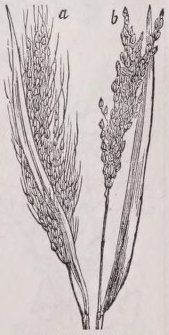
Rice
Encyclopedia Britannica
RICE. According to Roxburgh the cultivated rice with all its numerous varieties has originated from a wild plant called in India Newaree or Nivara {Oryza saliva). It is said to grow on the borders of lakes in the Circars and elsewhere in India, and is also native in tropical Australia. The rice plant is an annual grass with long linear glabrous leaves, each provided with a long sharply-pointed ligule. The spikelets are borne on a compound or branched spike, erect at first but afterwards bent downwards. Each spikelet contains a solitary flower with two outer small glumes and two inner, larger and folded lengthwise, the outer one of the two rather larger and sometimes provided with an awn. Within these are six stamens, a hairy ovary surmounted by two feathery styles which ripens into the fruit (grain), and which is invested by the husk formed by the persistent glumes. The cultivated varieties are extremely numerous, some kinds being adapted for marshy land, others for growth on the hill-sides. The cultivators make two principal divisions according as the sorts are early or late. Other subdivisions depend upon the habit of the plant, the presence or absence of an awn, the colour of the grain, and other particulars. Rice has been cultivated from time immemorial in tropical countries. According to Stanislas Julien a ceremonial ordinance was established in China by the emperor Chin-nung 2800 years b.c., in accordance with which the emperor sows the rice himself while the seeds of four other kinds may be sown by the princes of his family. This fact, joined to other considerations, induced Alphonse de Candolle to consider rice as a native of China. It was very early culti vated in India, in some parts of which country, as in tro pical Australia, it is, as we have seen, ...indigenous. It is not mentioned in the Bible, but its culture is alluded to in the Talmud.
There is no evi dence of the exist ence of rice in
Egyptian remains, nor is there any trace of it as a native plant among the Greeks, Ro mans, or ancient
Persians. There is proof of its culture in the Euphrates valley and in
Syria four hundred yearsbefore Christ.
Crawfurd on phi lological grounds considers that rice was introduced into Persia from southern India.
The Arabs carried the plant into
Spain under the name “aruz,” the arros of the Spanish, the mzo of the Italian, whence our word rice. Ricp was first cultivated in Italy near Pisa in 1468. It was not introduced into Carolina until 1700, and then, as it is said, by accident, although at one time the southern United States furnished a large proportion of the rice introduced into commerce. Rice, says Crawfurd, sports into far more varieties than any of the corns familiar to Europeans, for some varieties grow in the water and some on dry land; some come to maturity in three months, while others take four and six months to do so. The Hindus, however, are not content with such broad distinctions as might be derived from these obvious sources, but have names for varieties the distinctions between which are unappreciable by Europeans; besides terms for this corn founded on variety, on season, and on mode of culture, the grain itself bears one name in the straw, another when threshed, one name in the husk and another when freed from it, and a fifth when cooked. A similar abundance of terms is found in the languages of the Malay and Philippine Islands. Such minute nomen clatures seem to point to a great antiquity in the culture of this cereal.
Rice constitutes one of the most important articles of food in all tropical and subtropical countries, and is one of the most prolific of all crops. The rice yields best on low lands subject to occasional inundations, and thus enriched by alluvial deposits. Λn abundant rainfall during the growing season is also a desideratum. Rice is sown broadcast, and in some districts is transplanted after a fortnight or three weeks. No special rotation is followed; indeed the soil best suited for rice is ill adapted for any other crop. In some cases little manure is employed, but in others abundance of manure is used. No special tillage is required, but weeding and irrigation are requisite. Rice in the husk is known as “paddy.” On cutting across a grain of rice and examining it under the microscope, first the flattened and dried cells of the husk are seen, and then one or two layers of cells elongated in a direction parallel to the length of the seed, which contain the gluten or nitrogenous matter. Within these, and forming by far the largest part of the seed, are large polygonal cells filled with very numerous and very minute angular starch grains. Rice is not so valuable.as a food as some other cereals, inasmuch as the proportion of nitrogenous matter (gluten) is less. Payen gives only 7 per cent, of gluten in rice as compared with 22 per cent, in the finest wheat, 14 in oats, and 12 in maize. The percentage of potash in the ash is as 18 to 23 in wheat. The fatty matter is also less in proportion than in other cereals. Rice, therefore, is chiefly a farinaceous food, and requires to be combined with fatty and nitrogenous substances, such as milk or meat gravy, to satisfy the requirements of the system.
The imports of rice into the United Kingdom range from 7,000,000 cwt. to 8,000,000 cwt. annually, having an estimated value of,from £3,000,000 to £3,500,000. Nearly the whole of this comes from British Burmah and Bengal. A large proportion of the rice brought to Europe is used for starch-making, and some is taken by distillers of alcohol. Rice is also the source of a drinking spirit in India, and the national beverage of Japan—saké—is prepared entirely from the fermented grain.
9th ed. Encyclopædia Britannica, vol. 20, p. 538
[1,005 words — estimated reading time: 6 minutes]
[1,005 words — estimated reading time: 6 minutes]
Rice paper
Encyclopedia Britannica
RICE PAPER. The substance which has received this name in Europe, through the mistaken notion that it is made from rice, consists of the pith of a small tree Arabia papyrifera cut into thin slices. The tree grows in the swampy forests of Formosa and apparently nowhere else, and large quantities of the stems are conveyed to Chin-chew, where the snow-white delicate pith is carefully sliced by spiral cuts into uniform sheets of a fine ivory-like texture. It is dyed various colours, and extensively used for the preparation of artificial flowers, while the white sheets are employed by native artists for water-colour drawings.
9th ed. Encyclopædia Britannica, vol. 20, p. 539
[107 words — estimated reading time: 1 minute]
[107 words — estimated reading time: 1 minute]
1. RICE-BIRD ,
Any one of numerous species of small white polished marine shells of the genus Olivella.
1. Wealthy; opulent; possessing a large portion of land, goods or money, or a larger portion than is common to other men or to men of like rank. A farmer may be rich with property which would not make a nobleman rich An annual income of 500 sterling pounds would make a rich vicar, but not a rich bishop. Men more willingly acknowledge others to be richer, than to be wiser than themselves.
2. Abram was very rich in cattle, in silver and in gold.
3. Genesis 13:2 .
4. Splendid; costly; valuable; precious; sumptuous; as a rich dress; a rich border; a rich silk; rich furniture; a rich present.
5. Abundant in materials; yielding great quantities of any thing valuable; as a rich mine; rich ore.
7. So we say, a rich description; a discourse rich in ideas.
8. Full of valuable achievements or works.
9. Each minute shall be rich in some great action.
10. Fertile; fruitful; capable of producing large crops or quantities; as a rich soil; rich land; rich mold.
11. Abundant; large; as a rich crop.
12. Abundant; affording abundance; plentiful.
14. Full of beautiful scenery; as a rich landscape; a rich prospect.
15. Abounding with elegant colors; as a rich picture.
16. Plentifully stocked; as pastures rich in flocks.
17. Strong; vivid; perfect; as a rich color.
18. Having something precious; as a grove of rich trees.
19. Abounding with nutritious qualities; as a rich diet.
20. Highly seasoned; as rich paste; a rich dish of food.
21. Abounding with a variety of delicious food; as a rich table or entertainment.
22. Containing abundance beyond wants; as a rich treasury.
23. In music, full of sweet or harmonious sounds.
24. In Scripture, abounding; highly endowed with spiritual gifts; as rich in faith. James 2:5 .
25. Placing confidence in outward prosperity. Matthew 19:23 .
26. Self-righteous; abounding, in one's own opinion, with spiritual graces. Revelation 3:17 .
27. RICH in mercy, spoken of God, full of mercy, and ready to bestow good things on sinful men. Ephesians 2:4 . Romans 10:12 .
28. The rich used as a noun, denotes a rich man or person, or more frequently in the plural, rich men or persons.
29. The rich hath many friends. Proverbs 14:20 .
1. Having an abundance of material possessions; possessed of a large amount of property; well supplied with land, goods, or money; wealthy; opulent; affluent; -- opposed to poor.
2. Hence, in general, well supplied; abounding; abundant; copious; bountiful; as, a rich treasury; a rich entertainment; a rich crop.
3. Yielding large returns; productive or fertile; fruitful; as, rich soil or land; a rich mine.
4. Composed of valuable or costly materials or ingredients; procured at great outlay; highly valued; precious; sumptuous; costly; as, a rich dress; rich silk or fur; rich presents.
5. Abounding in agreeable or nutritive qualities; -- especially applied to articles of food or drink which are high-seasoned or abound in oleaginous ingredients, or are sweet, luscious, and high-flavored; as, a rich dish; rich cream or soup; rich pastry; rich wine or fruit.
6. Not faint or delicate; vivid; as, a rich color.
7. Full of sweet and harmonius sounds; as, a rich voice; rich music.
8. Abounding in beauty; gorgeous; as, a rich landscape; rich scenery.
9. Abounding in humor; exciting amusement; entertaining; as, the scene was a rich one; a rich incident or character.
Rich
Encyclopedia Britannica
RICH Claudius James (1787-1821), Eastern traveller and scholar, was born near Dijon, March 28, 1787. While still an infant he was taken to Bristol, where he spent his youth. At a very early age he developed a wonderful capacity for the acquisition of languages, soon becoming familiar not only with Latin and Greek but also with Hebrew, Syriac, Persian, Turkish, and other Eastern tongues. His unusual intelligence and extraordinary acquirements in Oriental languages procured for him in 1803 a nomination to a writership in the Bombay establishment of the East India Company. In 1804 Rich proceeded to Constantinople, where, and at Smyrna, he stayed a considerable time, perfecting himself in the Turkish language. Proceeding to Alexandria as assistant to the British consul-general there, he devoted himself to Arabic and its various dialects, and made himself master of Eastern manners and usages. On leaving Egypt he proceeded by land to the Persian Gulf, disguised as a Mameluke, visiting Damascus, and entering the great mosque undetected. At Bombay, which he reached in September 1807, he was the guest of Sir James Mackintosh, whose eldest daughter he married in January 1808, proceeding soon after to Baghdad as resident. While gaining the respect of Turks of all classes, as well as of Europeans, he now began his investigations into the geography, history, and antiquities of the vastly interesting region in the midst of which he was placed, the results of which give him a high place among Eastern students. He made collections of all kinds, visited and examined the remains of Babylon, and projected a geographical and statistical account of the pashalic of Baghdad. The results of his investigations at Babylon appeared first in the Vienna serial the Mines dx l ’ Oment, and in 1811 ...in England, under the title Narrative of a Journey to the Site of Babylon in 1811. In 1839 this was republished by his widow, with Major Rennell’s remarks upon it, and a second memoir by Rich in reference to these remarks, together with the narrative of a journey to Persepolis. In 1813-14 Rich spent some time in Europe, and on his return to Baghdad paid special attention to the geography of Asia Minor, and collected much information in Syrian and Chaldaean convents concerning the Yezzidis. He continued, too, to collect manuscripts of all kinds, his collections being probably the most extensive and valuable brought together by any private person up to that time. His collection of coins—Greek, Parthian, Sasanian, and Moslem—as well as of gems and engraved stones, was much enlarged. During this period he made a second excursion to Babylon, and in 1820 he undertook an extensive tour to Kurdistan—from Baghdad north to Sulimania, eastward to Sinna, then west to Nineveh, and thence down the Tigris to Baghdad. The narrative of this journey, which for the first time furnished accurate knowledge (from scientific observation) regarding the topography and geography of the region traversed, was published by his widow in 1836. It abounds with information on the country and the people, their history and traditions, the ruins and inscriptions met with, characterized by the profundity and thoroughness of the real scholar and trained observer. He visited many of the ancient Christian churches in Chaldaea, adding largely to his stock of manuscripts, including ancient Syrian and Chaldaean versions of the Scriptures. In 1821 Rich went to Basora, whence he made an excursion to Shiraz, visiting the ruins of Persepolis and the other remains of antiquity in the neighbourhood. An account of these excursions is given in the posthumous publication referred to, which also contains many notes on Rich’s collections and minor excursions as well as a brief memoir. At Shiraz he was struck down by cholera on October 5, 1821. His early death was a vast loss to Oriental investigation. The work he did accomplish was of great value for Eastern archaeology and history.
9th ed. Encyclopædia Britannica, vol. 20, p. 539
[652 words — estimated reading time: 4 minutes]
[652 words — estimated reading time: 4 minutes]
Richard
Encyclopedia Britannica
RICHARD earl of Cornwall and king of the Romans (1209-1272), second son of John, king of England, and IsabeLla, was born at Winchester, January 5, 1209. In 1225 he undertook the government of Gascony. In 1240 he went on a crusade, returning in 1241, after concluding a treaty with the sultan of Egypt. In 1242 he accompanied his brother on his unsuccessful expedition to Poitou. In 1244 and 1246 we find him heading the parliamentary opposition against Henry III., and a few years afterwards he befriended Simon de Montfort against his accusers. When Henry went to France in 1253, Richard, together with the queen, acted as regent. He had already (1252) declined the pope’s offer of the kingdom of Sicily, but in January 1257 he was elected emperor by a majority of the electors, and soon afterwards was crowned at Aix-la-Chapelle. In 1259 he returned to England and swore to observe the Provisions of Oxford. Next year he acted as peacemaker between Henry and the barons, and, after spending another year in Germany, he returned to England in 1263. It was largely owing to his mediation that the two parties submitted to the arbitration of Louis IX., but on the renewal of the civil war he took his brother’s side. Taken prisoner at the battle of Lewes, he was kept in confinement by De Montfort for a year, but released after the battle of Evesham. One of his last known acts was his mediation between the earl of Gloucester and the king. In 1269 he went to Germany again for a short time, and returned to England to die at Kirkham in 1272. He was thrice married—(1) to Isabella, sister of the earl of Pembroke; (2) to Sancia, daughter of Raymond, count of Provence; (3) to Beatrice of Falkenstein.
For authorities, see under Henry III.
RICHARD duke of Normandy. See Normandy, vol....
xvii. p. 541 sq.
RICHARD of Bury. See Aungervyle, Richard.
RICHARD of Cirencester (1335-1401), historical writer, was a member of the Benedictine abbey at Westminster, and his name (“Circestre ”) first appears on the chamberlain’s list of the monks of that foundation drawn up in the year 1355. In the year 1391 he obtained a licence from the abbot to go to Rome, his design being to visit limina Apostolorum, and in this licence the abbot gives his testimony to Richard’s perfect and sincere observance of religion for upwards of thirty years. In 1400 Richard was in the infirmary of the abbey, where his death took place in the following year. His only known extant work is Speculum Historiale de Gestis Regurn Angliae, IH f 7-1066. The manuscript of this is in the university library at Cambridge, and has been edited for the Master of the Rolls by Professor John E. B. Mayor (2 vols., 1863-1869). It is in four books, and at the conclusion of the fourth book Richard expresses his intention of continuing his narrative from the accession of William I., and incorporating a sketch of the Conqueror’s career from his birth. This design he does not, however, appear to have carried into effect. The value of the Speculum as a contribution to our historical knowledge is but slight, for it is mainly a compilation from Rodger Wendover, Geoffrey of Monmouth, William of Malmesbury, Florence, Asser, Henry of Huntingdon, and other writers; while even in transcribing these the compiler is guilty of great carelessness. He gives, however, numerous charters relating to Westminster Abbey, and also a very complete account of the saints whose tombs were in the abbey church, and especially of Edward the Confessor, with w r hose reign the fourth book is entirely occupied. The work was, notwithstanding, largely used by historians and antiquaries, until, with the rise of a more critical spirit, its value became more accurately estimated. Besides the Speculum Richard also wrote, according to the statement of William Woodford in his Answer to Wickliffe (Brown, Fasciculus Rerum expetendarum, p. 193), a treatise De Offi,ciis ; and there was formerly in the cathedral library at Peterborough another tractate from his pen, entitled Super Symbolum. Of neither of these works, however, does any known copy now exist.
Of the Speculum the main value may be said to be of a negative character, in that it affords the most conclusive proof of the spuriousness of another work attributed to Richard and long accepted by the learned world as his. This was the De Situ Britanniae, an elaborate forgery relating to the antiquities of Roman Britain which first appeared at Copenhagen in the year 1758. It was printed along with the works of Gildas and Nennius, under the editorship of Charles Julius Bertram, professor of English in the academy of Copenhagen in the middle of the last century, with the following special title :—“Richardi Corinensis monachi Westmonasteriensis de situ Britanniae libri duo. E Codici MS. descripsit, Notisque et Indice adornavit Carolus Bertram.”
This forgery was accepted, as genuine by a well-known antiquary of the last century, Dr William Stukeley, and under the sanction of his authority continued for a long time to be regarded in the same light by numerous scholars and antiquaries. Among their number were Gibbon, John Whitaker, Richard Gough, and Lingard. On the other hand, critics of a later date, such as J. J. Conybeare, Dr Guest, Wex, Raine, and Woodward, from time to time gave expression, on various grounds, to a contrary conclusion. All doubt on the subject may, however, be held to have been effectually set at rest by the masterly and exhaustive exposure of the whole fraud drawn up by Professor Mayor in the preface to the edition above referred to of the Speculum. He has there not only demonstrated, from the external and internal evidence alike, the spuriousness of the whole treatise, but in a collation (extending to nearly a hundred pages) of numerous passages with corresponding passages in classical mediaeval authorities, has also traced out the various sources from whence Bertram derived the terminology and the facts which he reproduced in the De Situ. “To say nothing,” says Professor Mayor, “of antiquaries whose canons of criticism are so lax that they cite a supposed monk of 1400 a.d. as authority for events of 1000 b.c., we find a forger alike contemptible as penman, Latinist, historian, geographer, critic, imposing upon members of the Royal and Antiquarian Societies, and of the two ancient universities, of the youthful Society D. U. K., on the writers of Germany and Denmark, of England, and of Scotland,—the last bribed by the invention of Vespasiana.”
RICHARD of Sτ Victor (oδ. c. 1173), a Scot by birth, was subprior of his convent in 1159 and prior in 1162, and was a friend of St Bernard, to whom some of his books are dedicated. The tendency of his mysticism has been characterized in vol. xvii. p. 132. Of his works, which embrace exegesis, moral and dogmatic subjects, and mystical contemplation, the first edition appeared at Paris in 1528, the best at Rouen in 1650.
9th ed. Encyclopædia Britannica, vol. 20, p. 542 — signed G. W. P.
[311 words — estimated reading time: 2 minutes]
[311 words — estimated reading time: 2 minutes]
Richard i
Encyclopedia Britannica
RICHARD I. (1157-1199), king of England, called even before his death “the Lion” or “Coeur de Lion,” was the third son of Henry II. and Eleanor of Aquitaine. He was born, probably at Oxford, on September 8, 1157. When little more than eleven years old he was invested with the duchy of Aquitaine, and imbibed in southern France the spirit of the adventurer and the troubadour which characterized him through life. In 1173 he joined the league against Henry II., but when the rebellion was suppressed in 1171 he was pardoned by his father. Shortly afterwards he was affianced to Alice, the daughter of Louis VII. The death of his brother Henry in 1184 made Richard heir to the throne. From this time he was the centre of the disturbances which troubled the last five years of Henry II.’s reign. The pretext for his quarrel with his father was the refusal of the latter to allow the barons to do fealty to Richard as heir, and Henry’s wish to transfer Aquitaine to his younger son John. War was for some time averted by the preparations for the third crusade, and Richard himself took the cross (1187). Next year, however, a quarrel between Richard and his neighbour the count of Toulouse led to the final breach. I , hilip, king of France, took advantage of this quarrel to invade Berri, whence he was driven out again by Richard, who so far was acting in concert with his father. A truce was made between the two kings, and Philip used the opportunity to separate Henry from his son. In November 1188 Richard did homage to Philip for his French provinces, and the latter demanded that Henry should acknowledge him as heir. Henry hesitated, and Richard openly joined Philip. In the spring of 1189 the allies overran Maine and Touraine, and forced Henry, in a meeting at Colombières, to ...submit to their demands. Two days later Henry died at Chinon (July G, 1189), and Richard became king of England.
Richard’s reign falls into two equal divisions—the one comprising his crusade and captivity, the other his wars against Philip in France. On his father’s death he was at once acknowledged as duke of Normandy and count of Anjou. On September 3, 1189, he was crowned with great pomp at Westminster. This is the first English coronation of which we have a full account, and the formalities then adopted have been followed with little alteration ever since. Richard at once set to work to collect funds for the crusade. He sold ecclesiastical and temporal offices, released the king of Scotland from the vassalage to which Henry II. had subjected him; and, having by these means and by taxation collected a large sum of money, he crossed to Calais on December 12. Soon afterwards he met Philip at St Remy and made a treaty with him for a joint crusade. On June 27, 1190, the two armies assembled at Vezelai, whence they marched together as far as Lyons. There Philip took the route to Genoa, while Richard went by Marseilles. Visiting Naples on the way, he landed at Messina on September 23, where he found the French army and his own fleet awaiting him. The two kings remained in Sicily during the winter. William IL, king of Sicily, husband of Richard’s sister Joanna, had died shortly before, and Tancred, nephew of William, had seized the throne. During the negotiations for the recovery of Joanna and her dowry, disturbances broke out which ended in Richard’s forcing his way into Messina at the head of his army. His real enemy was, however, not Tancred, but Philip. The natural jealousy of the two kings grew into mutual hatred during their stay in Sicily, and Tancred informed Richard of French intrigues. In March 1191 Richard made a treaty with Tancred, and recognized him as king of Sicily. At the same time he repudiated Alice, Philip’s sister, and betrothed himself to Berengaria of Navarre. Philip was the first to leave Sicily. He arrived at Acre early in April. On April 10 Richard set sail, and a month later reached Cyprus, where he married Berengaria (May 12). He then proceeded to conquer Cyprus, took Isaac Comnenus and his daughter prisoners, and set out again for the Holy Land, reaching Acre on June 8. Guy of Lusignan, who claimed the throne of Jerusalem, had besieged that fortress since 1189, but the Christian army was itself hemmed in by the forces of Saladin. Richard’s arrival encouraged the besiegers, and on July 11 Acre surrendered. The two kings now settled the dispute between Guy of Lusignan and Conrad of Montferrat about the throne of Jerusalem and on August· 3 Philip left the Holy Land. Saladin having failed to fulfil the terms on which Acre had surrendered, Richard ordered the massacre in cold blood of some three thousand Mohammedan prisoners. Soon afterwards he set out for Jaffa, and on the way thither won the battle cf Arsuf. Having rebuilt Jaffa, he started for Jerusalem. About Christmas 1191 he arrived at Beit-nûba, within sight of the Holy City, but, owing to the reluctance or desertion of his French allies, he found it impossible to besiege it, and therefore withdrew to the coast. In April 1192, at the instance of his followers, he recognized Conrad as king of Jerusalem, indemnifying Guy with the crown of Cyprus. The murder of Conrad immediately afterwards was laid, probably without sufficient ground, to the charge of Richard, who conferred the vacant throne on Henry, count of Champagne. Bad news from England now made him anxious to go home, but he resolved on one more attempt to save Jerusalem. He set out on June 4, arrived again within sight of the city, and again retired without venturing to attack. Jaffa, which had been taken by Saladin, was retaken on August 1. This was Richard’s last exploit in the East. On September 1 he made a three years’ truce with Saladin, on the basis of the status quo ; and on October 9 he sailed for home, leaving behind him a name long remembered by the Saracens, but, beyond the capture of Acre, having accomplished none of the objects with which he set out.
Fearing to go through France, Richard sailed up the Adriatic, and made his way on foot, as a pilgrim and almost alone, to Erdburg near Vienna. Here he was discovered (December 21, 1192) by Leopold, duke of Austria, of whom, while at Ascalon, he had made a bitter enemy. After being confined for some time at Dürrenstein on the Danube, he was surrendered in March 1193 to the emperor Henry VI., who imprisoned him first at Trifels and afterwards at Worms. Legend was already rife about him, but the story of his discovery by Blondel only dates from the following century, and is of French origin. In order to liberate himself, Richard resigned his crown to Henry VI. as overlord of Christendom, promised to pay a yearly tribute, and received back the crown as a vassal of the emperor. At Easter a diet was held at Spires, at which Richard was charged with various misdoings,—the recognition of Tancred, the conquest of Cyprus, the murder of Conrad, even with the betrayal of the Holy Land to Saladin. He defended himself eloquently, and the charges were dropped. Shortly afterwards a treaty was made at Worms (July 29) for Richard’s release on payment of a ransom of 150,000 marks, with other conditions. Great efforts were made in England to collect the money, two-thirds of which was paid over to Henry, hostages being given for the rest. Philip and John were able, however, by offers of money and other means, to induce the emperor to detain Richard till the following spring. At length he was liberated. On March 13, 1194, he set foot again in England. He found his dominions in great confusion owing to the intrigues of Philip and John. He rapidly made himself master of the castles which held out for John, and on April 17, 1194, he was crowned a second time. He then collected more money from the impoverished country for the rest of his ransom and for an expedition to France, and on May 12 left England again never to return. Philip retired before him; John submitted and was pardoned. For the remaining five years of his reign Richard kept up an intermittent struggle with Philip, a struggle marked by no great battles, and interrupted only by fruitless negotiations and truces which were never kept. Neither party was strong enough to inflict a severe blow upon the other. In the autumn of 1198 the war went decidedly against Philip, but in January 1199 a peace for five years was made, each side retaining what it held. Shortly afterwards Richard, while besieging the castle of Chaluz near Limoges, which was held against him by one of his vassals, was wounded by an arrow. He died on April 6, 1199, and was buried at Fontevraud. His brother John succeeded him.
In person Richard was tall, muscular, ruddy, with light brown hair. He was lavish, generous, and fearless; a skilful commander, but incapable of extensive combinations or far-reaching plans; more religious than his father or brothers, but equally vicious; a bad husband and a bad son, with much of the ferocity that characterized his race;
in fact, a typical representative of the faults as well as the virtues of the chivalry of his day. His reign was signalized by no great legal or administrative reform, and England owes him nothing but barren fame.
Chief Authorities.—Hoveden, Chronica·, Ralph de Diceto, Imagines Historiarum; Gervase of Canterbury, Chronica, &c.; Chronicles and Memorials of the Reign of Richard I.; Gesta Regis Henriei II., &c. (ascribed to Benedict of Peterborough); all the above have been edited, with most valuable prefaces, by Dr Stubbs for the Rolls Series; also William of Newburgh, Historia Rerum Anglicarum, edited for the Engl. Hist. Society by H. C. Hamilton, and for the Rolls Series by R. Howlett; Richard of Devizes, Chronieon, &c., edited for the Engl. Hist. Society by J. Stevenson; Pauli, Geschichte von England, vol. iii.; Stubbs, Early Plantagenets; Lingard, History of England, vol. ii. (G. W. P. )
9th ed. Encyclopædia Britannica, vol. 20, p. 539
[1,726 words — estimated reading time: 10 minutes]
[1,726 words — estimated reading time: 10 minutes]
Richard ii
Encyclopedia Britannica
RICHARD II. (1366-1400), king of England, the only son of Edward the Black Prince and Joan of Kent, was born at Bordeaux, April 13, 1366. He succeeded to the throne on the death of his grandfather Edward III., on June 21, 1377. He was crowned on July 16. During the first eleven years of his reign, Richard was in a position of tutelage. His uncles, John of Gaunt, duke of Lancaster, and Thomas, duke of Gloucester, were the most influential persons in the kingdom. The evils naturally inherent in a minority were intensified by war abroad, religious and social troubles at home, the existence of a turbulent nobility, and the intrigues and rivalries which broke up the royal house. Under the incapable rule of Lancaster, the southern coasts were ravaged by French fleets, the northern frontier was harried by the Scots, and the taxes collected for national purposes were wasted or embezzled. The weakness and unpopularity of the Government produced a ferment among the lower classes, which, aggravated by the heavy taxation of 1379 and 1380, culminated in the Peasants’ Revolt of June 1381. This revolt gave Richard, then a lad of fifteen, his first opportunity of distinguishing himself. On June 14 he met the rebels at Mile End, and, by promising the abolition of villenage, induced the Essex contingent to return home. Next day he met the Kentish men at Smithfield. In the parley which followed, their leader, Wat Tyler, was killed. The mob were about to avenge his death when the young king, riding forward alone, calmed their irritation and induced them to follθλv him to Islington. Here a body of troops came to the king’s aid, but Richard prevented a conflict, and persuaded the rioters to disperse. His presence of mind, extraordinary in one so young, not only saved his own life but ...averted a general disaster. In January 1382 he married Anne of Bohemia, daughter of the emperor Charles IV. Meanwhile the influence exerted by John of Gaunt was becoming more and more irksome to him. Charges of conspiracy brought against his uncle in 1384, though denied by Lancaster, so worked upon Richard that he attempted to seize him, but a reconciliation was soon afterwards effected. In 1385 the king led an expedition to Scotland. His refusal to allow the army to penetrate beyond Edinburgh is said to have caused another quarrel with the duke of Lancaster. The efforts made by Richard to form a party of personal adherents, in opposition to his uncles, are to be seen in the elevation of De Vere to the marquisate of Dublin and of De la Pole, the chancellor, to the earldom of Suffolk. After John of Gaunt’s departure to Portugal (July 1386) the quarrel between the king’s party and the opposition headed by Gloucester came to a head. Gloucester, supported by a strong majority in parliament, demanded the dismissal of the chancellor and the treasurer, to which Richard was obliged reluctantly to consent. The blow was followed up by the appointment of a committee of government which, like the baronial committee of 1258, practically superseded the monarchy. Richard submitted, but immediately set about making plans for the recovery of his authority. In November 1387 he came to London in order to overthrow the committee, but was anticipated by Gloucester, who, with Henry of Derby and three others, “appealed,” or impeached the king’s chief adherents of high treason. The party in power always found it easy to manipulate the elections, and the parliament which met in February 1388 was altogether on the side of the “appellants.” The leaders of the king’s party were executed, banished, or imprisoned, and Gloucester won a complete triumph. He failed, however, to establish his power on a firm basis, and in May 1389 Richard threw off the yoke. On the ground that he was now of full age, he suddenly informed his council that he intended to rule alone. Gloucester made no resistance; the nation acquiesced; and Richard was at last really king.
Richard did not for some time abuse his power. The “appellants” were not punished, and even remained members of the council. William of Wykeham, however, became chancellor, and it was apparently by his advice and that of John of Gaunt, who returned to England in 1389, that Richard regulated his conduct. For eight years he ruled constitutionally. The country was at peace at home and abroad. In June 1394 the queen died. In October of the same year Richard went to Ireland and received the submission of some of the chiefs. He remained in Ireland till May 1395. Next year he concluded a twenty-five years’ truce with France, and engaged to marry Isabella, the French king’s daughter. In September 1396 he w r ent to Calais and returned with his bride, a child of eight years old. This alliance seems to have encouraged Richard to carry out a stroke of policy which he had probably long contemplated. In July 1397 he suddenly seized the “appellants,” Warwick, Arundel, and Gloucester. The parliament, which met in September, repealed the acts of 1386, and declared the “appellants” guilty of high treason. Arundel was executed, Warwick imprisoned Gloucester died, probably by violence, in prison. Next year the parliament conferred on Richard tonnage and poundage for life, and delegated their authority to a committee of eighteen, practically chosen by the king, thus making him an absolute monarch. A treasonable conversation between Hereford and Norfolk, reported by the former, gave a pretext for the banishment of both. In February 1399 John of Gaunt died, and Richard seized the Lancaster estates, thus reducing Hereford to desperation. The latter at once began to prepare to recover his inheritance, and Richard, apparently ignorant of the danger, went over to Ireland (May 29), thus leaving the kingdom open to his rival. Henry landed in Yorkshire early in July, and rapidly collected an overpowering force. Richard returned to find Henry in possession of power and himself deserted by the nation. He surrendered to Henry at Flint (August 19) and was conveyed to London. On September 29 he executed a deed by which he resigned the crown. Next day the deed was read in parliament. Formal sentence of deposition was pronounced, and Henry claimed and received the crown. A month afterwards the date king was sentenced to perpetual imprisonment, and was removed to Pontefract. The conspiracy against Henry IV., which was discovered in January 1400, sealed Richard’s fate. The manner of his death is unknown, but there can be little doubt that he died by violence. He is said to have been buried at Langley, February 14, 1400.
In person Richard was slight, fair-haired, beardless, with rounded face and elegant but rather feminine features. His character, a strange mixture of strength and weakness, courage and irresolution, indolence and energy, remains an enigma to the historian. He protected Wickliffe, encouraged Chaucer, and made a serious attempt to establish an absolute monarchy. His reign, w τ hether we regard it from the religious, the political, or the social point of view, is one of very great importance, and its history has as yet been by no means fully elucidated.
Chief Authorities.—Knighton, De Eventibus Angliae, ed. Twysden in the Decern Scriptores, 1652; Walsingham, Historia Anglieana, ed. Riley (Rolls Series); Adam de Usk, Chronicon, ed. Thompson, 1876; Chronicon Angliae, by a monk of St Albans, ed. Thompson (Rolls Series); Historia Vitae et Regni Rieardi II., by a monk of Evesham, ed. Hearne, 1729; Cronicque de la traison et mort de Riehart deux, &c., ed. Williams (Engl. Hist. Society); Histoire du Roi di Angleterre Richard, ed. Webb, in Archaeok Brit., vol. xx.; Froissart, Chronicles; Stubbs, Constitutional History, vol. ii.; Pauli, Geschichte von England, vol. iv. (G. W. P. )
9th ed. Encyclopædia Britannica, vol. 20, p. 541
[1,301 words — estimated reading time: 8 minutes]
[1,301 words — estimated reading time: 8 minutes]
Richard iii
Encyclopedia Britannica
RICHARD III. (1452-1485), king of England, third son of Richard, duke of York, and Cicely Nevil, was born at Fotheringay on October 2, 1452. Having been sent out of England for safety on the death of his father in 1460, he was recalled next year by his brother Edward IY., who created him duke of Gloucester and appointed him lord high admiral. He remained faithful to his brother during the latter’s reign, sharing in his flight in 1470, and aiding him on his return in the victories of Barnet and Tewkesbury. In 1474 he married Anne, daughter of the earl of Warwick and widow of Prince Edward. In 1482 he led an army into Scotland to aid the duke of Albany against James III., occupied Edinburgh and captured Berwick. On the death of Edward IV. (April 9, 1483) Richard at once made himself master of the situation by seizing Prince Edward, his nephew. Having assumed the title of Protector, he rapidly developed his plans for securing the crown. Under the pretext of a plot against his life, he seized and beheaded Hastings, Grey, and others (June 13), forced the queen mother to give up her younger son Richard, and, on June 26, 1483, assumed the crown. The children of Edward IV. were set aside on the plea that their father was illegitimate. On July 6 Richard w τ as crowned king. Shortly afterwards it was publicly reported that the sons of Edward IV. were dead; their actual fate is to the present day unknown. In October 1483 the rebellion of the duke of Buckingham was put down; the duke himself was executed on November 2. A parliament which met in January 1484 acknowledged Richard as king, in return for which he assented to an Act abolishing benevolences. His only legitimate son, Edward, died on April 9, 1484, and in March 1485 the boy was followed by his mother. To strengthen his ...position Richard had made treaties with Scotland and Brittany (1484), and he now proposed to marry his niece Elizabeth. From this course, however, he was dissuaded. His short reign was mainly occupied in preparing to resist the invasion of Henry of Richmond. L τ nable to prevent Henry’s landing (August 7, 1485), Richard met his rival in battle at Bosworth (August 22), and at the same moment lost his crown and his life.
Tradition is divided as to Richard’s personal appearance, and the story of his deformity is possibly derived from Lancastrian malignity and from a misunderstanding of his nickname Crouchback. His courage, energy, and ability would have made a great and honoured name had not those qualities been matched by extreme ferocity and unscrupulousness, and perverted to an evil use by the turbulente of the time and his own nearness to the throne.
Chief Authorities.—Fabyan, Concordance of Histories, ed. Ellis, 1811; Historia Croylandensis, ed. Fell, Quinque Scriptores, 1687; Ross, Historia Regum Angliae; Paston Letters, ed. Gairdner, 1875; Letters and Papers illustrative of the reigns of Richard III. and Henry VII., ed. Gairdner (Rolls Series); Sir T. More, Histories of Edward V. and Richard 1II., 1556; H. Walpole, Historic Doubts on Richard III., 1768; Gairdner, Life and Reign of Richard III., 1878. (G. w. P.)
9th ed. Encyclopædia Britannica, vol. 20, p. 542
[539 words — estimated reading time: 4 minutes]
[539 words — estimated reading time: 4 minutes]
Richardson
Encyclopedia Britannica
RICHARDSON Sir John (1787-1865), naturalist, was born at Dumfries on November 5, 1787, and died near Grasmere on June 5, 1865. He became a surgeon in the navy in 1807, and is known by his share in the arctic explorations of Parry and Franklin, 1819-22 and 1825-26 (see Polar Regions, vol. xix. p. 319), and in the Franklin search expedition of 1848-49 (fib., p. 321), but especially by his Fauna Boreali-Americana (1829-37, 4 vols. 4 to). He also wrote Arctic Searching Expedition (1851), and other works on the zoology of the Arctic regions. He was knighted in. 1846....
RICHARDSON Samvel (1689—1761), as the inventor or the accidental discoverer of a new literary form, the modern novel of domestic life and manners, is entitled to a more prominent place in history than his powers, whether of thought or style, would justify. He stumbled on novel writing by accident and late in life. The son of a Derbyshire joiner (born in 1689), he had been apprenticed at the age of seventeen to a London printer (Wilde of Stationers’ Hall), had spent some years as a press reader or proof corrector—not a bad position for acquiring some knowledge of literature—had married his master’s daughter, and acquired an extensive business, trying his hand occasionally in composition as a writer of prefaces and dedications to the books that he printed. When he was near the age of fifty some bookseller friends of his, struck perhaps by the excellence of his letters, had suggested to him that he should compose a “familiar letter-writer”— “a little volume of letters, in common style, on such subjects as might be of use to those country readers who were unable to indite for themselves.” Richardson improved upon the suggestion. As it happened, he had had a singular experience in the way of writing letters for others. When he was a boy of thirteen three young women λvho could not write had employed him to conduct their correspondence with their sweethearts, which he did, he tells us, much to the satisfaction of his employers and without betraying their confidence. It occurred to him, turning over the project of the booksellers in his mind, and reverting to this early experience, that he might tell a story in a series of letters which would serve equally well as models for letter-writing and at the same time cultivate the principles of virtue and religion in the minds of the youth of both sexes. Accordingly, the publication being for country readers, he chose a country girl, Pamela, in the service of a young squire Mr B. (Fielding afterwards expanded the initial to “Booby ”), and made-her relate in letters to her friends her experiences from day to day and week to week in very trying circumstances. Friends write to advise Pamela in her difficulties, and so the story is carried on with circumstantial minuteness, Pamela describing with the most careful elaboration every particular of what happens to her, and adding her own reflexions, surmises, and appeals for approbation and counsel. The natural effect of this method is that, if we have any sympathy with the heroine, we get intensely interested in her perplexities,—the very fulness of the details and the close truth to nature with which the novelist follows every turn in the girl’s thoughts compelling us to read on. This effect was fully realized in days when the voluminous moralizing was more in harmony with the general taste than it is now, and the kind of thing was new and fresh. The success of Pamela was immediate and widespread, and extended at once far beyond the circle of country cousins for whom it was designed. It is said that ladies at Ranelagh Gardens were to be seen holding up one to another their copies of Pamela to show that they had in their possession the most popular book of the day. The industrious antiquary has cast doubt upon this anecdote, pointing out that Ranelagh Gardens were not open to the public till eighteen months after Pamela had begun to run through many editions. Vauxhall, however, was open if Ranelagh was not, and the incident may have been observed there. At any rate the fact expressed by the anecdote is true enough, that the novel was at once and universally popular. Pamela, the first of one long line of novels, was published in November 1740. In January 1741 the following appeared in the Gentleman's Magazine :—“Several encomiums on a series of Familiar Letters, published but last month, entitled Pamela, or Virtue Rewarded, came too late for this magazine, and we believe there will be little occasion for inserting them in our next, because a second edition will then come out to supply the demands of the country, it being judged in town as great a sign of want of curiosity not to have read Pamela as not to have seen the French and Italian Dancers.” This testimony is hardly less quaint and significant than the accredited anecdote.
It was thus that this industrious prosperous printer, a stout, rosy, vain, precise little man, carrying himself with sensitive dignity, not at all the kind of man that might have been expected to be a fashionable novelist, stumbled in the natural course of his business upon a new species of composition for which he had an unsuspected genius.
The fame of Pamela made him a great personal favourite, especially with women, of λvhose hearts and fancies he had shown a knowledge so intimate. Several ladies of quality made a pet of him, deluged him with questions and confidences, and urged him to write more. Under this flattering encouragement, the sedate author, still keeping his head and following his own plans amidst a multitude of counsellors, produced Clarissa Harlowe (1749), a model of every virtue in higher life, and Sir Charles Grandison (1753), his ideal of a perfect gentleman. Clarissa is universally acknowledged to be his masterpiece. Au anecdote was given by Macaulay which shows how entrancing the story may become to readers once fairly caught by the current of it. He took the whole eight volumes with him, when he was in India, to a hill station during the hot season, and one day lent the first volume to the governor’s wife. She read it and lent it to the governor’s secretary, and went to Macaulay for the second. Thus all the eight volumes passed from hand to hand, and for a week or more the whole station was in a ferment over the fortunes of Clarissa, the readers anxiously waiting their turn for the successive volumes. Richardson is long-winded and prolix to a degree; but that, in spite of all his faults, he had the art of interesting his own generation was abundantly proved, and apparently his greatest novel is still capable in favourable circumstances of exerting its spell.
Richardson has long received the honour of being regarded as the founder of the English novel, but of late it has been customary to go a little farther back and trace the beginnings of the novel in the papers of Addison and Steele in the Tatler and the Spectator. The novel, it is said, λvas developed, not created, by Richardson. Now this is hardly fair to the ingenious printer, if it is meant to deny him any of the credit generally given to originators of new forms in literature. It is true that the novel was developed and not created, but it is not more true of Richardson’s novel than of any other new species of composition, such as Marlowe’s tragedy, or Scott’s romantic tale, or Byron’s personal epic. All alike are not created but developed in this sense that they have strongly marked affinities with kinds of writing immediately anterior to them. Thus in the novel of manners there are two elements—there is description of ordinary character, and there is plot-interest, i.e., there is a story. Both of these elements are found in the generation before Richardson. But not in combination. It was he that combined them in his novel of manners, and therefore he is entitled to the praise of being the father of a new species of composition. There is abundance of description of manners in the Spectator and there are many delicate studies of character. And the general reader in the days of Queen Anne and of George I. had abundance of stories to choose from—tales of scandal, of crime, of high-flown romance. But it had not occurred to anybody before Richardson to make a heroine out of such a character as Jenny Simper, or a hero out of her baronet Sir Anthony Love, or a story out of incidents within the probabilities of ordinary life. The epistolary form in which his stories were cast, and which remains as a memorial of their first suggestion, was abandoned by Richardson’s first great follower and satirist, Fielding; but it was Richardson that led the way into the new field of literature. He lived long enough to see many imitators. Within twelve years of the publication of Pamela, the Monthly Review began to complain of the labour of reading the multitude of novels submitted to its judgment, and the masterpieces of Fielding, Smollett, and Sterne were produced before his death in 1761. His correspondence was published in six volumes in 1804.
9th ed. Encyclopædia Britannica, vol. 20, p. 543
[104 words — estimated reading time: 1 minute]
[104 words — estimated reading time: 1 minute]
Enriched. [Not used.]
Richelieu
Encyclopedia Britannica
RICHELIEU Armand du Plessis, Cardinal de (1585-1642), the greatest French statesman of the 17th century. As the chief events of his life have been recorded in connexion with the sketch of his political career in the article France (vol. ix. pp. 567-570), it only remains briefly to mention here some matters of secondary importance. In the early days of his courtiership when he retired for a time to Avignon Richelieu wrote two religious works which attained to considerable popularity— Principaux points de la foy défendus contre l’escrit adresse au roy par les quatre ministres de Charenton (1617), and La méthode la plus facile et assurée de convertir ceux qui sont séparés de l’Eglise (Paris, 1651). After he became master of France, his desire for distinction as a man of letters and especially as a dramatic author led him to resort to various devices that were as undignified and ludicrous as they were high-handed and arbitrary. In the life of Corneille it has already been told how he employed “five poets” to “wash his dirty linen” (as Voltaire described the similar service he rendered to Frederick the Great), and how he attempted to revenge himself on Corneille, the greatest of the five, by causing the French Academy to pass a hostile verdict on the Cifil. Even this high treason against art may perhaps be forgiven in consideration of the practical services the cardinal rendered to the cause of literature. Les Τhuileries, La Grande Pastorale, Mirame, and the other plays, over whose fate he trembled as over the result of an embassy or a campaign, have long been forgotten; but a permanent interest attaches to his Mémoires and correspondence (though owing to his way of working with substitutes and assistants it has been a difficult task to settle how much ...of what passes under his name is authentic) :— Mémoire d ’ Armand du Plessis de Richelieu, éveque de Luçon écrit de sa main, l’année 1607 ou 1610, alors qu’il méditait de paraître à la cour, edited by Armand Baschet, 1880; L’Histoire de la Mere et du Fils, (i.e., of Mary de’ Medici and Louis XIII.), Amsterdam, 1730, extending from 1610 to 1624, frequently attributed to Mézeray; Mémoires from 1624-1638, published in Petitot’s collection (Paris, 1823); Journal de M. le Cardinal de Richelieu, 1680-1631 (Amsterdam, 1664, 2 vols.); Testament politique du Cardinal de Richelieu (Paris, 1764); Les lettres, instructions diplomatiques, et papiers d’état du Cardinal de Richelieu, collected and edited by M. Avenel, and forming five volumes of the Collection de documents inédits sur l’histoire de France (Paris, 1853-56).
Besides the older works of Aubery (1660) and Leclerc (1694) see A. Jay, Hist, du ministère de Richelieu, 1815; Capefigue, Richelieu, Mazarin, la Fronde, Ac., 1844; Caillet, L'administration en France sous Richelieu, 1860; Martineau, Le Cardinal de Richelieu, 1865; Topin, Louis XIII. et Richelieu, 1877; Sainte-Beauve, Causeries du lundi, vol. vii.
RICHELIEU Louis François Armand du Plessis, Duc de, marshal of France and grand-nephew of Cardinal Richelieu, was born in Paris, 13th March 1696, and died in the same city 8th August 1788. Besides his reputation as the most scandalous Lovelace of a scandalous age, he attained, in spite of a deplorably defective education, distinction as a diplomatist and general. As ambassador to Vienna (1725-1729) he settled in 1727 the preliminaries of peace; in 1745 he helped to gain the victory of Fontenoy; three years afterwards he made a brilliant defence of Genoa; in 1756 he expelled the English from Minorca by the capture of the San Felipe fortress; and in 1757-1758 he closed his military career by those pillaging campaigns in Hanover which procured him the sobriquet of Petit Père de la Maraude. In his early days he was thrice imprisoned in the Bastille,— in 1711 at the instance of his stepfather, in 1716 in consequence of a duel, and in 1719 for his share in Alberoni’s conspiracy against the Regent. He was thrice married: first, against his will, at the age of fourteen to Mademoiselle de Noailles; secondly, in 1734, by the intrigues (according to the witty Frenchman’s own account) of Voltaire, to Mademoiselle de Guise; and thirdly, when he was eighty-four years old, to an Irish lady. Marshal Richelieu’s Mémoires published by Soulavie in nine volumes (1790) are partially spurious.
RICHELIEU Armand Emmanuel du Plessis, Due de (born 25th September 1766, died 17th May 1822), grandson of the marshal, is remembered mainly as the enlightened and heroic governor of Odessa (1803-1813) who guided the city through the terrible years of the plague, and as the minister of foreign affairs under Louis XVIII. to whom it fell to sign the treaty of 1815. A pension of 50,000 francs, voted to him by the two chambers, he bestowed on the public charities of Bordeaux.
9th ed. Encyclopædia Britannica, vol. 20, p. 544
[507 words — estimated reading time: 3 minutes]
[507 words — estimated reading time: 3 minutes]
Richerus
Encyclopedia Britannica
RICHERUS a chronicler of the 10th century, son of Rodulf, a trusty councillor and captain of Louis IV., studied at Rheims under Gerbert, afterwards Pope Silvester II. His intimacy with this famous man gave him many opportunities of knowing the history of his time, and when Gerbert became archbishop of Rheims he charged Richerus with the task of writing a history of the Gauls. This history in four books begins with Charles the Fat and Eudes, and goes down to the year 995. From 969 onwards Richerus had no earlier history before him, and his work is the chief source for the period when the Capets superseded the Carlovingians. It was first edited in Pertz’s Monumenta Germaniae, vol. iii., and there have since been several separate editions.
9th ed. Encyclopædia Britannica, vol. 20, p. 545
[128 words — estimated reading time: 1 minute]
[128 words — estimated reading time: 1 minute]
No thesaurus entries found for "Ric".
King James Bible KJV Bible
Berean Standard Bible BSB Bible
224 KJV and 151 BSB verses contain “Ric” — showing the first 20. Show all 258 verses (searchable)
And the LORD hath blessed my master greatly; and he is become great: and he hath given him flocks, and herds, and silver, and gold, and menservants, and maidservants, and camels, and asses.
“The LORD has greatly blessed my master, and he has become rich. He has given him sheep and cattle, silver and gold, menservants and maidservants, camels and donkeys.
And the man waxed great, and went forward, and grew until he became very great:
and he became richer and richer, until he was exceedingly wealthy.
For all the riches which God hath taken from our father, that is ours, and our children’s: now then, whatsoever God hath said unto thee, do.
Surely all the wealth that God has taken away from our father belongs to us and to our children. So do whatever God has told you.”
For their riches were more than that they might dwell together; and the land wherein they were strangers could not bear them because of their cattle.
For their possessions were too great for them to dwell together; the land where they stayed could not support them because of their livestock.
Out of Asher his bread shall be fat, and he shall yield royal dainties.
Asher’s food will be rich; he shall provide royal delicacies.
Ye shall do no unrighteousness in judgment: thou shalt not respect the person of the poor, nor honour the person of the mighty: but in righteousness shalt thou judge thy neighbour.
You must not pervert justice; you must not show partiality to the poor or favoritism to the rich; you are to judge your neighbor fairly.
And if a sojourner or stranger wax rich by thee, and thy brother that dwelleth by him wax poor, and sell himself unto the stranger or sojourner by thee, or to the stock of the stranger’s family:
If a foreigner residing among you prospers, but your countryman dwelling near him becomes destitute and sells himself to the foreigner or to a member of his clan,
For I will promote thee unto very great honour, and I will do whatsoever thou sayest unto me: come therefore, I pray thee, curse me this people.
for I will honor you richly and do whatever you say. So please come and put a curse on this people for me!’”
The LORD recompense thy work, and a full reward be given thee of the LORD God of Israel, under whose wings thou art come to trust.
May the LORD repay your work, and may you receive a rich reward from the LORD, the God of Israel, under whose wings you have taken refuge.”
And he said, Blessed be thou of the LORD, my daughter: for thou hast shewed more kindness in the latter end than at the beginning, inasmuch as thou followedst not young men, whether poor or rich.
Then Boaz said, “May the LORD bless you, my daughter. You have shown more kindness now than before, because you have not run after the younger men, whether rich or poor.
The LORD maketh poor, and maketh rich: he bringeth low, and lifteth up.
The LORD sends poverty and wealth; He humbles and He exalts.