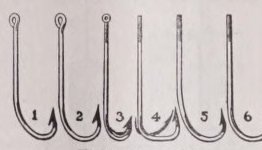
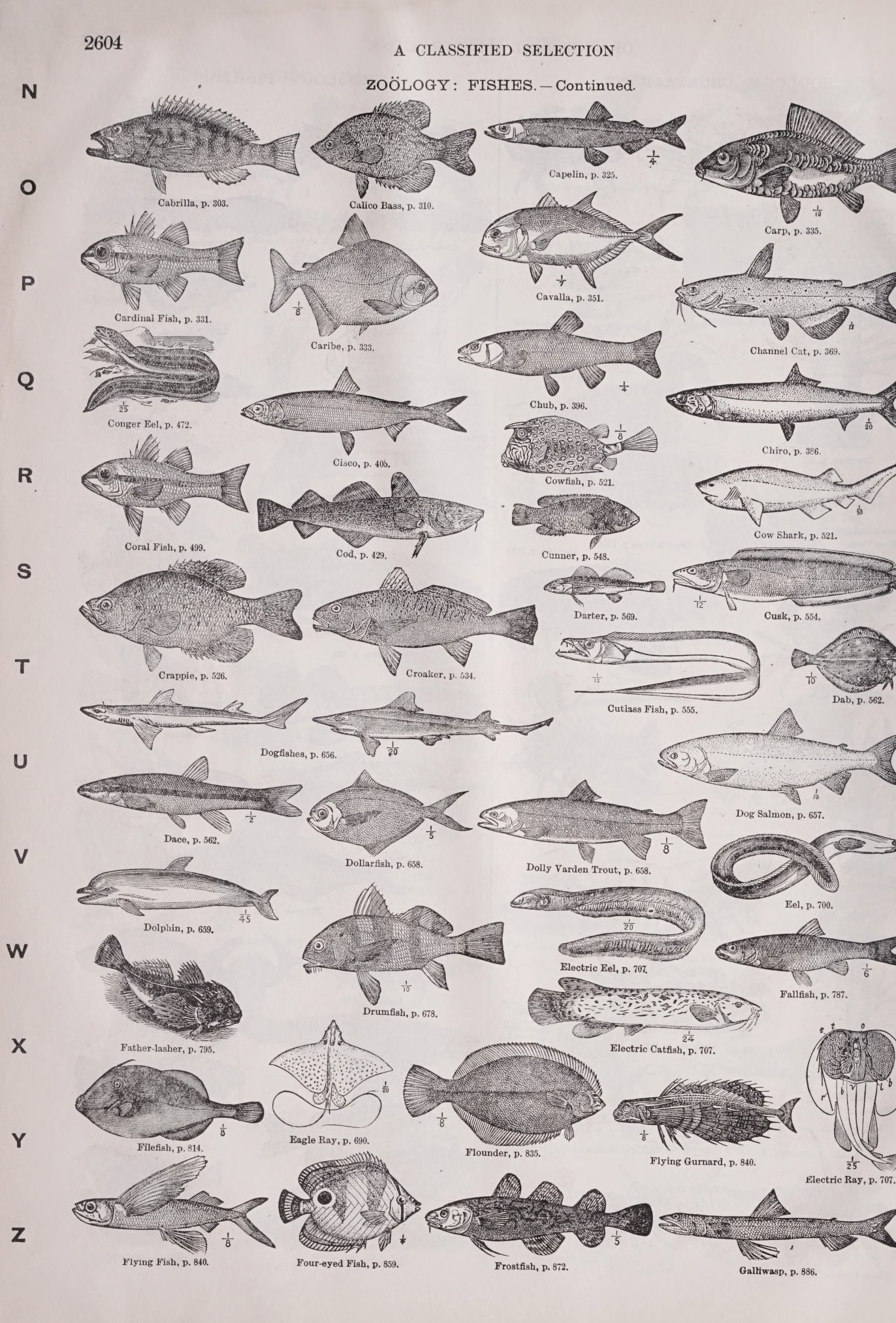
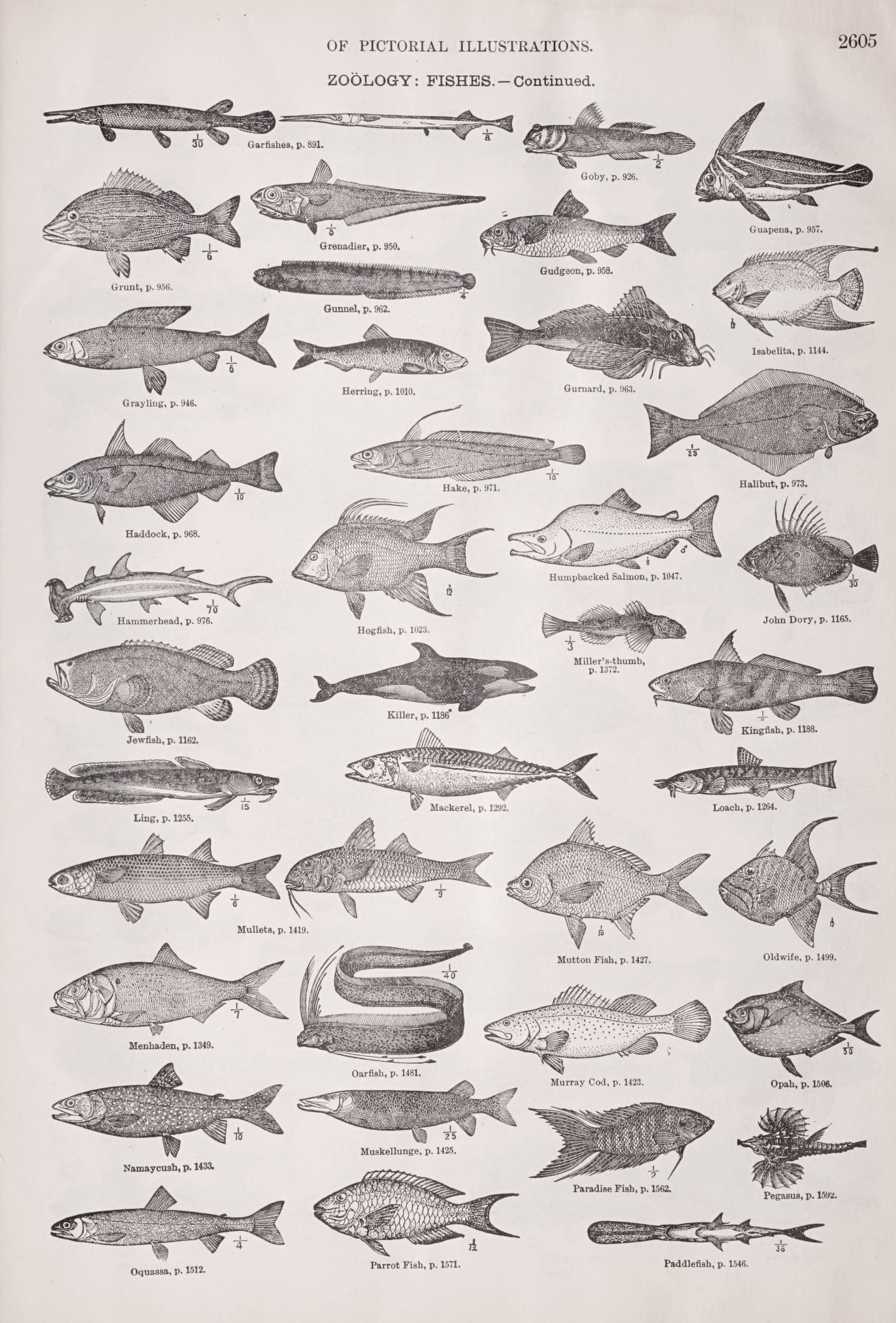
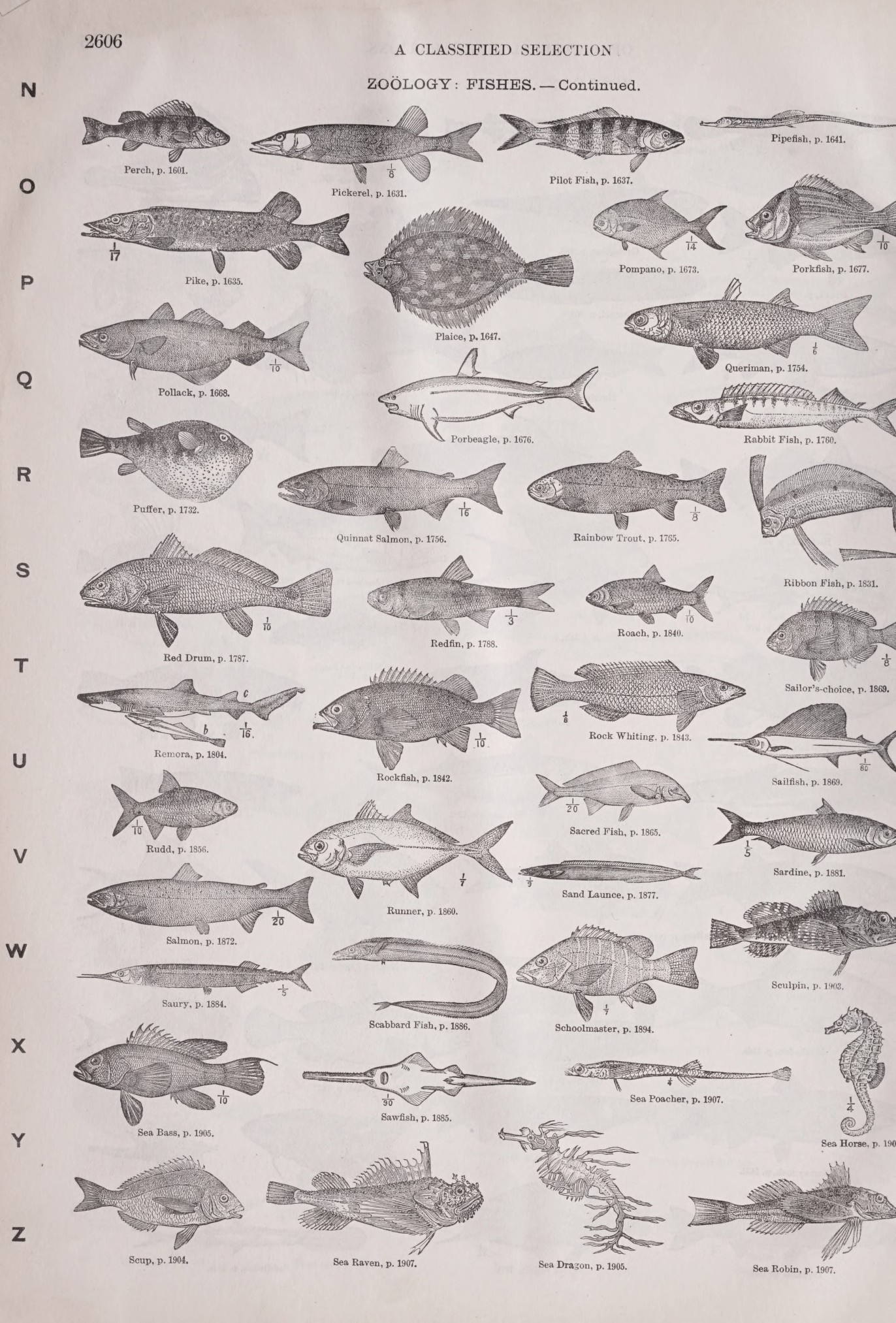
UNDER the heading Sea Fisheries, which form the particular subject of the present article, 1 may be included the various operations engaged in for the capture of the different forms of marine life which, in some manner or other, minister to the wants or convenience of man. The most important of these fisheries—those only, in fact, to which the title strictly belongs, and which have more or less widely occupied attention from probably the earliest times—are carried on chiefly by hook and line or net, with the object of obtaining fish for the purposes of food; and this main division of the general subject will be here considered....
Although little or nothing is known of the methods of fishing on our coasts in very early times, there can be no doubt that in England, as in all maritime countries, fish has always been eagerly sought after as an easily procurable article of food. The abundance of herrings and mackerel, for instance, on the coasts at regular seasons of the year, could not have failed to attract attention; and Swinden, in his History and Antiquities of Great Yarmouth, expresses his belief that the herring fishery began there soon after the year 495. In Scotland also there is evidence that the herring fishery was systematically carried on from a very early date. Precise records of other fisheries do not go back so far as that of the herring; but there is no reason for believing that cod and kindred fishes were not taken by the hook and line very many centuries ago, and, like the herring, were subjected to some ready mode of curing either with salt or by drying in the open air. In comparatively recent times all the fisheries have been largely developed, and none more so than that known as beamtrawling, a method of fishing which had probably attracted little notice a hundred years ago, but is now the most regularly productive and important on the English coast. Many circumstances have combined to encourage the working of sea fisheries as a national industry. The great extent of coast-line surrounding the British Islands provides ready access to the sea to a numerous population who become familiar from their youth with seafaring pursuits; and to such occupations large numbers betake themselves with instinctive aptitude, either as fishermen or sailors. In many cases early associations lead them to devote themselves to such fisheries as are within reach of their native villages; in others, they may become alternately sailors and fishermen, shipping for a few months every year on a trading voyage, and returning home in time to take part in the herring or some other temporary but profitable fishery; whilst in the case of the deep-sea trawling or cod fishery, they learn to become as good sailors as they are fishermen, for they have often to remain at sea in decked vessels for weeks at a time in all kinds of weather,—they must keep on their fishing ground, and must trust to their knowledge of seamanship to battle with the furious gales to which they may be at any time exposed when thus far away from shelter. Inducements to become fishermen are not wanting to this coast population. Nowhere are the best kinds of sea fish more abundant than in temperate and moderately high latitudes; and in this respect the British Islands are most advantageously situated, the seas surrounding them being frequented throughout the year by a variety of fishes always in request for the market, besides producing countless shoals of other kinds which only come within reach of the fishermen at particular seasons of the year. And great as may sometimes be the supply offish during the continuance of favourable weather, it is rarely that the demand for it is exceeded at the present day; for all the markets of the country are brought within reach by the facilities provided for rapid transport from the fishing ports by the extensive system of coast and inland railways now in operation. Fishermen, therefore, always find a market for their produce; and although it is to be feared that many of them obtain but a small proportion of the price for which their fish is ultimately sold to the consumer, the majority of them are enabled to live more comfortably than formerly, and to save enough to keep their fishing gear in good working order, and in many cases to pay for improved and larger boats.
There is no doubt that the fisheries fluctuate a good deal from year to year; and it is often the case that they may be good on one part of a coast when they are bad on another. The important herring fishery on the coasts of Scotland is a marked example of this, as must be familiar to all persons who have given any attention to the subject. Thus it not unfrequently happens that when the fishery on the east side is particularly successful, a scarcity occurs on the west coast, or vice versa. Again, in some years the fish are equally abundant or scarce on both coasts. These fluctuations are observed in even small districts of a line ofcoast, and one part of a season may be good and another bad in the same locality. Precisely the same variations occur on all the coasts of the British Islands, and with all kinds of fishes. Undoubtedly, weather is one of the most important elements in the question of success; and a generally stormy season has a marked effect in the diminished quantity of fish landed. It tells both in reducing the number of fishermen at work, and in driving the fish from their usual haunts. It is only quite recently that attention has been directed to the subject of temperature as affecting the movements of certain fishes towards or from the surface of the sea, and this will be further noticed when we speak of the herring fisheries. Apparently trifling circumstances may in some cases materially affect the catch of fish. Thus the sean fishery for pilchards on the coast of Cornwall has fluctuated exceedingly during the last 50 or 60 years for which returns are in existence; but however abundant these fish may be on the coast, the seans cannot catch them unless the shoals come quite close to the land in localities where these nets can be worked. Enormous hauls of pilchards have been made in particular years, whilst in others the fishermen have waited week after week without a chance of wetting their nets, although the drift-net fishermen at some little distance from the land have been meeting with fair success. The large apparent element of chance in the success of our fisheries cannot be better expressed than by the general hope of the fishermen for “good luck.”
Great changes have taken place in the fishing trade within the last 20 or 30 years, more especially in that for fish sent fresh to the market. Excluding herrings and cod, which to a great extent were consigned to the curer as soon as possible after they were caught, a large proportion of the fish formerly taken on our coasts was disposed of within a short distance of the place where it was landed. A good many turbot and soles were forwarded by light carts or coaches to the nearest railways as these gradually extended in different directions from London; but the people near the coast were, a generation or two ago, the principal consumers of fish, and the supply was compara tively scanty, for the fishing boats were small, and there was little inducement to fish on a large scale when the 1 For Coral, Pearl, Salmon, Sponge, and Whale Fisheries the reader is referred to those headings.
markets within reach were so few. All this has been completely changed, and the main agent in the work has been the great extension of railways throughout the length and breath of the land. Next to railways as a means of facilitating the transit of fish to all the markets, the use of ice for packing the fish has become of great importance, so much so in fact that without its employment it would be impossible to carry on the North Sea trawl fishery during summer at the distance from land at which it is generally worked, and where some of the most productive grounds are situated. Its special importance in this fishery will be further noticed when we speak of the general system of beam-trawling; but we may here mention that without the use of ice a large proportion of the fish now sent long distances by railway would never reach their destination in a condition fit for the table. The idea of using ice in connexion with the fish trade was first put into a practicable shape by Mr Samuel Hewett. At the present time about 30,000 tons of ice are imported annually from Norway into Hull, which is only one of the large North Sea trawling stations, for the sole purpose of preserving fish, either on board the fishing smacks or during its transit to market. With the exception of herrings, pilchards, and sprats, a large proportion of the fish now caught on the English coast is put into ice almost as soon as taken out of the water. Much of it is at once so packed on board the trawlers; it is brought on shore sometimes after several days, and sold in the wholesale markets; it is then repacked in ice and forwarded to other markets, where it is purchased by the fishmongers, who have a stock of ice at home ready to receive it; and there it remains, if properly taken care of, till wanted, sufficient only to make an attractive display being laid out at one time for sale.
The question of how long our present large supply of sea fish is likely to continue is one of much interest, and the answer to it depends on whether or not our fisheries are carried on in such a manner as to cause more destruction of fish life than can be compensated for by the vast reproductive powers of those fishes which escape the nets and hooks of the fishermen. For more than fifty years past the cry has been periodically raised that our fisheries are being ruined. The general complaint has been of the wasteful destruction of spawn and very young fish by beam-trawling and sean nets; and in 1863 the outcry was so loud that a Royal Commission was appointed, not only to examine this question, but also to inquire into the general condition of all our sea fisheries,—the special objects of inquiry being the state of the supply of fish, and the questions whether the methods of fishing in use involved a wasteful destruction of fish or spawn, and whether existing fishery restrictions operated injuriously on the fisheries. Ou these points the commissioners, after taking evidence all round the British Islands, were enabled to give a very decided opinion. They reported that the supply of fish generally had largely increased, that the methods of fishing involved no waste of young fish that could be prevented without interfering with the general fisheries, that spawn was not destroyed by the nets, and that all fishery restrictions should be removed except such as were desirable for protecting and keeping order among the fishermen. The recommendations of the commissioners were embodied in an Act of Parliament known as The Sea Fisheries Act 1868, by which, with one or two small exceptions relating to herring fishing on the west coast of Scotland, previous Fishery Acts were repealed, and fresh regulations made having reference to the registration of fishing boats, keeping order among driftfishermen and beam-trawlers, and providing a close time for oysters in the English Channel. The main object of the Act was to carry out a convention between the British Islands and France, for the better ordering of the fisheries in the seas adjoining the two countries. The Act came into force in England on the 1st of February 1869, but circumstances have hitherto prevented any date being fixed for carrying out the convention on the part of the French. Great advantage has undoubtedly been gained by British fishermen from the substitution of the present simple fishery regulations for the numerous Acts previously existing, many of which had long been obsolete; but the Royal Commission, which was issued virtually to inquire into the alleged destruction of fish spawn on the ground by beamtrawlers, would probably have never come into existence had the facts then been known which have since come to light about the spawning habits of most of our edible fishes. These facts are so important that a short notice of them may be given here.
Fishermen are in the habit of asserting with perfect confidence that fishes of almost every kind they arc accustomed to catch have certain grounds which they frequent at particular seasons for the purpose of depositing their ova. The herring is known to spawn on the ground,— at all events the spawn is found there in irregularly shaped lumps adhering to the bottom. It has therefore been concluded that all kinds of fishes have the same habits in this respect. Yet no one has been able to speak positively of having ever seen any fish spawn taken from the ground except that of the herring. Various soft and gelatinous substances are brought on shore by the sean nets, and commonly go by the name of spawn among the inshore fishermen: but that they are not fish spawn is perfectly well known to any one who has given attention to the variety of curious animal organisms inhabiting the sea.
It was stated by Professors Huxley and Allman in 1867, before the select committee of the House of Commons on the Sea Coast Fisheries (Ireland) Bill, as within their personal knowledge, that fish ova had been found floating at the surface of the sea, and that the ova they had met with were in all cases alive, and some of them in an advanced state of development. Reference was at the same time made to the observations then recently recorded by Norwegian naturalists on the spawning habits of the common cod, leading to the belief that spawning at the surface was by no means uncommon with our sea fishes. These investigations have been systematically carried on during the last ten years, under the direction of the Swedish Government, by Professor G. O. Sars of the university of Christiania, and have resulted in some unexpected discoveries. The seas in the neighbourhood of the Loffodcn Islands on the coast of Norway had long been known to be a great place of resort for cod during the spawning season; and in 1864 Professor Sars commenced his work there, and by means of a small surface towing net he obtained plenty of the ova of the common cod {Gadus morrhua) floating at the surface; examples in various stages of development were procured, the young fish were successfully hatched out, and the species identified beyond a doubt. Subsequent observations fully confirmed the accuracy of the conclusions previously arrived at that the cod spawn was not deposited on the ground but floated freely at or near the surface. In 1865 the same observations were made on the ova of the haddock (foadus aeglefinus), and it was satisfactorily proved that they went through all their stages of development while floating at the surface, in precisely the same manner as in the case of the cod. Sars was at first inclined to believe this development of the ova while floating was peculiar to the members of the Gadidae or cod family, in its restricted sense; but in the summer of 1865 he visited the southern coast of Norway during the season for mackerel, and found abundant evidence of the same rule obtaining in that widely distinct fish. In the case of the mackerel, the spawning actually takes place at the surface; but with the cod. family we believe the operation has not been so distinctly observed. The ova, however, are undoubtedly met with at the surface and at a short distance below it. Entirely subversive as these discoveries of Professor Sars are of the popular notions about fish-spawning, it is even more unexpected to find that both he and Μ. A. W. Malm of Gothenburg have independently ascertained that the ova of that essentially ground-fish the plaice (Pleuronectes platessa) follow the same rule of floating at the surface. Other kinds of floating ova were also obtained by Sars, some of which he succeeded in hatching; and he has completely identified the gurnard (Trigla) and the garfish (Bel lone), in addition to those before mentioned. It is evident, then, that the floating of fish ova during the development of the embryo must be taken as the general rule in several large and distinct families of sea fish. Sars has pointed out that the development takes place at the bottom in the case of those fishes especially whose ova are cemented together by a glutinous secretion, or fastened in lumps to foreign bodies, such as Algae, Hydroids, &c. He mentions as examples of this, among others, the herring (Clupea), the capelan (Osmerus), the species of Cottus, Liparis, &c.
It is particularly worthy of notice that, according to these observations of the Norwegian naturalists, all the important kinds of fish taken by our line fishermen and beam-trawlers, and the mackerel among such as are caught by the drift-nets, may be reasonably included among the species whose spawn floats at or near the surface of the sea, and their ova cannot therefore be liable to the slightest injury by any method of fishing which is carried on upon or near the ground. For if that be the rule with the spawn of the cod and haddock there can hardly be a doubt about its being so likewise with the ova of ling, coal-fish, whiting, pollack, hake, and that northern species, the tusk, all belonging to the same family. Again, turbot, holibut, brill, soles, plaice, dabs, and flounders are all closely allied, and there can scarcely be a doubt that the same rule applies to all which Sars and Malm have established in the case of the plaice, one of the most typical of this group of fishes. The gurnard family must also be included in this category; the spawn of the red mullet, we believe, has been observed floating in aquariums; and the dory, from its close affinity to the mackerel, may be expected to follow the same rule. On the other hand, we know that the spawn of the herring is commonly found at the bottom, although it by no means follows that the parent fish is there when the ova are excluded; for the full herring is frequently taken in drift nets which are very near the surface, and these nets are often covered with small lumps of spawn. At the same time the specific gravity of herring spawn is greater than water, and it sinks to the bottom sooner or later if nothing intercepts it. There is no evidence of its ever floating at or near the surface as is the case with that of the cod. In fact, the aggregation of the ova into masses of various sizes, and the glutinous substance in which the ova are embedded, by which they are enabled to adhere firmly to anything with which they may come in contact, point to their remaining in a fixed position during the process of development. It might have been anticipated that the other members of the herring family—the pilchard and sprat, for instance—would also have spawned on the ground, but, so far as we are aw*are, their ova have never been found there. Indeed, nothing is known of the spawning habits of the sprat, although this little fish has the roe well developed in December or January, when it is found in the greatest abundance on our coast, and comes nearest to the shore. The spawning of the pilchard is a matter of some little interest. The late Mr Jonathan Couch, who probably devoted more time to the study of the habits of this fish than any other ichthyologist, states his belief that the pilchard spawned at the surface, and the ova became mixed with a large quantity of tenacious mucus which spread out like a sheet on the water and kept them floating. If this should be confirmed, it will prove that even in the case of agglutinated masses of ova, development may naturally take place in them far away from the bottom. There appears to be little doubt that the pilchard spawns far out at sea, as they are on chance occasions taken in spawning condition in the mackerel drift-nets early in the year; and when, some months later, the shoals of pilchards approach the land the roe shows no signs of...