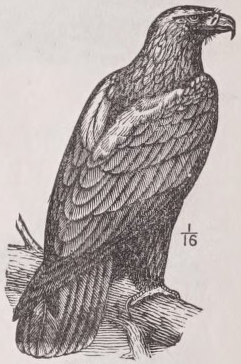
EAGLE (French Aigle, from the Latin Aquila), the name generally given to the larger Diurnal Birds-of-prey which are not Vultures; but tne limits of the subfamily Aquilinoe have been very variously assigned by different writers on systematic ornithology, and, as before observed (Buzzard, vol. iv. p. 603), there are Eagles smaller than certain Buzzards. By some authorities the Lämmergeier of the Alps, and other high mountains of Europe, North Africa, and Asia, is accounted an Eagle, but by others the genus Cypaetus is placed with the Vulturidoe, as its common English name (Bearded Vulture) shows. There are also other forms, such as the South-American Harpyia and its allies, which though generally called Eagles have been ranked as Buzzards. In the absence of any truly scientific definition of the family Aquilinoe it is best to leave these and many other more or less questionable members of the group—such as the genera Spizaetus, Circaetus, Spilorηis, Helotarsus, and so forth—and, so far as space will allow, to treat here of those whose position cannot be gainsaid....
True Eagles inhabit all the Regions of the world, and some seven or eight species at least are found in Europe, of which two are resident in the British Islands. In England and in the Lowlands of Scotland Eagles only exist as stragglers; but in the Hebrides and some parts of the Highlands a good many may yet be found, and their numbers appear to have rather increased of late years than diminished; for the foresters and shepherds, finding that a high price can be got for their eggs, take care to protect the owners of the eyries, which are nearly all well known, and to keep up the stock by allowing them at times to rear their young. There are also now not a few occupiers of Scottish forests who interfere so far as they can to protect the king of birds. But hardly twenty years ago trapping, poisoning, and other destructive devices were resorted to without stint, and there was then every probability that before long not an Eagle would be left to add the wild majesty of its appearance to the associations of the mountain or the lake. In Ireland the extirpation of Eagles seems to have been carried on almost unaffected by the prudent considerations which in the northern kingdom have operated so favourably for the race, and except in the wildest parts of Donegal, Mayo, and Kerry, Eagles in the sister-island are said to be almost birds of the past.
Of the two British species the Erne (Icel. (Ern) or Sea-Eagle (by some called also the White-tailed and Cinereous Eagle)— Haliaetus albicilla— affects chiefly the coast aud neighbourhood of inland waters, living in great part on the fish and refuse that is thrown up on the shore, though it not unfrequently takes living prey, such as iambs, hares, and rabbits. On these last, indeed, young examples mostly feed when they wander southward in autumn, as they yearly do, and appear in England. The adults (fig. 1) are distinguished by their prevalent greyish-brown colour, their pale head, yellow beak, and white tail—characters, however, wanting in the immature, which do not assume the perfect plumage for some three or four years. The eyry is commonly placed in a high cliff or on an island in a lake— sometimes on the ground, at others in a tree—and consists of a vast mass of sticks, in the midst of which is formed a hollow lined with Luzula sylvatica (as first observed by the late Mr John Wolley) or some similar grass, and here are laid the two or three white eggs. In former days the Sea-Eagle seems to have bred in several parts of England—as the Lake district, and possibly even in the Isle of Wight and on Dartmoor. This species inhabits all the northern part of the Old World from Iceland to Kamchatka, and breeds in Europe so far to the southward as Albania. In the New World, hotvever, it is only found in Greenland, being elsewhere replaced by the White-headed or Bald Eagle, H. leucocephalus, a bird of similar habits, and the chosen emblem of the United States of America. In the far east of Asia occurs a still larger and finer Sea-Eagle, H. pelagicus, remarkable for its white thighs and upper wingcoverts. South-eastern Europe and India furnish a much smaller species, 11. leucoryρhus, which has its representative, II. leucogaster, in the Malay Archipelago and Australia, and, as allies in South Africa and Madagascar, H. νocifer and II. vociferoides respectively. All these Eagles may be distinguished by their scaly tarsi, while the group next to be treated of have the tarsi feathered to the toes.
The Golden or Mountain-Eagle, Aquila chrysaetus, is the second British species. This also formerly inhabited England, and a nest, found in 1668 in the Peak of Derbyshire, is well described by Willughby, in whose time it was said to breed also in the Snowdon range. It seldom if ever frequents the coast, and is more active on the wing than the Sea-Eagle, being able to take some birds as they fly, but a large part of its sustenance is the flesh of animals that die a natural death. Its eyry is generally placed and built like that of the other British species, but the neighbourhood of water is not requisite. The eggs, from two to four in number, vary from a pure white to a mottled, and often highly-coloured, surface, on which appear different shades of red and purple. The adult bird (fig. 2) is of a rich, dark brown, with the elongated feathers of the neck, especially on the nape, light tawny, in which imagination sees a “golden” hue, and the tail marbled with brown and ashy-grey. In the young the tail is white at the base, and the neck has scarcely any tawny tint. The Golden Eagle does not occur in Iceland, but occupies suitable situations over the rest of the Palaearctic Region and a considerable portion of the Nearctic—though the. American bird has been, by some, considered a distinct species. Domesticated, it has many times been trained to take prey for its master in Europe, and to this species is thought to belong an Eagle habitually used by the Kirgiz Tartars, who call it Pergut or Pearcoot, for the capture' of antelopes, foxes, and wolves. It is carried hooded on horseback or on a perch between two men, and released when the quarry is in sight. Such a bird, when well trained, is valued, says Pallas, at the price of two camels. It is quite possible, however, that more than one kind of Eagle is thus used, and the services of A. heliaca (which is the Imperial Eagle of some writers) and of A. mogilnue— both of which are found in Central Asia, as well as in South-eastern Europe—may also be employed.
Of the other more or less nearly allied species or races want of room forbids the consideration, but there is a smaller form on which a few words may be said. This has usually gone under the name of A. noevia, but is now thought by the best authorities to include three local races, or, in the eyes of some, species. They inhabit Europe, North Africa, and Western Asia to India, and two examples of one of them— A. clanga, the form which is somewhat plentiful in North-eastern Germany—have occurred in Cornwall. The smallest true Eagle is A. pennata, which inhabits Southern Europe, Africa, and India. Differing from other Eagles of their genus by its wedge-shaped tail, though otherwise greatly resembling them, is the A. audax of Australia. Lastly may be noticed here a small group of Eagles, characterized by their long legs, forming the genus Nisaetus, of which one species, A r . fasciatus, is found in Europe. The Osprey lf*andion), though placed by many among the Aquilince, certainly does not belong to that subfamily. (a. n.)
נשר, Exod. xix, 4; Lev. xi, 13. The name is derived from a verb which signifies to _lacerate_, or _tear in pieces_. The eagle has always been considered as the king of birds, on account of its great strength, rapidity and elevation of flight, natural ferocity, and the terror it inspires into its fellows of the air. Its voracity is so great that a large extent of territory is requisite for the supply of proper sustenance; and providence has therefore constituted it a solitary animal: two pair of eagles are never found in the same neighbourhood, though the genus is dispersed through every quarter of the world. Its sight is quick, strong, and piercing, to a proverb. In Job xxxix, 27, the natural history of the eagle is finely drawn up:-- Is it at thy voice that the eagle soars? And therefore maketh his nest on high? The rock is the place of his habitation. He abides on the crag, the place of strength. Thence he pounces upon his prey. His eyes discern afar off. Even his young ones drink down blood; And wherever is slaughter, there is he. Alluding to the popular opinion that the eagle assists its feeble young in their flight, by bearing them up on its own pinions, Moses represents Jehovah as saying, “Ye have seen what I did to the Egyptians, and how I bore you on eagles’ wings, and brought you unto myself,” Exod. xix, 4. Scheuchzer has quoted from an ancient poet, the following beautiful paraphrase on this passage:-- _Ac velut alituum princeps, fulvusque tonantis Armiger, implumes, et adhue sine robore natos Sollicita refovet cura, pinguisque ferinæ Indulget pastus: mox ut cum viribus alæ Vesticipes crevere, vocat se blandior aura, Expansa invitat pluma, dorsoque morantes Excipit, attollitque humeris, plausuque secundo Fertur in arva, timens oneri, et tamen impete ...presso Remigium tentans alarum, incurvaque pinnis Vela legens, humiles tranat sub nubibus oras. Hinc sensim supra alta petit, jam jamque sub astra Erigitur, cursusque leves citus urget in auras, Omnia pervolitans late loca, et agmine fœtus Fertque refertque suos vario, moremque volandi Addocet: illi autem, longa assuetudine docti, Paulatim incipiunt pennis se credere cælo Impavidi: tantum a teneris valet addere curam._ [And as the king of birds, and tawny armour-bearer of the Thunderer, cherishes with anxious care his unfledged, and as yet feeble young, and gratifies their appetite with rich prey: presently when their downy wings have increased in strength, a milder air calls them forth, with expanded plumage he invites them, and receives them hesitating on his back, and sustains them on his shoulders, and with easy flight is borne over the fields, fearing for his burden, and yet with a moderated effort trying the rowing of their wings, and furling with his pinions his curved sails, he glides through the low regions beneath the clouds. Hence by degrees he soars aloft, and now he mounts to the starry heaven, and swiftly urges his rapid flight through the air, sweeping widely over space, and in his gyrations bearing his offspring to and fro, teaches them the art of flying:--but they, taught by long practice, gradually begin to trust themselves fearlessly on their wings: So much does it avail to train the young with care.]
When Balaam delivered his predictions respecting the fate that awaited the nations which he then particularized, he said of the Kenites, “Strong is thy dwelling, and thou puttest thy nest in a rock,” Num. xxiv, 21; alluding to that princely bird, the eagle, which not only delights in soaring to the loftiest heights, but chooses the highest rocks, and most elevated mountains, as desirable situations for erecting its nest, Hab. ii, 9; Obad. 4. What Job says concerning the eagle, which is to be understood in a literal sense, “Where the slain are, there is he,” our Saviour turns into a fine parable: “Wheresoever the carcass is, there will the eagles be gathered together,” Matt. xxiv, 28; that is, Wherever the Jews are, who have corruptly fallen from God, there will be the Romans, who bore the eagle as their standard, to execute vengeance upon them, Luke xvii, 37.
The swiftness of the flight of the eagle is alluded to in several passages of Scripture; as, “The Lord shall bring a nation against thee from afar, from the end of the earth, as swift as the eagle flieth,” Deut. xxviii, 49. In the affecting lamentation of David over Saul and Jonathan, their impetuous and rapid career is described in forcible terms: “They were swifter than eagles; they were stronger than lions,” 2 Sam. i, 23. Jeremiah when he beheld in vision the march of Nebuchadnezzar, cried, “Behold, he shall come up as clouds, and his chariots shall be as a whirlwind. His horses are swifter than eagles. Wo unto us, for we are spoiled,” Jer. iv, 13. To the wide-expanded wings of the eagle, and the rapidity of his flight, the same prophet beautifully alludes in a subsequent chapter, where he describes the subversion of Moab by the same ruthless conqueror: “Behold, he shall fly as an eagle, and spread his wings over Moab,” Jer. xlviii, 40. In the same manner he describes the sudden desolations of Ammon in the next chapter; but, when he turns his eye to the ruins of his own country, he exclaims, in still more energetic language, “Our persecutors are swifter than the eagles of the heavens,” Lament. iv, 19. Under the same comparison the patriarch Job describes the rapid flight of time: “My days are passed away, as the eagle that hasteth to the prey,” Job ix, 26. The surprising rapidity with which the blessings of common providence sometimes vanish from the grasp of the possessor is thus described by Solomon: “Riches certainly make themselves wings: they fly away as an eagle toward heaven,” Prov. xxiii, 5. The flight of this bird is as sublime as it is rapid and impetuous. None of the feathered race soar so high. In his daring excursions he is said to leave the clouds of heaven, and regions of thunder, and lightning, and tempest, far beneath him, and to approach the very limits of ether. There is an allusion to this lofty soaring in the prophecy of Obadiah, concerning the pride of Moab: “Though thou exalt thyself as the eagle, and though thou set thy nest among the stars, thence will I bring thee down, saith the Lord,” Obad. 4. The prophet Jeremiah pronounces the doom of Edom in similar terms: “O thou that dwellest in the clefts of the rock, that holdest the height of the hill; though thou shouldest make thy nest high as the eagle, I will bring thee down from thence, saith the Lord,” Jer. xlix, 16. The eagle lives and retains its vigour to a great age; and, after moulting, renews its vigour so surprisingly, as to be said, hyperbolically, to become young again, Psalm ciii, 5, and Isaiah xl, 31. It is remarkable that Cyrus, compared, in Isaiah xlvi, 11, to an eagle, (so the word translated “ravenous bird” should be rendered,) had an eagle for his ensign according to Xenophon, who uses, without knowing it, the identical word of the prophet, with only a Greek termination to it: so exact is the correspondence between the prophet and the historian, the prediction and the event. Xenophon and other ancient historians inform us that the golden eagle with extended wings was the ensign of the Persian monarchs long before it was adopted by the Romans; and it is very probable that the Persians borrowed the symbol from the ancient Assyrians, in whose banners it waved, till imperial Babylon bowed her head to the yoke of Cyrus. If this conjecture be well founded, it discovers the reason why the sacred writers, in describing the victorious march of the Assyrian armies, allude so frequently to the expanded eagle. Referring to the Babylonian monarch, the prophet Hosea proclaimed in the ears of all Israel, the measure of whose iniquities was nearly full, “He shall come as an eagle against the house of the Lord,” Hosea viii, 1. Jeremiah predicted a similar calamity: “Thus saith the Lord, Behold, he shall fly as an eagle, and spread his wings over Moab,” Jer. xlviii, 40; and the same figure was employed to denote the destruction that overtook the house of Esau: “Behold, he shall come up and fly as the eagle, and spread his wings over Bozrah,” xlix, 22. The words of these prophets received a full accomplishment in the irresistible impetuosity and complete success with which the Babylonian monarchs, and particularly Nebuchadnezzar, pursued their plans of conquest. Ezekiel denominates him, with great propriety, “a great eagle with great wings,” because he was the most powerful monarch of his time, and led into the field more numerous and better appointed armies, (which the prophet calls, by a beautiful figure, “his wings,” the wings of his army,) than perhaps the world had ever seen. The Prophet Isaiah, referring to the same monarch, predicted the subjugation of Judea in these terms: “He shall pass through Judah. He shall overflow, and go over. He shall reach even to the neck; and the stretching out of his wings” (the array of his army) “shall fill the breadth of thy land, O Immanuel,” Isaiah viii, 8. The king of Egypt is also styled by Ezekiel, “a great eagle, with great wings, and many feathers;” but he manifestly gives the preference to the king of Babylon, by adding, that he had “long wings, full of feathers, which had divers colours;” that is, greater wealth, and a more numerous army.