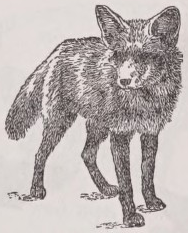
Closely allied to the common fox of Europe is the Red Fox (Vulpes fuivus) of eastern North America, regarded by many naturalists as only a variety of the common species— an opinion which receives some confirmation from the fact that hitherto no remains of the red fox have been found in the cave deposits of that continent, although remains of the grey fox are abundant. It may thus possibly be the descendant of individuals of the European species, introduced at a comparatively early period, and owing the differences that now distinguish it to the greatly altered conditions under which for centuries it has existed. It is altogether larger than the common fox of Europe, and the fur is longer and softer, the colour more brilliant, and the muzzle less extended. According to Sir J. Richardson, it preys largely on the smaller animals of the rat family, and is very fond of fish. “The red fox,” he says, “does not possess the wind of its English congener. It runs for about 100 yards with great swiftness, but its strength is exhausted in the first burst, and it is soon overtaken by a wolf or a mounted horseman.” In Canada and the United States it is largely hunted for its valuable fur, about 60,000 skins of this species being annually imported into the London market. There are several well-known varieties of the red fox, as the cross fox and the black or silver fox. The latter is very scarce, and its fur is more valuable than any other found in North America. La Hontan states that in his time a skin of the silver fox was worth its weight in gold, and an unusually fine skin has been sold in the London market for £50. The fur is sometimes of a uniform black shining colour, except at the tip of the tail, which is white; but more usually it has a hoary appearance from the admixture of white tipped hairs with those entirely black. This fox is exceedingly shy and difficult of approach, owing probably to the persistency with which it is hunted by the fur traders. About 1600 skins of the silver fox are annually imported into Britain. The Arctic Fox (Vulpes lagopus) is an inhabitant of the boreal regions of Europe, Asia, and America. It is somewhat smaller than the European fox, its ears being less pointed and the muzzle shorter. The soles of its feet are densely furred, resembling those of a hare, hence its specific name, lagopus. As with many Arctic animals the colour of its fur changes with the season, being in most cases of a pure white colour in winter, with the exception of a few black hairs at the extremity of the tail. Towards the end of April, however, when the Arctic snows begin to disappear, the long white fur gives place to shorter hair of a dark brown or sooty colour. Occasionally a dark-coloured fox may be seen in winter, and a white one in summer, and in Iceland, according to Professor Newton, the winter coat differs very slightly in colour from that of summer, probably owing to the comparatively mild character of the Icelandic winter. The Arctic fox has little of the proverbial cunning of its kind, having been seen to walk unsuspiciously into the trap which had been baited in its presence. It is an exceedingly cleanly animal, and the fetid odour characteristic of the entire genus is almost absent in this species. It differs also from the common fox in being gregarious, living, according to Richardson, in little villages consisting of 20 or 30 burrows placed near each other. The Arctic foxes seek their food, which consists of lemmings, birds, eggs, and carrion, at night, and their first impulse, says Captain Lyon, on securing it is to hide it, even though suffering severely from hunger. It was suggested some years ago by Professor Newton that this species supported itself during winter on a store of provisions laid up during summer, and Captain Feilden was able during the recent polar expedition (1875) to confirm this. When in Grinnell Land he and his companions came upon Arctic foxes, and were greatly surprised on discovering numerous deposits of dead lemmings. “In one nook,” says Captain Feilden, “under a rock we pulled out over 50; we disturbed numerous caches of 20 and 30, and the ground was honeycombed with holes, each of which contained several bodies of these little animals, a small quantity of earth being placed over them” (A Voyage to the Polar Sea, by Captain Sir G. Nares, 1878). Nearly 10,000 skins of the Arctic fox, chiefly in winter fur, are annually brought into Britain.
Foxes are found fossil in caverns in many parts of Europe, and extinct species occur in the Tertiary deposits of both hemispheres. (J. gi.)
FOX, Charles James (1749-1806), born on the 24th of January 1749, at 9 Conduit Street, in the city of Westminster, was the third son of Henry Fox, first Lord Holland. His mother was the eldest daughter of the second duke of Richmond. As his great-great-grandmother was duchess of Portsmouth, he had in his veins the blood of Charles II. of England and Henry IV. of France. His paternal grandfather, Sir Stephen Fox, was born shortly after Charles I. ascended the throne, and died shortly after the accession of George I. The public services of this member of the Fox family have received less notice than they deserve. He was a yeoman’s son who, having been taught to read, write, and cipher, was considered capable of rising in the world. When a youth he first obtained a situation in the household of the earl of Northumberland; then he entered the service of Lord Percy, the earl’s brother, and he was present with the royalist army at the battle of Worcester as Lord Percy’s deputy at the ordnance board. Accompanying Charles II. in his flight to the Continent, he served him in a menial capacity during his exile, till he was promoted to be keeper of the privy purse. He was employed as intermediary between the king and General Monk. Honours and emolument were his reward after the Restoration; he was knighted, and appointed to the lucrative offices of clerk of the green cloth and paymaster of the forces. He entered the House of Commons, first as member for Salisbury, and secondly for Westminster. He succeeded the earl of Rochester as a commissioner of the treasury, filling that office for 23 years and during three reigns. At the mature age of seventy-seven he married for the second time; four children were the issue of this marriage. He died in 1716 at the age of eighty-nine, and left a large fortune. It is his distinction to have founded Chelsea hospital, and to have contributed £13,000 in aid of this laudable public work. Though his place as a statesman is in the second or even the third rank, yet he was a useful man in his generation, and a public servant who creditably discharged all the duties with which he was entrusted. Unlike other statesmen of his day, he grew rich in the service of the nation without being suspected of corruption, and without forfeiting the esteem of his contemporaries. Sir Stephen Fox’s second son by his second marriage was named Henry. Inheriting a large share of the riches which his father had accumulated, he squandered it soon after attaining his majority. Henry Fox went to the Continent to escape from his creditors. There he made the acquaintance of a countrywoman of fortune, who became his patroness and was so lavish with her purse that, after several years’ absence, he was in a position to return home and to enter parliament as member for Hindon. He became the favourite pupil and devoted supporter of Sir Robert Walpole, achieving unequalled and unenviable proficiency in the worst political arts of his master and model. As a speaker he was fluent and self-possessed, imperturbable under attack, audacious in exposition or retort, and able to hold his own against Pitt himself. Thus he made himself a power in the House of Commons, and an indispensable member of several administrations. He heaped up riches when acting as paymaster of the forces during the war which Pitt conducted with extraordinary vigour, and in which the nation was intoxicated with glory. He served under the earl of Bute in order that he might exercise his skill in cajolery and corruption to induce the House of Commons to approve of the treaty of Paris; as a recompense, he was raised to the House of Lords with the title of Baron Holland. He strove, but in vain, to obtain promotion to the dignity of an earl, a dignity upon which he had set his heart, and he died a sorely disappointed man, with a reputation for cunning and unscrupulousness which cannot easily be matched, and with an unpopularity which justifies the conclusion that he was the most thoroughly hated statesman of his day. Henry Fox’s affection for his son Charles James verged on idolatry. The boy was both precocious and engaging. Whatever he chose to learn, he acquired with ease, and he displayed more than a boy’s good sense in correcting his faults. Once he overheard his mother, with whom he was no favourite, remark to his father, “Charles is dreadfully passionate; what shall we do with him ì” and the reply, “Oh, never mind; he is a very sensible little fellow, and he will learn to cure himself.” Thereupon he resolved to repress his angry passions, and he succeeded in rendering himself a pattern for gentle bearing and command of temper. He went to Eton when he was nine, having spent the preceding year, at his own request, in the school kept at Wandsworth by Pampelonne, a French refugee. The boy’s health was delicate, and this caused his father much anxiety. He was not diligent in learning, nor was his tendency towards indolence at school counteracted by the discipline to which he was subjected. The Rev. Dr Francis, his tutor, sent to his father accounts more flattering than just of his son’s progress and attention, and better fitted to gratify parental fondness than set forth the truth. He often went home in order to accompany his parents to some notable spectacle, chief among them being the coronation of George III., where he met with a slight accident, which, being reported in the newspapers, caused his father to write, “The article [in the newspapers] of Charles’s mishap has brought several messages. The boy is a great deal better beloved than his father is.” When fourteen he left school for four months, which he spent with his parents at Spa and Paris. His father taught him to game at Spa, giving him several gold pieces wherewith to try his luck, as the saying is, every evening. Hence he early became addicted to the vice which was for some years his besetting sin, and for which he could urge no other excuse, when taunted with it later by Lord Hillsborough in the House of Commons, than that it was a vice “countenanced by the fashion of the times, a vice to which some of the greatest characters had given way in the early part of their lives, and a vice which carried with it its own punishment, and entailed a curse upon those wΙιo were addicted to it.” He returned to Eton thinking himself a thorough young man of the world; but his dandified airs only excited the ridicule of his comrades, and Dr Barnard, the head master, by flogging him for misconduct, made him feel keenly that he was still a mere schoolboy. More instructive and advantageous than trips to the Continent and visits to Continental gaming houses were the visits which he made to the Houses of Parliament, in company with his father, to hear important debates. He was in the gallery of the House of Commons when Lord North moved “that the paper entitled the North Briton is a false, scandalous, and seditious libel.” His father impressed upon him that John Wilkes was a bad man, and that the earl of Bute was a sagacious minister; these opinions were embodied by him in some French verses, which injudicious admirers have reproduced to show his want of mastery over the French language, and the absurdity of his boyish political sentiments. Leaving Eton in 1764, Fox went to Oxford, where he entered Hertford College. In a letter to his friend Mr Macartney, he professed a great liking for Oxford and fondness for mathematics, adding, in another letter, that he believed mathematics were useful, and was sure they were entertaining, this being enough, in his opinion, to recommend them. The same letter contained his judgment on a newly published poem, which is far less paradoxical and more creditable to his discernment than the foregoing statement concerning mathematics. The poem was the Traveller, which the youthful critic pronounced, with perfect truth, “to have a good deal of merit.” A trip to Paris and a stay there of two months interrupted Fox’s university career. Dr Newcome, the head of his college, readily sanctioned this holiday, making the complimentary remark that such application as his required “some intermission, and you are the only person with whom I have ever had connexion to whom I could say this. . . . You need not interrupt your amusements by severe studies; for it is wholly unnecessary to make a step onward without you, and therefore we shall stop until we have the pleasure of your company.” This visit to the capital of France was no more serviceable to him, in a moral sense, than his previous one. His father encouraged him to indulge himself without stint in pleasures to which young men are only too prone, and, what is still more blameworthy, jested at the scruples of a son who had no strong liking for vicious courses. On his return to Oxford he worked hard at his studies, spending the greater part of a vacation in systematic reading along with his friend Dickson, who was afterwards bishop of Down. Their leisure was devoted to perusing the works of the early English dramatists, all of which they read. Taking his degree in 1766, he left Oxford and spent the succeeding two years in Continental travel, traversing France and Italy, either in company with his parents, or else with his friends Lord Carlisle, Lord Fitzwilliam, and Mr Uvedale Price. Along with Dlr Price he visited Voltaire at Ferney, where he was heartily welcomed by the great Frenchman for his fathers sake, and was advised to read Voltaire’s published works in order that he might emancipate himself from religious prejudices and increase his stock of ideas. He became a proficient in speaking the French tongue, and he practised himself in writing it by penning poetical epistles in French to his friend Fitzpatrick. He also mastered Italian, which he admired beyond measure, saying that there was “more good poetry in Italian than in all other languages that I understand put together.” He was then passionately fond of amateur acting and of wearing fine clothes. In after days his friends could scarcely credit the assurance of the friends of his youth when the latter stated that Fox, who had become a sloven in dress, was once a “macaroni,” having made a journey from Paris to Lyons in order to buy waistcoats, and was in the habit of walking about with a little French hat on his head and red-heeled shoes on his feet. As difficult was it for some among them to realize that Fox, the leader of the Whigs, and even further advanced in Liberal opinions than the majority of his party, had been such a Tory at the outset of his parliamentary career as to write to George Selwyn in the following terms: “I am reading Clarendon, but scarcely get on faster than you did with your Charles V. I think the style bad, and that he has a great deal of the old woman in his way of thinking, but hate the opposite party so much that it gives one a kind of partiality for him.” Hating the opposite party so thoroughly, it is not surprising that he should have been inimical to the first administration of the marquis of Rockingham, an administration that repealed the Stamp Act which George Grenville hod designed to raise a revenue in the American Colonies, an administration which was far too liberal in tendency and independent in character to suit the narrow and personal view’s of George III., and that he should have written to Sir George Macartney, “every body laughs at its members, holds them cheap, but, according to the fashionable phrase, doing justice to their good intentions^ In 1768 1 when still under age, Fox was returned for Midhurst, then a pocket borough. His father having made the arrangements necessary for his election had thereby provided a supporter of the ministry of the day which the earl of Chatham had formed, and in which the duke of Grafton was first lord of the treasury. Fox’s maiden speech in the House of Commons was delivered in defence of the ministry and in opposition to seating John Wilkes as member for Middlesex. He at once made his mark as a parliamentary speaker, recalling to some members the best traits of Charles Townshend and the elder Pitt. His father, delighted at the success achieved by his favourite son, communicated his satisfaction to his acquaintances, and wrote to one of them that he had been told Charles had spoken extremely well :—“It was all off-hand, all argumentative, in reply to Mr Burke and Mr Wedderburn, and excessively well indeed. I hear it spoken of by everybody as a most extraordinary thing, and I am, you see, not a little pleased with it.” Fox had his reward by being appointed a lord of the admiralty immediately after attaining his majority, and when Lord North had succeeded the duke of Grafton as prime minister. Two years afterwards he resigned, on account of a misunderstanding with his chief and a determination to oppose the Royal Marriage Bill, which the ministry introduced out of deference to George III., and about which the king wrote to Lord North :—“I do expect every nerve to be strained to carry the Bill through both Houses with a becoming firmness, for it is not a question that immediately relates to administration, but personally to myself; therefore I have a right to expect a hearty support from every one in my service, and shall remember defaulters.” Fox not only opposed this bill, which was framed to discourage members of the royal family from marrying, and to throw artificial obstacles in their way should they desire to make love matches, but he also introduced a bill to amend Lord Hardwicke’s Act, “For the better preventing of Clandestine Marriages,” which his father had virulently opposed. This conduct, which gave great offence to George III., was the origin of that implacable enmity to his great subject which ever after prevailed in the royal breast, to the detriment alike of the throne and the country. In introducing his bill Fox is said by Horace Walpole to have spoken “with ease, grace, and clearness”; he effectively answered Edmund Burke and Lord North who opposed it, ridiculing the arguments of the former and confuting those of the latter, “with a shrewdness that, from its multiplicity of reasons, as much exceeded his father in embracing all the arguments of his antagonists as he did in his manner and delivery.” This was doubly agreeable to his father, who had formed a clandestine marriage, and who thought such an Act as Lord Hardwicke’s a slur upon himself. The attempt of his son failed, though he had the triumph of beating the ministry by a majority of one on a motion for leave to introduce the bill. After being a year out of office, he became reconciled to Lord North, and re-entered the administration as a junior lord of the treasury. But he soon reasserted his independence, differing from Lord North on a question of procedure, and causing the defeat of the ministry in the House of Commons by pressing an unwelcome motion to a division. The king was incensed at what he styled Charles Fox’s presumption, adding, in a letter to the premier, “Indeed, that young man has so thoroughly cast off every principle of common honour and honesty that he must become as contemptible as he is odious; and I hope you will let him know you are not insensible of his conduct towards you.” Lord North, acting in conformity with the king’s suggestion, wrote as follows to Fox :—“Sir, his Majesty has thought proper to order a new commission of the treasury to be made out, in which I do not see your name.” Thus ended the first stage of Fox’s political career. A year later he avowed in the House of Commons that “the greatest folly of his life was in having supported Lord North.” He was chargeable with follies of another kind. Among the young men of the day he was conspicuous for staking money at play and making bets on horse races. Sometimes he won bets made at Newmarket, but he almost invariably lost larger sums in a gaming club at Almack’s, where the stakes were £50, and where as much as £10,000 was on the table at a time. Lord Holland advanced £40,000 to pay his debts, but this did not suffice, and he became the dupe of a Mrs Grieve, who, on the pretext of introducing him to a Miss Phipps, a West Indian heiress, obtained money from him. His reputation stood so low in public estimation that, according to Horace Walpole, it was commonly supposed he had been dismissed by Lord North for robbing the treasury. In 1774 Fox began that opposition to the ill-advised and ill-fated measures of Lord North which gave him a place among the greatest of orators and the most prescient of statesmen. He lost both his parents in that year, and his brother Stephen, second Lord Holland, soon followed them to the grave, leaving behind him the boy whom Fox treated with almost paternal fondness and care, whose memory as third Lord Holland is held in kindly remembrance, and who, with characteristic modesty, considered it his chief glory to have been the nephew of Fox and friend of Grey. Soon after Fox entered the ranks of the Opposition he became its acknowledged chief. This rapid advancement was largely due to the lessons in practical politics taught him by Edmund Burke, whose acquaintance he had made in early life. The story of his career from 1774, when he left Lord North's administration, to 1782, when Lord North resigned and when he became secretary of state in the second Rockingham administration, is associated with the unsparing and brilliant opposition of the Whig party to the war which ended with the ratification of the independence of the Thirteen United Colonies of America. An important episode during that period was his election as member for the city of Westminster. On the 2d of February 1780, a meeting in favour of parliamentary reform was held, in Westminster Hall, at which such leading members of the Whig party were present as the duke of Portland, Earl Temple, John Wilkes, General Burgoyne, Aiderman Sawbridge, Edmund Burke, and over which* Fox presided. He delivered a stirring speech in favour of a redress of grievances, and in particular of a reform in the representation of the people. After it had been resolved that a petition to that effect should be presented to parliament, it was proposed and carried by acclamation that Fox, “the Man of the People,” should become a candidate to represent Westminster in the House of Commons, and before the year closed he was a member for the constituency which he represented till the end of his life. A little more than a century had then elapsed since Sir Stephen Fox, his grandfather, had been first returned for the city of Westminster. George III. encouraged the opposition to the election of the “Man of the People,” of whom he wrote that “Fox never had any principle, and can therefore act as his interest may guide him.” Eight thousand pounds were contributed out of the civil list to promote the success of Lord Lincoln, the favourite of the court, yet neither corrupt expenditure nor royal disapproval sufficed to hinder the triumph of Fox. As secretary of state in the ministry of the Marquis of Rockingham, and leader of the House of Commons, Fox displayed great business aptitude and capacity for conciliation. A short time before he became minister, Horace Walpole wrote to Sir Horace Mann :—“Mr Fox is the first figure in all the places I have mentioned,—the hero in parliament, at the gaming-table, at Newmarket.” After he became minister, the same writer informed his correspondent— “Mr Fox already shines as greatly in place as he did in opposition, though infinitely more difficult a task. He is now as indefatigable as he was idle. He has perfect temper, and not only good humour but good nature, and, which is the first quality of a prime minister in a free country, has more common sense than any man, with amazing parts that are neither ostentatious nor affected” His experience of high office was very short Lord Rockingham became premier on the 27th of March 1782; he died on the first of the following July, aud Fox resigned immediately afterwards. He had finally resolved to do so before the death of his chief, having been outvoted in the cabinet on the question of unconditionally acknowledging the independence of the United Colonies. His brother secretary of state, the earl of Shelburne, and other colleagues thought that the concession of independence should be made one of the conditions of peace. Fox regarded Shelburne with undisguised aversion. When the administration was formed, he fancied that Shelburne was disposed to imitate Lord North and to pay undue deference to George III., and he told him that it appeared “the administration was to consist of two parts, one belonging to the king, the other to the public.” Four weeks after being in office Fox wrote to his friend Fitzpatrick :—“Shelburne shows himself more and more every day, is ridiculously jealous of my encroaching on his department, and wishes very much to encroach upon mine.” Shelburne, in turn, suspected Fox of designs to monopolize power, and to have his own way in all things. This unfortunate antagonism between two men of remarkable ability caused a split in the Whig party, and enabled the king to succeed in his policy of entrusting power only to ministers who were subservient to his will. Succeeding Lord Rockingham as premier, Shelburne held office til) the 24th February 1783. The coalition ministry, in which the duke of Portland was premier, and Lord North and Fox were secretaries of state, took the place of that over which Shelburne', ∣had presided. It was with extreme and undisguised reluctance that the king permitted this administration to be formed. When he found it hopeless to struggle against the inevitable result, he communicated his real feelings on the subject to those politicians who prided themselves upon being his friends. In conversation with Mr Wyndham Grenville, he poured out his indignation “upon Fox, whom he loaded with every expression of abhorrence; upon the duke of Portland, against whom he was little less violent; upon Lord North, to whose conduct he imputed all the disasters of the country; upon American independence, which seemed to have been a most bitter pill indeed.” His early detestation of Fox had now been intensified, owing to the unnatural behaviour of his eldest son, which he erroneously attributed to the teaching of the great Whig statesman. The king even consulted Lord Chancellor Thurlow and Lord Ashburton as to “what redress he could have against a man who alienated from him the affections of his son,” and it is said that Thurlow told him “he would have no peace till his son and Fox were secured in the Tower.” One of the first acts of the coalition was to arrange about the establishment and income of the Prince of Wales. The king was shocked at the proposition which the ministry laid before him, considering the sum which had been agreed upon as a fitting one for the prince to receive utterly extravagant; and he alleged that his advisers were ready to sacrifice the public interests to gratify au “ill-advised young man.” In consequence of the king’s disapproval of the scheme, his eldest son had to content himself with an allowance which was wholly inadequate; hence he had to make repeated applications to parliament to pay his debts. While the coalition ministry held office the definitive treaties of peace were signed between Great Britain and France, Spain, and the United States of America, and thus the war which a ministry after George III.’s own heart had provoked and carried on with amazing incompetence ceased to impoverish and humiliate the nation. But the chief act of the administration and the cause of its downfall was the introduction of a bill for the just and efficient government of British India. Though Burke had the principal share in planning the measure, yet Fox, having made himself thoroughly master of the questions at issue, expounded the scheme iu the House of Commons with great lucidity and impressiveness. The opposition to it was vehement and disingenuous; the measure was falsely described as having been solely designed in order to confiscate the property of the East India Company and establish the supremacy of the Whig party. William Pitt, who was then unsparing and unfair in his criticism, afterwards did practical justice to the wisdom of Fox and his colleagues by bringing a measure into parliament resembling that of the coalition ministry in many essential particulars. Fox’s prediction was thus verified, for the day arrived when his statesmanlike and much maligned bill was “regarded in its true light as a strong, but as a necessary and a just measure.” But the king had determined that the bill which Fox had safely piloted through the House of Commons should never pass into law; several persons calling themselves his friends aided him in accomplishing his object, and the ministry, after being defeated by a small majority in the House of Lords, was summarily and contemptuously dismissed. Twenty-two years elapsed before Fox returned to office.
During three months after his dismissal, Fox endeavoured to counteract the power of the sovereign to dissolve parliament; but he was baffled by the boldness and patience of William Pitt, the young prime minister. Then followed a more trying discomfiture when the country pronounced in favour of his rival at the general election of 1784. Even the Nonconformists, who had no warmer advocate than Fox, and whose only hope for the redress of intolerable grievances consisted in the Whig party being in office, turned against their true friends, rallying to the shout of “Pitt aud the constitution,” instead of aiding by voice and vote the cause of “Fox and free government.” They deserted him at a critical juncture. Nevertheless he continued to plead for them with his whole heart and soul, and merely remarked, “on recollection of what had been their conduct upon that occasion [the coalition], the House would at least do him the justice to say that, in supporting them that day, he was not influenced by any very obvious motives of private partiality or attachment. Yet he was determined to let them know that, though they could upon some occasions lose sight of their principles of liberty, he would not upon any occasion lose sight of his principles of toleration." It was not enough for the king and the young and haughty premier that the Whig party should be defeated in the country; they were resolved to exclude Fox from parliament, and in any case to prevent his re-election for Westminster. Admiral Lord Hood, Sir Cecil Wray, and Fox were the candidates for the two seats. The court and the ministry were bent upon the first two being chosen. What the king styled “gold pills” were lavished on the occasion. Moreover, 280 of the Guards were sent to vote as householders, a thing which Horace Walpole said his father “in the most quiet season would not have dared to do.” The character of the struggle recalled an envenomed contest 89 years previously, when the Jacobites strove with all their might to hinder the re-election of Sir Stephen Fox, a declared supporter of the Revolution settlement. In 1784, as in 1695, the party of freedom and constitutional government carried the day in Westminster, and Fox was returned by a majority of 236. But the partisans of divine right in 1695 never dreamed of retrieving their defeat in the manner which found favour in the eyes of George III. and his advisers in 1784. A scrutiny was demanded, in order that Fox might not take his seat. Happily, this pettifogging manoeuvre was thwarted by the action of attached friends, who procured his election for the Kirkwall burghs. The validity of this election was challenged, but without result, and Fox was able to make that impassioned and masterly protest in the House of Commons against the shameful treatment to which he had been subjected, which is known as his speech on the Westminster scrutiny, and which ranks among the best speeches ever delivered in parliament. The scrutiny went on for a year, till even Pitt’s docile majority resented the further continuance of the unconstitutional farce, and voted that it should end. In consequence of this Fox took his seat as member for Westminster, brought an action against the high bailiff, who had conducted himself in the affair as a tool of the ministry, and recovered £2000 damages, which he distributed among the Westminster charities. The remainder of Fox’s parliamentary career is more remarkable for eloquent speeches than for stirring personal incident. His criticism of Pitt’s measures was always shrewd and vigorous, though not invariably just. He blundered most seriously in denouncing the commercial treaty with France, a scheme of far-seeing policy and admirable patriotism. When this subject was debated he gave utterance to a phrase which, like the utterances of many other notable men, has been repeated to his discredit by persons who, purposely or inadvertently, dissociate it from the context, and withhold the qualifying clauses. Having said that “France was the natural political enemy of Great Britain,” he was reproached for calling the French the natural enemies of the English. What he meant to convey was, not that enmity necessarily existed between the English and the French, but that the policy of France, as directed by the house of Bourbon, was irreconcilably opposed to the interests of England,—a proposition which was really incontrovertible. His liking for the French people was extreme, and this was openly displayed so soon as they had emancipated themselves from a rule which they detested, and which rendered them the disturbers of the world. Then he avowed his conviction that the new form of government in France “would render her a better neighbour, and less disposed to hostility, than when she was subject to the cabal and intrigues of ambitious and interested state men.” Again, it is forgotten or concealed by those persons who have censured Fox on accoun
FOX, George (1624-1690), the founder of the “Society of Friends” or “Quakers,” was born at Drayton, Leicestershire, in July 1624. His father, Christopher Fox, called by the neighbours “Righteous Christer,” was a weaver by occupation; and his mother, Mary Lago, “an upright woman and accomplished above most of her degree,” came of a family that had suffered much in former days of religious persecution. Both were members of the Church of England, and took great pains in the training of their children. George from his childhood “appeared of another frame than the rest of his brethren, being more religious, inward, still, solid, and observing beyond his years;” and he himself declares, “When I came to eleven years of age I knew pureness and righteousness; for while a child I was taught how to walk to be kept pure.” Some of his relations wished that he should be educated for the church; but his father, after he had barely learned to read and write, lost no time in apprenticing him to a certain shoemaker, who also dealt in wool and cattle. In this service he remained till his nineteenth year, and acquired some proficiency in all the branches of his master’s somewhat miscellaneous business; according to Penn, “He took most delight in sheep,” but he himself simply says, “A good deal went through my hands. . . . People had generally a love to me for my innocency and honesty.” In 1643, being upon business at a fair, and having accompanied some friends to the village public-house, he was deeply scandalized by a proposal to “drink healths,” and abruptly withdrew in great grief of spirit. “When I had done what business I had to do I returned home, but did not go to bed that night, nor could I sleep, but sometimes walked up and down, and sometimes prayed and cried to the Lord, who said unto me, ‘ Thou seest how young people go together into vanity and old people into the earth; thou must forsake all, both young and old, and keep out of all, and be a stranger unto all’ Then, at the command of God, on the ninth day of the seventh month, 1643, I left my relations and broke off all familiarity or fellowship with old or young.” Thus briefly he describes what appears to have been the greatest moral crisis in his life. Of the four years which followed •—the “times of the first workings of the Lord in him ”— he has left but a confused account They were cn the whole years of great perplexity and distress, though sometimes “I had intermissions, and was sometimes brought into such a heavenly joy that I thought I had been in Abraham’s bosom.” He did not continue for many months to adhere to the letter of the command he believed himself to have received; he soon began to have some misgivings as to the propriety of his action in having forsaken his relations, and, apparently without waiting for any new revelation, he ultimately conceded so much to the claims of natural affection as occasionally to visit those whom he had formerly thought it his duty to leave. Still, throughout this period his wanderings were very numerous, and covered a very wide area. He would go from town to town, “travelling up and down as a stranger in the earth, which way the Lord inclined my heart; taking a chamber to myself in the town where I came, and tarrying sometimes a month, more or less, in a place;” and the reason he gives for this migratory habit is that he was “afraid both of professor and profane, lest, being a tender young man, he should be hurt by conversing much with either.” The same fear often led him to shun all society for days at a time; but frequently lie would apply to “professors” for spiritual direction and consolation. These applications, however, never proved successful; he invariably found that his advisers “possessed not what they professed.” Some recommended marriage, others enlistment as a soldier in the civil wars; one “ancient priest” bade him take tobacco and sing psalms; another of the same fraternity, “in high account,” advised physic and blood-letting. About the beginning of 1646 îiis thoughts began to take more definite shape; or, as he himself expresses it, he began to receive more revelations. For example, as he was one day approaching the gate of Coventry, “the Lord opened to him” that none were true believers but such as were born of God and had passed from death unto life; and this was soon followed by other “openings” to the effect that “being bred at Oxford or Cambridge was not enough to fit and qualify men to be ministers of Christ,” and that “God who made the world did not dwell in temples made with hands.” “I had also great openings concerning the things written in the Revelations.” He also experienced deeper manifestations of Christ within his own soul. “When I myself was in the deep, shut up under all [the burden of corruptions], I could not believe that I should ever overcome; my troubles, my sorrows, and my temptations were so great that I thought many times I should have despaired, I was so tempted. But when Christ opened to me how He was tempted by the same devil, and overcame him and bruised his head, and that through Him, and His power, light, grace, and spirit, I should overcome also, I had confidence in Him; so He it was that opened to me, when I was shut up and had no hope nor faith. Christ, who had enlightened me, gave me His light to believe in; He gave me hope which He Himself revealed in me; and He gave me His spirit and grace, which I found sufficient in the deeps and in weakness.” With the knowledge he had thus received, Fox, towards the end of the year 1647, felt himself constrained to begin the work of his life as an itinerant preacher, the positive element in his teaching being to the effect that men ought to give sincere and earnest heed to the inner light—the light of Christ— which God had placed in every human heart. The scenes of his early labours and early successes were in the neighbourhood of Dukinfield and Manchester, where he had “great openings and prophecies,” and succeeded in establishing his influence over a considerable number of followers. From this date his creed grew rapidly in point of explicitness, especially on its negative and practical sides. For example, in 1648 it was revealed to him by the inner light that he was not to take off his hat to any person, high or low; that he was to use in addressing any single individual of whatever rank no other pronouns than the simple “thou” and “thee”; that he was not to bid people good morning or good evening; and that he was not to “bow or scrape with his leg to any one.” Increasingly persuaded of the truth and importance of his message, he daily became bolder in the delivery of it. Iu the year 1649, as he was walking towards Nottingham on a first-day morning accompanied by some friends, he heard the bell of the “steeple house” of the city, and was admonished by an inward voice to go forward and cry against the great temple and the worshippers in it. Entering the church he found the preacher engaged in expounding the words, “We have also a more sure word of prophecy,” from which the ordinary Protestant doctrine of the supreme authority of Scripture was being enforced in a manner which appeared to Fox so defective or erroneous as to call for his immediate and most energetic protest. Lifting up his voice against the preacher’s doctrine, he declared that it is not by the Scripture alone, but by the divine light by which the Scriptures were given, that doctrines ought to be judged. The result of the disturbance which not unnaturally ensued was that he was seized by the constables and carried off to prison, where he was detained for some time, and from which be was released only by tho favour of the sheriff, whose sympathies he had succeeded in enlisting. A similar adventure at Derby ended less favourably. For raising a discussion which seemed not unlikely to end in a breach of the peace in the church there, he was brought before the magistrates, and after examination, committed along with one of his comrades to the house of correction as a blasphemer; and not till the beginning of 1651, after he had been a prisoner for almost a year, did he succeed in regaining his freedom. It would be here out of place to follow with any minuteness the details of his subsequent imprisonments, such as that at Carlisle in 1653, at London in 1654, at Launceston 1656, at Lancaster in 1660 and again in 1663, at Scarborough in 1666, and at Worcester in 1674. They are related with a certain monotony, which is yet far from being tedious or uninteresting, in the Journal, fortunately an easily accessible book. Suffice it to say that during these terms of imprisonment his pen was not idle, as is amply shown by the very numerous letters, pastorals, and exhortations which have been preserved by his followers; while during his intervals of liberty he was unwearied in the work of preaching and making disciples. While his labours were for the most part confined to the midland and northern counties of England, he found time in 1657 for a tour through Scotland, which, in his opinion, was not altogether without result. In 1669 he married the widow of a Welsh judge, Margaret Fell, who, with her family, had been among his earliest converts; but almost immediately afterwards his proselytizing ardour impelled him to proceed alone to Barbados, Jamaica, and the American continent. In all places visited by him there he met with a good reception, and was successful in making many converts. Shortly after his return in 1673 he was, as has been already noted, apprehended in Worcestershire for attending meetings that were forbidden by the law. He was ultimately set at liberty on account of errors in the indictment which had been drawn up against him, but this was not until after he had suffered a captivity of nearly fourteen months. In 1677 he visited Holland along with his followers Barclay and Penn; and this visit he renewed in 1684, extending his tour through a considerable part of North Germany. The later years of his life were spent mostly in London, where he continued to give public addresses, comparatively unmolested, until within a few days of his death, which took place November 13, 1690.
In personal appearance Fox was tall and strongly built, “graceful in countenance, manly in personage, grave in gesture;” in manner he was courteous and unaffected, “civil, beyond all forms of breeding,” and “tender, compassionate, and pitiful;” essentially, he was “a heavenly-minded man, zealous for the name of the Lord, and preferred the honour of God before all things;” “a man that God endued with a clear and wonderful depth, a discerner of others’ spirits, and very much a master of his own.” These and similar characterizations by his friendly contemporaries, who, for the rest, do not pretend that he was in any way remarkable either for grasp of intellect or for profundity in learning, surely deserve some weight as against the somewhat prevalent opinion that Fox was nothing more than a vulgar charlatan whom we have “no reason for placing morally or intellectually above Ludowick Muggleton or Joanna Southcote” (Macaulay). The mere fact that he was able to attract to himself so considerable a body of respectable followers, including such men as Ellwood, Barclay, and Penn, is sufficient to prove that he possessed in a very eminent degree the power of conviction, persuasion, and moral ascendency; while of his personal uprightness, single-mindedness, and sincerity there ought to be no question.
The writings of Fox have been collected in three volumes folio,— the first containing his journal, the second his correspondence, and the third all that he has written in vindication of his doctrines. The Journal is especially interesting; of it Sir James Mackintosh has said that “it is one of the most extraordinary and instructive naιτatives in the world, which no reader of competent judgment can peruse without revering the virtue of the writer.” Of other works attributed to him, perhaps the most curious is that originally published in London in 1660, entitled A battle door for teachers and professors to learn singular and plural; you to many and thou to one; singular, one, thou; plural, many, you. According to the Journal, however, this performance is not to be attributed solely to Fox. “J. Stubbs and Benjamin Furly took great pains in compiling it, which I set them upon, and some things I added to it.” Indeed, it has sometimes been seriously doubted whether he was the real author of any of the publications which have been attributed to him; but this doubt, which proceeds merely upon the fact of his very imperfect literary education, seems to be conclusively settled by the clause in his will (which document may bø seen in the Harleian Miscellany, vii. 599) referring to his “Bookes, Episeles, and Papers.” The Journal was originally published in London in 1694, and has frequently been reprinted. A very useful edition is the seventh, with notes biographical and historical by Wilson Armistead, London, 1852. Several Memoirs of Fox have recently appeared,—one by J. Marsh in 1846; another by Janney, with dissertations on his views concerning the doctrine, testimonies, and discipline of the Christian church (Philadelphia, 1852); a third by the Rev. John Selby Watson (London, 1860). For details of the principles and history of the Society of Friends, see the article Quakers.
FOX, Richard, an English prelate, statesman, and diplomatist, bishop successively of Exeter, Bath and Wells, Durham, and Winchester, and founder of Corpus Christi College, Oxford, was born about the close of the reign of Henry VI. He was a native of Roρesley, near Grantham, in Lincolnshire, and his parents are said to have been in humble circumstances. His education, however, was not neglected, for he was sent to school either at Boston or at Winchester, and thence transferred to Magdalen College, Oxford. His studies, in which he gained much distinction, were interrupted by an outbreak of the plague, and he went to continue them at Pembroke Hall, Cambridge. He next went to Paris, and there pursued the study of theology and the canon law, At Paris he became acquainted with Morton, bishop of Ely, then an exile, and by him he was introduced to Henry, earl of Richmond, who was preparing his invasion of England. He at once gained Henry’s confidence, and managed for him the delicate business of getting assistance in men and money from the king of France. After the victory of Bosworth and accession of the earl as Henry VII., Fox, now a doctor of divinity, was made a nrivy councillor, and became one of the most trusted advisers of the king. Honours fell thick upon him. In rapid succession he was made a prebendary of Sarum, bishop of Exeter, keeper of the privy seal, principal secretary of state, and master of St Cross, Winchester (1487). From this time he was almost constantly employed by the king in political affairs both at home and abroad. He was several times sent ambassador to Scotland, and several times to France. In 1491 he was translated to the see of Bath and Wells, and three years later to that of Durham. In 1497 he personally defended his castle of Norham when besieged by the Scots, until it was relieved by the earl of Surrey. The same year he negotiated a truce for seven years between England and Scotland. He also tcok part in the treaty for the marriage between James IV. of Scotland and Margaret, daughter of Henry VII. In 1500 he was chosen chancellor of the university of Cambridge, and held the office for two years. The same year he was translated to the see of Winchester, which he held till his death, a period of twenty-eight years. He was master of Pembroke Hall, Cambridge, from 1507 to 1519. During the reign of Henry VII. his influence was supreme in the state, no important affair being undertaken without consulting him. The king named Fox one of his executors, and especially recommended him to his son and successor Henry VIII. But his credit soon declined under the new king, partly owing to the character of Henry, and partly to the rivalry of the earl of Surrey. Amongst the chaplains of Bishop Fox at this time was Thomas Wolsey; and in order to counteract the influence of Surrey, Fox introduced Wolsey to the king. In a little while the new comer took precedence of both the rivals. Fox, however, did not suddenly lose the royal favour. In March 1510 he was sent ambassador to France with Surrey and the bishop of Durham, and signed the treaty of alliance with Louis XII. In 1513 he attended Henry VIII. in his expedition to France, and was present at the taking of Terouenne. The same year he took part in negotiating a treaty with the emperor Maximilian. Fox was one of the executors of Margaret, countess of Richmond, and in this capacity had a share in completing the settlement of St John’s College, Cambridge. Continually mortified by the supremacy of his former protégé, Wolsey, and by the insults he had to endure from him, he at length (1515) withdrew from the court and retired to his diocese. The rest of his life was devoted to the discharge of his ecclesiastical duties and to works of charity and munificence. During this period he rendered great service to the cause of liberal education by his foundation of Corpus Christi College, Oxford. His first intention was to make it a monkish seminary, and for this he obtained a licence. But on the advice of Oldham, bishop of Exeter/ he changed his plan, and made it simply a school for the increase of learning. Bishop Oldham contributed largely to the cost of the buildings. Fox was founder also of free schools at Taunton and at Grantham. He became blind some years before his death, and was pressed by Wolsey to resign his see to him, but this he stoutly refused to do. He died, in a good old age, September 14, 1528.