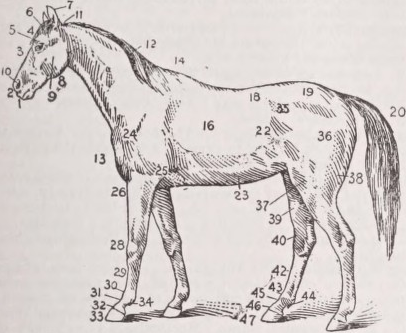
THE horse and its near allies, the several species of asses and zebras, constitute the genus Equns of Linnaeus, a small group of animals of the class Mammalia, so distinct in their organization from all other existing members of the class that in many of the older zoological systems they were placed in an order apart, under the name of Solidungula or Monodactyla.
Investigations in comparative anatomy have, however, demonstrated that their structure, at first sight so singular and exceptional, is really but a modification of the same general plan upon which the tapirs and rhinoceroses are formed, and the discovery and restoration of the characters of extinct species, inaugurated by Cuvier during his fruitful researches into the fauna of the Paris basin, continued in various European localities by Kaup, Riitimeyer, Gervais, Gaudry, Huxley, and others, and recently conducted on a more ample scale in the prolific fossiliferous strata of North America by Leidy, Marsh, and Cope, have revealed numerous intermediate stages through which the existing horses appear to have passed in their modification from a very different ancestral form.
We shall best understand what a horse really is if we first consider its origin and lineage; and this we are in a better position to do than with almost any other animal, as it is one of the few whose history (if the evidence afforded by palaeontology can be relied upon) can be traced back through an almost unbroken chain of links as far as the earliest Tertiary age....
We have as yet no cognizance of the history of any mammals of the group to which the horse belongs before the dawn of the Eocene period. Of where they lived and what they were like, from what earlier forms and by what stages of modifications descended, our actual knowledge is an absolute blank. Conjecture helps us but little, and why none of their remains have not ere this been discovered is a palaeontological mystery. We have, however, certain knowledge that when the land which formed the bottom of the great cretaceous ocean which flowed over a considerablepart of the present continents of Europe and North America was lifted above the level of the water and became fitted for the habitation of terrestrial animals, it was very soon the abode of vast numbers of herbivorous mammals belonging to the group now called Ungulata or “hoofed animals.” Wherever they came from, they had existed sufficiently long to have become already completely differentiated into two·
principal forms, separated from each other by many distinct points in their organization, among which one of the most externally conspicuous was the structure of their feet. From this character the one form has received the name of Artiodactyla or “even-toed,” the other Perissodactyla or “odd-toed.” It is only of the latter that we shall have to speak in this article.
Perhaps the best notion of a perissodactyle ungulate of the Eocene age can be derived from the tapir of the present day, an animal which has changed less from the primitive and generalized type of the group of that time than any other existing member of the order. These early forms had all the complete number of teeth found in so many of the mammals of that period of various orders, arranged according to the well-known formula— incisors ∣ -, canines γ, premolars ⅛, molars ⅜ = τγ on each side, or 44 in all. The molar teeth had very short square crowns, with transverse or oblique ridges on tfie grinding surface. In the fore limbs the radius and ulna, and in the hind limbs the tibia and fibula, were distinct and well-developed bones. Whatever the number of toes on each foot, the one corresponding to the middle or third digit of the generalized pentadactyle limb was the longest; its ungual phalanx was symmetrical in itself, and it formed the centre of the foot, on each side of which the other toes were arranged in complete or partial symmetry according to the stage of development. In the hind foot in all known cases the symmetry was complete, only one toe on each side of the middle digit being present (fig. 3, c); but in the fore foot the primitive symmetry, formed by the presence of two toes on each side of the middle toe, had been lost in nearly all, by the disappearance of one of the outer toes (the first), the condition still retained by the tapirs (fig. 3, a); or it had been replaced by the second stage of symmetry, in which both outer toes are absent, and only three remain, as in the modern rhinoceros (fig. 3, c). By no animal of this period had the third, or most highly specialized stage of symmetry, that which, as we shall see, characterizes the modern horses (fig. 3, e), been attained.
By various and gradually progressing deviations from the common original type, these animals began at a very early period to break up into several groups, some of which (as Macraucheniaf after undergoing a considerable degree of specialization, have become extinct without leaving successors; but three of these modified types, already distinct at the close of the Eocene period, have continued up to the present day, gradually, as time advanced, becoming more and more divergent from each other. These are now represented by the three families of the rhinoceroses, the tapirs, and the horses. Great as may be the differences between these animals as we see them now, we can trace their history step by step, as revealed by the fragments preserved from former ages, further and further back in time, their differences continually becoming less marked, and ultimately blending together, if not into one common ancestor, at all events into forms so closely alike in all essentials that no reasonable doubt can be held as to their common origin.
Leaving out of further consideration the two collateral branches, it will be our purpose now to follow the history of the special subject of this article.
The remains of the earliest known animals to which it is possible to trace back the modern horse by a series of successive modifications are found in the lowest strata of the great lacustrine formations assigned to the Eocene period, spread over considerable portions of the present territories of New Mexico, Wyoming, and Utah in North America. That similar animals may have existed in other parts of the world is extremely probable. Negative evidence in such cases is of little value, as may be judged by the fact that it is only within a very few years that the existence of these deposits teeming with fossil remains of previously unsuspected forms has been brought to light, and their systematic exploration has scarcely yet commenced. A little animal, not larger than a fox, Eohippus of Marsh, presented the most generalized form of the perissodactyle type as yet discovered, as besides the four well-developed toes of the fore foot, found in so many others, it had at least a rudiment of a fifth. All analogy leads to the supposition that this must in its turn have been represented at a still earlier period by another form with all five toes complete, but direct evidence of this is at present wanting.
The transition from this horse-like animal of the early period to the horses of modern times has been accompanied by a gradual increase in size. The diminutive Eocene Eohiρpus and Orohippus were succeeded in the Miocene period by other forms to which the names of Anchitherium and Miohippus have been given, of the size of sheep; these again in Pliocene times by Hipparion and Pliohippus, as large as the modern donkeys; and it is only in the Pleistocene period that Equidoe appeared which approached in size the existing horse. Important structural modifications have also taken place, with corresponding changes in the mode of life of the animal. The neck has become elongated, the skull altered in form, the teeth greatly modified, and the limbs have undergone remarkable changes. The last two require to be described more in detail.
The teeth in the Eocene forms had, as mentioned above, the characteristic number of forty-four. This number has been retained throughout the series, at least theoretically; but one tooth on each side of each jaw, the anterior premolar, which in all the Eocene and Miocene species was a well-developed tooth, persisting through the life time of the animal, is in all modern horses rudimentary, functionless, and generally lost at an early period of life, evidently passing through a stage which must soon lead to its complete disappearance. The canines have also greatly diminished in size, and are rarely present in the female sex, so that practically a very large number of adult horses of the present day have eight teeth less than the number possessed by their predecessors. The diastema or interval between the incisor and premolar teeth, of essential importance in the domesticated horse to his master, as without it there could be no room for inserting the special instrument of subjugation to his commands, the bit, already existed in the earliest known forms, but has gradually increased in length. The incisors have undergone in comparatively recent times that curious change producing the structure which will be more fully described hereafter, and which distinguishes the horse’s incisors from those of all other known animals. Lastly, the molars have undergone a remarkable series of modifications, much resembling in principle those that have taken place in several other groups of herbivorous animals. Distinctions in form which existed between the premolars, at least the anterior members of the series, and the true molars have gradually disappeared, the teeth becoming all very uniform in the shape and structure of their grinding surface. The crowns of all these teeth in the early forms were very short(see fig. 2, α); there was a distinct constriction, the neck, between the crown and roots; and when the tooth was developing, as soon as the neck once rose fairly above the alveolar margin, the tooth remained permanently in this position. The term “brachyodont” expresses this ’ condition of teeth, the mode of growth of which may be illustrated by those of man. The free surface had two nearly transverse curved ridges, with valleys between (fig. 2, α); but the valleys were shallow and had no deposit of cementum filling them, the whole exposed surface of the unworn tooth being formed of enamel. When the ridges be-cameworndown the dentineof the interiorwas exposed,forming islands surrounded by enamel. With the progress of time the crowns of the teeth gradually become longer, the valleys deeper, and the ridges not only more elevated but more curved and complex in arrangement. To give support to these high ridges and save them from breaking in use, the valleys or cavities between them became filled up to the top with cementum, and as the crown wore down an admirable grinding surface consisting of patches and islands of the two softer substances, dentine and cement, separated by variously reduplicated and contorted lines of intensely hard enamel, resulted (fig. 2, c). The crown continued lengthening until in the modern horses it has assumed the form called “hypsidont” (fig. 2, b). Instead of contracting into a neck, and forming roots, its sides continue parallel for a considerable depth in the socket, and as the surface wears away, the whole tooth slowly pushes up, and maintains the grinding edge constantly at the same level above the alveolus, much as in the perpetually growing rodent’s teeth. But in existing horses there is still a limit to the growth of the molar. After a length is attained which in normal conditions supplies sufficient grinding surface for the lifetime of the animal, a neck and roots are formed, and the tooth is reduced to the condition of that of the brachyodont ancestor. It is perfectly clear that this lengthening of the crown adds greatly to the power of the teeth as organs of mastication, and enables the animals in which it has taken place to find their sustenance among the comparatively dry and harsh herbage of the open plains, instead of being limited to the more succulent vegetable productions of the marshes and forests in which their predecessors mainly dwelt.
The modifications of the limbs which took place pari passu with those of the teeth must have been associated with increased speed, especially over firm and unyielding ground. Short, stout legs, and broad feet, with numerous toes, spreading apart from each other when the weight of the creature is borne on them, are sufficiently well adapted for plodding deliberately over marshy and yielding surfaces, and the tapirs and the rhinoceroses, which in the structure of the limbs have altered but little from the primitive Eocene forms, still haunt the borders of streams and lakes and the shady depths of the forests, as was probably the habit of their ancient representatives, while the horses are all inhabitants of the open plains, for life upon which their whole organization is in the most eminent degree adapted. The length and mobility of the neck, position of the eye and ear, and great development of the organ of smell, give them ample means of becoming aware of the approach of enemies, while the length of their limbs, the angles the different segments form vzith each other, and especially the combination of firmness, stability, and lightness in the reduction of all the toes to a single one, upon which the whole weight of the body and all the muscular power are concentrated, give them speed and endurance surpassing that of almost any other animal. When surprised, however, they are by no means helpless,both fore and hind feet becoming at need powerful weapons of defence.
If we were not so habituated to the sight of the horse as hardly ever to consider its structure, we should greatly marvel at being told of a mammal so strangely constructed that it had but a single toe on each extremity, on the end of the nail of which it walked or galloped. Such a formation is without a parallel in the vertebrate series, and is one of the most remarkable instances of specialization, or deviation from the usual type, in accordance with special conditions of life. It can be demonstrated, both by the structure of the foot itself, and also by an examination of the intermediate forms, that this toe corresponds to the middle or third of the complete typical or pentadactyle foot, the “ring finger” of man; and there is very strong evidence to show that by a gradual concentration of all the power of the limb upon this toe, and the concurrent dwindling away and final disappearance of all the others, the present condition of the horse’s foot has been produced.
The small horse-like animals of the Eocene period with four, or rudiments at least of five, toes on the fore foot have been already mentioned. In the early Miocene period the animal most like an existing horse was the Anchιthemum y the remains of which are found in a fossil state both in Europe and in America. In this genus there were three well-developed toes reaching the ground on each foot, and the radius and ulna, and the tibia and fibula of the hind leg, were complete and distinct. This was succeeded on the European and Asiatic continent by Hiρparion and in America by Pliohipρus, perhaps more directly in the line of descent, as Hipparion has some special characters of its own in the teeth and skull, which make it probable that it is a collateral branch which became extinct without leaving descendants. In these and other forms which flourished at this period, the lateral toes, though containing the full number of bones, were much reduced in size, and did not reach the ground, but were suspended to the outside of and rather behind the large middle one, like the rudimentary ou'er toes of the deer, or the short first digit (“dew-claw”) of the dog. Horses, or rather horse-like creatures, with this structure of feet were no longer met with in the Pleistocene period, but then for the first time appeared the true horse in its development exactly or very nearly as we know it now. The outer toes were reduced to rudiments of the metacarpals or metatarsals only, the so-called “splint bones” entirely concealed beneath the skin (fig. 3, e, π. and ιv.), the middle toe (in.) greatly elongated, and with its ungual phalanx and hoof expanded, and the stability of the forearm and leg increased by the complete subordination of the ulna and fibula to the larger bones, the radius and tibia, which alone are concerned in the formation of the wrist and ankle joint.
Fossil remains of true horses, differing but very slightly from the smaller and inferior breeds of those now existing, are found abundantly in deposits of the most recent geological age, in almost every part of America, from Escholz Bay in the north to Patagonia in the south. In that continent, however, they became quite extinct, and no horses, either wild or domesticated, existed there at the time of the »Spanish conquest, which is the more remarkable as, when introduced from Europe, the horses that ran wild proved by their rapid multiplication in the plains of South America and Texas that the climate, food, and other circumstances were highly favourable for their existence. The former great abundance of Equidoe in America, their complete extinction, and their perfect acclimatization when reintroduced by man, form curious but as yet unsolved problems in geographical distribution.
The existing species of the genus Equus are the following
(1.) The Horse, Eqnus caballus, Linn., is distinguished from the others by the long hairs of the tail being more abundant and growing quite from the base as well as the end and sides, and also by possessing a small bare callosity on the inner side of the hind leg, just below the “hock” or heel joint, in addition to the one on the inner side of the forearm above the carpus, common to all the genus. The mane is also longer and more flowing, and the ears shorter, the limbs longer, and the head smaller.
Though the existing horses are usually not marked in any definite manner, or only irregularly dappled, or spotted with light surrounded by a darker ring, many examples are met with showing a dark median dorsal streak like that found in all the other members of the genus, and even with dark stripes on the shoulders and legs indicating “the probability of the descent of all the existing races from a single dun-coloured, more or less striped, primitive stock, to which our horses still occasionally revert.”
In Europe wild horses were extremely abundant in the Neolithic or polished-stone period. Judging from the quantity of their remains found associated with those of the men of that time, the chase of these animals must have been among his chief occupations, and they must have furnished him with one of his most important food supplies. The characters of the bones preserved, and certain rude but graphic representations carved on bones or reindeers’ antlers, enable us to know that they were rather small in size, and heavy in build, with large heads and rough shaggy manes and tails, much like, in fact, the present wild horses of the steppes of the south of Russia. These horses were domesticated by the inhabitants of Europe before the dawn of history, but it is doubtful whether the majority of the animals now existing on the Continent are derived directly from them, as it is more probable that they are descendants from horses imported though Greece and Italy from Asia, derived from a still earlier domestication, followed by gradual improvement through long-continued attention bestowed on their breeding and training. Horses are now diffused by the agency of man throughout almost the whole of the inhabited parts of the globe, and the great modifications they have undergone in consequence of domestication and selective breeding are well exemplified by comparing such extreme forms as the Shetland pony, dwarfed by uncongenial climate, the thoroughbred racer, and the London dray-horse. In Australia, as in America, horses imported by the European settlers have escaped into the unreclaimed lands, and multiplied to a prodigious extent, roaming in vast herds over the plains where no hoofed animal ever trod before.
(2.) Equus asinus, Linn.—The Domestic Ass is nearly as widely diffused and useful to man as the horse. It was known in Egypt long before the horse, and is probably of African origin, indeed its close resemblance to the existing wild ass of Abyssinia, E. tcenιopus, Heuglin, leaves little doubt as to its identity with that species.
(3.) The Asiatic Wild Asses, which roam in small herds in the open plains of Syria, of many parts of Persia, of the north-west of India, and the highlands of Tartary...