As it is by this member of the body that we chiefly exert our strength, it is therefore used in Scripture for an emblem of power. Thus God is said to have delivered his people from Egyptian bondage “with a stretched-out arm,” Deut. v, 15; and he thus threatens Eli the high priest, “I will cut off thine arm, and the arm of thy father’s house,” 1 Sam. ii, 31; that is, I will deprive thee and thy family of power and authority.
[83 words — estimated reading time: 1 minute]
ARMADA, a Spanish word, meaning generally an armed force or fleet, is applied specially to designate the great expedition sent out against England in 1588 by Philip of Spain. His principal motive for this enterprise was the desire to strike a decisive blow at the Protestant faith, of which England was then the bulwark. For many months the whole energies of the Spanish nation had been directed towards the construction and equipment of the requisite ships. In 1587 everything was nearly ready, but the sailing of the expedition was delayed for a year by Drake, who made a bold dash into the harbour of Cadiz and destroyed nearly a hundred ships, with immense stores of provisions. A further delay was caused by the sudden death of the marquis of Santa Cruz, who had been originally intrusted with the chief command. His loss was a serious blow to the Spanish, cause, for he was an experienced sailor. The duke of Medina Sidonia, a man almost entirely ignorant of naval affairs, was then made admiral. All preparations being at length completed, the great fleet sailed from Lisbon on the 29th (19th o. s.) May 1588. It consisted of 129 large vessels, and carried 19,295 soldiers, 8460 sailors, besides slaves as rowers, and 2431 cannon. Their destination was the coast of Flanders, where Alexander Farnese, prince of Parma, was lying with about 35,000 men and a flotilla of boats. This force was to be landed on the Isle of Thanet at the mouth of the Thames, under the protection of the Armada, which would be able to keep the Channel perfectly clear. Another body of troops was then to be landed further north; and it had been hoped at one time that the duke of Guise would effect a diversion by landing a force on the west coast. These plans, however, were considerably deranged by the length of ...time occupied in preparing the expedition, and by the further delays encountered. For tho fleet had scarcely sailed from Lisbon, when it was overtaken by a severe storm, which shattered several of the ships, and compelled them all to put in for repairs at Coruna. It was the 22d (12th) July before they finally sailed from Spain. England meanwhile had not been idle; when tho news arrived that the great expedition waβ really about to set out, the most intense enthusiasm took possession of the people, who gladly furnished ships and stores, · and raised volunteer bands for coast defence. The command of the army was given to the earl of Leicester, who took his post, with about 16,000 men, at Tilbury to oppose the landing of Parma. About 45,000 were assembled round the Queen, to protect her person. The royal navy, which consisted of about thirty ships, was at once put in order, and gradually increased, by the addition of merchantmen and privateers, to about 180 vessels. These carried about 18,000 sailors, but they had not half the weight of the Spanish artillery, and they were scantily supplied with ammunition and provisions. The ships, however,—those of the Queen in particular,—were in splendid order, and the sailors were the finest in England. The lord high admiral was Lord Howard of Effingham, who had under him Drake, Hawkins, Frobisher, and others, the most celebrated mariners of the age, He took his station with the main body of the ships, about eighty in number, at Plymouth, and another squadron, under Lord Seymour, cruised off Dunkirk, commanding the straits and blockading the prince of Parma. Meantime news was brought to England that the Armada had encountered severe storms, and that the expedition was given up. So much faith was put in this report that several ships began to discharge their crews. Howard, however, sailed down towards Coruna, and discovered that the report had no foundation. On the 29th (19th) July, the fleet was observed entering the Channel, and the beacon-lights along the coast gave warning to England that the dreaded enemy was at hand. That evening Howard’s ships were moored so as to be able to elip out of Plymouth Sound at a moment’s notice. On the following day the Armada was seen standing up the Channel in the form of a crescent, seven miles long, and numbering 150 ships. They passed Plymouth towards evening, and during the night the English fleet sailed out of the Sound, and took up a position to windward. On the following day the action began by the duke of Medina Sidonia attempting to close and come to a general engagement. But he found this to be impossible; the English ships, light and admirably handled, sailed so swiftly, and were manoeuvred with such dexterity, that it was out of his power to inflict any injury on them. Their fire also was rapid and deadly, while the Spanish guns were worked slowly, and generally sent the shot far over the light English vessels. Dismayed at their want of success, the Spanish fleet stood off up the Channel, closely pursued by the English. Throughout all the next week the same tactics were pursued; the English, hovering on the rear of the Armada, harassed and weakened it without coming to a general engagement. At length, on the 6th August (27th July), Medina Sidonia cast anchor in the roads of Calais, and sent messengers to the prince of Parma, asking him for ammunition and light vessels, and suggesting that he should now attempt his landing on the coast of England. But the prince declared that it was impossible to cross the Channel while the English fleet was on the sea, that he had no light ships, and that the state of the weather prevented him sending such ammunition as he could spare. Lord Howard had now been joined by Seymour’s squadron and by many private ships, but he and the other commanders were still in the deepest anxiety. They were almost destitute of provisions and powder, and did not yet know what damage they had inflicted on the Armada, which, after all their endeavours, seemed now to have reached its destination. At last it was resolved to drive the Spanish fleet out into the open sea, and to effect this by means of fire-ships. Eight ships were selected and filled with combustibles, their rigging was smeared with pitch, and on the night of the 7th August (28th July) they were drifted down with the tide and set on fire. The Spaniards, in great alarm, immediately cut their cables and cleared off from the shore. Next morning Drake pursued them, while Howard remained for some time to attack a galleon that had gone ashore during the night. The Spanish fleet was scattered over a large space off Gravelines, and Drake at once began the action, driving them together into a confused mass by his rapid firing and swift manoeuvring, and forcing the whole towards the coast of Flanders. Had his ammunition held out he might have completed the ruin by driving them on shore; as it was, the injury inflicted by this one day’s fighting was enormous. Nearly 4000 men were killed and many ships were disabled, and the hopes of the Spaniards were broken. Their courage completely deserted them; and next day, when a council of war was held, it was resolved to try the perilous voyage to Spain by the North Sea and Pentland Firth rather than again face Drake and the English fleet. The whole fleet, still numbering 120 vessels, stood off accordingly towards the North Sea. Drake and Howard pursued for some days, till want of provisions compelled them to return. But the weather proved a sufficiently formidable enemy to the unhappy Spaniards. The continuous violent gales which accompanied them along their route, by the north of Scotland and the wild Irish coast, completely shattered their unseaworthy vessels. The shores were strewn with wrecks, and many hundreds of unfortunates who were saved from the sea were slain by the Irish. Constant sickness had decimated the troops, and when at length, in September and October, fifty-four shattered vessels reached Spain, they conveyed only 9000 or 10,000 men, and these were in a pitiable state from sickness and want.
A full account of the Armada is given in the curious Spanish work, La felicisima Armada, <kc., published in 1588, a copy of which, with Lord Burleigh’s manuscript notes, is in the British Museum. Froude {History, vol. xii.) gives valuable extracts from Spanish manuscripts bearing on the expedition.
[1,426 words — estimated reading time: 9 minutes]
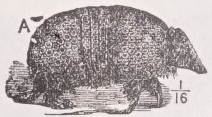
ARMADILLO, a family of South American mammals (Dasypidoe), belonging to the order Edentata, and distinguished by the peculiar nature of their external covering. This consists of a bony case, partly composed of solid buckler-like plates, and partly of movable transverse bands, the latter differing in number with the species, and, to a certain extent, with the age and sex of the individual, and giving to the entire body a considerable degree of flexibility. The under parts are destitute of bony covering, but in every case are more or less thickly covered with hair. The legs of the armadillo are short, and its movements usually slow, although, when pursued, it is said to be able to outrun a man. In danger, however, it chiefly depends for safety on its long, powerful claws, by which it can bury itself, in a few minutes, several feet below the surface of the ground. Most of the species are nocturnal in their habits, with small, weak eyes, but highly developed organs of hearing and smelling. They all possess molar teeth, and, with the exception of a single species, those only. Their food consists principally of fruits, roots, worms, and insects, but a few species are more carnivorous, greedily devouring the semi-putrid carcases of the wild cattle of the pampas, and even, it is said, burrowing into human graves. All the species are eaten by the natives and by the Portuguese and Spanish settlers, who esteem them a delicacy when roasted in the shell. The habitat of the armadilloes, extending from Mexico and Texas southward to Patagonia, is the region which, during the Tertiary period, was inhabited by the Glyptodons—gigantic armadilloes as large as the rhinoceros, whose remains are found abundantly in the bone-caves of Brazil.
[294 words — estimated reading time: 2 minutes]
a place spoken of, Rev. xvi, 16, which literally signifies “the mountain of Mageddon,” or “Megiddo,” a city situated in the great plain at the foot of Mount Carmel, where the good prince Josiah received his mortal wound, in the battle against Necho, king of Egypt. At Armageddon, the three unclean spirits coming out of the dragon’s mouth shall gather together the kings of the earth, to the battle of the great day of God Almighty, Rev. xvi, 13, 14; where the word Armageddon, according to Mr. Pool, does not signify any particular place, but is used in allusion to Megiddo, mentioned Judges v, 19, where Barak overcame Sisera with his great army, and where Josiah was slain, 2 Kings xxiii, 30. If so, the term must have been a proverbial one for a place of destruction and mourning.
[139 words — estimated reading time: 1 minute]
ARMAGH, an inland county of Ireland in the province of Ulster, situated between lat. 54° 3' and 54° 3Γ N., and long. 6° 14' and 6° 45' W.; comprising an area of 328,086 statute acres, of which 178,064 are under tillage, 100,137 in pasture, 4670 in plantation, and 28,177 in waste, <fcc., while 17,038 acres are under water. It is bounded on the N. by Lough Neagh, on the E. by the county of Down, on the S. by Louth, and on the W. by Monaghan and Tyrone. The general surface of the county is gently undulating and pleasingly diversified; but in the northern extremity, on the borders of Lough Neagh, is a considerable tract of low, marshy land, and the southern border of the county is occupied by a barren range of hills, the highest of which, named Slieve Gullion, attains an elevation of 1893 feet, being the highest mountain in Ulster excepting Slieve Donard in the county of Down. The summit of Slieve Gullion, commanding one of the finest prospects in the province, is crowned by a large cairn or pile of stones, which forms the roof of a singular cavern of artificial construction. In the western portion of the county are the Few Mountains, a chain of abrupt hills mostly incapable of cultivation.
The soil of the northern portion of the county is a rich, brown loam, on a substratum of clay or gravel, with an abundance of limestone near Armagh and other places. Towards Charlemont there is much reclaimable bog resting on a limestone substratum. The eastern portion of the county is generally of a light friable soil; the southern portion rocky and barren, with but little bog except in the neighbourhood of Newton Hamilton. The climate of Armagh is considered to be one of the most genial in Ireland, and less rain is supposed to fall in this than in any other county....
The county is well watered by numerous streams. The principal are the Callen, the Tynan, and the Tallwater, flowing into the Blackwater, which, after forming the boundary between this county and Tyrone, empties itself into the south-western angle of Lough Neagh. The Tara, the Newtown-Hamilton, the Creggan, and the Fleury flow into the Bay of Dundalk. The Cam or Camlin joins the Bann, which, crossing the north-western corner of the county, falls into Lough Neagh to the east of the Blackwater. The Newry canal, communicating with Carlingford Lough at Warrenspoint, six miles below Newry, proceeds northwards through the county of Armagh for about 21 miles, joining the Bann at Whitecoat. The Ulster Canal commences at Charlemont on the River Blackwater, near its junction with Lough Neagh, proceeding through the western border of the county, and passing thence to the south-west by Monaghan and Clones into Upper Lough Erne, after a couse of 48 miles.
The geological features of the county are various and interesting. The granite of Slieve Gullion, an offset of the granite district of Down, is often used for millstones, being very hard and fine grained. The Newry Mountains and the Fathom Hills are also composed of granite. Around Camlough large beds of mica-slate exist. Slate quarries have been worked partially at Dorcy, Newtown-Hamilton, Creggan Duff, and in the neighbourhood of Crossmaglen. Lead mines have been worked, but without much success, in several parts of the county. There are extensive deposits of lignite in the district near Lough Neagh. The other mineral substances found are potters’ clay and a variety of ochres.
The total population in 1821 amounted to 197,427 souls. In 1831 the population was 220,134, and in 1841 it was 232,393, but in 1851 the numbers had declined to 196,085, and by the census of 1871 it was 179,260.
The land is in general but indifferently cultivated, yet owing to the occupation of the peasantry in the linen manufacture they are better lodged, clothed, and fed than in most other parts of Ireland. The cultivation of grain has been for some time slightly on the decrease, and the number of acres under flax diminished from 27,245 in 1866 to 7530 in 1872; but in the green crops there has been considerable increase. The total number of acres under crops amounted in 1872 to 172,550, viz., wheat, 10,599; oats, 68,487; barley, bere, and rye, 379; beans and pease, 254; potatoes, 32,799; turnips, 7998; other green crops, 3287; flax, 7530; meadow and clover, 41,164.
The farms are in general very small, and show less tendency to decrease in number than in most other parts of Ireland. In 1872 there were 6220 holdings of less than five acres each. Notwithstanding this, their owners are generally in circumstances of comparative comfort, owing to their employment in the linen manufacture. There are few* who do not keep at least one cow, or a few sheep; none but the poorest cottar is without a pig. The usual diet is oatmeal, potatoes, and milk-porridge, varied sometimes by salt-herrings. The better description of farmers use animal food, chiefly bacon and poultry.
The principal manufacture, and that which has given a peculiar tone to the character of the population, is still that of linen, though it has somewhat declined of late. It is noways necessary to the promotion of this manufacture that the spinners and weavers should be congregated in large towns, or united in crowded and unwholesome factories. On the contrary, most of its branches can be carried on in the cottages of the peasantry. The men devote to the loom those hours which are not required for the cultivation of their little farms; the women spin and reel the yarn during the intervals of their other domestic occupations. Smooth lawns, perennial streams, pure springs, and the open face of heaven, are necessary for perfecting the bleaching process. Hence the extensive bleachers dwell in the country with all their assistants and machinery. Such is the effect of this combination of agricultural occupations with domestic manufactures, that the farmers are more than competent to supply the resident population of the county with vegetable, though not with animal food; and some of the less crowded and less productive parts of Ulster receive from it a considerable supply of oats, barley, and flour. Apples are grown in such quantities as to entitle the county to the epithet applied to it, the orchard of Ireland.
The antiquities consist of cairns and tumuli; the remains of the fortress of Eamania near Armagh, once the residence of the kings of Ulster; the Dane’s Cast, an extensive fortification in the south-east of the county, extending into the county of Down; spears, battle-axes, collars, rings, amulets, medals of gold, ornaments of silver, jet, and amber, <kc., have also been found in various places. The religious houses were at Armagh, Clonfeacle, Killevy, Kilmore, Stradhailloyse, and Tahenny. Of military antiquities the most remarkable are Tyrone’s ditches, near Poyntz-Pass, Castle Roe, the fort of Navan, the castles of Criff-Keirn and Argonell, and that in the pass of Moyrath.
Armagh, together with Louth, Monaghan, and some smaller districts, formed part of a territory called Orgial or Urial, which was long subject to the occasional incursions of the Danes.
The county was made shire ground in 1586, and called Armagh after the city, by Sir John Perrott. When James I. proceeded to plant with English and Scotch colonists the vast tracts escheated to the crown in Ulster, the whole of the arable and pasture land in Armagh, estimated at 77,800 acres, was to have been allotted in sixty-one portions. Nineteen of these, comprising 22,180 acres, were to have been allotted to the church, and forty-two, amounting to 55,620 acres, to English and Scotch colonists, servitors, native Irish, and four corporate towns, —the swordsmen to be dispersed throughout Connaught and Munster. This project was not strictly adhered to in the county of Armagh, nor were the Irish swordsmen or soldiers transplanted into Connaught and Munster from this and some other counties.
Armagh is now divided into eight baronies, viz., Armagh, Fews Lower and Upper, Oneiland East and West, Orior Lower and Upper, and Tiranny. It contains twenty-nine parishes and parts of parishes, the greater number of which are in the archdiocese of Armagh, and a few in the diocese of Dromore. The county is in the Belfast military district, having barracks at Armagh and Newry. The constabulary force has its headquarters at Armagh, the county being divided into five districts. Assizes are held at Armagh, where the county prison, the county infirmary, and ,the district lunatic asylum are situated. The only savings bank in the county is at Armagh. There are two poor-law unions, Armagh (partly in Tyrone) and Lurgan (partly in Antrim and Down). The valuation of rateable property in 1872 amounted to £410,757. The chief towns are— Armagh, population in 1871, 8946; Lurgan, 10,632; Portadown, 6735; and part of Newry, with 5321 inhabb tants, the remainder of this place, with 9616 inhabitants, being in the county of Down. The county returns three members to the imperial parliament, two for the county generally,—constituency in 1873, 7044; and one for Armagh city,—constituency, 621.
In the towns and level parts of the county the Protestant religion, in its two principal forms of the Episcopal and Presbyterian, predominates; but the Roman Catholic faith is prevalent in the mountainous and less cultivated parts. By the census returns of 1871 the Roman Catholics number 85,057, or nearly one-half of the gross population. The number of children at school in 1871 amounted to 19,887, of whom 14,838 attended the various “National Schools.” There were in the same year twenty-one persons who knew nothing but the native Erse, and 3903 were able to speak both that language and the English.
Armagh, a city and parliamentary borough in the above county, 64 miles north of Dublin, in lat. 54° 20' 55 z, N., and long. 6° 37' 57" W. It derives its name of Ard-macha, or High-Field, from its situation on the sides of a steep hill called Drumsailech, or the Hill of Willows, which rises in the midst of a fertile plain. Of high antiquity, and, like so many other Irish towns, claiming to have been founded by St Patrick, it long possessed the more important distinction of being the metropolis of Ireland; and, as the seat of a flourishing college, was greatly frequented by students from other lands, among whom the English and Scotch were said to have been so numerous as to give the name of Trian-Sassanagh, or Saxon Street, to one of the quarters of the city. Of a synod that was held here as early as 448, we have interesting memorials in the Booh of Armagh. Exposed to the successive calamities of the Danish incursions, the English conquest, and the English wars, and at last deserted by its bishops, who retired to Drogheda, the venerable city sank into an insignificant collection of cabins, with a dilapidated cathedral covered with shingles. From this state of decay, however, it was raised by the unwearied exertions of Primate Robinson (otherwise Lord Rokeby), which, seconded as they have been by similar devotion on the part of his successors of the Beresford family, have made of Armagh one of the best-built and most respectable towns in the country. As the ecclesiastical metropolis of both the Anglican and Roman organisations, it possesses two cathedrals—of which the Catholic.is of the more recent construction—and two archiépiscopal palaces. As the county town it has a court-house, a prison, a lunatic asylum, and a county infirmary. Besides these, there is a fever hospital, erected by John George Beresford; a college, which Primate Robinson was very anxious to raise to the rank of a university; a public library founded by him, and containing upwards of 14,000 volumes; an observatory, which has become famous from the efficiency of its astronomers; and a number of churches and schools. Almost all the buildings are built of the limestone of the district, but the Anglican cathedral is of red sandstone. Population of the parliamentary borough in 1871, 8946.

[2,057 words — estimated reading time: 12 minutes]
ARMAGNAC, a district of the south of France, corresponding to a large part of the present department of Gers, with portions of the neighbouring territory, erected in the 10th century into a countship in favour of Bernard the Squint-eyed (le Louche), son of the count of Fezinsac. The family thus founded at various times exercised great influence on the destinies of France, especially in the persons of John I. (d. 1373), Bernard VII. (d. 1418), John IV. (d. 1451), and John V. (d. 1473). Under Bernard VII. the name Armagnacs was given to the party of the house of Orleans, which carried on so ruthless a contest with the house of Burgundy during the imbecile reign of Charles VI. In 1444-5, the Emperor Frederick III. of Germany obtained from Charles VII. a large army of Armagnacs to enforce his claims in Switzerland, and the war which ensued took the name of the Armagnac war {Armagnaken∙ krieg') . In Germany the name of the foreigners, who were completely defeated in the battle of St Jakob on the Birs, not far from Bâle, was mockingly corrupted into Arnie Jacken, Poor Jackets, or Arme Gecken, Poor Fools. On the death of Charles of Armagnac, in 1497, the countship was united to the crown by Charles VII., but was again bestowed on Charles, the nephew of that count, by Francis I., who at the same time gave him his sister Margaret in marriage. After the death of her husband, by whom she had no children, she married Henry of Albret, king of Navarre; and thus the countship of Armagnac came back to the French crown along with the other dominions of Henry IV. In 1645, Louis XIV. erected a countship of Armagnac in favour of Henry of Lorraine, count of Harcourt, in whose family it continued till the Revolution. James of Armagnac, grandson of Bernard VII., was made duke of Nemours in ...1462, and was succeeded in the dukedom by his second son, John, who died without issue, and his third son, Louis, in whom the house of Armagnac became extinct in 1503.
[351 words — estimated reading time: 3 minutes]
ARMENIA(Hayasdani or Haikh, in the native language), formerly an extensive country of Western Asia, which is now divided between Turkey, Russia, and Persia. Its political relations, and consequently its geographical limits, were subject to frequent variation, but in its widest extent it may be described as reaching from the Caucasus in the N. to the Mountains of Kurdistan in the S., and from the Caspian Sea in the E. to Asia Minor in the W., frequently, indeed, somewhat overlapping with the last-mentioned geographical division. From a very early period a distinction was drawn between Greater Armenia (Armenia Major, Medz Hayotz), to the east of the Euphrates, and Lesser Armenia (Armenia Minor, Phokhr Hayotz), lying to the west. The former is more properly Armenia. It consists for the most part of an elevated table-laud, about 7000 feet above the level of the sea, culminating in the peaks of Mount Ararat, and sinking towards the plains of Iran on the east and those of Asia Minor in the west, while it is frequently broken by glens and valleys. It is watered by the Euphrates, the Tigris, the Aras, and the Kur, all of which have their sources within its borders; and, like other mountainous countries, it possesses a large number of lakes. The most important of these are Van or Aghtamar, Sevan or Khabodan, and Urmiah or Keghem. The country is naturally fertile, producing grain, cotton, tobacco, and grapes, but for many centuries it has been sadly neglected. It abounds in romantic scenery and luxuriant pasture. The beauty of the district of Ararat especially has been celebrated by patriotic historians like Moses of Khorene and Lazarus of Pharb. In the time of its greatest prosperity, Armenia Major was divided into fifteen provinces, and contained a large number of flourishing ...and important towns. The capital for many centuries, under the Haikian dynasty, was Armavir, to the north of the Araxes, but it was changed for Artaxata (Ardashad) towards the close of the first century of our era. Erovant II. (58-78 a.d.) built Erovantashad and Pakaran, and adorned them with the spoils of the earlier cities. From the 2d to the 4th century the royal residence was at Valarsabad, which no longer exists, and, under the Pagratid dynasty, the chief town waβ first Shiragavan and afterwards Ani, the remains of which still testify to its magnificence. (Texier, Description de l ’ Arménie ; Brosset, Ruines T Ani., 1860, 1861.) Other places of importance were Erzeroum, Van or Shamira-maguerd, Nakhjuan, Amid, and Pakovan. Divided and incorporated by the three great empires already mentioned, Armenia has no longer a separate existence, and details regarding the present condition of the country that formerly bore the name come more appropriately elsewhere. The Russian portion extends south to the Aras, and is mainly included in the government of Erivan; the Persian share is absorbed in Azerbijan; and Turkish Armenia is principally contained in the province of Erzeroum. The chief towns in the first are Erivan, Etchmiadzin, Ordubad, and Alexand-ropol; in the second, Urumiyah; and in the third, Erzeroum and Van.
According to their own legendary history, in which ancient traditions are curiously incorporated with Biblical lore, the Armenians are descendants of Ξaik, a spn of Togarmah, the grandson of Japhet, who fled from the tyranny of Belus of Assyria and settled in the country which now, in their language, bears his name. The conquest of the land by Semiramis, and the revolt of Barvir against Sardanapalus, are the chief events in the early ages. Tigranes or Dikran is regarded as the contemporary and ally of Cyrus, and the history of his reign is recorded in detail. His son, Vahakin, who succeeded him, was celebrated for his strength, and was deified after his death. The dynasty came to an end in the person of Vahi, who was defeated by Alexander the Great, 328 B.c.
The Armenians threw off the Macedonian yoke in 317 β.c., and chose Ardvates as their king; but on his death, about thirty-three years afterwards, they submitted to the Seleucids of Syria. About 190 b.c., Artaxias, who had been appointed governor by Antiochus the Great, took advantage of that monarch’s defeat by the Romans and proclaimed Armenia Major independent. It was this prince who afforded an asylum in his court to the exiled Hannibal. The example of revolt was followed in Lesser Armenia by Zadriades, whose descendants maintained their position till the time of Tigranes IL, when their territory was annexed to Greater Armenia.
About the middle of the 2d century b.c., the great Parthian king, Mithridates I., who had already extended his empire over Syria, established his brother, Valarsaces (Wagharshag), in Armenia, and thus rendered him the founder of one of the most important branches of the Arsacid family. The new king greatly promoted the prosperity of the country by founding cities, establishing laws, and rewarding persons of talent. The most celebrated of his successors was his great-grandson, Tigranes II., who made himself master of Syria, the Lesser Armenia, and many Parthian provinces, and would, ’probably, have been the founder of an extensive empire had not the solicitations of his fathef-in-law, Mithridates of Pontus, brought him into collision with the Romans. In reward for the submission which he ultimately made to Pompey, he was allowed to keep possession of Armenia, with the exception of the provinces of Sophene and Gordyene, which were erected into a separate kingdom for his son, Tigranes. He ] continued a faithful ally of the Romans till his death, 1 about 55 b.c., when he was succeeded by his son, Arta- i vasdes, who, having adopted a more independent policy, was taken prisoner by Antony and carried to Alexandria, where he was afterwards beheaded by Cleopatra in 30 b.c.
A period follows of nominal Roman supremacy and actual anarchy; 170 independent’ families all asserting themselves to the best of their ability, and a few of them succeeding in establishing their petty principalities. At length a usurper, Erovant, an Arsacid by the female line, made himself in some sort master of all the kingdom about 58 A.D., and maintained his position till he was expelled by Ardashes (Exedarus), a more direct representative of the race, who was repeatedly dethroned and restored by Parthian and Roman interference, but managed to do something for the amelioration of his country.
When the Arsacids were driven from the Persian throne 1 by the Sassanid Artaxerxes (Ardeshir), Chosroes the Great 1 of Armenia naturally took up arms in their defence; and ‘ he maintained the contest till his assassination by Anag, an Arsacid prince of Persia, when Armenia became subject to the Persian dynasty, 232 a.d. In the massacre of the royal family which ensued, none escaped but Tiridates (Tirdat), a son of Chosroes, who fled to Rome, and afterwards, with the help of the Romans, established himself on the throne, 259 a.d. The first act of his reign was the persecution of the Christians, who had begun to take root in the country during the previous century. St Gregory, surnamed the Illuminator, was cast into prison; but the king being, as he supposed, miraculously cured of a dangerous distemper by the saint, the Christian religion was embraced by himself and most of his people. The introduction of Christianity tended to arouse the animosity of the Persians; and from this period Armenia became the theatre of almost uninterrupted struggles between that nation and the Romans, until Theodosius the Great agreed to cede to Persia the eastern part of the country, which was thence called Persarmenia, while the western part was annexed to the Roman empire. Theodosius nominated Arsaces IV., then nominal king of Armenia, governor of the western division; and the Persian king, to conciliate the people, appointed Chosroes III., a descendant of another branch of the Arsacids, governor of the eastern part. The rule of the Arsacids in Persarmenia ended with Ardashes IV., who was dethroned by Bahram V. of Persia in 428; and from that date Armenia ceased to be a kingdom, and was ruled till 632 by Persian marzbans or governors. The Persians had all along endeavoured to subvert Christianity, and for that purpose had recourse to the most cruel persecutions. Frequent insurrections were the consequence, one of the most remarkable being that which was led by Vartan (see Neumann’s History of Vor fan, by Elisoeus, 1830). From 632 till 839 Armenia was the scene of almost incessant struggles between the Greeks and Mahometans, while its own native prince3 added to the confusion by their rivalries and strife. Ashod, a member of the Pagratid family, which claimed to be of ancient Jewish origin, became master of Central and Northern Armenia about 743, and, being recognised by the caliphs as an independent prince, founded a dynasty which continued till 1079, when Cakig II was assassinated, and his kingdom incorporated with the Greek empire. Another family, which claimed the parricide sons of Sennacherib as its founders, held possession of the province of Vasburagan and some of the neighbouring territory, and maintained its independence till 1080, when it likewise succumbed to Byzantium. During the same period the district northwest of lake Van was held by the Mussulman race of the Merwanids,—called by the Armenians the princes of Abra-huni,—who gave a nominal submission now to the Byzantine government and now to the sultans.
Rhupen (Ruben), a relative of the last king of the Pagratid dynasty, retired to the north of Cilicia, and founded in the shelter of the Taurus a small principality, which gradually extended its boundaries to the Mediterranean, and became known as the kingdom of Lesser Armenia. The Rhupenians entered into alliance with the Crusaders, and formed, along with the kings of Cyprus, the last bulwark of Christianity in the East. They welcomed as allies the Mongolian hordes that overran Asia in the 13th century, and shared in the hostility and vengeance of the Mamelukes. The last king of the family, Leon, or Ghevond VI., was taken prisoner in spite of a Vigorous defence at Gaban in 1375, and, after six years of captivity in Egypt, wandered through Europe till his death, at Paris, in 1393. (See Langlois, Essai sur les rois de la dyn. Roupénienne, St Petersb., 1860; Documents pour servir à l’hist. des Lusignans de la P. Arm., 1859; Le Trésor des chartes T Arménie, 1863.)
About the middle of the 14th century the Kurds had possession of the south of Armenia, the Persians of the north, and the Ottomans of the west. The whole was subjected to the sway of Tim our, of whose cruelties a graphic account has been left by the Armenian, Thomas of Medzoph (see Nève’s Etude sur Thomas de MedzopK). It was mainly governed by Persian officials during the next century, the only national authority being the patriarch. Tn 1604 Shah Abbas, in his contest with Ahmed I., laid the whole country waste, and forcibly transplanted about 40,000 of the inhabitants into Persia, where they settled principally in Ispahan and New Julfa, as they fondly called the city which they founded. Since then the Armenians have had no political position as a nation, though they continue to form an important and valuable portion of the population in Russia, Turkey, and Persia, and their colonies have spread into almost all quarters of the globe. It was calculated, about 1850, that there were approximately four millions of Armenians in the world, of whom 2,500,000 were inhabitants of the Ottoman empire, 1,200,000 of the Russian empire, 25,000 in the empire of Austria, 150,000 in Persia and Azerbijan, 25,000 in continental India and the Archipelago of Asia, and the remaining 100,000 scattered in various countries (Dulau-rier). According to a recent statistician of Turkey (Lejean), there are 400.000 Armenians in the European part of the empire, of whom more than 200,000 are in Constantinople itself. Originally ∙a brave and warlike people, they have become distinguished for their peaceful character and their submissiveness to the government of every country in which they live. (See the articles of Dulaurier and Prince Dadian in Revue des D. Mondes, 1854 and 1867.)
See Saint-Martin’s Mémoires sur l’Arménie, Paris, 1818-19. Brosset’s Vοy. Archeοl. dans la Géorgie et dans l’Arménie en 1847-8, Paris, 1849-51; Boré’s “Arménie” in L’Univers Pittoresque; Curzon’s Armenia, London, 1854; Jaubert’s Voy. en Arménie, &c.; Mo-ier’s Zweite Reise durch Persien u. Armenien; Serpos’s Compendio storico concernente la naz. Arm.; Collection des hist, anc. et mod. de I' Arm., by Langlois; Recueil d’actes et documens rel. à l’hist. de la nation Arm., 3 vols., Moscow; Chamich’s History, trans, by Avdall, Calcutta, 1827; Phahnazarian’s Esquisse de l’hist. de ÎArm., 1856; Dulaurier, Rcch. sur la chron. Arm.; Goerres, Die Japhetitcn und ihre gemeinsame Heimath in Armen., Munich, 1845.
[2,182 words — estimated reading time: 13 minutes]
a considerable country of Asia, having Colchis and Iberia on the north, Media on the east, Mesopotamia on the south, Pontus and Cappadocia on the west, and the Euphrates and Syria on the south-west. Armenia is often confounded with Aramæa, the land of Aram or Syria; but they are totally different. Armenia, which is separated from Aram by Mount Taurus, was so denominated from Ar-Men, the mountainous country of Meni or Minni, the people of which country are mentioned under this name by Jeremiah, when summoning the nations against Babylon. The people of this country have in all ages maintained a great similarity of character, partly commercial and partly pastoral. They have, in fact, in the northern parts of the Asiatic continent, been what the Cushites and Ishmaelites were in the south, tenders of cattle, living on the produce of their flocks and herds, and carriers of merchandize between the neighbouring nations; a part living at home with their flocks, and a part travelling as merchants and dealers into distant countries. In the flourishing times of Tyre, the Armenians, according to Ezekiel, xxvii, 14, brought horses and mules to the markets of that city; and, according to Herodotus, they had a considerable trade in wine, which they sent down the Euphrates to Babylon, &c. At the present day, the Armenians are the principal traders of the east; and are to be found in the capacity of merchants or commercial agents all over Asia, a patient, frugal, industrious, and honest people, whose known character for these virtues has withstood the tyranny and extortions of the wretched governments under which they chiefly live. The religion of the Armenians is a corrupt Christianity of the sect of Eutyches; that is, they own but one nature in Jesus Christ. Their rites partake of ...those of the Greek and Latin churches, but they reject the idolatries of both. It is indeed a remarkable instance of the firmness of this people, that while the surrounding nations submitted to the religion as well as the arms of the Turks, they have preserved the purity of their ancient faith, such as it is, to the present day. It cannot be supposed but that the Turks used every effort to impose on the conquered Armenians the doctrines of the Koran. More tolerant, indeed, than the Saracens, liberty of conscience was still not to be purchased of them but by great sacrifices, which for three centuries the Armenians have patiently endured, and exhibit to the world an honourable and solitary instance of a successful national opposition of Christianity to Mohammedanism.
[430 words — estimated reading time: 3 minutes]
CHURCH, a branch, originally, of the Greek church, residing in Armenia. They probably received Christianity in the fourth century. Mr. Yeates gives the most recent account of them:-- “Their whole ecclesiastical establishment is under the government of four patriarchs; the first has his residence in Echmiadzin, or Egmiathin, near Irivan; the second, at Sis, in the lesser Armenia; the third, in Georgia; and the fourth, in Achtamar, or Altamar, on the Lake of Van; but the power of the two last is bounded within their own diocesses, while the others have more extensive authority, and the patriarch of Egmiathan has, or had, under him eighteen bishops, beside those who are priors of monasteries. The Armenians every where perform divine service in their own tongue, in which their liturgy and offices are written, in the dialect of the fourth or fifth centuries. They have the whole Bible translated from the Septuagint, as they say, so early as the time of Chrysostom. The Armenian confession is similar to that of the Jacobite Christians, both being Monophysites, acknowledging but one nature in the person of Christ; but this, according to Mr. Simon, is little more than a dispute about terms; few of them being able to enter into the subtilties of polemics. “In the year 1664, an Armenian bishop, named Uscan, visited Europe for the purpose of getting printed the Armenian Bible, and communicated the above particulars to Mr. Simon. In 1667, a certain patriarch of the lesser Armenia visited Rome, and made a profession of faith which was considered orthodox, and procured him a cordial reception, with the hope of reconciling the Armenian Christians to the Roman church; but, before he got out of Italy, it was found he had prevaricated, and still persisted in the errors of his church. ...About this time, Clement IX, wrote to the king of Persia, in favour of some Catholic converts in Armenia, and received a favourable answer; but the Armenian church could never be persuaded to acknowledge the authority of Rome. “They have among them a number of monasteries and convents, in which is maintained a severe discipline; marriage is discountenanced, though not absolutely prohibited; a married priest cannot obtain promotion, and the higher clergy are not allowed to marry. They worship in the eastern manner, by prostration: they are very superstitious, and their ceremonies much resemble those of the Greek church. Once in their lives they generally perform a pilgrimage to Jerusalem; and in 1819, the number of Armenian pilgrims was thirteen hundred, nearly as many as the Greeks. Dr. Buchanan, however, says, ‘Of all the Christians in central Asia, they have preserved themselves most free from Mohammedan and Papal corruptions.’”
[447 words — estimated reading time: 3 minutes]
ARMENIAN CHURCH, The, is one of the oldest Eastern Christian churches not in communion with the orthodox Greek Church or with the Church of Rome....
1. History.— This is divided into three periods, from 34 to 302 a.d., from 302 to 491, and from 491 to the present time. (1.) The first period is mainly legendary. The Church of Armenia claims an older than apostolic foundation. Our Lord, they say, corresponded by letter with Akbar, prince of Ur or Orfa; and the apostle Thaddeus, accompanied by Bartholomew and Judas, preached the gospel, and founded a Christian church in Armenia as early as the year 34 a.d. But whatever the value of these primitive traditions, Armenia could hardly be said to have a church at all during this first period, although there are evident traces of Christian worship in the country at a very early time. (2.) The historical founder of the Armenian Church was S. Gregory, called the “Illuminator.” He was a prince of the reigning family of the Arsacidae, who, having been converted to Christianity, was eager for the conversion of his countrymen. In his missionary work he endured many persecutions, but at last managed to win over the king of Armenia and a considerable portion of his subjects. At the king’s desire Gregory went to Caesarea, or Sis, and was there consecrated bishop of Armenia (302 a.d.) His successors afterwards assumed the title of . Patriarch, subsequently Catholicos, and under their rule the infant church grew and prospered. It had to struggle against the opposition of heathen fellow-countrymen and Persian conquerors, but it succeeded in establishing itself in the hearts of the people. The Bible was translated in 410 a.d. ; the Liturgy, said to be very old, was improved; and the Armenian bishops took part in several of the synods of the church, notably in the third oecumenical council (Ephesus, 431 a.d.) About 450 a.d. the Armenian Church suffered a severe persecution, which prevented any of the bishops being present at the fourth oecumenical council (Chalcedon, 451 a,d.), at which Eutyches and hià followers, the extreme opponents of Nestorius, were condemned. The Armenian Church never accepted the decisions of the Council of Chalcedon, and, in 491 a.d., the patriarch, in full synod, solemnly annulled them. This act led to the separation of the Armenian from the orthodox Greek Church. (3.) The period of schismatic existence divides into three—(a), from 491 a.d. to the middle of the 15th century; (δ), from the middle of the 15th to the middle of the 18th centuries; (c), from 1746 down to the present time. It is difficult to account for the schism of the Armenian Church; according to common report, the Armenians were Eutychians, and were virtually cut off from the church when the Council of Chalcedon condemned that heresy, but their own account of the matter in their authoritative documents is very different. They allege that they were misled by false reports when they annulled the fourth council; that it was reported to them that the council had decided in favour of the Nestorian heresy, and that this mistake was confirmed by a letter to the patriarch upon the subject from the bishop of Rome, in which certain words were used which might easily be interpreted in the Nestorian sense. The Patriarch Narses, in his letter to the Emperor Manuel Com-nenus, in 1166, distinctly repudiates the Eutychian heresy, but it is to be noted that, in defending the doctrinal views of his church, he employs the somewhat vague terms in use before the Council of Chalcedon, not those stricter definitions which were in use afterwards; he employs (rvppi^v;, for instance, in its pre-Chalcedonian meaning, not ίνωσις. However occasioned, the separation was gradual; Armenian bishops attended the 5th, 6th, and 7th oecumenical councils (2d of Constantinople, 553; 3d of Constantinople, 680; 2d of Nicaea, 788), and the church acknowledges the decrees of those councils as binding. Cut off from the Eastern Church, the Armenian bishops became all the more closely identified with their native country, and kept alive patriotic feeling in times of great national distress. In spite of many national calamities, foreign domination, internal dissensions, and even banishment, the Armenian Church preserved its character, doctrine, and discipline until the middle of the 15th century, when great dissensions arose which -resulted in a schism. These quarrels were occasioned by Jesuit missionaries, who endeavoured to make the Armenians adopt the doctrine, liturgy, and ceremonies of the Roman Church. They succeeded in prevailing upon a great number of the adherents of the Armenian Church to separate from the community and join the communion of Rome. The Catholic Armenians, as they are called, first became a separate community towards the end of the 16th century; their existence has proved a source of great weakness to the orthodox church, and through their exertions the old persecutions were revived. This state of matters went on until the middle of the 18th century, when the patriarch sought and obtained the intervention of Peter the Great of Russia. Since then the Armenian Church has found shelter under the protection of Russia. There is a reformation now going on in the Armenian Church, and a Reformed Church has arisen, which seeks to ally itself with the Calvinist Churches of Europe and America.
2. Doctrines.— These are almost identical with those of the orthodox Greek Church. The Armenians accept the first three, and the fifth, sixth, and seventh oecumenical councils, denying that of Chalcedon only, but, as has been explained, they, in their authoritative documents, reject the Eutychian heresy, which that council was called to condemn. The chief source of information as to the doctrine is contained in the letter of Narses above referred to. They reject the Western addition of filioque to the Nicene Creed, and deny the distinctive doctrines of the Roman Church.
3. The Liturgy is said to date from the 1st century, and to have been founded on that of the Church of Jerusalem. St Gregory remodelled it, and introduced the Nicene Creed, using that edition which contains the damnatory clause, and adding a conclusion of his own. Prayers of John Chrysostom and of Basil the Great were introduced in 430 a.d. Prayers are said for the dead, and entreaty is made for the pardon of their sins, but the church does not believe in purgatory, nor admit of indulgences. The holy days are Sundays, the chief feasts observed in the Eastern Church, and ten national saints’ days. Christmas is celebrated on the 6th of January, on the day of the Epiphany, and not on the 25th of December.
4. Sacraments.— The Church of Armenia has the seven sacraments: baptism, confirmation, the eucharist, penance, ordination, marriage, and extreme unction, Baptism is by immersion; the child is immersed three times; it is then anointed with holy oil, is confirmed, and partakes of the eucharist in both elements. Confirmation is administered to children immediately after baptism. The eucharist is administered in both elements to all members of the church; the bread is always unleavened, and the wine is not mixed with water. Confession must precede the partaking of the eucharist, save in the case of children under seven years of age. Penance consists of confession and fasting. Ordination is by anointing with the holy oil. The τnαrnαye service is almost the same as in the Greek Church. In extreme unction only priests are anointed with oil. Laity have the prayers said over them, but are not anointed.
5. The Clergy.— There is the threefold order— bishops, priests, and deacons; and there are three degrees of episcopal rank—the archbishops (chief among whom is the patriarch or catholicos), the bishop, and the vartabed, or doctor of theology, who has frequently charge of a diocese, with episcopal functions. The clergy are further divided into the black and the white. The black clergy are monks, and are alone eligible for the higher clerical offices; the white clergy include the parish priests and lower clergy. The clergy may marry before ordination, but not after; and a priest’s widow is not allowed to remarry. The priesthood is hereditary. During his father’s or grandfather’s lifetime the heir may follow a secular calling; but he must leave this and enter the priest’s office on the death of the priest he is heir to. There are four patriarchs, who have their seats at Constantinople, Jerusalem, Sis, and Etchmiadzin. The clergy of all ranks are supported entirely by the free-will offerings of the people.
Authorities :— The Life and Times of S. Gregory the Illuminator, translated, by S. C. Malan, 1868. (This is a translation of authoritative papers, and includes a short summary of the state of the Armenian Church. It is founded on authoritative documents.) The Divine Liturgy of the Armenian Church, transi, by S. C. Malan, Lond. 1870 (very carefully done). Histoire, Dogmes, Traditions et Liturgie de l'Eglise Arménienne, Paris, 1855 (fuller, but not so accurate). Codex Mysterii Missal Armenorum seu Liturgia Armena, Pome, 1677 (Lat and Armen. Later editions of the Liturgy published at Rome belong to the Catholic Armenian Church, and are worthless). (T. Μ. L.)
[1,542 words — estimated reading time: 9 minutes]
ARMENIAN LANGUAGE. The Armenian or Haikan language is an offshoot of the Iranian branch of the IndoGermanic family of languages. Its earliest stage is probably represented in the cuneiform inscriptions of Van, on which see Hincks, in Jour. P. Asiatic Soc., vol. ix. (1848), and Mordtmann, in Zeitschrift d. deutschen morgenl. Gesellschaft, vol. xxvi, (1872). The existing literature of the Armenians dates from the 4th century, and is essentially and exclusively Christian. The translation of the Old Testament by Sahag Bartevatsi, and of the N ew by Miesrob, are among its oldest monuments. The dialect in which this version is written, and in which it is still publicly read in their churches, is called the old Armenian. The modern Armenian not only departs from the elder form by dialectic changes in the native elements of the language itself, but also by the great intermixture of Persian and Turkish words, which has resulted from the conquest and subjection of the country, and by the character of inversion in the structure of its sentences. Of its two principal dialects,—the Western, spoken in Constantinople and Asia Minor, and the Eastern, spoken by the Armenians scattered over Tartary, Persia, and India,—the latter approaches more nearly to the idiom of the ancient language. According to Philostratus (Vita Apollonii, ii. 2), the Armenians had an alphabet of their own in the 2d century a.d., of which, however, no traces remain. The invention of the present alphabet is ascribed to Miesrob at the beginning of the 5th century; it is probably an amplification of the previous one upon the Greek system of arrangement, and consists of thirty-eight letters, the two last of which, 6 and f 1 were added after the 12th century. The order of writing is from left to right. The capital ...letters are used in inscriptions, and at the beginning of sentences and proper names. As to its phonetic elements, the Armenian language is rough and consonantal, with the accent on the last sySable. It possesses no grammatical gender, except that a masculine is sometimes made feminine by the addition of uhi, and that the words for man and woman may be prefixed to nouns to express their natural gender; there is no dual. The declension is divided into vowel and consonantal declensions, each again being subdivided into strong and weak There are seven cases, including an instrumental. The nine demonstrative pronouns are regulated by the demonstrative letters s, t, n, the first of which expresses proximity, the second lesser, and the last greater distance. The verb has four conjugations, according to the class vowels, e, a, u, i, and four tenses,—present, imperfect, aorist, and future, the last two having two forms. In its syntactical structure the old Armenian resembles most nearly the classical Greek. The best and most recent Grammars are by H. Petermann (Berlin, 1872), and Μ. Lauer (Vienna, 1869); Dictionaries by Aucher and Brand (2 vols., Venice, 1821), and by A. Calfa (Paris, 1861), which comprises also the modern dialects. A good Grammar of the modern Armenian (Western dialect) is that of E. Riggs (Constantinople, 1856). There is an essay on the dialect of Tiflis, by H. Petermann, in Abhandlungen der K. Academie der Wissenschaften, Berlin, 1867. The best recent surveys of Armenian literature are by H. G. O. Dwight {Jour. Amer. Or. Soc., iii.) and M. Patcanian {Melanges Asiatiques, iv.) See also, by the last-mentioned writer, “Recherches sur la formation de la langue Arménienne,” in Journal Asiatique, August and September 1870.
[587 words — estimated reading time: 4 minutes]
ARMENIAN LITERATURE. With the exception of a few fragments incorporated in later writers, the pre-Christian literature of Armenia has totally perished. The early Armenians seem to have possessed a body of traditional and historical songs analogous to the Shah-nameh of Persia, the memory of which lingered long among the common people, especially in the province of Koghten. Portions of these have been preserved by Moses of Khorene, and investigated by several modern scholars (see Vebk Hnuin Hayasdani, i.e., Chants hist, et pop. de l , Ancienne Arménie, J. B. Emin, Moscow, 1850; Dulaurier, Peυ. des D. Mondes, 1852, vol. xiv.; “Etudes sur les chants hist, de l'anc s Arménie,” in Journal Asiatique, 1852). With the introduction of Christianity a great development of literary activity took place, which chiefly expended itself, however, in translations from the Syriac and Greek. Armenian students were found in Athens and Byzantium, Alexandria and Rome, and some of them attained celebrity in their chosen pursuits. To this tendency we owe the preservation, in Armenian, of many works that have perished in their original languages. Such are the Chronicle of Eusebius, some of the works of Philo, Bardesanes, Faustus of Byzantium, Lerubna of Edessa, &c. (see Wenrich, De auctorum Graecorum versionibus Arabicis, Armeniacis, dec., Leipsic, 1842). The 5th century was one of the most flourishing periods of Armenian literature. It was then that .Miesrob accomplished that modification and development of the Armenian alphabet which has frequently procured him the honour of being regarded as its inventor (see Fr. Muller, lieber den Ursprung der Armenischen Schrift, 1865). The Old Testament was translated from the Septuagint by Isaac or Sahak, the patriarch (critical edition, Ven. 1805). ...These learned men were succeeded by a number of worthy disciples, such as Esnig of Golp (Koghb), Goriun the biographer of Miesrob, and David the Invincible, a keen student of Greek philosophy, who has left us Philosophical Definitions and translations from Aristotle (see “La vie et les ouvrages de David le phil. Armen.,” by Neumann in Journal Asiatique, 1829). Yeghishe or Elisaeus wrote a very popular account of the wars of Vartan against the Persians, which has been frequently translated (Neumann, London, 1830). Moses of Khorene is one of the most important as well as best known historians of his native country. In the 6th century all connection with the centres of Greek culture being cut off by the Persian monarchs, Armenian literature became almost extinct. In the 7th century John the Mamigonian continued Zenob’s History of Daron (Taron); Sebeos composed a history of Heraclius; Ananias of Shirag was the author of astronomical works, and Theodorus and Sahak wrote upon theological subjects. Among the writers of the 8th century the chief place is held by John of Osdin and Stephanus of Siunia; and in the 9th century we find John the Catho-likos, Thomas Ardzruni, and Miesrob of Hayotz-dsor. In the 10th century, Khosrov the Great, Ghevond or Leontius the Presbyter, Gregory of Narek, Moses of Kalkand, and Stephanus Asolik (Assoghik) may be mentioned; and in the 11 th, Aristakes of Lastiverd, a national historian, and Matthew Yeretz {i.e., the Presbyter) of Edessa, the biographer of Chrysostom.
The 12th and 13th centuries form a second great period of Armenian literature, during which the influence of Syriac is again perceptible. Gregory Magistros, who introduced the Arabic system of versification into his native language, Narses of Lampron, Mekhitar Kosh (sec Joum. Asiat., 1841), John Vanacan {i.e., the Monk), Vardan the Great {Journ. Asiat., 1867), Vahram, and Sempad, are a few of the numerous writers of note. From the 14th to the 18th century there is a falling off, the most important work, perhaps, being Thomas of Medzoph’s History of Timour. In the 18th century a revival took place, which was mainly due to the Mekhita-rists of Venice (see Langlois, Notice sur le couvent Arménien de V île Saint-Lazare de Venise, Paris, 1863), and since then Armenian literature has acquired a development which is remarkable in the absence of national unity. Printing presses have been established in most of the cities where Armenians are numerous, the ancient writers have been published and studied, the vernacular literature has been enriched both by original productions and translations, and magazines and newspapers have been established in many of the centres of Armenian activity. The study of the Armenian language and literature by the savants of Western Europe has shared in the general development of Indo-European philology. The earlier labours of Rivola (1633), Villote, La Croze, Osgan, Villefroy, and Freret have been almost completely eclipsed by such men as Saint Martin (an Armenian by race), Dulaurier, Langlois, Boré, and Prudhomme in France; Nève in Holland; Emin, Patcanian,and Brosset in Russia; and Windischmann, Marie, Spiegel, Justi, Neumann, and Petermann in Germany.
See Somal’s Quadro della storia lei. di Arm.; Karikin, Hist, de lΛ lit. Arm.; Patcanian, “Cat. de la lit. Arm.,” in Mélanges Asiat., vol. iv. Petersb., I860; Neumann’s Versuch einer Gesch. der Arm. Lit.; Alishan’s Tableau succinet de l'hist. et de la lit. de VArm., 1860; Hamachod’s Chronological succ. of Arm. Patriarchs (in Armenian).
[866 words — estimated reading time: 5 minutes]