HORN. The weapons which project from the heads of various species of animals, constituting what are known as horns, embrace substances which are, in their anatomical structure and chemical composition, quite distinct from each other; and although in commerce also they are known indiscriminately as horn, their uses are altogether dissimilar. These differences in structure and properties are thus indicated by Professor Owen “The weapons to which the term horn is properly or technically applied consist of very different substances, and belong to two organic systems, as distinct from each other as both are from the teeth. Thus the horns of deer consist of bone, and are processes of the frontal bone; those of the giraffe are independent bones or ‘epiphyses’ covered by hairy skin; those of oxen, sheep, and antelopes are ‘ apophyses ’ of the frontal bone, covered by the corium and by a sheath of true homy material; those of the prong-horned antelope consist at their basis of bony processes covered by hairy skin, and are covered by horny sheaths in the rest of their extent. They thus combine the character of those of the giraffe and ordinary antelope, together with the expanded and branched form of the antlers of deers. Only the horns of the rhinoceros are composed wholly of horny matter, and this is disposed in longitudinal fibres, so that the horns seem rather to consist of coarse bristles compactly matted together in the form of a more or less elongated sub-compressed cone.” True horny matter is really a modified form of epidermic tissue, and consists of an albuminoid principle termed “keratin.” It forms, not only the horns of the ox tribe, but also the hoofs, claws, or nails of animals generally, the carapace of the tortoises and the armadillo.es, the scales ...of the pangolin, porcupine quills, and birds’ feathers, &c. The principal application of horns is for the manufacture of combs, and under the heading Comb, vol. vi. pp. 177-78, that industry is described. The other uses to which horn is now devoted, among which may be noted the pressing of buttons, the making of handles for walking-sticks, umbrellas, and knives, the manufacture of drinking-cups, spoons of various kinds, and snuff-boxes, do not here require extended notice. The parings and refuse of horn are valuable for the manufacture of prussiate of potash and as manure; and the ash of the cores of horn makes excellent cupels for the assay of precious metals. In former times horn was applied to several uses for which it is no longer required, although such applications have left their traces in our language. Thus the musical instruments and fog signals known as horns indicate their descent from earlier and simpler forms of apparatus made from horn. Tn the same way powder-horns were spoken of long after they ceased to be made of that substance; to a small extent lanterns still continue to be “glazed” with thin transparent plates of horn, a practice which a century ago was universal. Hornbooks consisted of spelling-books with their leaves protected by thin plates of horn, and it was in former times customary to protect the titles of valuable MSS. in the same way. Deer-horn is almost exclusively used for handles by cutlers and walking-stick and umbrella makers. The largest supply is obtained from the East Indies, and consists principally of the antlers of the axis, Axis maculata, and the Rusa deer, Pusa Aristotelis.
HORN, or French Horn, a wind instrument made at various times of various materials such as wood, ivory, and several metals, but belonging in its modern significance to the class of brass instruments. In how far the instruments of similar type or character used by the Jews and other Eastern nations, by the Romans, and by mediaeval knights may have been related to the modern horn it is needless to investigate here. The instrument as we know it dates at least from the 16th century, for a picture of the circular horn is found in Virdung⅛ Musica (1511). But ruder representations of similarly-shaped instruments occur in armorial bearings of a much remoter period. The horn in its earlier form served exclusively the various purposes of the hunt, whence its name in the different languages: Italian, corno di caccia; French, cor de chasse; German, Waldhorn. Originally there seems to have been only a single ring, but a second semicircle occurs at an early date. The capabilities of the primitive instrument were as limited as its purpose, the latter being chiefly that of announcing by signals the various stages and incidents of the hunt, such as the Reveille, the Hallali, and the Mort. Simple tunes, however, were within its range, for Mersenne mentions a “concert à quatre” for horns as early as 1637. The demands on the horn were naturally much enlarged when it was introduced into the orchestra as an exponent of artistic and complicated music. As to the date of this event opinions differ considerably. It has been asserted that Gossec was the first to make use of the horn in an important orchestral part in 1759. But this is true, if true at all, of France only. In Germany and England the instrument was in common use at a much earlier period. From 1712-1740 two hornists were members of the imperial chapel in Vienna at the not inconsiderable salary of 360 florins. Moreover, both Handel (in his Water Music, 1715, and elsewhere) and Bach assign important parts to the horn. The notes natural to the horn and produced by the action of the lips alone are the so-called harmonics or partial tones of the bottom note between the extreme limits of the C below the staff in the bass clef to the E in alt. Some of these notes are, however, not used in practice. In order to supply the notes not in the scale of natural harmonics various methods have been used. The simplest is the insertion of the hand in the bell of the instrument, accidentally discovered by a German hornplayer towards the end of the last century. The effect is to lower the note by a semitone or a whole tone, according to the extent that the orifice is closed. The drawback attaching to this system is that the “closed” or “stopped” (étouffé) notes differ in character from the open ones, and are in part dull. It is true that a good composer may produce certain effects by this means. In the modern horn a mechanical contrivance generally takes the place βf the hand. This is the valve or ventil, an apparatus for lowering the note by means of the pressure of the fingers. There are three valves attached to the ventil-horn, lowering the note by one, two, and three semitones respectively. Most modern composers write for the ventil-horn exclusively; others use it in combination with natural or hand horns. Another important appliance of the horn is the crook, which may best be described as a transposing machine. The crooks can be removed at will, their effect (by altering the length of the tube) being to transpose the notes produced by the lips into anything that is required. The player therefore plays as it were in one and the same key, and the difficulty of transposing his part mentally is saved to him. In consequence the horn part in a score is always written in the key of C, which may be changed into E flat or F or E by merely inserting the crook intended for that key. In this way not only the diatonic scale, but all kinds of chromatic progressions can be produced on the horn. Of these opportunities modern composers have largely availed themselves, frequently tasking the capabilities of the players to the utmost degree. The passage for three horns in the great scena of Fidelio in Beethoven’s opera of that name is celebrated for its effectiveness as well as for its difficulty. With Wagner also the horns are favourite instruments. In the economy of the orchestra the horns form the transition from the wood winds to the trumpets, trombones, and other loud brass instruments; they share the softness of the former with the power of the latter, and may be used with equal effect both in filling up the harmony and in emphasizing the melody. In works of a romantic character, such as Mendelssohn’s overture to  Midsummer Night's Dream, or Weber’s Der Freischütz, they are invaluable for the purpose of local colouring. There are also many solo pieces written for the· horn, amongst whifch Mozart’s three concert! for horn and orchestra, Schumann’s concerto for 4 horns and Orchestra (op. 86), Beethoven’s horn sonata (op. 17), and Brahms’s trio for pianoforte, violin, and horn (op. 40) may be cited.
[579 words — estimated reading time: 4 minutes]
By horns the Hebrews sometimes understood an eminence, or angle, a corner, or a rising. By horns of the altar of burnt offerings, many understand the angles of that altar; but there were also horns, or eminences, at the corners of that altar, Exod. xxvii, 2; xxx, 2. Horn also signifies glory, brightness, rays. God’s “brightness was as the light, he had horns coming out of his hand,” Hab. iii, 4; that is, refulgent beams issuing from the hollow of it. As the ancients frequently used horns to hold liquors, vessels containing oil and perfumes are often called horns, whether made of horn or not. “Fill thine horn with oil,” says the Lord to Samuel, “and anoint David,” 1 Sam. xvi, 1. Zadok took a horn of oil out of the tabernacle, and anointed Solomon, 1 Kings i, 39. Job called one of his daughters Kerenhappuch, horn of antimony, or horn to put antimony (_stibium_) in, which the women of the east still use at this day, Job xliii, 14. The principal defence and strength of horned beasts consist in their horns; and hence the Scripture mentions the horn as a symbol of strength. The Lord exalted the horn of David, the horn of his people; he breaketh the horn of the ungodly; he cutteth off the horn of Moab; he cutteth off the horn of Israel; he promiseth to make the horn of Israel to bud forth; to reëstablish the honour of it, and restore its former vigour. Moses compares Joseph to a young bull, and says that he has horns like those of a unicorn. Kingdoms and great powers are often in Scripture described by the symbol of horns. In Daniel vii, viii, horns represent the power of the Persians, of the Greeks, of Syria, of Egypt, or of Pagan and Papal Rome. The prophet represents three animals as having many horns, one of which grew from the other. This emblem is a ...natural one, since in the east are rams which have many horns.
[337 words — estimated reading time: 2 minutes]
HORN-BOOK, a name sometimes given to an elementary treatise on any subject; It was originally applied to a sheet containing the letters of the alphabet, which formed a primer for the use of children. It was mounted on wood and protected with transparent horn. Sometimes the leaf was simply pasted against the slice of horn. The wooden frame had a handle, and it was usually hung at the child’s girdle. The sheet, which in ancient times was of vellum and latterly of paper, contained first a large cross—the criss-crosse— from which the horn-book was called the Christ Cross Row, or criss-cross-row. The alphabet in large and small letters followed. The vowels then formed a line, and their combinations with the consonants were given in a tabular form. The usual exorcism—“in the name of the Father and of the Sonne and of the Holy Ghost, Amen ”—followed, then the Lord’s Prayer, the "whole concluding with the Roman numerals. The horn-book is mentioned in Shakespeare’s Love's Labour's Lost, V. 1, where the ba, the a, e, i, o, u, and the horn, are alluded to by Moth. It is also described by Ben Jonson—
1 ‘ The letters may be read, through the horn, That make the story perfect.”
Horn-books are now of great rarity. A representation of a good specimen will be found prefixed to Halliwell’s Notices of Fugitive Tracts, in the twenty-ninth volume of the works printed for the Percy Society.
[256 words — estimated reading time: 2 minutes]
HORNBEAM, Carpinus, Tournef., a small genus of trees of the natural order Cupiiliferoe and sub-order Coryleoe. The Latin name Carpinus has been thought to be derived from the Celtic car, wood, and pin or pen, head, the wood of hornbeams having been used for yokes of cattle (see Loudon, Eηcy. of Pl., p. 792, new ed., 1855, and Littré, Diet., ii. 556). The common hornbeam, or yoke-elm, Carpinus Betulus, L. (Gr., probably ζνγlα ; Germ., Horn-baum and Hornbuche ; Fr., charmf), is indigenous in the temperate parts of western Asia and of Asia Minor, and in Europe, where it ranges as high as 55° and 56° N. lat. It is common in woods and hedges in parts of Wales and of the south of England. The trunk is usually flattened, and twisted as though composed of several stems united; the bark is smooth, and light grey; and the leaves are sub-distichous, 2 to 3 inches long, elliptic-ovate, doubly serrate, pointed, numerously ribbed, hairy below, and opaque, and not glossy as in the beech, have large stipules and short petioles, and when young are plaited. The flowers appear with the leaves in April and May. The male catkins are about 1∣∙ inches long, and have pale yellow anthers, bearing tufts of hairs at the apex; the female attain a length of 2 to 4 inches, with bracts 1 to 1∣ inches long. The green and angular fruit or “nut” ripens in October; it is about ∣ inch in length, is in shape like a small chestnut, and is enclosed in leafy, 3-lobed bracts. The hornbeam thrives well on stiff, clayey, moist soils, into which its roots penetrate deeply; on chalk or gravel it does not flourish. Raised from seed it may become a tree 40 to as much as 70 feet in height, greatly resembling the beech, except in its rounder and closer head. It is, however, rarely grown as a ...timber-tree, its chief employment being for hedges. “In the single row,” says Evelyn (Sylva, p. 29, 1664), “it makes the noblest and the stateliest hedges for long Walks in Gardens or Parks, of any Tree whatsoever whose leaves are deciduous." As it bears clipping well, it was formerly much used in geometric gardening. The branches should not be lopped in spring, on account of their tendency to bleed at that season.
The wood of the hornbeam is white and close-grained, and polishes ill, is of considerable tenacity and little flexibility, and is extremely tough and hard to work—whence, according to Gerard, the name of the tree. It has been found to lose about 8 per cent, of its weight by drying. As a fuel it is excellent; and its charcoal is much esteemed for making gunpowder. The bark of the hornbeam has tonic properties, and the inner part is stated by Linnaeus to afford a yellow dye. In France the leaves serve as fodder. The tree is a favourite with hares and rabbits, and the seedlings are apt to be destroyed by mice. Pliny (Nat. Hist., xxvi. 26), who describes its wood as red and easily split, classes the hornbeam with maples. The American hornbeam, blue or water beech, or iron-wood, is Carpinus americana, Mich.; the common hop-hornbeam, a native of the south of Europe, is Ostrya vulgaris, Willd., and the American, O. virgiηica, Willd.
See Gilpin, For. Scenery, i., ed. Lauder, 1834; Loudon, Arboretum, iii. 2004, 1838; Selby, Forest Trees, p. 337, 1842; Bentham, Ηαndb. ofBrU. Flora, ii. 753, 1865; Syme, Sowcrby’s Eng. Bot., viii. 176, 1868; J. D. Hooker, Student's Flora, p. 365, 2ded., 187ft; and Arboriculture, vol. ii. p. 317.
[615 words — estimated reading time: 4 minutes]
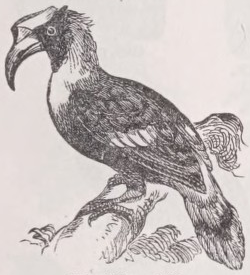
HORNBILL, the English name for a long while generally given to all the birds of the Family Bucerotidoe of modern ornithologists, from the extraordinary horn-like excrescence (epithema) developed on the bill of most of the species, though to which of them it was first applied seems doubtful. Among classical authors Pliny had heard of such animals, and mentions them (Hist. Hat., lib. x. cap. lxx.) under the name of Tragopan ; but he deemed their existence fabulous, comparing them with Pegasi and Gryphones— in the words of Holland, his translator (vol. i. p. 296)—“I thinke the same of the Tragopanades, which many men affirme to bee greater than the Aegle; having crooked homes like a Ram on either side of the head, of the colour of yron, and the head onely red.” Yet this is but an exaggerated description of some of the species with which doubtless his informants had an imperfect acquaintance. Mediaeval writers found Pliny’s bird to be no fable, for specimens of the beak of one species or another seem occasionally to have been brought to Europe, where they were preserved in the cabinets of the curious, and thus Aldrovandus was able to describe pretty fairly and to figure (Orηithologia, lib. xii. cap. xx. tab. x. fig. 7) one of them under the name of “Rhinoceros Avisf though the rest of the bird was wholly unknown to him. When the exploration of the East Indies had extended further, more examples reached Europe, and the “Corvus Indicus cornutus ,, of Bontius became fully recognized by Willughby and Ray, under the title of the “Horned Indian Raven or Topau called the Rhinocerot Bird.” Since the time of those excellent ornithologists our knowledge of the Hornbills has been steadily increasing, but it must be confessed that in regard to many points there is ...still great lack of precise information, and accordingly the completion of Mr Elliot’s “Monograph of the Bucerotidae” (now in course of publication) is most earnestly to be desired, for therein it is to be hoped that all questions respecting their history and classification may be fully treated. At present great diversity of opinion prevails as to how many real genera the Family comprises, or how many species. The group, though no doubt ought to be entertained as to its limits, has not attracted sufficient notice from ornithologists, and therefore, apart from the merest superficial characters, the difference of the several sections which it includes has never been properly explained, nor have their distinctions been placed on a firm basis. Some authors appear to have despaired of dividing it satisfactorily, and have left all the described species in the Linnaean genus Buceros, as for example, Professor Schlegel (Cat. du Mus. des Ρays Bas, Buceros); others have split that genus into more than a score—a number which seems to be quite unnecessary. Sundevall (Tentamen, pp. 96, 97), with his usual caution, has restrained himself to the recognition of three genera, but it is unquestionable that more should reasonably be admitted, though the present writer is not prepared to state how many are required.
The first genus admitted by Sundevall is Rhiηοplαx, which seems properly to contain but one species, the Buccrοs vigil, B. scutatus, or B. galcakusο{ authors, commonly known as the Helmet-Hornbill, a native of Sumatra and Borneo. This is easily distinguished by having the front of its nearly vertical and slightly convex eρithcma composed of a solid mass of horn instead of a thin coating of the light and cellular structure found in the others. So dense and hard is this portion of the “helmet” that Chinese and Malay artists carve figures on its surface, or cut it transversely into plates, which from their agreeable colouring, bright yellow with a scarlet rim, are worn as brooches or other ornaments. This bird, which is larger than a Raven, is also remarkable for its long graduated tail, having the two middle feathers nearly twice the length of the rest. Nothing is known of its habits. Its head was figured by Edwards more than a century ago, but little else had been seen of it until 1801, when Latham described the plumage from a specimen in the British Museum, and the first figure of the whole bird from an example in the Museum at Calcutta was published by Hardwieke in 1823 (Trans. Linn. Society, xiv. pl. 23). Yet more than twenty years elapsed before French naturalists became acquainted with it. Under Rhinoplax Sundevall places the Buceros cornutus of Raffles; but this would seem to be a wrong position for that species, the type of Bonaparte’s genus Berenicornis, since it does not appear to possess a frontlet of solid horn.
Sundevall divides the genus Buceros into three sections, of which one, Buceros proper, contains the species having the epithema developed to its greatest extent, such as B. rhinoceros, B. hydro- corax, B. bicornis, and others, while the remaining sections have little or no epithema, and one of them has the throat feathered. This last includes the African forms which seem to belong to the genus Toccus of Lesson, while the other comprises the Oriental species exemplified by Mr Hodgson's genus Aceros∙, but the arrangement cannot be deemed wlιolly satisfactory, and must be regarded only as an approach to a better. The presence or absence of the epithema may indeed be considered in distinguishing genera; but among those that possess it, seeing that its development is to a great degree dependent upon age and perhaps sex (this last being uncertain), its size and shape hardly afford good generic characters, and, though the group assigned by Sundevall to Buceros proper doubtless requires further separation, some less superficial distinctions must be pointed out than those which have been taken as sufficient to establish many of the “genera” of this family suggested bv several ornithologists. Again, in the grouping of those forms which possess little or no epithema sound characters are equally wanting for the divisions as yet set forth, and until further investigations have been made the limits of even the genera Accros and Toccus cannot be laid down. Tickell in his manuscript Birds of India (in the library of the Zoological Society of London) divides the Hornbills of that country into two genera only, Buceros and Aceros, remarking that the birds of the former fly by alternately flapping their wings and sailing, while those of the latter fly by regular flapping only. Several differences of structure are presented by the sternal apparatus of the various Bucerotidoe, and it is quite possible that these differences may be correlated with TickelΓs observations so as to furnish, when more is known about these birds, a better mode of classing them, and the same may be said of those of the African group containing the genus Toccus and its allies.
Lastly, we have the genus Bucorιnιs, or Bucorax as some call it, confined to Africa, and containing at least two and perhaps more species, distinguishable by their longer legs and shorter toes, the Ground-Hornbills of English writers, in contrast to all the preceding, which are chiefly arboreal in their habits, and when not flying move by short leaps or hops, while the members of this group walk and run with facility. From the days' of Bruce at least there are few African travellers who have not met with and in their narratives more or less fully described one or other of these birds, whose large size and fearless habits render them conspicuous objects.
As a whole the Hornbills, of which more than 50 species have been described, form a very natural and in some respects an isolated group, placed by Professor Huxley among his Goccygornorphoe. It has been suggested that they have some affinity with the Hoopoes (Ujrupidoe), but even if that view be good the affinity cannot be very near. Their supposed alliance to the Toucans (Rhamphastidoe) rests only on the apparent similarity presented by the enormous beak, and is contradicted by important structural characters. In many of their habits, so far as these are known, all Hornbills seem to be much alike, and though the modification in the form of the beak, and the presence or absence of the extraordinary excrescence, whence their name is derived, causes great diversity of aspect among them, the possession of prominent eyelashes (not a common feature in Birds) produces a uniformity of expression which makes it impossible to mistake any member of the family. Hornbills are social birds, keeping in companies, not to say flocks, and living chiefly on fruits and seeds; but the bigger species also capture and devour a large number of snakes, while the smaller are great destroyers of insects. The older writers say that they eat carrion, but further evidence to that effect is required before the statement can be believed. Almost every morsel of food that is picked up is tossed into the air, and then caught in the bill before it is swallowed. They breed in holes of trees, laying large white eggs, and when the hen begins to sit the cock plasters up the entrance with mud or clay, leaving only a small window through which she receives the food he brings her during O o o he? incarceration.
This remarkable habit, almost simultaneously noticed by Dr Mason in Burma, Tickell in India, and Livingstone in Africa, and since confirmed by other observers, especially Mr Wallace in the Malay Archipelago, has been connected by Mr Bartlett (Proc. Zool. Society, 1869, p. 142) with a peculiarity as remarkable, which he was the first to notice. This is the fact that Hornbills at intervals of time, whether periodical or irregular is not yet known, cast the epithelial layer of their gizzard, that layer being formed by a secretion derived from the glands of the proventriculus or some other upper part of the alimentary canal. The epithelium is ejected in the form of a sack or bag, the mouth of which is closely folded, and is filled with the fruit that the bird has been eating. The announcement of a circumstance so extraordinary naturally caused some hesitation in its acceptance, but the essential truth of Mr Bartlett’s observations has been abundantly confirmed by Professor Flower (tom. cit., p. 150), and especially by Dr Murie (op. cit., 1874, p. 420), and what seems now to be most wanted is to know whether these castings are really intended to form the hen bird’s food during her confinement. (a. n.)
[1,760 words — estimated reading time: 11 minutes]
HORNCASTLE, a market-town giving its name to a soke in Lincolnshire, England, is situated at the foot of a line of low hills called the Wolds, on an angle formed by the confluence of the Bain and Waring, and at the terminus of a branch line of the Great Northern Railway, 21 miles east of Lincoln. The principal buildings are the parish church of St Mary’s (supposed to have been originally erected in the time of Henry VII., possessing a square embattled tower, many fine old monuments, and an old brass), Queen Elizabeth’s grammar school founded in 1562, the dispensary opened in 1789, the corn exchange opened in 1856, with a room for public meetings, and accommodation for the mechanics’ institute, a library, and a news-room. There are also national and Wesleyan schools, and an infant school for poor children. Among the charities is one for apprenticing orphan boys belonging to the parish. A few fragments still remain of the ancient fortification from which the town takes its name, and many Roman urns and coins have been discovered in the vicinity. Near the confluence of the rivers there at one time existed an ancient labyrinth called the Julian bower. To the south-east of the town there is a spot calledHangman’sCorner, where criminals were formerly executed. The prosperity of the town is chiefly dependent on agriculture and its horse fairs,—that held in August being the largest of· its class in England. Brewing, malting, and currying are carried on, and there is some trade in coal and iron. The population of the parish in 1871 was 4947, and of the soke 10,469....
Horncastle is believed to be the Roman Bαnnοvαlliim. The fort is said to have been originally constructed by the Romans, refortified and strengthened by Horsa, the brother of Hengest, but shortly afterwards demolished by Vortimer, king of the Britons. The manor at the time of the Norman survey belonged to the king, and after being for an unknown period in private hands, was sold in the reign of Henry III. to the bishop of Carlisle, who received from Henry a charter authorizing him to try felons and hold a court 1eet j and granting free warren and an annual fair.
he declares must hinder them from getting their food with ease. The only corroboration his perverted view receives is afforded by the observed fact that Hornbills, in captivity at any rate, never have any fat about them. The part played by the wonderful epithema in the birds’ economy is altogether unknown.
[432 words — estimated reading time: 3 minutes]
HORNE, George (1730-1792), bishop of Norwich, was born on November 1, 1730, at Otham near Maidstone, where his father was a clergyman, and received his early education at the Maidstone school, whence he proceeded to University College, Oxford. In 1749 he became a fellow of Magdalen College, of which in 1768 he was appointed president. As a preacher he early attained great popularity; and his reputation was further helped by several clever if somewhat wrong headed publications, including a satirical pamphlet entitled The Theology and Philosophy of Cicero's Somnium Scipionis (1751), a defence of the Hutchinsonians in A Fair, Candid, and Imparti d State of the Case between Sir Isaac Newton and Mr Hutchinson (1753), and critiques upon Dr Shuckford (1754) and Dr Kennicott (1760). In 1776 he published his well-known Commentary on the Book of Psalms, and in the same year he was chosen vice-chancellor of his university; in 1781 he was made dean of Canterbury, and in 1790 he was raised to the see of Norwich, which, however, he held for less than two years. He died at Bath January 17, 1792.
His collected Works were first published, with a Memoir by one of his chaplains (Jones), in 1795. There have been several subsequent editions, the latest being that of 1830. The most popular and also the best of his writings, the Commentary on the Psalms, has been still more frequently reprinted, occasionally along with an essay by James Montgomery, or with a much more remarkable discourse by Edward Irving....
HORNE, Thomas Hartwell (1780-1862), a well-known writer on Biblical introduction, was born in London on October 20, 1780, and from 1789-95 was educated at Christ’s Hospital, where Coleridge was an elder contemporary. On leaving school, his circumstances not permitting him to proceed to the university, he became clerk to a barrister, but early manifested an unconquerable passion for literary pursuits. When barely twenty years of age he published (1800) A Brief View of the Necessity and Truth of the Christian Revelation, which reached a second edition in 1802. In the years immediately following he became the author of several minor works, and in 1814, having been appointed librarian of the Surrey Institution, he issued his Introduction to the Study of Bibliography. This was followed in 1818 by the work to which he had devoted the best part of many years, the Introduction to the Critical Study of the Holy Scriptures, which rapidly attained a rare popularity, and secured for its author a high and secure place among contemporary scholars. In 1819 he received ordination from the bishop of London, although unpossessed of the customary university degree, and some time afterwards he was appointed to the cure of the united parishes of St Edmund the King and St Nicolas Aeons in London. On the breaking up of the Surrey Institution in 1823, he was appointed (1824) to superintend the classification and publication of the British Museum Catalogue. After the project of making a classed catalogue had been abandoned, he continued to take part in the preparation of the alphabetical catalogue, and his connexion with the museum continued to subsist until 1861, when his infirmities caused him to resign. He died in London on January 26, 1862.
Besides the works already mentioned Horne wrote numerous others of secondary importance, which, as catalogued in Allibone’s Dictionary by himself, exceed forty in number. The Introduction, edited by Ayreand Tregelles, reached a 12th edition in 1869 (4 vols. 8vo); but, owing to the recent rapid advances of critical science, it is now somewhat out of date.
[256 words — estimated reading time: 2 minutes]
HORNELLSVILLE, a township and post village of Steuben county, New York, is situated on the Canisteo river and on the Erie Railway, 90 miles south-east of Buffalo. It is well supplied with schools and churches, and possesses planing-mills, tanneries, and factories for sashes and blinds, furniture, cars, mowing-machines, and boots and shoes. The population was 5639 in 1870, and 9852 in 1880.
[65 words — estimated reading time: 1 minute]
HORNER, Francis (1778-1817), political economist, was born at Edinburgh, August 12th, 1778. After passing through the usual courses at the high school and university of his native city, he devoted five years, the first two in England, to comprehensive but desultory study, and in 1800 was called to the Scotch bar. Desirous, however, of a wider sphere, Horner removed to London in 1802, and occupied the interval that elapsed before his admission to the English bar in 1807 with researches in law, philosophy, and political economy, and latterly with parliamentary duties. In February 1806 he became one of the commissioners for adjusting the claims against the nawab of Arcot, and in November entered parliament as member for St Ives. Next year he sat for Wendover, and in 1812 for St Mawes, in the patronage of the marquis of Buckingham. In 1811, when Lord Grenville was organizing a prospective ministry, Horner had the offer, which he refused, of a treasury secretaryship. He had resolved not to accept office till he could afford to live out of office; and his professional income, on which he depended, was at no time proportionate to his abilities. His labours at last began to tell upon a constitution never robust, and in October 1816 his physicians ordered him to Italy, where, however, he sank under his malady. He died at Pisa, February 8, 1817. He was buried at Leghorn, and a marble statue by Chantrey was erected to his memory in Westminster Abbey....
Without the advantages of rank, or wealth, or even of genius, Francis Horner rose to a high position of public influence and private esteem. The speeches in the House of Commons on the occasion of moving for a new writ for St Mawes combine with the letters of private friends in testifying to the respect and honour commanded by his integrity and wide and cultured intellect, and to the affection won by his sweet and noble disposition, as well as to the general regret for the untimely death of one who gave promise of such abilities as a statesman. The early friend of Brougham and Jeffrey in Edinburgh, and welcomed in London by Romilly, Mackintosh, Abercromby, and Lord Holland, Horner was by sincere conviction a Whig. His special field was political economy. Master of that subject, and exercising a sort of moral as well as intellectual influence over the House of Commons, he, by his nervous and earnest rather than eloquent style of speaking, could fix its attention for hours on such dτy topics as finance, and coinage, and currency. As chairman of the parliamentary committee for investigating the depreciation of bank notes, for which he moved in 1810, he extended and confirmed his fame as a political economist by his share in the famous Bullion Report. It was chiefly through his efforts that the paper-issue of the English banks was checked, and gold and silver reinstated in their true position as circulating media; and his views on free trade and commerce have been generally accepted at their really high value. Horner was one of the promoters of the Edinburgh Review in 1802. His articles in the early numbers of that publication, chiefly on political economy, form his only literary legacy.
Memoirs and Correspondence of Francis Horner, Μ. P., was published by his brother in 1843. See also the Edinburgh and Quarterly Reviews for the same year; and Blackwood's Magazine, vol. i.
[572 words — estimated reading time: 4 minutes]
HORNET. See Wasp.
[3 words — estimated reading time: 1 minute]
הצרעה, Exod. xxiii, 28; Deut. vii, 20; Joshua xxiv, 12. The hornet, in natural history, belongs to the species _crabo_, of the genus _vespa_ or wasp. It is a most voracious insect, and is exceedingly strong for its size, which is generally an inch in length, and sometimes more. In each of the instances where this creature is mentioned in Scripture, it is as sent among the enemies of the Israelites, to drive them out of the land. Some explain the word metaphorically, as “I will send my terror as the hornet,” &c. But Bochart contends that it is to be taken in its proper literal meaning, and has accumulated examples of several other people having been chased from their habitations by insects of different kinds. Ælian records that the Phaselites, who dwelt about the mountains of Solyma, were driven out of their country by wasps. As these people were Phenicians or Canaanites, it is probable that the event to which he refers is the same as took place in the days of Joshua. How distressing and destructive a multitude of these fierce and severely stinging insects might be, any person may conjecture. No armour, no weapons could avail against them. A few thousands of them would be sufficient to overthrow the best disciplined army and put it into confusion and rout. From Joshua xxiv, 12, we find that two kings of the Amorites were actually driven out of the land by these hornets, so that the Israelites were not obliged to use either sword or bow in the conquest. One of these, according to the Jewish commentaries of R. Nachman, was the nation of the Girgashites, who retired into Africa, fearing the power of God. And Procopius, in his history of the Vandals, mentions an ancient inscription in Mauritania Tingitana, stating, that the inhabitants had fled thither from the ...face of Joshua, the son of Nun. This account accords with Scripture, in which, though the Girgashites are included in the general list of the seven devoted nations either to be driven out or destroyed by the Israelites, Gen. xv, 20, 21; Deut. vii, 1; Josh. iii, 10; xxiv, 11; yet they are omitted in the list of those to be utterly destroyed, Deut. xx, 17; and among whom, in neglect of the divine decree, the Israelites lived and intermarried, Judges iii, 1–6. That the name of the Girgashites, however, was not extirpated, we may collect from the Gergesenes, in our Saviour’s time, inhabiting the same country, Matt. viii, 28. Other tribes of the Hivites, Canaanites, and Hittites, were also expelled by the hornet gradually; not in one year, lest the land should become desolate, and the wild beasts multiply to the prejudice of the Israelites, Exod. xxiii, 28–30. The “arms of Jove,” to which Virgil refers, (_Æneid_ viii, 355–358,) in describing the flight of Saturn from the east, were the hornets sent by the God of Israel, Iahoh, or by contraction Io, to which also his description of the Asilus exactly corresponds:-- _Plurimus--volitans, (cui nomen Asilo Romanum est_; οἶστρον, _Graii vertere vocantes,) Asper, acerba sonans, quo tota exterrita sylvis Diffugiunt armenta_. Georg. iii, 145. “About the Alburnian groves, with holly green, Of winged insects mighty swarms are seen; This flying plague, to mark its quality, ŒSTROS the Grecians call; ASYLUS, we: A fierce loud buzzing breeze; their stings draw blood, And drive the cattle gadding through the wood. Seized with unusual pains, they loudly cry.” DRYDEN. Dr. Hales is of opinion, that the Latin _asilus_ and Greek οιστρον, were probably only different pronunciations of the same oriental term, הצרעה, _hatsiraah_, as this fly is called by Moses and Joshua. The vindictive power that presided over this dreadful scourge was worshipped at Ekron, in Palestine, through fear, the reigning motive of Pagan superstition, under the title of _Baal-zebub_, “master or lord of the hornet,” whence _Beelzebub_, in the New Testament, “the prince of demons,” Matt. xii, 24. Isaiah, denouncing a wo against Abyssinia, describes it as “the land of the winged cymbal,” (_tsaltsal canaphim_,) Isaiah xviii, 1; by the same analogy that _tsaltsal_ signifies “a locust,” Deut. xxviii, 42; _a streperâ voce sic dictam_. [So called from its streperous sound.] Bruce, in his Travels in Abyssinia, has given an accurate description of this tremendous fly, which in Arabic is called _zimb_, and by the Abyssinians _tsaltsal-ya_, “the cymbal of the Lord,” from its sonorous buzzing. And in his Appendix he has given a drawing of it, magnified, for distinctness’ sake, something above twice the natural size: after which he observes, “He has no sting, though he seems to me to be rather of the bee kind; but his motion is more rapid and sudden than that of the bee, (_volitans_,) and resembles that of the gad-fly in England. There is something particular in the sound or buzzing of this insect; it is a jarring noise, together with a humming, (_acerba sonans_,) which induces me to believe it proceeds, in part at least, from a vibration made with the three hairs at his snout.” Bruce does not cite or refer to Virgil’s description, though his account furnishes the most critical and exact explanation of it. Such undesigned coincidences are most satisfactory and convincing; they show that the poet and the naturalist both copied from nature. And the terror impressed by this insect on all the cattle, _quo tota exterrita sylvis diffugiunt_, [affrighted at which the entire herds flee to the thickets,] according to Virgil, is thus illustrated by Bruce: “As soon as this plague appears, and their buzzing is heard, all the cattle forsake their food, and run wildly about the plain till they die, worn out with fatigue, fright, and hunger. No remedy remains but to leave the black earth, where they breed, and hasten down to the sands of Atbara; and there they remain while the periodical rains last, this cruel enemy (_asper_) never daring to pursue them farther. The camel, emphatically called by the Arabs the ship of the desert, though his size is immense as is his strength, and his body covered with a thick skin, defended with strong hair, still is not able to sustain the violent punctures the fly makes with his pointed proboscis. He must lose no time in removing to the sands of Atbara; for when once attacked by this fly, his body, head, and legs, break out into large bosses, which swell, break, and putrefy, to the certain destruction of the creature. I have found some of these tubercles upon almost every elephant and rhinoceros that I have seen, and attribute them to this cause. All the inhabitants of the sea coast are obliged to put themselves in motion, and remove to the next sand, in the beginning of the rainy season, to prevent all their stock of cattle from being destroyed. Nor is there any alternative, or means of avoiding this, though a hostile band was in the way, capable of spoiling them of half their substance, as was actually the case when we were at Sennaar. Of such consequence is the weakest instrument in the hand of Providence.” See FLIES and BEELZEBUB.
[1,192 words — estimated reading time: 7 minutes]