
Having the form of a bell
Word of the Day: Catachrestical
1. A vessel or hollow body, used for making sounds. Its constituent parts are a barrel or hollow body, enlarged or expanded at one end, an ear or cannon by which it is hung to a beam, and a clapper on the inside. It is formed of a composition of metals. Bells are of high antiquity. The blue tunic of the Jewish High Priest was adorned with golden bells; and the kings of Persia are said to have the hem of their robe adorned with them in like manner. Among the Greeks, those who went the nightly rounds in camps or garrisons, used to ring a bell at each sentinel-box, to see that the soldier on duty was awake. Bells were also put on the necks of criminals, to warn persons to move out of the way of so ill an omen, as the sight of a criminal or his executioner; also on the necks of beasts and birds, and in houses. In churches and other public buildings, bells are now used to notify the time of meeting of any congregation or other assembly.
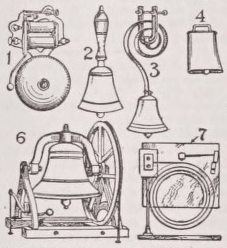
2. In private houses, bells are used to call servants, either hung and moved by a wire, or as hand-bells. Small bells are also used in electrical experiments.
3. A hollow body of metal, perforated, and containing a solid ball, to give sounds when shaken; used on animals, as on horses or hawks.
4. Any thing in form of a bell as the cup or calix of a flower.
To grow in the form of bells, as buds or flowers.
1. A hollow metallic vessel, usually shaped somewhat like a cup with a flaring mouth, containing a clapper or tongue, and giving forth a ringing sound on being struck.
2. A hollow perforated sphere of metal containing a loose ball which causes it to sound when moved.
3. Anything in the form of a bell, as the cup or corol of a flower.
4. That part of the capital of a column included between the abacus and neck molding; also used for the naked core of nearly cylindrical shape, assumed to exist within the leafage of a capital.
5. The strikes of the bell which mark the time; or the time so designated.
1. To develop bells or corollas; to take the form of a bell; to blossom; as, hops bell.
1. To put a bell upon; as, to bell the cat.
2. To make bell-mouthed; as, to bell a tube.
3. To utter by bellowing.
Bell
Encyclopedia Britannica
BELL (from Ang. Sax. bellan,∖a resound, akin to peαZ),an open percussion instrument varying in shape and material, but usually cup-like or globular and metallic, so constructed as to yield one dominant note. This definition excludes on the score of sound the cauldrons of Dodona {Dodonaei lebetes of the Greek oracular temples), and also the Chinese or Indian gongs, and, on the score of shape, all drums, cymbals, the metal plates of the Romans, and resonant bars of metal or wood still used by many savage tribes.
Antiquaries have worried themselves and their readers about the antiquity of bells and to small purpose. It is doubtful whether the bells of gold (Exod. xxvni. 32, 35) were anything but jangling ornaments of some kind worn by the high priest; but Mr Layard believes that he has found some small bronze bells in the palace of Nimroud. We may gather generally that small bells long preceded large ones, which latter, however, were used in India and China long before they were known in Europe....
The Romans used bells for various purposes. Lucian, 180 A.D., mentions an instrument {Clepsydra') mechanically constructed with water, which rang a bell as the water flowed to measure time. Bells summoned the Romans to the public baths; they were also used in processions, and so passed naturally into the service of the Western Church. The first recorded application of them to churches is ascribed by Polydore Vergil to Paulinus {circa 400 a.d.) He was bishop of Nola, a city of Campania (hence nola and campana, the names of certain bells). It has been maintained that Pope Sabinianus, 604, first used church bells; but it seems clear that they were introduced into France as early as 550. In 680 Benedict, abbot of Wearmouth, imported them from Italy; and in the 7th century, Bede mentions them in England. St Dunstan hung many in the 10th century; and in the 11th they were not uncommon in Switzerland and Germany. It is incredible that the Greek Christians, as has been asserted, were αnacquainted with bells till the 9th century; but it is certain that, for political reasons after the taking of Constantinople by the Turks, in 1453, their use was forbidden, lest they should provide a popular signal for revolt.
Several old bells are extant in Scotland, Ireland, and Wales; the oldest are often quadrangular, made of thin iron plates hammered and rivetted together. Dr Reeves of Lusk described in 1850 St Patrick’s bell preserved at Belfast, called Clog an eadhachta Phatraic, “ the bell of St Patrick’s will.” It is 6 inches high, 5 broad, 4 deep, adorned with gems and gold and silver filagree-work; it is inscribed 1091 and 1105, but is probably alluded to in Ulster annals in 552. For Scotch belle, see Illustrated Catalogue oj Archaeological Museum, Edinburgh, for 1856.
The four-sided bell of the Irish missionary St Gall, 646, is preserved at the monastery of St Gall, Switzerland. In these early times bells were usually small; even in the 11th century a bell presented to the church at Orleans weighing 2600 lb was thought large. In the 13th century larger bells were cast. The bell, Jacqueline of Paris, cast 1400, weighed 15,000 ft>; another Paris bell of 1472, 25,000 ft>; and the famous Amboise bell at Rouen, 1501, 36,364 ft. But there we have reached the threshold of the golden age of bells, of which more anon.
Before we enter on the history and manufacture of the bell in Europe it is worth while to enumerate the different kinds of bells named by Hieronymus Magius in his work De Tintinnabulis: — 1. Tintinnabulum, a little bell, otherwise called tinniol·um, for refectory or dormitory, according to Belethus, but Durandus names squilla for tho refectory ; 2. Petasius, or larger “broad-brimmed hat” bell; 3. Codon, orifice of trumpet, a Greek hand-bell; 4. Mela (see ante), a very small bell, used in the choir, according to Durandus; 5. Campana (see ante), a large bell, first used in the Latin churches in the steeple (Durandus), in the tower (Belethus); 6. Squilla, a shrill little bell. We read of cymbalum for the cloister (Durandus), or campanella for the cloister (Belethus); nolula or dupla in the clock; signum in the tower. There was also a bell called corrigiuncula t to summon the monks at scourging time.
We shall now give a brief account of the manufacture of the bell proper, i.e., the church bell of the last five centuries. It must not be supposed that the early bell-founders understood all the principles of construction, mixture of metals, lines, and proportions which go to form our notion of a good bell. As the Amati or Stradiuarius violin is the result of innumerable experiments extending over centuries, so the bells of Van den Gheyn (1550) and Hemony (1650) disengaged themselves after ages of empirical trials as the true models, and supplied the finished type for all succeeding bell-workers.
Bell-metal is a mixture of copper and tin in the proportion of 4 to 1. In Henry III.’s reign it was 2 to 1. In Mr Layard’s Nineveh bronze bells, it was 10 to 1. Zinc and lead are used in small bells. The thickness of the bell’s edge is 1*15th of its diameter, and its height is twelve times its thickness.
Bells, like viols, have been made of every conceivable shape within certain limits. The long narrow bell, the quadrangular, and the mitre-shaped in Europe at least indicate antiquity, and the graceful curved-inwardly-midway and full trumpet-mouthed bell indicates an age not earlier than the 16th century.
The bell is first designed on paper according to the scale of measurement. Then the crook is made, which is a kind of double wooden compass, the legs of which are respectively curved to the shape of the inner and outer sides of the bell, a space of the exact form and thickness of the bell being left betwixt them. The compass is pivotted on a stake driven into the bottom of the casting-pit. A stuffing of brickwork is built round the stake, leaving room for a fire to be lighted inside it. The outside of this stuffing is then padded with fine soft clay, well mixed and bound together with calves’ hair, and the inner leg of the compas3 run round it, bringing it to the exact shape of the inside of the bell. Upon this core, well smeared’with grease, is fashioned the false clay bell, the outside of which is defined by the outer leg of the compass. Inscriptions are now moulded in wax on the outside of the clay-bell; these are carefully smeared with grease, then lightly covered with the finest clay, and then with coarser clay, until a solid mantle is thickened over the outside of the clay belL A fire is now lighted, and the whole baked hard; the grease and wax inscriptions steam out through holes at the top, leaving the sham clay bell baked hard and tolerably loose, between the core and the cope or mantle. The cope is then lifted, the clay bell broken up, the cope let down again, enclosing now between itself and the core the exact shape of the bell. The metal is then boiled, and run molten into the mould. A large bell will take several weeks to cool. When extιicated it ought to be scarcely touched, and should hardly require tuning. This is called its maiden state, and it is one so sought after that many bells are left rough and out of tune in order to claim it.
A good bell, when struck, yields one note, so that any person with an ear for music can say what it is. This note is called the consonant, and when it is distinctly heard the bell is said to be “true.” Any bell of moderate size (little bells cannot well be experimented upon) may be tested in the following manner Tap the bell just on the curve of the top, and it will yield a note one octave above the consonant. Tap the bell about one quarter’s distance from the top, and it should yield a note which is the quint or fifth of the octave. Tap it two quarters and a half lower, and it will yield a tierce or third of the octave. Tap it strongly above the rim where the clapper strikes, and the quint, the tierce, and the octave will now sound simultaneously, yielding the consonant or key-note of the bell.
If the tierce is too sharp the bell’s note (i.e., the consonant) wavers between a tone and a half-tone above it; if the tierce is flat the note wavers between a tone and a half-tone below it; in either case the bell is said to be “false.” A sharp tierce can be flattened by filing away the inside of the bell just where the tierce is struck; but if the bell when cast is found to have a flat tierce there is no remedy. The consonant or key-note of a bell can be slightly sharpened by cutting away the inner rim of the bell, or flattened by filing it a little higher up inside, just above the rim. (See H. R. Haweis’s Music and Morals, 5th edition, p. 429.)
The quality of a bell depends not only on the casting and the fineness and mixture of metals, but upon the due proportion of metal to the calibre of the bell. The larger the bell the lower the tone; but if we try to make a large E bell with metal only enough for a smaller F bell, the E bell will be puny and poor. It has been calculated that for a peal of bells to give the pure chord of the ground tone or key-note, third, fifth, and octave, the diameters are required to be as thirty, twenty-four, twenty, fifteen, and the weights as eighty, forty-one, twenty-four, and ten.
The history of bells is full of romantic interest. In civilized times they have been intimately associated, not only with all kinds of religious and social rights, but with almost every important historical event. Their influence Upon architecture is not less remarkable, for to them indirectly we probably owe all the most famous towers in the world. Grose in his Antiquities observes, “Towers at first scarcely rose above the roof, being intended as lanterns for the admission of light, an addition to the height was in all likelihood suggested on the more common use of bells.”
Bells early summoned soldiers to arms, as well as citizens to bath or senate, or Christians to church. They sounded the alarm in fire or tumult; and the rights of the burghers in their bells were jealously guarded. Thus the chief bell in the cathedral often belonged to the town, not to the cathedral chapter. The curfew, the Carolus, and St Mary’s bell in the Antwerp tower all belong to the town; the rest are the property of the chapter. He who commanded the bell commanded the town; for by that sound, at a moment’s notice, he could rally and concentrate his adherents. Hence a conqueror commonly acknowledged the political importance of bells by melting them down; and the cannon of the conquered was in turn melted up to supply the garrison with bells to be used in the suppression of revolts. Many a bloody chapter in history has been rung in and out by bells.
On the third day of Easter 1282, at the ringing of the Sicilian vespers, 8000 French were massacred in cold blood by John of Procida, who had thus planned to free Sicily from Charles of Anjou. On the 24th of August, St Bartholomew’s day, 1571, bells ushered in the massacre of the Huguenots in France, to the number, it is said, of 100,000. Bells have rung alike over slaughtered and ransomed cities; and far and wide throughout Europe in the hour of victory or irreparable loss. At the news of Nelson’s triumph and death at Trafalgar, the bells of Chester rang a merry peal alternated with one deep toll, and similar striking incidents could be indefinitely multiplied. It was, however, in the low countries of Belgium and Holland, distracted with incessant civil wars, that, for purely political reasons, bells acquired unique importance.
But their religious and civil uses may be further noticed. The Ave Mary bell tolled at 6 and 12 to remind men of prayer to the Virgin; the vesper bell for evening prayer; the compline was for the last service of the day. The sanctus, often a handbell, rung at the sacrifice of the mass; the passing bell, at death. The curfew {couvre feu), introduced by the Conqueror into England, rang at 8 o’clock to extinguish all lights. In many parts of the country and in university towns at 8 and 6 o’clock bells are still rung. At Antwerp cathedral we find the Cloche de Triomphe, by Dumery; sixteen bells at Sotteghem and several at Ghent and elsewhere bear the same maker’s name. The Horrida, or ancient tocsin at Antwerp, said to date from 1316, is longshaped and is now unused. The curfew in the same tower rings at 5, 12, and 8. The Santa Maria (4⅜ tons) first rang when Carl the Bold entered Antwerp 1467. St Antoine is another celebrated bell, and the favourite Carolus, given by Charles V. (7∣ tons), is made of copper, silver, and gold, and valued at .£20,000. At Strasburg we have the Holy Ghost bell, with motto, “0 Rex gloriae Christoe veni cum pace,” and date 1375, 3 nonas Augusti (8 tons), only rung when two fires are seen in the town at once. The recall or storm bell warns travellers in the plain of the storm coming from the Vosges Mountains. The Thor or gate bell, for shutting and opening gates of the city, has been cast three times (1618, 1641, and 1651); it bears the following inscription :—
“Dieses Thor Glocke das erst mal schallt Als man 161S sahlt
Dass Mgte jahr regnet man
Nach doctor Luther Jubal jahr Das Bös hinaus das Gut hinein Zu läuten soll igr arbeit seyn.”
The Mittags, or 12 o'clock bell, taken down in the French Revolution, bore the motto—
Voco vos—orate—venite.”
From all this it will appear that these Continental bells acquired a strong personality from the feelings and uses with which they were associated; and, indeed, they were formally christened with more ceremony than we give to christening our ships, and were then supposed to have the power of driving away evil spirits, dispersing storms, &c.
Bell-founding attained perfection in Holland in the 16th and 17th centuries; and the names of Hemony, Dumery, and the Van den Gheyns stand out as the princes of the art. Their bells are still heard throughout the Low Countries, and are plentiful at Amsterdam, Bruges, Ghent, Louvain, Mechlin, and Antwerp. These bells are frequently adorned with bas reliefs of exquisite beauty, such as feathers, forest leaves, fruit, flowers, portraits, or dancing groups, and inscribed with Latin, sometimes bad, but strong, quaint, and often pathetic. We give the preference to Hemony’s small bells, and to Van den Gheyns’s large ones. The names of Deklerk, Claes Noorden and Johann Albert de Grave (1714), Claude and Joseph Plumere (1664), Bartholomew Goethale (1680), and Andrew Steiliert (1563) also occur in Belgium. The following illustrate the nature of inscriptions and mottoes common in Belgium :—“Non sunt loquelae neque sermones audiantur voces eorum, F. Hemony, Amstelodamia, 1658;” “Laudate Domini omnes gentes, F. Hemony, 1674 ; ” and on a Ghent bell—
“Mynem naem is Roelant
Ale ick luyde dan is storm in Vlaenderland. ’
A common inscription runs—
“Funera plango, Fulgura frango, Sabbata pango, Excito lentos, Dissipo ventos, Paco cruentos.”
A few other inscriptions which occur on bells in France and England may be quoted. The bell in the cathedral at Rouen, already mentioned, which was melted down by the Revolutionists in 1793, bore the words—
“Je suis George d’Ambois Qui trente cinque mille pois Mais lui qui me pesera Trente six mille me trouvera.”
Bells of the parish church at Winnington,Bedfordshire,had— “Nomina campanis haec indita sunt quoque nostris.” 1st bell.—“Hoc signum Petri pulsatur nomine Christi.” 2d „ “Nomen Magdalene campana sonat melode.”
8d ,, “Sit nomen Domini benedictum semper in eum.”
4th ,, “Musa Raphaelis sonat auribus Immanuelis.”
δth ,, “Sum Rosa pulsata mundique Maria vocata.”
By an old chartulary it appears that the bells of the Priory of Little Dunmow, in Essex, were in the year 1501 new cast and baptized—
“Prima in honore Sancti Michaelis Archangeli.
Secunda in honore Sancti Johannis Evangelist!
Tertia in honore S. Johannis Baptisti.
Quarta in honore Assumptionis beatae Mariae.
Quinta in honore sanctae Trinitatis et omnium sanctorum.”
In the little sanctum at Westminster, Edward III. built a clocher, and placed in it bells for St Stephen’s chapel, round the largest of which was cast—
“King Edward made mee thirtye thousand weight and three Take me down and wey mee,
And more you shall fynd mee.”
Some of the music played on the carillon clavecin is still extant. We may specially mention the morceaux fugues discovered by the Chevalier van Elewyck, in the archives at Louvain, the work of the celebrated organist and carilloneur Matthias van den Gheyn (published by Schott and Co., Brussels and London). This music is as fine in its way as Bach or Handel.
Quite lately several carillons have been put up in England; and one (1875) is in contemplation for St Paul’s cathedral. The new carillon machinery by Messrs Gillett and Bland of Croydon, now employed almost everywhere in connection with clocks and carillons, is incomparably superior to anything of the kind on the Continent. By its aid the hammer, which falls on the outside of the bell, is raised mechanically instead of by the action of the fist or fingeT on the key; and all that the stroke on the key does is to let it slide off like a hair-trigger, and drop on the bell. Thus the touch of the modern carillon clavecin bids fair to rival that of the organ. The same firm has also invented a bell piano. The chief carillons in England at present are at Boston church, Lincolnshire, Worcester cathedral, Bradford town-hall, Rochdale town-hall, and Shoreditch. Several good peals of bells in London are immortalized in the common nursery rhyme—
“Gay go up and Gay go down,
To ring the bells of London town.’
Bell-ringing by rope is still a popular art in England. The first regular peal of bells in this country was sent in 1456 by Pope Calixtus III. to King’s College, Cambridge, and was for 300 years the largest peal in England. At the beginning of the 16th century sets of eight bells were hung in a few large churches. In 1668 a famous work on bells, Tintinalogia, by T. W. [White], appeared, introducing a sort of bell-notation by printing the bells 1, 2, 3, 4, &c., on slips of paper in different orders according to the changes rung. Of these changes there is a great variety, spoken of technically as hunting, dodging, snapping, place-making, plain-bob, bob-triple, bob-major, bobmajor reversed, double bob-major, grandsire-bob-cator, &c.
The following numbers show how three bells can ring six changes 1, 2, 3; 1, 3, 2; 2,1, 3; 2,3,1; 3,1,2; 3, 2,1. Four bells ring four times as many as three, i.e., twenty-four; five bells ring five times as many as four, or 120. And it may thus be shown that it would take ninety-one years to ring all the changes upon twelve bells at two strokes a second; whilst twenty-four bells would occupy more than 117 billions of years!
Bell-ringing is conducted as follows :—Ropes hang through holes in the bell-chamber, and are usually fastened to a wheel for leverage, round which the rope passes. There is a great knack in handling the rope. The first half-pull “drops” the bell, the second “sets” it; it next swings up to the slur-bar, then it swings down and up to the other side, the clapper striking as it ascends. Eight bells make the most perfect peal, tuned in the diatonic scale.
Bells are struck in three ways,—(1) with a hammer on the outside, let off either by a tambour or revolving drum, similar in appearance to the prickly cylinder of a musical box, which drum can be fitted with tunes or chimes by musical nuts or spikes, and altered at will; (2) the bell can also be struck by hand, as in the common stand of small bells to be seen occasionally in the London streets, the player having a hammer in each hand; or (3) the clapper may strike the bell internally, either being pulled by a rope, the bell being stationary, or by the bell swinging to and fro. If the hammer or clapper be too light the tone of the bell is not properly drawn;...
9th ed. Encyclopædia Britannica, vol. 3, p. 536
[4,608 words — estimated reading time: 30 minutes]
[4,608 words — estimated reading time: 30 minutes]
Bell animalcule
Webster's Dictionary 1913
An infusorian of the family Vorticellidae, common in fresh-water ponds.
Bell bearer
Webster's Dictionary 1913
Bell crank
Webster's Dictionary 1913
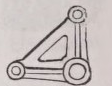
A lever whose two arms form a right angle, or nearly a right angle, having its fulcrum at the apex of the angle. It is used in bell pulls and in changing the direction of bell wires at angles of rooms, etc., and also in machinery.
Bell jar
Webster's Dictionary 1913
A glass vessel, varying in size, open at the bottom and closed at the top like a bell, and having a knob or handle at the top for lifting it. It is used for a great variety of purposes; as, with the air pump, and for holding gases, also for keeping the dust from articles exposed to view.
Bell metal
Webster's Dictionary 1913
A hard alloy or bronze, consisting usually of about three parts of copper to one of tin; -- used for making bells.
Bell pepper
Webster's Dictionary 1913
Having the striking surface convex; -- said of hammers.
1. A genus of plants, so named from the shape of the corol or flower which resembles a bell, Latin Campanula, a genus of monogynian pentanders, comprehending many species.
2. A man whose occupation is to found or cast bells.
3. A man who rings a bell, especially to give notice of anything in the streets.
1. A mixture of copper and tin, in the proportion of about ten parts of copper to one of tin, or according to Thomson, three parts to one, and usually a small portion of brass or zink; used for making bells.
2. A name of the Guinea pepper, a species of Capsicum. This is the red pepper of the gardens, and most proper for pickling.
3. One whose business is to ring a church or other bell.
Expanding at the mouth; as, a bell-mouthed gun.
Having the form of a bell.
Having the shape of a wide-mouthed bell; campanulate.
1. A wether or sheep which leads the flock, with a bell on his neck.
2. A plant, the Uvularia.
Bella
Encyclopedia Britannica
BELLA, Stefano de la, engraver, was born at Florence in 1610. He was apprenticed to a goldsmith; but some prints of Callot having fallen into his hands, he began to turn his attention entirely towards engraving, and studied the art under Canta Gallina, who had also been the instructor of Callot. By the liberality of Lorenzo de’ Medici he was enabled to spend three years in study at Rome. In 1642 he went to Paris, where Cardinal Richelieu engaged him to go to Arras and make drawings of the siege and taking of that town by the royal army. After residing a considerable time at Paris he returned to Florence, where he obtained a pension from the grand duke, whose son, Cosmo, he instructed in drawing. He died in 1664. His productions were very numerous, amounting to over 1400 separate pieces.
9th ed. Encyclopædia Britannica, vol. 3, p. 543
[141 words — estimated reading time: 1 minute]
[141 words — estimated reading time: 1 minute]
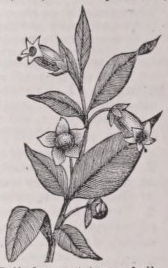
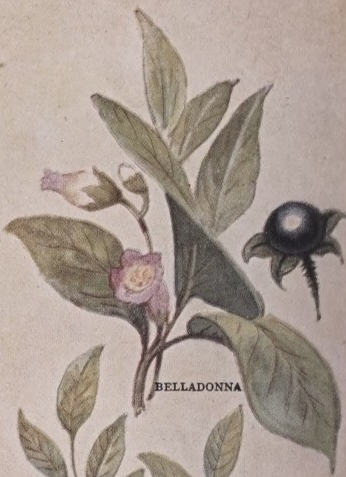
1. An herbaceous European plant (Atropa belladonna) with reddish bell-shaped flowers and shining black berries. The whole plant and its fruit are very poisonous, and the root and leaves are used as powerful medicinal agents. Its properties are largely due to the alkaloid atropine which it contains. Called also deadly nightshade.
Belladonna
Encyclopedia Britannica
BELLADONNA, Dwale, or Deadly Nightshade(Atropa BdlaΛonnay, a tall bushy herb of the natural order Solanace<n, growing to a height of 4 or 5 feet, having leaves of a dull green colour, with a black shining berry fruit about the size of a cherry, and a large tapering root. The plant is a native of Central and South Europe, extending into Asia, and it is also found in waste places and hedgerows of Britain, though it is a doubtful native. The entire plant is highly poisonous, and accidents not unfrequently occur through children and unwary persons eating the attractive-looking fruit. Its leaves and roots are largely used in medicine, on which account the plant is cultivated, chiefly in South Germany, Switzerland, and France. Both roots and leaves contain the poisonous alkaloid atropia, but in practice the roots only are employed for its extraction. The proportions in which atropia is present in the roots range between 0 ’ 6 and 0 ’ 25, the roots of young plants being always richest in the alkaloid. The percentage found in leaves is much more uniform, being about 0’47, and extracts and tinctures of the leaves are therefore of much more constant strength than if prepared from roots. Preparations of belladonna and atropia are used in medicine as anodynes in local nervous pains,—atropia being frequently hypodermically injected but rarely taken internally. They are also of great value in ophthalmic practice on account of their peculiar property of producing dilatation of the pupil, either when painted around or dropped into the eye. Belladonna is also used as an antispasmodic in hooping-cough and spasmodic coughs generally, and for various other medicinal purposes. A remarkable antagonism between the physiological action of atropia and the alkaloid of the calabar bean ...has been experimentally worked out by Dr Thomas R. Fraser (Trans. Roy. Soc. Ed., 1870-1). To a more limited extent also an anta gonism between atropia and morphia and other alkaloids has been established; and the researches on these substances, and on the mutual action of alkaloids generally, have been continued in experiments conducted by Dr J. G. M'Kendrick, reported to the British Medical Association in 1874.
9th ed. Encyclopædia Britannica, vol. 3, p. 543
[365 words — estimated reading time: 3 minutes]
[365 words — estimated reading time: 3 minutes]
Bellamy
Encyclopedia Britannica
BELLAMY, Jacobus, a Dutch poet, was born at Flushing in 1757. He was apprenticed when young to a baker, but his abilities were discovered by a clergyman named De Water, who exerted himself in the boy’s behalf, and obtained sufficient assistance to send him, in 1782, to the University of Utrecht. In 1785 appeared his Vaderlandsche Gézangen , which at once gained him the highest reputation as'a poet. Three years previously a small volume of his, Gezangen mijner Jeugd, published under the pseudonym Zelandus, had attracted considerable attention. His longest and, in the opinion of many, his best work is the poetic romance Roosje, 1784. Bellamy was one of the first to create a new and original literature in Holland; his songs have had wide circulation and great popularity.
9th ed. Encyclopædia Britannica, vol. 3, p. 543
[131 words — estimated reading time: 1 minute]
[131 words — estimated reading time: 1 minute]
Bellarmine
Encyclopedia Britannica
BELLARMINE (Ital. Bellarmino), Robert Francis Romulus, Cardinal, Catholic theologian and polemic, was born, October 4, 1542, at Montepulciano, in Tuscany. He was destined by his father for state service, but his inclinations were too strong to be restrained, and at the age of eighteen he entered the Society of Jesus. After studying in various colleges for some years, he was appointed by the order to lecture on theology at the famous university of Louvain. His seven years’ residence in the Low Countries brought him into close relations with modes of thought differing essentially from his own, and so compelled him to define his theological principles more clearly and sharply than before. On his return to Italy he received from Gregory XIII. an appointment in the newly-founded Collegium Romanum, and began to deliver lectures on the principal points of difference between the Roman Catholic and other forms of faith. Out of these lectures grew his famous work, Disputationes de Controversiis Christianes Fidei adversus hujus temporis Hoereticos (3 vols., 1581, 1582, 1593), for long the finest polemical writing on the Catholic side, and still worthy of consideration. It was replied to at the time by Chemnitz, Gerhard, and Charnier, and continued for many years to furnish occasions of attack to Protestant theologians. So highly were Bellarmine’s abilities rated, that he was selected to accompany, in the capacity of divine or theologian, the legation sent into France in 1590 by Sixtus V. In 1599 he was, much against his will, raised to the dignity of cardinal, and two years later was made archbishop of Capua. He resigned the archbishopric in 1605, being detained in Rome by the desire of the newly-elected Pope Paul V. About the same time he had a con- ∙oversy with James I. of ...England, who, after the discovery of the Gunpowder Plot, had passed severe laws against Roman Catholics. In 1610 he published his work De Potestate summi Pontificis in rebus Temporcdibus, directed against William Barclay, in which he asserted boldly and undisguisedly the doctrine of the Pope’s temporal sovereignty. For some years before his death, which occurred at Rome, 17th September 1621, he held the bishopric of his native town. Bellarmine, whose life was a model of Christian asceticism, is one of the greatest theologians, particularly in the department of polemics, that the Romish Church has ever produced. His works, which are very numerous, are written in an easy perspicuous style. The most important are the Disputatio de Controversiis, the De Potestate summi Pontificis, Institutiones Hebroeicoe Linguoe, De Scriptoribus Ecclesiasticis, De Ascensione Mentis in Deum. A life of Bellarmine, founded on an autobiography, was written by Fulligato, 1624.
9th ed. Encyclopædia Britannica, vol. 3, p. 544
[444 words — estimated reading time: 3 minutes]
[444 words — estimated reading time: 3 minutes]
A ruddy, glittering star of the second magnitude, in the left shoulder of Orion; so named from its imagined influence in exciting war.
Bellay
Encyclopedia Britannica
BELLAY, Joachim du, an eminent French poet and member of the Pleiad, was born late in 1524, at Lyré, on the left bank of the Loire, not far from Angers. In the absence of documents we are thrown upon the autobiographical passages in his poems for information about the events of his life, and these, fortunately, are copious. From these, and especially from the beautiful Latin elegy addressed to his friend Jean Morel, we learn that, deprived early of both his parents, he was left to the mercy of an elder brother, who allowed him to be brought up without other education than what his own ardent spirit supplied. Before he reached manhood this brother also died, and Joachim found himself at the head of the family, a vigorous, manly, but half-cultured youth. Suddenly he was struck down by illness; and, confined for many months to his bed, he softened the long hours of suffering by fervent study; he now read the Latin and Greek poets for the first time, and felt a passionate desire to imitate them in French. In 1548, having to a great measure recovered his health, he happened to meet Ronsard in an inn in Poitiers, and a friendship instantly sprang up between them that ceased only with Du Bellay’s death. He joined the six poets, who, under Dorat, were forming a society, the Pleiad, for the creation of a French school of Renaissance poetry; and his first contribution to it was a prose volume, the famous Deffence et Illustration de la Langue française, which remains one of the earliest and most perfect pieces of literary criticism in existence, and overweighs in positive value much of his actual poetry. This appeared in 1549, and was followed within a twelvemonth by two volumes in verse, the Recueil de Poésie, and the collection of lovesonnets called L ’ Olive. The latter ...celebrate, in the manner of Petrarch, the loveliness of a semi-mythical mistress, understood to be a Parisienne, and by name Viole, of which Olive is an anagram. The Recueil caused a quarrel with Ronsard, about which much speculation has been wasted, and which still remains obscure. It seems that Ronsard had invented a new form of the ode, which he allowed Du Bellay to see in manuscript. Ronsard’s book was delayed in publication, and Du Bellay’s odes, written after his metrical pattern, appeared first. Ronsard’s natural and passing vexation has been exaggerated into a law-suit; but the friends were soon on the old affectionate footing. In L ’ Olive Du Bellay was the first French writer to use the sonnet with fluency. After he had translated two books of the Aeneid, which appeared in 1552, the yearning he had always felt to visit Italy was appeased by his being sent to Rome in 1550 as secretary to his influential relative, Cardinal du Bellay, and he remained in that city four years and a half. At first, however, he was miserable enough. Everything around him was displeasing to him and jarred on his refined and sometimes sickly nerves. At last he fell violently in love with a lady, whose real name was Faustine, but whom he celebrates under the poetical title of Columba and Columbelle. In his Latin poems this sincere and absorbing passion burns like a clear flame, more veiled though no less burning in his French Regrets. Before he won her she was shut up from his sight by her old and jealous husband. Frenzied with grief and desire, burning with fever, exhausted with watching and physical suffering,—for his health was still very delicate,·—Du Bellay walked day and night to and fro before the house. At last, mysteriously enough, she is given to him; and the Latin poems end in rapturous delight. At this point, however, and possibly for this reason, he was hurried back to Paris, where he became canon of Nôtre Dame in June 1555. He returned by Venice, the Grisons, and Geneva, and was received by his friends in France with transport. He set himself to literary labour of various kinds, publishing his Latin poems and his French sonnets called Les Antiquitez de Rome, in 1558, and his greatest lyrical work, the Regrets, in 1559. In the latter year, however, a calumny deprived him of the protection of the -cardinal, and threw him into the deepest distress and embarrassment. The nature of this charge is not known, but it must have quickly passed away, for later on in that year we find him preparing a new volume of poems, Les Jeux Rustiques, for the press, and nominated archbishop of Bordeaux. He did not live to enjoy this distinction, for on the 1st of January 1560, he died of apoplexy, and was bαried in Nôtre-Dame de Paris. Like Ronsard he was very deaf.
His collected works did not appear until 1568. The early death of the French Ovid, as he has been called, was a serious loss to European literature, for Joachim du Bellay wa3 at the height of his power, and still rapidly advancing. His poems have a force, an occasional sublimity, and a direct pathos for which we look in vain among his contemporaries; and none but Ronsard excelled him in facility and grace. His most famous poem, Un Vanneur de Blé aux Vents, one of the loveliest lyrics of the age, was written shortly before his death, and appeared in the Jeux Rustiques in 1560; it is nominally a paraphrase from the Latin of Naugerius. The standard edition of the French works of Joachim du Bellay is that published in 2 vols, by Lemerre in 1866, and edited by Ch. Marty-Laveaux. Spenser translated sixty of Du Bellay’s Roman sonnets into English, and published them in 1591. A very delicate essay on the poet will be found in Mr W. H. Pater’s Studies in the History of the Renaissance, 1873.
9th ed. Encyclopædia Britannica, vol. 3, p. 544
[994 words — estimated reading time: 6 minutes]
[994 words — estimated reading time: 6 minutes]
Resonance Roget’s Thesaurus §408
N. resonance, ring, ringing, tintinabulation, reflexion, reflection, reverberation, echo, reecho, zap, zot, buzz (hiss) 409, low note, base note, bass note, flat note, grave note, deep note, bass, basso, basso profondo, baritone, barytone, contralto, echo chamber, resonator, tinnitus, bell, doorbell, buzzer, gong, cymbals (musical instruments) 417, sympathetic vibrations, natural frequency, coupled vibration frequency, overtone, resonating cavity, sounding board, tuning fork, tuning, squelch, frequency selection, resonator, resonator circuit, radio &c. @2, 3, 1, 6, 8, resonant structure, aromaticity, alternating double bonds, non-bonded resonance, pi clouds, unsaturation, double bond (valence) @2, 3, 2, 2
V. resound, reverberate, reecho, resonate, ring, jingle, gingle, chink, clink, tink, tinkle, chime, gurgle plash, goggle, echo, ring in the ear
Adj. resounding, resonant, reverberant, tinnient|, tintinnabulary, sonorous, booming, deep-toned, deep-sounding, deep-mouthed, vibrant, hollow, sepulchral, gruff
Phr. "sweet bells jangled, out of time and harsh", echoing down the mountain and through the dell
Musical Instruments Roget’s Thesaurus §417
N. musical instruments, band, string- band, brass-band, orchestra, orchestrina, monochord, polychord, harp, lyre, lute, archlute, mandola, mandolin, mandoline, guitar, zither, cither, cithern, gittern, rebeck, bandurria, bandura, banjo, bina, vina, xanorphica, viol, violin, fiddle, kit, viola, viola d'amore, viola di gamba, tenor, cremona, violoncello, bass, bass viol, base viol, theorbo, double base, contrabasso, violone, *psaltery, bow, fiddlestick, piano, pianoforte, harpsichord, clavichord, clarichord, manichord, clavier, spinet, virginals, dulcimer, hurdy-gurdy, vielle, pianino, eolian harp, organ, harmonium, harmoniphon, american organ, barrel organ, hand organ, accordion, seraphina, concertina, humming top, flute, fife, piccolo, flageolet, clarinet, claronet, basset horn, corno di bassetto, oboe, hautboy, cor anglais, corno inglese, bassoon, double bassoon, contrafagotto, serpent, bass clarinet, bagpipes, union pipes, musette, ocarina, pandean pipes, reed instrument, sirene, pipe, pitch-pipe, sourdet, whistle, catcall, doodlesack, harmoniphone, horn, bugle, cornet, cornet-a-pistons, cornopean|, clarion, trumpet, trombone, ophicleide, french horn, saxophone, sax, buglehorn, saxhorn, flugelhorn, althorn, helicanhorn, posthorn, sackbut, euphonium, bombardon tuba, cymbal, bell, gong, tambour|, tambourine, tamborine, drum, tom-tom, tabor, tabret, tabourine, taborin, side drum, kettle drum, timpani, tympani, tymbal, timbrel, castanet, bones, musical glasses, musical stones, harmonica, sounding-board, rattle, tam-tam, zambomba, reed, tuning fork, triangle, jew's harp, musical box, harmonicon, xylophone, sordine, sordet, sourdine, sourdet, mute, (iv) perception of sound
Indication Roget’s Thesaurus §550
N. indication, symbolism, symbolization, semiology, semiotics, semeiology, semeiotics, zeitgeist, characteristic, diagnostic, lineament, feature, trait, fingerprint, voiceprint, footprint, noseprint, cloven hoof, footfall, recognition (memory) 505, diagnostic, divining rod, detector, sign, symbol, index, indice|, indicator, point, pointer, exponent, note, token, symptom, dollar sign, dollar mark, type, figure, emblem, cipher, device, representation, epigraph, motto, posy, gesture, gesticulation, pantomime, wink, glance, leer, nod, shrug, beck, touch, nudge, dactylology, dactylonomy, freemasonry, telegraphy, chirology, byplay, dumb show, cue, hint, clue, clew, key, scent, signal, signal post, rocket, blue light, watch fire, watch tower, telegraph, semaphore, flagstaff, cresset, fiery cross, calumet, heliograph, guidon, headlight, mark, scratch, line, stroke, dash, score, stripe, streak, tick, dot, point, notch, nick, print, imprint, impress, impression, keyboard symbols, printing symbols, red letter, italics, sublineation, underlining, bold font, jotting, note, annotation, reference, blaze, cedilla, guillemets, hachure, quotation marks, double quotes, "", parentheses, brackets, braces, curly brackets, arrows, slashes, left parenthesis, "("; right parenthesis, ")", opening bracket, " ", left curly brace, "{"; right curly brace, "}", left arrow, "<", right arrow, ">", forward slash, "/", backward slash, "\", exclamation point, "!", commercial at, "@", pound sign, "#", percent sign, "%", carat, "^", ampersand, "&", asterisk, "*", hyphen, "-", dash, "-", "", em dash, "—", plus sign, "+", equals sign, "=", question mark, "?", period, ".", semicolon, ";", colon, ":", comma, ",", apostrophe, "'", single quote, "'", tilde, "~", badge, criterion, countercheck, countermark, countersign, counterfoil, duplicate, tally, label, ticket, billet, letter, counter, check, chip, chop, dib, totem, tessera, card, bill, witness, voucher, stamp, cacher, trade mark, hall mark, signature, mark, autograph, autography, attestation, hand, hand writing, sign manual, cipher, seal, sigil, signet, hand and seal, paraph, brand, superscription, indorsement, endorsement, password, watchword, catchword, security card, pass, passkey, credentials, open sesame, timbrology, mot de passe, mot du guet, pass-parole, shibboleth, title, heading, docket, address card, visiting card, carte de visite, insignia, banner, banneret, bannerol, bandrol, flag, colors, streamer, standard, eagle, labarum, oriflamb, oriflamme, figurehead, ensign, pennon, pennant, pendant, burgee, blue peter, jack, ancient, gonfalon, union jack, banderole, "old glory", quarantine flag, vexillum, yellow-flag, yellow jack, tricolor, stars and stripes, bunting, heraldry, crest, coat of arms, arms, armorial bearings, hatchment, escutcheon, scutcheon, shield, supporters, livery, uniform, cockade, epaulet, chevron, garland, love knot, favor, beacon, cairn, post, staff, flagstaff, hand, pointer, vane, cock, weathercock, guidepost, handpost, fingerpost, directing post, signpost, pillars of hercules, pharos, bale-fire, beacon- fire, l'etoile du nord, landmark, seamark, lighthouse, balize, polestar, loadstar, lodestar, cynosure, guide, address, direction, name, sign, signboard, warning, omen, prefigurement, trace, record, warning, alarm, scepter, trophy, gauge, milestone, milepost, brand, fool's cap, check, telltale, test, mileage ticket, milliary, notification, advertisement, word of command, call, bugle call, trumpet call, bell, alarum, cry, battle cry, rallying cry, angelus, reveille, sacring bell, sanctus bell, exposition, proof, pattern
V. indicate, be the sign, of, denote, betoken, argue, testify, bear the impress, of, connote, connotate, represent, stand for, typify, symbolize, put an indication, put a mark, note, mark, stamp, earmark, blaze, label, ticket, docket, dot, spot, score, dash, trace, chalk, print, imprint, impress, engrave, stereotype, make a sign, signalize, underscore, give a signal, hang out a signal, beckon, nod, wink, glance, leer, nudge, shrug, tip the wink, gesticulate, raise the finger, hold up the finger, raise the hand, hold up the hand, saw the air, "suit the action to the word", wave a banner, unfurl a banner, hoist a banner, hang out a banner, wave the hand, wave a kerchief, give the cue, show one's colors, give an alarm, sound an alarm, beat the drum, sound the trumpets, raise a cry, sign, seal, attest, underline, call attention to, give notice
Adj. indicating, indicative, indicatory, denotative, connotative, diacritical, representative, typical, symbolic, pantomimic, pathognomonic, symptomatic, characteristic, demonstrative, diagnostic, exponential, emblematic, armorial, individual, known by, recognizable by, indicated, pointed, marked, denotable, indelible
Adv. in token of, symbolically, in dumb show
Phr. ecce signum, ex ungue leonem, ex pede herculem, vide ut supra, vultus ariete fortior
King James Bible KJV Bible
Berean Standard Bible BSB Bible
65 KJV and 26 BSB verses contain “Bell” — showing the first 20. Show all 65 verses (searchable)
A golden bell and a pomegranate, a golden bell and a pomegranate, upon the hem of the robe round about.
A bell and a pomegranate, a bell and a pomegranate, round about the hem of the robe to minister in; as the LORD commanded Moses.
Whatsoever goeth upon the belly, and whatsoever goeth upon all four, or whatsoever hath more feet among all creeping things that creep upon the earth, them ye shall not eat; for they are an abomination.
Do not eat any creature that moves along the ground, whether it crawls on its belly or walks on four or more feet; for such creatures are detestable.
And when he hath made her to drink the water, then it shall come to pass, that, if she be defiled, and have done trespass against her husband, that the water that causeth the curse shall enter into her, and become bitter, and her belly shall swell, and her thigh shall rot: and the woman shall be a curse among her people.
And the chapiters upon the two pillars had pomegranates also above, over against the belly which was by the network: and the pomegranates were two hundred in rows round about upon the other chapiter.
On the capitals of both pillars, just above the rounded projection next to the network, were the two hundred pomegranates in rows encircling each capital.